



Abstract
Current short video recommendation systems face challenges in accurately identifying user interests due to large-scale, heterogeneous user data, as well as addressing cold-start problems when encountering new users and content. This study proposes a deep learning and reinforcement learning (DLRL) framework to enhance recommendation performance. User and video data are collected and preprocessed using the Hadoop platform, while automated metadata extraction tools, optical character recognition (OCR), and audio-to-text technologies extract multimodal features, including subtitles and audio content. A convolutional neural network (CNN) extracts semantic and visual features from text-image data, while a long short-term memory (LSTM) network captures temporal dependencies in user behavior to detect interest changes. A multimodal attention mechanism integrates these diverse features to form comprehensive user portraits, and a deep neural network (DNN) reduces feature dimensionality to represent user preferences accurately. The recommendation process is formulated as a reinforcement learning task optimized through Deep Q Network (DQN) and Proximal Policy Optimization (PPO) algorithms. Experimental results demonstrate that the proposed approach achieves superior click-through rates (6.22%), viewing duration (73.31 s), accuracy (0.877), and recall (0.858), effectively overcoming cold-start limitations and dynamically adapting to evolving user interests. This shows that combining DLRL can optimize the performance of short video recommendations, improve accuracy and experience, and address the issues of cold start and capturing changes in user interests.
Keywords
Introduction
With the rise of mobile Internet, new media short video platforms have become a new channel for people to obtain information and entertainment.1–3 These platforms meet the needs of users to use their fragmented time with a variety of short videos.4,5 However, traditional recommendation systems still have major problems in dealing with this new media environment. They mostly rely on collaborative filtering or content recommendation. Although they can recommend similar content to users based on historical data, they are difficult to accurately grasp the current interests and preferences of users, resulting in the recommended content often not meeting the real needs of users.6–8 In addition, in the face of massive content and a large user base, traditional methods are difficult to efficiently provide personalized services to each user, which affects user experience and platform interaction. Therefore, this study proposes the use of machine learning techniques to improve the personalized recommendation system for short video platforms. Machine learning can deeply mine user behavior data and precisely predict users’ future interests, thereby greatly enhancing the recommendation system’s accuracy and timeliness.9,10 At the same time, this technology can also provide users with more intelligent and personalized recommendation services by continuously learning user behavior patterns.11,12 Therefore, using machine learning to optimize the recommendation system is not only a powerful supplement to traditional technologies, but also a core measure to promote the sustainable development of short video platforms. This innovative measure has effectively promoted the adaptability of the new media environment and injected new vitality into the booming development of the short video industry.
This study makes three significant contributions: (1) employing Word2Vec technology to analyze students’ learning behaviors by extracting feature vectors from learning records, enabling precise identification of semantic patterns and interest preferences, which serves as a robust foundation for personalized recommendations and sentiment analysis; (2) proposing a dynamic learning intervention strategy that leverages real-time sentiment analysis to monitor students’ emotional states and automatically adjust learning content and task difficulty, thereby enhancing engagement and addressing learning challenges; and (3) developing a hybrid recommendation system that integrates Word2Vec-based content recommendations with collaborative filtering algorithms, significantly improving recommendation accuracy, diversity, and alignment with students’ personalized learning needs. These contributions collectively advance the development of intelligent and adaptive educational systems.
Related work
Optimizing recommendation algorithms can precisely capture user interests, provide personalized recommendations, and improve user satisfaction and stickiness, so as to improve resource utilization, promote positive interactions, and promote platform development.13,14 In past studies, many scholars have tried to improve recommendation algorithms to enhance the performance of recommendation systems. Collaborative filtering algorithms are based on the analysis of a large amount of user historical behavior data to discover user interests and recommend suitable products to users. Shen Jian implemented a movie recommendation system in the Ubuntu system using Java language based on the MapReduce framework and project recommendation algorithm. The system could achieve high efficiency and reliability in large datasets. 15 To improve the recommendation accuracy, Yin Minghao proposed a collaborative filtering algorithm based on tensor decomposition, which determined the user’s location preference score by two items with different weights, thereby determining the recommended results visited by the user at a given time. 16 Traditional collaborative filtering technology has cold start and data sparsity problems. To solve these problems, Aljunid Mohammed Fadhel proposed a multi-model DL method to build a hybrid recommendation system by integrating user and item functions. Compared with existing methods, it has shown significant performance. 17 Neighbor selection becomes more difficult for collaborative and content-based filtering recommendation systems due to data scarcity. Priya S. Kavi applied a cross-social recommendation structure using CNNs and RELU (Rectified Linear Unit) networks, and pointed out through experiments that the accuracy of the proposed method was improved compared with existing technologies. 18 The research of scholars has demonstrated a variety of technical attempts to optimize the recommendation system, improving accuracy and personalization. However, the cold start and data sparsity problems have not been completely solved, which limits the recommendation effect of new users or content.
Deep learning (DL) and reinforcement learning (RL) have significantly advanced personalized recommendation systems, with DL enhancing recommendation accuracy and personalization, and RL enabling adaptive strategy adjustments based on user feedback.19,20 Recent studies have increasingly integrated DL and RL into personalized recommendation research. For instance, Zhang Gu proposed a hybrid approach combining content-based and neural network collaborative filtering for scientific literature recommendations, transforming the recommendation task into a binary classification problem. This method demonstrated the ability to rapidly identify relationships between researchers’ interests and article topics, effectively capturing user preferences and improving recommendation accuracy. 21 Similarly, Intayoad Wacharawan introduced a contextual bandits-based RL method, which proved highly effective in dynamic environments and outperformed benchmark approaches. 22 These studies highlight the potential of DL and RL in addressing complex user preferences and environmental dynamics. However, challenges remain, including high data and resource requirements, which limit scalability and efficiency. Additionally, while these models excel in specific domains, their generalizability across diverse scenarios requires further validation.
Optimization of personalized recommendation system for new media short videos
Personalized recommendation system design
Overall process of the system
The personalized recommendation system for new media short videos designed in this article mainly includes three modules. The first is data collection and processing, which uses the Hadoop platform to obtain and process user operation data and video description data. The second is user and video modeling, which extracts key video features through text mining algorithms and combines user playback records to achieve user and video modeling. Finally, neural network training, using user and video modeling as training samples, inputs deep neural networks for supervised training. DL technology is utilized to extract features; the intrinsic connection between user interests and videos is explored; a personalized recommendation system is built. This system can precisely grasp the semantic features of users and videos, provide users with more personalized recommendation services, and improve user experience and satisfaction.
Data collection and processing
New media short video user behavior data collection.

This article uses an automated metadata extraction tool to parse key information of the video, such as title and description, and uses OCR23–25 and audio-to-text technology to extract subtitles and voice, deepen video understanding, and prepare for content feature extraction. At the social level, the focus is on user interactions such as following and private messaging. Data is regularly extracted from the social module through the API (Application Programming Interface), and combined with user behavior data to build a more comprehensive social network map. This comprehensive data collection method helps to grasp the mutual influence between users, improves the social relevance of the recommendation system, and brings users a more precise and personalized recommendation experience.
The text data of new media short videos comes from video titles, descriptions, and user comments. These texts contain a lot of natural language. If they are used directly for model training, they may be affected by noise and sparsity. Therefore, before feature extraction, the text data needs to be cleaned and processed. The video title and description are segmented to extract meaningful words. Stem extraction technology is used to simplify the vocabulary, normalize synonyms or words with morphological changes, and reduce data sparsity. To enhance the expression of text features, the TF-IDF (term frequency-inverse document frequency) method is utilized to weight the text and calculate the importance of each word in a specific video. TF-IDF can highlight the keywords of the video content and prevent common words from affecting the model performance.26,27 These processes convert text data into low-dimensional, efficient features to support subsequent feature fusion and DL models.
Image data includes cover images and key frames. Similar to text data, image data needs to be normalized before input into the DL model to ensure data consistency. Key frames or cover images are extracted from the video, and representative frames are selected as input data. To ensure consistent image size, they are uniformly adjusted to the same resolution (256*256 pixels) to meet the input requirements of the CNN model. Image normalization and denoising are performed to improve data quality. After processing, the image data is converted into a standardized tensor format to facilitate deep neural network feature learning.
User behavior data such as viewing history, likes, comments, and sharing reflect user interests and are the core of building user portraits and predicting recommended content. Since user behavior data is time series data, timestamps need to be aligned during processing to ensure accurate time sequence. To more accurately grasp the trend of user interest changes, the user behavior data is converted into a sequence form. In this way, each user’s behavior can be represented by a specific sequence, and the formula is:
Multimodal data fusion
Feature extraction
The purpose of feature extraction is to extract key features from different data to provide support for subsequent recommendation models.28,29 In new media short video recommendation, text, image, and user behavior data are processed, and different DL models are used for feature extraction according to data characteristics. 30
Text data mostly comes from video titles, descriptions, and comments, and contains rich semantics. To extract useful features, CNN is used. CNN can automatically identify local features of text, which is crucial for capturing video themes and emotions.31–33 The preprocessed text is converted into a word vector sequence and mapped to a low-dimensional space through word embedding. After the text sequence is input into CNN, the local features are extracted through the convolution layer operation to reflect the basic semantics. The text feature is represented as a fixed-dimensional vector that describes the semantics and emotional tendency of the video.
After the convolution operation, the input word vector sequence 
Image data is mainly presented through cover images or key frames. CNN is used to extract image features. The preprocessed image data is input into CNN, and features are extracted through convolution and pooling layers. The convolution layer captures edge and texture information, and the pooling layer compresses the feature dimension. Finally, the obtained high-dimensional feature vector effectively represents the image content, style, and elements, providing key visual information for the recommendation system.
Assuming that the input image is J, the size is 
Since user behavior data such as viewing, liking, and commenting are time series, LSTM is used to process these data. LSTM network can capture the time series relationship of user behavior and identify its long-term and short-term interest changes. After the behavior data is converted into a vector sequence, it is input into LSTM, and features are extracted through calculation.
The user behavior data sequence is 
Feature fusion
Feature fusion integrates the features of text, image, and user behavior data to form a comprehensive user profile. This article uses the attention mechanism and fusion layer in DL to combine multimodal features, highlight important features, and ensure accurate fusion of information, thereby improving recommendation accuracy and robustness.
To dynamically capture the importance of each modality, this article applies the attention mechanism. This mechanism enables the model to weight the features of each modality according to the context, highlight key features, suppress noise, and improve the recommendation effect. This article designs a multimodal attention network and adjusts the weights by learning the correlation between modalities. The text 
After obtaining the weighted features, they need to be fused into a unified user profile. The splicing method connects the weighted features of each modality into a long vector, retaining the modality independence and facilitating subsequent analysis and processing. The formula for concatenating weighted feature vectors is:
To further optimize the model performance, an adaptive fusion strategy is adopted, combining multiple fusion methods to dynamically select the most suitable feature combination. The fully connected layer processes the concatenated features, and the attention mechanism weights the results to achieve flexible and efficient fusion. The fused features are used as a unified user portrait and input into the recommendation model to precisely predict user interests. This process successfully combines text, image, and behavior features to form a multidimensional dynamic user portrait, providing strong support for the new media short video recommendation system.
User portrait construction
User portrait construction is the key to transforming multimodal features into user interests. Through the combination of embedding layer and fully connected layer, user interests can be effectively represented, and recommendation performance can be improved. This study first uses the embedding layer to convert the multimodal feature 
After the embedding vector is generated, it is further processed by the fully connected layer to capture the multidimensional characteristics of user interests. The fully connected layer uses nonlinear transformations and parameterized weights to map the embedding vector to the specific user interest dimension level to obtain a comprehensive and detailed user portrait. The final user portrait is expressed as:
Combining the embedding layer and the fully connected layer, a comprehensive user portrait is constructed, integrating multimodal features and dynamically displaying the user’s multidimensional interests. This portrait serves as the core input to improve recommendation accuracy and satisfaction.
Model construction and training
Deep neural network feature learning
To deeply explore the high-level information of multimodal data fusion features, DNN is used for feature learning. DNN captures complex associations and patterns in data through multi-layer full connection and nonlinear activation.34,35 The feature vector is input into the network and gradually abstracted through the hidden layer. Each layer undergoes linear transformation and nonlinear activation. The formula is:
After multi-layer nonlinear transformation, DNN outputs low-dimensional features to characterize the user’s long-term interests, fuse multimodal data, and accurately describe user preferences. The Dropout strategy is used during training to prevent overfitting and improve generalization ability and learning efficiency.
Recurrent neural network dynamic interest modeling
To capture the dynamic changes of user interests, LSTM network is used to model the temporal characteristics of user behavior. LSTM solves the gradient problem through the gating mechanism and effectively captures long-term dependencies.
36
The user behavior sequence 

Finally, the hidden state sequence output by LSTM shows the dynamic changes of user behavior. The hidden state of the last time step is selected to represent the dynamic interest of the user. The formula is:
The model combines user historical behavior and time dependency to generate a dynamic interest representation
To fully represent user interests, the static features learned by DNN and the dynamic features modeled by LSTM are integrated to form a comprehensive interest representation. Static features reflect long-term preferences, and dynamic features reflect recent changes. The two are combined by splicing and weighted summation. Splicing is merging by dimension, and weighted summation dynamically adjusts the influence according to the importance of features. Combining static and dynamic interests not only retains users’ long-term preferences, but also reflects recent behavior changes, which is crucial for short video recommendations.
Model training
In the training of the recommendation system, the cross-entropy loss function is used as the optimization target to guide the learning of model parameters. Based on the user’s comprehensive interests and candidate videos, the video prediction score Judgment process of the relationship between users and new media short videos.

The loss function optimizes model parameters and improves the accuracy of user interest prediction by reducing the gap between prediction and actual clicks. The Adam (Adaptive Moment Estimation) optimization algorithm is used, combined with momentum and adaptive learning rate, to quickly converge to the optimal solution and avoid learning rate problems. To improve generalization ability and prevent overfitting, L2 regularization is added to the training to limit excessive growth of parameters, reduce model complexity, and reduce overfitting. Combining regularization with cross-entropy loss, the model can reduce errors and avoid overfitting, thereby improving generalization ability. This article combines the hybrid model of DNN and LSTM to effectively capture the static and dynamic interest characteristics of users, greatly improving recommendation accuracy and user experience.
Reinforcement learning recommendation strategy
When optimizing the personalized recommendation system of new media short videos, RL recommendation strategy is crucial to improving long-term user engagement.37,38 To transform the recommendation problem into a RL decision problem, the environment and state space are defined. The user’s recommendation scenario is regarded as an independent environment, and the action is the recommended video. The state
The action space consists of candidate videos, each of which represents a recommended action. The system selects video
To balance the exploration and utilization in the new media short video recommendation problem, Q-Learning is adopted and extended to DQN (DeepQ-Network) to handle large-scale states and actions. DQN combines DNN with Q-Learning to learn the optimal strategy. DQN inputs the state 
To stabilize the training, the experience replay buffer is applied to randomly extract previous experience for batch update to reduce data correlation and prevent overfitting.
In addition to DQN, PPO is also tried to optimize the recommendation strategy. PPO directly optimizes the strategy function 
Model optimization and adjustment
Cold start is a major problem in personalized recommendation, especially for new users and new videos. To improve this problem, transfer learning is used to apply pre-trained DL models to short video recommendations to improve the initial recommendation effect. First, the pre-trained deep CNN is utilized to extract the key visual features of the video, and the BERT (Bidirectional Encoder Representations from Transformers) model is used to generate the semantic embedding of the video title or description. Then, a small amount of short video platform data is used for fine-tuning to make the model more adaptable to the platform content and user characteristics. At the same time, the new user interest representation 
Aiming at the problem of lack of initial user feedback for new videos, a migration strategy based on content similarity is designed. By calculating the similarity between the new video and the existing video, the most similar k videos are selected, and their interest tags are used to provide the initial recommendation basis for the new video. In terms of similarity measurement, the multimodal features of the video, such as vision, text, and metadata, are comprehensively considered, and these features are balanced by optimizing the weights. To achieve dynamic adjustment of the recommendation system, adaptive optimization technology is applied, including online learning and parameter adaptive adjustment. Online learning allows the model to update parameters instantly when receiving new data without retraining the entire model. The incremental gradient descent algorithm is adopted to ensure that the system can optimize the model parameters immediately whenever the user interacts.
It is assumed that the current model parameter is 
This update method enables the model to respond quickly to changes in user behavior while maintaining stability. Considering the diversity of user behavior, the unified parameter configuration of the model may not meet the needs of different users. User clustering is also applied to configure the optimal model parameters for different user categories. When a new user joins, the system calculates the probability of belonging to the category based on its initial behavior feature 
As user data accumulates, the system re-evaluates user classification and updates cluster centers and parameters to adapt to the new data distribution. Finally, this article summarizes the main research process of the method in this article, and the results are illustrated in Figure 2. The main research process of the method in this article.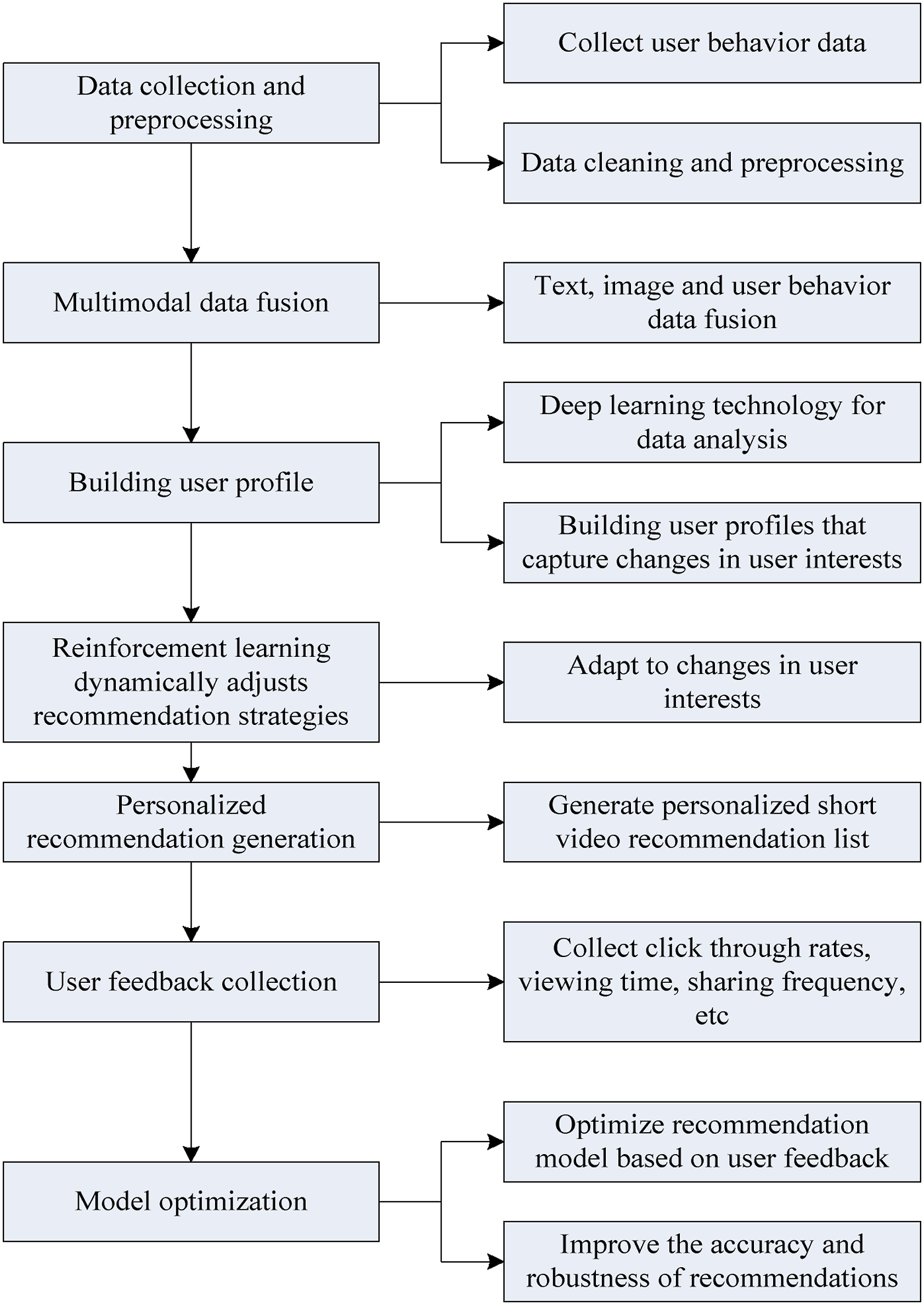
Effectiveness evaluation of personalized recommendation system for new media short videos
Experimental design
Processed dataset.
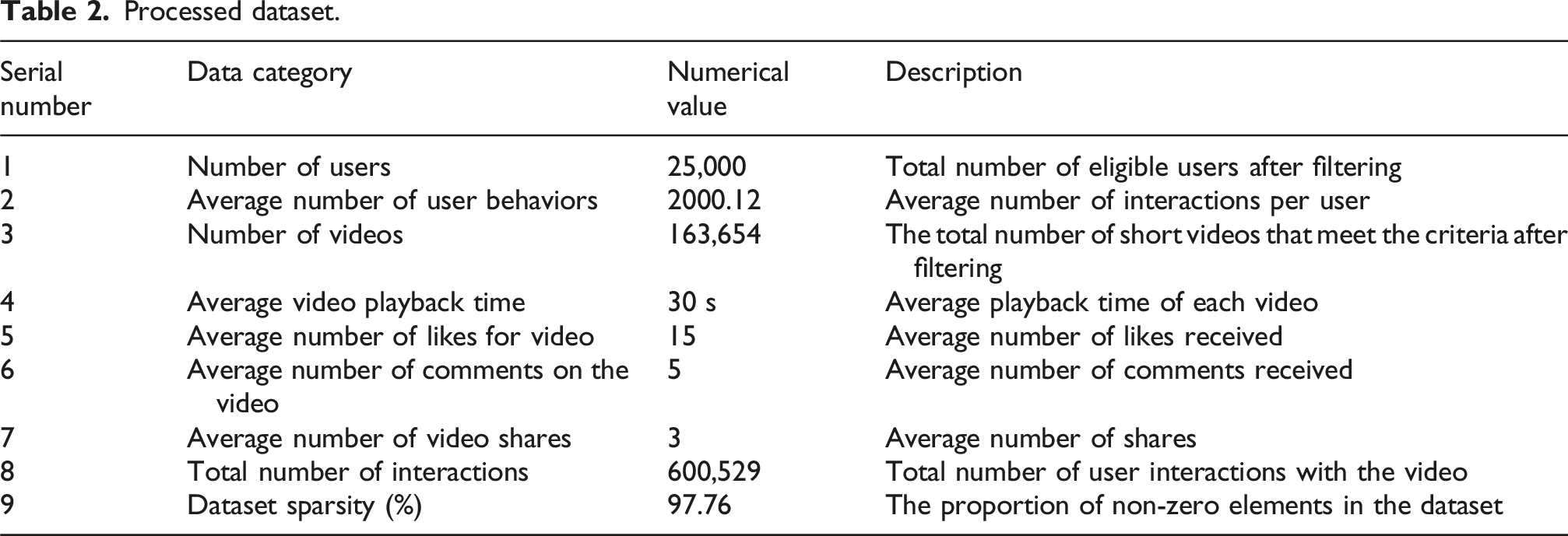
To evaluate the recommendation system performance, click-through rate, average viewing time, recommendation accuracy, recall rate, and mean absolute error are chosen as the five main indicators of the experimental test. To more intuitively evaluate the effect of this method, it is compared with three common baseline recommendation algorithms, namely, collaborative filtering, content-based recommendation, and matrix decomposition. Through comparative analysis, the advantages of this method can be better demonstrated.
Experimental results
Click-through rate and average viewing time
Click-through rate is a key indicator for measuring the effectiveness of recommendations. It reflects the user’s interest in the recommended content and the accuracy of the recommendation. A high click-through rate shows that the recommended content is more in line with user needs. Through click-through rate analysis, the effectiveness of the recommendation algorithm can be evaluated, and the model and user experience can be optimized. This article tests the click-through rate of the four algorithms under different experimental times. The outcomes are illustrated in Figure 3. Click-through rate of the four algorithms under different experimental times.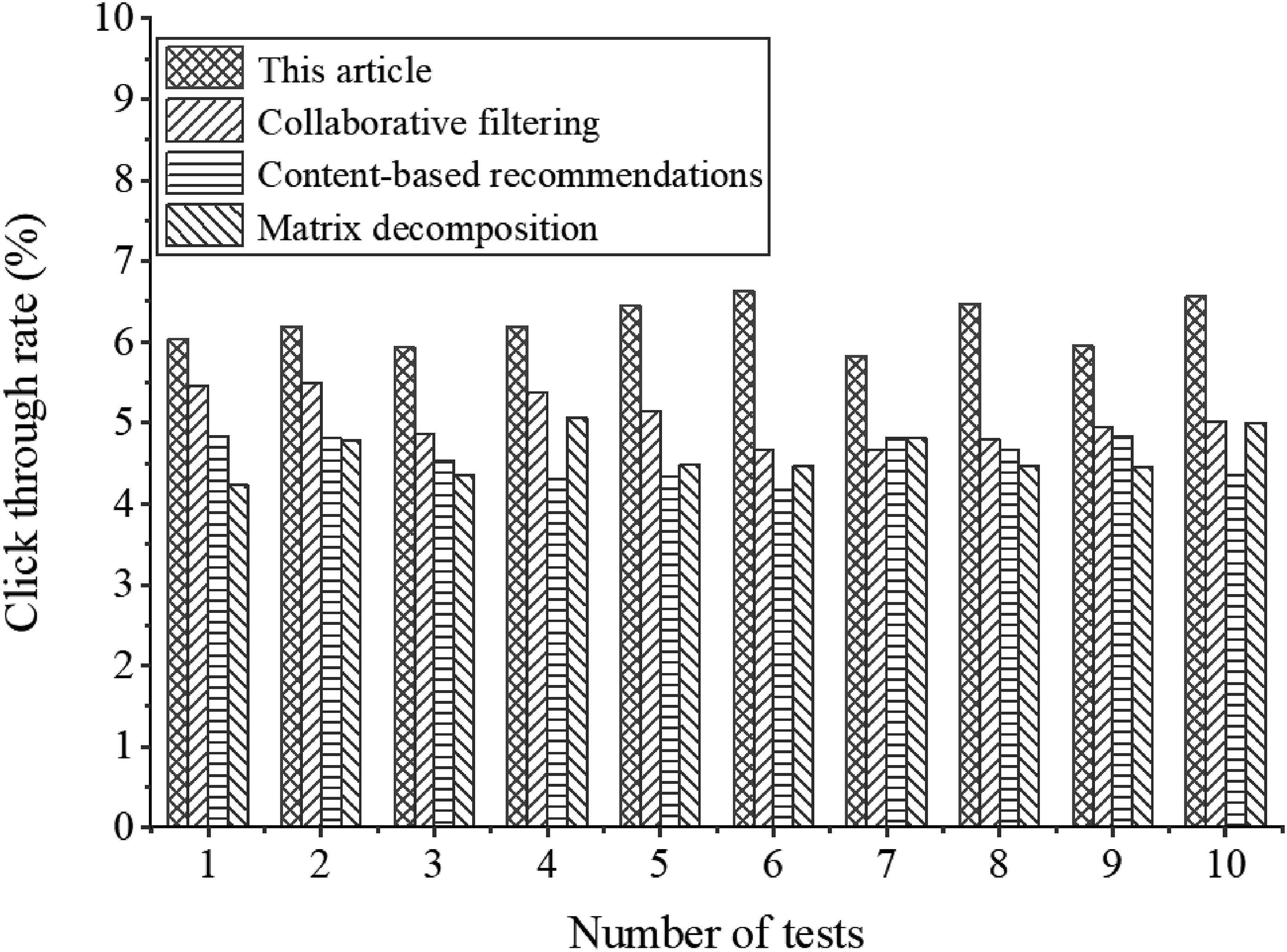
According to Figure 4, the algorithm in this article maintains a high click-through rate throughout the test. The average click-through rate of 10 tests is 6.22%; the highest click-through rate is 6.63%; the lowest is 5.83%, showing strong user appeal and recommendation accuracy. The average click-through rate of the collaborative filtering algorithm is 5.04%; the lowest is 4.66%; the highest is 5.50%. The average click-through rate of the content-based recommendation algorithm is 4.57%; the lowest is 4.18%; the highest is 4.84%. The average click-through rate of the matrix decomposition algorithm is 4.61%; the lowest is 4.24%; the highest is 5.06%. The findings demonstrate that the algorithm in this article has a high click-through rate, which can more accurately reflect user preferences, effectively improve user experience, and show its advantages in new media short video recommendation. Recommendation accuracy and recall rate of 4 algorithms under different test times. (a) Algorithm in this article; (b) collaborative filtering; (c) content-based recommendation; and (d) matrix decomposition.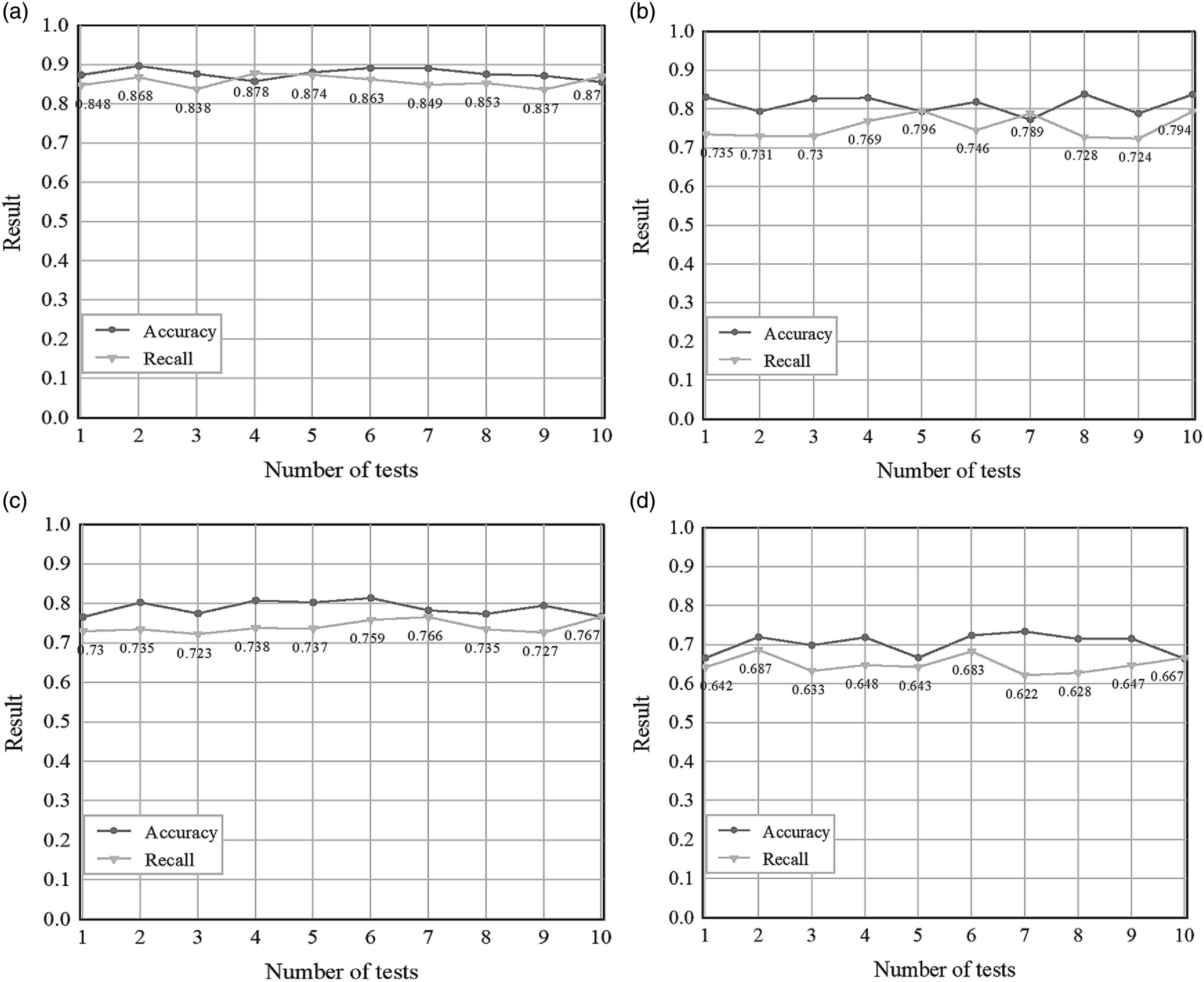
Average viewing time of short videos under the four algorithms.
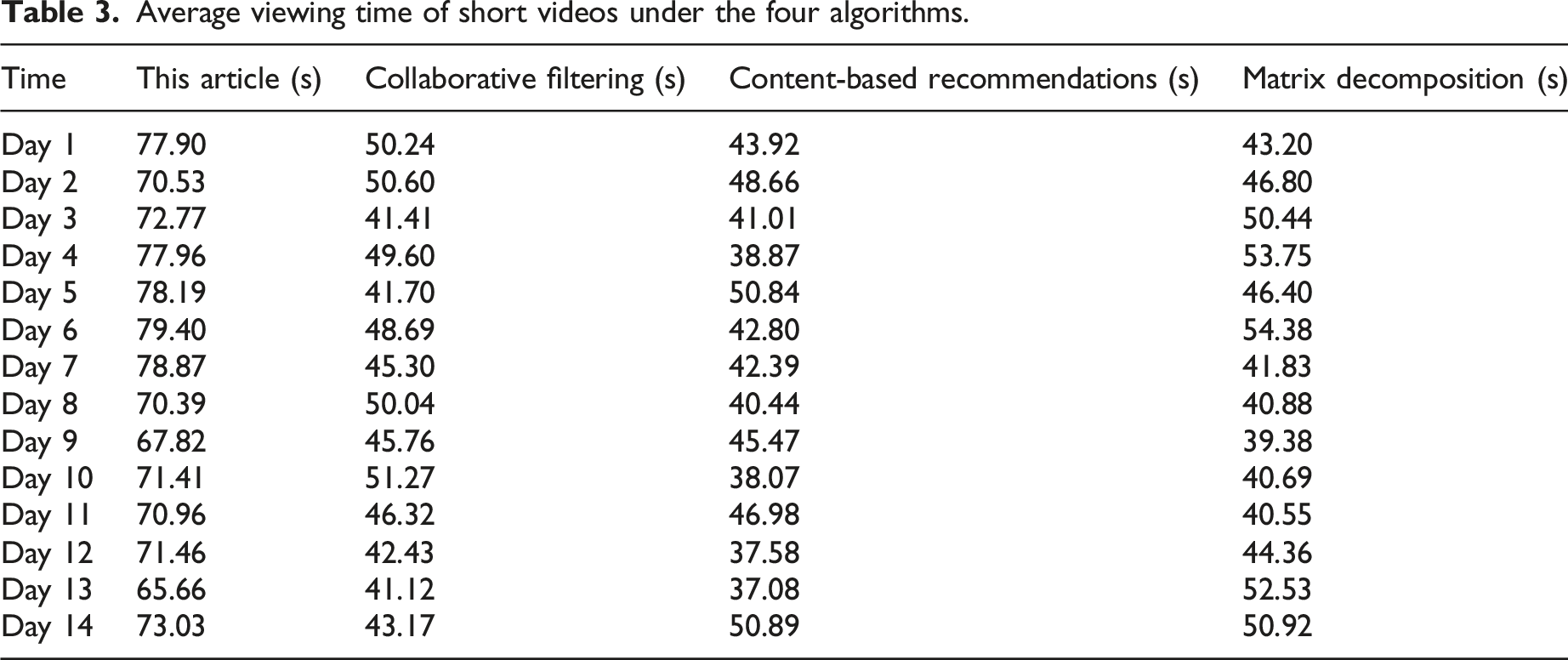
According to Table 3, the average viewing time of the algorithm in this article on the first day is 77.90 s, while the average viewing time of collaborative filtering, content-based recommendation, and matrix decomposition algorithms on the first day is 50.24 s, 43.92 s, and 43.2 s, respectively. On the 7th day, the average viewing time of the algorithm in this article is 78.87 s, and the average viewing time of the other three algorithms is 45.3 s, 42.39 s, and 41.83 s, respectively; on the 14th day, the average viewing time of the four algorithms is 73.03 s, 43.17 s, 50.89 s, and 50.92 s, respectively. It can be seen that users have a higher interest in the content recommended by the algorithm in this article, and their average viewing time is also longer. Overall, the overall average viewing time of the algorithm in this article, collaborative filtering, content-based recommendation, and matrix decomposition algorithm in 14 days is 73.31 s, 46.26 s, 43.21 s, and 46.15 s, respectively. The findings demonstrate that the algorithm in this article can capture user interests more precisely, provide attractive content, and significantly improve user viewing experience and interaction level.
Recommendation accuracy and recall rate
Recommendation accuracy and recall rate are key indicators for evaluating models. Accuracy shows the matching degree between recommended content and user interests. The higher the accuracy, the closer it is to user preferences. Recall rate reflects the proportion of user interest content recommended. The higher the accuracy, the better it covers user interests. This article counts the recommendation accuracy and recall rate of 4 algorithms under different test times. The outcomes are illustrated in Figure 4.
From the data in Figure 4(a)–(d), it can be learned that the average accuracy of the algorithm in this article is as high as 0.877, and the highest even reaches 0.897; the average recall rate is 0.858, and the highest reaches 0.878. This shows that the algorithm in this article can precisely identify user interests and widely cover their potential needs. In comparison, the collaborative filtering algorithm has an average accuracy of 0.813 and an average recall of 0.754. The average accuracy and recall of the content-based recommendation algorithm are 0.789 and 0.742, respectively. The performance of the matrix decomposition algorithm is relatively weak, with an average accuracy and recall of 0.702 and 0.650, respectively. In summary, the algorithm in this article is significantly better than the other three algorithms in accuracy and recall, showing strong potential in new media short video recommendation.
Mean absolute error
Mean Absolute Error (MAE) is a key indicator for evaluating prediction accuracy, measuring the difference between predicted scores and actual behaviors. Low MAE means high precision and reliability. Testing MAE can evaluate algorithm performance and improve the quality of the recommendation system. To this end, this article tests the mean absolute error under 4 algorithms. The outcomes are illustrated in Figure 5. Mean absolute error under four algorithms.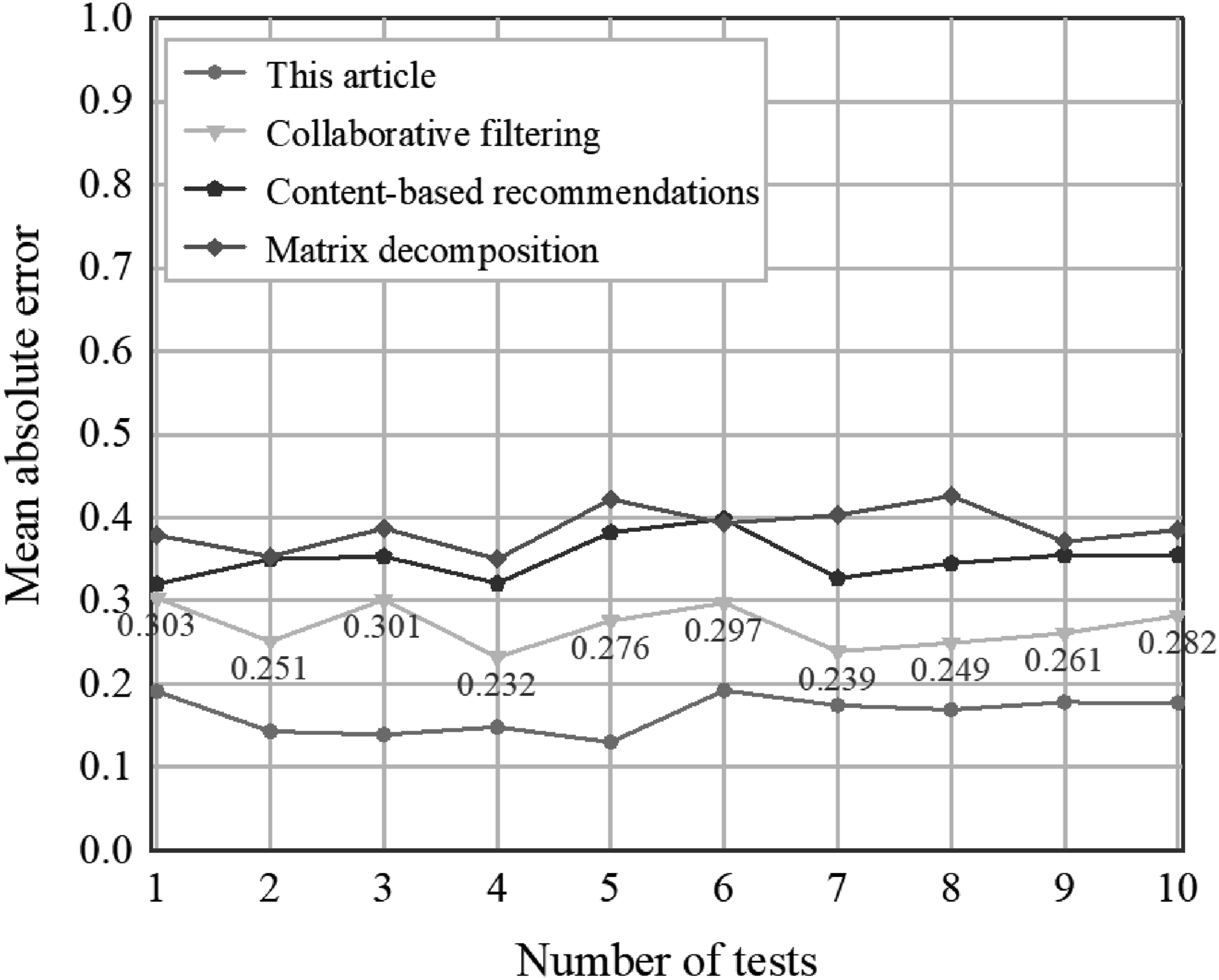
According to Figure 6, the MAE of this algorithm is lower than that of the other three algorithms in multiple tests. In the first test, the MAE of this algorithm is 0.191, while the MAE of collaborative filtering, content-based recommendation, and matrix decomposition algorithms are 0.303, 0.32 and 0.379, respectively. By the fifth test, the MAE of this algorithm becomes 0.130, and the MAE of the other three algorithms are 0.276, 0.382, and 0.422, respectively. In the tenth test, the MAE of the four algorithms are 0.177, 0.282, 0.355, and 0.385, respectively. Overall, the average MAE of the 10 tests of the four algorithms are 0.164, 0.269, 0.351, and 0.387, respectively. Overall, the algorithm in this article maintains the lowest MAE in multiple tests, showing good stability and predictive ability, which is crucial for optimizing the new media short video recommendation system. Time consumption of each experiment in the training and evaluation stages of the model under four algorithms.
Model complexity
Model complexity is crucial to algorithm performance and practicality. High complexity may improve accuracy, but it may also lead to overfitting and increased resource consumption, affecting real-time and scalability. To compare the complexity of the short video recommendation system model under different methods, this article tests the time consumption of each experiment in the training and evaluation stages of the model under four algorithms. The results are presented in Figure 6.
Figure 6(a) is the algorithm in this article; Figure 6(b) is collaborative filtering; Figure 6(c) is content-based recommendation; Figure 6(d) is matrix decomposition. According to Figure 6(a)–(d), in 10 experiments, the training time of the algorithm in this article is between 6.65 and 9.22 s, and the evaluation time is between 1.32 and 2.32 s. The average training and evaluation time of 10 experiments are 8.05 s and 1.80 s, respectively. The collaborative filtering algorithm training takes 20.39–23.63 s, and the evaluation takes 5.22–8.59 s. The average training and evaluation times are 22.15 s and 6.92 s, respectively. The content-based recommendation algorithm training takes 30.57–35.20 s, with an average of 32.20 s; the evaluation takes 9.56–12.76 s, with an average of 11.12 s. The matrix decomposition algorithm training takes 29.11–33.04 s, with an average of 31.41 s; the evaluation takes 10.45–13.80 s, with an average of 12.04 s. It can be learned that the algorithm in this article not only has an advantage in prediction accuracy, but also performs well in model complexity control, ensuring the system’s efficient operation and real-time response. This is crucial for optimizing the recommendation system of new media short video platforms, and helps researchers find algorithms that balance model complexity and performance, thereby improving user experience.
Conclusions
This study integrates deep learning (DL) and reinforcement learning (RL) to construct a comprehensive user profile using multimodal data, enabling RL to dynamically adjust recommendation strategies in response to rapidly changing user interests. Experimental results demonstrate that the proposed algorithm outperforms baseline recommendation methods in key metrics, including click-through rate, viewing duration, recommendation accuracy, and recall rate. Additionally, the algorithm exhibits strong stability and predictive capabilities, highlighting its effectiveness in capturing user preferences and enhancing user experience and platform engagement. The system also excels in addressing cold-start problems and adapting to dynamic user interests, showcasing its potential for real-world applications. However, further validation in diverse real-world scenarios is necessary to confirm its generalizability, and efforts to reduce model complexity and resource consumption remain critical areas for improvement.
Future research directions
Future studies could focus on optimizing the algorithm’s computational efficiency to reduce resource demands while maintaining performance. Exploring the integration of additional data sources, such as social media activity or contextual information, could further enhance the system’s adaptability and accuracy. Additionally, investigating lightweight model architectures or transfer learning techniques may improve scalability and applicability across different platforms and domains. Longitudinal studies in real-world settings would also provide valuable insights into the system’s long-term effectiveness and versatility.
Footnotes

Funding
The author received no financial support for the research, authorship, and/or publication of this article.
Declaration of conflicting interests
The author declared no potential conflicts of interest with respect to the research, authorship, and/or publication of this article.