




Abstract
This paper presents a collaborative optimization control framework using a Stackelberg game (leader-follower game) approach for microgrid source-grid-load-storage coordination. In this framework, the microgrid system acts as the leader, whose objective is to minimize the total operational cost. Distributed energy resources including renewable energy and energy storage as well as flexible loads serve as followers. Specifically, renewable energy followers seek to minimize costs by considering penalties for curtailment. Energy storage followers optimize regulation performance while considering overcharging/over-discharging risks. Load followers focus on improving power quality while maintaining demand response capabilities. Results demonstrate that all participants under the proposed game framework can reach a Stackelberg equilibrium, effectively harmonizing the interests of various participants and enhancing energy storage safety and regulation capabilities. The microgrid scheduling plan ensures the secure and stable operation of the system.
Keywords
Introduction
In recent years, renewable energy, particularly represented by wind power and solar energy, has undergone rapid development worldwide. China alone reached a total renewable energy capacity of 760 GW by the end of 2022, with projections indicating renewables will exceed a 50% share of installed capacity by 2050. 1 However, the inherent uncertainty, volatility, and anti-peak nature of renewable energy, coupled with diverse access modes (e.g., centralized and distributed) and the rise of flexible loads like electric vehicles and energy storage systems, present significant challenges to the power system’s safe, stable, and economically efficient operation.2–6 Coordinating the optimization of these adjustable resources economically and efficiently becomes crucial in addressing these challenges.
Microgrid systems are localized grids that can operate independently from the traditional grid, managing energy resources within a specific area. 7 They address modern power system challenges by integrating renewable energy sources like solar panels and wind turbines, along with energy storage systems, to enhance energy security, reduce transmission losses, and promote sustainability. The increasing focus on reducing greenhouse gas emissions and the need for resilient energy systems during natural disasters have driven interest in microgrids. 8 Advancements in smart grid technologies, such as intelligent control systems and real-time monitoring, further improve the efficiency and reliability of microgrid operations. 9
Various researchers have explored the optimal control strategies for renewable energy,10–12 energy storage,13–15 and flexible load16,17 in microgrids. Ref. 10 presents a control system for a microgrid powered by wind and solar energy sources. It utilizes a doubly-fed induction generator for wind energy conversion and incorporates a battery bank connected to a common DC bus. The system employs voltage and frequency control achieved through an indirect vector control method. A robust control system (RCS) is utilized in 11 due to the turbine’s nonlinear aerodynamic characteristics, resulting in a substantial 25% increase in active power gain compared to conventional control systems. A comprehensive analysis of various optimization methods for islanded hybrid microgrid systems is provided in terms of net present cost in 12, where an advanced control strategy incorporating PID and FLC with automated tuning effectively manages voltage and frequency. Ref. 13 analyses and compares control methods for hybrid energy storage systems (HESS) in microgrids, and also investigates the impact of communication system-induced time delays on HESS controllers and proposes a novel droop-coordinated control method. This paper categorizes strategies into centralized, decentralized, and distributed types and studies their latest developments. Combining a genetic algorithm (GA) and artificial neural network (ANN), Ref. 14 proposes a self-tuning proportional-integral (PI) controller for frequency regulation of islanded microgrids including energy storage. Focusing on peak shaving, a microgrid utilizing a vanadium redox flow battery alongside biomass gasification and solid oxide fuel cell for rural applications is investigated in 15, where a predictive control method is proposed to enhance flow battery efficiency. Ref. 16 introduces an event-triggered multiagent system with a dual-layer design to tackle the complexity of optimizing hybrid energy systems under variable renewable supply and demand response dynamics. It employs a price-bidding model leveraging Nash equilibrium and assigns specific tasks to four agents through intelligent controls and load adjustments. Similarly, Ref. 17 proposes a dynamic time-of-use electricity price game model to achieve flexible control of loads in active distribution networks, considering the power consumption willingness of multiple user types.
As modern power systems continue to evolve, there has been a notable shift in the dynamic interaction among renewable energy sources, energy storage systems, and flexible loads. This transition has moved away from the conventional “source-follows-load” model toward a more collaborative approach known as “source-load-storage” interaction. Microgrids which encompass a diverse array of distributed renewable energy sources, energy storage units, and flexible loads can play a pivotal role in orchestrating and coordinating multiple controllable resources, thereby ensuring the efficient, stable, and sustainable operation of the grid. By embracing either distributed autonomy or centralized coordination, microgrids can seamlessly integrate with the broader power system, facilitating the widespread and efficient utilization of renewable energy while enhancing power quality and ensuring the safety, stability, and cost-effectiveness of power system operations. 18 Research on collaborative optimization of multiple controllable resources leveraging microgrid technology has been conducted in recent years. Utilizing a multi-agent hierarchical control architecture, Ref. 19 introduces a distributed cooperative optimal control approach, employing the discrete consistency algorithm to enhance energy management in AC microgrids efficiently. Similarly, employing a multi-objective tri-stage hierarchical decision-making framework, Ref. 20 proposes a day-ahead stochastic operation planning model which maximizes generation and demand-side flexibilities to improve system adaptability to short-term changes. Ref. 21 presents a hybrid energy management systems (EMS) architecture based on canonical coalition games for cooperative power exchange management among networked microgrids. This framework involves central and local EMSs in scheduling, monitoring, rescheduling, and benefits distribution processes to optimize power exchange strategies while ensuring microgrid privacy. A two-stage robust optimal model for cooperative microgrids (CMGs) aiming at minimizing daily costs is proposed in 22. In this paper, the model optimizes first-stage decision results under expected scenarios and a column and constraint generation algorithm is used to obtain second-stage decision results. Ref. 23 proposes an optimal decentralized control method for source-network-load-storage coordination in AC/DC hybrid microgrids, ensuring power quality across different areas and load types through flexible switching modes. By considering exergy efficiency and operation cost, Ref. 24 proposes a multi-objective hierarchical source-load-storage scheduling method for a multi-energy system, utilizing different dispatch intervals based on subsystem characteristics to mitigate uncertainties and improve energy utilization efficiency.
Based on the comprehensive analysis of existing literature, it is evident that the predominant focus lies in optimizing the coordination of sources, loads, and storage within microgrid systems to enhance their safety, stability, efficiency, and economic viability. However, as renewable energy sources, energy storage solutions, and flexible loads continue to advance, future microgrid configurations, and potentially entire power systems, are expected to encompass a multitude of stakeholders. These stakeholders may include system operators, renewable energy providers, storage facility operators, and end consumers. Each entity will not only be obligated to adhere to the essential safety and stability protocols governing power system operations but also endeavor to maximize its interests. This transition from the current centralized grid-centric operational model, wherein resources are managed collectively, to a future scenario characterized by the coexistence of diverse entities, is anticipated to necessitate a paradigm shift in the operation and management approaches of power systems. Consequently, there arises a critical need to explore and devise novel operational management strategies tailored specifically to accommodate the complexities of systems featuring multiple coexisting entities.
This paper investigates a novel operation method of microgrid systems with multiple entities. The main contributions are presented as follows: (1) A novel operational paradigm is introduced, leveraging a leader-follower game optimization framework to facilitate interactions among various entities within microgrid systems. Here, the microgrid system assumes the role of the leader, while renewable energy sources, energy storage units, and flexible loads function as followers. Unlike conventional microgrid optimization approaches, the proposed leader-follower game model not only enables coordinated interaction among sources, grid infrastructure, loads, and storage elements within microgrids but also effectively harmonizes the interests of diverse entities within these systems by attaining game equilibrium. This innovative approach maximizes the utilization of multiple adjustable resources while fostering equilibrium among stakeholders, thereby enhancing the overall efficiency and sustainability of microgrid operations. (2) Detailed models are formulated for the followers within the game model, addressing key considerations for each entity. Specifically, for renewable energy sources, this study introduces an optimization approach that incorporates penalty costs for curtailed wind and solar power, enhancing coordination and regulation capabilities while maximizing renewable energy utilization. Similarly, for energy storage systems, an optimization method is proposed to mitigate the risk of overcharging/over-discharging by introducing penalty costs for such occurrences, thereby ensuring flexible adjustment of the state of charge (SOC) and avoiding regulatory issues caused by unreasonable SOC threshold settings. Additionally, for flexible loads, an optimization method is presented that considers power quality, introducing a power quality index to enhance system flexibility through demand response while optimizing load power quality. By employing these targeted models, a harmonious balance of interests between each follower and the microgrid leader is effectively achieved, contributing to the overall efficiency and reliability of microgrid operations.
Leader-follower game and microgrid system modeling
Basic theory of leader-follower game
The leader-follower game is characterized by sequential decision-making among participants. In the game model, the second decision-maker’s strategy is influenced by the first decision-maker’s actions, and vice versa, creating a dynamic interplay between them. This interaction can be represented by the following model:

If
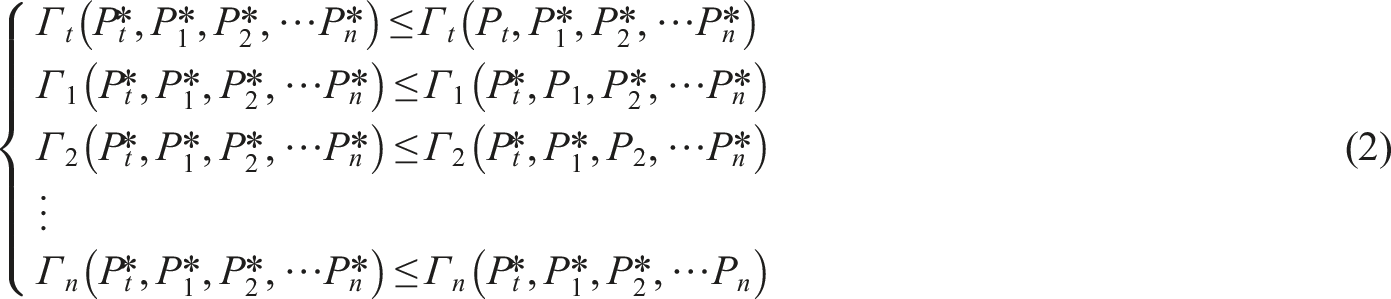
Equation (2) suggests that no participant can independently alter their strategy to achieve a lower payment in the Stackelberg equilibrium solution.
Microgrid system modeling
Figure 1 depicts a schematic representation of a power system comprising multiple microgrids, each equipped with diverse power sources including renewable energy sources, energy storage systems, and loads. Through effective coordination and control of these assets within each microgrid, while considering the interests of all stakeholders, efficient integration of distributed energy resources can be achieved to meet various load demands effectively. Furthermore, by enabling multiple microgrids to participate in power system regulation through either distributed autonomy or centralized coordination, the overall power system can ensure economical, efficient, safe, and stable operation. Illustration of a multi-microgrid power system.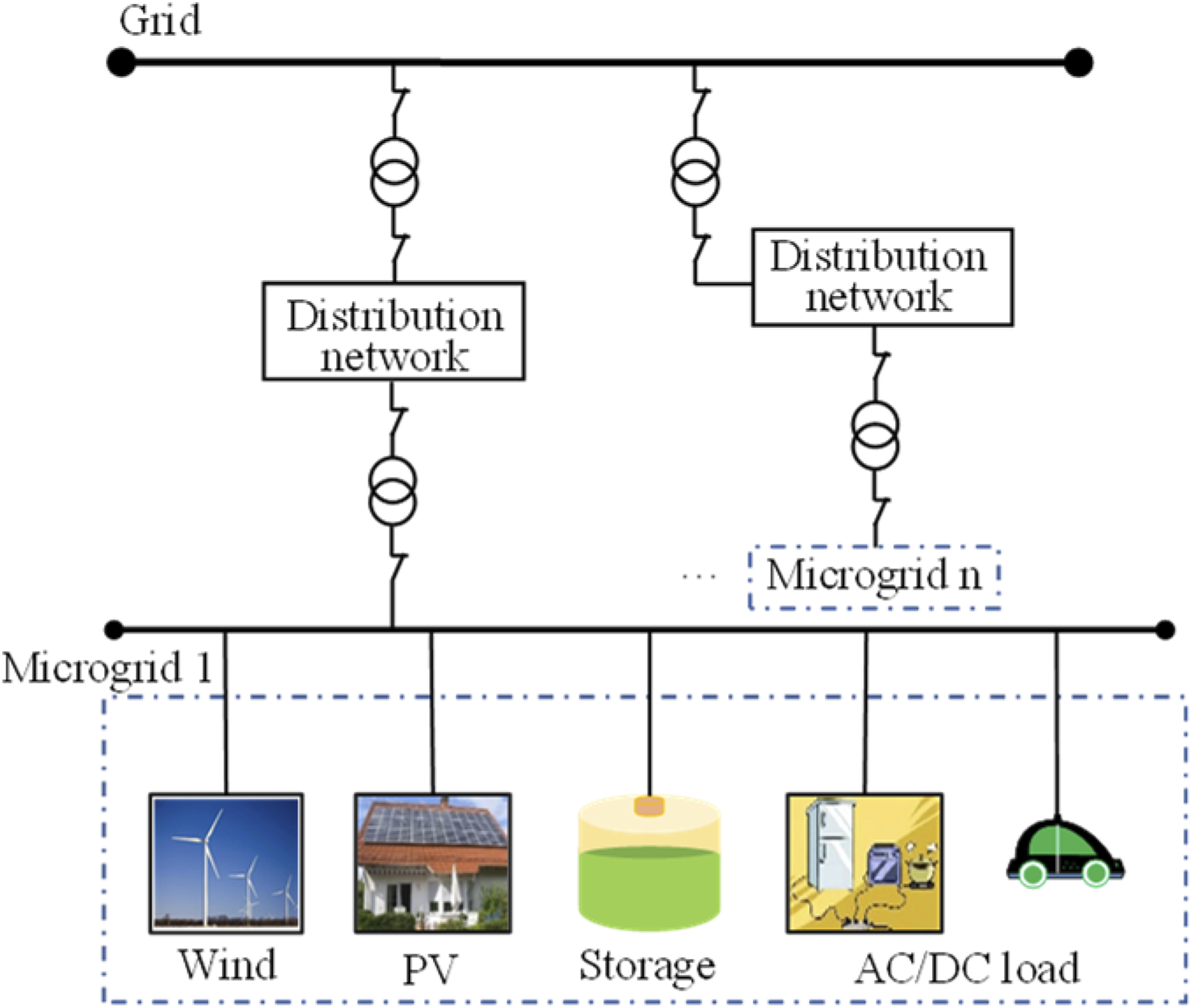
Optimal leader-follower game model for microgrid source-load-storage coordination
This section involves modeling and optimizing microgrid systems that include renewable energy sources (wind and photovoltaic power generation), energy storage, and adjustable loads using the leader-follower game approach. It aims to develop a scheduling plan for the next 24 h with a time step of 1 hour.
Objective
In the context of the game, participants include microgrids, renewable energy sources, energy storage systems, and loads. The microgrid system assumes the role of the leader, prioritizing system safety and economic operation. Meanwhile, renewable energy sources, energy storage systems, and loads act as followers, contributing to the cooperative dynamics of the game. (1) As the leader in the game, the microgrid aims to reduce the operational cost of the microgrid system while ensuring safety and stability. Consequently, the objective of the game leader is the minimization of the overall operational cost: (2) As a participant in the game, renewable energy sources operate as followers, with their optimal objective being the maximization of wind and photovoltaic power utilization levels. In this context, the paper introduces operational and maintenance costs for wind and solar operations, alongside significant penalty costs for curtailing renewable energy generation. This approach deviates from rigid constraints on renewable energy integration, fostering greater flexibility in accommodating renewable energy generation. The objective function is formulated as follows: (3) The objective for the load game follower is to enhance the power quality of the load and the system’s regulation flexibility, while still retaining a portion of loads for potential demand response actions. This objective is defined as follows: (4) The objective pursued by the energy storage follower is to mitigate the risk associated with overcharging/over-discharging while optimizing its regulation capabilities. Rather than imposing overly conservative or aggressive SOC thresholds, which might compromise regulation capacity or lead to excessive charging/discharging, this study accounts for both system safety and the interests of the energy storage follower. It strikes a balance between safety and regulation capabilities, incorporating the adjustment cost of energy storage as the optimization objective for this participant in the game.




The provided equations incorporate deviation cost and risk cost considerations. In this study, the initial SOC for the energy storage follower is set to 0.5, thus maximizing the discharge and charge regulation margins. Therefore, for the energy storage follower, the deviation cost is employed to assess its regulation margin. A smaller regulation margin occurs when the SOC exceeds the predefined threshold. Consequently, the risk cost is introduced to evaluate the risk of overcharging. When the SOC remains within the range of the designated threshold, the overcharging/over-discharging cost is zero. However, as SOC approaches 1 or 0, the risk cost escalates.
Constraints
The power balance constraint indicates that generation from all power sources should satisfy the load in the system all the time.

The power outputs of renewable energy sources should be less than their respective predictive output.


The interruptible load constraint is formulated as follows:

The operational constraints for energy storage include SOC cycle constraint, SOC upper and lower limits constraint, charge and discharge power limits, and charge and discharge power ramp constraint.




Based on the above, the proposed microgrid source-grid-load-storage leader-follower game model can be expressed as follows: (1) Both the leader’s and followers’ strategies constitute non-empty convex sets. (2) Given the leader’s strategies, each follower possesses a unique optimal solution. (3) Conversely, given the followers’ strategies, the leader attains a unique optimal solution.




Based on equation (15), the leader’s optimization objective represents a linear function. Consequently, when the followers’ strategies are established, the leader can achieve a unique optimal solution within its constraints. Therefore, the leader-follower game model, as depicted in equation (15), inherently demonstrates a unique Stackelberg equilibrium. In this model, the leader initially formulates the scheduling strategy for the entire microgrid system. Subsequently, the followers, including renewable energy sources, loads, and energy storage units, tailor their scheduling strategies in accordance with the leader’s provided scheduling strategy. Finally, the Stackelberg equilibrium solution is obtained through iterative loops between the leader’s and followers’ models. The solving procedure is illustrated in Figure 2. Flowchart outlining the process for solving the optimal operation using the leader-follower game strategy.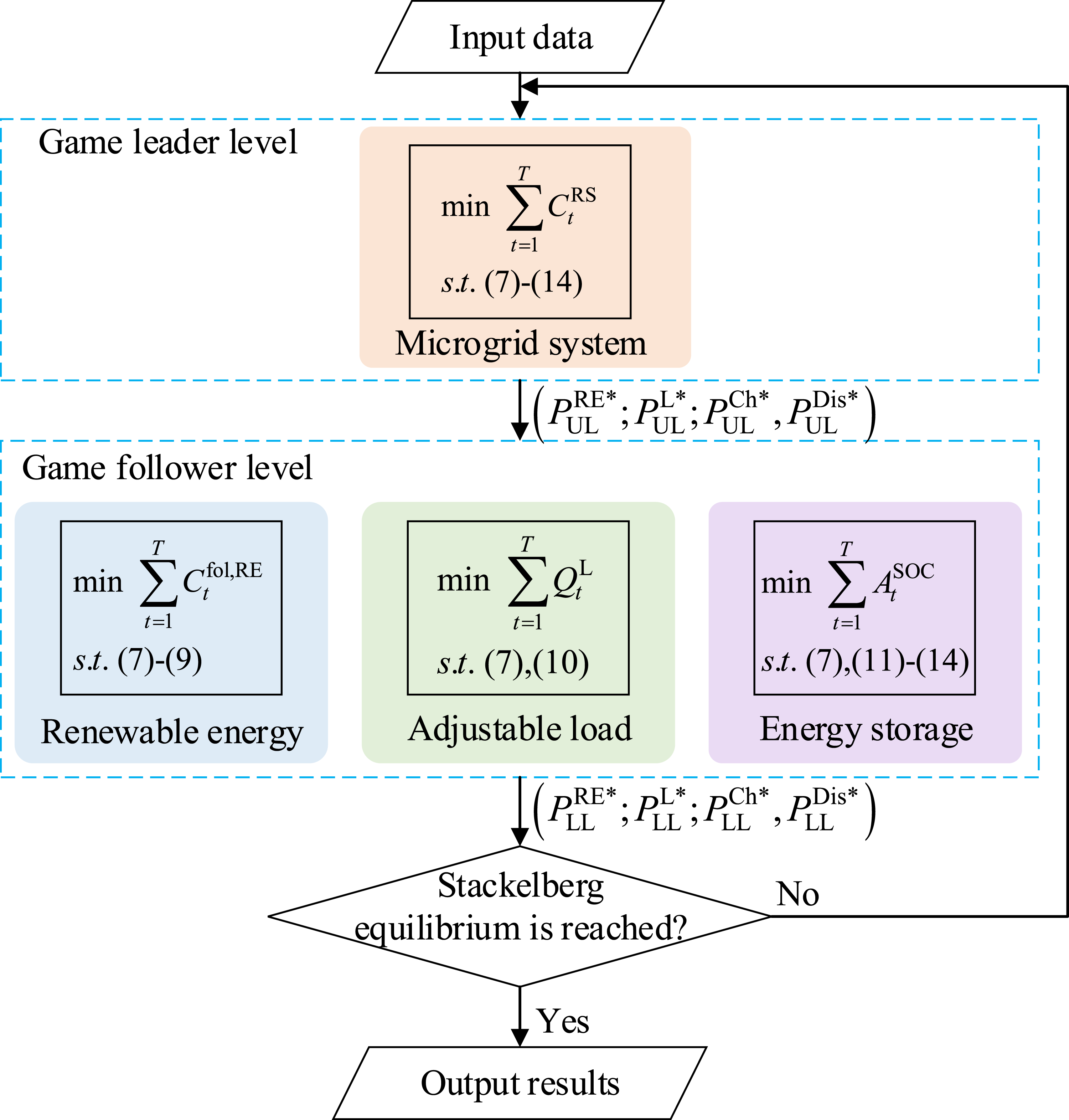
Case study
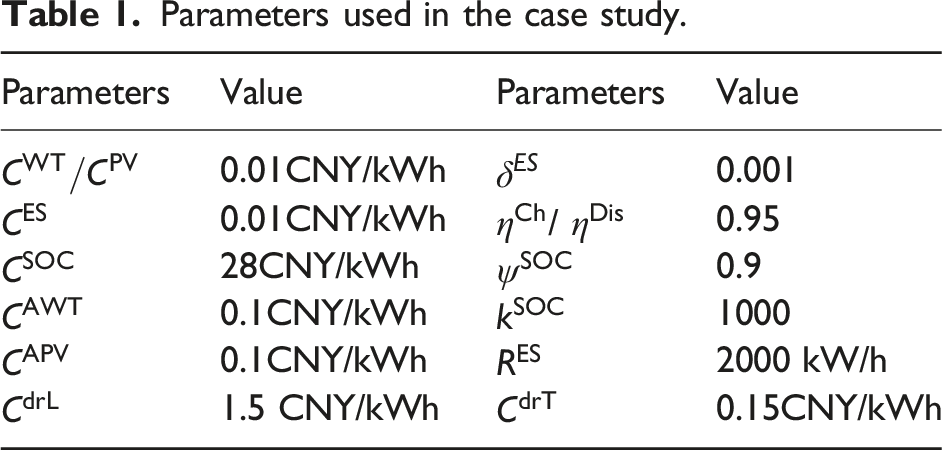
In this section, the validation of the proposed method is conducted using data obtained from a microgrid demonstration project and relevant literature sources.9,14,19,21 The microgrid demonstration project is interconnected with the external distribution grid and comprises wind and solar energy, energy storage facilities, and flexible loads. Figure 3 illustrates the measured load, wind and solar output, and time-of-use electricity price curves. Utilizing the measured load and renewable energy output values, a random error is introduced to simulate predicted values for the load and renewable energy output for the next day. In this paper, the prediction errors for load and renewable energy output are set at 10% and 15%, respectively. Other parameters used in this paper can be found in Table 1. Various loads, renewable energy outputs, and energy prices. Parameters used in the case study.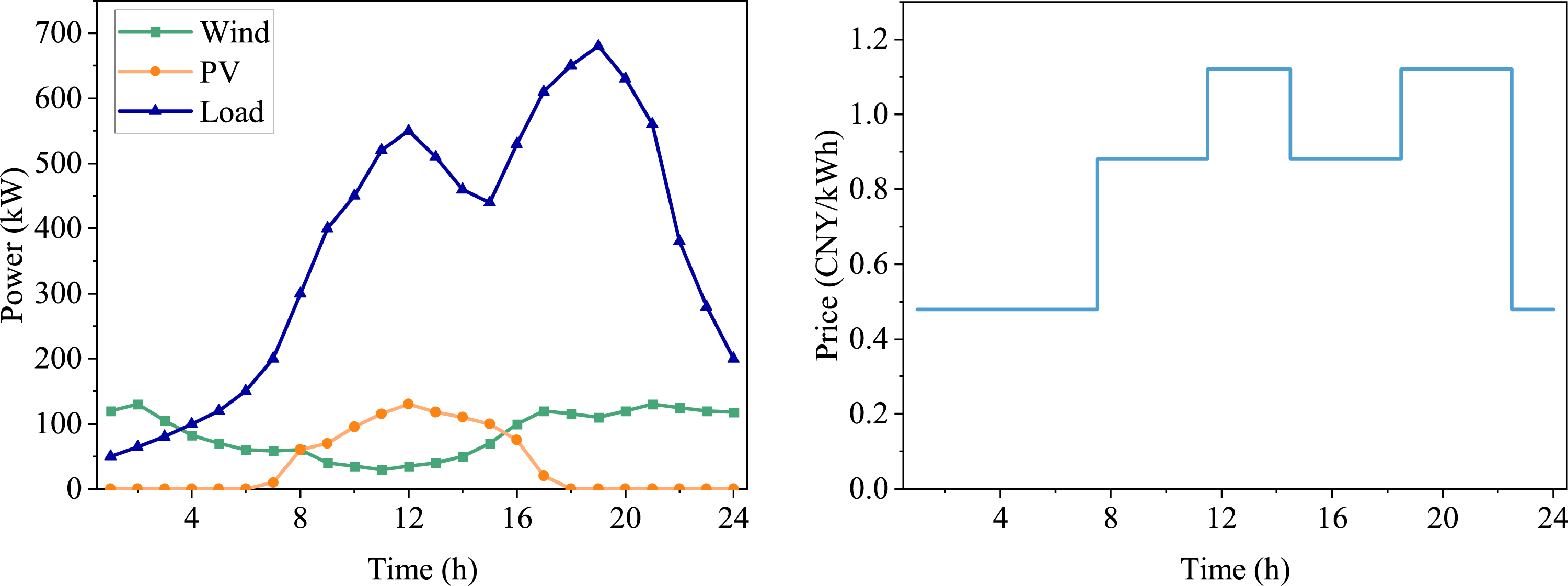
Game result analysis
According to model (15), the microgrid consisting of wind power, photovoltaics, energy storage, and flexible loads is optimized through a leader-follower game. Figure 4(a)–(d) show the convergence plots of the Stackelberg equilibrium for the leader and each follower. The legends “UL-(*)” and “LL-(*)” represent objective values of followers calculated in the game leader and follower levels, respectively. Upon observing 45 rounds of games, the iteration process converges and all participants in the game achieve the Stackelberg equilibrium. Concerning convergence speed, the flexible load follower exhibits the fastest convergence, followed by the energy storage and the renewable energy followers. Game results for microgrid game leader (a) and game followers (b) for energy storage, (c) for renewable energy, and (d) for load.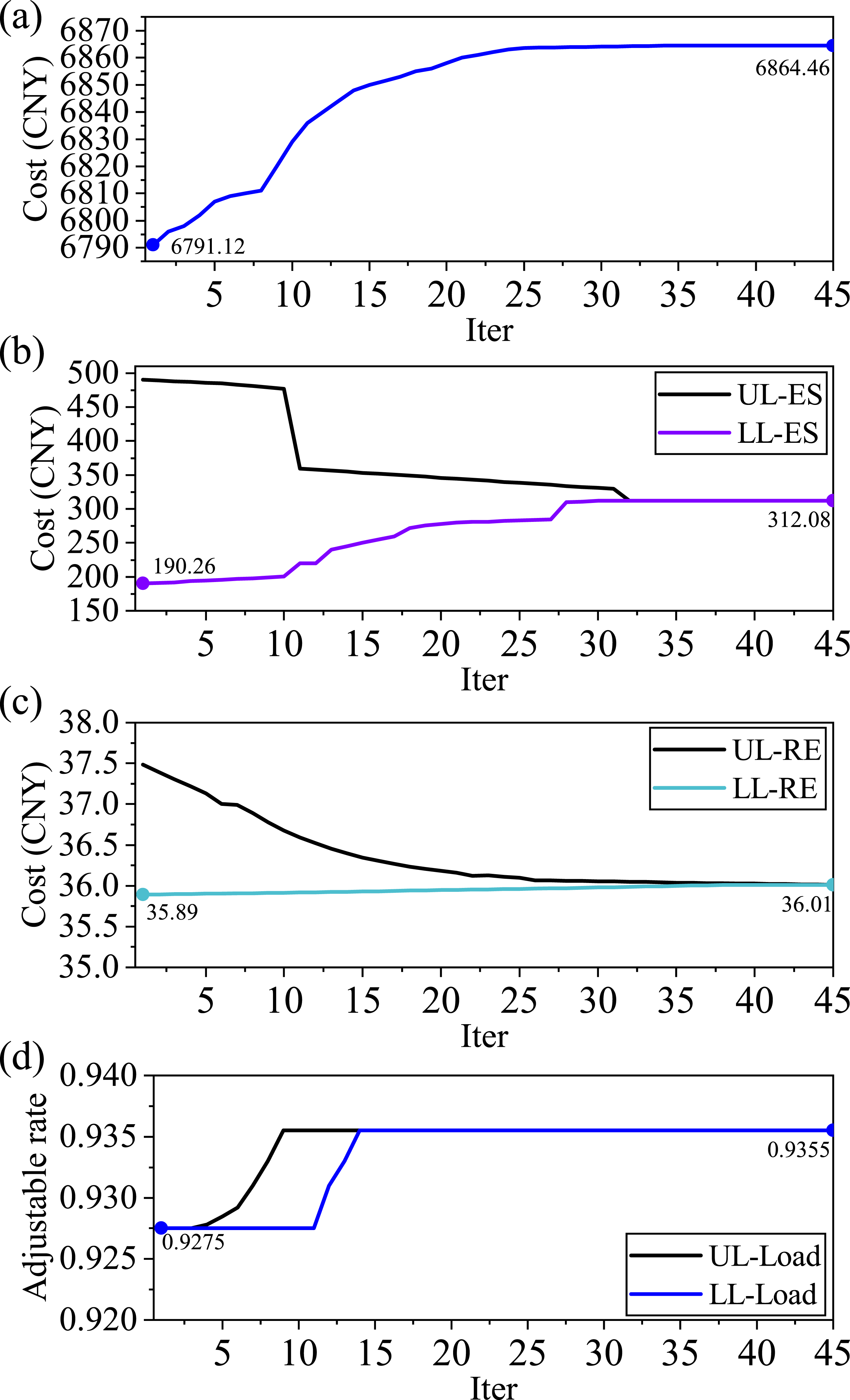
In Figure 4(b), the black and purple curves illustrate the optimal energy regulation cost of the energy storage follower within the leader model computed based on equation (6) and the game follower model itself. As the iteration goes on, the energy regulation cost of the energy storage calculated by the leader model gradually diminishes, while this cost term optimized within the energy storage follower model gradually rises. With the progress of iteration, the cost values calculated by these two models gradually approach and eventually converge, ultimately reaching the Stackelberg equilibrium. Similarly, Figure 4(c) and (d) indicate that as the number of game iterations increases, the renewable energy operation cost and the load power quality index at both leader and follower levels progressively converge, eventually reaching the Stackelberg equilibrium.
Notably, the green line in Figure 4(c) displays minimal variation with increasing game iterations, suggesting that within the follower model, the disparity between the renewable energy operation cost and the Stackelberg equilibrium value remains negligible. Conversely, the trends depicted by the black and blue curves in Figure 4(d) show a rapid convergence to the Stackelberg equilibrium value, suggesting minimal influence from the leader-follower game on the load power quality index. Rather, the optimization outcomes predominantly depend on the system’s operational state and inherent constraints.
Figure 4 also depicts the changes in objectives before and after the game iterations for both the leader and the followers, comprising renewable energy, energy storage, and flexible loads. As shown in the figure, the objective function values obtained from the first and last iterations have been marked. The leader’s costs rose by CNY 73.34 (1.08%), while those of the energy storage follower surged by CNY 121.82 (64.03%). Comparatively, the cost increase for the renewable energy follower was minimal, at only CNY 0.12 (0.35%), and for the flexible load follower, it was merely 0.008 (0.86%). Notably, the substantial increase in cost for the energy storage follower underscores the pivotal role of energy storage in system’s coordinated optimization. Conversely, the nearly unchanged cost for the renewable energy follower implies its limited regulation margin in system optimization, resulting in a minor impact on the overall system dynamics.
Figure 5 illustrates the trend in the total operating cost of the entire system for the game leader and each follower as the number of game iterations increases. It is evident that after 45 iterations, the game leader and each follower achieve Stackelberg equilibrium. The black curve, representing the game leader, first coincides with the green curve, representing the adjustable load follower, indicating that the optimal value of the adjustable load follower converges first. The blue curve, representing the renewable energy follower, coincides with the black curve before the red curve, which represents the energy storage follower, indicating that the optimization results for the renewable energy follower converge faster than those for the energy storage follower. Changing trend of overall operating cost from perspectives of game leader and each follower.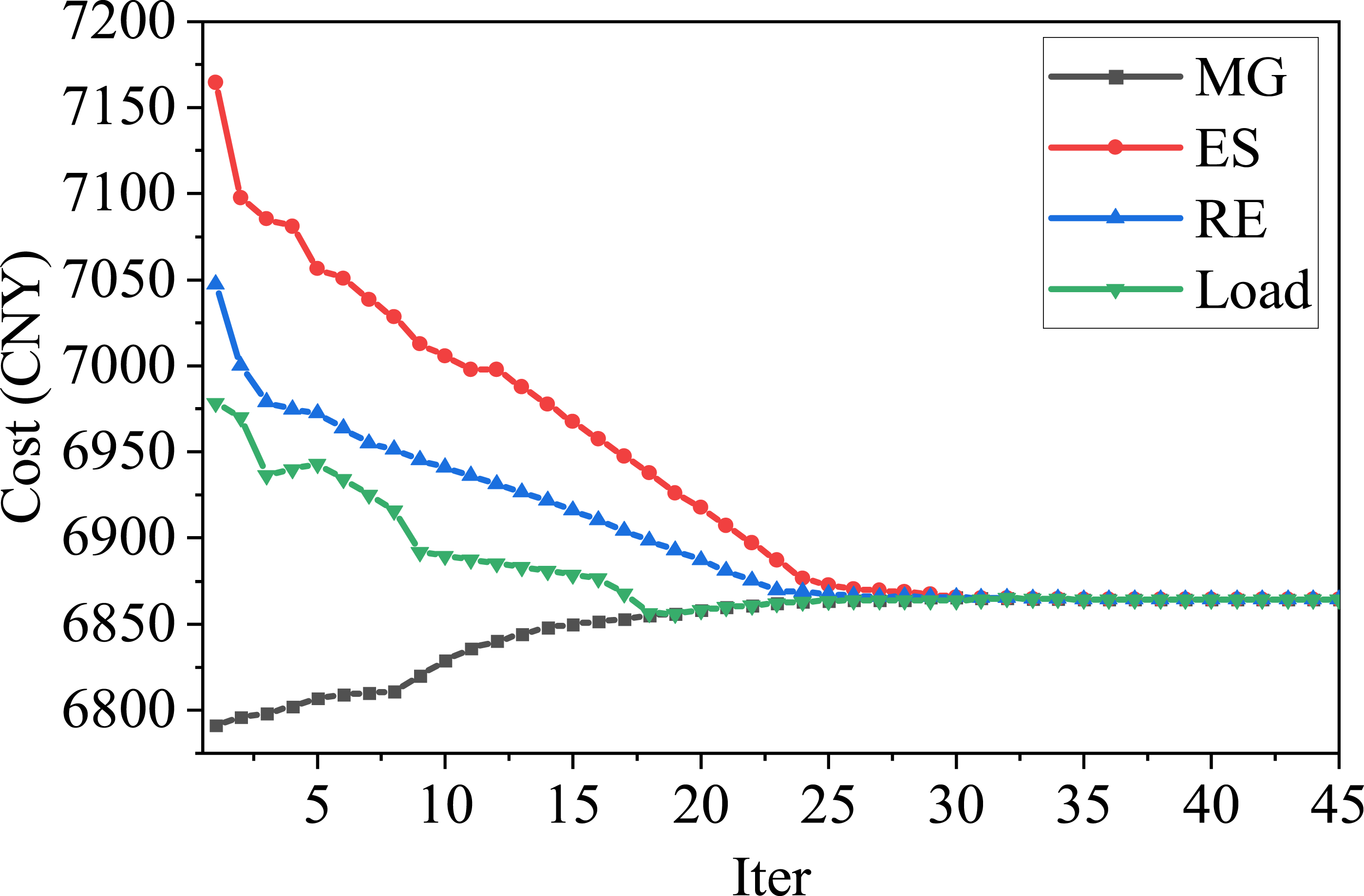
Operation result analysis
Figure 6 depicts the operation plan of the generation assets in the system before and after the game. It is evident that before and after the game, the overall trend of the operation schedule remains unchanged, indicating the effectiveness of the proposed method in balancing the interests of all participants in the game while ensuring stable system operation. Notably, the adjustment of the load appears minimally impacted by the leader-follower game strategy, suggesting that in this case load adjustment is primarily limited by the system’s power balance constraint. Optimal operation scheme before (a) and after (b) the game.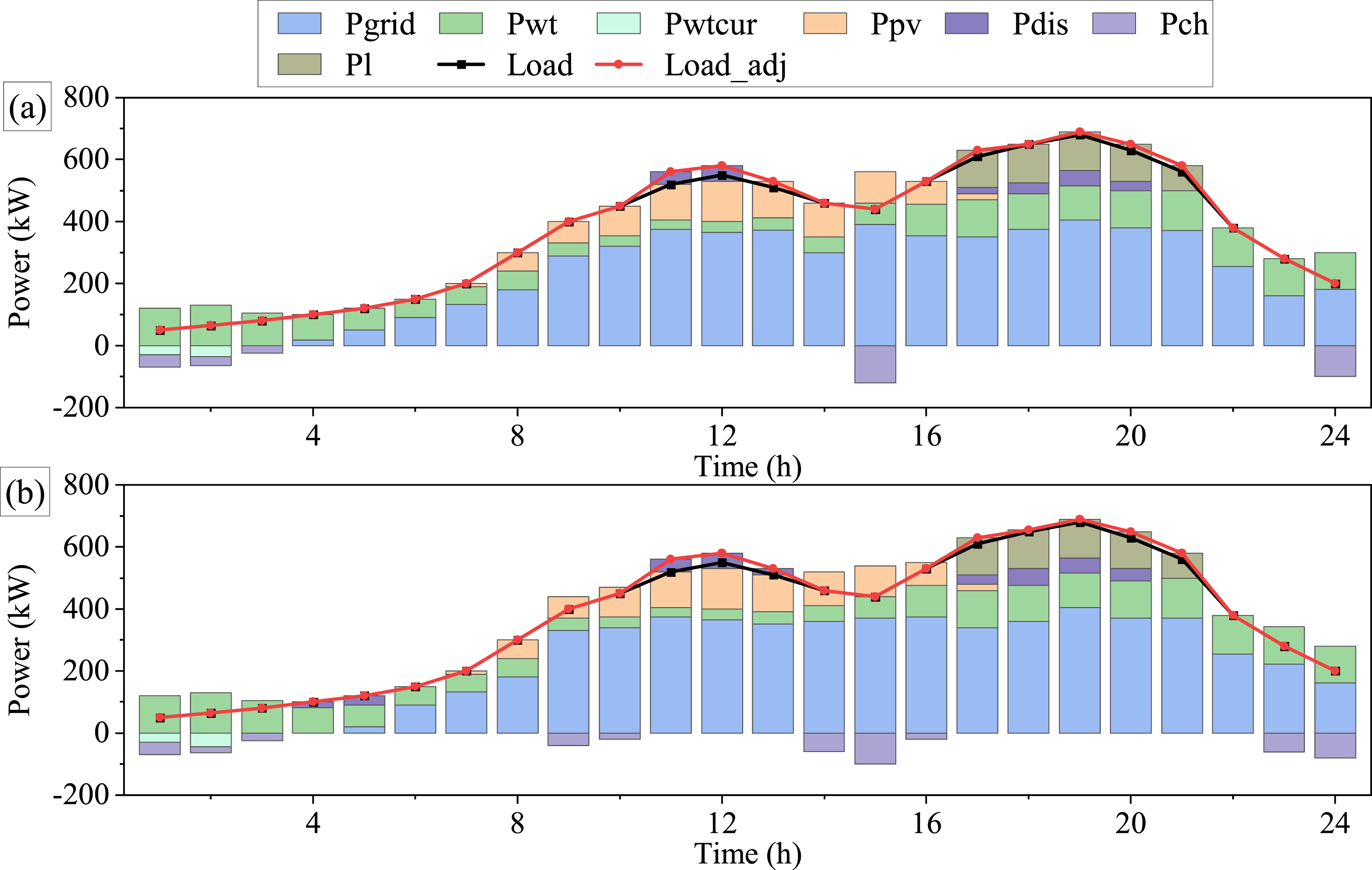
In particular, Figure 7 illustrates the optimization outcomes for energy storage operations. As depicted in Figure 7(a), both before and after the game, significant fluctuations in charging/discharging are evident in the energy storage system, underscoring its pivotal role in system regulation and its substantial impact on optimization. Examining Figure 7(b), it is apparent that the SOC curve post-game (blue curve) predominantly falls within the range delimited by the black and red curves. This signifies that the leader-follower game optimization effectively balances the interests of the leader and the energy storage follower, exerting a significant influence on system optimization. Furthermore, in the black curve, there are intervals where upper and lower limits are consistently reached. This observation suggests that the optimization approach proposed in this paper, which considers the risk of energy storage overcharging/over-discharging, markedly enhances the operational safety and regulatory efficacy of energy storage. Optimal operation scheme for energy storage charging/discharging power (a) and SOC (b) before and after the game.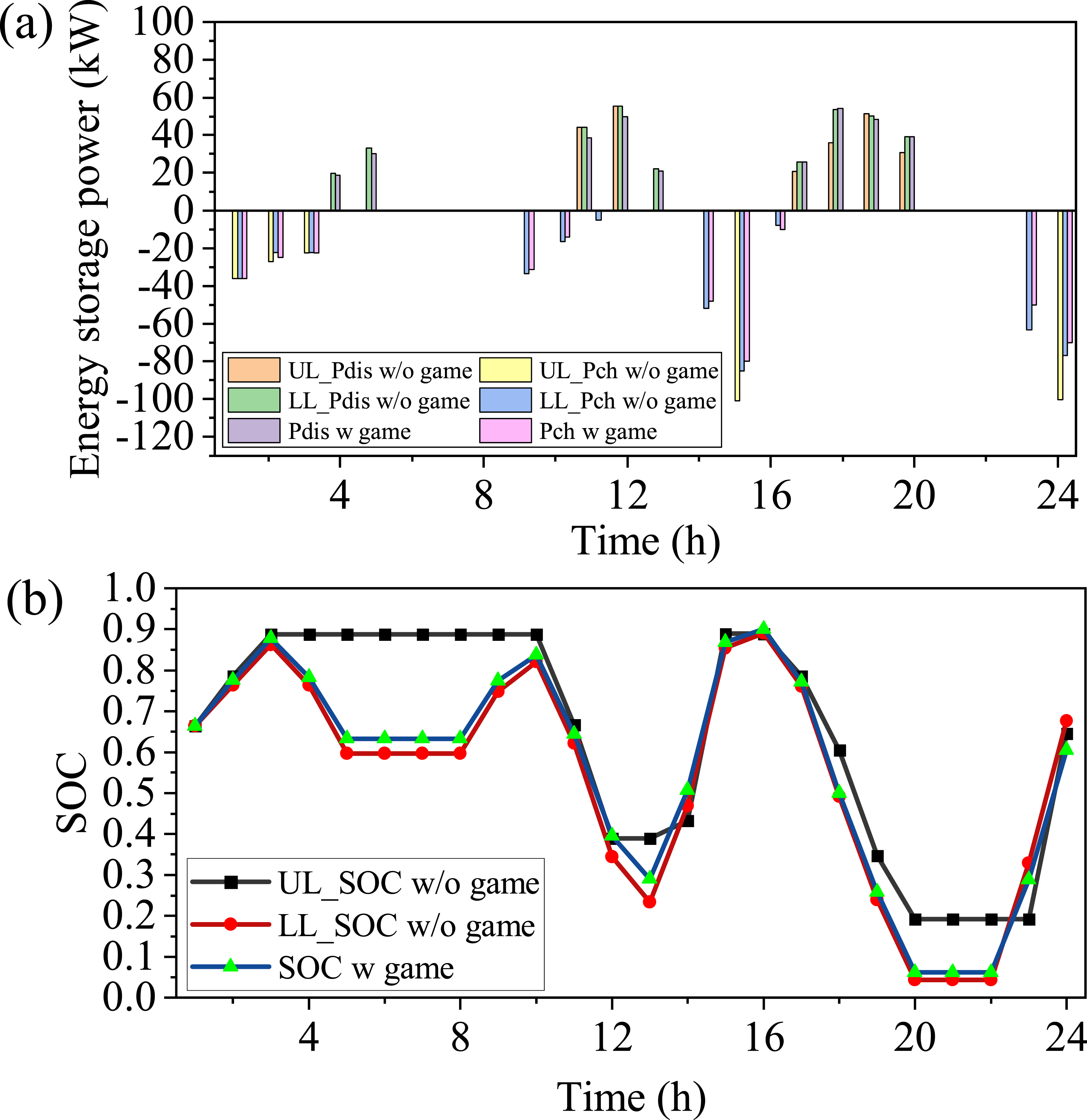
Conclusion
The paper proposes a leader-follower game optimization approach for microgrid source-grid-load-storage systems, taking into account the risk associated with energy storage overcharging/over-discharging. The key findings are summarized: (1) The microgrid operation plan optimized using the proposed leader-follower game method remains largely consistent with existing plans, ensuring system safety and stability. (2) Numerical results demonstrate that after 45 iterations of the game, a Stackelberg equilibrium is reached between the leader and each follower. (3) The energy storage follower’s operating cost in the game increases by 64.03% compared to optimization based solely on its interests, highlighting the crucial regulatory role of energy storage in system optimization. The proposed optimization method imposes penalties for energy storage overcharging/over-discharging, ensuring its flexible regulation capability while mitigating the risk associated with these phenomena. Overall, the leader-follower game-based optimization approach offers a viable pathway for optimizing future microgrid/power systems.
Footnotes
Funding
The authors disclosed receipt of the following financial support for the research, authorship, and/or publication of this article: This research was supported by the Science and technology projects of State Grid Corporation of China Project Number: B7010623004P.
Declaration of conflicting interests
The authors declared no potential conflicts of interest with respect to the research, authorship, and/or publication of this article.