




Abstract
Torsional effects in planar irregular buildings can lead to structural damage, making torsional response analysis of buildings a critical aspect of structural design. This study conducts numerical simulations on L-shaped frames subjected to frequent earthquakes to investigate the influence of low-frequency content on the torsional responses of planar irregular frame structures (PIFSs). Five L-shaped frame models with varying length-to-width ratios (L/B) of the protruding limbs-1:1, 1.5:1, 2:1, 2.5:1, and 3:1 were developed using ABAQUS. Columns were modeled using solid elements, reinforcing steel with truss elements, and floor slabs with shell elements. The peak shear forces and bending moments in corner columns were compared under various conditions of low-frequency content to analyze the effects of low-frequency content and L/B ratios on wave passage effect in frames. The results indicate that when the low-frequency content of seismic waves is sufficient, wave passage effect occurs in outer corner columns, whereas inner corner columns remain unaffected. At apparent wave velocity of 2000 m/s, increasing L/B ratios amplify peak shear forces and bending moments in wave-facing outer corner columns by 28.3% and 43.8%, respectively. Conversely, when the low-frequency content of seismic waves is insufficient, neither outer nor inner corner columns exhibit wave passage effect.
Keywords
Introduction
Torsional responses in building structures can be induced by three primary mechanisms: base torsional excitation, spatially varying multi-support excitation, and structural eccentricity. 1 Base torsional excitation refers to the direct induction of foundation torsion by seismic waves containing rotational components around the vertical axis. Spatially varying multi-support excitation includes wave passage effect, incoherence effect, side effect, and attenuation effect. Structural eccentricity can be classified into two categories based on eccentricity direction: vertical irregular structures and planar irregular structures. Vertical irregularities primarily manifest as mass distribution, geometric configuration, stiffness variations, or structural setbacks. 2 Planar irregular structures include discontinuities caused by L-, U-, F-, and T-shaped configurations.3,4
As early as 1969, Newmark 5 investigated torsional responses of structures under base torsional excitation and proposed considering additional accidental eccentricity in horizontal seismic force calculations. He also established a method for determining this accidental eccentricity length. Subsequently, numerous scholars6–11 expanded on Newmark’s work by studying foundation torsion-induced structural responses. Researchers further explored the influence of spatially varying multi-support excitation on structural torsion.12–14 For instance, Hao 12 analyzed torsional responses of single-story symmetric buildings under multi-support excitation, concluding that seismic analyses considering uniform excitation tend to underestimate column shear forces in rigid or large-scale structures. Hao 13 later investigated the impacts of multi-support excitation on single-story structures with varying eccentricities and supports, discovering that multi-support-induced torsion exceeds eccentricity-induced torsion in symmetric/asymmetric structures with high eccentricity ratios.
Furthermore, Hao 1 examined the combined effects of structural eccentricity and multi-support excitation on the torsional-lateral coupled responses in bidirectionally eccentric structures. Heredia-Zavoni and Leyva 14 evaluated wave passage and incoherence effects on torsional responses of 3D, multi-story, multi-span symmetric buildings. Their results indicated wave passage and incoherence effects on column shear forces intensify with increasing structural fundamental frequencies. These studies conclude that multi-support excitation significantly influences column shear forces in high-frequency structures. Scholars also employed analytical methods15,16 to investigate the wave passage effect on frame structures. Gu 15 identified wave passage excitation as a torsional vibration source. Li and Liu 16 analytically demonstrated that the wave passage effect correlates with low-frequency content, becoming more pronounced when such content is sufficient. However, these investigations were primarily limited to symmetric structures, overlooking torsional responses of irregular structures under wave passage excitation.
Previous studies on torsional responses of vertically irregular structures,17–25 planar irregular structures,26–34 and combined planar-vertical irregular structures35,36 have primarily focused on uniform excitation, with limited investigations into their responses under earthquake wave passage excitation. However, irregular, predominantly L-shaped configurations with multi-span internal corridors in practical engineering are widely adopted for architectural aesthetics. Therefore, analyzing the torsional responses of L-shaped frame structures with varying degrees of planar irregularity under earthquake wave passage excitation is essential. This study conducts linear dynamic time-history analyses on torsional responses of L-shaped frame structures with different planar irregularity levels under earthquake wave passage excitation to investigate the influence of low-frequency content on their responses. Using ABAQUS software, five L-shaped frame models with length-to-width ratios (L/B) of the protruding limbs—1:1, 1.5:1, 2:1, 2.5:1, and 3:1—were developed, where columns were modeled with solid elements, reinforcing steel with truss elements and floor slabs with shell elements. Total masses of floor slabs and their reinforcing steel and beams and reinforcing steel were assigned to floor slab centroids, with the same method applied to rotational inertia. The effect of low-frequency content and length-to-width ratios (L/B) on wave passage effect in L-shaped frames during earthquakes were evaluated and compared. Peak shear forces and bending moments at the tops of corner columns in the excitation direction were adopted as indices to evaluate structural torsional responses. By comparing results with uniform excitation, this research highlights the necessity of considering low-frequency-sufficient earthquake wave passage excitation in the design of planar irregular L-shaped frame structures. The obtained response characteristics provide a reference for the seismic design of such structures.
Numerical model in ABAQUS
Dynamic calculation method
ABAQUS uses the finite element method to discretize the continuum and transform it into an ordinary differential equation as follows:

In this equation,
Constitutive models of reinforcing steel and concrete
In Figure 1, reinforcing steel behavior is modeled using ABAQUS’
37
double-slope material model. Concrete columns employ the concrete damage plasticity (CDP) formulation from ABAQUS 2024,
37
with uniaxial stress–strain relationships defined by Chinese standard GB 50010-2010
38
in Figure 2. Diagram of the double-slash constitutive model of steel reinforcement. Uniaxial stress–strain curve of concrete.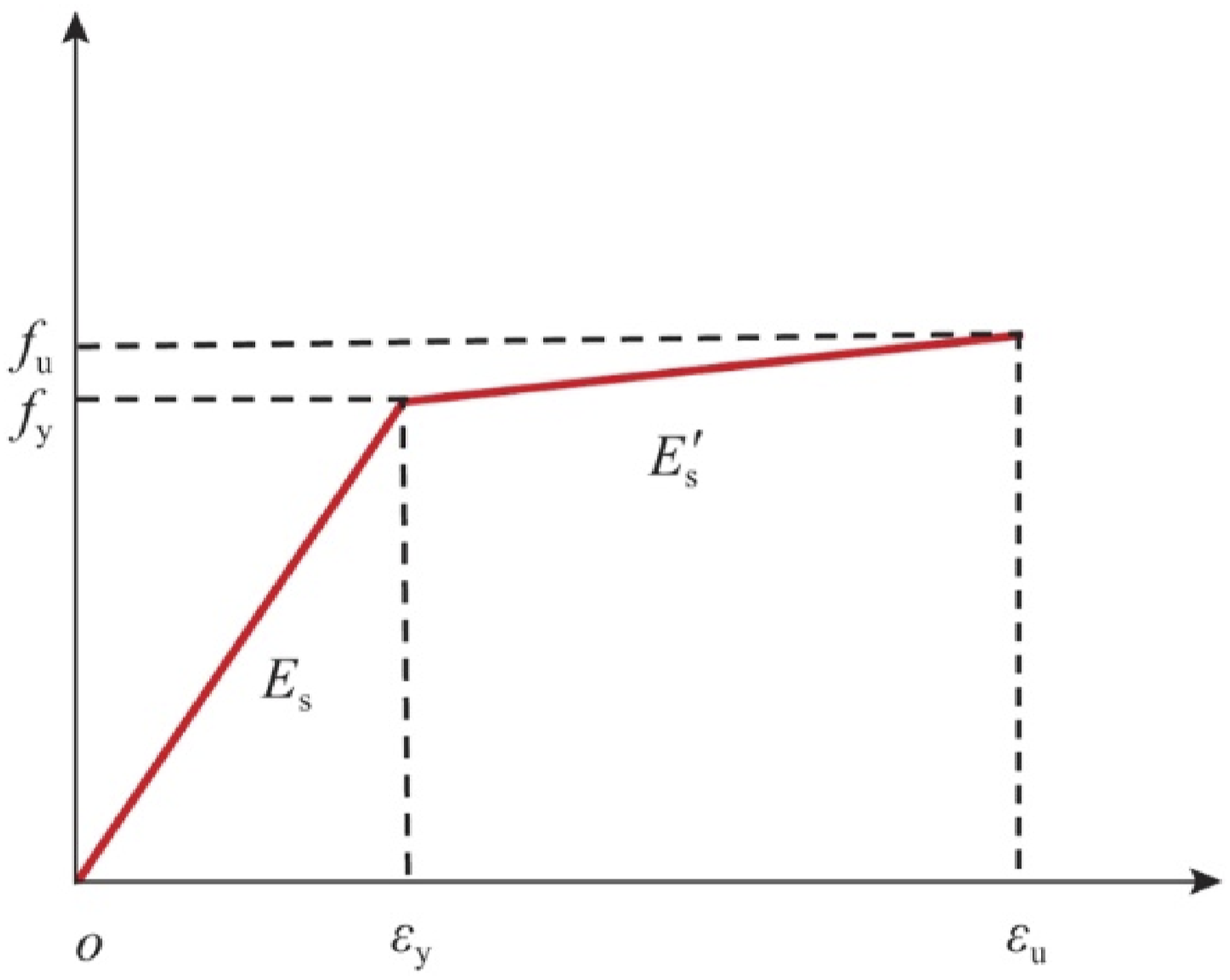
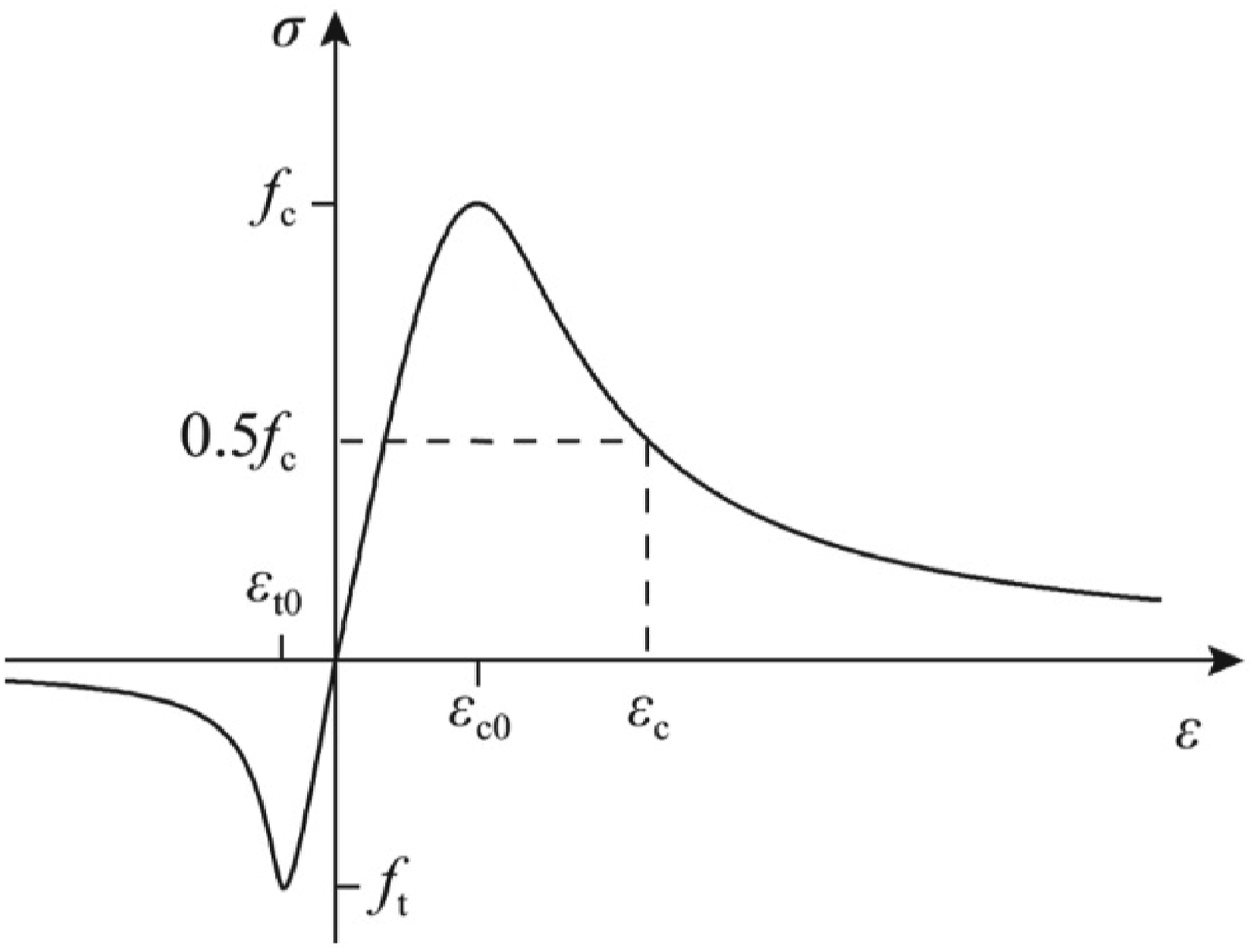
Selection of earthquake waves
Following the methodology established by Li et al.
16
for selecting earthquake waves with varying low-frequency content, three ground motions with sufficient low-frequency content (RSN1193-H2 wave, RSN1268-H1 wave, and RSN1302-H2 wave) and three within sufficient low-frequency content (RSN19110-H1 wave, RSN18332-H1 wave, and RSN20226-H1 wave) were selected from the PEER earthquake database.
39
The acceleration time histories were scaled to achieve a peak ground acceleration (PGA) of 0.35 m/s2, corresponding to frequent earthquakes at intensity level 7. Figure 3 illustrates the Fourier acceleration amplitude spectra of the six waves, with the horizontal axis aligned to the fundamental frequency of the structural excitation direction. Through frequency analysis, the basic frequencies for the five frame structures (L-1, L-1.5, L-2, L-2.5, and L-3) along the excitation direction, obtained through frequency analysis are 5.26 Hz, 5.23 Hz, 5.20 Hz, 5.18 Hz, and 5.16 Hz, respectively. Fourier acceleration amplitude spectrums for seismic waves of the frame structures. (a) RSN1193H2 wave, (b) RSN1268H1 wave, (c) RSN1302H1 wave, (d) RSN19110H1 wave, (e) RSN18332H1 wave, and (f) RSN20226H1 wave.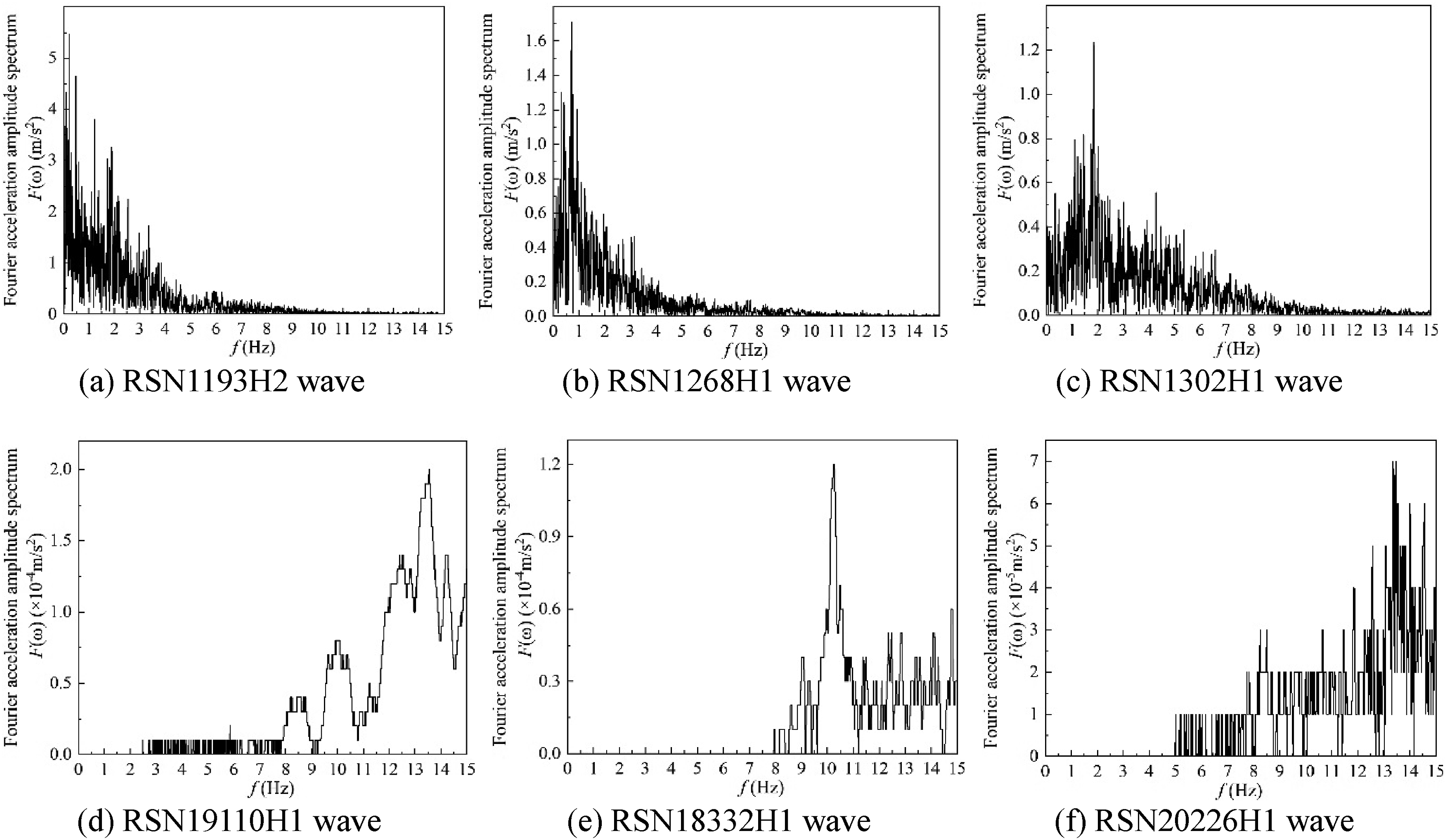
Figure 3 shows that the dominant frequencies of the RSN1193H2, RSN1268H1, and RSN1302H1 waves are approximately 2 Hz, which is significantly lower than the fundamental frequencies of the five L-shaped frames in the excitation direction (5.26 Hz, 5.23 Hz, 5.20 Hz, 5.18 Hz, and 5.16 Hz). This indicates sufficient low-frequency content in these seismic waves, where closer proximity of dominant frequencies to the origin corresponds to richer low-frequency components. Conversely, RSN19110H1, RSN18332H1, and RSN20226H1 waves exhibit dominant frequencies exceeding 5 Hz, surpassing structural fundamental frequencies. Compared to low-frequency-sufficient waves, these low-frequency-insufficient waves have dominant frequencies farther from the origin, confirming the insufficient low-frequency content.
Finite element model
Material properties of the concrete.

Material properties of reinforcing bars.

Five structural models were established with varying projecting limb length-to-width ratios (L/B) of 1:1, 1.5:1, 2:1, 2.5:1, and 3:1. According to Section 3.4.4 in the Code for Seismic Design of Buildings, 38 the dimension L must exceed 0.3 times the total dimension Lmax in the corresponding projection direction. Consequently, five structural models were established with projected limb length-to-width ratios (L/B) of 1:1, 1.5:1, 2:1, 2.5:1, and 3:1, corresponding to L/Lmax values of 0.45, 0.56, 0.63, 0.68, and 0.71, respectively. All configurations satisfy the definition of plan irregular structures.
The total masses of the floor slabs (including slab reinforcement and beam reinforcement) are 758.3 t, 818.4 t, 878.6 t, 938.8 t, and 999 t, respectively, all with a thickness of 120 mm. These models are designated L-1, L-1.5, L-2, L-2.5, and L-3 for clarity and subsequent analysis. The structure plans of the five configurations are presented in Figure 1, with dimensions in mm. Seismic waves propagate along the x-direction (aligned with Columns 1 and 3) and are applied as excitation along the y-direction (aligned with Columns 1 and 2).
In ABAQUS, solid elements are employed for concrete columns, truss elements for reinforcing steel, and shell elements for floor slabs. A reference point (RP) is set at the centroid of each floor slab for the specific modeling method of beams. The combined mass of the floor slab and its reinforcing steel, along with that of the beams and their reinforcing steel, is input at the reference point of each floor slab. The same approach is used for the moment of inertia. Here, the moment of inertia under discussion is related to the rotation of the floor slab around a vertical axis passing through its centroid.
After assembling the floor slabs and columns, steel reinforcement cages are embedded within the concrete columns. Then the floor slabs are securely tied to the top of each column. Finally, a reference point (RP) is positioned at the center of the base of each column as the input point for seismic excitation, and the bottom of each column is coupled with its corresponding RP point. The instances are meshed, and a frequency analysis step is introduced to determine the fundamental frequencies of the frame structure in the excitation direction. The fundamental frequencies of the five L-shaped frame structures in this direction are 5.26 Hz, 5.23 Hz, 5.20 Hz, 5.18 Hz, and 5.16 Hz, respectively. The numerical model of the established frame structure is illustrated in Figure 4. Numerical models. (a) L-1, (b) L-1.5, (c) L-2, (d) L-2.5, and (e) L-3.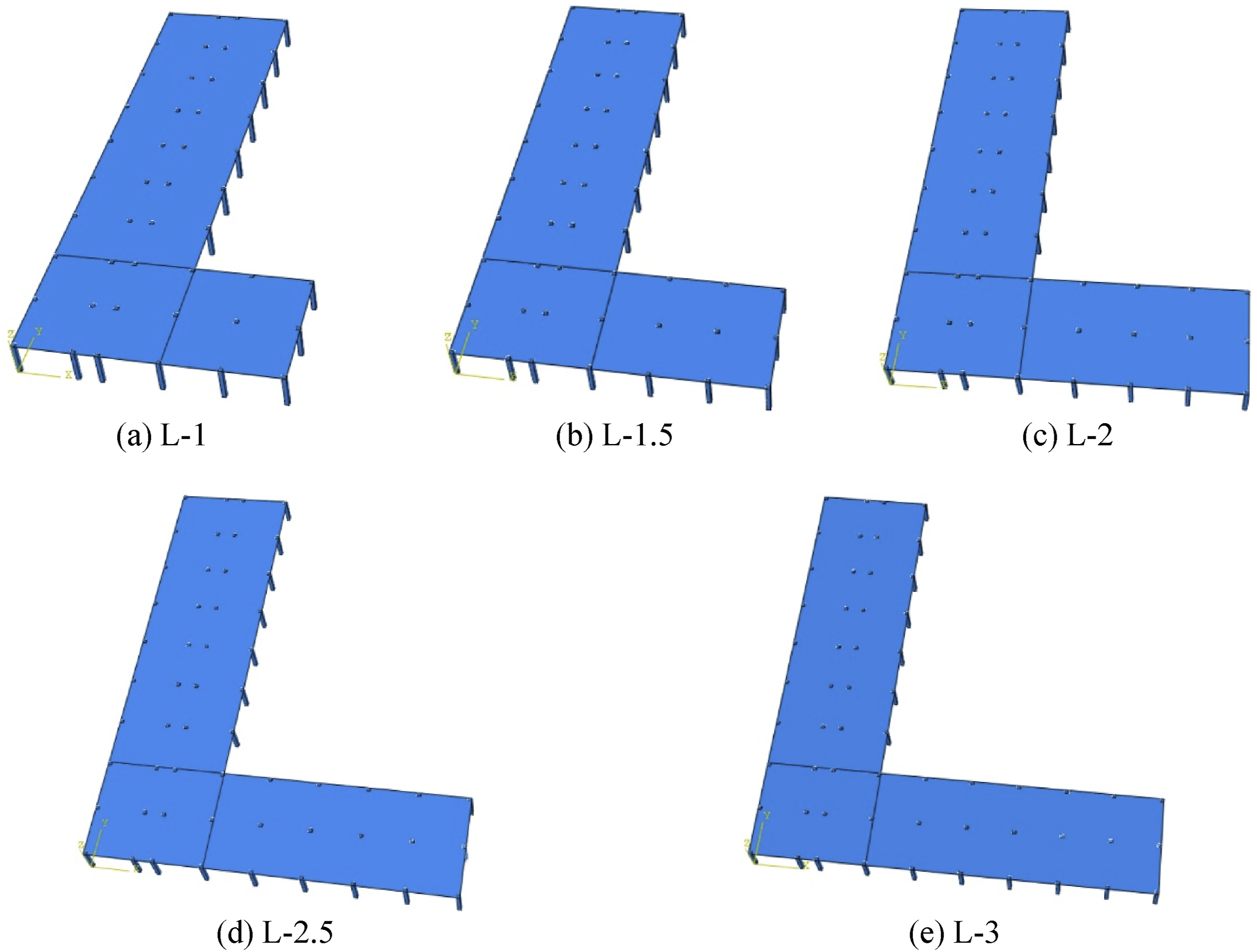
Results and discussion
Peak shear force of corner column
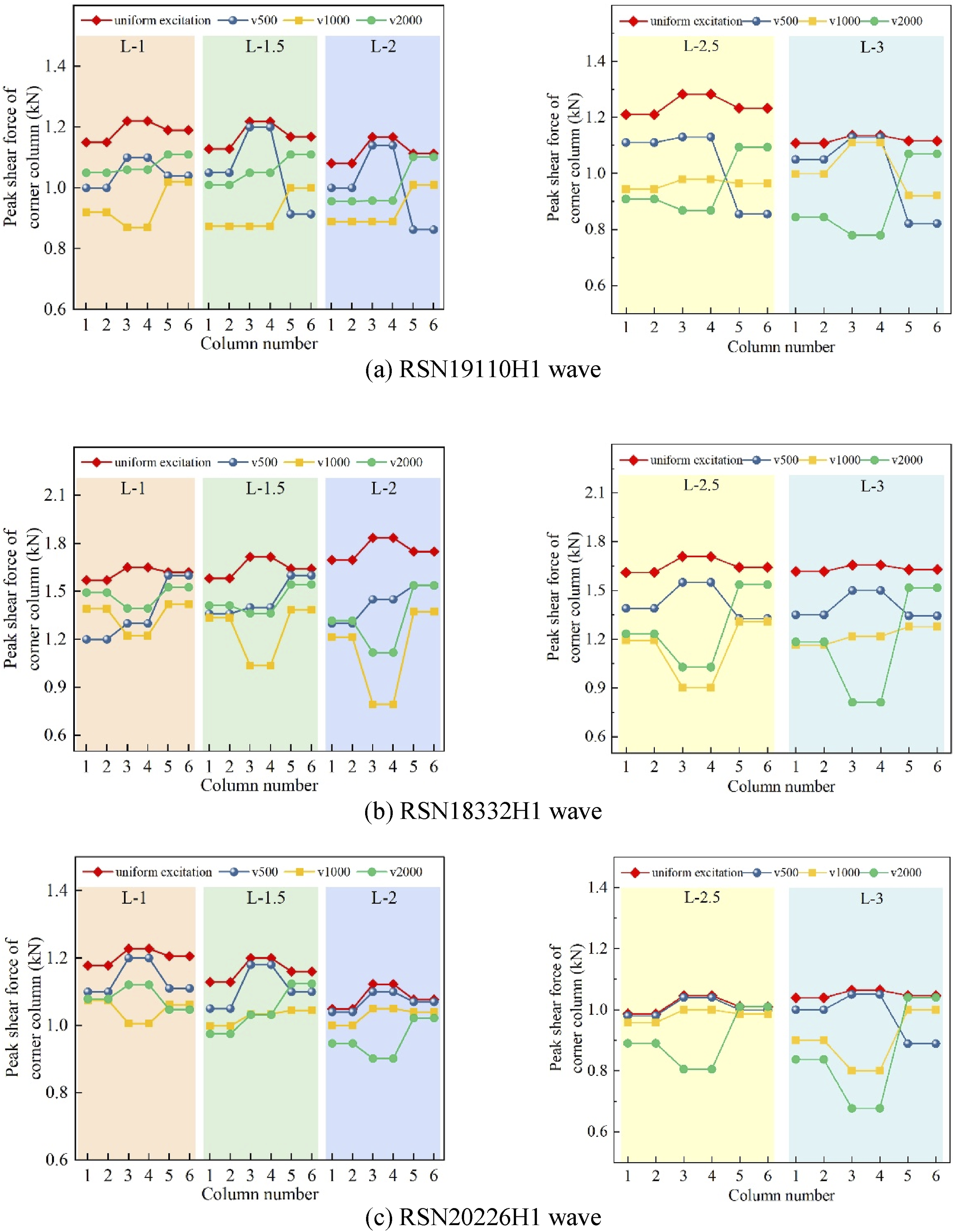
Figure 5 labels outer corner columns as Columns 1–2 (wave-facing), Columns 3–4 (last-arriving), and inner corner columns as Columns 5–6. Figures 6 and 7 show peak shear force variations at column tops under low-frequency-sufficient/insufficient excitations, analyzed at apparent wave velocities of 500 m/s, 1000 m/s, and 2000 m/s. Structure plane. (a) L-1, (b) L-1.5, (c) L-2, (d) L-2.5, and (e) L-3. Peak shear forces at the top of corner columns subjected to wave passage excitations with sufficient low-frequency content. (a) RSN1193H2 wave, (b) RSN1268H1 wave, and (c) RSN1302H1 wave. Peak shear forces at the top of corner columns subjected to wave passage excitations with insufficient low-frequency content. (a) RSN19110H1 wave, (b) RSN18332H1 wave, and (c) RSN20226H1 wave.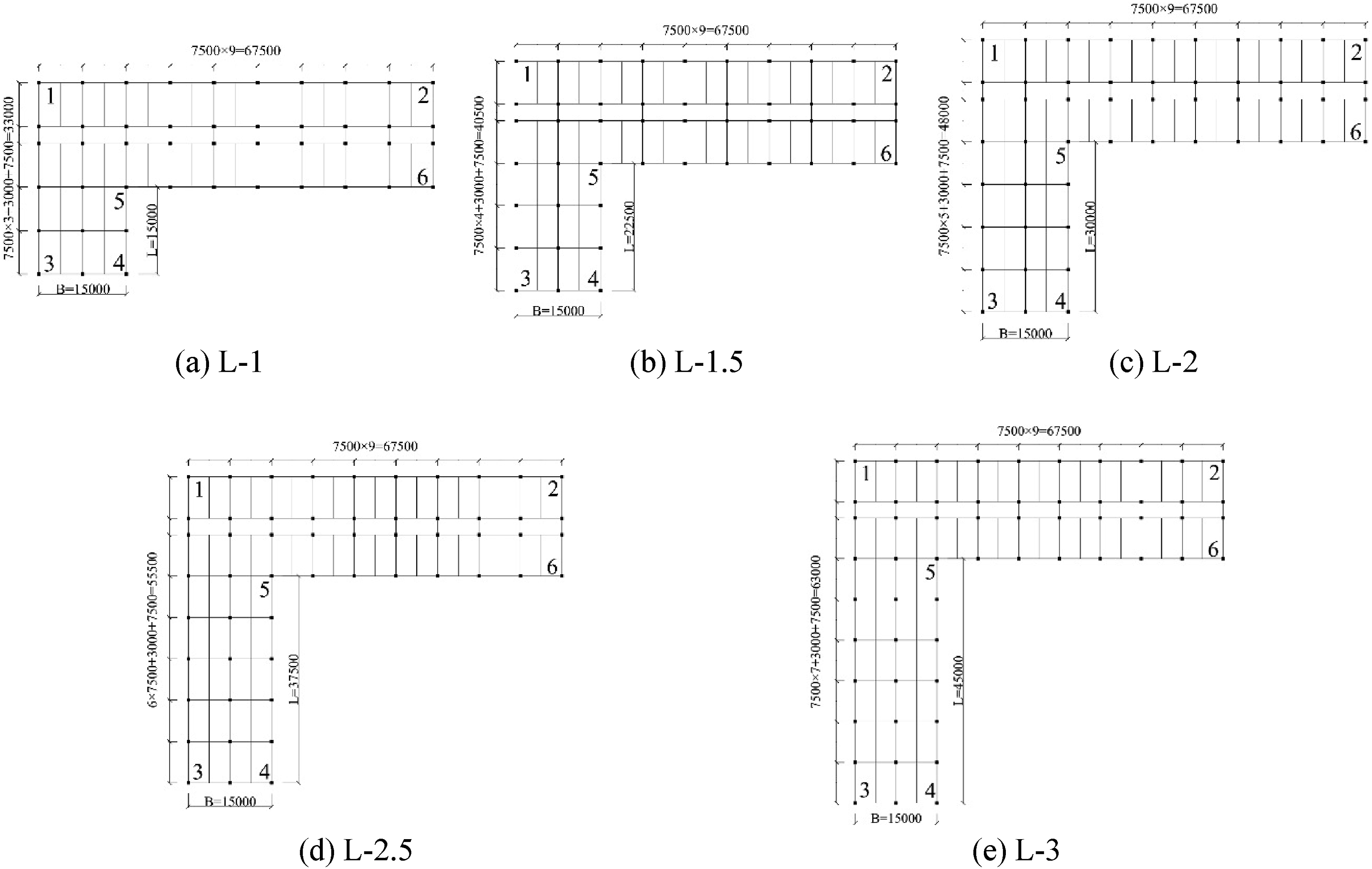
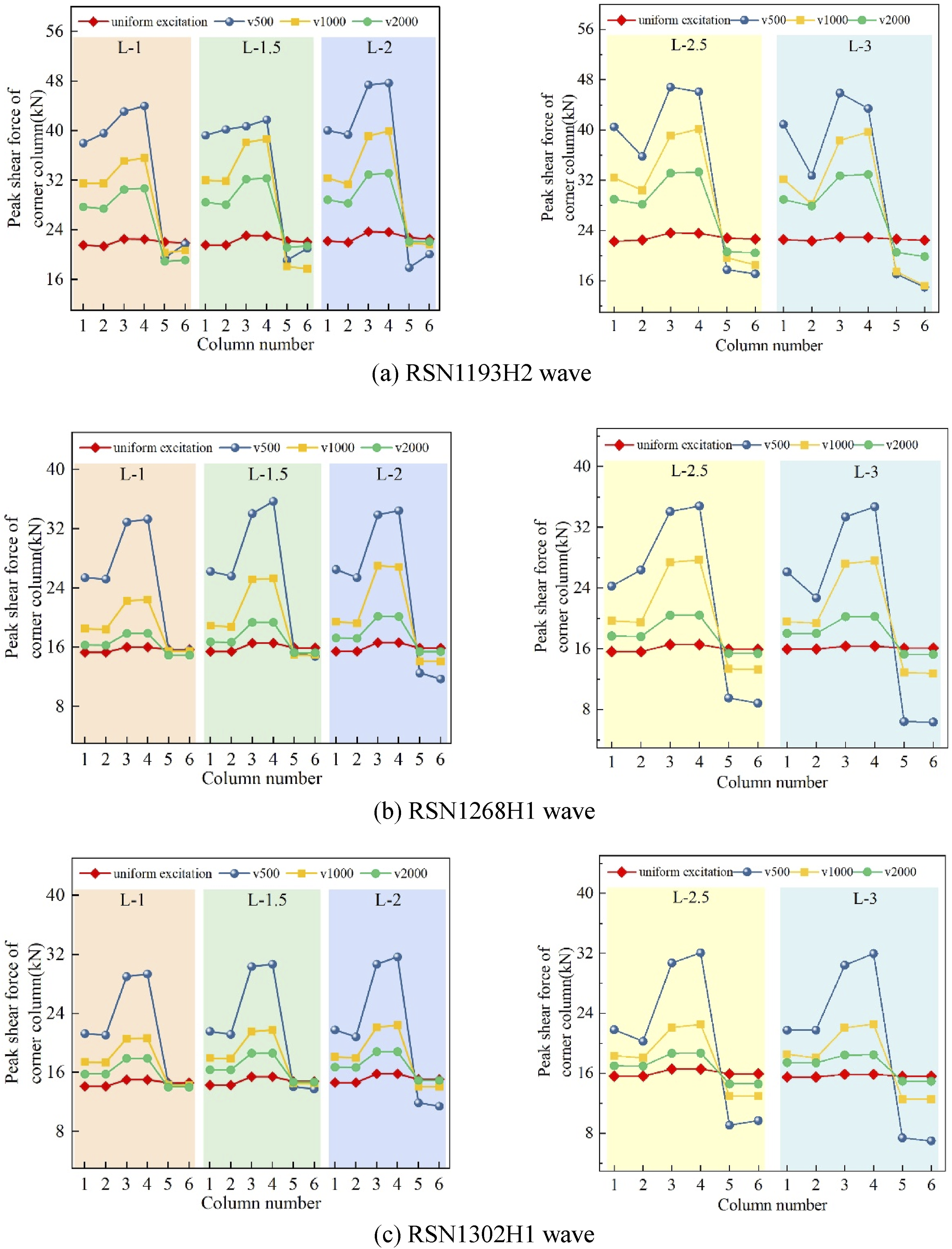
As illustrated in Figure 6, when seismic waves contain sufficient low-frequency content (their dominant frequencies are below the structural fundamental frequency in the excitation direction), peak shear forces in wave-facing outer corner columns (Columns 1 and 2) and last-arriving outer corner columns (Columns 3 and 4) of the L-shaped frame structure exceed those under uniform excitation. On the contrary, peak shear forces in inner corner columns (Columns 5 and 6) are lower than those under uniform excitation. This indicates that when seismic waves contain sufficient low-frequency content during frequent earthquakes, the wave passage effect occurs in the outer corner columns of L-shaped frame structures, while the inner corner columns remain unaffected. Notably, peak shear forces in the last-arriving outer corner columns (Columns 3 and 4) consistently exceed those in wave-facing outer corner columns (Columns 1 and 2) under earthquake wave passage excitation, demonstrating stronger wave passage effect in last-arriving outer corner columns. As apparent wave velocity increases, peak shear forces in outer corner columns gradually decrease, whereas those in inner corner columns increase progressively. This suggests wave passage effect on outer corner columns diminishes with higher wave velocities. In contrast, although experiencing increasing shear forces, inner corner columns remain immune to traveling wave-induced amplifications.
Taking the RSN1268H1 wave as a case study, it is observed that compared to uniform excitation, increasing the length-to-width ratio (L/B) under an apparent wave velocity of 500 m/s leads to shear force amplifications in wave-facing outer corner columns (Columns 1 and 2) increasing from 66% to 81.9%. For the last-arriving outer corner columns (Columns 3 and 4), amplifications increase from 108.2% to 110.1%. Concurrently, reductions in inner corner columns (Columns 5 and 6) rise significantly from 0.6% to 60%. At 1000 m/s apparent wave velocity, wave-facing columns amplify from 20.3% to 22.5%, while the last-arriving columns show increases from 39.1% to 68.8%. The reduction in the inner column also increases from 1.3% to 19.8%. At 2000 m/s, wave-facing column amplifications grow from 6.4% to 12.7%, while last-arriving columns increase from 11.75% to 24%. Conversely, reductions in the inner column show a slight decrease from 4.8% to 4.5%. These results demonstrate that wave passage effect on outer corner columns intensifies with increasing length-to-width ratios (L/B) ratios, with last-arriving columns consistently experiencing greater amplification than wave-facing columns across all wave velocities tested.
As illustrated in Figure 7, when earthquake waves lack sufficient low-frequency content, specifically when their predominant frequencies exceed the structural fundamental frequency in the excitation direction, the peak column shear forces in the excitation direction for both outer (Columns 1, 2, 3, and 4) and inter corner columns (Columns 5 and 6) of the L-shaped frame structures are lower than those under uniform excitations. This result indicates that during frequent earthquakes, characterized by inadequate low-frequency content, neither outer nor inter corner columns of the L-shaped frame structures exhibit significant wave passage effect. Additionally, no systematic trends were observed in the influence of the wave passage effect on corner columns as the (L/B) ratios or apparent wave velocities increased.
Peak bending moment of the corner column
Figures 8 and 9 show the changes in the peak bending moment at the top of the corner column under seismic waves of different low-frequency content. Peak bending moment at the top of corner columns subjected to wave passage excitations with sufficient low-frequency content. (a) RSN1193H2 wave, (b) RSN1268H1 wave, and (c) RSN1302H1 wave. Peak bending moment at the top of corner columns subjected to wave passage excitations with insufficient low-frequency content. (a) RSN19110H1 wave, (b) RSN18332H1 wave, and (c) RSN20226H1 wave.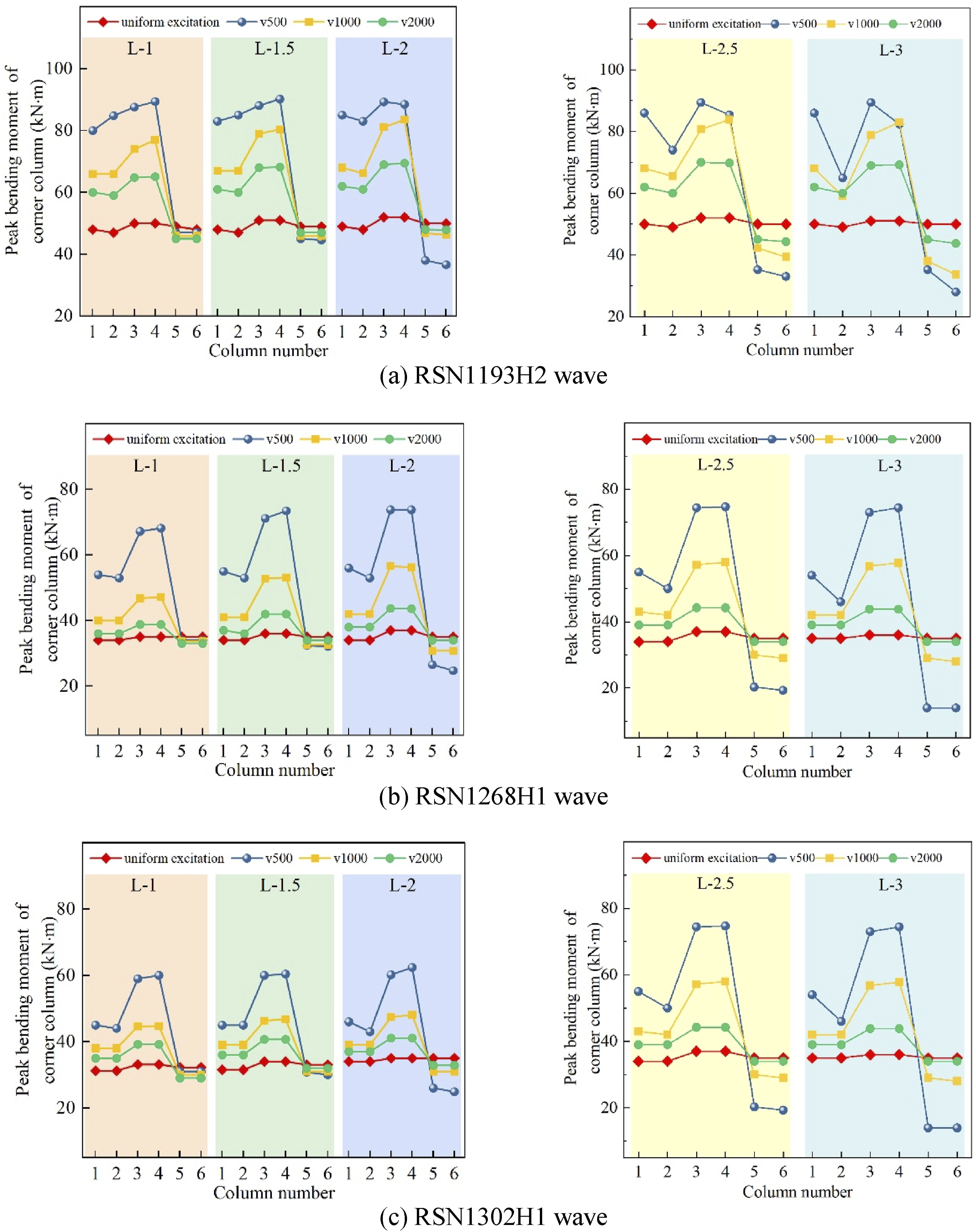
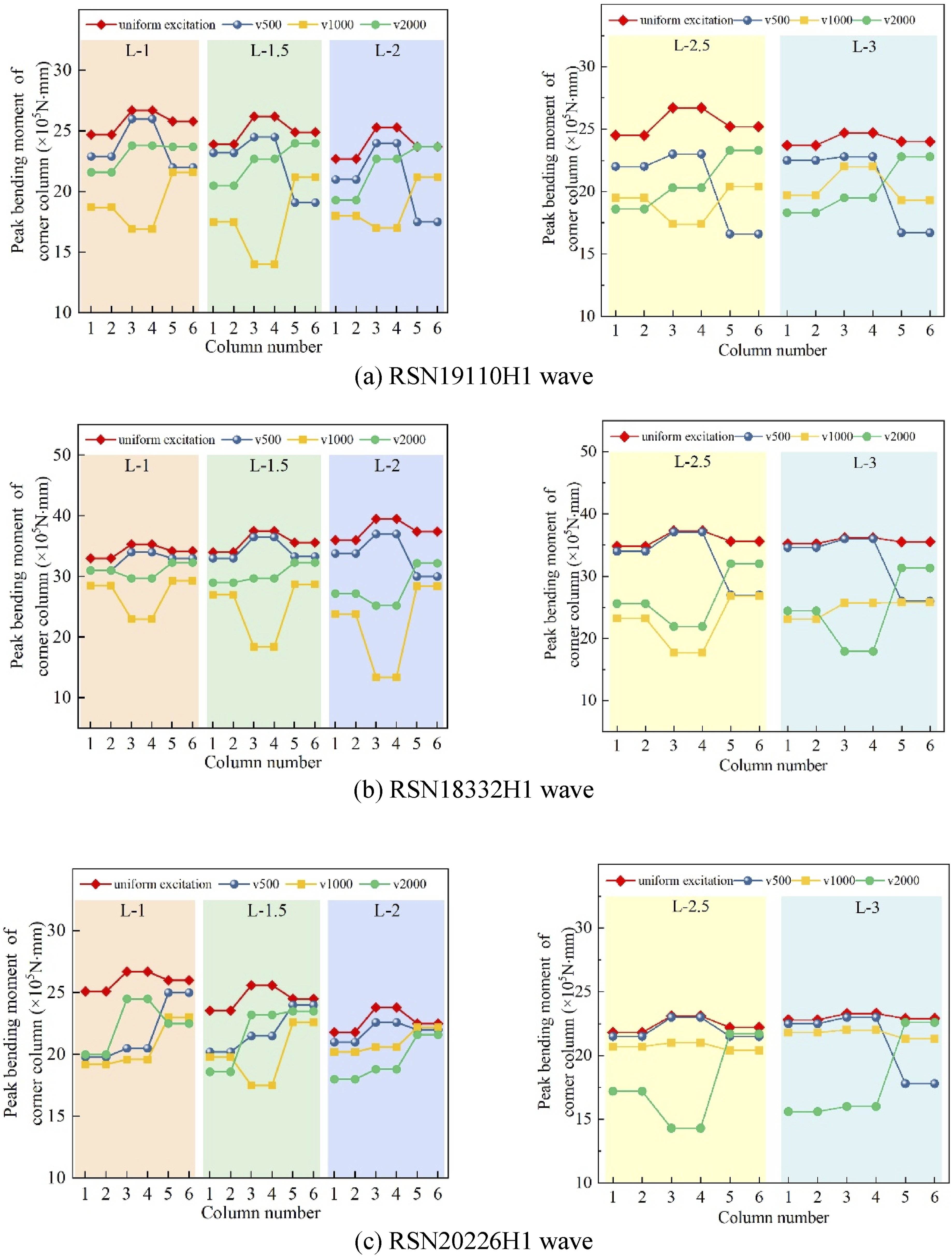
As illustrated in Figure 8, when seismic waves contain sufficient low-frequency content, indicating their dominant frequencies fall below the structural fundamental frequency in the excitation direction, the peak bending moments in wave-facing outer corner columns (Columns 1 and 2). Furthermore, the last-arriving outer corner columns (Columns 3 and 4) of the L-shaped frame structure exceed those under uniform excitation. In contrast, peak bending moments in inner corner columns (Columns 5 and 6) are lower than those under uniform excitation. This further confirms that when seismic waves contain sufficient low-frequency content under frequent earthquakes, the wave passage effect occurs in outer corner columns of L-shaped frames, while inner corner columns remain unaffected.
Notably, peak bending moments in last-arriving outer corner columns (Columns 3 and 4) consistently surpass those in wave-facing outer corner columns (Columns 1 and 2), indicating stronger wave passage effects in last-arriving columns. As apparent wave velocity increases, peak bending moments in outer corner columns gradually decrease, whereas those in inner corner columns increase progressively. This suggests that wave passage effects on outer corner columns diminish with higher wave velocities. In contrast, although the inner corner columns experience increasing bending moments, their values remain lower than those observed under uniform excitation.
As illustrated in Figure 9, when seismic waves contain lack sufficient low-frequency content (their dominant frequencies exceed the structural fundamental frequency in the excitation direction), peak bending moments in both outer corner columns (Columns 1, 2, 3, and 4) and inner corner columns (Columns 5 and 6) of the L-shaped frame structure are lower than those experienced under uniform excitation. This result indicates that when seismic waves contain insufficient low-frequency content under frequent earthquakes, neither the outer nor inner corner columns of L-shaped frames exhibit significant wave passage effect. Furthermore, the wave passage effect on corner columns demonstrates no systematic trends with increasing length-to-width ratios (L/B) or apparent wave velocity.
Conclusion
This study conducted linear time-history analyses on five planar irregular L-shaped reinforced concrete frame structures under frequent earthquakes. Five typical L-shaped frame models with length-to-width ratios (L/B) of the projecting limbs—1:1, 1.5:1, 2:1, 2.5:1, and 3:1—were developed according to Chinese seismic design codes. These L-shaped frames were modeled using ABAQUS finite element software, with solid elements for columns, truss elements for reinforcing steel, and shell elements for floor slabs. Total masses of floor slabs and their reinforcing steel and beams and reinforcing steel were assigned to floor slab centroids, with the same method applied to rotational inertia. The torsional responses of five L-shaped structures were analyzed under two types of earthquake wave passage excitations with varying low-frequency content: sufficient and insufficient were calculated. Peak shear forces and bending moments at the tops of corner columns in the excitation direction were adopted as indices to evaluate structural torsional responses. By comparing results with uniform excitation, this research highlights the necessity of considering low-frequency-sufficient seismic waves in the design of planar irregular L-shaped frame structures. (1) In the case of frequent earthquakes, when seismic waves contain sufficient low-frequency content, the wave-facing outer corner columns (Columns 1 and 2) and the last-arriving outer corner columns (Columns 3 and 4) of the L-shaped frame structure exhibit significant wave passage effect. Conversely, the inner corner columns (Columns 5 and 6) are less likely to experience this effect. When the apparent wave velocity is 2000 m/s, when the length-to-width ratio (L/B) is equal to 3, the peak column shear force and peak bending moment in the wave-facing outer corner columns can rise by 28.3% and 24%, respectively. Furthermore, the increases in the peak shear force and the peak bending moment of the last-arriving outer corner columns can reach 43.8% and 35.7%, respectively. (2) Under frequent earthquakes, as the length-to-width ratio (L/B) of the projecting limb increases, the wave passage effect on the last-arriving corner columns of the L-shaped frame structure becomes more significant when seismic waves contain sufficient low-frequency content. Specifically, wave passage effects influence last-arriving outer corner columns more than wave-facing outer corner columns. (3) Under frequent earthquakes, when the earthquake waves lack sufficient low-frequency content, all corner columns of the L-shaped frame structure are less likely to experience wave passage effect.
Footnotes
Acknowledgments

Ethical approval
This article does not contain any studies with human participants performed by any of the authors.
Informed consent
This article does not contain any studies with human participants performed by any of the authors.
Author contributions
Fan Yang: Conceptualization, methodology, software, data curation, writing—original draft preparation, visualization, investigation, and writing—reviewing and editing; Tielin Liu: Supervision, validation, and writing—reviewing and editing. All authors read and approved the final manuscript.
Funding
The authors received no financial support for the research, authorship, and/or publication of this article.
Declaration of conflicting interests
The authors declared no potential conflicts of interest with respect to the research, authorship, and/or publication of this article.
Data Availability Statement
The data that support the findings of this study are available from the corresponding author (Fan Yang) upon reasonable request.