




Abstract
The value co-creation is the true success of PPP projects. However, the traditional static governance based on project performance cannot cope with the lengthy process of value co-creation in PPP projects; as a result, the strategic asset of partnership has not been fully developed and utilized. This article takes the partnership in PPP projects as the starting point, defines the new connotation of the multi-value of PPP projects, introduces the trust parameter and establishes a contract incentive model based on the game theory which is a two-dimensional integration of contract and trust, and comprehensively analyzes the impact of the optimal incentive coefficient, optimal effort level, and trust level on the creation of cooperation value and overall project benefits by both parties through the establishment of a dual incentive game model of contract and trust. It provides path selection for promoting effective cooperation between the government department and social capitals to co-create project value.
Introduction
The introduction of PPP model realizes the complementary advantages of the government department and social capitals in resources, capabilities, and experience. 1 Through the deep participation of the social capitals, the project value can be created collaboratively, which can play an important role in promoting economic growth and sustainable development. However, in China, which has experienced a boom in PPP projects, the true state of value co-creation is not optimistic: state-owned enterprises’ economic under, operational failure, and failure to achieve value for money have led to the failure of many PPP projects; And the large investment scale and long operating cycle of PPP projects pose significant challenges to the value creation of PPP projects. Factors such as restrictions on the disclosure of commercial information by social capital investors, internal tension in government policies and information transparency systems, and heterogeneity of goals between partners can lead to conflicts, risks, and unreasonable allocation of resources and rights, resulting in fragile relationships and value losses among project partners. Therefore, how to motivate the government department and social capitals to jointly create project value is currently an urgent problem to be solved.
Although the concept of value co-creation has not been explicitly proposed in the research of PPP projects, it is unanimously recognized that the value of PPP projects is jointly created by all participants, 2 and the value creation of PPP projects must be stimulated and promoted through incentive mechanisms. 7 Therefore, the existing literature research mainly focuses on two aspects: (1) value creation or value appreciation. Li X and Li L believe that the ways to measure PPP value creation include ensuring quality standards, providing the lowest priced products or services to the public, and minimizing risks and losses in the service production process.3,4 Erk believes that the way PPP creates value is for both public and private parties to manage, control, and operate projects with value as the center, 5 Zhang constructs a value-added Stackelberg game model based on transaction cost theory and verified that early intervention of financial institutions in PPP projects can enhance the value-added level of the projects. 6 However, the value creation of existing PPP projects mostly focuses on PPP projects, and there is little research specifically on PPP project partnerships. (2) The incentive mechanism of PPP projects. Wei identifies opportunistic behavior among participants and eliminated information asymmetry between public and private parties through negotiation games, thereby incentivizing both parties to contribute to creating project value. 8 Wang Y believes that the government's commitment to ensuring minimum returns can incentivize the social capital with a preference for reciprocity.9,10 Li H believe that the government can use reputation mechanisms as indirect incentives. 11 Wang designed a contract menu with a fixed payment and performance sharing ratio for the government to incentivize the social capital. 12 Zhang designed a flexible incentive and constraint mechanism, and analyzed the behavioral evolution trend of the government and other project stakeholders under this incentive mechanism.13–15 However, most of the incentive mechanism designs for PPP projects have adopted contract incentives and reputation incentives, without considering the perspective of maintaining long-term stable partnerships.
Based on the above analysis, this article believes that the premise of value co-creation in PPP projects is a lasting and stable partnership. 16 Therefore, this article will focus on the partnership in PPP projects, first explore the connotation of the government department and social capitals co-creating multi-value; Then, with the goal of value co-creation, a dual incentive model of contract and trust is constructed to explore the incentive effect of incentive mechanisms on value creation, in order to provide new ideas for the realization of value co-creation in PPP projects.
The connotation of the multi-value in PPP projects
The PPP projects involve multiple participating parties, each with different value demands, and the value demands have expanded from simple profit demands to the realization of multi-values. Firstly, the PPP model can improve the efficiency of engineering construction, not only providing significant profits for all parties involved, but also driving the rapid development of industries such as building materials and equipment, equipment manufacturing, and surrounding service industries, promoting regional economic development. Secondly, the PPP projects focuses on the social impact throughout the entire lifecycle, and need to properly address issues such as demolition and resettlement, reemployment, and ecological environment impact to provide social value. Thirdly, the PPP mode makes the participating parties more diverse and the relationships between them more complex, requiring breakthroughs in project value through resource integration and communication coordination. Therefore, the participating parties in PPP projects have the multi-value demand of economy, society, and cooperation.
The partnership in PPP projects is obviously not a one-time transaction relationship, but a long-term cooperation; And the trust is the core of effective cooperation among parties in an incomplete contract environment, and it is the driving force for participating parties to work together to create value. Therefore, the creation of collaborative value between the government departments and the social capital cannot be separated from two major factors: partnership and trust. The value of cooperation is defined as the product of the value of the partnership and the level of trust between the public and private. If either of these factors is zero, the PPP project will be declared a failure.
The incentive mechanism design for the multi-value co-creation in PPP projects
The incentive mechanism for the multi-value co-creation in PPP projects is the dual incentive mechanism that includes the contract incentives driven by interests and the trust incentives based on conceptual recognition.
Contract incentives
A contract, also known as a formal agreement, is a formal agreement established based on legal constraints. The contracts signed between government departments and social capital parties specify the incentive content of benefit distribution and reward and punishment constraint mechanisms.
Trust incentives
Under the theory of incomplete contracts, the long-term nature of the PPP model and the uncertainty of the external environment make it impossible for contract terms to cover all matters throughout the entire lifecycle. Trust incentives can have a positive effect on contract incentives, that is, whether the contract can be truly fulfilled must be based on trust in the other party's ability and willingness to fulfill the agreement. Generally speaking, if cooperative actions can transcend the constraints of interests and institutions, and achieve psychological trust in the other party, the partnership will be more stable and long-lasting.
The dual incentive model for the multi-value co-creation in PPP projects
Problem description and model assumptions
The previous incentive models for PPP projects has mostly solved for the optimal contract incentive coefficient through game models, without considering trust factors. Therefore, the question that needs to be addressed in this chapter is how trust affects the cooperative behavior of social capital parties, and how contract incentives and trust incentives can jointly promote the realization of the multi-values in PPP projects.
In view of this, the Stackelberg game model is constructed by making the following assumptions: Assumption 1: In the incentive model, both the government and social capital are rational and seek the optimal strategy with the goal of maximizing their own interests. Assumption 2: Assumption 3: Assumption 4: The multi-value of PPP projects include not only economic income, social benefits and cooperative value, but also option value, environmental benefits and public satisfaction. For the convenience of model establishment, only the first three are included in the multi-value. Let

Among them, Assumption 5: The effort cost function of the government department is Assumption 6: The income of social capital parties comes from multiple aspects. In order to reflect the impact of contract and trust on their income, this model assumes that the income comes from two aspects: one is the reward of contract incentives, which refers to the form of income agreed upon by government departments in contracts based on the economic income and social benefits produced by the social capitals’ efforts, which is mandatory. The second is the cooperative value obtained, which exists in the relationship contract and is a commitment that cannot be confirmed and executed by the third party.

In the formula, Assumption 7: Assuming the government department is risk neutral, the social capitals are risk averse and have the utility function of invariant absolute risk avoidance, that is
Based on the above assumptions, the revenue of the government department comes from two aspects: one is the residual income of the project, and the other is the cooperation value. The expected utility and actual benefits of the government department are equivalent:

The actual income of the social capital is

So R
s
which represents the deterministic equivalent return of the social capitals is equal to the actual income minus the risk cost:

Model establishment and solution
Under the incentive contract, the government department engages in a single cycle game with the social capitals. Firstly, the government department designs the contract incentive coefficients (
The social capitals’ choice of the value co-creation behavior
According to the reverse solution of the two-stage game theory, assuming that the contract reward is given, the optimal level of work effort (

The level of effort made by the social capitals to achieve economic income and social benefits depends on the contract incentive coefficient (
The government department’s choice of the value co-creation behavior
The government department chooses its level of effort (



In the optimization problem P1, the equation (7) is the objective function for maximizing the government department revenue, the equation (8) is the incentive compatibility constraint (IC) for the social capitals, and the equation (9) is the participation constraint (IR) for the social capitals. The
In the optimal case, the government department do not need to pay more on the basis of ensuring the participation of social capital in constraints, that is, the participation constraint equation (9) is equal, so:

By substituting equation (10) into equation (7), the expected utility function of the government department is obtained, that is


By substituting equation (12) into the objective function (11), there is
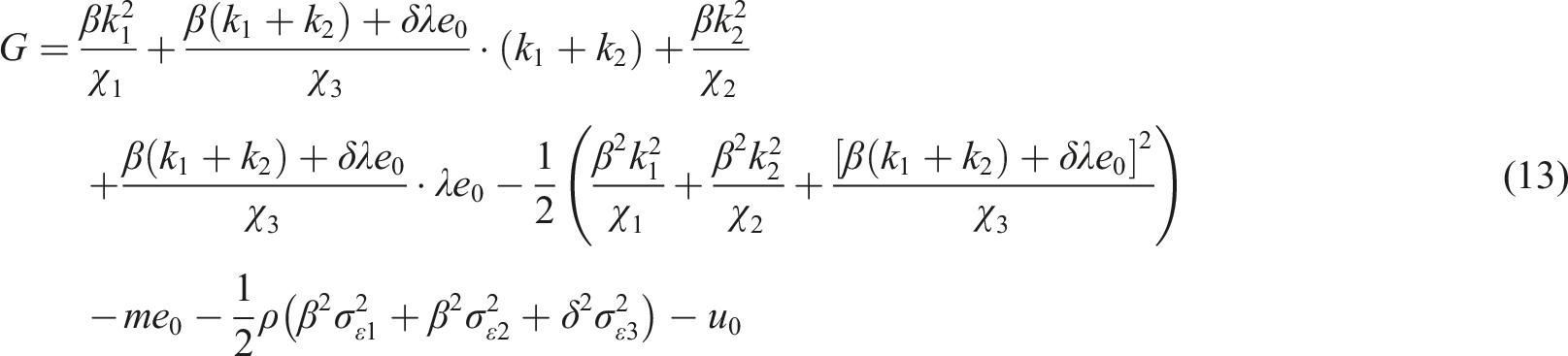
Because
When
When
Substituting (1) (2) (3) The government department’s choice of the optimal contract incentive coefficient
In the first stage, the government department needs to set the contract incentive coefficient to maximize the expected returns of social capital (

Substituting equation (14) into equation (13), we obtain that


Therefore, from the change rate of the effort cost coefficient of the government department, the government department can decide whether to make efforts to realize the cooperation value. (1) When (2) When


In summary, when
When
The above two situations of equilibrium in the game between the two parties indicate that when government departments are more willing to make efforts in advance to achieve cooperative value and enhance the level of trust between the two parties, it will further increase the level of effort of the social capitals to achieve cooperative value and the higher contract incentive coefficient formulated by the government department. The realization of cooperative value means the co-creation of the multi-value in PPP projects.
The analysis of incentive effects of the multi-value co-creation
The influence effect of optimal contract incentive coefficient
(1) Due to (2) When (3) From the optimization problem P2, it can be seen that the greater the overall revenue of the project, the greater revenue for the government department. The optimal incentive coefficient selected by government departments can guide the behavior of both parties to achieve higher overall project benefits. (4) If the effort level of the social capitals that maximizes the overall expected return of the project is
The impact effect of the optimal effort level
Due to
The impact effect of trust level
Due to
The interaction effect between contract incentives and trust incentives
(1) Due to
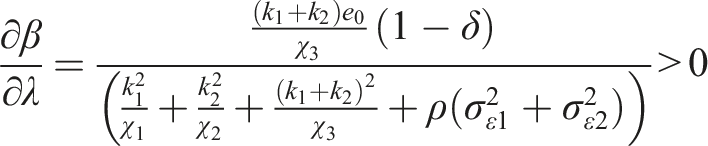

This indicates that the effort level made by the government department to achieve cooperative value can regulate the positive correlation between trust level and optimal contract incentive coefficient. The harder they work, the more they can promote the direct complementary effect between the two. (2) By taking he second-order partial derivative of the overall expected return of the project on the contract incentive coefficient and trust level, we can obtain
Conclusion
Based on the trust factor that can strengthen the sense of belonging and cohesion of public-private partnerships, the new connotation of the multi-value including economy, society and cooperation in PPP projects is constructed. And by introducing the parameters of trust level of the government department and the social capitals, the dual incentive model for PPP project contracts and trust is constructed by using the game theory. It analyzes the impact path of the optimal contract incentive coefficient, optimal effort level, and public-private trust level on the co-creation of the multi-value, as well as the boundary conditions for the interaction effect between contract incentives and trust incentives. These provide a new path stimulating the initiative and creativity of the government and the social capitals, and promoting them to take joint action in the co-creation of multi-value of the project, so that the cooperation can be long-term and stable.
Moreover, we apply the model to the actual case of the PPP construction project of Beiluoxiao National Forest Park in Hunan, which verifies effectiveness of the model conclusion.
Footnotes

Funding
The authors disclosed receipt of the following financial support for the research, authorship, and/or publication of this article: This paper was supported by 2022 Hunan Provincial Department of Education Science Research Youth Project (Grant No.: 22B0998).
Declaration of conflicting interests
The authors declared no potential conflicts of interest with respect to the research, authorship, and/or publication of this article.