




Abstract
Scientific physical training management is vital to improve the police’s practical literacy and law enforcement capabilities, and it is also crucial in making the police force move towards formalization and professionalism. Good physical fitness is an essential foundation for the police to perform tasks and an important way to improve and apply police techniques and tactics. As the management of police physical training is a complex process, it is a qualitative concept with “fuzziness,” and it is impossible to accurately and ideally describe its content quantitatively only by classical and random mathematics. To carry out scientific quantitative analysis and objective evaluation of its advantages and disadvantages and to promote the development of police physical training and comprehensively improve the level of police physical fitness. This paper studies the application effect of four kinds of Fuzzy (Fuzzy mathematics) calculation methods in the management evaluation of police physical training by combining the fuzzy formula method with a questionnaire survey. The study results show that using four Fuzzy (fuzzy mathematics) scoring methods can determine the quality level of any police physical training management and rank the comprehensive scores from high too low to distinguish the ranking order clearly. The four Fuzzy (fuzzy mathematics) scoring methods are both scientific and reasonable: (reliability), and is simple and easy to implement (validity). Especially in sports research, quantitative evaluation of people or things in a “fuzzy state” is worthy of praise for development and application. Finally, we concluded that the four Fuzzy (fuzzy mathematics) calculation methods have good feasibility and operability.
Introduction
The physical fitness level of police officers is closely related to the quality of daily police work. 1 Physical fitness, also known as physical fitness, refers to the ability to complete daily activities without excessive fatigue and to have enough energy to engage in leisure activities. It can be expressed as aerobic and anaerobic capacity, strength, speed, endurance, coordination, flexibility, agility, and other athletic qualities. 2 From the perspective of the professional characteristics of the police, police physical fitness is the physical ability of the human body to maximize the functions of various organs and systems of the body during work, training, and law enforcement, resist physical and mental fatigue, and complete work tasks with high efficiency and high-quality. 3 Although most of the police’s work time is spent in low-intensity physical activities (household registration, checking personal identity), it will also involve critical tasks with high intensity of physical exertion, such as crowd control, extreme criminal incidents (armed robberies and terrorist attacks), large-scale demonstrations, and natural disasters.4–6 These events usually occur urgently and cause tremendous pressure on the relevant personnel or even endanger their lives. 7 In addition, police work with high intensity of physical exertion not only occurs in hazardous incidents but also occurs in daily work, such as running short and long distances, jumping and avoiding obstacles, climbing stairs and fences, balance control, pushing and pulling, dragging and lifting objects and people, and using hands and feet for self-defense. 8 In addition, police officers are required to wear mandatory personal protective equipment (bulletproof vests, long and short weapons) during the execution of their duties to reduce the risk of injury and death when encountering danger. This personal protective equipment adds significant weight-bearing demands and causes negative effects to reduce peak physiological responses to maximum oxygen consumption and heart rate when performing tasks (dragging victims, carrying heavy objects, controlling aggressive suspects, etc.). Also, it harms the completion level, emphasizing the importance of high physical fitness levels.9–11 In specific critical tasks, athletic qualities such as strength, speed, endurance, coordination, flexibility, and agility are the key factors in determining the outcome of an encounter between police and criminals or successfully assisting others in an emergency. Suppose the police do not have sufficient physical strength but cannot perform tasks well. In that case, they will put the police themselves or the public in a dangerous position, suggesting that physical fitness is directly related to the safety of the police and their ability to handle emergencies. A high level of physical fitness not only ensures that the police can perform their tasks well but also plays a vital role in protecting their own safety.
Therefore, the research on police physical training, especially the evaluation of police physical training, is fundamental. Because the review of police physical training involves a wide range of people and things and is very complex and changeable, especially the psychological activities, knowledge, and ability, will quality, discernment ability, prediction, and decision-making level of the police, instructors, leaders, and scientific researchers, etc. It is impossible to accurately and quantitatively describe the evaluation and identification of people or things by classical and random mathematics alone. We must also rely on the Fuzzy (fuzzy mathematics) method to evaluate the relevant factors of these people or something in a “fuzzy state.” Processing so that it can obtain correct analysis conclusions and ideal evaluation and judgment effects, and then guide the smooth progress of police physical training research work.
Fuzzy (fuzzy mathematics) evaluation method
Fuzzy (fuzzy mathematics) is an applied mathematical method that studies and processes people or things in a fuzzy state (phenomenon) and assigns it to a particular scientific quantification process. It is a comprehensive evaluation method used to design fuzzy factor systems. A method of a thorough evaluation for situations where the concepts and boundaries of certain things are difficult to quantify, or the status is unclear. 12 Its founder is an American cybernetics expert, Professor Zaden (Chad) of the University of California, who first proposed it in the 1960s and laid a solid theoretical foundation for “fuzzy mathematics.” It has developed dramatically in the past half-century and has become an effective method for analyzing and studying various “fuzzy phenomena” in human society. Fuzzy comprehensive evaluation decision-making can effectively handle things affected by multiple factors, and can comprehensively consider the weights of various factors for comprehensive evaluation. With the development of society and technology, the description of such fuzzy concepts needs to be quantified or data-driven, which requires a new tool that can handle fuzzy concepts. Fuzzy mathematics is a good tool. 13 In recent years, fruitful results have been achieved in its introduction and application in sports scientific research, and its further development prospects are also up and coming.
The general steps of the fuzzy comprehensive evaluation method are determining the evaluated object’s set of factors (indicators). Secondly, determine each element’s weight and membership vector, obtain the fuzzy evaluation matrix, and finally combine the fuzzy evaluation matrix with the factors. The weight set is subjected to fuzzy operation and unified, and finally, an evaluation result is obtained. 14 Things in real life are ever-changing, and there are too many uncertain factors. Therefore, there are a large number of decisions that are not quantitative but qualitative, multi-level, multi-objective and have no apparent structure.
Moreover, the relationships in the system are intricate and complicated, and the boundaries are not allowed to be determined. Fuzzy cannot be accurately assigned. For example, we cannot determine the quality of a student’s health status with a numerical value. Given this, we can use sorting and corresponding fuzzy evaluation to deal with the related problems with the help of computers so that the relationship between sub-elements and variables becomes Clear, which means that fuzzy decision-making can be made clear and coherent using the fuzzy evaluation method.
Four fuzzy (fuzzy mathematics) calculation methods
Today, there are four Fuzzy (fuzzy mathematics) calculation methods commonly used internationally and domestically: M (∧·∨)—take the small first, then the large calculation method (referred to as the I method); M (∨)—multiply first, then take large calculation method (referred to as II method); M (∧+)—calculation method of taking the small number first and then adding it (referred to as III method); M (+)—Multiplication first, then addition calculation method (referred to as IV method).
These four different Fuzzy (fuzzy mathematics) calculation methods fall into two categories: A: “main factor prominent type” and B: “weighted average type.” Among them, M (∧·∨)-(Method I); M (∨)-(Method II); M (∧·+)-(Method III) both belong to category A; M (+)-(Method IV) Belongs to category B.
Application examples and analysis of four evaluation calculation methods of fuzzy (fuzzy mathematics)
Example: Chinese police physical training management uses the Fuzzy method to conduct comprehensive quality evaluation exploration.
Problem-solving instructions
With the continuous in-depth research of scientific researchers, the scientific level of police physical training has gradually improved. However, most public security colleges in China still need more physical training courses and single training methods and means, resulting in inconsistent training processes. System problems. This will inevitably lead to the inability to effectively improve the physical fitness level of the police and affect the training results. Under the new situation of continuous deepening reform of new sports management technologies, the development of police physical training management level faces new opportunities and new challenges. The world’s police physical training has entered the stage of scientific evaluation. 15 To integrate more quickly with international standards and better summarize and improve excellent police physical training management experience, it is indispensable to conduct a scientific and quantitative comprehensive evaluation of enhancing the level of police physical training management to reduce the shortcomings of qualitative assessment based on experience alone for a long time, thereby sublimating it to the height of accurate scientific quantitative evaluation to summarize and improve, innovating and constantly developing.
Basic principles of comprehensive evaluation
From the theory of scientific quantitative evaluation, we know that evaluation is the definition of the value of the research object (person or thing). Comprehensive scoring is an essential means that can comprehensively, objectively, and quantitatively reflect the accurate picture of the evaluation object. The basic principles it should follow are: 1 The evaluation must truthfully reflect the objective facts, accurately measure and clearly distinguish the fundamental differences between the objects being evaluated, and eliminate the phenomenon of high and low scores. 2 The evaluation should make the number of scores correspond to the performance quality (efficiency). The range of points given should be consistent with the level’s difficulty. That is to say, the greater the problem and the more complex the work, the higher the score, and vice versa. 3 The comprehensive scoring method should be scientific, reasonable, simple, and easy to implement. Pilot colleges and universities can apply it at all levels and types that run high-level sports teams.
Calculation and analysis of four methods of fuzzy (fuzzy mathematics)
Because the quality evaluation of police physical training management is a typical subject with a “fuzzy nature,” it is better to use the “fuzzy mathematics” method to examine and quantify it.
Comprehensive evaluation form of police physical training management quality.
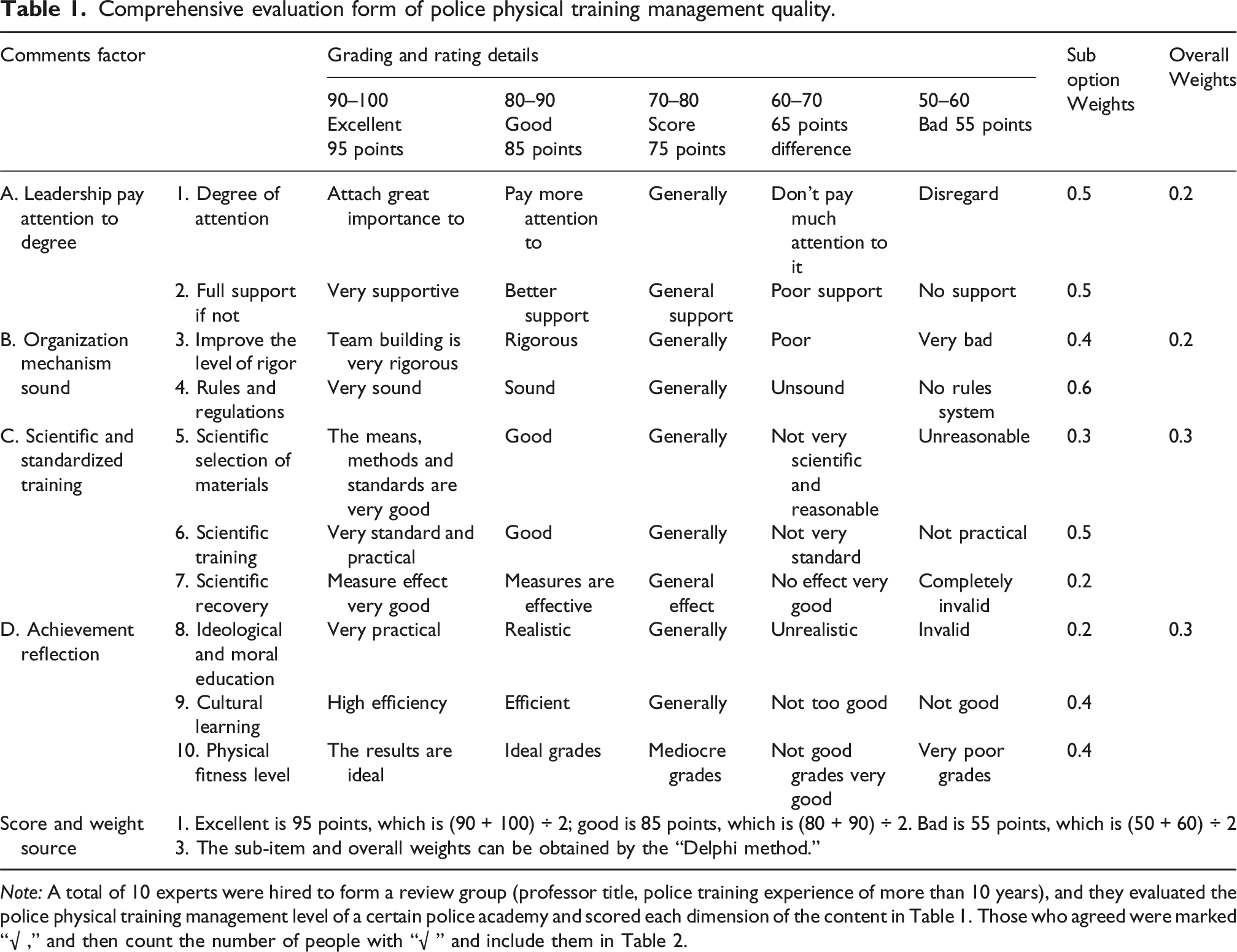
Note: A total of 10 experts were hired to form a review group (professor title, police training experience of more than 10 years), and they evaluated the police physical training management level of a certain police academy and scored each dimension of the content in Table 1. Those who agreed were marked “√ ,” and then count the number of people with “√ ” and include them in Table 2.
Fuzzy comprehensive score calculation table.
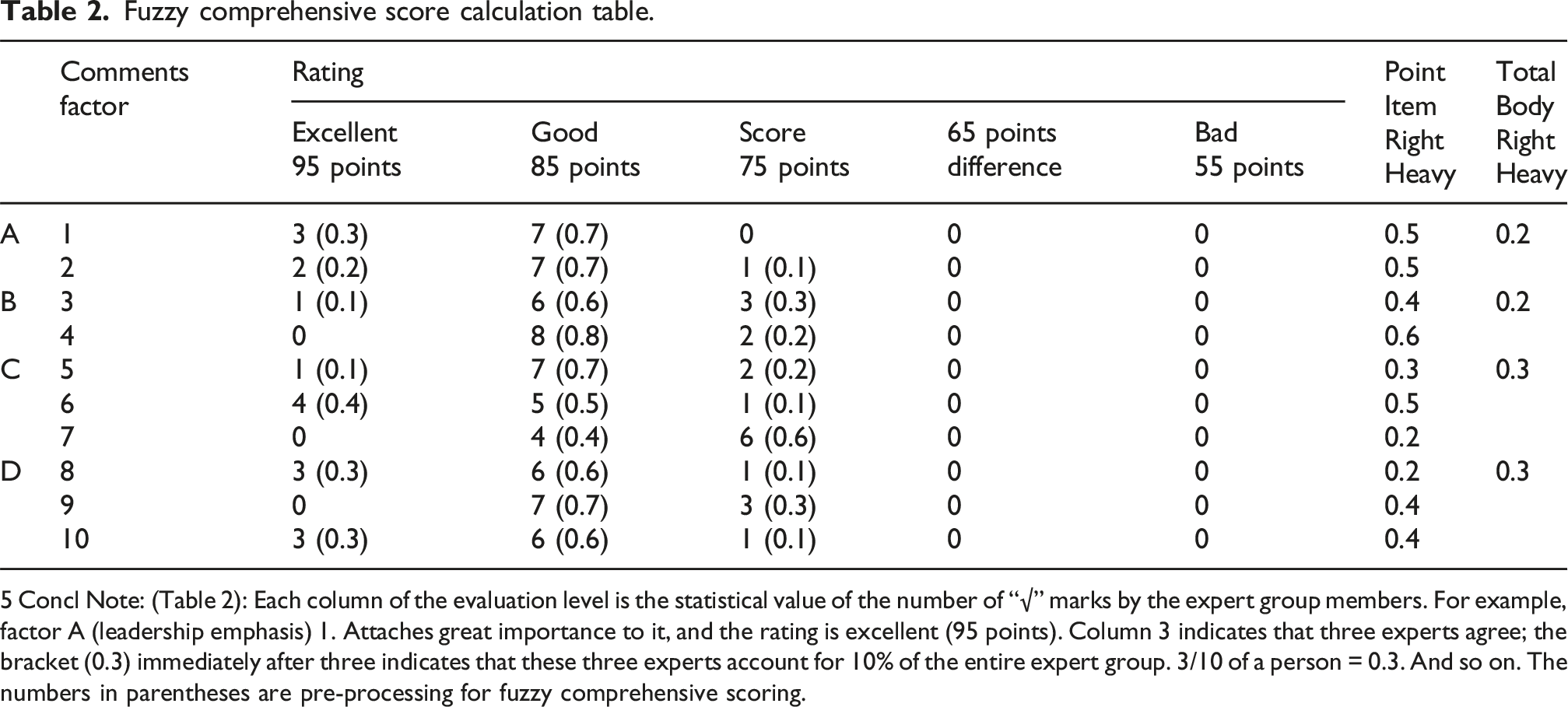
5 Concl Note: (Table 2): Each column of the evaluation level is the statistical value of the number of “√” marks by the expert group members. For example, factor A (leadership emphasis) 1. Attaches great importance to it, and the rating is excellent (95 points). Column 3 indicates that three experts agree; the bracket (0.3) immediately after three indicates that these three experts account for 10% of the entire expert group. 3/10 of a person = 0.3. And so on. The numbers in parentheses are pre-processing for fuzzy comprehensive scoring.
Problem-solving step 2, conduct fuzzy comprehensive evaluation (scoring) (i) Press M (∧·∨) to get the smaller value first, then the larger calculation mode to solve (Method I)





Find the comprehensive judgment set
The specific percentage of conversion: 0.33 × 95 + 0.34 × 85 + 0.33 × 75 = 85 (points)
In the same way, (ii) press M (∨) to multiply first, and then use the large calculation mode to solve (II method)



Find the comprehensive decision set
In the same way, (iii) press M (∧·+) to get the larger value first, and then add the calculation mode to solve (III method)



Find the comprehensive judgment set
In the same way, (iv) press M (+) to multiply first and then add the calculation mode to solve (IV method)

Normalized to get (0.04 0.72 0.24 0 0)

Find the comprehensive judgment set
The specific percentage of conversion: 0.164 × 95 + 0.58 × 85 + 0.255 × 75=15.58 + 49.3 + 19.13=84.01 ≈ 84 points
Step 3: Add the scores of the above four fuzzy scoring models, and then take the average (average) to get the final score of the × Police Academy Physical Training Management Quality Comprehensive Evaluation (score)
Step 4: Result Analysis
This example is evaluated through four different calculation modes of fuzzy mathematics I, II, III, and IV. It can be considered that the results are basically the same. However, upon closer inspection, there is still a difference of (85–84) = 1 point. From a precise perspective, it should be said that a difference of 1 point among the four methods should be taken seriously and considered. The average calculation of the results of these four scoring modes should also be regarded as desirable. It can be understood as a compromise (neither too high nor too low, just round up) to follow the fair evaluation rules. Therefore, it is recommended that in the evaluation (scoring) work of many issues (things) with fuzzy attributes, it is best to use both A “main factor salient type” [M (∧·∨)], [M (·∨)∨) and [M (∧+)] and use B “weighted average type” [M (·+)] to evaluate at the same time and take the average of the results of the two major categories of methods (i.e., “averaging” processing) as the final quantified value. This can make it possible to learn from each other’s strengths and achieve more ideal, credible, and feasible results. In this way, it can be determined that the final comprehensive evaluation score of the police physical training management quality of the police academy is 85 points.
Conclusion
1 Using four Fuzzy (fuzzy mathematics) scoring methods and referring to the calculation steps of this example, the quality level of police physical training management of any pilot police academy can be evaluated, and the final comprehensive score of each evaluated police academy can be ranked from high to low. Queuing will clearly distinguish the ranking order, providing a fair basis for standard implementation of rewards and punishments and summary. 2 The four Fuzzy (fuzzy mathematics) scoring methods are both scientific and reasonable (reliability) and simple and easy to implement (validity). Especially in sports research, quantitative evaluation of people or things in a “fuzzy state” is worthy of praise and development applied. But it should be noted that the three methods I, II, and III belong to type A—“main factor prominent type.” The calculation either takes a larger or smaller value, losing much useful information and only considering the main factors, ignoring secondary factors. Therefore, Category A can be used if only a rough evaluation or the influence of primary factors is emphasized; Method IV belongs to Category B—“weighted average type,” which fully uses all relevant aspects and all information. If a more comprehensive and detailed inspection is required and the influence of all factors needs to be considered, Category B can be used; it is best to “average” the comprehensive evaluation scores of Category A and B to make it fairer and more practical. Therefore, it is recommended to choose reasonably and carefully in practical applications.
Footnotes
Funding
The authors disclosed receipt of the following financial support for the research, authorship, and/or publication of this article: This study is supported by: 2023 Supported by the Humanities and Social Sciences Foundation of the Ministry of Education of China. Project Number: 23A11483001.
Declaration of conflicting interests
The authors declared no potential conflicts of interest with respect to the research, authorship, and/or publication of this article.