




Abstract
Tourism e-commerce is a mode of combining e-commerce and tourism industry to realize online transactions in tourism industry. This paper aims to explore the construction and application of tourism e-commerce platform based on cloud computing, firstly analyzing the characteristics and advantages of cloud computing technology, as well as the current situation of the development of tourism e-commerce and the existing problems, and then proposing the architecture and functional modules of the tourism e-commerce platform based on cloud computing, followed by the introduction of the platform’s design methodology and implementation technology, and finally verifying, through examples, the platform’s feasibility and effectiveness, providing a new solution for the digital transformation of the tourism industry.
Introduction
Tourism e-commerce, on the other hand, is a new business model that utilizes the Internet and other information technologies to realize online tourism transactions and operations management. Currently, the global tourism e-commerce platform is in a stage of rapid development and change. With the continuous development and application of cloud computing, big data, artificial intelligence, and other technologies, the functions and performance of tourism e-commerce platforms have been greatly improved. More and more tourism enterprises have begun to use e-commerce platforms for online marketing, product promotion, and service provision to attract more consumers. At the same time, consumers’ expectations of tourism e-commerce platforms are also rising, and they hope that the platforms can provide more personalized, convenient and efficient services. This new business model has the characteristics of informatization, virtualization, globalization, and interactivity, which broadens the way for the development of tourism market and provides more convenient ways and tools. Cloud computing and tourism e-commerce have become hot topics nowadays, and there is a close correlation and interaction between them. Cloud computing provides strong technical support for tourism e-commerce, enabling it to operate efficiently, safely, conveniently, and at low cost. At the same time, tourism e-commerce also puts forward a large number of application scenarios and demands for cloud computing, which further promotes the innovative development of cloud computing. The problems in the development of tourism e-commerce are shown in Figure 1 below.1,2 Problems in the development of tourism e-commerce.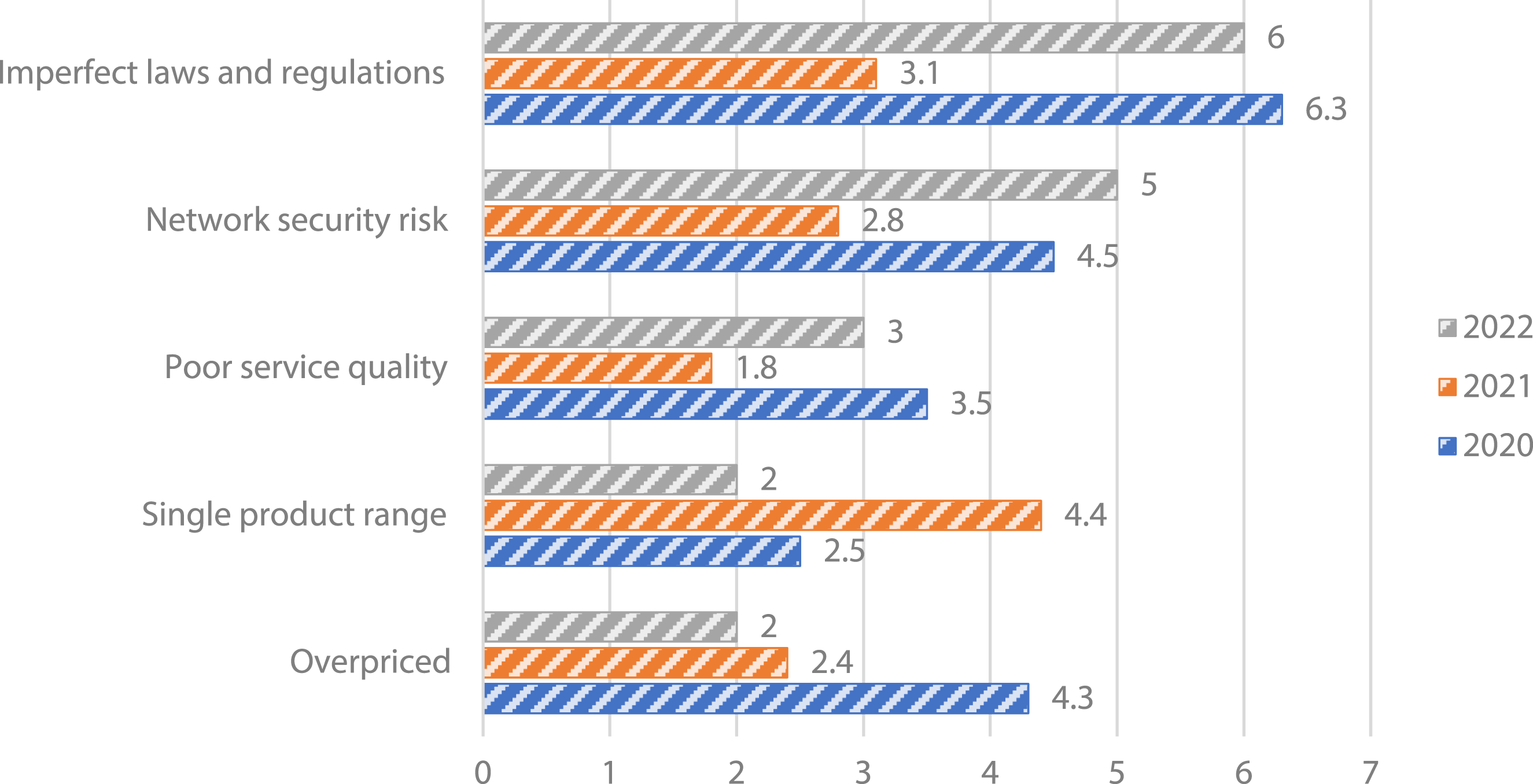
With the continuous expansion of the tourism market and the diversification of consumer demands, traditional tourism e-commerce platforms face problems such as large data volume, high operation and maintenance costs, low security, and poor service quality. Cloud computing can provide tourism e-commerce platforms with the advantages of elastic resource allocation, low expenses, efficient data processing, reliable security, etc., which can help tourism e-commerce platforms cope with market changes, enhance competitiveness, and satisfy consumer demands. 3 The design of tourism e-commerce platform based on cloud computing can promote the digital, intelligent and personalized development of the tourism industry, and provide travelers with more convenient, rich and high-quality tourism services. For example, cloud computing can realize the functions of intelligent recommendation of tourism products and services, intelligent planning of tourism itinerary, intelligent guiding of tourism attractions, intelligent evaluation of tourism experience, etc., which can enhance the satisfaction and loyalty of tourists. Meanwhile, cloud computing can also provide tourism enterprises and management departments with services such as big data analysis, cloud collaboration, and intelligent management to improve the operational efficiency and management level of the tourism industry and promote the sustainable development of the tourism industry.4,5 This study aims to explore the establishment of a tourism e-commerce platform based on cloud computing and its practical applications, which involves the platform’s demand analysis, architectural design, functional modules, technical implementation, application scenarios, and results, so as to promote the development of tourism e-commerce.
With the rapid development of information technology, cloud computing, as an emerging technology architecture, has gradually penetrated into various industrial fields, especially in the field of e-commerce, its advantages are even more obvious. Tourism e-commerce platform as an important branch of e-commerce, how to use cloud computing technology to optimize and improve its service quality is a topic worthy of in-depth study at present. The emergence of cloud computing technology brings infinite possibilities for tourism e-commerce platform. Firstly, the high scalability and flexibility of cloud computing provides a strong data processing capability for the tourism e-commerce platform, which enables the platform to cope with the peak period of tourism business and ensures the stability and continuity of service. Secondly, cloud computing’s pay-as-you-go model greatly reduces the operating costs of tourism e-commerce platforms and improves economic efficiency. Furthermore, the data security of cloud computing provides a reliable guarantee for the tourism e-commerce platform, effectively preventing data leakage and illegal access. Therefore, this paper aims to explore how to optimize the tourism e-commerce platform by using cloud computing technology to solve the challenges faced by the tourism e-commerce platform in terms of data security, data processing and data analysis, and to provide new ideas and methods for the development of tourism e-commerce.
Relevant studies
In recent years, scholars at home and abroad have conducted extensive research on the construction and application of tourism e-commerce platform based on cloud computing, and have achieved some valuable results. Daries et al. designed and realized a tourism e-commerce platform based on cloud computing, which adopts B/S architecture and utilizes big data technologies such as Hadoop and Spark to realize the centralized management of tourism resources, intelligent recommendation of tourism services, and secure payment of tourism transactions, which improves the efficiency and quality of tourism e-commerce.
6
Wu et al. constructed a tourism e-commerce platform system based on cloud computing from the characteristics of cloud computing and the needs of tourism e-commerce, which includes four layers, namely, cloud computing layer, platform layer, application layer, and user layer, corresponding to the infrastructure, platform service, application service, and user service of cloud computing, respectively, and formed a complete cloud computing tourism e-commerce service chain
7
. The design and realization of a cloud computing-based tourism e-commerce platform, which adopts three service modes of cloud computing: IaaS, PaaS, and SaaS, is studied in Henan Province as an example.
8
It realizes the functions of cloud storage of tourism resources, cloud analysis of tourism data, and cloud delivery of tourism services, which provides technical support for the development of tourism in Henan Province. Gao published a series of articles on the design and realization of tourism e-commerce platform based on cloud computing in different journals, detailing the platform’s demand analysis, functional design, system architecture, technology selection, module implementation, test and evaluation, etc., demonstrating the platform’s operation effect and application effect, which provides a reference for the research and development of tourism e-commerce platform based on cloud computing. The service model of cloud computing is shown in Figure 2.9–11 Cloud computing service model.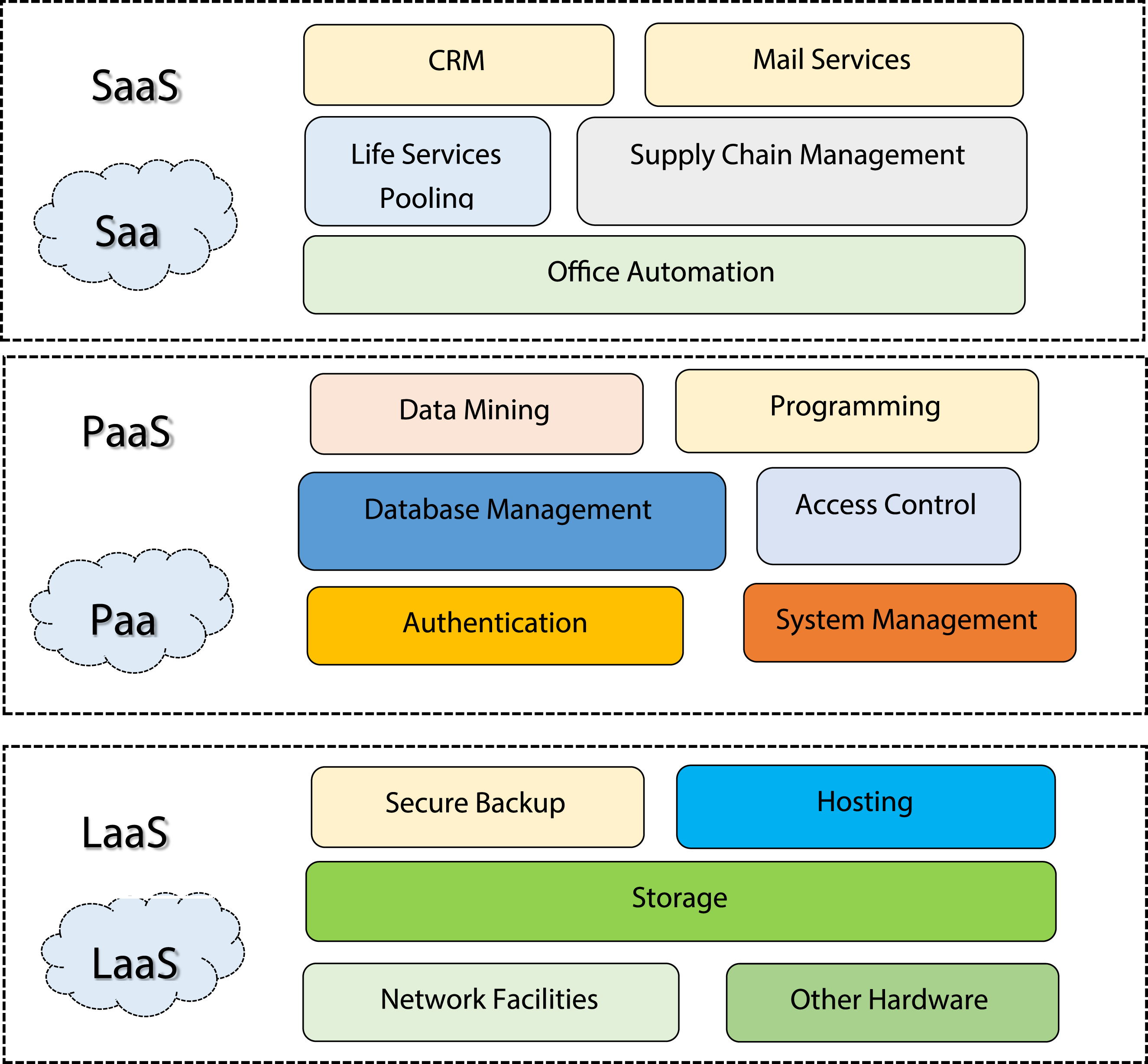
As an important branch of e-commerce, tourism e-commerce, its development history and characteristics have received widespread attention. In recent years, with the rise of cloud computing technology, more and more scholars have begun to study how to apply cloud computing technology to the field of tourism e-commerce. For example, Song et al. 12 studied the application of cloud computing in data processing of tourism e-commerce platform; and Mustafa et al. 13 conducted in-depth analyses on the security of cloud computing in tourism e-commerce platform. Although the application of cloud computing technology in tourism e-commerce has a broad prospect, there are some problems and challenges facing the actual application.
Cloud computing-based tourism e-commerce platform
Based on cloud computing tourism e-commerce platform, aims to improve the stability and performance of e-commerce platform, this chapter mainly introduces the demand analysis, architecture design, functional modules, technical implementation, and application scenarios and effects of cloud computing based tourism e-commerce platform.
Needs analysis
Tourism e-commerce refers to the use of Internet technology and e-commerce mode to provide tourism consumers and tourism suppliers with a transaction and information platform for tourism products and services. Tourism e-commerce platform is the core of tourism e-commerce, which can realize the functions of displaying, recommending, booking, paying, evaluating, and so on of tourism products, and provide convenient, efficient, and personalized tourism services for tourism consumers, and provide a broad, low-cost, and high-efficiency tourism market for tourism suppliers. Tourism e-commerce platforms, mainly facing three major challenges: first, the growth of data volume, that is, the platform needs to deal with massive and complex tourism data; second, the improvement of service quality, that is, the platform needs to provide accurate and intelligent tourism services; and third, the guarantee of security, that is, the platform needs to protect the security of tourism data and tourism services.13,14 These three challenges impose high standards and difficult requirements on the platform’s storage, processing, analysis, algorithms, models, technologies, and security mechanisms. Among them, data security, data processing, and data analysis are the three most prominent challenges. The issue of data security is the basis for the operation of tourism e-commerce platform, and how to ensure the security and integrity of data is an urgent problem to be solved. In terms of data processing, tourism e-commerce platform needs to deal with a large amount of user data and transaction data, how to efficiently and accurately deal with these data and improve the platform’s operational efficiency is another challenge to be faced. Data analysis, on the other hand, is the key for tourism e-commerce platforms to improve their service quality and competitiveness. How to optimize products and services and enhance user satisfaction through data analysis is a topic that tourism e-commerce platforms need to study in depth. In order to meet the above needs and challenges, this paper proposes a solution for the construction and application of a tourism e-commerce platform based on cloud computing, which utilizes the characteristics and advantages of cloud computing to provide tourism e-commerce platforms with elastic resources, efficient services, and security, and to improve the performance and value of tourism e-commerce platforms.15,16
Architecture design of cloud computing-based tourism e-commerce platform
The architectural design of the travel e-commerce platform based on cloud computing is shown in Figure 3, which consists of the following levels. Architectural design of cloud computing-based tourism e-commerce platform.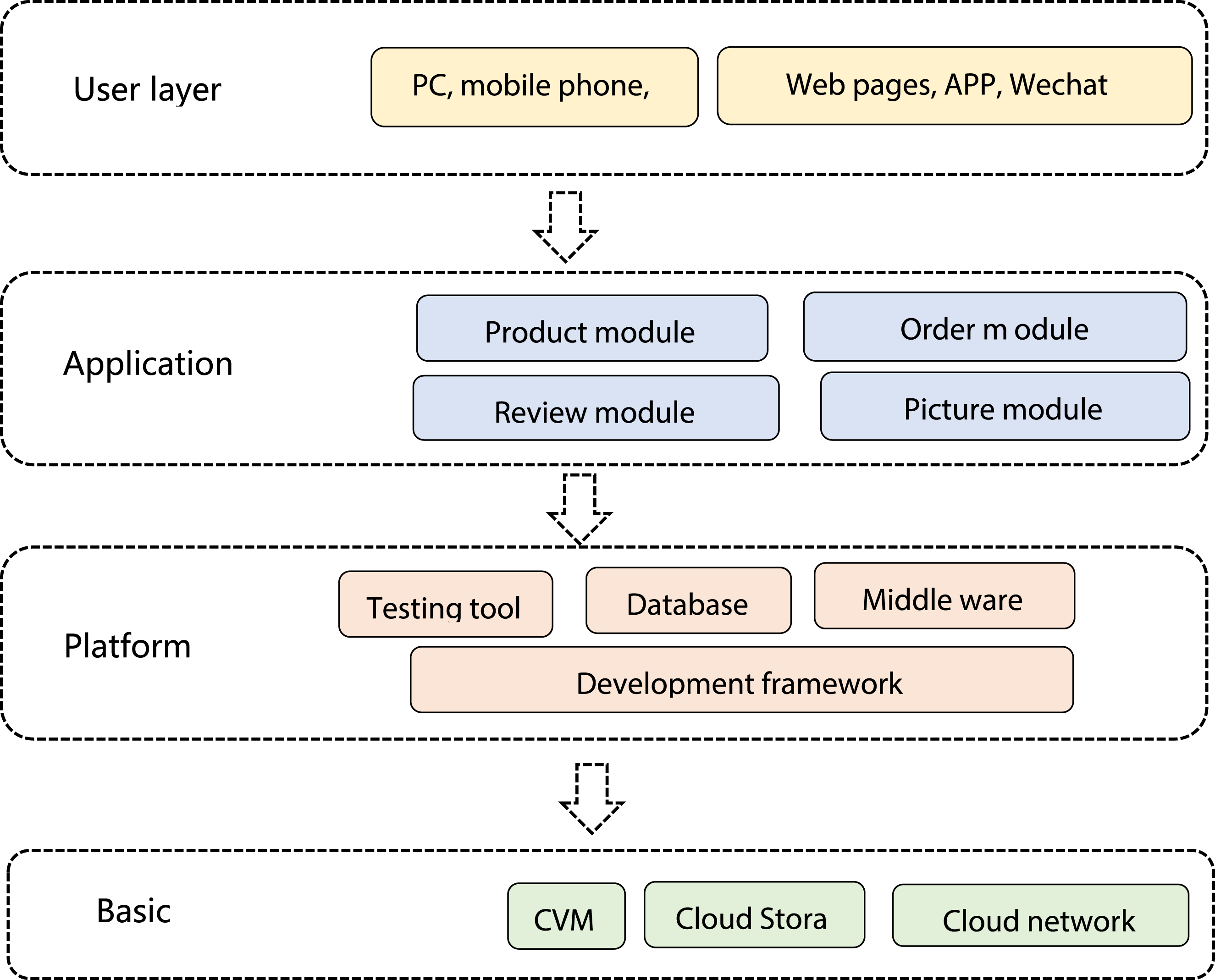
User Layer: The user layer is the outermost layer of the tourism e-commerce platform, which is the interactive interface between tourism consumers and tourism suppliers and the tourism e-commerce platform, and it can realize the use and experience of the functions and services of the tourism e-commerce platform through different terminal devices (PCs, cell phones, tablets, etc.) and different access modes (web pages, APPs, WeChat, etc.).17,18
Application Layer: The application layer is the core layer of the tourism e-commerce platform, which is the realization layer of the functions and services of the tourism e-commerce platform. It can provide the functions and services of the tourism e-commerce platform in the form of software in an on-demand, dynamic, and elastic way through the SaaS mode of cloud computing, so as to realize the efficiency and intelligence of the tourism e-commerce platform. The application layer mainly includes the following functional modules, such as tourism product module, tourism order module, tourism comment module, tourism picture module, tourism video module, etc., which will be introduced in detail in Section 3.3.
Platform Layer: The platform layer is the support layer of the tourism e-commerce platform, which is the platform for the development and operation of the functions and services of the tourism e-commerce platform. It can provide the resources and tools required for the development and operation of the tourism e-commerce platform in the form of a platform in the form of a platform, which is on-demand, dynamic, and elastic to the developers and operators, so as to realize the sharing and optimization of the tourism e-commerce platform.19,20 The platform layer mainly includes the following resources and tools, such as databases, middleware, development frameworks, testing tools, monitoring tools, etc., which will be introduced in detail in Section 3.4. Foundation Layer: The foundation layer is the basic layer of the tourism e-commerce platform, which is the basis for the storage and computation of the functions and services of the tourism e-commerce platform. It can provide the resources required for the storage and computation of the tourism e-commerce platform (servers, storage, network, etc.) in the form of infrastructure in the form of infrastructure, which can be provided on-demand, dynamically, and elastically to the platform and application layers, so as to realize the elasticity and security of the tourism E-commerce platform’s elasticity and security. The infrastructure layer mainly includes the following kinds of resources, such as cloud servers, cloud storage, cloud network, etc., which will be introduced in detail in Section 3, 4.21,22
Aiming at the above problems and challenges, this paper proposes an architecture design of tourism e-commerce platform based on cloud computing. The architecture mainly includes three layers: application layer, platform layer, and infrastructure layer. The application layer is the direct interface between the tourism e-commerce platform and the users, which contains several modules such as user management, product display, order processing, payment, and settlement. These modules achieve efficient data processing and interaction through cloud computing technology, providing users with a smooth and convenient service experience. The platform layer is the core part of the tourism e-commerce platform, containing multiple components such as data processing, data analysis, and security management. These components achieve efficient and flexible data processing and analysis through the elastic expansion and pay-as-you-go mode of cloud computing, providing strong technical support for the tourism e-commerce platform. The infrastructure layer is the basic support of the tourism e-commerce platform, including computing resources, storage resources and network resources. These resources are efficiently managed and utilized through the virtualization technology of cloud computing, providing a stable and reliable infrastructure for the tourism e-commerce platform.
Algorithm optimization
In order to improve the performance of the cloud-based e-commerce platform in this paper, we use some optimization algorithms. The details are shown in Figure 4. Optimization algorithm.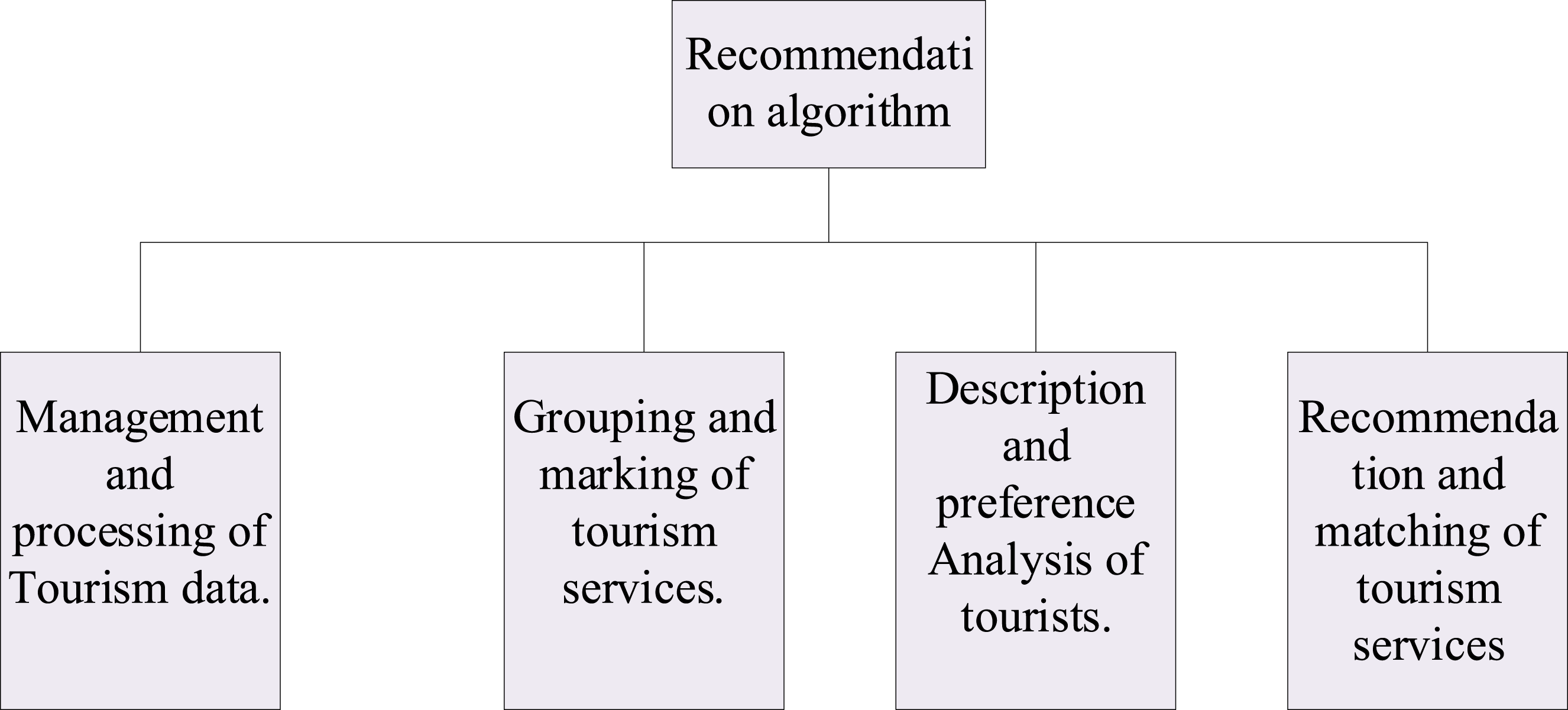
Management and Processing of Tourism Data: Hadoop Distributed File System (HDFS) is utilized to store various types of tourism data, such as basic tourist information, tourism behavior, and tourism evaluation. The MapReduce framework is utilized to pre-process the data, including data cleaning, conversion, integration, and aggregation, to improve the quality and availability of the data. Let
Firstly, partitioning and load balancing strategies for HDFS storage, data partitioning based on the time attributes and geographical attributes of tourism data, etc., to optimize the data reading efficiency; secondly, reasonable scheduling of MapReduce jobs, such as the use of a capacity scheduler or a fair scheduler, to ensure that high-priority or large-data-volume tasks can be processed in a timely manner; thirdly, optimization of key-value pairs design in the MapReduce phase key-value pair design to reduce the amount of data transfer in the shuffle phase; in addition, combining Spark and other in-memory computing frameworks for interactive query optimization to improve real-time analysis capabilities. The implementation steps include: firstly, configure and deploy Hadoop cluster, and set reasonable hardware resource configuration according to the data size and business requirements; then, realize efficient storage and management of raw travel data on HDFS; then, write targeted MapReduce programs to perform preprocessing operations, and meanwhile, continuously debug and optimize job configuration; finally, perform performance testing and quality evaluation on the processed preprocessed dataset. Finally, performance testing and quality assessment of the processed preprocessed dataset is carried out. The quantitative assessment of the optimization effect is mainly done through the following points: first, comparing the time cost of data processing before and after optimization, such as the overall processing time and the execution time of individual tasks, etc.; second, observing the changes in the system resource indexes such as the utilization rate of the HDFS storage, network bandwidth usage, etc.; third, measuring the degree of improvement of the optimization measures on the efficiency of the system through the query response speed, the performance indexes such as the data processing throughput, etc.; and fourth, through the comparing the quality of the preprocessed data (the proportion of missing values, consistency test results, etc.) to assess the effect of data preprocessing.
Grouping and Labeling of Tourism Services: Tourism services are grouped using K-means clustering algorithm to classify similar tourism services into a category based on their features and attributes. Let
Tourist description and preference analysis: Using collaborative filtering algorithms to analyze the historical behavior and evaluation data of tourists to construct the description of tourists, including the basic information of tourists, travel preferences, travel needs, and so on. Let

The Apriori association rule mining algorithm is used to discover the potential needs and interests of travelers and provide personalized travel suggestions for travelers. Let

Recommendation and Matching of Tourist Services: Using the content-based recommendation algorithm, the recommendation list is generated by selecting the tourist service that best matches the tourist from the grouping and labeling of tourist services according to the description and preference of the tourist. The optimization principle of recommendation algorithms is usually based on collaborative filtering, content filtering, or hybrid models, which capture the implicit associations between user behavioral patterns, preference features, and service attributes through machine learning techniques. On the travel e-commerce platform, the actual operation path includes multiple steps such as data collection, user profile construction, service feature extraction, similarity calculation, and recommendation list generation. Through the real-time update and feedback mechanism, the optimized algorithm is able to handle massive user requests in a short period of time and improve recommendation accuracy, recall, coverage, and diversity, thus enhancing user experience and promoting platform conversion rate and user stickiness. For example, by fine-tuning and personalizing the ordering of recommendation results, the user click rate and the number of order conversions are effectively enhanced, which ultimately manifests itself in the growth of platform revenue. Let

Functional modules of cloud computing-based tourism e-commerce platform
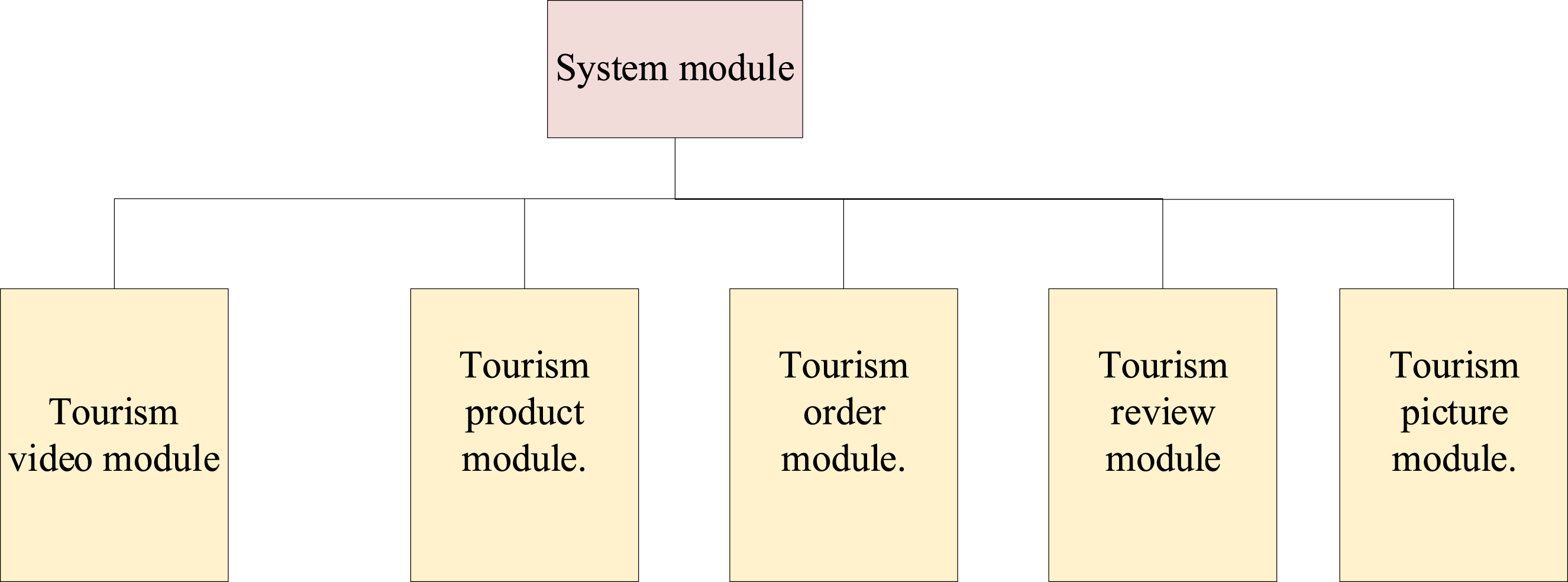
This section mainly introduces the functional modules of the cloud computing-based tourism e-commerce platform, including the tourism review module, tourism picture module, tourism video module, etc. These functional modules realize different functions and services of the tourism e-commerce platform, respectively, as shown in Figure 5. (1) Tourism Product Module: responsible for managing and displaying tourism products, such as routes, attractions, hotels, tickets, etc., utilizing cloud computing to achieve massive storage, efficient query, fast loading, intelligent recommendation, and other functions. (2) Travel Order Module: Responsible for processing and managing travel orders, such as creation, payment, cancellation, refund, evaluation, etc., utilizing cloud computing to achieve rapid response, secure transmission, reliable storage, intelligent analysis, and other functions. (3) Tourism Review Module: Responsible for collecting and displaying tourism reviews, such as evaluations, suggestions, feelings, etc., utilizing cloud computing to achieve mass storage, efficient querying, fast loading, natural language processing, and other functions.
30
(4) Tourism Picture Module: It is responsible for processing and displaying tourism pictures, such as product pictures, user pictures, and pictures of attractions, etc. It utilizes cloud computing to realize mass storage, efficient query, fast loading, and image processing. (5) Tourism Video Module: Responsible for processing and displaying tourism videos, such as product videos, user videos, attraction videos, etc., utilizing cloud computing to achieve mass storage, efficient query, fast loading, video processing, and other functions. Functional module diagram.
Evaluation of a cloud computing-based tourism e-commerce platform
This chapter evaluates the performance and effectiveness of the cloud computing-based tourism e-commerce platform, which includes three main parts: data acquisition, experimental design, and experimental results. 31
Data acquisition
Description of the data set.

Experimental design
In this paper, two sets of experiments are designed to evaluate the cloud computing-based travel e-commerce platform from the aspects of performance and effect, respectively. In terms of performance, the response time, throughput, scalability, and reliability of the platform are examined; in terms of effect, the accuracy, recall, coverage, and diversity of the platform’s travel service recommendations are examined. Diversity: refers to the degree of difference between different tourism services among the tourism services recommended by the platform. The algorithm takes into account the significant differences between different types of tourism services in terms of price, quality, geographic location, and features, such as hotel class, room type, level of attraction, content of activities, and comfort of the mode of transportation. It is as specific as equation (4)
33

In this paper, 10 cloud servers are used as the experimental platform, and each cloud server is configured with Intel® Xeon® E5-2680 v4 @ 2.40 GHz CPU, 16 GB RAM, 1 TB hard disk, and 100 Mbps network bandwidth.
In this paper, the following software was used as components of the experimental platform: the operating system was Ubuntu 18.04, the database was MySQL 8.0, Hadoop version 3.2.1, Spark version 3.0.1, Python version 3.7, Flask version 1.1.2, and TensorFlow version 2.3.1.
Experimental results
Performance comparison of the two platforms.
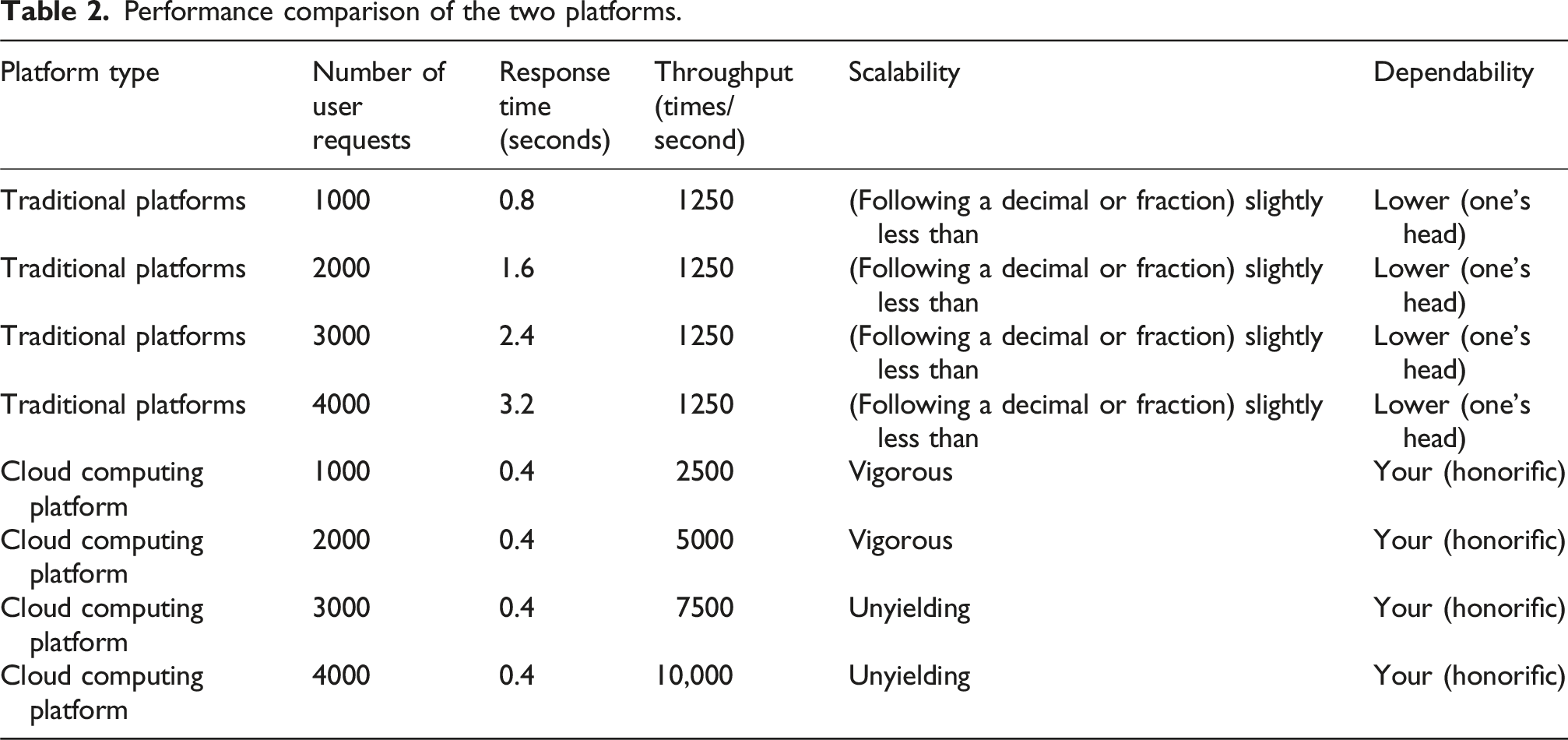
As can be seen from Table 2, the cloud computing-based travel e-commerce platform is significantly better than the traditional travel e-commerce platform in terms of response time, throughput, scalability, and reliability. Specifically:
Comparison of the effectiveness of the two platforms.

From Table 3, it can be seen that the cloud computing-based travel e-commerce platform is significantly better than the traditional travel e-commerce platform in terms of recommendation accuracy, recall, coverage, and diversity. In comparison, cloud computing platforms, due to more powerful computing power and storage resources, put forward higher requirements on various performance indicators of recommendation systems, probably because cloud computing platforms often serve large-scale, highly concurrent scenarios and need to achieve more refined personalized recommendations on the basis of big data. The gap between traditional platforms and cloud computing platforms in recommender system performance reflects the impact of technological advances, as well as the increase in business expectations for the quality of recommendations as technology develops. When designing and optimizing recommendation systems, enterprises or developers should combine their own platform characteristics and business needs to set and pursue reasonable target values for these key indicators. As can be seen from Table 3, the cloud computing-based tourism e-commerce platform is significantly better than the traditional tourism e-commerce platform in terms of both performance and effectiveness. Specifically35,36:
In terms of performance, the response time of cloud computing platforms is half that of traditional platforms, the throughput is twice or more that of traditional platforms, and scalability and reliability are both strong, while traditional platforms are both weak and low. This indicates that cloud computing platforms are able to process user requests faster, utilize resources more efficiently, adapt to user changes more flexibly, and provide services more stably. 37 In terms of effectiveness, the recommendation accuracy and recall of the cloud computing platform are both 0.2 higher than that of the traditional platform, and the recommendation coverage and diversity are both 0.15 higher than that of the traditional platform. 38 This indicates that the cloud computing platform is able to more accurately understand the users' needs and preferences, more comprehensively cover the types of travel services, and more diversely provide choices of travel services.39,40
Conclusion
This paper provides a new solution for the digital transformation of the tourism industry. The tourism e-commerce platform based on cloud computing can promote the digital, intelligent, and personalized development of the tourism industry, provide tourists with more convenient, rich, and high-quality tourism services, and provide tourism enterprises and management with services such as big data analysis, cloud collaboration, and intelligent management, so as to improve the operational efficiency and management level of the tourism industry, and promote the sustainable development of tourism. After experimental verification, this paper based on cloud computing tourism e-commerce platform in terms of performance and effect are better than the traditional system The research in this paper has certain theoretical significance and practical significance. The tourism service recommendation algorithm in this paper is mainly based on the user’s historical behavior and preferences, and does not take into account the user’s real-time context and dynamic needs, which may have a certain lag and inaccuracy. Future research can introduce the user’s contextual information, such as geographic location, time, weather, emotions, etc., to achieve more intelligent and personalized recommendations.
Footnotes
Funding
The author received no financial support for the research, authorship, and/or publication of this article.
Declaration of conflicting interests
The author declared no potential conflicts of interest with respect to the research, authorship, and/or publication of this article.