




Abstract
In the context of Open innovation, it has become an important way for manufacturing enterprises to use knowledge network embedding (KNE) to achieve intelligent transformation (IT). This study combines the theory of absorptive capacity (AC) and constructs a chain mediation model of “KNE-PAC (potential absorptive capacity)-AAC (actual absorptive capacity)-IT” based on the logical chain of “resources-capabilities-results” to explore the internal mechanism of KNE. 208 manufacturing enterprises are used as research samples. The empirical results based on hierarchical regression analysis and Bootstrap method indicate that: (1) KNE positively affects IT; (2) PAC plays a complete mediating role between KNE and IT; (3) AAC does not have a mediating effect between KNE and IT; (4) PAC and AAC play a chain mediating role of KNE on IT. This study expands the research on the impact of KNE on IT, promotes the theoretical exploration of AC on IT, and provides practical reference for manufacturing enterprises to achieve IT in the era of open innovation.
Keywords
Introduction
With the rise of a new round of technological and industrial revolution in the world, 1 intelligent manufacturing, which is characterized by the integration of emerging information technology and advanced manufacturing technological convergence, has become a key breakthrough and an important starting point for enterprises to achieve transformation and upgrading. “Made in China 2025” clearly points out that we should take intelligent manufacturing as the main direction of attack and step into the ranks of manufacturing powers. Achieve IT is an important way for China’s manufacturing industry to move towards a stage of high-quality development. 2
In a more open, dynamic, and complex environment, knowledge resources are highly dispersed and rapidly changing. It is difficult for a single enterprise to rely on its own local knowledge resources to obtain the best innovation. Embedding external knowledge networks and utilizing a wider range of knowledge resources to achieve technological innovation has become a new trend for enterprises to achieve IT and achieve high-quality economic development. At present, practitioners and theorists seem to have reached a consensus: enterprises need to effectively embed external knowledge networks, actively acquire, absorb, and commercialize knowledge resources in the knowledge network (i.e., AC), in order to successfully achieve IT. However, existing scholars mainly focus on the influencing factors of IT from aspects such as intelligent manufacturing technology, management and policy and innovation flexibility. Few scholars pay attention to the impact of KNE on IT.
In response to the above issues and insufficient research, this study introduces the theory of AC into the research framework. Following the logical chain of “resources-capabilities-results,” it explores the mechanism of KNE on IT.
Theoretical basis and research hypothesis
The impact of KNE on IT
The embeddedness of the network has become an important feature of the interconnection between modern organizations, and different organizations have formed a high degree of penetration and complementarity, promoting network to become an important way for enterprises to acquire knowledge and innovation. 3 According to the social network theory, economic activities are embedded in and restricted by the network. The more connections a company has embedded in a network, the more susceptible its strategic decisions and actions are to the influence of the network structure it is embedded in. As a result, the company can easily access and utilize the resources hidden in the network. In addition to its role in allocating social capital, the internet itself is also a form of social capital that can enhance innovation performance by promoting enterprises to acquire and utilize new knowledge and improve learning abilities. Furthermore, enterprises can also utilize their relationship links and network structures to jointly innovate the value of knowledge to promote mutual learning. The quality and structure of relationships among various actors in the network determine the synergy of knowledge learning activities and the improvement of knowledge innovation capabilities among enterprises. Embedding in the network is more conducive to the exchange, diffusion, and sharing of enterprise knowledge, in order to achieve knowledge accumulation and innovation, continuously improve the technological advantages and innovation capabilities of enterprises, and establish long-term competitive advantages.
Manufacturing enterprises embedded in knowledge networks, leveraging government agencies, peer enterprises, and industrial chains, use knowledge resources as a medium to promote cooperation among manufacturing enterprises, internet enterprises, and productive service enterprises, driving the IT. Manufacturing enterprises embedded in knowledge networks collaborate and exchange knowledge resources with other enterprises through relationship embedding, structural embedding, and cultural embedding. By embedding relationships, channels and pathways for external contact are enhanced, enhancing the ability to acquire heterogeneous resources and creating conditions for the formation of innovative technologies and the realization of innovative products, the trust mechanism between enterprises enhances the willingness of information exchange between nodes, reduces the asymmetry and ambiguity of information exchange, and provides more accurate information for enterprises. The resource effect formed by it can reflect market demand, which is conducive to technological innovation for enterprises. Through structure embedding enterprises have more strategic scarce resources and strategic support, making it easier to obtain new knowledge, technology, and information resources, which is conducive to alleviating internal constraints on organizational resources, and helping to enhance the enterprise’s technological innovation ability and accelerate innovation speed; Through cultural embedding, enterprises can establish a corporate culture with common customs, behavioral norms, and values, it enhance the depth, breadth, and durability of enterprise communication, and further enhance the utilization of existing resources for rational planning. It is also conducive to the improvement of technological innovation capabilities and the realization of IT.
It can be seen that manufacturing enterprises can re-integrate the resources in the knowledge network by embedding it, more flexible for them to innovate and adjust to different needs, and better adapt to changes in external demands. Individualized needs, as an important driving force for enterprises to develop towards intelligent manufacturing, promote the transformation of manufacturing enterprises towards intelligence in the design, production, management, and service stages. In summary, this study assumes that:
KNE has a positive impact on IT.
The mediating role of AC in KNE and IT
IT can break through self-resource constraints, developing, integrating, and utilizing internal and external resources to create new services and value. It requires manufacturing enterprises to develop towards intelligence in the design, production, management, and service stages. In the process of IT in manufacturing enterprises, external knowledge resources are crucial strategic resources. However, external knowledge resources cannot directly promote IT; it needs enterprises to digest and transform their own production and operation activities before they can carry out commercial applications to unleash their potential value and promote IT.
AC is the ability to identify, digest, and commercialize the application of external new knowledge. Some scholar divided AC into two dimensions: PAC and AAC. 4 PAC refers to the ability of enterprises to acquire and digest knowledge. AAC refers to the ability of enterprises to transform and apply knowledge. This article divides absorption capacity into potential absorption capacity and actual absorption capacity based on the practices of the scholars mentioned above.
The knowledge based theory holds that enterprises are essentially a collection of various types of knowledge. As a collection of relationships between enterprises and external organizations, external knowledge networks can enhance PAC through network characteristics such as network size, centrality, and connectivity. For example, the larger the scale of external knowledge network, the more channels it has to acquire external knowledge. The higher the centrality of external knowledge network, the more connections it has with its members, and the faster the transfer of knowledge between organizations, which can promote the acquisition and digestion of external knowledge. The improvement of PAC can strengthen the acquisition and digestion of external knowledge, assist in the development of new products, and promote IT. 5 In addition, enterprises with strong potential absorptive capability are good at discovering changing trends in their external environment and constantly modifying their knowledge storage to overcome the “capability trap.” At the same time, updating their knowledge base also helps enterprises cope with changing markets, actively utilizing emerging innovation opportunities, and helping them achieve IT. In summary, this study assumes that:
PAC plays a mediating role between KNE and IT. Due to limited knowledge reserves, manufacturing enterprises need to embed external knowledge networks and establish deep connections with suppliers, customers, research institutions, and peer enterprises. In the process of embedding external knowledge networks, AAC plays a real role in IT of enterprises by exchanging knowledge with innovative entities within the knowledge network, achieving the economic and commercial value of knowledge. AAC mainly refers to the ability to create technology through innovative activities, generate new products or processes, and apply new technologies to production operations, enabling them to be successfully commercialized and put into the market to generate economic benefits. Most of the knowledge it achieves will be used for the technological upgrading and leap of the enterprise. Therefore, the stronger of AAC, the more resources it invests in product innovation and process innovation. In summary, this study assumes that:
AAC plays a mediating role between knowledge networks embedding and IT.
The chain mediating effect between PAC and AAC
The theory of AC indicates that enterprises not only need to attach importance to the acquisition and digestion of external knowledge resources, but also need to focus on transforming external knowledge resources into internal knowledge resources and conducting commercial applications. As a continuous process, the level of PAC can help enterprises cope with changing market conditions and thereby enhance AAC. 6
In the era of knowledge economy, manufacturing enterprises can quickly and accurately acquire and digest knowledge resources with potential value in external knowledge networks through PAC. By integrating external knowledge resources with internal knowledge resources, they can innovate new products and services, promote IT in the design, production, management, and service stages, and promote intelligent development of manufacturing enterprises. In summary, this study assumes that:
PAC and AAC have chain mediating effect between KNE and IT. In summary, the research model proposed in this study is shown in Figure 1.
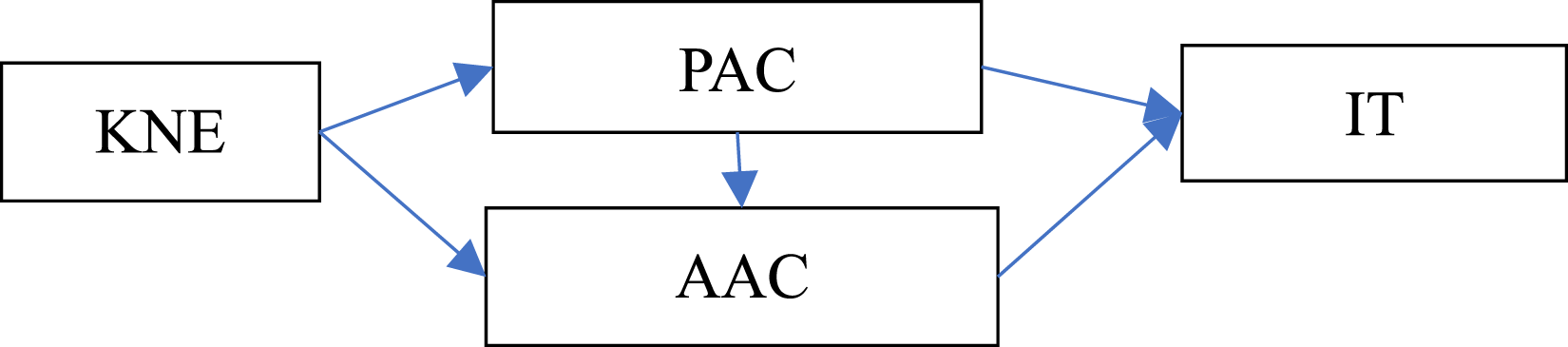
Conceptual model.
Study design
Sample and data sources
Sample distribution characteristics.

Variable measurement
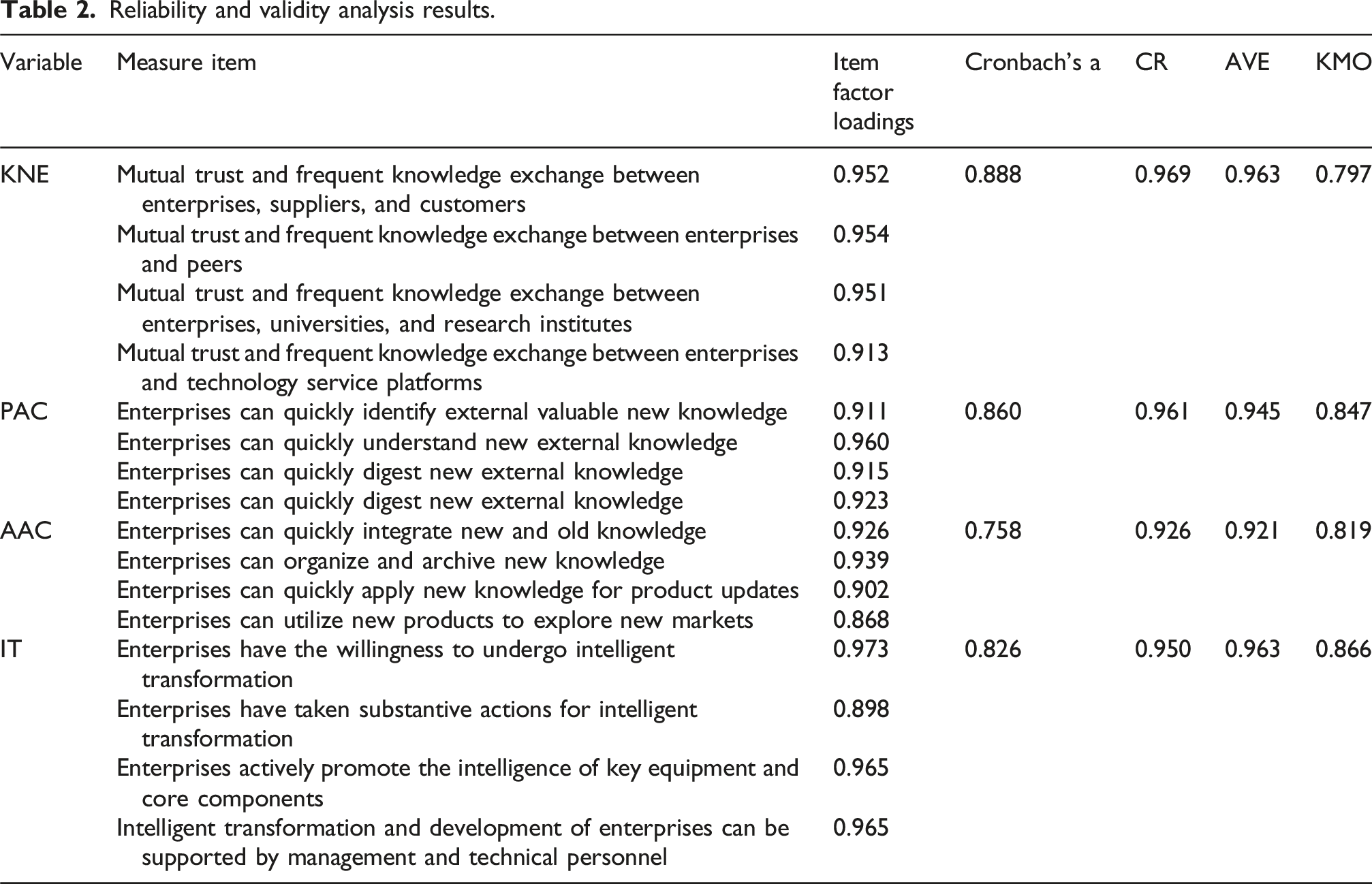
This study draws on the effective measurement indicators used and proven by domestic and foreign scholars, and continuously improves them according to the actual situation to form the final scale. In the questionnaire design, the Likert 5-point scale was used for scoring. The interviewees were graded on a scale of 1–5 based on the actual situation of the enterprise, with “1” indicating “non-conformity” and “5” indicating “complete conformity.” The specific sources of variable measurement items are as follows: The measurement of IT draws on the research findings of Yu, 7 using four measurement items such as the willingness of enterprises to undergo IT. KNE draws on the research findings of Liu and Tang, 3 using four measurement questions such as mutual trust between enterprises, suppliers, customers, and frequent knowledge exchange. The measurement of PAC and AAC draws on the research findings of Song et al., 4 using four measurement items such as enterprise can quickly identify external valuable new knowledge, and enterprise can quickly integrate new and old knowledge.
Reliability and validity analysis
A common problem when collecting data from common sources is the bias of common methods, which can damage the validity of the study. This study selected the Harman single factor method to test this issue, and used SPSS 22.0 to conduct exploratory analysis on 16 factor items. The interpretation rate of the first principal component precipitated before rotation was 47.88%, which is lower than the recommended 50% standard. The KMO value of the total table was 0.883, x2 = 4053.810, p < 0.000, and there was no serious common method deviation in this study.
Reliability and validity analysis results.
Correlation coefficients between variables (N = 208).
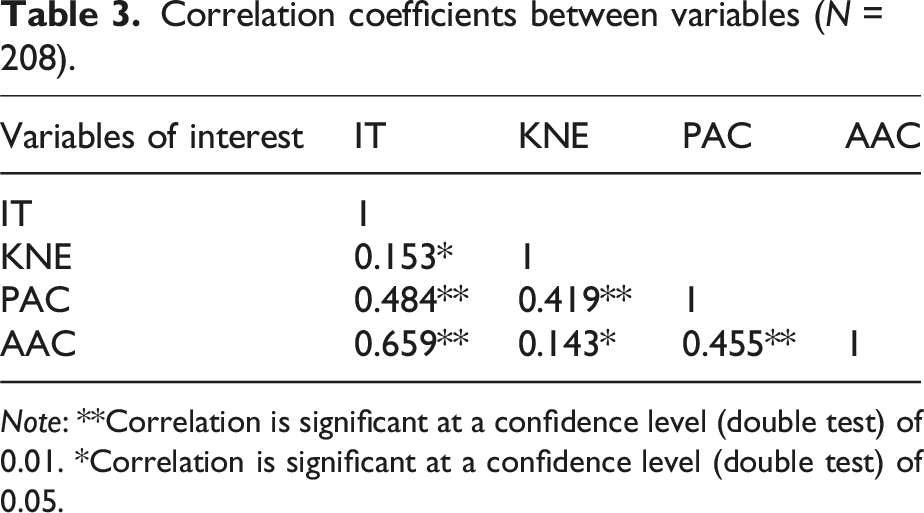
Note: **Correlation is significant at a confidence level (double test) of 0.01. *Correlation is significant at a confidence level (double test) of 0.05.
Hypothesis testing
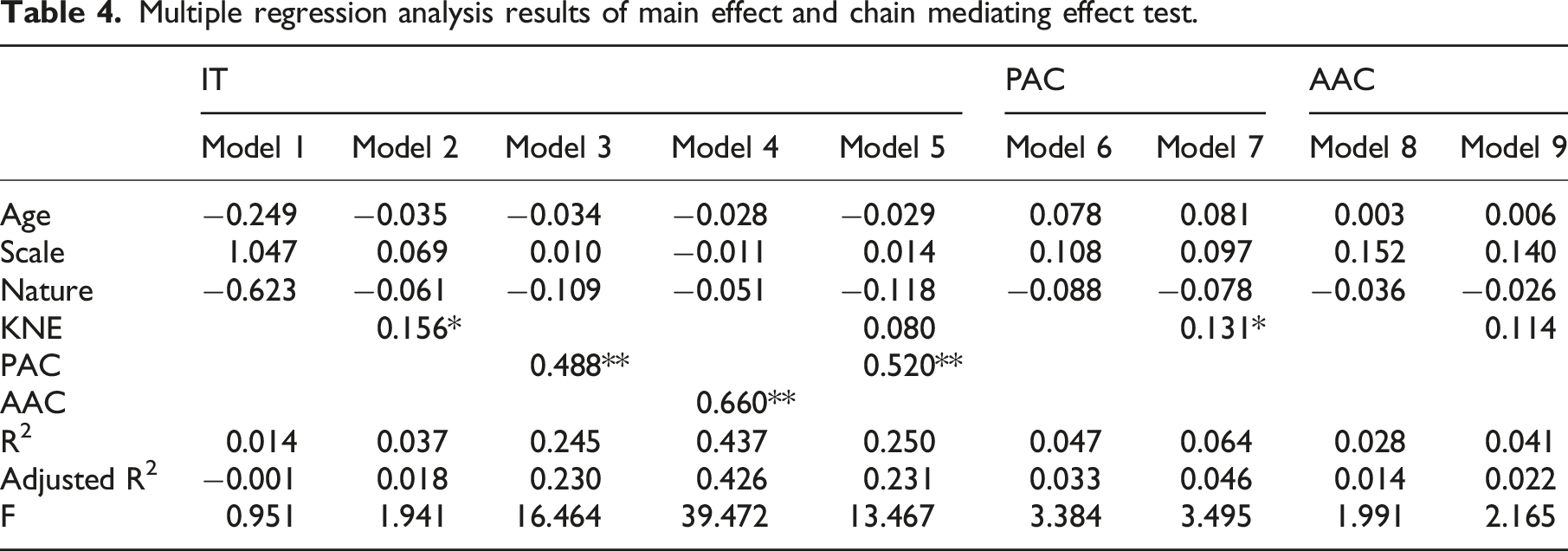
(1) Analysis of multi-layer linear regression results.
Multiple regression analysis results of main effect and chain mediating effect test.
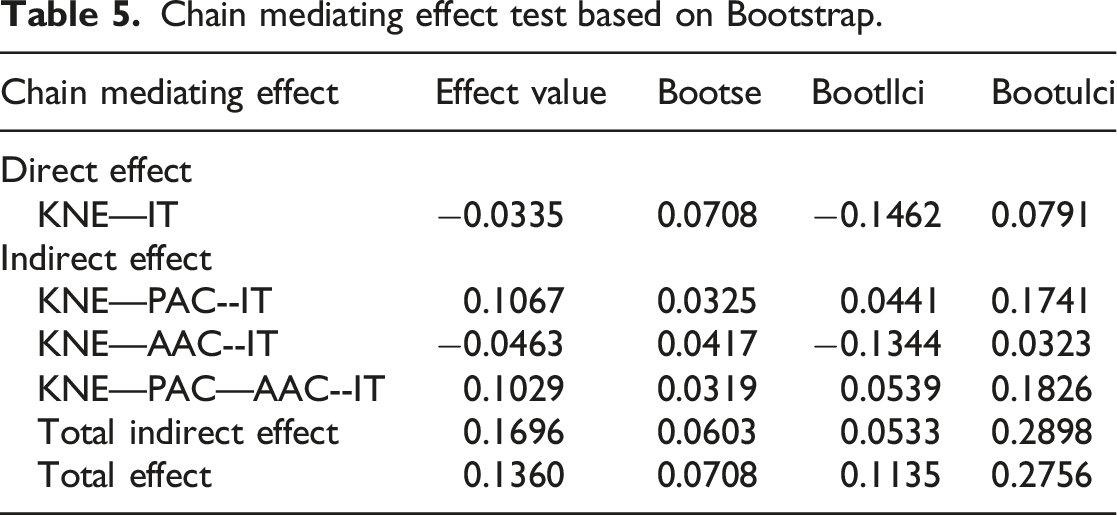
(2) Mediation and chain mediating effect test based on Bootstrap.
Chain mediating effect test based on Bootstrap.
Conclusion and suggestions
Research conclusion
The research objective of this study is to explore the effect of KNE on IT. To address this issue, this study uses 208 manufacturing enterprises as research samples and tests the impact of KNE on IT through multi-layer regression analysis and Bootstrap method. It also verifies the mediation and chain mediating effect of PAC and AAC. Some of the hypotheses in this study are supported. This study has found that: (1) KNE helps to improve IT; (2) PAC is the path that KNE plays a dominant role. PAC completely mediates the relationship between KNE and IT, while AAC does not play mediation between KNE and IT. (3) PAC and AAC play chain mediating effect between KNE and IT, indicating that KNE affects AAC through PAC, thereby achieving IT. The conclusions indicate that the impact of PAC on IT of enterprises is internalized and fundamental. PAC can promote enterprises to better absorb, transform, integrate, and digest the knowledge resources, improve their own knowledge stock level, and provide a knowledge foundation for the improvement of AAC.
Theoretical suggestions
(1) The academic community generally emphasizes the importance of resources/knowledge for quickly perceiving and meeting market demand. Based on this, this study empirically verifies the positive impact of KNE on IT. KNE can accurately perceive changes in external market demand for enterprises, provide personalized value-added services to customers, and these are the driving forces for manufacturing enterprises to promote IT.
9
This study expands antecedent variable of IT from the perspective of KNE. (2) IT requires the matching of organizational capabilities. This study incorporates PAC and AAC into the mechanism of KNE on IT. The results show that PAC has a complete mediating effect between KNE and IT, and PAC further promotes IT through AAC. It can be seen that the more external knowledge resources that manufacturing enterprises acquire and digest, the more conducive it is to transform and commercialize the use of external knowledge resources, and innovate new products or value-added services through effective knowledge integration, promoting IT.
2
Management suggestions
(1) KNE is an important strategic measure to promote IT. This study indicates that KNE can promote external knowledge flow and achieve IT. Therefore, in the context of globalization, manufacturing enterprises in China should not only actively embed local knowledge networks, but also actively integrate into global knowledge networks with a more open attitude. While efficiently integrating and utilizing global knowledge capital and technological resources, they should actively import relatively advanced new technologies, core components, and key equipment to fully utilize the spillover effect of knowledge and technology to drive the improvement of their own technological innovation capabilities. (2) Enterprises should place emphasis on transforming PAC into AAC to promote knowledge spillover effects embedded in knowledge networks. In order to transform PAC into AAC, enterprises can enhance communication between departments and members, promote the concept of information sharing, build a learning organizational culture, and provide opportunities for training, job rotation, decision-making participation, and informal social network communication outside of working hours to enhance the degree of cooperation within the enterprise. Enterprises can use open social capital to enhance the ability of acquire, digest, absorb, and utilize external knowledge networks to innovate subject technical knowledge. At the same time, by establishing a recyclable AC cultivation mechanism, external knowledge can be transformed into knowledge stock based on the current AC, which in turn promotes the further strengthening of knowledge AC in the next stage, enhances the technological innovation ability of enterprises, and promotes IT. (3) Emphasize the cultivation of AC. Enterprises can acquire and digest multi domain knowledge required for innovation through KNE. However, it is difficult for enterprises to achieve internal transformation and commercial application of knowledge only depending on external knowledge sources. Therefore, it is necessary to organize internal resources to support the transformation of external new knowledge into internal knowledge and achieve commercial utilization. It can be seen that the cultivation of AC requires active and effective utilization of external and internal advantageous resources. If the company only uses external support systems to obtain external knowledge sources and neglects the application of knowledge, it may lack the ability to apply knowledge and be unable to further transform knowledge into new products. On the contrary, if a company only focuses on the construction of internal support systems and does not engage with external knowledge sources, it may fall into a “mature trap” and cannot achieve long-term growth.
Research limitation
This study explores the impact and mechanism of KNE on IT, and there are still certain limitations. First, the questionnaire data belongs to Cross-sectional data, and there is no continuous periodic tracking of the survey samples. In the future, consider the design of longitudinal study to better reveal its dynamic development process. Secondly, this study explores the impact of KNE on IT. However, the advantages of knowledge networks are far from this. Future research can identify other mediating or moderating variables from a new theoretical perspective, delve deeper into the mechanism of KNE on organizational performance, and further deepen relevant research on knowledge networks.
Footnotes
Funding
The author disclosed receipt of the following financial support for the research, authorship, and/or publication of this article: The work is financially supported by project of Ministry of Education Humanities and Social Sciences Research Project: Research on the Configuration Effects and Mechanisms of SRDI Enterprises’ Digital Transformation in the Context of High-Quality Development (24YJA630001).
Declaration of conflicting interests
The author declared no potential conflicts of interest with respect to the research, authorship, and/or publication of this article.