




Abstract
Community members seek benefits-sharing planning agreements to advance their own distributive justice goals by directing benefits to communities. Nonideal theory does much to explain the context and possibilities for these agreements. The agreements forged between communities and development interests seek to address, but not completely achieve, distributive justice via consensus about incremental changes in project benefit distribution. However, implementation and outcomes can vary widely. This article develops theory to conceptualize a practical framework for these planning agreements using nonideal justice theories, granted the triple concerns of inaction, tokenism, and rhetorical trickery posed by ineffective implementation. The Crenshaw Light Rail Project in Los Angeles illustrates the issues in play.
Keywords
Introduction
This article uses nonideal theory to understand the spectrum along which agreements negotiated between communities and planners, such as community benefits agreements, can fall, from one end of moving projects toward stated distributive justice goals to the other end of simply co-opting community engagement to serve more powerful development interests. Community members seek benefits-sharing agreements, in part, to explicitly address the costs and benefits distribution problems of large-scale projects that have produced community harm, including those experienced during urban renewal. Communities pursue benefits-sharing agreements to improve both the planning process and outcomes for marginalized communities, through local benefits provision and significant community participation (Baxamusa, 2008; Haas, 2012; Lucas-Darby, 2012; Parkin, 2003; Rosen, 2016; Wolf-Powers, 2010).
Benefits-sharing agreements, if formulated and enacted through good faith negotiation and deliberation that represents community members and their interests, express, at least in part, community preferences for how development projects should proceed, and the standards that projects must meet to represent progress toward stated justice goals (Comacho, 2013). In other words, these agreements can reveal what benefits community residents seek—and how much is enough—for a specific project to generally advance, fit into, or at least not worsen, distributive justice patterns for communities, within existing institutional constraints and political systems.
In contrast to ideal theory, which specifies the conditions under which a society would be completely just, nonideal theory attempts to identify what constitutes improvements in justice within imperfect, nonideal societal and institutional conditions. In so doing, nonideal theory allows for comparing between different actions and outcomes, measured against the ideal standard (Robeyns, 2008). Therefore, nonideal theory provides an important framework for evaluating actions intended to improve justice within existing, imperfect societal and institutional conditions.
In this article, we use nonideal theory to provide a lens for understanding the ways in which benefits-sharing agreements in planning can undermine progress toward justice. We identify three key areas of concern posed by ineffective implementation: inaction (replication of the status quo), tokenism (the extent to which marginalized groups and individuals have an influential voice in decision-making), and rhetorical trickery (the extent to which events are accurately represented to larger constituencies) (Arnstein, 1969; Goodin, 1980). We argue that the extent to which these concerns arise influences where an agreement falls along the spectrum between progress toward justice and co-optation.
Planning and public policy currently have a gap in the normative theory evaluating an individual project’s just-ness within larger planning goals around addressing inequality. On one end of the spectrum are traditional public finance rationales such as the Kaldor–Hicks criterion: if a project produces public benefits sufficiently large that the winners could compensate the losers, and still gain, then the project represents sufficient public good to proceed. In this framework, benefits-distribution agreements might be understood as a simple matter of the “losers” specifying the Hicksian compensation they need to be made whole by a given project (Hicks, 1939; Kaldor, 1939).
The other end of the gulf includes scholars who critique compensation, even secured through consensus-based, benefits-sharing agreements, as a tool that powerful elite interests pursue primarily to secure the neoliberal status quo and promote capitalistic real estate development. 1 Purcell (2009) makes a powerful argument here. Deliberation about costs and benefits is not fully inclusive, but rather tends to systematically exclude marginalized interests and include landowners and elites, which further concentrates elite power in urban development and entrenches existing power distributions. Therefore, even within representative deliberations, neoliberal goals, favored outcomes, and rubrics remain privileged in urban politics and project development.
Beyond issues of who participates, participants frequently lack the autonomy to influence the political agenda, including what issues get discussed and deliberation procedures (Fung, 2006; Urbanti, 2010). In this way, deliberations and any resulting consensus are distinctly undemocratic and exclusive. Those marginalized actors that do get to participate have limited ability to influence the deliberation; those not included are effectively silenced and sidelined. In sum, this suggests that even very good consensus building deliberations produce inherently limited agreements (Sager, 2005, 2009).
This gulf in the theoretical framing leaves little room in practice for
acknowledging power differences between communities and pro-growth interests, or the legacy of past injustices and inequality in which contemporary deliberations occur, in the case of simple economic efficiency criteria for project justifications; or
helping communities cope with future harms, and the need for concurrent benefits, that community advocates work to achieve, even granted the power differences and legacies of injustice, in the case of neo-Marxist critiques of supposedly consensual agreements.
In other words, existing theory suffers from either too optimistic faith that compensating harms through benefit distribution by itself discharges the state’s and planners’ project-related justice obligations, or too pessimistic view that leaves no room for communities to successfully attain what they seek from institutions, imperfect as they are, and to open avenues of influence for those previously excluded. This latter point suggests that individual communities who want or need changes from a new project should work for larger social and economic change, like dismantling neoliberal development regimes, which have proven remarkably robust in urban politics, rather than the tangible, immediate and incremental benefits specified by the community members themselves, such as parks or jobs. It is possible, however, for individuals within communities to want and need a new investment, and for new projects and related agreements to reflect their own preferences, even if powers relations and institutions are not ideal.
Although unjust institutions and existing inequalities shape the context in which these agreements are formed, community members pursue benefits-sharing agreements to make incremental, but likely meaningful to them, progress toward distributive justice goals. Community residents and organizations also use benefits-sharing agreements to fundamentally alter the development process, attempting to create “community control over development” through greater participation in, and influence over, local decision-making (Haas, 2012: 273). Work by Lucas-Darby (2012), Parks and Warren (2009) and Baxamusa (2008) shows how communities use community benefits agreements to promote equitable development and dedicate local benefits, but also to create local accountability and community empowerment through organizing, community monitoring, and enforcement. Given the legacy of community harm from past planning failures, including those that occurred during urban renewal, these agreements offer a way to ensure that future planning decisions avoid a similar path. When pursued by communities, project labor agreements (PLAs), such as the agreement described in this article, are also used by community activists to alter how planning decisions and processes occur, with communities organizing to generate influence and demanding formal participation in oversight (Herrera et al., 2014; Parkin, 2003; Rosen, 2016).
Therefore, through the negotiation and implementation of benefits-sharing agreements, communities work to create some community control over, and benefit from development, however limited that control may be. Therefore, when developers and local governments forge these agreements, which require community organizing efforts and resources to achieve, the stipulations represent promises to communities, many of which have had poor experiences with planning and development during prior generations of redevelopment and urban renewal (Haas, 2012; Lucas-Darby, 2012; Saito and Truong, 2014).
Benefits-sharing agreements in planning thus occur in what Valentini (2012) calls the “transitional context” in the spectrum between nonideal and ideal justice theory, which emphasizes progress toward an often unspecified, perfectly just distribution. Race, class, gender, and other forms of oppression have left a legacy in cities and planning of political, social, and economic injustices, and deep-seated mistrust of planning and planning institutions among the oppressed (Yiftachel, 1998). In this transitional context, strict adherence to ideal or “vision” conceptions of more just outcomes may risk discounting badly needed short-term local benefits, even if partial or inadequate to the ideal justice project. In colloquial terms, ideal theory risks letting the perfect get in the way of the good. Conversely, settling or excusing slow progress on inequality-related goals can, for all practical purposes, replicate the status quo (inaction), and engage in tokenism or rhetorical trickery, both of which cover for inaction. Both tokenism and rhetorical trickery represent serious barriers to social change for local neighborhoods and marginalized communities that lack the institutional and media access that more highly resourced agreement parties, such as developers, political leaders, or public agencies, enjoy (Arnstein, 1969; Goodin, 1980).
As a result, planners need better theory that acknowledges the challenges of the “transitional space” in which most planning for more just outcomes occurs, and that aids planning practice in following through on commitments made to, and with, oppressed groups, in the form of agreements and explicit promises. That need suggests a focus on implementation, or making good on the agreements forged with communities. This article develops theory that conceptualizes a practical approach for planning around benefits-sharing agreements granted the triple concerns of inaction, tokenism, and rhetorical trickery.
Situating ideal and nonideal theory
In A Theory of Justice, John Rawls (1971) develops a framework for determining the principles of justice in a “well-ordered society” (p. 4). Rawls offers a powerful rejection of utilitarianism, noting that without considering the distributions across society, even utility-maximizing decisions can produce injustice (Basta, 2016; Fainstein, 2010). Rawls is primarily concerned with arriving at a just distribution of primary goods across society. To establish such a distribution, Rawls envisions a thought exercise whereby individuals imagine themselves, through the “original position,” behind a “veil of ignorance” in which they are ignorant of their position, and relative privilege, within society. Under these conditions, Rawls claims that participants would arrive at two principles of justice, the first of which has priority over the second, such that social and economic inequality can never warrant producing inequality of individual liberty:
that all persons enjoy “an equal right to the most extensive basic liberty compatible with a similar liberty for others” (p. 60); and
that “social and economic inequalities are to be arranged so that they are both (a) reasonably expected to be to everyone’s advantage, and (b) attached to positions and offices open to all” (p. 60).
Any further decisions or changes are governed by the difference principle, which mandates that any change can produce inequality only insofar as benefits accrue to the least advantaged members of society. Rawls’ articulation is understood as “transcendental” in that it holds across societal structures and differences (Basta, 2016; Chettiparamb, 2016; Sen, 2006).
In articulating this position, Rawls (1971) distinguishes between ideal and nonideal theory, and emphasizes the former. For Rawls, ideal theory
assumes strict compliance and works out the principles that characterize a well-ordered society under favorable circumstances. It develops a conception of a perfectly just basic structure and the corresponding duties and obligations of persons under the fixed constraints of human life. (p. 245)
Thus, ideal theory provides the means to specify social justice through the process of envisioning a pattern of society’s costs and benefits distributions. For planning, this standard cannot feasibly be met given present-day societal conditions due to Rawls’ critical assumptions, including strict compliance by individuals to the original position (ignorance regarding their position in the distributive paradigm), and that “historical, economic, and natural conditions are such that realization of the ideal is feasible” (Korsgaard, 1986: 343).
Ideal theory can fall on a spectrum between comprehensive or partial. Comprehensive ideal theory refers to those theories that attempt to specify each condition that must be achieved to remove all incidences of injustice. Partial ideal theory can be less than comprehensive in multiple ways. Ideal theory may only detail the “minimum principles of justice, while leaving open the possibility that if these principles are met, further principles of justice would need to be achieved” (Robeyns, 2008: 344). Ideal theory may also be partial if it is domain or geography-specific; some theories, such as the work of Norman Daniels (2001) on health justice and Karel Martens (2016) on transport justice, concern what is required of complete justice within specific domains, while others may focus on justice within an individual nation, rather than at the global scale. Throughout these ideal theories, however, the objective is to specify those social conditions required to achieve complete justice, whether within societies, specific domains, or for all humans (Robeyns, 2008).
While there is some debate about whether specifying an ideal state is a necessary precondition to distinguishing progress toward justice, many scholars hold that despite its limitations, ideal theory can establish a useful standard against which to judge actions within nonideal circumstances (Mills, 2005; Robeyns, 2008; Schmidtz, 2011; Sen, 2006; Swift, 2008). Swift (2008) states that,
as long as philosophers can tell us why the ideal would be ideal, and not simply that it is, much of what they actually do when they do “ideal theory” is likely to help with the evaluation of options within the feasible set. (p. 365, emphasis in original)
Mills (2005) further clarifies that, “a nonideal approach is … better able to realize the ideals, by virtue of realistically recognizing the obstacles to their acceptance and implementation” (p. 181, emphasis in original). Accordingly, envisioning the ideal can enable and guide action within existing, nonideal contexts, provided that it affords some method for establishing the “distances” from which actions depart from the ideal, to allow comparison (Mills, 2013; Sen, 2006).
In contrast, nonideal theory addresses injustices that arise due to circumstances that do not satisfy the conditions that ideal theory specifies. In so doing, nonideal theory delineates a fundamentally incremental approach, intended to enhance justice without necessarily achieving ideal conditions. It can also allow for comparing different situations based on the extent to which each reduces or promotes injustice, to allow intervention “to make the world less unjust” (Robeyns, 2008; Sen, 2006: 228). Nonideal theory informs action within the unjust initial contexts that characterize contemporary societies and institutions, and therefore can identify and address related injustices, to improve upon these existing conditions. For this reason, scholars such as Amartya Sen have called for a greater focus on the nonideal, to evaluate different actions and outcomes in terms of the extent to which they progress society toward a more just state (Sen, 2006).
Planning and nonideal theory: potential pitfalls
Plans and developments occur within influential, ongoing historical and spatial contexts. History always matters, in the form of “a specific past that is present to some degree” (MacIntyre, 1981: 326). Planning interventions such as benefits-sharing agreements are not autochthonous, and can be understood as operating within a transitional condition or space between ideal and nonideal theory. Planning interventions that attempt to alter costs and benefits distributions employ nonideal theory, as they implicitly aim to progress society toward a (potentially unachievable and frequently unspecified) ideal state. This approach recognizes that planning operates in underlying, influential conditions of injustice and within imperfect institutions (Fainstein, 2010; Schweitzer, 2016), and yet acts anyway because of the potential for good to result, even if it is partial.
In nonideal contexts, agreement implementation raises the specter of partial or noncompliance. Ideal theory assumes full compliance, or that individuals adhere to what justice requires of them, and that achieving justice is possible within contextual constraints such as history and socioeconomic conditions (Rawls, 1971; Swift, 2008; Valentini, 2012). Taylor (2009) defines partial compliance as “ongoing, systematic injustices carried out by private and/or public agents” (p. 485). Actors can either do less than, equal to, or more than their “fair share” of action to advance justice (Valentini, 2012). 2 Partial compliance can include active discrimination on the basis of race, gender, or other characteristics, or the contemporary effects of past such discrimination (Taylor, 2009). In other words, parties may vary significantly in the extent to which they comply with the terms and spirit of plans and agreements, consequentially influencing both process and outcomes. In real-world circumstances, partial compliance occurs frequently due to socioeconomic conditions and the difficulty of predicting future outcomes.
Partial compliance, therefore, is likely in nonideal contexts and in planning and development more generally. This is particularly true regarding benefits distributions that may be contested in the definition, measurement, or conditions that signal benefits delivery. The adjudication of whether the agreement has delivered community benefits hinges on the perceptions, interpretations, and evidence of those making agreements, particularly the intended community beneficiaries. That is a well-known problem in implementation, where, once development approvals have been granted or policies enacted, community influence over other actors and policy enforcement may decrease significantly. 3
Planning and public management theory provides three key indicators for differentiating between partial compliance in nonideal contexts and reversion to status quo power relations and distributions. With partial compliance in nonideal contexts, parties have made a good faith effort to deliver promised benefits but, perhaps because of circumstances, have fallen short. In contrast, reversion to status quo power relations and distributions signal that agencies, not nonideal conditions, are undermining benefits delivery. The first indicator, inaction related to benefits delivery, is fairly obvious. The other two indicators or warning signs concern how planners subsequent to forging the agreement either shut down or minimize community members’ influence over interpreting whether the agreement has been met. The second indicator, tokenism, concerns influence over the project agency or developer in maintaining community involvement in interpreting, enforcing, and evaluating the agreement; the third, rhetorical trickery, concerns influence in representing the agreement’s success or failure among wider, influential constituencies.
Arnstein (1969) clarifies that without “genuine participation” (p. 217), planning processes risk tokenism by failing to confer “the real power to affect the outcome of that process” (p. 216). Tokenism enables
the have-nots to hear and to have a voice … But under these conditions they lack the power to insure that their views will be heeded by the powerful. When participation is restricted to these levels, there is no … assurance of changing the status quo. (p. 217)
While participation alone does not empower marginalized groups, and varies in form and perception, Arnstein maintains that “genuine” democratic participation has intrinsic value. Arnstein’s argument implies that planners, as actors serving the public, have a responsibility to ensure that participation enhances real control by disempowered, affected groups and avoids tokenism, to the extent possible.
While Arnstein’s (1969) discussion concerns the planning process, her perspective is relevant for implementation as well. Without implementation and delivery of the benefits promised as part of a project, even “genuine participation” in planning processes, to use her term, can be rendered tokenistic regardless of whether the original negotiations involved meaningful participation and possessed the intent to deliver. In such instances, participation produces no change in the status quo, since disempowered stakeholders lack influence over outcomes, and therefore cannot meaningfully promote their interests. Therefore, partial implementation constitutes a significant risk of tokenism in practice even if not in intent. The fact that planning occurs under nonideal conditions, with shifting conditions for plan and project implementation, should not be a cover for tokenistic practice.
Indicators of tokenism come down to a somewhat binary idea: do community representatives retain the ability to influence what the agreement delivers and determine whether the agreement has delivered as the project moves forward, or are community representatives relegated to an advisory or passive role? It is possible that agencies can and will deliver promised outcomes when community participation is advisory or passive. Post-agreement reversion to the status quo in power relations and distributive outcomes can also signal simple tokensim, where agencies, planners, and project managers—a subset of those who had originally forged the agreement—limit community influence while retaining control over defining and interpreting agreement outcomes.
The final, and related, indicator concerns the ways in which agreements and their implementation are represented to others who might influence implementation, or what Robert Goodin (1980) calls “rhetorical power.” Rhetorical power is the ability to define terms and narratives and to have those accepted within influential audiences. Unchallenged tokenism risks allowing negotiated agreements to become, in mass democracies, a form of “rhetorical trickery” (Goodin, 1980). For those outside of negotiations who regard distributive justice as a primary goal of planning or development, benefits-sharing agreements can signify that project sponsors have brokered an agreement between a community facing harm on behalf of larger publics who are likely to benefit from the project. It is a signaling to wider publics that subgroups (communities) have been made better off vis-à-vis the harm, even if not made whole. These agreements can become ipso facto indictors that public agencies mediating these agreements legitimately fulfill their democratic purpose in pursuing developments that serve the broader public while simultaneously mediating harm for those hardest hit. Thus, agreements, and what they appear to offer communities, can maintain the legitimacy of planning and development agencies within political communities where interests about developments and new projects split between majority interests and those of a specific, local group.
Rhetorical trickery can manipulate those without enough information to evaluate statements for their accuracy, to disentangle fact from fiction or hyperbole. Agreements can encourage the perception among broader, or more influential, components of the political community that planners have taken action, and that the action taken was effective, to remedy past injustice or current harms—when, in reality, no consensus exists with the community that the agreement has actually accomplished what it was designed to accomplish. While the intent to deceive may not be there, the result for communities seeking benefits may be the same regardless.
Both rhetorical trickery and tokenism reflect problems in implementation that indicate that key avenues of influence over outcomes, and thus compliance with agreements aimed at addressing distributive justice, have been set aside or co-opted—a movement from the merely nonideal in implementation to an unacceptable reversion in power and information away from community partners in favor of more powerful actors and the status quo.
Rhetorical power is hard for communities to effectively counter. As Goodin (1980) notes,
There are two aspects to this question of how rhetorical power is distributed. First is the matter of who has the power to use the tricks. Second is the matter of who has the power to expose (and, by exposing, destroy) the tricks. (p. 111)
When intent differs, those with the power to blast their message, such as politicians who are more likely to receive press attention, can promote their narrative more visibly and effectively than those without such ability (Schweitzer and Stephenson, 2016). Exposing rhetorical tricks requires the resources and information to remain engaged to monitor implementation, such that tokenism and rhetorical trickery can overlap significantly. In this respect, information availability can enable or limit those without rhetorical power from exposing misinformation or misunderstanding to others, such as media outlets or the legal system, who might act as a check on agencies’ and planners’ interpretation of agreement compliance. It is not oppressed communities that can or should bear the sole burden of monitoring as planning moves agreements to implementation.
Valentini (2012) concludes that “in situations of partial compliance, individuals ought to do what is reasonably within their power to respond to existing injustice” depending on the context and individual capacity (p. 656, emphasis in original). Some actors may be obligated to do more than others, based on their differing roles and capacities in implementation. By this logic, actors representing public interests, including planners, have a greater obligation to promote outcomes from agreements that involve public commitments, as do parties that gain benefits, and enter agreements, to simply get their projects built. Planners are also obligated to promote community influence to the extent possible, to ensure that all parties can track compliance and assess implementation and its progress.
We use the Los Angeles County Metropolitan Transportation Authority (referred to as Metro) PLA case study to develop a practical framework of planning justice, built upon the risk of three major harms: inaction, tokenism, and rhetorical trickery. This large-scale, innovative PLA, studied as implementation proceeded, was chosen to because of its exemplar status: it represents a massive, well-resourced project, within a local context of innovative benefits-sharing agreements, in which to study how implementation has unfolded. This case study relies upon over 4 years of action research with a Los Angeles–based community organization. The organization was deeply involved in the PLA formulation process, and continues to monitor and enforce the agreement, such that observing their work enabled us to track PLA implementation as it unfolded. This research includes data from participant observation in organization meetings, events, and community monitoring efforts.
We triangulated these data with data from 11 semi-structured field interviews with the different stakeholders involved in agreement formulation and implementation: staff from community organizations, local construction unions, contractors, and Metro representatives focused on PLA implementation. Interviews lasted approximately 1 h each. Recordings were transcribed and coded using a grounded coding approach. We also attended five public meetings, including events held by Metro to discuss progress on the PLA. We also gathered archival data from library visits, documents provided by stakeholders, blog reporting from Metro (The Metro Source) and community activists, organizational website data, and a content analysis of media articles related to the agreement. Archival documents included available meeting agendas and minutes, PLA hiring reports from Metro based on contractor payroll data, and community monitoring reports by community organizations. In total, 95 media articles were scraped from Proquest and online searches using the terms (1) “Los Angeles” Metro “Project Labor Agreement” and (2) “project labor agreement” Crenshaw. Each web hit was examined, and each article was downloaded and then coded using a grounded coding approach and sentiment analysis. We also set up a Google Alert for each search term, so we were kept up-to-date with new reporting as it emerged.
The Metro PLA: implementing an instrument of nonideal justice
In 2008, Los Angeles County voters approved Measure R, a sales tax measure that directs $40 billion to county transportation projects over 30 years, including entirely new light-rail lines (Metro, 2012b). According to original estimates, Measure R will create 210,000 new construction jobs and contribute US$32 million in regional economic spillovers (Metro, 2012b). Construction projects offer an important opportunity for local residents because these projects will create jobs that pay well, include valuable training opportunities and are attainable regardless of educational achievement (Metro, 2012c). Getting hired, even if temporarily on a project, can open the opportunity to training and sustained employment in the building trades. Hiring deficits for some groups, including African American and female workers, persist due to entrenched discrimination, especially for skilled jobs that pay higher wages (US Bureau of Labor Statistics (BLS), 2013).
To direct the jobs produced by this substantial, local investment, many actors, including community activists, advocated for a benefits agreement related to Measure R projects. This culminated in a PLA between the Los Angeles County Metropolitan Transportation Authority (Metro) and the Los Angeles/Orange County Building and Construction Trades Council, which Metro approved in January 2012. The agreement has received national attention under the Obama Administration by the US Departments of Labor and Transportation and the White House as a means to increase access to construction jobs for local, disadvantaged residents (Foxx, 2015; Ubaldo, 2014; Weikel, 2012). Accordingly, the PLA directs the jobs and career opportunities created by Measure R, a multi-billion dollar infrastructural investment funded by local tax revenue, to historically marginalized, local workers. This policy is also intended to produce spillover benefits for entire communities through local spending. In sum, the PLA explicitly attempts to create a pathway to community development and social equity, by enhancing human capital, undermining structural discrimination, and fostering local economic development (Nelson, 2014).
Metro has a tense relationship with the local community, rooted in agency prioritization of light-rail projects that benefit middle-income riders, at the expense of bus transit and low-income riders (Interview with Respondents 3, 4, and 8; Soja, 2010). The PLA is intended to mitigate historical and contemporary injustices by targeting hiring to local, disadvantaged workers, including historically excluded groups such as African American workers (Griffin, 2012; Metro, 2012a, 2012c; Weikel, 2012).
To accomplish this, the PLA specifies that “Local Targeted Workers, with priority given to Community Area Residents” complete 40% of total work hours for applicable projects (Metro, 2012c: 14). 4 Ten percent of total work hours must be completed by “Disadvantaged Workers whose primary place of residence is within Los Angeles County” (Metro, 2012c: 14). Furthermore, the PLA requires that, at minimum, apprentices must complete 20% of all project hours (Metro, 2012c). This important apprenticeship provision attempts to (a) ensure that the target workforce has the necessary skills to gain access to jobs and (b) create lasting career opportunities. Apprenticeships enable unskilled residents to gain access to union construction careers and vital on-the-job experience that helps workers advance to the more skilled (and more lucrative) journeyman positions (Metro, 2012c; Interview with Respondent 1).
The disadvantaged worker classification serves as a proxy, to meet the limitations imposed on targeted and local hire at the state and federal level. Federally funded projects prohibit local hire, so this PLA could not target hiring directly to local workers but instead uses a zip code proxy for local hire. 5 The proxy does not geographically limit hiring to the areas closest to construction, but expands the targeted area from what community PLA proponents originally envisioned (Interview with Respondents 1, 2, and 4; Sulaiman, 2013). Furthermore, California Proposition 209 prohibits affirmative action on state-funded construction projects (Parkin, 2003). The disadvantaged worker classification substitutes for affirmative action, but prevents worker targeting by race and ethnicity. Together, these provisions introduce vagueness that enable the PLA to be implemented in ways that may not augment racial or ethnic diversity, while still meeting its established targets. This ambiguity, combined with obscured data and no direct community control over implementation, prompts stakeholders to contest jobs distribution throughout implementation.
The Crenshaw/LAX Corridor Project, to which the PLA applies, illustrates this tension and its impacts. While this project remains ongoing, and agreement outcomes are continuing to materialize, the tensions that have arisen during implementation have already been established. The project broke ground on January 21, 2014, and is expected to open in 2019 (Metro, 2014a, 2014b). This project, estimated at $2.058 billion, will create the Crenshaw Line, which is a new, 8.5-mile light-rail line through Crenshaw, Inglewood and Westchester (Metro, 2014a, 2014b, n.d.-a, n.d.-b). It will transverse a relatively disadvantaged, predominantly African American community. Before construction began, approximately 62.5% of local residents were African American, compared with 8% in Los Angeles County. Only 3.5% of residents were employed in construction, about half of the county, state, and federal levels. Over half of households had annual incomes less than $40,000, with unemployment at almost 16% (U.S. Census Bureau, 2008-2012). 6
Tension arose early in the project concerning job creation. Initial reports indicated that the Crenshaw Line would produce 18,000 new jobs, when, in reality, the number is closer to only a few hundred new jobs, since many jobs are routed directly to “core workers” who traditionally shift between sites but permanently work with a given contractor or subcontractor (Hymon, 2014; Metro, 2014d; Sulaiman, 2013; Interview with Respondent 3). The larger number also included spillover jobs not directly in construction. However, elected officials promoted the 18,000 jobs figure, despite that is inaccurate about local impact, and it gained traction with the media (Interview with Respondent 3; Hymon, 2014; Sulaiman, 2013). This problem highlights the potential for misunderstanding and misreading the agreement’s implementation by those outside of the referent community, and with significant, lingering consequences for what all parties understand about the agreement and its intended outcomes.
Due to this overpromise, some community residents seemed to believe that the Crenshaw project would produce jobs for most residents (Interview with Respondents 4 and 8; Sulaiman, 2013). Metro staff expressed frustration at how elected officials characterized job creation, and noted that the agency continues to work to overcome the suspicion that this action generated in the community about this project. For the Crenshaw community, the disputed number contributes to ongoing institutional mistrust, and this incident remains a source of contention between the community and Metro (Hymon, 2014; Sulaiman, 2013; Interview with Respondents 3, 4, and 8).
Currently, however, outcomes suggest that the PLA may be meeting most of its targets (Table 1) although many community outcomes are hard to assess with available data. As of December 11, 2016, approximately 87% of project hours are complete. Table 1 shows the reports produced by the jobs coordinator, available on the Metro website. The reports indicate that the project is exceeding most PLA goals, with apprenticeship numbers particularly improved over time (Metro, 2015, 2016). However, when examining the breakdown by race/ethnicity, it becomes apparent that worker composition differs significantly from the Crenshaw area.
Current outcomes according to jobs coordinator reporting. a
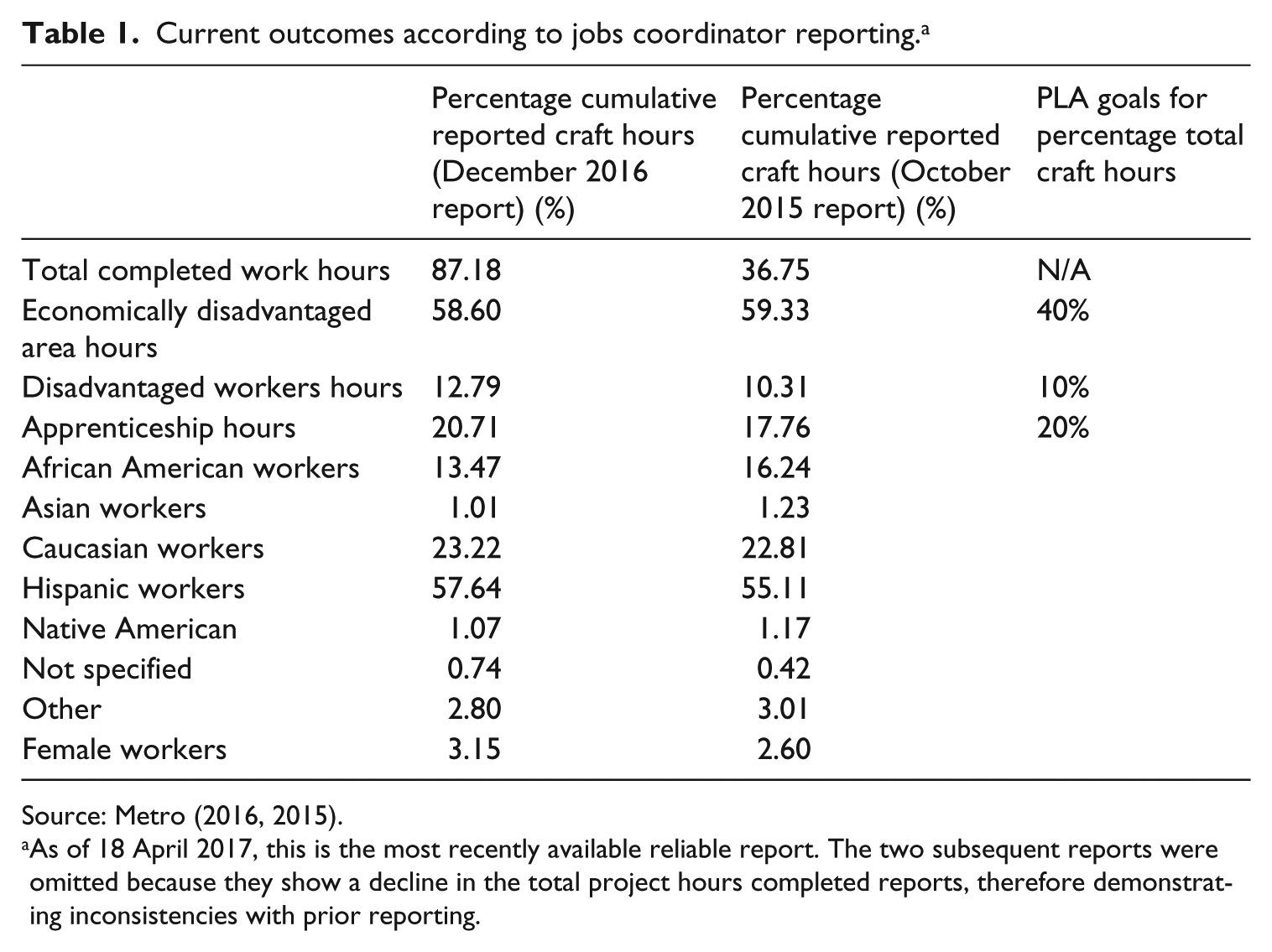
Source: Metro (2016, 2015).
As of 18 April 2017, this is the most recently available reliable report. The two subsequent reports were omitted because they show a decline in the total project hours completed reports, therefore demonstrating inconsistencies with prior reporting.
The means by which data are reported obscures many important factors, including that different quality jobs are stratified across race and gender. Reporting by the percentage of total payroll, rather than project hours completed, would reveal this information. Jobs are reported by “craft hours,” which makes tracking individual workers across a task and observing job creation extremely challenging with the available data 7 (Hymon, 2014; Metro, 2014d). In sum, the reporting format makes it difficult for outsiders to observe the labor outcomes produced by the PLA, including the quantity and quality of jobs produced.
Metro staff express reluctance to report by total workers. Since construction work is often temporary, reporting data by total workers may prove misleading, since it would not distinguish brief hires from those employed for months. Community groups continue to press for this data, to track the number and types of careers created, which they emphasize is the ultimate goal of the community benefits within the PLA. Metro has indicated that it may give this information, but only after “educating the public” about data interpretation, since misinformation proved disastrous around the initial jobs created estimate (Interview with Respondents 3 and 8). While it makes sense for the agency to hope that the numbers released would become part of a dialogue between the agency and the intended agreement beneficiaries, the idea that people need to be educated before they are allowed to see the numbers renders them into a largely passive role in deciding when and whether they are, or are not, able to meet Metro staff’s ideas about what numbers they can understand in the context of the agreement.
Moreover, data reporting obscures job quality and workforce training. Access across job type matters, since light-rail line construction requires a varied workforce, such as electricians, operating engineers, sheet metal workers, laborers and painters. These jobs differ in pay, education, skill level, risk and potential for career growth (BLS, 2014). Therefore, while Metro has released more data as the project has proceeded, important outcomes still remain obscured from public scrutiny (Interview with Respondent 1).
One community organization, concerned that other PLA stakeholders will neglect their commitment to local, disadvantaged workers, has undertaken burdensome efforts to monitor and enforce the PLA as a watchdog. Initially, this organization attempted to gain a formal role in implementation, such as through an oversight committee, which Metro did not allow (Interview with Respondent 4). By disallowing community organization members a formal, institutional role in agreement adjudication, Metro increased the potential for rendering the agreement tokenistic despite Metro staffers’ good faith attempts to comply with the agreement and meet disclosure requests.
Observing worker characteristics is difficult without direct access to construction sites, particularly as construction work moves into underground drilling phases. Regardless, the community organization is using their observations to create public reports to question Metro’s data and PLA outcomes. In one example, community monitors found that most female workers appeared to be working as laborers and flagging, which is relatively unskilled work. This raised questions about jobs distributions across trades (laborers earn less than workers in other trades) and whether marginalized workers are developing skills to gain future jobs and promote within the trades, consistent with the original agreement goal of creating career opportunities. To their credit, the agency and prime contractor have granted the community organization some access to the site for observations (Interview with Respondents 4 and 10).
Metro staff members assert that this organization’s role is fundamental to PLA implementation, improves the agency’s information, and pushes Metro to go further in its implementation efforts (Interview with Respondent 1). The community organization maintains this watchdog role and somewhat adversarial relationship, and recognizes the gains made by the agreement and Metro. However, it continues to push Metro for full compliance to the PLA targets, and in particular hiring Black workers, women and apprentices, consistent with what they argue is the spirit of the agreement (Interview with Respondents 1, 4, and 8).
Despite this somewhat contentious, ongoing implementation process, political leaders and media reports have long since characterized this PLA as an overwhelming success. Just after the PLA was approved in 2011, then-Los Angeles Mayor and Metro Board Chairman Antonio Villaraigosa stated, “This landmark program is part of a strategy to deliver public transit projects while creating jobs that will lift people out of poverty and into the middle class” (Weikel, 2012). The Los Angeles Times and local news outlets ran numerous articles that cite the PLA as a major victory for the communi that benefits residents through local job creation while simultaneously investing in valuable infrastructure (Griffin, 2012; Miller, 2013; Nelson, 2014; Streeter, 2013; Weikel, 2012). Both the Secretary of Labor and Secretary of Transportation have also visibly promoted the PLA as a national model for local hire that should be replicated nationally. One female apprentice, a single mother who was chronically unemployed, has become a public exemplar of hiring success on the project. She was invited as a special guest of First Lady Michelle Obama to the 2015 State of the Union Address in Washington, DC, and met with the Secretaries of Labor and Transportation (Foxx, 2015; Kirkham, 2015; Ubaldo, 2014). This public narrative, initiated before any worker was hired on the project, does not accurately reflect the ongoing implementation process, in which community activists continue to question the extent to which their interests are being met and how much influence they actually have over benefits distribution now that the project has moved forward.
Such controversy has added to tension over worker visibility, transparency, and accountability. As community respondents noted, worker visibility is an end in itself; it matters that this historically marginalized, African American community, with deep institutional mistrust, “sees itself” in this large-scale, local project (Interview with Respondents 4 and 8). While Metro contends that many local workers are working underground, efforts like that of the referent community organizations, to monitor African American worker hiring on the Crenshaw Line project, remain valued within this community. As one community respondent clarified, this is an issue of community residents being empowered to identify problems in implementation, express them to their representatives and be heard, and witness change because of their actions. One respondent gave voice to her concerns about tokenism:
We’re taxpayers just like everybody else, but our voice gets drowned out by the Westside and the Valley and folks who have had institutional access to power at City Hall for a lot longer than we have … It comes down to: this is our community, you’re literally tearing up our streets where we drive every day, where we walk every day. We need to see our workers, who have been historically pushed out of the trades for many, many reasons, some of them have to do with Metro, a lot of them don’t, but we need to see our workers on these jobs. And we need to see community benefit because we, just us, we are going to struggle through this five-year project. You know? We need to be able to have enough power at these places to say this is what we need, and to see response. We all have enough power to walk into a public meeting and say what we want to say, but are people paying attention? Are people actually taking our voices to be important enough to actually evaluate how they’re doing and to say: we can make a change here. (Interview with Respondent 8)
Concerns about co-optation and rhetorical trickery persist, as well. In late 2014, Metro posted large posters at light-rail construction sites along major roads promoting its successes at hiring and training underrepresented local workers (Figure 1). Metro staff members contend that the agency installed the posters “multiply the effect” of worker hiring, and increase visibility to address community concern (Interview with Respondent 3). However, these massive public displays can suggest to those outside the community that PLA outcomes have already been achieved, with Metro serving the local community. The posters do not address the underlying problem of visibility: the ability to observe how many African Americans are actually working on the Crenshaw project, and how to remedy institutional distrust. Regardless, the agency emphasized that the action was undertaken to address a genuine community concern (Interview with Respondent 3).
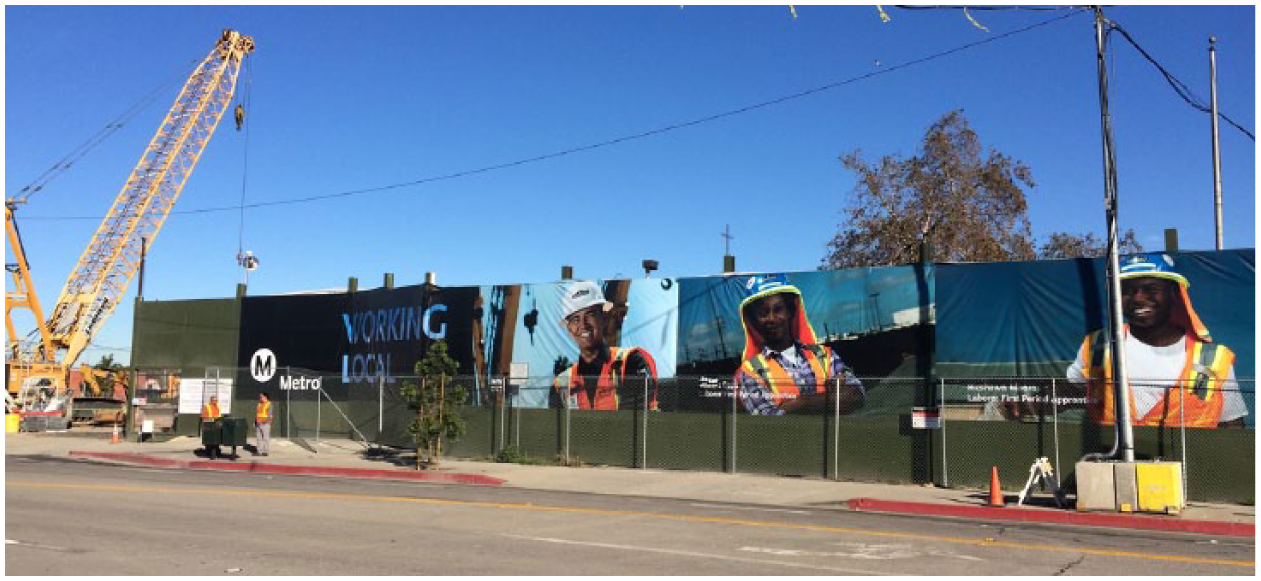
Metro construction site billboards.
In this way, Metro can promote a message via regional media (whether unintentionally or not) that implies that simply passing the PLA successfully delivers the promised community benefits. This message, sent to democratic majorities outside the community itself, is hard for the community to dispute, as local residents and organizations lack a similar, public platform for contesting Metro’s assertions about successful jobs delivery in general, let alone jobs for disadvantaged workers. Community representatives who complain or challenge the success narrative can become readily discounted as malcontents, particularly by those who may already oppose preferential hiring practices.
In nonideal contexts, agreements such this PLA, if they are to be more than tokenism, have to maintain community influence in defining what implementation success and failure mean. Metro, for example, would never agree to contract with a consultant where the consultant retained sole control in deciding whether they had delivered the promised work. Instead, Metro retains the ability to withhold payment until they approve of the deliverables received. Public projects are not the same as agency procurement, nor are we advocating for agreement implementation to devolve into bean-counting in the name of accountability. The opposite—explicit acceptance that benefits fulfillment is a complex extension of deliberation itself—makes more sense (O’Neill, 2002). Community influence in determining whether benefits have resulted, and how the agreement process is represented to external constituents, partly marks the difference between a deliberation that has committed to sharing managerial control, however nonideal the starting conditions and however difficult implementation becomes. Failure to deliver, when community influence over interpreting and managing the outcomes is minimized, marks the type of agreement that Purcell (2009) problematizes. It is not inevitable; Metro seems to have done more here than many, similarly positioned agencies would, and in general, Metro staff appear to sincerely support the concept of sharing benefits and supporting local labor development. Staffers, too, are subject to higher level administrators and politicians who guard managerial and narrative control over projects, information and the agency’s public reputation. They have a strong interest in claiming success from this agreement, as do many others, including unions and transit boosters in Los Angeles.
Conclusion
Scholars have previously argued that large-scale public spending, such as the Metro project, calls for “heightened scrutiny” and a greater focus on equity (Fainstein, 2010: 173; Soja, 2010). Benefits-sharing agreements such as the PLA described here implicitly embody a nonideal approach to incrementally altering distributions, and by extension, distributional justice. By definition, these agreements exist within circumstances and institutional contexts that do not meet the ideal theory threshold for socially just distributions, with full compliance and no historical legacies of maldistribution. Objectives such as increasing access to good jobs for disadvantaged individuals do not equalize historical inequality, but seek to mitigate its contemporary effects and offer some individuals benefits from public investment from which they have been barred previously. Therefore, these agreements aim to make progress toward better distributions, even if not achieving ideal distributions. Implementation influences the outcomes produced, introduces feasibility constraints and unforeseen outcomes, and can vary dramatically, determining the extent to which this policy effectively addresses either historical injustices or contemporary inequalities (Robeyns, 2008). In this article, we have used the lens of nonideal theory to raise three central concerns that may arise during implementation and undermine an agreement’s progress toward justice.
While benefits-sharing agreements specify an end-state within the policy and the context—to allocate a certain amount of benefits, such as jobs or housing, to a specific population—they do not specify the ideal end-state for society or for the group in question within society. Therefore, when a policy fails to realize its specified goals, it is not falling short of the unattainable ideal theory specifications, which nonideal theory permits. Rather, when these agreements fail to meet their goals, they are falling short of a nonideal, transitional approach, with agreement terms often specified by and at the expense of oppressed communities.
Yet “complete” or “ideal” implementation may not be feasible, and partial implementation occurs frequently in planning (Fainstein, 2010). However messy allowing community representatives a formal role in project oversight might have proven, it may, in the long-term, have been a better way to engage with community members in dialogue to reach consensus about sufficient agency compliance to the spirit, if not the letter, of the agreement. With community and advocacy organizations in an advisory role, and continued agency promotion of its own success, Metro risks perception that the agreement has devolved into tokenism and rhetorical trickery. Agreement noncompliance, combined with the conditions specified by nonideal theory, can produce the worst possible outcome when viewed through the lens of distributive justice. In this case, another set of perceived-broken promises enters into the impactful historical legacy of broken promises in a neighborhood that planning in Los Angeles has failed time and time again. Given the upward pressures on land values, and potential local gentrification and displacement, the community may wind up believing they received very little—and they may be right.
We are not counting Metro out, not just yet. The project is still in construction. Planning and project management staff in the agency appear committed to delivering and disclosing job outcomes. Political leaders have made high profile claims about the efficacy of the program. Some of those leaders remain in office, and others who have left have been angling for higher offices. South LA’s county supervisor has been an avid supporter of the PLA, and he routinely asks for job creation updates from Metro staff and contractors. That arrangement for monitoring progress, however, may vanish if the supervisor loses interest or leaves office.
The early research on benefits-sharing agreements has frequently reported disappointing results. Our case and theory suggest reasons why community advocates continue to fight for these agreements despite past compliance issues. 8 Long-term community organizing to change neoliberal real estate development and booster local democratic management, as crucial as it is, may be some time in obtaining benefits. If or until that happens, asking for targeted benefits may be, simply, better than nothing for people, like many South LA residents, who need immediate local investment and opportunities. While community influence may be fragile in the Metro case, some local residents have gotten new opportunities, and while less than ideal, those opportunities do matter to those that obtained them.
Planners and public managers deliberating these agreements with communities could readily retain community representatives in project outcomes evaluation through formal oversight roles (Fine, 2014; Luce, 2005, 2012; O’Rourke, 2002). If these agreements are to successfully improve distribution outcomes, planners and project sponsors must help design the institutional and procedural conditions for that transition, not community representatives, who may be unfamiliar about what to ask for in terms of oversight during implementation, such as the power to review, challenge, and/or approve subcontractor reports or press releases about performance. 9
Throughout, viewing these agreements through nonideal theory reminds us that justice necessitates action. Past injustice contributes to contemporary harm for individuals and communities. New planning projects risk perpetuating a legacy of harm and exclusion unless interventions improve planning processes and outcomes. Therefore, clarity about what benefits agreements might achieve in a highly imperfect world can help planners move project development agreements toward more just outcomes.
Footnotes
Funding
This research was supported by funding from the John Randolph Haynes and Dora Haynes Foundation, the Labor Action and Research Network, and the Judith and John Bedrosian Center at the University of Southern California.
Notes
Author biographies
Jovanna Rosen is a postdoctoral scholar at the Sol Price Center for Social Innovation at the University of Southern California. Lisa Schweitzer is an associate professor in the Price School of Public Policy at the University of Southern California.