




Abstract
Hardin was wrong. There was not a tragedy of overuse. The Commons were dismantled by the state to make room for the formal economy and higher income user groups. I revisit the history of the Commons as a central, planned space in cities in order to ask two main questions. First, what role did the Commons play for cities and how is its lost felt? Second, how might planning reintroduce the Commons? In response, this research builds a functional theory of self-sufficiency at multiple scales of governance based on the opportunities of the Commons. The conclusion charts an urgent agenda for planning practice during a global population phase shift as cities increasingly house a greater proportion of humanity.
Hardin was wrong
Continuing the tradition of Nobel prize–winning Elinor Ostrom (2015; Cox et al., 2010, 2016), I offer empiric evidence that Garrett Hardin lacked. His 1968 article was sloppy and tired. His thesis is an old one, dating back to Malthus—and likely before: 1 There are too many people who want to make use of common resources. Without drastic action, they will run rough-sod over the resource to its and their own demise. This argument has misled for a very long time, obfuscating science with poor hypotheses that masquerade as theory, never fully validated with empiric evidence. Yet, like today’s false new stories (Vosoughi et al., 2018), Hardin’s sensationalist narrative appears to have circulated faster and further than the truth. Citation analysis shows that Hardin’s “Tragedy” is continuing to be cited in ecology, economics, biology, and other physical science disciplines (Costanza et al., 2004; Fidelis, 2018). His premise has wormed its way across disciplines and genres. Even the latest Marvel box office movie—Avengers: Infinity War—features a Hardin-esque supervillain who purges the galaxy of half of all life in the name of resource conservation. To build science on faulty theory is quite dangerous. For the popular imagination to be caught on false logic is far worse.
In order to make room for new imaginaries, this research first revisits the spatial population dynamics that Hardin misinterpreted. Next, I leverage historic and current case studies of the Commons. The cases highlight the similarities between Commons, informal settlements, slums, and Freetowns with the main difference being that the Commons were designated spatially by formal planning and centrally located. Although separated by 300 years, the cases also reveal the important role that Commons play in allowing self-sufficiency, particularly when the state and formal economy fail. In distilling lessons from the cases, I propose a theory on the Opportunity of the Commons. The concluding agenda details how planning might promote self-sufficiency in basic resource use for energy, food, water, and housing.
The agenda is urgent. Cities prepared, or not, are sheltering more and more of the human population, particularly those who have moved to urban areas desperate and poor as refugees of climate change, war, and evaporating rural livelihoods. Current politics reveal that cities are vulnerable in these dynamics as they negotiate for the care of urban poor with increasingly reticent nation-states and private markets. The Commons may have an important role to play in decreasing urban reliance on other scales of governance during this dramatic population shift.
The population phase shift
Where Malthus, Hardin, and Erlich erroneously feared a “population bomb,” Rosling et al. (2018) and others have demonstrated a sigmoidal growth curve. We are now in the phase shift away from exponential growth to a leveling off of population growth. Moreover, population growth is not the direct contributing problem to resource degradation or starvation, as Hardin presumed. Where Hardin saw the poor masses as spurring resource degradation through over-use, evidence shows that it is the wealthy. The wealthiest 10 percent of people produce half of the planet’s individual-consumption-based fossil fuel emissions, while the poorest 50 percent — about 3.5 billion people — contribute only 10 percent according to a study by Oxfam (Gore et al., 2015). Correspondingly, uneven resource distribution (not insufficiant supply) results in human suffering and loss of life. The world’s worst famines have been precipitated by failures in governance as evidenced by the Soviet Union’s experimentation with farming collectivization, resulting in the deaths of between six and 13 million people (Fitzpatrick, 1996) and China’s Great Leap Forward, which spurred a famine that killed an estimated 36 million people (Jisheng, 2012).
Neither does privatization appear to be the cure Hardin (1968) presumed with his conclusion: “the tragedy of the commons … is averted by private property, or something formally like it.” When considering global greenhouse gas emisisons, Griffin et al (2017) found that 100 companies have been the source of more than 70% of the world’s greenhouse gas emissions since 1988 – the year the Intergovernmental Panel on Climate Change was established. Abetted by the nation-state, formal economic markets are driving increasing inequality in wages, cost of living, and savings. From 1980 to 2016, the poorest half of the population has seen its share of income steadily decline (Alvaredo et al., 2018; Chetty et al., 2018), while the wealthiest 1% of the world’s population now owns more than half of the world’s wealth, according to a Credit Suisse report.
An important population dynamic that Hardin overlooked is the urbanization of humanity and its broad impact on the politics of resource allocation. Humanity surpassed 50% in urban areas in 2010. Future projections are being adjusted as new data show that 70% of humanity will be urban by 2050.
As cities grow in population, so does the strain between them and nation-states over wealth generation and distribution. The seeds of urbanization’s tension began with federalism. Cities, with more people, negotiated taxes and social services with rural areas that had fewer people and more land. The debate has further deepened as the proportion of humanity that lives in urban areas grows, but representation in nation-state politics shrinks. Recent elections in the United States have highlighted that cities have lower turnout rates for voting than rural areas. Compounding this, more populous states have less representation per capita than more rural states (Geys, 2006). The presidential election of Donald Trump is a further manifestation of the rural-urban divide, as cities have increasingly voted Democratic while their rural counterparts voted Republican (Kron, 2012). Rural and Republican animosity to cities is a recurrent theme in politics made palpable in Trump’s a 2016 campaign debate, where he asserted that “cities are a disaster … They have no education. They have no jobs.” Never mind that Jane Jacobs (1985) described cities as “the wealth of nations” on the basis of their ability to provide jobs and education. In support of Jacobs, just 259 US cities are responsible for about 85% of the country’s gross domestic product (GDP; Manyika et al., 2012). Much of that wealth gets circulated to states and the federal government and then bargained back in services.
While cities are growing in population, generating wealth, and decreasing in nation-state representation, the dynamics of power are shifting. The shift has prompted many keynote speakers at this year’s Association of Collegiate Schools of Planning (ACSP) and Association of European Schools of Planning (AESOP) conferences to deliver impassioned pleas to save cities, which are depicted as under the yoke of nation-state tyranny. Though cities generate the nation’s wealth, they are also not building fast enough to house the influx of new people. Social services are lacking. Child homelessness in the United States has surged to an all-time high with 1 in 30 children experiencing homelessness (Bassuk et al., 2014). Rising city pension fund obligations offer an excellent example of cities reorganizing their budgets to provide services that the nation-state and private market do not. Yet, cities also shoulder the vulnerability of such obligations. Globally, the United Nations Human Settlements Programme (2003) estimates that by 2050, nearly half of the 6.4 billion people living in cities will live in slums, double the current slum population. With federal aid being rapidly removed from social services, cities need to reinvent how they care for the urban poor, the “commoners” who once subsisted off the Commons.
The real fall of the Commons
One thing that Hardin did get right is that the Commons fell. The fall had little to do with depletion of the common good resource. Using city ordinances, court cases, news articles, and images from the 1600s to the 1930s, we (Brinkley and Vitiello, 2014) have pieced together the history of the fall of American Commons. A better understanding of the events leading up to the fall can teach us about collective action and resource management today, helping to correct for a cognitive blind spot in the planning field, and thereby reframing urban history, theory, and the resulting practice of planning.
In the case study section, I narrowly define the “commons” based on its epistemological origin as a designated place: the Commons. The term itself delineates a planned area central to most early cities. For example, Paris’ Montmartre Commons housed pigsties and chicken coops, processing the city’s organic waste into compost while boosting urban food supplies (Sanborn, 1905: 273). The term likely has earlier origins, as many tribal villages also designate a central shared space. The Law of the Indies (1542) continued the tradition of designating Commons into city plans during the colonization of the Americas. This intentionally undeveloped space was to be managed, not by the state, but by the users for pasturing animals. Later iterations of Commons included the four central parks in Philadelphia originally design by William Penn in the 1600s (Holme, 1683). Ralph Waldo Emerson, a famous American Romantic poet, pastured his grandmother’s cows on the Boston Commons (depicted in Figure 1). Emerson famously quipped, “the cows laid out Boston” not surveyors ( Emerson et al., 1971 p. 105). The Commons that Fredrick Law Olmsted redesigned into New York’s Central Park contained a dairy where children could get fresh milk into the 1930s.
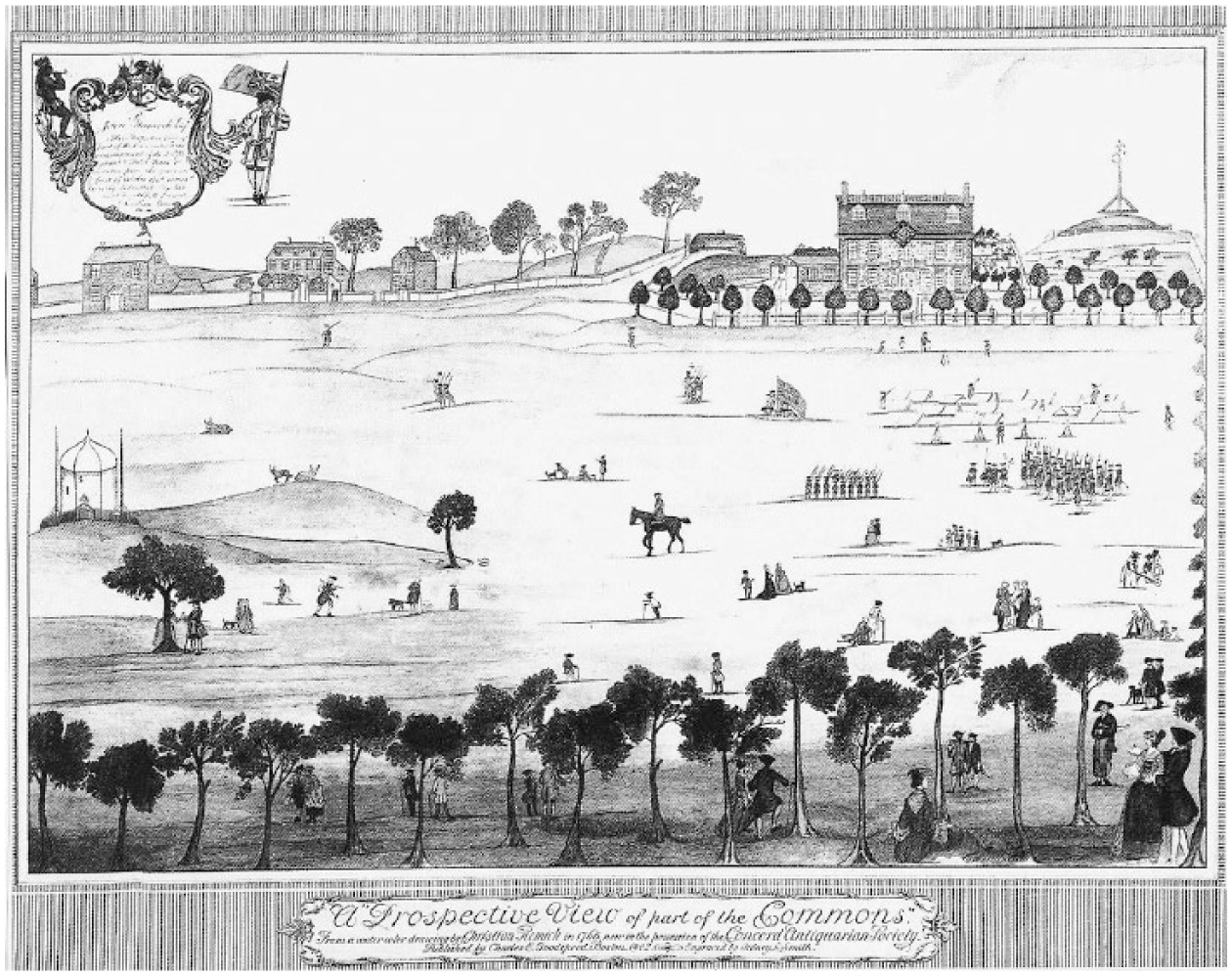
Boston Commons.
This narrow definition of place is not to be confused with Commons-associated goods or transactions, which may be taxed by the state in a formal economy or left untaxed in an informal economy. Indeed, the literature often muddles terms for Commons as place, commons as a collective governance practice, common public goods, or the commons as a market (Lant et al., 2008). In part, this is often because the informal economy is supported by the Commons, and the commoners are the laborers. Because place is under the purview of planning, I focus here on the Commons as place.
The original Commons did not embody the romantic pastoralism so frequently invoked. The Commons was a dump. Where today’s New York Central Park sits, there was a large bone boiling operation as the city’s slops were collected and processed before feeding to pigs (McNeur, 2011, 2014; Figure 2). New York’s Commons were also home to over 5000 Native Americans, Blacks, and Whites—all low income (Brinkley and Vitiello, 2013). Indeed, many of the Commons were what literature might refer to as slums or informal settlements today with the key difference that Commons were a central location designated by the city-state through planning.

Lithograph of New York’s Commons before the design of Central Park, Year 1860.
Residents supported the Commons, noting that the rapid processing of the city’s waste not only added “purity and salubrity to the air, but infinitely to the convenience and accommodation of the city inhabitants” (“For the American Daily Advertiser,” Poulson’s American Daily Advertiser, 5 December 1817). A quote to a reporter at the New York Times in 1865 noted that neighborhoods near the Commons were “one of the most healthful in the city” because pigs promptly processed the waste, which would have otherwise rotted in the streets.
Although beneficial, the Commons were also a nuisance. Wealthier neighbors charged that the Commons depreciated nearby property values, driving wealthy residents out of the city. New York’s upper class desired the central location for a different use—one that would not include the smells of waste management or high density of low-income people. In addition, there were public health concerns over the co-occurrence of hog cholera and human cholera cases due to poor water and sanitation infrastructure. Public health proved a powerful, though inaccurate, argument for removing the Commons. Hog cholera could not be transmitted to people. Indeed, the very first study conducted by the newly formed Rockefeller Institute showed that inner city farms supplied less polluted food than that shipped in from the countryside, which was often adulterated and warmed without refrigeration on its way (Childe, 1902).
The commoners did not let the Commons go without a fight. Multiple attempts were made in what a Philadelphia newspaper called “the war over swine.” In New York, a newly elected mayor sent 100 police officers to burn Irish shantytowns, slaughter animals, and spread lime on the ground. Political organization on behalf of the Irish immigrant community through Tammany Hall politics saw that this mayor was replaced with one more favorable, and the Commons sprang back to life, a testimony to their necessity. The New York Times (1865) exposé chronicled the events in a series of articles titled “Squatter Sovereignty,” noting that over half of the tenement housing relied solely on animal agriculture on the Commons for their food and livelihoods.
The appropriation of the Commons intersected informal housing, waste management, and immigration. Above all, the Commons represented a right to access the economic and cultural opportunities provided by the city. The Commons provided a place for the urban poor to live and work. When attempts to end the Commons succeeded, neighbors complained about an unhealthy miasma as slops went uncollected, rotting in the street, and disease spread.
Importantly, the Commons could not be untangled from the city until the state grew. Cities sprouted departments of public health, sanitation, waste management, and urban planning that were empowered to write and enforce municipal ordinances. Whole disciplines were birthed to untangle the Commons from the commoners, including social workers, veterinarians, housing inspectors, and educators. As the state dismantled the sovereign food supply and livelihoods of the urban poor, it was forced to replace systems of self-provisioning with public–nonprofit partnerships such as Alms Houses, and later government food aid programs. It is telling that the flock of sheep that graced New York’s Central Park were removed by none other than Robert Moses, the architect of New York’s urban renewal. In addition, the previously informal and low-cost services provided by the commoners and the Commons needed to be taken on by the state for wealthier communities as well. Formalized waste management represented a large line-item cost on government budgets.
Hardin misdiagnosed the use of Commons as a tragedy where he should have seen opportunity. Instead, he saw opportunity in the dismantling of the Commons where he should have seen the exacerbated tragedy of displaced, hungry, out-of-work urban poor. As scholars of urban renewal and slum clearance have noted, tragedy is manufactured for the poor when they are deprived of their livelihoods and homes in order to marginally expand the coffers of those who are already well off (e.g. Greene, 2003; Macharia, 1992).
There are important lessons to be learned where the informal is replaced by a proliferating state, where poverty is criminalized, and where the poor are stripped of their sovereignty. I propose two thought experiments. The first, what would a city look like if the Commons persisted? The second, what might recommoning entail?
Cairo: continuing the Commons
First, imagine that at the heart of the city, there is an informal economy with pig-feeding operations. This high-density, low-income community has privileged access to the culturally important city center, and small-scale diverse informal businesses thrive. This is the story of Cairo’s Zabaleen. They recycle municipal waste at rates higher than the most advanced European systems, thereby reducing greenhouse gas emissions and tightening waste recovery streams. The privatization of Cairo’s Commons was followed by trash in the streets, civil unrest, and the Arab Spring.
In the early 1900s, two groups of migrants, the Zabaleen and the wahiya, joined to collect municipal waste in Cairo to use as fodder for pig farming (Assaad, 1996; Haynes and El-Hakim, 1979, Moates, 2010). In the 1990s, the city government created an agreement formalizing this waste collection service (Fahmi and Sutton, 2010). It is estimated that this waste service handled one third to one half of Cairo’s waste (EQI, 1991; Van de Klundert and Lardinois, 1995) for 14 million clients, mainly in low-income areas (Golia, 2004). Collecting 3000 to 6000 tons of waste daily, with 85% recycling rates through microbusinesses, 60% was food and organic waste for the pigs (Assad, 1996; Didero, M., 2012; EQI 1991; and Fahmi and Sutton, 2010). To add to their business, every 6 months, the waste collectors sold adult hogs to traders, earning over a month’s garbage collecting salary per pig.
The Zabaleen typically collect waste door to door by foot or donkey cart through the narrow streets in Cairo (Christensen and Kjær, 2009). Cairo has one of the highest urban densities of any of the world’s megacities due to the compact, centralized Commons (Figure 3). The rapid population growth in the last decades has seen Cairo further expand in size and density (Haynes and El-Hakim, 1979: 101; Megahed et al., 2015). In 2004, it was estimated that Cairo had 909 slum areas, housing more than 5.5 million people (GTZ (Deutsche Gesellschaft für Technische Zusammenarbeit GmbH), 2010: 19). Compounded with poor transportation infrastructure such that only 25% of the roads were paved in the 1970s, many neighborhoods are difficult to reach by vehicle and lacked modern sewer, electricity, and waste infrastructure.
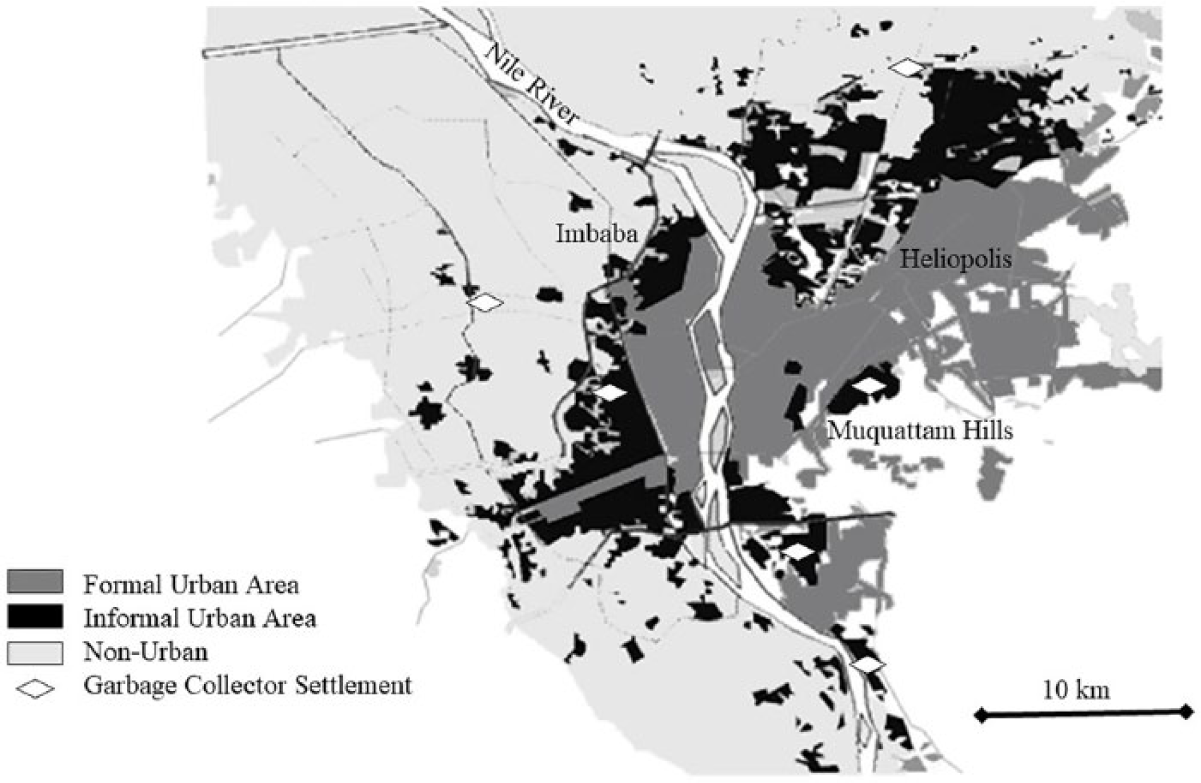
Location of Cario’s informal settlements and garbage collector settlements.
The “Garbage City” within the Muqattam Mountains lower plateau is relatively centrally located (Figure 3), near Cairo’s historic quarters and many tourist-centric urban rehabilitation projects. Property development companies desired the land for redevelopment and pressured the government to relocate the Zabaleen (Fahmi and Sutton, 2010). At the same time, there are concerns for the health and well-being of the Zabaleen. A 1981 study by Environmental Quality International showed the mortality rate of Zabaleen infants to be nearly 3 times the average in Cairo. Yet, researchers noted that many of the health risks the Zabaleen incur may be more related to a life of poverty and poor living conditions rather than occupational hazards involved in handling waste (Binion and Gutberlet, 2012).
In response, city officials planned to privatize waste management services and redevelop medieval Cairo (Sutton and Fahmi, 2002). In 2002, the Zabaleen began losing their licenses as part of this official development strategy. Plans also included removing the Eastern Cemetery’s tomb dweller shanty towns and informal Zabaleen settlements. Multiple international waste companies signed 15-year contracts for millions of dollars to collect and process Cairo’s waste (Fahmi and Sutton, 2010). Foreign companies would only be required to recycle 20% of waste collected, whereas the Zabaleen had recycled upward of 80% (Fahmi and Sutton, 2006). While the private companies planned to contract with the Zabaleen and employ them at higher rates than they normally earned, these plans rarely came to fruition. The Zabaleen who worked in collection services reported earning less than half what they used to earn (Fahmi and Sutton, 2013) and clients complained of disruptions and irregular waste collection services as the international companies struggled to navigate the narrow streets and low-income neighborhoods. After a Zabaleen protest in 2003, several international waste companies subcontracted with the Zabaleen to collect the waste and allowed them to search the landfill sites for organic waste to be used in their pig-feeding operations. The waste reform had failed to transform the collection procedure and had added a costly line item to the city budget in the form of supplementing international middlemen while reducing the amount of waste recycled.
In 2009, the H1N1 “swine flu” pandemic, which swept from Mexico across the world, created another opportunity for public officials to reform waste management. The Egyptian Agricultural Ministry, at the behest of President Hosni Mubarak, ordered the slaughter of all pigs in April 2009 through an appointed “Cairo Beautification Authority” (Leach and Mariz, 2014, Slackman, 2009a and b). The enforcement was similar to that experienced in New York’s Irish Commons 150 years earlier. Pigs were pushed from buildings and buried alive in pits. Between 190,000 and 300,000 pigs were killed, and 70,000 Zabaleen families were impacted. Government compensated the farmers as little as from one-twentieth to one-fourth the market value of the pigs (Fahmi and Sutton, 2010). All pork processors and retail outlets were mandated to close, leaving the Christian minority making up nearly 10% of Cairo’s population questioning the motives of the cull. World Health Organization officials announced that H1N1 could not be transmitted from pigs to humans, and the Food and Agriculture Organization of the United Nations denounced the cull. Nonetheless, the government persisted in its removal of Zabaleen settlements, changing its rationale from one of public health to blight removal.
The threat of swine flu was replaced with the threat of typhus from the rotting organic debris accumulating in the streets. The Zabaleen protested their diminished livelihood and food source. Journalists and nonprofits documented signs of malnourishment in Zabaleen children (Fraser, 2009). Rotting food accrued in the streets of low-income neighborhoods such as Imbaba (Figure 2) and middle-class neighborhoods such as Heliopolis (Slackman, 2009a and b; Figure 2). Members of parliament spoke out about the cull and displacement. The dirty streets and civil unrest contributed to the Arab Spring in 2011. After Hosni Mubarak’s government was replaced, journalists began reporting that Zabeleen waste management firms were once again cleaning the streets of Cairo (Chiaramonte, 2013; Guénard, 2013; Kingsley, 2014a and b), demonstrating the sustainability of the business model against the backdrop of uncertain city infrastructure.
Durable Commons
While separated by over 200 years, the disruption of Commons in early American cities and current-day Cairo has similarities that are reiterated in many other places across the world. More than a quarter of the world’s four billion urbanites today live in “slums,” also termed “informal settlements” or “freetowns.” 2 Informal waste collection is prevalent, and perhaps even well adapted to low-income, dense, environs with narrow streets and few formal city services (Rogerson, 2001; Katusiimeh et al., 2013; Nas and Jaff, 2004; Wilson et al., 2006). Animal waste feeding is a complimentary practice (Medina, 2000) and operations are often managed by the informal sector and concentrated in slums (Losada et al., 1998). In the Global South, it is common for municipalities to spend 20% to 50% of their available recurrent budget on solid waste management (The World Bank, 2015). Yet, it is also common that 30% to 60% of all the urban solid waste is uncollected and less than 50% of the population is served (The World Bank, 2015). While local governments may be eager to “modernize” away from animal-feeding garbage services as rapidly as possible, it is important to note that the process for Philadelphia took over 100 years. Indeed, some waste experts encourage informal sector involvement (Wilson et al., 2009). In the case of Cairo, efforts to rapidly replace the Zabaleen with international waste services had detrimental impacts across the city, for clients, the Zabaleen, and the policy makers themselves.
If we reframe from tragedy to Opportunity of the Commons, we are allowed to see the potential of the Commons to provide when state and private aid is not available. The Commons itself is nested in the city, and negotiates with the city-state. As the cases above demonstrate, where the city-state cannot (or will not) provide for the urban poor, the Commons have traditionally offered a path of self-sufficiency.
The cases above help elucidate the importance of self-sufficiency at multiple scales of Ostrom’s polycentric governance models (Borch and Kornberger, 2015; Foster and Iaione, 2015). As many have asserted, the city is “a commons” in the sense that it is a larger scale version of the Commons and follows Ostrom’s (1990) eight design principles of collective governance over space (pp. 58–102). 3 Indeed, the right to the city is now being framed as a right for the poorest residents to partake in “urban metabolism” (Schillington, 2013), which includes access to a job, amenities, and the services that the nation-state offers in cities at a high density through education in public schools, museums, public art. The city is, in turn, nested in the nation-state, another scale of collective governance over a territory. At larger scales, nation-states negotiate governance power with private landowners, often represented by transnational corporations. Indeed, over 70% of land in America is privately owned, and in the last decade, the 100 largest private landholders have doubled their holdings and now own over 40 million acres, roughly equivalent to the six states northeast of New York (Ingraham, 2017).
At each scale of governance, self-reliance is implicitly and explicitly encouraged. Self-sufficency in food supply at multiple scales of governance provides a powerful example. After the 1972 food crisis and global market turmoil, many nation-states began stockpiling grain and instituting national self-sufficiency policies (Tyers and Anderson, 1992). Similarly, cities must be self-reliant when nation-states collapse or fail to respond. Examples of successful city–region self-sufficiency are shown in the small-scale, local farming that supported war-time Berlin, economically dislocated Russian cities, and embargoed Cuba (Brinkley, 2013). Emphasis on self-reliance occurs in partial recognition of the inequality and fragility of large-scale networks of resource extraction and distribution, which leave many communities, especially low-income communities, without access to the basic essentials of food, water, energy, and housing.
Here, it may be important to note that the nation-state scale of governance is new. Before the 1700s, empires loosely held territories. Many nation-states were forcedly carved out by other nation-states. For example, representatives of 13 newly formed European states and the United States of America, divided up the African nations “in accordance with international law” (Fischer, 2015). The scale governance at which multi-national corporations is operate is even more recent as evidenced by the rise of global food industry with advancements in transportation and refrigeration (Donofrio, 2014; Vitiello and Brinkley, 2013). Consolidation of power and governance at the multinational scale is appears to be ongoing (Howard, 2009).
Comparatively, cities are older and enduring. They have miraculously sprung back to life despite fire, famine, plague, and war. Commons are moreso. In his book The Durable Slum, Weinstein (2014) notes how informal settlements are often able to survive disasters and multiple attempts by the city-state to dismantle them. Indeed, the Commons have been fundamental to the survival of the commoners and the cities that depended on them and the informal economy.
Commoning
I draw distinctions between the formal designation of Commons and the creation of squatter encampments. Commons are formally designated spaces. When space is not designated for the urban poor through Commons, it is nonetheless created. The use of both spaces is the same: low-income people are driven toward self-sufficiency and the informal economy in the absence of other options. Roy et al. (2014) review the reasons that slums form. Many slums began because the formal economy failed to make room in land, housing, and job sectors for immigrants, refugees, and rural-to-urban migration. Simlarly, the historic Commons were space where people could build their own houses, and partake in the informal economy, which goes beyond the waste management examples above to include construction, childcare, housecleaning, sex work, mining, and agricultural labor. At smaller scales, squatting occurs whenever and wherever the state and market fail to provide services and do not police use. Mattei and Quarta (2015) provide the example of an abandoned factory in Pisa, Italy, that was occupied and transformed into a library, tailor, school for migrants, nursery school, bicycle mechanic, farmers market, restaurant, and gym. Denmark’s “Freetown” of Christiania is another example, where housing-stressed families occupied an unused military base and built their own housing (Wasshede, 2017). Where communities feel that the state or private owner is not caring for a space, they occupy it, reasserting a more localized control and challenging the state by evoking “squatter’s rights” through “temporary use” laws.
Nuisance law is the legal mechanism for disbanding both a Commons and a squatter encampment. As the case studies demonstrate, what one group finds to be a nuisance, another may depend on for sustenance or housing. At all scales, dismantling takes the form of evictions and policing, often in the absence of efforts to woo commoners into the formal economy or state services. For example, the city-state often evicts homeless camps from public parks and railroad tracks while not supplying housing elsewhere or managing “Housing First” programs that have limited capacity and are difficult to navigate (Padgett et al., 2016).
Likely, more slums will form as transnational corporations apply technological advances and mechanize jobs, further shrinking rural job markets and pushing laborers to the city in search of work. In the city, informal jobs are easier to find. Already, the global informal economy is estimated to be worth 10 trillion USD; it employs around 80% of the workforce in the Global South and is the fastest growing sector of the economy (Neuwirth, 2012).
Without a formally deisgnated Commons, slums often form on marginalized land. Makoko in Nigeria is the world’s largest floating slum. It sits on stilts over water. Indeed, most of the world’s mega-slums are on the water’s edge and vulnerable to climate change (Wennersten and Robbins, 2017). Geisler and Currens (2017) estimate that near one fifth of the world’s population may become climate change refugees by 2060 due to rising sea levels alone. The current patterns in city building make their most vulnerable residents all the more vulnerable with food, water, and energy insecurity. The result is politically combustible, leading to riots.
Recentering the Commons in planning
The keynotes at this year’s ACSP and AESOP conferences invoked a call to protect cities and commoners along with them in reaction to current dynamics with nation-states. ACSP keynote speaker, Rosa Clemente, exposed America’s failure to provide food, energy, and water aid to Puerto Rico after Hurricane Maria. Over 3000 people, many children, died from largely preventable causes related to water contamination. Clemente urged planning policies that transition cities to become self-sufficient in order to decrease reliance on outside aid, may never arrive. In her AESOP keynote, Ceyda Sungur reminded planners what is at stake as the national government reasserts control over public space and suppresses not only commoners but also institutions of knowledge. As a Planning PhD student, Sungur was pepper sprayed by police in 2013. She became known as “The Lady in Red,” an iconic symbol of protests against the nation-state of Turkey. Ananya Roy also evoked the notion of the need for planners and cities to resist the nation-state in her keynote address to AESOP. Roy reminded the conference attendees that cities are offering sanctuary where nation-states are closing borders. The 1980s saw an upsurge in refugees from Central/South American countries where the US nation-state was interfering with local politics. The influx of refugees prompted cities to become sanctuary cities and uphold immigrant constitutional rights to due process where the nation-state was denying those rights (Ridgley, 2008). As I write, a “caravan” of thousands of refugees are marching through Mexico on their way to the US border (Sherman, 2018). Roy charged planners to showcase “radical hospitality” in making space for the commoners as well as war and climate refugees. They are coming whether or not cities are prepared.
In answering this call, the conclusion leverages the Opportunity of the Commons theory to distill practical recommendations in support of the commoners. The premise of recommendations is that provisions for self-sufficiency offer critical stopgap measures while also decreasing reliance on larger scales of governance and the formal economy. Here, it is important to note that planners are already on the front lines for crafting policies supportive to city self-sufficiency as they negotiate with both the nation-state and markets. For example, when the United States left the Paris Accord in 2017, hundreds of city leaders pledged to live up to the Paris agreement and signed on as members of the “Climate Mayors,” a bipartisan, peer-to-peer network of cities working to demonstrate leadership on climate change. Planners are working on Climate Action Plans to assist with this work (Wheeler, 2008). There is reason to believe that such efforts can mitigate greenhouse gas emissions and climate change at the individual city level as well as globally. Lutsey and Sperling (2008) have cataloged local, state, and regional climate action policy in the United States, and show that the subnational initiatives could stabilize US emissions at 2010 levels by the year 2020. Further, empirical research on economies that have decoupled from greenhouse gas emissions shows that local efforts exerted dramatic effects long before the 1990s Kyoto Protocol agreements among nation-states (Brinkley, 2014). For example, the collective effort of Swedish municipality investment in district energy is largely attributed with cutting per capita emissions by 40% for the whole country over two decades beginning in the 1970s (Brinkley, 2018; DiLucia and Ericsson, 2014). In addition to counteracting nation-state energy policies, such investment ensured city self-sufficiency in heat and power, a basic necessity for urban dwellers. The European Union is promoting similar decentralized city-level efforts to decarbonize through district energy, thereby making cities less energy reliant on the national grid and more regionally self-sufficient (Connolly et al., 2014). In sum, planners are already doing the work to reinforce city self-sufficency.
Planners have more work to do. Many cities appear to be aware of their dependence on the global food system and resulting vulnerability to pricing and supply disruptions. For this and other reasons, cities and regions are forming food system plans that have established goals to increase local food self-reliance by taking stock of their farmlands and water supply (Horst and Goalch, 2015). According to a recent study, one in five cities in the United States produce enough eggs and milk to feed their residents; another one in 10 could completely satisfy local demand for fruit and vegetables using what they grow within their metropolitan boundaries (Nixon and Ramaswami, 2018). Planners can help build self-sufficiency at the scale of city–region food systems by coordinating farmland preservation, growth management, and right-to-farm laws (Brinkley, 2012). Below the city scale, self-provisioning within cities is often discussed as a critical component in food sovereignty movements (Horst et al., 2017). Planners can help support the growth of such food spaces with land banking for urban agriculture and backyard farming ordinances. At the smaller scales, such policies mean creating a municipal code that is supportive of home kitchens, urban gardens, and street food vending all of which are often relegated to the informal economy. Indeed, planning has spawned a new specialization in food system planning to guide just such efforts (Brinkley and Hoch, 2018).
More specific to the Commons in cities, Brelsford et al. (2018) advances a proposal to build cities without slums.
Perhaps controversially, I argue the almost the opposite; build cities with Commons. Given the history of the Commons as a historic planning feature in durable cities, I propose planners build cities with the capacity to house large informal settlements centrally. Such designated spaces can be welcoming pads, enticing current freetowners to a better location away from vulnerable water supplies and rising sea levels while also welcoming the influx of new city dwellers.
Perhaps, over time, it will be possible to build cities with the spatial capacity to house Commons and with policies to prevent slums from forming by offering better alternatives through expanded, well-funded, easy to navigate social services. What this might look like practically is large, inner city parks, located on high, safe ground with access to the urban economy. When not in use, this space can be maintained as a park or wildlands with a “cues to care” (Nassauer, 1995, 2011) such as trimmed paths that indicate that the city-state is aware of the space and maintaining it welcomingly. Building on landscape architect David Gouverneur’s (2014) work on civic armature, the Commons can be fringed with social services, transportation connections, hospitals, schools and libraries- all the amenities that the city-state can offer to woo commoners into the formal economy so that the Commons can remain a park, and not an emergency shelter for refugees forced in self-sufficiency in the absence of aid. Indeed, in the shift away from monarchy to more democratic land management through nation-states in the 1700s, states have worked to progressively woo the commoners with state social services. Planning must continue to work with public health officials and the many other state agencies that originally formed around integrating commoners into the formal economy and state-supported social services through housing, job, food, education, and health programs. Where cities can provide adequate services, the Commons space can remain a giant, urban, multi-use park connected to civic centers.
Last, any cynic will wonder: ‘what’s in this for the city?’ Such cynics should remember that refugees fleeing wars, climate disasters and flooding are coming regardless of how prepared a city is to house them. Providing space for the Commons is as much preventive as reactionary. In building this theory around the Opportunity of the Commons, I argue that providing this space may well be a cornerstone of what makes a city durable from the outset.
The city was the immigrants. If they hadn’t come, it would have dwindled and disappeared. They have come at all times, and continue to come. From all places, the countryside, other cities, other countries. They and their children and children’s children built the city, and are the city. (Per Anders Fogelström’s “Mina Drömmars Stad”; City of My Dreams, 1960).
Footnotes
Funding
The author(s) received no financial support for the research, authorship, and/or publication of this article.