



Abstract
For about 250 years, private property has been ideologized as an instrument of the owners’ power to exclude. The most popular expression of the ideology of exclusion (although not his exclusive invention) is attributed to Sir William Blackstone. Speculative vacancies, a recent development in the real estate industry criticized by the UN Special Rapporteur on housing, emphasize the anti-social ideology of Blackstonian property. The article suggests that an ideology proposed by the French jurist Léon Duguit should be considered as an alternative. Based on the teachings of Comte and Durkheim, Duguit rejected the idea of property as a right and treated property as a social function. His views offer spatial planners new opportunities to define the content and boundaries of private property in land.
Keywords
Slaves, beasts, and other things …
‘Dehumanized housing’ is a phrase coined by the UN Special Rapporteur (2017: 9–10) on housing. It refers to the use of apartment houses and other residential properties as assets in the financial market. Dehumanized housing means that these assets in many cities are no longer used as homes for humans, but as investment and saving opportunities or ‘speculative vacancies’ (Cashmore, 2014, 2015). I want to reflect on the ideological underpinnings of property in land in which the practices of dehumanized housing and speculative vacancies are rooted. I also want to reflect on an alternative ideology, often called ‘property as a social function’ (Duguit, 1920), which has been quite influential in the Latin American context (Ankersen and Ruppert, 2006; Cunha, 2011; Foster and Bonilla, 2011; Mirow, 2010, 2011; Ondetti, 2016). As housing is one of the principal concerns of spatial planning, the relationship between dehumanized housing, property ideology, and planning is worrying. Attempting to disentangle the complex relationship, I shall start with property and a biographical observation.
In 1974, when I began studying law at the University of Vienna, the curriculum demanded that students be taught Roman law, the history of German law, and canon law. The topic of one of the Roman law classes was possession, property, and contract law. It started with de rerum (the classification of things) and continued with the elements of possession (animus possidendi as the will to possess and corpus as the physical taking of power over a thing). Possession always has to be animo et corpore (by will and physical possession), my instructor explained, unless a thing is delivered by traditio brevi manu (when the recipient of a thing already has possession of the thing) or traditio longa manu (when the recipient gains possession of the thing without taking immediate hold herself). None of the students, and certainly not me, who were painstakingly writing down these instructions, took issue with ‘the thing’ recurring in the classroom examples. ‘The thing’ was often a slave. While I am writing this, I am checking Justinian’s Institutiones, part of the collection of legal rules and opinions codified under the last powerful Roman emperor (although his court resided not in Rome, but in Byzantium, today Istanbul). Looking to confirm my memory, I stumble upon Inst. II 4: Usufruct is the right to the use and fruits of another person’s property, with the duty to preserve its substance … There can be a usufruct in slaves, beasts, and other things, as well as land and buildings. (Birks and McLeod, 1987: 61)
In the Roman Empire, slavery was a well-established practice. It is not surprising that Roman jurists occupied themselves with the use, ownership, and sale of slaves. But what about first-year law students in 1970s Vienna? The expectation that we study case law dealing with slavery seems both grotesque and brilliant. On the one hand, as my instructor explained, the law of things and the law of contracts were highly formalized and the Roman law codified under the Emperor Justinian would help students understand the structure of legal reasoning. This I find grotesque. Treating humans as slaves is no formality. Yet, none of my professors spent time with the Slavery Convention (1926, 60 LNTS 253) and other human rights laws preventing slavery, bonded labour, human trafficking, or similar types of property rights over humans. My professors, however, spent much time pontificating on the finer points of Roman law regarding the sale of servi (slaves). On the other hand, none of the students even noticed the appalling neglect of humanity and human rights embedded in these classes. Like the test persons in the Milgram experiments (Milgram, 1963), who obediently tortured the ‘pupils’ in an (alleged) learning experience, all students submissively allowed one message to be embedded in their minds. The message said: ‘Property is formal. Do not mind who owns what, only mind the formal rules’. This de-coupling, although morally despicable, I find brilliant. The experience proved to me how easily ideology can be propagated to young minds – as long as it looks boring and apolitical. Certainly, if my instructor had suggested that slavery be re-introduced in Austria, he would have caused a furious backlash. But, merely by using Latin phrases, referring to legal traditions, and with the authority of history on his side, he turned all students, and certainly me, into his ideological slaves. He successfully untied property from its oppressive history by pretending that to Romans the slaves were like bicycles or Sony Walkmen® were to us students. All lawyers share this transition from human being to legal expert. If law students mature into lawyers, they learn not to think too hard about the ideological underpinnings of property (although one reviewer reassured me that British law schools today are different from my 1970s experiences in Vienna).
Property as a false consciousness of planning
Ideology, as a concept, is difficult to grasp (Althusser, 2008 [1971]; Eagleton, 2007; Engels, 1893; Freeden et al., 2013; Heywood, 2017 [1992]; Mannheim, 1936; Marcuse, 2002 [1964]; Marx and Engels, 1939; Taylor, 2007; Thompson, 1990; Žižek, 1989, 2012). Planning ‘is inherently ideological, because ideology constitutes our chosen and dominant belief, or value, systems’ (Gunder, 2010: 299). No consensus exists about what constitutes an ideology. Some authors use a broad concept. Hans Kelsen, a legal positivist, asserted that the law as such should be considered as an ideological product. Ideologies are, according to Kelsen, all statements that do not describe the natural reality, but are influenced by subjective value judgements. Ideological statements would conceal, glorify, or distort reality (Kelsen, 1960: 111). Other authors call an ideology any ‘set of beliefs which coheres and inspires a specific group or class in the pursuit of political interests judged to be desirable’ (Eagleton, 2007: 44). Narrowing down the field of ideologies even more are those who expect from an ideology a comprehensive world explanation as offered, for example, by liberalism, conservatism, socialism, anarchism, fascism (Freeden et al., 2013; Heywood, 2017 [1992]). I am using the term ‘ideology’ neither as broadly as Kelsen (1960) or Gunder (2010) nor in the selective sense of a comprehensive world explanation. I prefer to define ideologies as powerful ideas that often remain unreflected. Ideologies in this sense sometimes obstruct (Mannheim, 1936: 94–96) and sometimes help negotiate (Eagleton, 2007: 45) social progress.
Ideologies are often suspected of aiding a sinister purpose. An example is Hayek’s (1944) indictment of planning as a ‘road to serfdom’. Hayek saw the foundation of planning in the ideologies of centralism and collectivism (which, in his opinion, were emblematic of Nazism, communism, and socialism). His polemic explained the popularity of planning with the fact that everybody desires, of course, that we should handle our common problems as rationally as possible and that, in doing so, we should use as much foresight as we can command. (Hayek, 1944: 85)
Hayek did not blame planners for their racist or anti-capitalist sentiments, but took issue with planners handling ‘problems as rationally as possible’ and with ‘as much foresight as we can command’. Other analyses have been less odd. According to McAuslan (1980: 2), modern planning balances three ideologies: the protection of private property, advancement of public interest and public participation (also see Adshead, 2014; Sheppard et al., 2017: 22–23). Although each of the three ideologies is worth being examined as a ‘false consciousness’ of planning, I shall focus on private property. McAuslan (1980: 2–4) does not consider certain ideas about private property as a consciousness of planning (false or otherwise), but claims the translation of common law principles (e.g. nuisance law, law of easements) into town and country planning. This is an example of unreflected property language, indicative of an ideological bias in favour of the common law handed down by the courts.
The widespread use of words like ‘property’, ‘ownership’ or ‘possession’ assumes a general agreement on the meaning of these words. No such agreement exists, however, although property is a ubiquitous concept (Alexander, 2006; Allen, 2010; Alterman, 2010; Blackstone, 1766; Davy, 2012, 2017; Kelsen, 1934; Locke, 1698; Marx, 1894; Marx and Engels, 1939; Ploeger and Groetelaers, 2007; Renner, 1949 [1929]; Schlatter, 1951; Singer, 2000; van der Walt, 1999, 2005). Yet, the precise meaning of ‘property’ is quite unclear (Davy, 2012: 141–142): Is property a thing, a string of norms, a constraint on parliamentary and governmental powers, a bundle of rights, a number of conceptions, a regime, a relation or all of the above? One idea helps most people to forget that no generally accepted meaning of property, ownership or possession exists. Frequently, this idea is traced back to Sir William Blackstone, who defined the right to property as that sole and despotic dominion which one man claims and exercises over the external things of the world, in total exclusion of the right of any other individual in the universe. (Blackstone, 1766: 2 [Book II, Chapter 1])
Although Blackstone himself did not believe in property as an absolute right to exclude (Schorr, 2009), the Blackstonian conception is entrenched as the dominant Western property ideology (Claeys, 2012; Dagan, 2014; Grear, 2003; Katz, 2008; Krier, 2015; Mirow, 2010: 193–194; Schultz, 1991), including civil law countries (see, for example, Article 544 of the Code Napoléon). The right to private property is a boundary that planners, who pursue the public interest, may overstep only with an explicit authorization by law. Regulatory plans that designate permitted land uses are conceived of as interventions into the realm of property rights. The exclusion-based concept of property serves as the ‘false consciousness’ – the unreflected ideology – of spatial planning. But what is the truth here? Without land management and land use planning (Dale and McLaughlin, 1999; Sheppard et al., 2017), propertised cities would be quite unlikely. Surveying and registering cadastral parcels as well as planning the uses of private and common land are, in fact, crucial for the profitable uses of property (a fact noticed in the increasing prices during land conversion). Instead of being grateful to planners, however, private landowners often blame zoning and other instruments of land use control to constitute an intrusion into the sphere of individual rights. The opposite is true, and planning is even accused of being the handmaiden of neoliberal space-making (Gunder, 2010). Without the comfort of planning, parcels of building land would neither exist as objects of appropriation, nor would private land be serviced by roads, water and sewage systems, electricity or other publicly financed infrastructure (Davy, 2012). Yet, even planners, who do not consider themselves as the handmaidens of neoliberalism, are daunted by the false consciousness provided by Blackstonian property (Figure 1). What does ‘false consciousness’ really mean?

Property as exclusion: rickshaw in Prague.
Speaking about ‘false consciousness’ implies that ideologies offer a distorted view of the world (Mannheim, 1936: 94–96). In a letter to Gehring, Friedrich Engels (1893) characterized ‘ideology’ as ‘a process accomplished by the so-called thinker consciously, indeed, but with a false consciousness’. The phrase ‘false consciousness’ (falsches Bewußtsein), which is often attributed wrongly to Karl Marx (McCarney, 2005), fits nicely with the practice of compelling law students to study slave ownership or reducing property to the Blackstonian power to exclude. What Engels meant, however, was that ‘the so-called thinker’ had no idea why, when and where he went wrong: The real motives impelling him remain unknown to him, otherwise it would not be an ideological process at all. Hence he imagines false or apparent motives. Because it is a process of thought he derives both its form and its content from pure thought, either his own or that of his predecessors. (Engels, 1893)
What Engels called ‘unknown’ or ‘false’, I call unreflected. What makes ideologies offer a distorted, biased view of the world is neither a magical trick nor a lack of intellectual power (Hall, 1986: 38). An ideology may be unreflected for different reasons. Perhaps, it makes its followers feel good about themselves, or nobody wants to challenge the emperor’s lack of clothing, or it seems too costly to start thinking all over again. I doubt that my law school instructor supported slavery. Presumably, he thought that higher education must always start with history, or that Roman jurisprudence was the best way to guide young minds through the thicket of the law. As far as I remember, my instructor never mentioned any of the ideological underpinnings of property. This is quite typical of property ideologies: There is nothing which so generally strikes the imagination, and engages the affections of mankind, as the right of property … And yet there are very few, that will give themselves the trouble to consider the original and foundation of this right. (Blackstone, 1766: 2 [Book II, Chapter 1])
Successful ideologies mix passion and boredom, affection and ignorance. Castoriadis (1997) even defined ideology through its double function of clarification and camouflage: ‘Ideology thus has to render everything explicit, transparent, explicable, and rationalizable – at the same time its function is to occult everything’ (p. 237). Surely, the lack of reflection on the ‘original and foundation’ of property amounts to false consciousness. This is illustrated by natural law scholars. In the history of property, the claim of a natural right is prevalent (Schlatter, 1951). John Locke’s (1698) famous account of property acquisition through manual labour is a romantic, even if fascinating narrative of Western property ideology: As much Land as a Man Tills, Plants, Improves, Cultivates, and can use the Product of, so much is his Property. He by his Labour does, as it were, inclose it from the Common … He that … subdued, tilled and sowed any part of it, thereby annexed to it something that was his Property, which another had not Title to, nor could without injury take from him. (pp. 290–291 [II, §§ 31 and 32])
The notion of property as a natural right that takes precedence over acts of parliament has often been rejected. Bentham (1843: 501) called natural rights ‘nonsense upon stilts’. Kelsen (1955: 76–79) presented a brilliant critique of Locke. He rejected any notion of extralegal foundations of private property, such as a natural or divine property right. He assumed that property rights only exist within a legal system of norms. From his perspective, private property cannot be conceived as a given standard that legislators or regulators have to respect and cannot change (Kelsen, 1934: 41–46). Speaking of property as a right in rem (as a legal relationship between the owner and her things) would often serve the ideological purpose of concealing the true nature of property relations: exploitation (Kelsen, 1934: 45). Another Austrian legal theorist presumed that the concept of formal property prevents most people from recognizing the devastating power of private property (Renner, 1949 [1929]). Kelsen and Renner continued an observation already made by Karl Marx: property rights are not neutral elements of civil law, but instruments of the capitalist ideology (Marx, 1867: 874–895; Marx, 1894: 911). Karl Mannheim (1936) asserted that ideologies help persons ‘to cover up their “real” relations to themselves and the world’ (p. 96). He used as an example of the cover-up that of a landed proprietor, whose estate has already become a capitalistic undertaking but who still attempts to explain his relations to his labourers and his own function in the undertaking by means of categories reminiscent of the patriarchal order. (Mannheim, 1936: 96)
Only very few professionals in the field of land use reflect upon the ideological underpinnings – or, as Blackstone (1766) called it, ‘the original and foundation’ – of property. Notable exceptions are scarce (Alexander, 1982; Robertson, 1995; Singer, 2000, 2014; Singer and Beermann, 1993). Vast parts of the scholarship on property help conceal the ideological kernel inside property’s formal shell. Legal education in US law schools puts great emphasis on the history of property law as if the quaint details in case law possibly outweigh property’s propensity to inflict injustice (Alexander, 1986; Fisher, 1990; Hunter, 1990). The historical bias of property is particularly disturbing with respect to aboriginal land rights (McDonnell et al., 2017), racist property regimes (Bonds, 2018; Freund, 2007) or immigration and citizenship (Shachar and Hirsch, 2007; Singer, 2014). Critical geographers and planning theorists have voiced doubt in the legitimacy of the relationship of planning and the ideological underpinnings of property (Blomely, 2017; Fawaz, 2017; Porter, 2014).
When Engels called ideology a thought process grounded in a ‘false consciousness’ (Engels, 1893), he and Karl Marx had already spent much time pondering ideology. Ironically, their book The German Ideology neither has been published during their lifetime, nor does it contain a quote for which Marx and Engels are famous: Das Sein bestimmt das Bewußtsein (being (or existence) determines consciousness). The popular misquote, however, could have been coined by either Marx or Engels because they demanded: ‘Let us revolt against the rule of thoughts’ (Marx and Engels, 1939: 1). Furthermore, they noted that, Consciousness can never be anything else than conscious existence, and the existence of men is their actual life-process … [W]e do not set out from what men say, imagine, conceive, nor from men as narrated, thought of, imagined, conceived, in order to arrive at men in the flesh. We set out from real, active men, and on the basis of their real life-process we demonstrate the development of the ideological reflexes and echoes of this life-process … Life is not determined by consciousness, but consciousness by life. (Marx and Engels, 1939: 14–15)
Quite frequently, someone calls ‘ideology’ the actual or suspected mistakes upon which their opponents establish their actions (Mannheim, 1936: 55). In this sense, Marx and Engels agitated against Feuerbach, Stirner (whom they ridiculed as Heiliger Max or Saint Max), and other philosophers as representatives of ‘German ideology’. The famous ‘book’ is, in fact, a haphazard collection of polemic. At one point, Marx and Engels (1939) even seem to contradict their own notion of materialism, favouring instead the power of ideology: The ideas of the ruling class are in every epoch the ruling ideas: i.e. the class, which is the ruling material force of society, is at the same time its ruling intellectual force … The ruling ideas are nothing more than the ideal expression of the dominant material relationships … (p. 39)
The unreflected influence of property on planning illustrates the ambiguity of ideas versus material relationships. In many countries, spatial planning is guided by the entrenched idea of private property rights in land (McAuslan, 1980; Ploeger and Groetelaers, 2007). This guidance draws mostly from the social construction of land as a commodity which has been called ‘perhaps the weirdest of all undertakings of our ancestors’ (Polanyi, 1944: 178). It is not the idea, however, of planners being guided by property rights that is weird. As Castoriadis (1997) asserts, ‘an ideology is not to be judged by the words it employs but by what it becomes in social reality’ (p. 109). What I call weird is the social reality based on private property. In the following, I will use the example of speculative vacancies to illustrate the ideological relationship between spatial planning and private property.
Dehumanized housing and speculative vacancies
I am borrowing the phrase ‘speculative vacancies’ from a series of reports published by Prosper Australia, a Melbourne-based think-tank (Cashmore, 2014, 2015). Speculative vacancies occur when real estate is treated merely as an investment opportunity. The developers and investors rely on the ideology of property as exclusion to protect their empty apartments. Speculative vacancies, a recent development in the real estate industry, emphasize the anti-social ideology of Blackstonian property and have been criticized by the UN Special Rapporteur on housing (Special Rapporteur, 2017, using arguments similar to Comte, 1875: 123).
Speculative vacancies have emerged as a worldwide phenomenon in the wake of the real estate and financial crises that started in 2008 (Figure 2). The phenomenon has been noticed in New York City (Badger, 2017), London (Neate, 2018) and all over England and Wales (Mason, 2018), in Melbourne (Cashmore, 2014, 2015; Dow, 2014), Vancouver (Bula, 2018; Ip, 2018; Ma, 2018), the City of Changsha (Holdstock, 2017) and other cities in mainland China (Johanson, 2017), Jerusalem (Staff, 2015), Cape Town (Wimberly and Pertsovsky, 2017), and many Swiss cities (Skoczek and Hafner, 2017). Neither land speculation nor vacant properties are recent occurrences. What seems to be new, however, is the number of empty apartments in high-end buildings sitting in prime locations – often in the face of a housing crisis. An article in The Guardian criticized the ‘towers of “safe-deposit boxes”’: ‘Too many new properties in London are simply designed as places for the super-rich to park their cash’ (Rees, 2015).
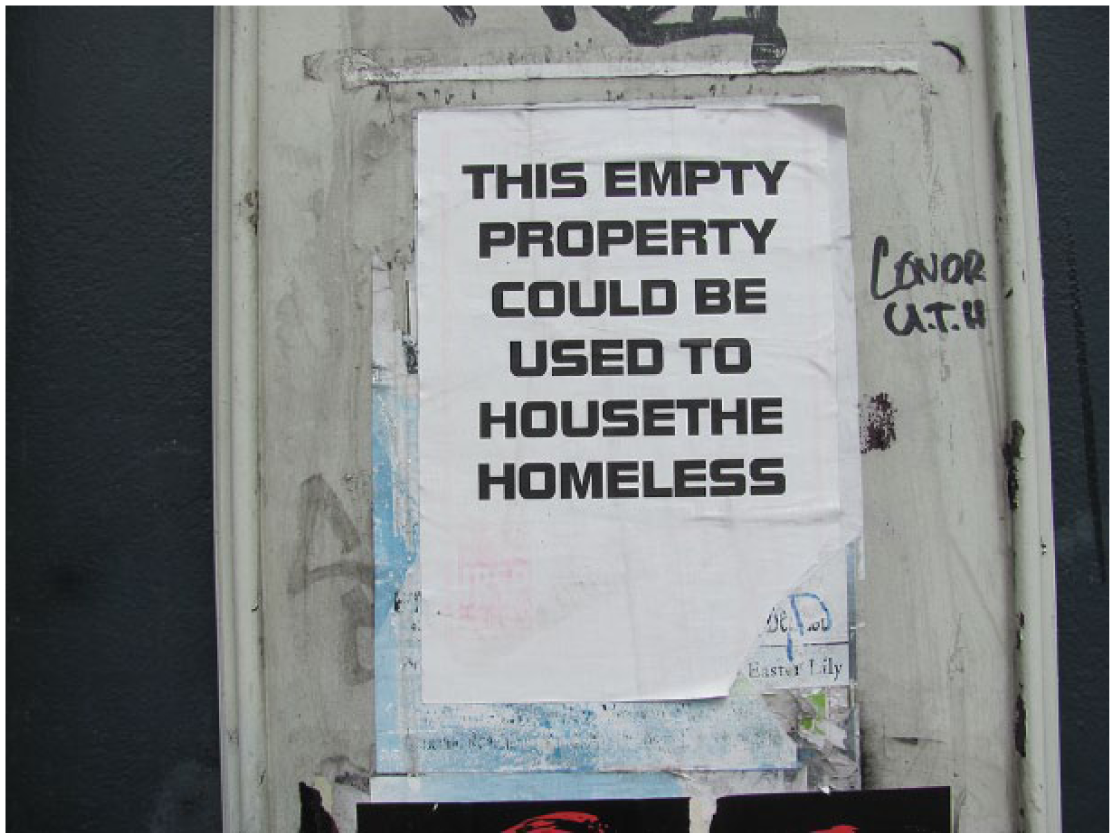
Speculative vacancies in Belfast, North of Ireland.
Ms Leilani Farha, since 2014 the UN Special Rapporteur on housing, disapproves of ‘dehumanized housing’ and empty homes: A significant portion of investor-owned homes are simply left empty. In … prime locations for wealthy foreign investors, the number of vacant units increased … In such markets, the value of housing is no longer based on its social use. The housing is as valuable whether it is vacant or occupied, lived in or devoid of life. Homes sit empty while homeless populations burgeon … Financialized housing markets respond to preferences of global investors rather than to the needs of communities … Many corporate owners of housing are nameless … Many residential rental properties are now owned by bondholders or holders of public stock with no direct connection to properties. (Special Rapporteur, 2017: 9–10)
Apartments can remain empty for a variety of reasons, not all of which constitute a speculative vacancy. Empty apartments can belong to wealthy owners, who visit Jerusalem or their Swiss chalet only during the holiday season of their choice, but do not want to put their property on the Airbnb market. Apartments can remain empty because their owners want to keep wear and tear to a minimum until they retire and use their apartment as the keystone of their social security. Or properties can sit vacant, perhaps even are abandoned, because of weak demand (Mallach, 2018). In the remainder of the article, ‘speculative vacancy’ is used more narrowly and refers to activities criticized by the UN Special Rapporteur. The financialization of housing, the apparent cause of speculative vacancies, refers to the way capital investment in housing increasingly disconnects housing from its social function of providing a place to live in security and dignity and hence undermines the realization of housing as a human right. It refers to the way housing and financial markets are oblivious to people and communities, and the role housing plays in their well-being.(Special Rapporteur, 2017: 3)
In this sense, speculative vacancies and dehumanized housing result from investors’ behaviour in housing markets, including the mass purchasing of apartments by shell companies registered in offshore havens, investment packages, tax management and avoidance, or even money laundering.
Speculative vacancies can be harmful to the urban environment. Ms Farha has repeatedly drawn a connection between widespread homelessness and speculative vacancies (see, for example, Farha, 2018). The evidence of a direct link seems weak, and with respect to luxury homes any connection with the homeless is far-fetched. Still, the practices denounced by the UN Special Rapporteur justify the question of the extent to which the ideology of property as exclusion is allowed to operate as a false consciousness of planning. Should the UN Special Rapporteur have her facts right, does then the ‘sole and despotic dominion’ proclaimed by Blackstone enable the owners of speculatively vacant apartments to exclude ‘any other individual in the universe’? In a financialized housing market, Blackstonian property is a false consciousness in the sense in which Herbert Marcuse (2002 [1964]) deplored the ‘one-dimensional man’: ‘The … owners are losing their identity as responsible agents; they are assuming the function of bureaucrats in a corporate machine’ (p. 35). Or in the words of the UN Special Rapporteur’s (2017) report: ‘It is difficult to know who is accountable for human rights when the owner of housing is a multibillion dollar fund, bondholders, public stockholders or a nameless corporate shell’ (p. 10).
A financialized housing market not only raises a property question, but also affects spatial planning. High-end apartment buildings are not established like informal settlements, for they need and have received planning permissions and are built on land designated for residential uses. No statutory planning law lists the use class ‘investment land’ or ‘empty apartment zone’. Speculative vacancies are not desirable, but accidents that result in valuable urban land not being used for the purposes envisioned by town planners. Apparently, the most common reaction of city governments to empty apartments (if any reaction comes forward at all) is the raising of property taxes (Bula, 2018; Ip, 2018; Staff, 2015). Such taxes imply that dehumanized housing and speculative vacancies are an acceptable use of property. The assumption is wrong, as neighbourhood advocate Melody Ma claims in her polemic against the Vancouver empty homes tax (Ma, 2018). Presumably, Blackstonian property facilitates the false consciousness of empty homes as permitted uses of property (and not as illegal activities like drug trafficking). Surely, Blackstonian property must be rejected in order to curb speculative vacancies and other perverted uses of urban properties. This, at least, was the conclusion of the UN Special Rapporteur (2017: 21, para. 77): The Special Rapporteur suggests that the way forward requires a shift to take hold so that States ensure that all investment in housing recognizes its social function and States’ human rights obligations in that regard.
Insisting on a ‘social function’ rejects the ideational hegemony of the Western property ideology. The UN Special Rapporteur offers for consideration an alternative ideology. In the history of ideas on property, this alternative ideology is called ‘property as a social function’.
Property as a social function
Comte, Durkheim, Duguit
In August and September 1911, Léon Duguit, a constitutional law professor from Bordeaux, gave several lectures at the law school in Buenos Aires (Foster and Bonilla, 2011; Mirow, 2010). Duguit published the lectures as Les transformations générales du droit privé depuis le Code Napoléon (Duguit, 1920 [1912]). Some of the material has been translated into English (Duguit, 1918, 1923). Duguit proposed a property ideology in entire opposition to the Blackstonian ideology of a right to exclusive property (Mirow, 2010: 195). Duguit called his ideology ‘property as a social function’: ‘Mais la propriété n’est pas un droit; elle est une fonction sociale’ (Duguit, 1920 [1912]: 21); in English: ‘Property is not a right; it is a social function’ (Duguit, 1918: 128; Duguit, 1923: 315).
Duguit (1918: 75–76) drew from sociological theories, particularly Emile Durkheim’s De la division du travail social, the concept of ‘social solidarity’ or ‘social interdependence’. Durkheim (1933 [1893]: 111–132) mostly used the phrase ‘organic solidarity’, which he juxtaposed with mechanical solidarity: [M]echanical solidarity does not link men with the same force as the division of labor, and … it leaves outside its scope the major part of phenomena actually social … [S]ocial solidarity tends to become exclusively organic. It is the division of labor which, more and more, fills the role that was formerly filled by the common conscience. It is the principal bond of social aggregates of higher types. (Durkheim, 1933 [1893]: 173)
Duguit was strongly influenced by Durkheim (Grimm, 1973: 38–46; Hayward, 1960). He asserted that social interdependence would not be a sentiment or doctrine, but ‘an existing fact … it is the fact of the social structure itself’ (Duguit, 1918: 75). He had in mind a social division of labour, based on rational cooperation and trust: Men belonging to the same group are linked to one another, first, because of their common needs, which they can satisfy only by a life in common. This is solidarity or interdependence by reason of similarity of interests. But men are also united because they have different needs and at the same time different talents, and because, living together, they are enabled thereby to render mutual services and procure the satisfaction of their various needs. This is solidarity or social interdependence by reason of the division of labor. (Duguit, 1918: 75–76)
Duguit (1918) drew from his observations a remarkable conclusion: under a division of social labour, everybody has a certain task to perform in that vast workship composing the social body. This task or function is determined by the position which the individual or group in fact occupies in a community. The individual possesses no subjective rights; he can possess none, because a right is an abstraction without reality. But, by the mere fact that he is a member of a social group he is under an obligation, existing in fact, to accomplish a certain social function … (p. 76)
The transformation mentioned in the title of Duguit’s collection of Buenos Aires lectures is nothing less but the complete transformation of an individualistic system of law into a system determined by the social function. The transformation affects liberty, contracts, liability, and property. Ascertaining ‘the new conception of property as a social function’, Duguit (1918: 129–146) relies heavily on Auguste Comte’s political philosophy: Property is in its nature social, and … it needs control. Property has been erroneously represented by most modern jurists as an absolute right upon the possessor, irrespectively of the good or bad use made of it … It is an anti-social theory, due historically to exaggerated reaction against previous legislation. (Comte, 1875: 123)
Because of its social nature, property always requires ‘the co-operation of the public’ and permits interventions by the government (Comte, 1875: 123). Duguit picks up Comte’s reasoning with regard to social, political and economic change. As it is no longer necessary to protect private property from feudal transgressions, property must be aligned with its social nature and the social interdependence that exists between members of society. With respect to ‘capitalist property’, Duguit (1918) observed that property – in the face of changing economic needs – had been ‘socialized’: First … private ownership is ceasing to be a private right and becoming a social function; and second that those instances of the application of wealth to collective uses which should be legally protected, are becoming more and more numerous. (pp. 129–130)
With respect to ‘capitalist property’, Duguit (1918) was particularly critical of an owner who left ‘his lands uncultivated, his city lots unimproved, his houses untenanted and unrepaired, his capital consisting of personal property unproductive’ (p. 132). The ideology of property as a social function turns the right to property into an obligation of the owner: Every individual is under an obligation to perform a certain function in the community, determined directly by the station which he occupies in it. The possessor of wealth, by reason simply of his possession, is enabled thereby to accomplish a certain work where others can not … For social reasons he is under a duty, therefore, to perform this work and society will protect his acts only if he accomplishes it and in the measure in which he accomplishes it. Property is no longer a subjective right of the owner; it is the social function of the possessor of wealth. (Duguit, 1918: 133–134)
Introducing the concept of property as a social function encourages neither anarchy nor nationalization or communism. In Duguit’s world, all owners are fully protected by law, the government and courts in so far as they use their property according to its social function. Yet, if property is not used according to its social function does the legal protection of property cease. The most prominent case of the social function is the ‘obligation to cultivate land’ (Duguit, 1918: 135–136). Although no evidence exists of Duguit’s influence on the Constitution of the German Reich (1919), Article 155, para. 3, followed this idea: ‘The exploitation and utilisation of the land is a duty of the proprietor towards the community’ (Kaoutchansky, 1932: 265).
Critical reflections
Property in land as a social function is not about helping the poor; it is about the best use of land. Comte, Durkheim, and Duguit were not the first authors, who emphasized owners’ obligations to use their property productively. Locke’s labour theory of property demands that the resources appropriated from the commons be used by the landowner: But if either the Grass of his Inclosure rotted on the Ground, or the Fruit of his planting perished without gathering, and laying up, this part of the Earth, notwithstanding his Inclosure, was still to be looked on as Waste, and might be the Possession of any other. ((Locke, 1698: 295 [Book II, § 38])
Locke did not elaborate on the role of government in the redistribution of unused private land, and it is easy to imagine how the taking away of unused private land by ‘any other’ might have entailed violence. Johann Heinrich Gottlob von Justi, one of the less prominent founders of political economy (Backhaus, 2009), proposed a more elaborate concept: the enclosure and privatization of the commons in combination with the strict control of the productive uses of privatized land. His argument against the commons foreshadowed Hardin’s (1968) view on the tragedy of the commons: Nobody makes an attempt to improve or cultivate a thing that may be used by so many; and while everybody rushes to gain a little benefit from the common property, the users prevent each other from receiving proper benefits. (Von Justi, 1760: 122)
In order to make pastoral land and other commons more productive, Von Justi (1760) suggested that as much land as possible be put into the hands of individual users: The good judgment of the government must result in a suitable division of property in the country’s surface, an indispensable condition for the successful cultivation of land. I consider this rule one of the most noble principles of political science: As much property in land as possible must be put into the hands of private individuals and, with the exception of outstanding needs, no land must remain with the municipalities and ownership communities. (p. 122)
Although individual landowners, in Von Justi’s (1760) opinion, should have full liberty to use the land, he rejected a property right not to use land: Above all, the government never must permit that landowners leave their farms or other fecund land idle, even if the owners pay all of their taxes. Although each land-owner enjoys the most extensive freedom to use his property as he deems fit, this liberty never comprises his right not to cultivate and use his land. Each private property simultaneously belongs to the public domain because it is located within the state’s territory. (p. 128)
A well-established government should enact a law directing that private property, if remaining idle for 4–6 years, will be taken from its present landowner and sold to the highest bidder. The sales price, upon deduction of costs and taxes, should be given as compensation to the previous owner. Only if nobody wants to buy the idle land, should it be transferred for free to anybody, who promises a suitable use of the land in the future (Davy, 2012: 205–207). About 150 years prior to Duguit’s lectures in Buenos Aires, Von Justi already presented a complete concept as to how to implement property as a social function.
Oscar Wilde (1891), writing on The Soul of Man under Socialism, used the social obligations heaped upon private owners as a sarcastic argument in favour of abandoning all private property: Property not merely has duties, but has so many duties that its possession to any large extent is a bore … If property had simply pleasures, we could stand it; but its duties make it unbearable. In the interest of the rich we must get rid of it. (p. 127)
Other authors, who have developed a similar ideology or followed Duguit, include Richard Tawney and Roscoe Pound. In The Acquisitive Society, Tawney (1921) demanded that rights always be regarded ‘relative to functions’ and ‘may justly be revoked when the functions are not performed’ (p. 29). Criticizing the egotism of competing individuals in the market society, Tawney (1921) rejected the ‘tyranny of functionless property’ (pp. 87–95). In a review of developments in property law, Pound (1939) mentioned Duguit and Kelsen and the idea of property as a social function, not a right (pp. 996–997), but did not try to persuade American jurists to follow this path. In fact, even rather progressive property scholars have set themselves apart from Duguit in order to preserve the(ir) liberal agenda (Alexander, 2014: 1270).
Duguit’s ideology of property as a social function received some criticism. Hans Kelsen, an opponent of property as a natural right, still considered Duguit not to be a fellow positivist. Duguit’s reliance on solidarité sociale (social solidarity) would put him next to Hegel’s Volksgeist in the category of natural law doctrine (Kelsen, 2005: 127). Duguit proclaims what the legislation must do or should have done, a normative approach that does not sit well with legal positivism (Terrier, 2017). In other instances, Duguit and Kelsen agree. Both reject as metaphysical or ideological any distinction between individual rights and objective law. Furthermore, they agree in their suspicion against property in capital. It is this agreement where Comte, Durkheim, Duguit, and Kelsen align with Marxist property theory (although all four frequently have repudiated Marxism). Needless to say, Marxist legal theory rejects Kelsen’s positivism as well as Duguit’s concept of property as a social function. Pashukanis (2002: 75–76) ridiculed Kelsen as ‘the consistent Neo-Kantian’ and was particularly critical of Duguit: Duguit’s declaration that the property-owner should only be protected when he fulfils his social obligation has no meaning in this general form. It is hypocrisy in the bourgeois state, and obscures the facts in the proletarian state. The anti-social aspects of private property can only be eliminated de facto, that is by the development of socialist planned economy at the expense of the market economy. But there is absolutely no formula, be it even drawn from the writings of the most progressive Western European jurists imaginable, which can transform the legal transactions arising out of our Civil Code into socially useful transactions, and can transform every property-owner into a person performing social functions. (Pashukanis, 2002: 97–99)
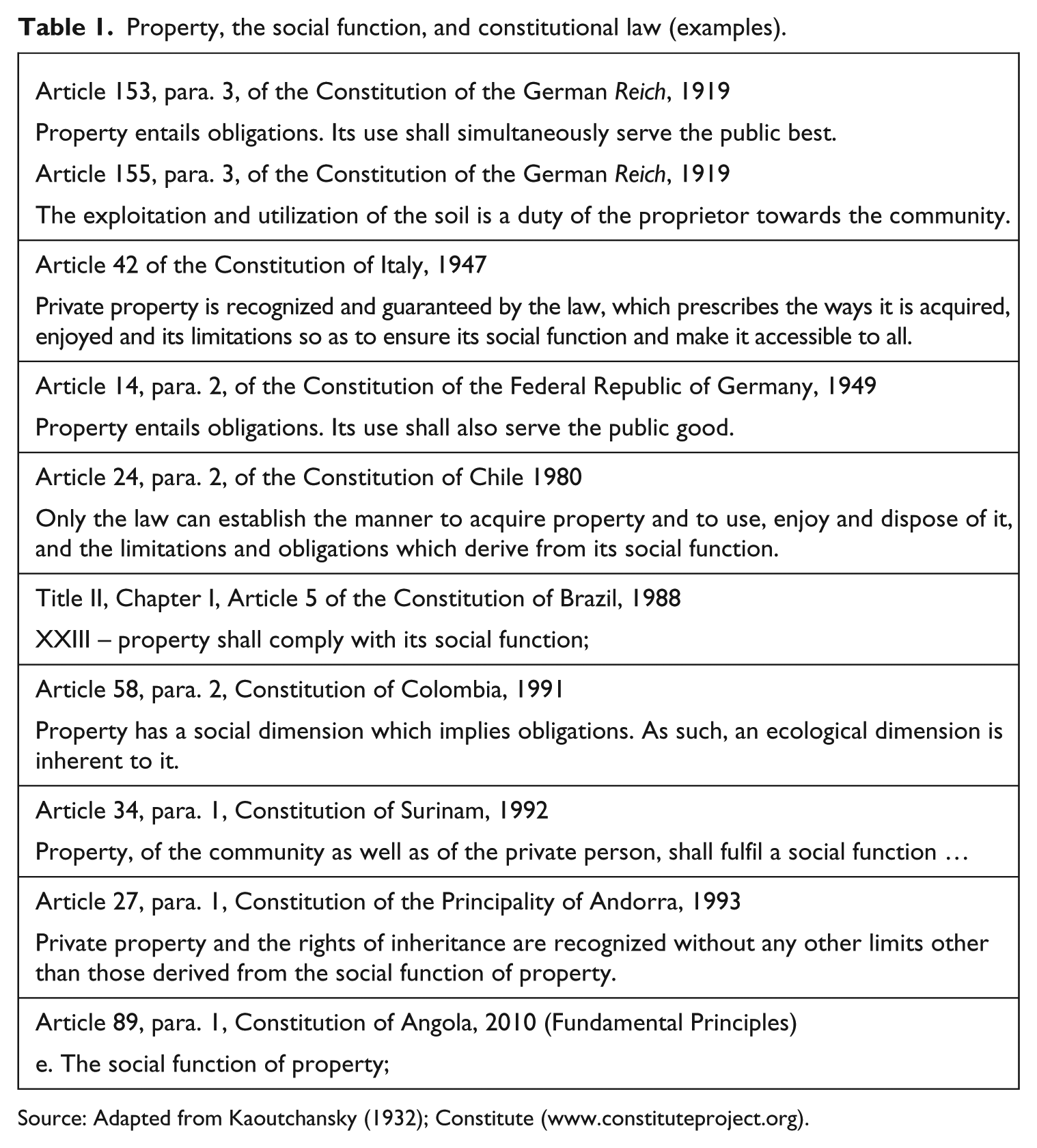
From the perspective of the analysis of ideology, the partial agreements and disagreements offer an insight into the fundamental difficulties of establishing a unified left ideology. Duguit has been criticized not only for being leftist, but his concept of social solidarity (borrowed from Durkheim) has also been accused of supporting fascism in Italy (Stone, 1937: 185–188). The ambivalence can be explained with a common denominator: Duguit as well as Marxism and fascism commences with the ideological rejection of liberalism (Grimm, 1973: 95–107). Many constitutions that have adopted property as a social function, however, are neither communist nor fascist (see Table 1).
Property, the social function, and constitutional law (examples).
Source: Adapted from Kaoutchansky (1932); Constitute (www.constituteproject.org).
Duguit’s influence on constitutional property clauses (see Table 1) was – and still is – particularly strong in Latin America, although some notice that his ideas have also influenced property systems in Europe (Kaoutchansky, 1932; Katzarov, 1964: 118–120) and Asia (Chen, 1993: 35). With respect to Latin America, the ideology of social function has been described as the innovative empowerment of progressive forces to overcome traditional views on property, wealth, and society (Azuela, 2011; Cunha, 2011; Foster and Bonilla, 2011; Hendrix, 1995). The ideology of social function is sometimes attributed to Duguit (Azuela, 2011: 1939; Mirow, 2011: 1184), but often scholars (Hendrix, 1995: 5–6) and courts (Cunha, 2011: 1171) neglect Duguit’s influence. The social function of property inspired land reform (Ankersen and Ruppert, 2006; Eder, 1965: 29, 32; Ondetti, 2016), the right to the city (Layard, 2012: 256; Mattei and Quarta, 2015), and – as the ecological function of property – the preservation of the natural environment (Bryner, 2016; Wadley, 1988).
As Duguit does not consider property a right, does this mean that property is a duty? Blackstone does not ask landowners to fulfil a duty prior to confirming their ‘sole and despotic dominion’. Nevertheless, the Western property paradigm has not been completely blind to the correlation of rights and duties. The notion of property as a duty-related right, as a source of social obligations, is well established in some jurisdictions and among property scholars (Alexander, 2009; Ankersen and Ruppert, 2006; Davy, 2012; Mirow, 2010; Ondetti, 2016; Singer, 2000; Singer and Beermann, 1993; van der Walt, 1999, 2005, 2009; van der Walt and Viljoen, 2015). The social obligations approach apparently aligns Duguit with a liberal worldview: The so-called social function of property … asserts that the right of private ownership includes an obligation to use land in ways that benefit society as a whole. (Ondetti, 2016: 29)
However, the social obligations attached to property and Duguit’s ideology of property as a social function are not identical. Social obligations are of an auxiliary nature and subordinated to the right to property. Duguit (1918: 133–134) also spoke of the obligations of proprietors, but to him these obligations were not merely auxiliary. He asserted that a violation of the owners’ obligations extinguishes property. Outside the scope defined by the social function, property does not exist (a radical reading of Duguit) or exists not as a protected right (a conciliatory reading of Duguit). Conforming with the social function is not merely a collateral duty of the proprietor, it constitutes property.
An unfinished ideology?
Think of an owner who – without good reason – wishes to burn her house, kill her pony, shred her Van Gogh. Fire regulations, animal protection laws or heritage conservation may prevent her from doing so, but does property law? Not if the ideology of Blackstonian property prevails. Dehumanized housing and speculative vacancies are a similar perversion. Duguit’s ideology of property as a social function renders powerful advice to policymakers, who wish to control dehumanized housing and speculative vacancies. As described in her report (Special Rapporteur, 2017: 3), Ms Farha doubts that real estate investors, who own speculative vacancies, serve the social function of property in housing. This, at least, is true for financialized housing markets that use housing only as assets – as ‘capitalist property’ (Duguit, 1918: 129) – and not as homes. In a setting that accepts property as a social function, the municipal government would have to give a fair warning to the owner: unless the property is used for housing purposes within a certain period of time, it ceases to be protected by property rights. Only within its social function does Duguit’s concept assert that private property be protected. Outside its social function, no property exists (Duguit, 1918: 133–134). As a consequence, the confiscation of housing units that have been speculatively kept vacant would not amount to a taking of property (in the United States) or an expropriation (in Europe). As a further consequence, the government would not have to compensate the owners of speculative vacancies at market value. And how would everybody know which social function their property entails? The obvious answer points to regional and urban plans. Planners, who designate land for specific uses in their plans (e.g. residential or commercial land), are defining the social function of that land. From a perspective informed by Duguit, spatial plans are documents that guide landowners in the use of their properties as a social function.
Is this fresh look at spatial planning as defining the social function of land unrealistic? Will it be blocked forever by the prevalent ideology of Western property? The answer depends on which degree of furtiveness is acceptable for an ideology. A concept of property as a social function – based on Comte, Durkheim, and Duguit as well as constitutional experiences (see Table 1) and progressive Latin American ideas (Azuela, 2011; Bryner, 2016; Cunha, 2011; Foster and Bonilla, 2011; Hendrix, 1995) – has not been recognized by most policymakers as a concept for environmentally friendly and socially responsible ownership. Although such recognition has not taken place explicitly, lawmakers and courts as well as property theorists and planners in many countries have enforced property as a social function implicitly (Cribbet, 1986: 6). Property as a social function, in a rather furtive way, already has subverted Blackstone’s property as exclusion. In this sense, property as a social function can be called an unfinished ideology. At least in Western planning systems, the amount of land use regulations has passed well beyond what Comte, Durkheim, or Duguit have envisioned. The omnipotence of the Blackstonian owner has been greatly reduced by land use plans, environmental law, building codes, and other statutory obligations. It seems well worth bringing to light the surprising, yet clandestine, ideology of property as a social function.
Footnotes
Acknowledgements
I am grateful to Edward Shepherd, Andy Inch, and Tim Marshall (guest editors) and all the contributors to the Special Issue ‘Narratives of power; bringing ideology to the fore of planning analysis’, who participated in the workshop at University of Reading and made insightful suggestions. My article evolved from work with the research group ‘Understanding Southern Welfare’ at the Centre for Interdisciplinary Research (ZiF), University of Bielefeld. I particularly gained from the intellectual exchange with Ulrike Davy and Gabriel Ondetti. Thanks to the ZiF for making such productive research cooperation possible ( )! Finally, I thank three anonymous reviewers as well as Bertie Dockerill for helping me polish the final version (I own, of course, all remaining mistakes).
Funding
The author received no financial support for the research, authorship and/or publication of this article.