



Abstract
This article concerns the growing interest in ‘co-production’ in spatial planning, focusing on its relationship with planning systems. The article refers to Italy and England – two institutional contexts with different planning systems – and concludes that co-production can operate outside or inside the planning system. Both models have pros and cons. However, the critical factor determining co-production regarding the planning system appears to be related to how land use rights are allocated. While prior allocation through prescriptive plans keeps co-production out of the system, only allocation as a final case-by-case decision allows co-production to be part of it.
Introduction
The need to question power relations between governments and civil society in spatial planning processes, making them more open and inclusive of non-institutional voices, had emerged since the 1960s – when citizens were increasingly demanding to be involved in government decision-making – and is manifested today mainly through the shared concept of ‘co-production’ (Beito et al., 2002; Sorrentino et al., 2018). The latter has been fostered over the last decade by national governments and supranational institutions such as the European Union (EU), under the implicit assumption that social innovation is the “modern panacea” in a variety of policy areas (Bragaglia, 2021; Osborne and Strokosch, 2013; Sorrentino et al., 2018).
This article aims to contribute to this debate in technical and neutral terms, by reflecting on how a spatial planning system may condition (for better or worse) co-production. Recent comparative research by Nadin et al. (2020) on spatial planning trends in 32 European countries confirms that the paradigm of co-production and citizen inclusion is spreading across the continent. However, a correlation also seems to emerge between planning systems and the level of citizen engagement in spatial planning processes. Starting from this assumption, one must wonder if some planning systems address co-production implementation more structurally or differently than others.
One approach to explore this issue is to highlight the boundaries of co-production in different planning systems, framing how communities’ collaboration shares responsibilities with institutions within a certain framework of public rules reinforced by a precise legal system (North, 1990). In order to investigate this hypothesis, the article focuses on two very different (and in some ways opposite) spatial planning systems in the European context: the Italian and English planning systems are indeed classified unequivocally differently from the main comparative studies in this field, whether they are considered in relation to ‘legal families’ (Davies et al., 1989; Newman and Thornley, 1996) or ‘ideal types’ (CEC, 1997; Nadin and Stead, 2013) or ‘institutional technologies’ (Berisha et al., 2021; Janin Rivolin, 2008, 2012, 2017). It should be emphasised that the English, and not the British, planning system is considered here to give the best conditions of comparison, although co-production experience is present in other forms also in the rest of the United Kingdom (UK).
The concept of co-production is generally disputed, but this article does not intend to take sides in this dispute (Durose et al., 2022; Voorberg et al., 2015). On the one hand, proponents see it as a way to advance democracy and redress inequalities (e.g., Bevir et al., 2019; Robinson and Tansey, 2006). On the other, several authors have warned that co-production can be used with a ‘tokenistic’ approach or even easily de-politicised to reinforce neoliberal policies and blur the role of the state (e.g., Habermehl and Perry, 2021; Williams et al., 2020). Aware of this tension and inclined to believe that co-production’s positive or negative aspects depend essentially on how it is used in practice, the authors rather try to shed light on how co-production can present specific opportunities and threats when applied in different institutional contexts. As will become more evident in the article, a crucial point is how the planning system determines that land use rights are allocated. While prior allocation through prescriptive plans (as in Italy) keeps co-production out of the system, only allocation as a final case-by-case decision (as in England) allows co-production to be part of it.
After this introduction, a brief methodological note follows. Two separate sections will then cover a literature review on the concept of co-production and a summary of the main comparative studies on spatial planning systems. Two further sections will focus on the investigation of how co-production between institutions and civil society finds its place in Italy and England, with particular regard to the operation of respective planning systems. The article concludes that co-production can take place outside or inside the planning system and discusses the advantages and drawbacks of the two models. A final section rounds off the contents of the article and indicates the need for further research.
Methodological note
This contribution is based on qualitative content analysis, i.e. ‘the longest established method of text analysis’ (Tischer and Bryan, 2000: 55). Three types of sources were considered: (i) existing scholarly literature (a) on co-production and (b) on spatial planning systems in Europe; (ii) official regulatory documents (such as laws and administrative acts), reports and informative policy documents; and (iii) interviews with relevant stakeholders (such as representatives of public institutions, community actors, academics who have already dealt with the same or similar issues). These sources were gathered mainly thanks to an in-depth desk review developed (a) in two doctoral theses on co-production, focusing on Italy and England, respectively, and (b) a comparative analysis of spatial planning systems conducted over several years in the framework of some ESPON (European Spatial Planning Observation Network) research projects. These are, namely, Governance of territorial and urban policies from EU to local level, 1 TANGO - Territorial Approaches for New Governance 2 and COMPASS – Comparative Analysis of Territorial Governance and Spatial Planning Systems in Europe. 3
Overall, the starting hypothesis – that planning systems condition forms of urban co-production – was tested through a comparative analysis of the Italian and English planning systems and leads to the conclusion that co-production can operate outside or inside the planning system depending on how land use rights are allocated. With this analysis, the paper more generally suggests the usefulness and fertility of reflections on institutionalisation in spatial planning and urban studies.
Co-production: Genesis and perspectives of a multifaceted concept
Although co-production has only recently experienced a fervent debate in planning theory and practice (Watson, 2014), it is not a completely new phenomenon (Brunetta and Moroni, 2012). The notion of co-production was developed in the 1970s by the Nobel Prize for Economics Elinor Ostrom to describe the active involvement in the public sector of citizens and the third sector in services design and provision. According to Ostrom, co-production is a ‘process through which inputs used to provide a good or service are contributed by individuals who are not ‘in’ the same organisation’ (1996: 1073; see also: Ostrom and Whitaker, 1973). From this pioneering definition, wide-ranging literature in economics and political science has developed (see, for instance, Bovaird et al., 2019; Parks et al., 1981). Co-production has also become a buzzword of New Public Management (Brandsen et al., 2012; Sorrentino et al., 2018), in international organizations’ policies (OECD, 2011), and in European programming. A decade after the global economic crisis outbreak, the European Commission published the dossier Co-production. Enhancing the role of citizens in governance and service delivery (CEC, 2018). Within this approach, ‘the citizen self-provision of public services occurs primarily when there is a high demand for services, but citizens are not satisfied with the quality or quantity of goods and services provided by the public sector’ (Mizrahi, 2012: 286).
A wide range of activities can be included in the umbrella concept of co-production (Verschuere et al., 2012). Indeed, co-production may be used for different purposes and in different manners according to the different kinds and levels of action. As Sorrentino et al. (2018) emphasise, the forms of co-production differ in both the ‘co-’ and ‘-production’ terms. The former implies that more than one actor is involved in a long-term process, usually an institutional actor (ranging from the state to local authorities) and a lay actor (e.g., citizens or third-sector associations). This distinguishes co-production from the self-organisation (Boonstra and Rauws, 2021) of civil society and more traditional forms of participation (Rosen and Painter, 2019). And it can be applied to an almost unlimited number of fields: among these, recently, also urban governance and spatial planning.
As Habermehl and Perry (2021) acknowledged, recent urban scholarship is highlighting the potential of co-production ‘as a way to address long-standing urban governance failures’ (p. 555). Indeed, many authors have explicitly focused on the concept in that field (among others, Albrechts, 2013; Bragaglia, 2021; Caldarice, 2018; Galuszka, 2019; Mitlin, 2008; Siame and Watson, 2022; Watson, 2014). Reflections on co-production in urban governance and spatial planning debates are based on arguments of democracy and efficiency. Parker and Street (2018) frame co-production as the outcome of a ‘post-collaborative turn’ in spatial planning. This provides a better understanding of how this concept differs from the more traditional concept of participation.
Although the two concepts are often used interchangeably, co-production extends citizen participation (Rosen and Painter, 2019). More in general, several concepts have been coined in the academic literature to describe, albeit with slight nuances, this collaborative turn, such as collaborative planning (Healey, 1997), deliberative planning (Forester, 1999), communicative planning (Innes, 1998), and participatory governance (Fung and Wright, 2003). In more recent times, greater space has been taken by different forms of urban self-organisation, defined as the ‘role of civil society in addressing urban transformations that emerge from not-centrally coordinated, local, and place-based interactions between a plurality of agents and/or elements’ (Boonstra and Rauws, 2021: 1). Current cycles of economic recession, the decline of trust in representative democracy, and, not least, the very recent global health crisis due to the Covid-19 pandemic have imposed a radical rethinking of planning policies to manage uncertainty (Moroni and Chiffi, 2021; Portugali, 2021). As Nadin et al. (2020) pointed out, citizens’ inclusion is motivated by pragmatic and normative reasons. On the one hand, there is the need to establish new relationships of trust between governments and civil society by sharing responsibilities; on the other, the democratisation of decision-making processes is now seen as a crucial feature of good governance. Social requests emerging during the crisis have embodied a significant critique of both the dominion of austerity and the model of representative democracy (Mazza, 2010).
Ultimately, co-production is interrelated with these two strands of research – participatory governance and citizens’ self-organisation – which explains the dualism at times present in addressing the barriers and approaches to, and impacts of co-production. What differentiates co-production from participation and self-organisation is that the former encompasses the involvement of citizens in decision-making (or service planning or design) as well as in service delivery. In other words, all actors are interdependent in co-production, and civil society’s lived experience is as relevant as professional expertise. Co-production indicates the need ‘to promote persistent change not only for citizens but with citizens’ (Sorrentino et al., 2018: 285). In this sense, it can also be understood as ‘delivering public services in an equal and reciprocal relationship between professionals, people using services, their families and their neighbours’ (Boyle and Harris, 2009). This is both in its more classical sense of the inclusion of civil society in service provision (Ostrom and Whitaker, 1973; Parks et al., 1981) and in its more specific relation to the field of urban governance and spatial planning (Albrechts, 2013 and Galuszka, 2019). Especially in Europe, several current stressors have led many governments to experiment with new models of devolving responsibilities and – at least in principle – powers to communities also in the field of urban governance (Balducci, 2012; Bragaglia, 2021; Ponzini, 2016) in a context of shrinking resources. As shown by Pill (2022: 985), ‘[t]here is broad agreement that co-production is particularly relevant at the local and particularly neighbourhood level closest to citizens’ (emphasis added). Therefore, it is essential to investigate how spatial planning systems face the challenge of co-production at the local scale.
The European comparison between spatial planning systems
Comparative analysis of spatial planning systems is a recent research practice. Against the backdrop of the new challenges and the need for mutual knowledge posed by European integration, the first ‘comparative study’, labelled as such, was commissioned by the UK government to understand the modalities of public control over spatial development in Western Europe (Davies et al., 1989). This study classified the analysed planning systems into two distinct ‘legal families’. In particular, it argued that, by the historical influence of the Napoleonic codes (derived in turn from Roman law), the ‘continental’ systems are based on binding plans, which provide complete and detailed sets of rules created in advance of each punctual decision of spatial development; on the contrary, the English system – inspired by the principles of Common law – is based chiefly on non-binding plans, which allow the planning authority more flexibility (and discretion) in deciding case-by-case. Focused on England (specifically) and a few North-Western European countries (i.e., Denmark, France, Germany and the Netherlands), this first study did not directly examine the Italian system that, however, was implicitly placed in the ‘continental family’.
Although making the original focus on public control more nuanced, an independent study classified a few years later 14 European spatial planning systems in four ‘legal families’ – namely Germanic, Scandinavian, Napoleonic and British – with the addition of a family ‘in transition’ from the Soviet influence (Newman and Thornley, 1996). In confirming the specificity of the English system, this study has finally recognised the belonging of the Italian system to the ‘Napoleonic’ family in a straightforward way. More generally, however, it showed more clearly that a simple comparison between the legal and administrative structures of planning systems ended up leaving in the shadows the actual variety of planning practices and their outcomes.
The first comprehensive comparative study commissioned by the EU, well known as the ‘EU Compendium’ (CEC, 1997), adopted a more complex approach. First, the systems of the then 15 EU member states were scrutinised according also to various other ‘interrelated factors’, such as the scope of the system, the extent and type of planning at national and regional levels, the locus of power, the relative roles of public and private sectors, the maturity and completeness of the system and the distance between expressed objectives and achieved outcomes. Then, the overall comparison led to identifying four ‘ideal types’ of planning systems within the EU-15 – namely, the ‘regional economic planning approach’, the ‘comprehensive integrated approach’, the ‘land use management’ and the ‘urbanism tradition’ (Ibid.: 36-37) – representing a sort of reference models to guide an understanding of spatial planning systems in the EU framework (Nadin and Stead, 2013). Even from this comparison, the Italian and English systems are examples of two distinct and very different ideal types. Respectively, the urbanism tradition, ‘which has strong architectural flavour and concern with urban design, townscape and building control’ and for which ‘regulation has been undertaken through rigid zoning and codes’; and land use management, ‘where planning is more closely associated with the narrower task of controlling the change of use of land at the strategic and local levels’ (CEC, 1997: 37).
More recently, the acknowledgement that spatial planning systems are ‘institutional technologies’, pivoted on different social devices of allocation of land uses and spatial development rights (Janin Rivolin, 2012) has allowed us to clarify why and how the more traditional and widespread conformative model has been replaced in some institutional contexts by the performative one. We can call the former ‘conformative’ because it seeks primarily a ‘correspondence in form, manner, or character’ or an ‘action in accordance with some specified standard or authority’ (definitions by the Encyclopedia Britannica Online, cit. in: Janin Rivolin, 2008: 168). It is the most traditional since the establishment of modern states, still widespread in the world and applied in the countries of Southern Europe (including Italy). It pivots on a ‘preventive’ binding zoning of a comprehensive urban area, which implies, in general, that (Janin Rivolin, 2017: 1001-3): a) a public spatial strategy is transposed in a binding plan, which assigns rights for land use and for spatial development; b) based on this rights assignation, the delivery of building permits is subject to a control of the proposed development projects in terms of conformity (whether they conform to the plan); c) if projects are considered for any reason preferable to the existing assignation of rights, a new plan (or a substantive variation of the existing one) is needed to assign new rights for land use and spatial development.
We can call the latter ‘performative’ because it pursues ‘the execution of an action’ or ‘the fulfilment of a claim, promise, or request’ (definitions by the Encyclopedia Britannica Online, cit. in: Janin Rivolin, 2008: 168). It was established in the UK (especially in England), Ireland and some Commonwealth countries since the post-war period as a reaction to the failures of the traditional model (Booth, 2007). It is based on indicative and non-binding zoning for the comprehensive urban area, which means, in general, that (Janin Rivolin, 2017: 1003-4): a) a public spatial strategy is transposed into a non-binding plan, that is, not having juridical implications for the assignation of rights for land use and for spatial development; b) for this reason, the delivery of building permits is subject to control and the negotiation of the proposed development projects in order to ensure their performance towards the plan (i.e. their capacity to perform the public strategy); c) new rights for land use and for spatial development are assigned contextually with the possible delivery of the building permit.
Regardless of the advantages and disadvantages of the two models of institutional technology, it is appropriate to highlight that their difference hinges precisely on the different ways of allocating land use rights. According to the traditional conformative model (still prevalent in Italy), these rights are assigned in advance through a binding plan in an attempt to condition future developments; according to the performative model (in force, among others, in England), the rights are allocated at the conclusion of the evaluation of each development project, together with the building permit (Figure 1). Ultimately, it is not far-fetched to state that the Italian and English planning systems are representative of two main models of institutional technology, widespread in the Western world: that is, the traditional one, hinged on the prescriptive power of the plan, and its more rarely occurring evolution, based on the subjective power of project control. Two models of planning systems as institutional technologies (authors processing based on: Berisha et al., 2021).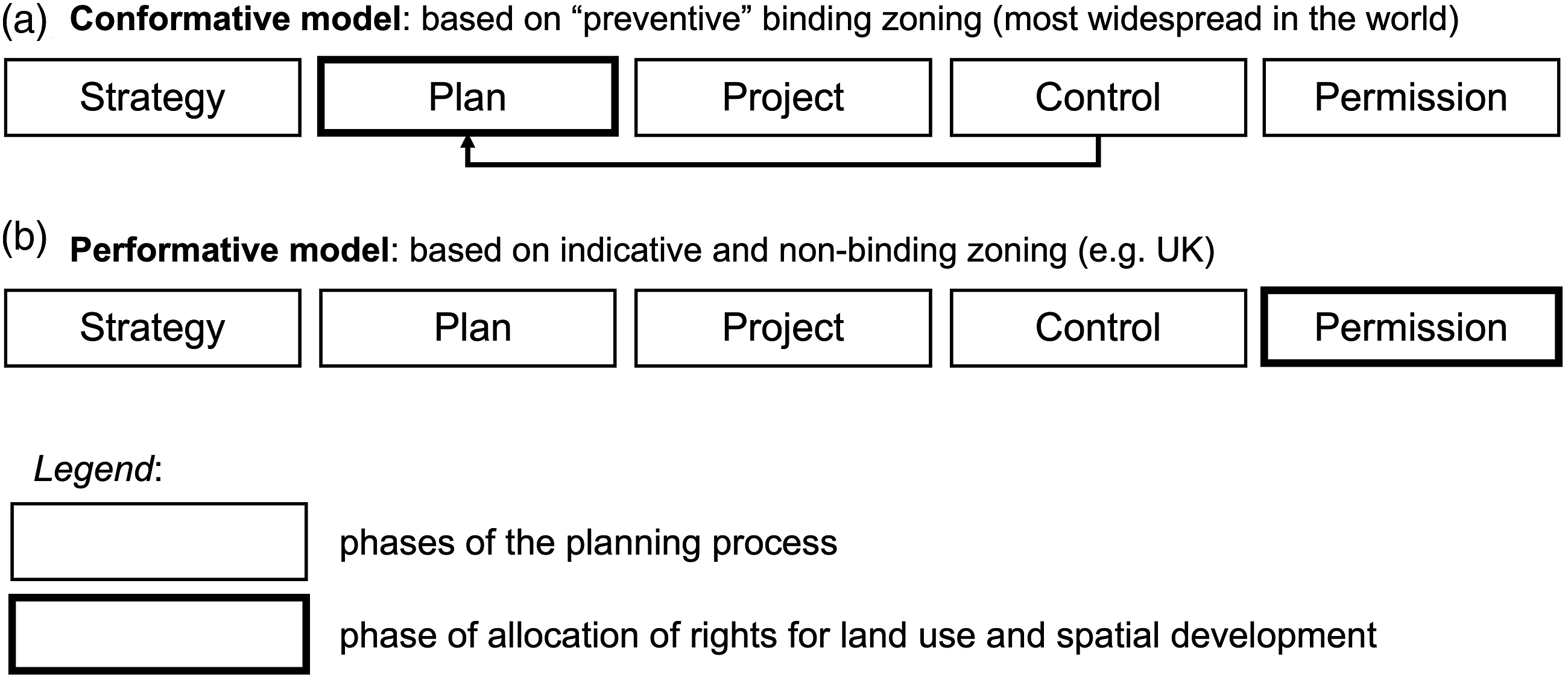
Italy: Co-production outside the planning system
Embedded within an administrative and legal structure belonging to the ‘Napoleonic family’ (see above) and characterised by strongly hierarchical power relationships between the state and municipalities, the Italian planning system took shape during the Fascist regime. The legal basis of the Italian planning system – the 1942 National Planning Law (Legge urbanistica nazionale) – established, first and foremost, the centrality of the municipal zoning plan for both confirming existing land uses and prescribing future developments (so-called Piano regolatore generale, or ‘General regulatory plan’) (CEC, 2000a). An attempt at reinforcing the effectiveness of spatial planning occurred in 1967 with Law no. 765, the so-called Legge ponte or ‘bridge law’ alluding to its supposed provisional character. It consolidated the adopted conformative model, introducing more precise zoning typologies, quantitative indicators and minimum standards for public services and infrastructure provision (so-called standard urbanistici, see also below).
After thirty years, as a late consequence of the application of the 1948 Italian Constitution, Presidential Decree no. 616/1977 implied an important change in the system’s structure through the extension of certain legislative powers (including planning) to the regions (Scattoni and Falco, 2011). This progressive regionalisation has accentuated the differentiation of regional planning systems under a common national framework (Breton and Fraschini, 2016; Palermo and Wilson, 2013), which essentially maintained the original conformative approach. Since then, ‘ordinary planning practice and their working cultures vary significantly, in a way, among regions (the institutional setting of spatial planning) and among communities of practice’ (Vettoretto, 2009: 190), but the operation of the Italian planning system – especially the way land rights are allocated – remains similar throughout the country (OECD, 2017). The system is currently structured at four administrative levels of government (Figure 2): national, regional (19 Regions and two Autonomous Provinces with regional powers), provincial (110 Provinces, out of which 14 acquired the status of ‘Metropolitan City’ in 2015) and local (7.901 Municipalities). The administrative levels of the Italian spatial planning system (authors processing).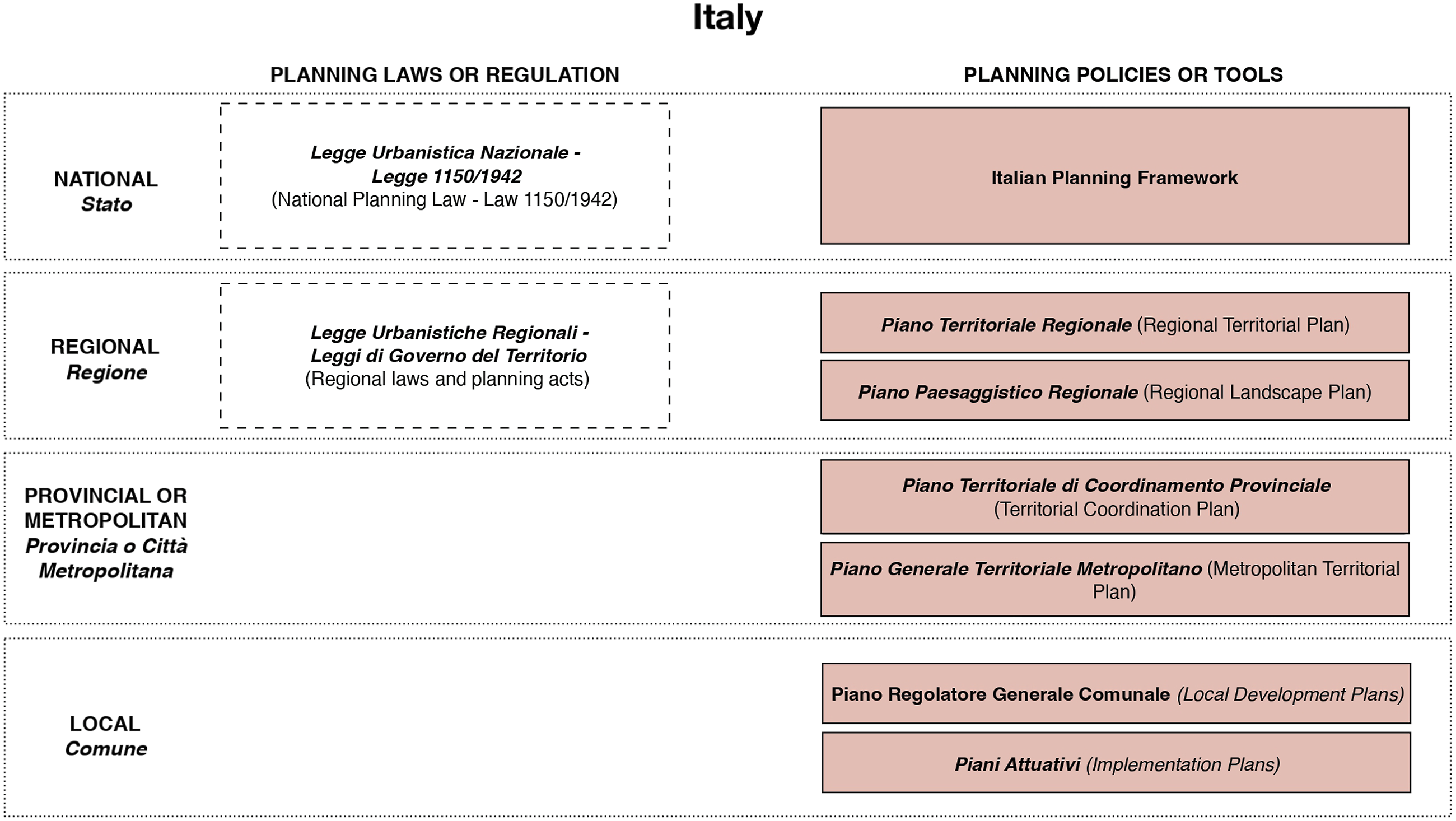
Even despite more recent efforts to modernise spatial planning in Italy since the 1990s (Palermo and Ponzini, 2010; Cotella and Janin Rivolin, 2011; Caldarice and Cozzolino, 2019), the Italian planning system maintains its original conformative approach to the allocation of land use rights. As Carmona (2016: 708) has pointed out, these all-encompassing, fine-grained forms of regulations that define from parking regulations to building and density requirements are very often ‘limited in their scope, technical in their aspirations, not generated by a place-based vision, and are imposed on projects without regard to outcomes’ (see also Carmona et al., 2023). Overall, ‘a sort of hybridisation of mere old regulative styles and new perspectives’ characterises spatial planning in Italy at present. As a result, ‘a traditional culture of planning, as essentially a command and control activity, is still vital and influential’ (Vettoretto, 2009: 201-202).
In Italy, participatory instances in spatial planning have emerged quite recently and, above all, through experimental forms (Bellaviti, 1994). Legally, citizens’ involvement has been recognised thanks to the introduction of the principle of ‘horizontal subsidiarity’ within the Italian Constitution (Constitutional Law no. 3/2001, art. 118, clause 4, authors’ translation): State, regions, metropolitan cities, provinces and municipalities support autonomous citizens’ initiatives, as individuals or in association, in order to carry out activities of general interest; this is based on the principle of subsidiarity.
The horizontal subsidiarity principle is not synonymous with co-production. Rather, it refers to the shared governance foreshadowing co-production so that groups of ‘organised citizens’ could present proposals to implement easily achievable projects that do not burden the public authorities. In other words, horizontal subsidiarity implies a strong collaboration with citizens forwarding a new organisational model for public administration, defined as ‘Shared Administration’. This model makes it possible to overcome the so-called ‘bipolar paradigm’ between the citizen and the public administration, as it requires shared action between the private and public spheres. It is possible to voluntarily find answers to questions to which the public or private sphere alone cannot find solutions (Arena and Coturri, 2010). The concept of shared administration gave rise to the ‘Regulation for collaboration between citizens and administration’ (hereafter referred to as the Regulation), usually implemented through ‘Collaboration Agreements’ (Brunetta, 2018). Ultimately, the Regulation and Collaboration Agreements – the most advanced tools for promoting co-production in Italy – provide concrete opportunities to empower citizens, release their energies, and enhance their knowledge and skills in a renewed alliance with public institutions (Ciaffi and Saporito, 2017). As the online Report by the Laboratory for the Subsidiarity (Labsus, 2020) states, about 300 Italian municipalities have approved a Regulation up to 2020. The track opener has been the City Council of Bologna that in 2014 approved the first Regulation in Italy, called ‘Regulation on collaboration between Citizens and the City for the care and regeneration of urban commons’ (authors’ translation). The Bologna Regulation can be used here as an example, as it has led the way for other similar regulations adopted in other Italian cities increasingly following the ‘collaborative city’ model (Foster and Iaione, 2022). It aims to enable collaboration between citizens and municipal authorities, promoting the application of the principle of horizontal subsidiarity and favouring autonomous initiatives of citizens, individually or in association, for the joint performance of activities of general interest (Bartoletti and Faccioli, 2013). On that point, the online Bologna Regulation declares that ‘the City promotes creativity, arts, education and artistic experimentation as one of the fundamental instruments for the requalification of urban areas or single goods, for the production of value for the territory, the social cohesion and the development of capabilities’ (article 8, authors’ translation). The Regulations thus promote the co-production of public services, assuming that social innovation requires a shift from a traditional to a collaborative welfare system. Therefore, they promote the direct involvement of the end-user of public services in their planning and delivery in order to optimise or integrate the overall service supply and meet emerging social needs.
Due to the conformative approach of the Italian planning system, however, land use rights, already assigned by municipal plans, cannot be brought into play by Regulations (unless the plans are amended). Even the provision of urban services is subject to prescriptive interpretation (Falco, 1987). The above-mentioned standard urbanistici, introduced in national legislation since the late 1960s, mean indeed that municipal plans must establish a mandatory amount of land for public services. This amount is set at least 18 sqm of land per inhabitant (or more, depending on regional legislations), to be reserved for public spaces for instruction, collective activities, urban greenery and parking. Above all, the quantities of space laid down in municipal plans cannot be decreased, but neither can they be increased (unless the plans are amended). Indeed, the provision of urban services remains a fundamental institutional purpose of the Italian planning system (Caldarice, 2018), which one would say does not admit the ‘possibility of co-production’. The system exclusively entrusts the (prescriptive) spatial plan, which already operates in the name of the public interest (Moroni, 2004), with the task of guaranteeing the development of desired and needed collective services (Secchi, 2009). In other words, in the Italian planning system the supply of urban services is an infrastructural intervention in which ‘the space and time (of the possible actions on which the public decision is focused) are pre-determined’ (Moroni, 2023: 3). The welcome of social demands for additional public services must be formally defined in a new, or a formal variance, local plan. Ultimately, the Italian planning system, based on the conformative model of allocation of land use rights through the plan, precludes the possibility of ‘at stake’ for co-production with civil society in development projects. Co-production is certainly possible and ‘stimulated’, but with very limited margins for negotiation and, in any case, outside the mainstream established by the system itself. Co-production regulations and agreements have no direct relationship with the plan and are irrevocably conditioned by the land use rights established in the (prescriptive) plan. The latter are, therefore, non-negotiable in a shared co-production project.
England: Co-production inside the planning system
The foundations of the current spatial planning system in England (and the UK) were laid with the Town and Country Planning act of 1947, which established a more discretionary model based on non-binding zoning (CEC, 2000b; Nadin and Stead, 2014). Inspired by the legal tradition of common law, the English planning system provides that land use rights for spatial development are not assigned by the plan, but with the planning permission if a project pursues collective interests, which are indicated in the (non-regulative) plans. Thus, in the English planning system, ‘decisions on particular development proposals are made as they arise, against the policy background of a generalised plan’ (Cullingworth et al., 2015: 108). The ‘performative model’ of planning implemented in England seems to facilitate citizens’ involvement. The 1968 Town and County Planning Act – which completed the system’s operation by distinguishing structure and local plans – formally included citizen participation in planning (Reynolds, 1969).
In the following decades, public involvement in England remained central until the recent devolution process, where community-based planning was implemented (Gallent, 2013). Since the late 1990s, both the Blair and Cameron governments have pursued the idea of decentralising power in public sector decision-making previously held in Westminster to put it in the hands of local communities (Blair, 1998; Cameron, 2010). Notably, by the mid 2000s, the UK government has strongly advocated the idea of a ‘double devolution’, meaning the devolution of responsibilities and powers to local authorities and then to individuals (see Jordan, 2007; Wargent, 2020). The UK’s localist agenda pursued by the Coalition Government has become a rhetorical discourse deeply linked to citizen empowerment and community control. Direct mobilisation of local communities was seen as a way of reforming the welfare state and coping with the government’s austerity policies to overcome the 2008 economic crisis.
Within this context, co-production has become a key concept in rethinking public services’ narrative in the devolved UK (Williams et al., 2014), and community-led planning may be regarded as a particular form of public service delivery (Pemberton et al., 2015). In a study funded by the ‘Planning Exchange Foundation’, Pemberton and Peel (2016: 7) clarified this aspect: Lying behind the general notion of ‘community planning’ is a drive towards the decentralisation of services to enable more responsive local services, support greater influence and control by community and voluntary groups, and offer greater sensitivity to user needs in defined places or localities. In the UK, community planning has thus emerged as a specific type of ‘policy partnership vehicle’ to address a range of issues (…).
The UK government has tested a range of governance tools to encourage citizen engagement in governance and planning at the neighbourhood level (Parker et al., 2023). These have included Community Involvement Statements, Community Strategies and Parish Panning. Moreover, some local governments, such as Birmingham, Bristol, Liverpool, and London, have also progressively moved towards the ‘co-city’ model (Foster and Iaione, 2022), adopting deliberative tools such as participatory budgeting, citizen panels, and collaborative platforms. There is a wide range of initiatives that have prompted the active role of citizens in urban governance and local planning in recent decades. This role seems to be recognised by local communities also in the future, as mentioned in the Levelling Up White Paper (HM Government, 2022) which considers them as crucial actors in defining local priorities, also with the purpose of ‘approaching the highest level of devolution’ (ibid: 7). However, the aim of this paper is to specifically investigate the relationship between co-production and spatial planning. The attention is thus focused on the Neighbourhood Development Plan (better known as Neighbourhood Plan) as it is ‘the first citizen-led planning tool to confer statutory power on the outcome of community planning processes’ (Parker et al. 2023: 2). Neighbourhood Plans constitute the sub-local level of planning in England which were introduced in England by the 2011 Localism Act, which made several changes to the English planning system (Figure 3). The main spatial planning instruments in the English spatial planning system (authors processing).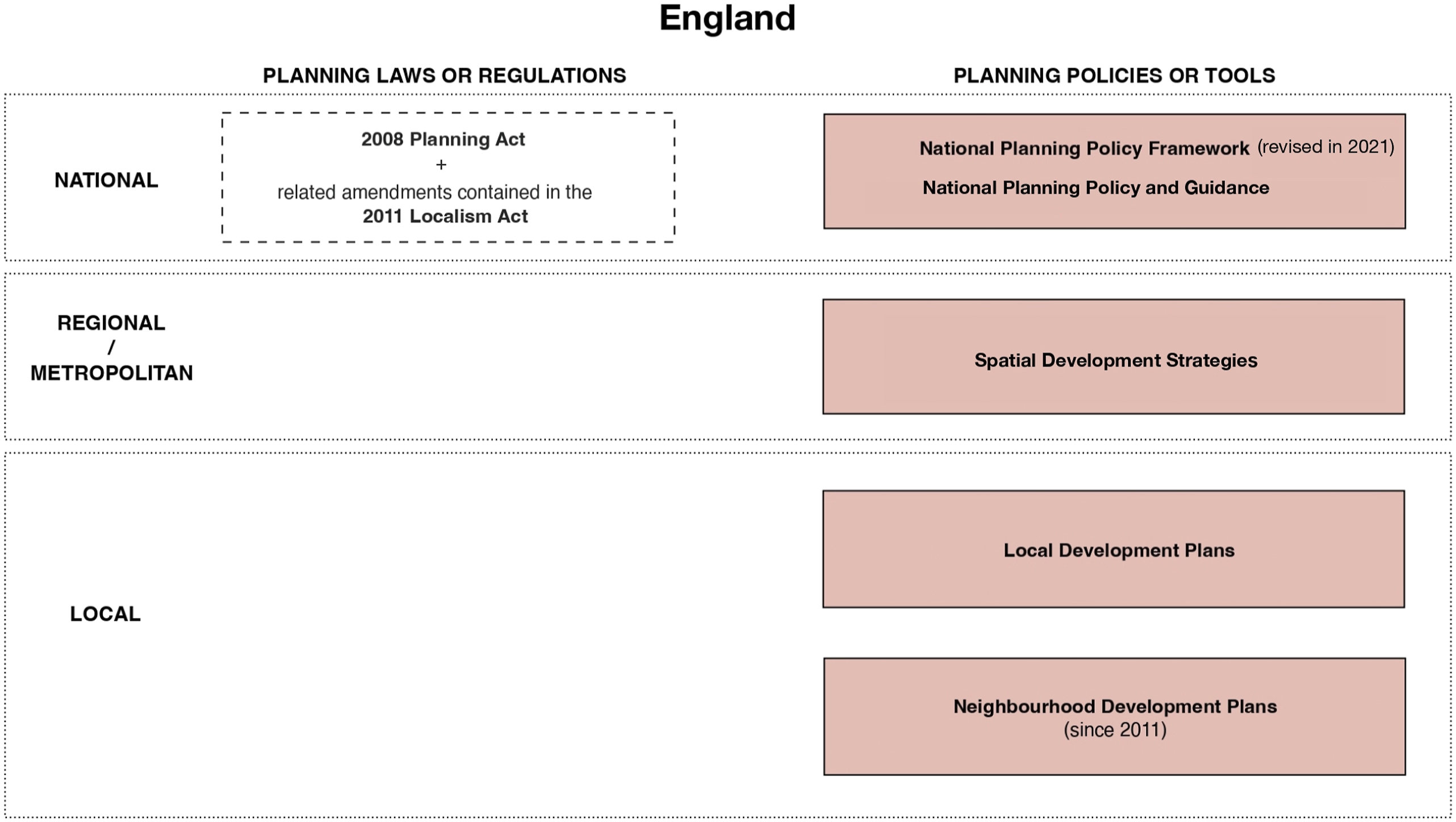
Several scholars have highlighted how the idea of ‘come together’ ‘calls for the co-production of plans between communities and planners’ (Brownill, 2017:33). Therefore, neighbourhood planning was seen as a significant form of co-production at the neighbourhood scale (Gallent and Robinson, 2012; Parker et al., 2015). Through neighbourhood plans, local communities can develop a shared vision for their neighbourhoods, choose where to locate new development, grant planning permission, define building design policies and protect specific sites (MHCLG, 2021). Once the plan is made after a structured regulatory process that must be followed and that generally takes years, it becomes part of the statutory planning framework against which planning applications presented by developers are assessed. Since its inception, neighbourhood planning has involved more than 2,500 communities throughout England which have invested their time in the plan-making (Parker et al., 2020), and the threshold of 1,000 approved neighbourhood plans was reached in February 2020 (MHCLG, 2020).
The Neighbourhood Plan in England is the only case of community-led planning in the UK where the plan, if approved, becomes part of the statutory planning system, detailing the Local Plan policies to which it must be in ‘general conformity’ (UK Government, 2012). Through neighbourhood planning, local communities in rural and urban areas can produce a planning policy document containing a 10/15 years-vision of their neighbourhood. Neighbourhood planning policy is based on the idea that local communities have ‘local knowledge’ that planning officers do not.
Beyond the romanticised ‘power to the people’, one should not forget that Neighbourhood Development Plans were essentially created as plans to stimulate development. The central government has expressly made it clear that when given power over decisions, residents are less likely to resist new development (Sturzaker, 2011; Cowie and Davoudi, 2015). For this reason, neighbourhood planning has been harshly criticised as the ultimate strategy for ‘governing through community’ (Rose, 1996). Within neighbourhood planning, local communities only have decision-making possibilities within boundaries defined by the central government and local authorities.
The extensive literature on neighbourhood planning has highlighted the opportunities of the instrument and the related community ferment (Bradley, 2017; Bradley and Sparling, 2017; Pycock, 2020). However, there has been no shortage of critical reflections on a policy judged ambiguous in its actual purposes beyond the rhetoric of ‘power to de people’ (Parker et al., 2023; Wargent and Parker, 2018). The instrumentalisation of this tool as part of a neoliberal discourse to foster and speeding-up growth and market-led development in English neighbourhoods has been highlighted, as well as its capacity to devolve responsibilities to local communities while carefully choreographing the boundaries of their actions (Allmendinger and Haughton, 2012; Sturzaker and Shaw, 2015; Wargent, 2020).
Tension arises between the contradictions of the localist agenda pursued through neighbourhood plans and this instrument itself, which however constitutes an interesting political innovation incorporating co-production inside the English planning system. Indeed, it seems possible to assume that the English performative model, by virtue of the absence of the ‘preventive’ legal assignation of development rights by the plan, seems to favour an entry of co-production with civil society inside the planning system’s operation.
Outside-in: A comparison
As the Italian and English cases exemplify, there seems to be a clear relation between the type of spatial planning system and the positioning of co-production activities outside or inside the system itself.
Although not for long, the need to involve civil society in urban issues has become evident in Italy, focused mainly on the commons and the ‘co-city’ model (Chirulli and Iaione, 2018; Foster and Iaione, 2022). As discussed, co-production between authorities and citizens in Italy depends greatly on context (i.e. the local level). The management of the co-city and the commons occurs through regulations and agreements that a municipal administration decides to sign with citizens. However, even when they are strongly linked to the urban and spatial dimensions, such instruments cannot interfere with the plan, in particular with the allocation of land rights established by the latter. In general terms, this may seem a limitation. But it could also mean that not all decisions in spatial planning are negotiable. Moreover, one may wonder whether operating outside the planning system does not imply that citizens contribute more easily to urban governance without having to immerse themselves in the often opaque and bureaucratic language of spatial planning.
The case of England would suggest, rather, that bringing co-production forms into the planning system enables the complexity of contemporary challenges to be addressed more effectively and potentially in a shared way. However, also this type of model is not without criticism. Several scholars have branded the idea of co-production inside the planning system and beyond (i.e., in some types of public services) just as neoliberalism with a community face and a tokenistic strategy to create public support and flatten possible dissent about spatial transformations (Allmendinger and Haughton, 2012; Wargent, 2020). MacCallum (2019) suggests that the wide take up of concepts such as social innovation and co-production in a context like England, where ‘policy at every level is steeped in neoliberal assumptions, speaks as much to its rhetorical appeal as to its success as a model of community development’ (p. 68). Furthermore, it has been argued that the powers offered to communities through neighbourhood plans are restricted within precise boundaries that severely limit their freedom of action (Allmendinger and Haughton, 2012). We can therefore define it as a form of constrained co-production, in which the range of possibilities offered to the community is limited.
When we talk about co-production, be it outside or inside the planning system, we should perhaps pay more attention to the interest of the actors involved and their more or less hidden purposes. The discourse on co-production implies a broader reflection on the themes of power and responsibility and on how much of them the authorities are willing to transfer to the citizens. Indeed genuine ‘coproduction (…) challenges more fundamental political issues through its implication for the distribution of power between citizen and state’ (Mitlin, 2008: 345; see also: Albrechts, 2013). Similar traps regarding vertical power relations between governments and local communities in Italy and England have been highlighted. That is, while co-production can be a partial solution to urban austerity, it can also paradoxically reproduce it and de-politicise the debate at the same time (on Italy: Bianchi, 2018; on England: Habermehl and Perry, 2021). Watson (2014: 65) noticed that co-production in planning might constitute ‘cost-effective state service delivery rather than community empowerment as an end in itself’.
Moreover, co-production as an agency of direct democracy in planning is far from simple. Insofar as it requires considerable technocratic expertise and resources, this is particularly evident where, as in England, co-production operates inside the planning system: local communities are, in this case, required to draw up a plan that is technically consistent and precise. Co-production requires a great deal of effort from lay actors in terms of time, resources and civic skills that not everyone may have and this can therefore raise barriers (Agger, 2012; Inch, 2015; Parker et al. 2020). Thus, in terms of horizontal power relations between members of local communities, it is always necessary to question who benefits from the opportunity of co-production. Reflecting on who co-produces and why is also relevant for understanding the degree of public value produced by co-production (Alford, 2014). This is particularly relevant in cases where co-production is within the planning system and hence where groups of lay actors can spatially model the transformation of neighbourhoods or parts thereof.
This article has shown that the co-production discourse is becoming preponderant in Italy, even if its activity remains outside the planning system without influencing its functioning or structure. In contrast, co-production is inside the planning system in England and modifies its structure by adding a sub-level of planning at the local scale, which is communitarian and co-produced in nature, such as the Neighbourhood Plans (Figure 4). Regardless of the strengths and weaknesses of both models that would deserve further investigation in future research, the critical factor that determines the positioning of co-production with respect to a planning system is the way land use and development rights are allocated. On the one hand, the conformative model typical of the Italian planning system leads to allocate land use and transformation rights concurrently with the general plan. This makes the system little permeable to co-production, which cannot treat land rights as “stakes” nor can it contribute to the overall spatial strategy. On the other hand, in the English performative model, land use rights are allocated after evaluating specific development proposals against (also) the general plan. This makes it possible for local community collaboration in sub-local or neighbourhood-scale planning to have land rights among the possible “stakes” of co-production. Positioning co-production with respect to the Italian and English planning systems (authors processing based on: Berisha et al., 2021).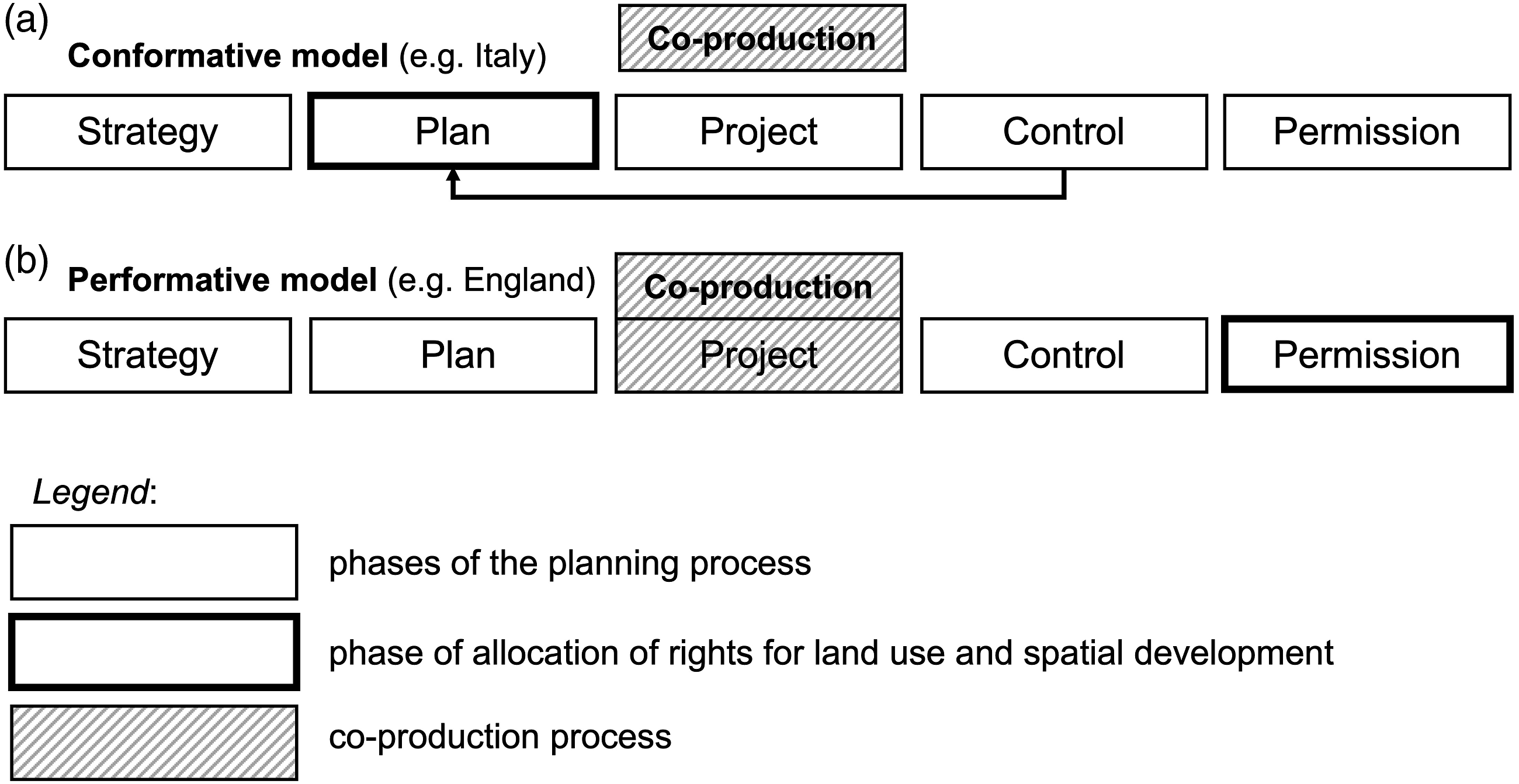
Conclusions
Across Europe there is a growing trend toward citizen involvement and empowerment in urban matters (Nadin et al., 2020). The complexity of current challenges coupled with limited public resources has highlighted the need for a substantial change: from the idea of a ‘providing state’ to an ‘activating state’ (Rosol, 2012). Contemporary urban governance is increasingly a matter of doing with citizens rather than doing for them. In this sense, co-production has become a watchword of this new paradigm and is invested with high hopes in the public debate. As Albrechts (2013: 56) points out, ‘[c]oproduction helps to understand the full complexity of places and helps to broaden the scope of the possible answers’ by bringing together different forms of expertise (Durose et al., 2022).
This article started from the assumption that spatial planning systems of different types mediate co-production in urban governance and spatial planning. Its aim was not to argue whether co-production is in itself desirable or a trojan horse, as it depends essentially on the purposes for which it is used. While recognising the cruciality of critical studies about co-production opportunities and limitations in specific policy contexts, this article has placed its focus more on reasoning on how co-production can operate with respect to the functioning of different planning systems. The Italian and English systems have been chosen as case studies because they are considered quite different from the literature on the subject. They are representative of two distinct institutional technologies: more traditional and widespread (the Italian one) and more recent but less frequent (the English one).
Although based on only two case studies, the article showed that the possibility of managing forms of urban co-production inside a spatial planning system is related to the type of the system itself. In particular, in the case of more widespread ‘conformative’ systems, characterised by the general and prior allocation of rights, co-production is destined to remain outside the planning system and cannot treat land rights as a possible stake. On the contrary, co-production finds a place inside the planning system, where these have taken on ‘performative’ characteristics, i.e. where land use and development rights are allocated on a case-by-case basis and thus remain “available” for co-production activities.
What emerged from the article opens two promising agendas for future research. The links between spatial planning systems and co-production on urban issues are still largely unexplored but may indicate avenues of research, as the two illustrated case studies showed. Future research could approach a broader typology of spatial planning systems (e.g., Berisha et al., 2021) to understand how the various types of systems deal with the issue of co-production. Be that as it may, further reflection on these issues can stimulate debate in planning theory and practice. Secondly, in light of the caution required in addressing the challenge of co-production, it is crucial to investigate this concept further within the institutional contexts in which it occurs. In this sense, multiple case study research on how co-production is applied in different countries can be functional to compare the actors, beneficiaries, contexts and conditions in which co-production operates and its results. If the time is ripe for co-production in urban governance and spatial planning, it is also time to understand more about it.
Footnotes
Acknowledgements
The authors would like to acknowledge and thank the editor of Planning Theory and the four anonymous reviewers, whose insightful and precious comments helped improve the paper.
Declaration of conflicting interests
The author(s) declared no potential conflicts of interest with respect to the research, authorship, and/or publication of this article.
Funding
The author(s) received no financial support for the research, authorship, and/or publication of this article.
