




Abstract

Concern that Courts in England and Wales May Impose Curfews in ‘Inappropriate Situations’
The imposition of curfews in cases involving children below the age of 18 years has become increasingly popular in the recent period. As indicated in Table 1, the number of curfew orders rose from 1293 in 2002/3 to 8367 in 2008/9, the last full year that such a disposal was available as a stand-alone order. Over the same period, curfews as a proportion of all sentences imposed also increased from 1.4 to 7.6 per cent. For offences committed after 30 November 2009, all existing community sentences for children were replaced by the youth rehabilitation order to which a range of requirements − including a curfew − could be attached. Figures for subsequent years are not accordingly available in a comparable format. However, in 2011/12, the total amount paid to contractors providing electronic monitoring services to the Ministry of Justice (in respect of both adults and children) stood at £116.9 million.
Curfew orders imposed on children and curfews as a proportion of all youth sentences: 2002/3–2008/9

Of those children sentenced to a curfew order during 2009/10, 67.6 per cent were reconvicted within a year, a recidivism rate higher than that for any other non-custodial youth disposal.
A thematic inspection of electronically monitored curfews in adult cases, conducted by Her Majesty’s Inspectorate of Probation, found that a minority were imposed following a thorough assessment, raising concerns as to whether they were being used appropriately. Conversely, most orders were unrelated to the offence and appeared to be used by the court as an additional punishment for crimes that would not otherwise attract imprisonment, rather than as part of strategy to reduce offending behaviour. Where defendants were also subject to statutory supervision, the curfew was rarely integrated into the sentence planning. While it is, of course, possible that such findings would not be replicated within the youth justice system, the rapid increase in the use of curfews for children, and the relatively high rates of reoffending, suggest that investigation of whether similar shortcomings apply would be beneficial.
The Legal Aid, Sentencing and Punishment of Offenders Act 2012 contains provision, not yet implemented, to expand the powers of the court in relation to curfews. At present, a curfew requirement can be attached to a youth rehabilitation order for up to six months and require the young person to remain indoors for a maximum duration of twelve hours per day. Following implementation, those maxima will increase to twelve months and sixteen hours respectively.
Figures for curfew orders are derived from respective editions of Youth Justice Annual Statistics
The total cost of electronic monitoring services within the criminal justice system is given in answer to a Parliamentary question by Crispin Blunt, Parliamentary Under-Secretary of State for Prisons and Probation, at Hansard, House of Commons, column 17, 14 May 2012
It’s complicated: The Management of Electronically Monitored Curfews, published by Her Majesty’s Inspectorate of Probation, is available at: www.justice.gov.uk/downloads/publications/inspectorate-reports/hmiprobation/joint-thematic/electronic-monitoring-report-2012.pdf.
Government Decides Not to Extend Appropriate Adult Provision to 17year-olds Detained in Police Custody in England and Wales
When children aged 10−16 years are detained at the police station, there is a statutory requirement that an appropriate adult should be present during each of the key stages in the process. In most cases, parents, carers or other family members attend in this capacity, but the Youth Offending Team has a statutory obligation to co-ordinate the provision of appropriate adults where parents are unable or unwilling to attend, or are, for some reason, disqualified from acting in that capacity. The role of the appropriate adult is to: advise the child; make representations on his or her behalf; ensure that his or her treatment accords with relevant Codes of Practice governing police detention; confirm that any questioning is conducted properly and fairly and facilitate communication between the child and the police.
Children aged 17 years are exempted from these statutory requirements and are, accordingly, not entitled to the support of an appropriate adult. Moreover, where police bail is refused following charge, there is no provision, as there is in the case of a younger child, to transfer him or her to local authority accommodation. This is largely an historical accident arising from the fact that the Police and Criminal Evidence Act 1984 (PACE), which introduced the appropriate adult role, predates the extension of the jurisdiction of the youth court to include children up to the age of 18 years through the provisions of the Criminal Justice Act 1991.
Following a review of PACE in 2008, the then Labour government announced its intention to limit the role of appropriate adult to those with adequate training, with parents or family members invited to attend the police station in addition to the appropriate adult. The government also confirmed that access to appropriate adults would be extended to all children below the age of 18 years. However, no legislation was introduced to that effect.
In February 2012, during the passage of what became the Legal Aid, Sentencing and Punishment of Offenders Act, Baroness Northover indicated on behalf of the coalition government that work was underway: … in the Home Office, the Youth Justice Board and the Ministry of Justice to look at the possibility of extending the appropriate adult scheme for all under-18s in the criminal justice system. However, we will need to consider fully the resource implications before any change can be made. At the moment, we feel that the scheme needs to remain as it is, but we keep it under review.
More recently, however, in July 2012, in answer to a parliamentary question, Nick Herbert, Minister of State for Police and Criminal Justice, confirmed that the government had ‘concluded that it would not be appropriate to amend the law at the present time’ in the light of the ‘benefits, costs and risks’ of treating 17 year-olds as children for the purposes of PACE. No indication was given as to how such benefits, costs and risks had been ascertained or what criteria had been adopted in assessing them. Commenting on the decision, the National Association for Youth Justice noted that, as a consequence, ‘the only mechanism for consistently protecting the rights of 17 year-olds … is to define them as ‘vulnerable’ adults within local protocols between youth offending teams and the police’ since adults classified as vulnerable are entitled to have an appropriate adult, irrespective of age.
The decision not to implement the previous administration’s commitments will appear increasingly anomalous with the implementation of the youth justice related provisions of the Legal Aid, Sentencing and Punishment of Offenders Act 2012. For similar historical reasons, children aged 17 appearing in court have hitherto been treated as adults for remand purposes with there being no option of a remand to local authority accommodation where bail is denied for defendants of that age. The Act aligns the remand arrangements for all those below the age of 18, leaving police detention as the only area of the youth justice system where 17 year-olds continue to be treated as adults.
Government proposals in response to the review of the Police and Criminal
Evidence Act 1984, published by the Home Office, is available at: hwww.criminalsolicitor.net/forum/uploads/Gavin/GLink/2008-08-28_171222_cons-2008-pace-review.pdf
Baroness Northover’s comments appear at Hansard, House of Lords, Column 882, February 2012.
Nick Herbert’s answer is given at: Hansard, House of Commons, Column 548W, 16 July 2012.
The National Association for Youth Justice’s comment appears in Children in Police Detention: NAYJ Briefing, by Dr Di Hart, and is available at: http://thenayj.org.uk/wp-content/files_mf/briefingchildreninpolicedetention.pdf.
American Supreme Court Rules Sentencing of Juveniles to Life Imprisonment without the Prospect of Parole Unconstitutional
One 25 June 2012, the Supreme Court held that the imposition of life imprisonment without the prospect of parole constitutes a violation of the US Constitution of the Eighth Amendment’s prohibition of cruel and unusual punishment. The judgement follows an earlier 2010 ruling in Graham v Florida (reported in Youth Justice News 12(2)) that such sentences were unconstitutional other than in cases of homicide. The latest decision of the court extends that principle to all offences.
The court considered two cases in which children were convicted of murder at the age of 14 years. Kuntrell Jackson, who had a previous history of offending involving shoplifting and car theft, was involved in the robbery of a video store with two others during which a store worker was shot and killed. Jackson was charged as an adult and, although he had not fired the gun, was found guilty of murder. He was sentenced to imprisonment without the prospect of release. Evan Miller, who had a history of being in and out of care as a consequence of his mother’s alcohol and drug dependency and had attempted suicide on four occasions, was convicted of the murder of a neighbour who had come to sell drugs to his mother. Evan followed the neighbour to his trailer with a friend. The victim passed out after drinking and smoking marijuana with the two boys and awoke to find Evan stealing his wallet. In the ensuing struggle Evan hit the neighbour repeatedly over the head with a baseball bat. To cover the evidence of the crime, he set fire to the trailer and the victim later died from a combination of smoke inhalation and his injuries. Evan was sentenced to life imprisonment without parole.
The court took the view that none of the arguments adduced in Graham v Florida, to establish that life sentences without the prospect of release in the case of a child breached the Constitution, were offence specific. The same reasoning ought accordingly to apply irrespective of the nature of crimes involved. In coming to a judgement the court observed that: Mandatory life without parole for a juvenile precludes consideration of his chronological age and its hallmark features − among them, immaturity, impetuosity and failure to appreciate risks and consequences. It prevents taking into account the family and home environment that surrounds him − and from which he cannot usually extricate himself − no matter how brutal or dysfunctional. It neglects the circumstances of the homicide offense, including the extent of his participation in the conduct and the way familial and peer pressures may have affected him… And finally, this mandatory punishment disregards the possibility of rehabilitation even when the circumstances most suggest it.
The decision has been welcomed by the American Psychological Association who provided evidence to the court to the effect that: young people should not be held to the same standards of culpability as adults; neuropsychological research demonstrates the extended period over which the adolescent brain develops; children have greater potential for rehabilitation than adults; and ‘even serious juvenile offenders are highly unlikely to continue to commit crimes as they mature’.
The judgement of the Supreme Court in Miller v Alabama and Jackson v Hobbs is available at: www.supremecourt.gov/opinions/11pdf/10-9646g2i8.pdf
The American Psychological Association’s brief to the court is available at: www.apa.org/about/offices/ogc/amicus/miller-hobbs.pdf.
The Rate of Serious Violent Youth Crime Falls in the US
According to the latest key national indicators of child well-being, 22 two per cent of children aged 0−17 years in the United States, a total of 16.4 million, live in poverty. The extent of deprivation varies according to ethnic background with just 12 per cent of white children classified as poor by comparison with 35 per cent of those of Hispanic background and 39 per cent of black children. Nonetheless the overall position of children appears to have improved and youth crime has fallen. The use of illicit drugs among high school children has remained broadly stable over the past five years, but tobacco and alcohol intake have both fallen. The proportion of children who report smoking daily is the lowest since monitoring began in 1980. Similarly, between 2006 and 2011, heavy drinking (defined as having five or more alcoholic drinks on a single occasion in the past two weeks) declined from 25 per cent of those in the twelfth grade to 22 per cent.
In 2010, the prevalence of serious violent offending was nine incidents per 1000 children in the 12−17 age range, compared with more than 50 per 1000 in 1993. Over the same period, the proportion of all serious violent crimes where the perpetrator was below the age of 18 years fell from 26 to 18 per cent.
Detected youth crime, more generally, has also declined in recent years following sharp rises between 1960 and the mid-1990s. In 2009, the latest year for which figures are available, juvenile courts dealt with an estimated 1,504,100 delinquency cases (49.3 cases for every 1000 juveniles in the population), representing a reduction of 20 per cent compared with 1997. The fall in property offences − at 35 per cent − has been particularly sharp, but there have also been reductions over the same period in offences against the person (13%) and drugs related offending (12%). The pattern for boys and girls differs significantly: between 1997 and 2009, the number of cases involving the former fell by 24 per cent while those involving the latter remained broadly stable, showing a one per cent decline overall. The variation is largely a consequence of increases in prosecution of girls for public order matters and offences against the person; the trend for property offences is similar for both groups.
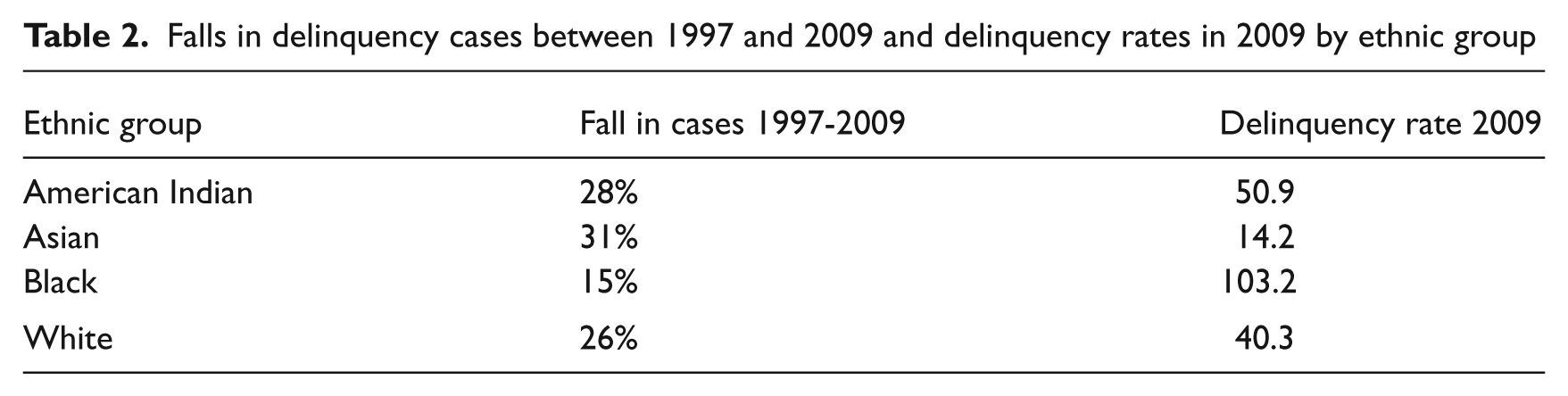
The delinquency rate (expressed as the number of cases per 1000 in the relevant population) also varies significantly by ethnicity. As indicated in Table 2, the proportion of black children appearing in court in 2009 was more than double that of their white peers and the decline in cases over the last two decades has been considerably less pronounced for the former group. The decrease for ‘American Indians’ has been greater than that of their white counterparts, but they remain overrepresented in the court system. Asian young people are underrepresented and the prevalence of detected offending among this population has fallen more rapidly than for any other group.
Falls in delinquency cases between 1997 and 2009 and delinquency rates in 2009 by ethnic group
While black children and young people accounted for 34 per cent of total cases in 2009, they constituted 42 per cent of those subject to detention prior to final disposal. They were also more likely to receive a disposal involving ‘out-of-home placement’ as indicated in Table 3.
Proportion of adjudications resulting in a disposition of out-of-home placement by ethnic group in 2009

Figures on poverty, substance misuse and participation rates in serious violent offending are given in America’s Children in Brief: Key National Indicators of Wellbeing 2012, published by the Federal Interagency Forum on Child and Family Statistics and available at: www.childstats.gov/pdf/ac2012/ac_12.pdf
Figures for delinquency cases and outcomes are given in Juvenile Court Statistics 2009, by Charles Puzzanchera, Benjamin Adams and Sarah Hockenberry, published by the National Center for Juvenile Justice, which is available at: www.ojjdp.gov/pubs/239114.pdf.
Children Given Low Level Community Sentences in England and Wales Less Likely to Reoffend than those Given Higher Level Disposals
‘Propensity score matching’ analysis conducted by the Ministry of Justice − using characteristics including age, gender, offence and criminal history to construct statistical comparison groups − explores reoffending of groups of young people given different sentences. Children aged 15–17 years who received a low level community penalty (attendance centre order, reparation order or action plan order) were found to be significantly less likely to reoffend in each year between 2005 and 2009 than those given a higher level community penalty (community punishment order, community rehabilitation order, community rehabilitation and punishment order, supervision order or curfew order). In 2009, for instance, the reoffending rate within one year of disposal for the former group was four percentage points lower. Moreover, in the same year, the low community sentence group committed significantly fewer further offences.
Children given a high level community sentence had, in turn, a lower rate of reconviction than those imprisoned for six months or less. The differences were statistically significant in each of the years between 2005 and 2008, but not during 2009. There was, however, a statistically significant difference in the number of re-offences in that year, with those sentenced to custody committing an average of 0.48 more offences within 12 months of release. The length of custodial sentence does not appear to have an impact on reoffending, however, as there were no statistically significant differences in recidivism between those sentenced to custody for six months or less and those imprisoned for between six and twelve months.
2012 Compendium of Re-offending Statistics and Analysis, published by the Ministry of Justice, is available at: www.justice.gov.uk/downloads/statistics/reoffending/2012-compendium-reoffending-stats-analysis.pdf.
Research Finds ‘No Evidence’ that North Liverpool Community Court in England has a Greater Impact on Children’s Offending than Other Courts
Based on the model of the Red Hook community justice centre in Brooklyn New York, the North Liverpool community justice centre opened in September 2005. The centre brought together a magistrates’ court, a youth court and a crown court with a range of criminal justice agencies and problem solving professionals co-located on the premises. It deals with all crime committed by children within the catchment area other than homicides and sexual offences. Where possible, a single judge deals with all matters to provide a sense of continuity, consistency and accountability. While the centre in Liverpool was the first to open in England and Wales, 12 other pilot sites were established. However, these are no longer operating on the same model and the Liverpool centre is the only one of its type still in existence.
An evaluation undertaken on behalf of the Ministry of Justice found that the period from offence to conviction was shorter in the community justice centre than the national average, although not significantly so. The mean number of hearings in contested cases was lower, suggesting a higher level of efficiency in this regard than elsewhere. However, the centre also experienced a higher rate of ‘cracked trials’; cases where the trial does not proceed to conclusion because the defendant changes his or her plea on the day of trial or the prosecution offers no evidence. Consequently, ‘time may be being wasted in preparing cases that are subsequently closed on the day of trial’, although the evaluators acknowledge that this finding might also be an artefact of the relatively high proportion of domestic violence cases passing through the court.
To assess any potential impact on reoffending, individual young people sentenced at the community justice centre were matched to those whose cases were disposed of in other courts. Reconviction rates for the former group were higher (at 62.5 per cent compared to 55.6 per cent), although the difference was not statistically significant. The average number of re-offences per head was slightly lower for North Liverpool community justice centre, but not significantly so. The breach rate for adults was significantly higher for defendants within the jurisdiction of the centre (22.3 per cent compared to 14.2 per cent elsewhere). The incidence of breach for juveniles was also higher but not to the extent that was statistically significant.
The authors of the evaluation conclude that there is no evidence that the model established at the North Liverpool community justice centre has been any more effective in preventing children’s reoffending than other courts. Moreover, trends for overall levels of crime within the catchment area have been consistent with other parts of England and Wales. The report acknowledges that the centre may have other benefits including, for instance, improved community confidence, but these issues were not explored in the evaluation.
North Liverpool Community Justice Centre: Analysis of Re-offending Rates and Efficiency of Court Processes, Research Series 10/12, by Lucy Booth, Adam Altoft, Rachel Dubourg, Miguel Gonçalves and Catriona Mirrlees-Black, is published by the Ministry of Justice and is available at: www.justice.gov.uk/downloads/publications/research-and-analysis/moj-research/liverpool-community-centre.pdf.
The Netherlands Pilots Greater Flexibility in the Treatment of Adolescents
On 9 September 2012, a six month pilot of anticipated reforms to the adolescent criminal law commenced in the Dutch municipality of Almelo. A second pilot will start in Groningen in November. The new proposed legislation, announced by Fred Teeven, the State Secretary of Security and Justice in December 2011, is intended to offer a ‘coherent package’ aimed at children and young people aged from 15 (the minimum age of criminal responsibility) to 23 years. The intention is to allow a more flexible response to crimes committed by adolescents so that ‘the approach to juveniles under 18 will be more in line with the approach to young adults over 18, and vice versa’.
Legislation allows for young people around the threshold of 18 to be processed either as adults or juveniles and the new provisions would raise the upper age limit for applying the juvenile criminal law from 21 to 23 years. During the pilot, probation workers and staff from the Child Care and Protection Agency will produce a report for the prosecution service and the court - focusing on the young person’s stage of development − to allow a more informed assessment of whether he or she should be processed as a juvenile or adult.
The package of reforms proposes to increase the maximum period of youth detention from two to four years, preclude the use of a community disposal for serious sexual or violent offences and introduce compulsory aftercare in the form of conditional release, which may be subject to electronic monitoring, for those sentenced to youth custody. Where assessment indicates that a young person remains a risk at the end of the custodial period, the courts would have the power to convert the placement in a correctional facility to a hospital order to allow continued detention once the sentence is completed.
The measures proposed can be understood in the context of government ‘endeavours to achieve more safety by applying longer detentions to reoffenders, by enforcing sentences faster and by vigorously tackling youth gangs’ which are being introduced in spite of recent falls in recidivism. Figures released by the Scientific Research and Documentation Centre show that while 39.1 per cent of juveniles prosecuted for serious offences in 2002 reoffended within two years, the equivalent figure for 2008 was 35.9 per cent.
An overview of the proposed changes to the adolescent criminal law is available at: www.government.nl/documents-and-publications/press-releases/2011/12/16/state-secretary-mr-teeven-introduces-adolescent-criminal-law.html
The announcement of the pilot by the State Secretary is available at: www.government.nl/news/2012/09/05/teeven-starts-an-adolescent-criminal-law-pilot.html
Reoffending data are published by the Scientific Research and Documentation Centre (WODC) and are available at: https://english.wodc.nl/onderzoek/cijfers-en-prognoses/Recidive-monitor/.
Average Length of Youth Conference Plans in Northern Ireland Rises
Restorative youth conferencing lies at the heart of the youth justice system in Northern Ireland. It functions as a diversionary measure pre-court and, in the event of prosecution, there is a statutory presumption that the court should consider whether to order a youth conference. A review published in 2011 was generally positive about the new system, but raised the issue of whether conferencing might lead to disproportionate outcomes in cases of minor offending.
Data published by the Northern Ireland Youth Justice Agency might be thought to provide some evidence in support of that criticism, since they indicate that the length of intervention for young people subject to plans agreed at youth conferences has risen over the past five years. During 2011/12, almost one in four diversionary conference plans lasted for more than 12 months compared with fewer than 15 per cent in 2007/08. Over the same period, the proportion of plans with a duration of longer than one year rose from 27 to 41 per cent. In seems unlikely that this is a consequence of the conferencing system dealing with more serious offending, since, as shown in Table 4, the total number of plans agreed has tended to increase and the proportion of plans that are diversionary, as opposed to ordered by the court, has risen sharply.
Number of and type of youth conference plans: 2007/8 to 2011/12

Over the same period, the number of initial admissions of children to the Juvenile Justice Centre, the Youth Justice Agency’s custodial facility, has risen by nearly 16 per cent, from 346 to 400. The expansion is largely a consequence of a statutory change in the status of 17 year-olds who, from November 2009, were brought within the definition of young people for the purposes of arrest and police detention. As a result, children of that age have been detained within the Juvenile Justice Centre rather than adult custodial facilities; in 2011/12, there were 137 initial admissions of 17 year-olds compared with an equivalent figure of 27 in 2007/08.
A Review of the Youth Justice System in Northern Ireland, by John Graham, Stella Perrott and Kathleen Marshall, is published the Youth Justice Unit of the Department of Justice and is available at: www.dojni.gov.uk/index/publications/publication-categories/pubs-criminal-justice/review-of-youth-justice---large-print-version-of-report.pdf
Figures for trends in youth conferencing and admissions to the Juvenile Justice Centre are given in Youth Justice Agency Annual Workload Statistics: 2011/12, Statistical Bulletin 1/2012, by A McAvoy, available at: www.youthjusticeagencyni.gov.uk/document_uploads/YJA_Annual_Workload_Statistics_2011-12.pdf.
Areas Operating ‘Triage’ Schemes in England Show Larger Falls in the Number of Children Entering the Youth Justice System for the First Time
In 2008, the Home Office, Cabinet Office and Ministry of Justice jointly published the Youth Crime Action Plan which set out how government, working with communities, parents, schools and others, would tackle youth crime. The ‘Action Plan’ encouraged the development of youth justice ‘triage’ arrangements and, according to the Department for Education, there were 55 such schemes in operation in England in January 2011, most of which had commenced operation in 2009. In accordance with the statutory aim of the youth justice system, the primary objective of the initiative is to prevent reoffending by children and young people who come to the attention of criminal justice agencies, but it is also intended to provide a mechanism for diverting low level offending from formal youth justice outcomes, while ensuring access of the children involved to appropriate assessment and intervention.
The model, derived from health care, involves classifying young people arrested by the police according to the seriousness of the offence, their previous antecedent history and their assessed level of risk/need. Triage workers, in most cases staff from the youth offending team, liaise with the police to identify the most suitable outcome for the particular young person.
An evaluation of the initiative, on behalf of the Home Office, adopts a ‘case study’ approach, focusing on seven areas selected to ensure a varied distribution in terms of size, location and demographics. Five areas had well established triage arrangements, while two had difficulties with implementation: one of the latter had failed to establish the project. A major obstacle identified by respondents was resistance from the police. In at least some areas, senior officers were concerned that cases where triage successfully diverts children from a formal youth justice disposal did not count as ‘sanction detections’, the volume of which has in the past been used as a measure of police performance. Consequently, schemes tended to be more easily established, and operate more smoothly, where there was a strong pre-existing partnership between the youth offending service and the police or there was a local police ‘champion’ wedded to the approach.
All but one area involved in the evaluation operated level 1 triage, which attempts to divert young people, who have committed minor offences and generally have no antecedent history, from the formal youth justice system through restorative interventions such as letters of apology, reparative activity, or in some cases attendance at a panel. A number of schemes also provided level 2 triage which focuses on children who may have previous pre-court disposals, and are thought to require an assessment by the youth offending team. Level 2 results in the offer of more intensive intervention and may lead to a diversionary outcome, but it not guaranteed to do so. Just one area also engaged in level 3 triage, targeted at children committing more serious offences who are likely to attract a formal criminal justice sanction. These different approaches were reflected in a wide variation in scheme throughput with mean number of contacts ranging from 147 to just two per month. Areas with triage workers operating out of police custody suites tended to have higher levels of contact whereas those who depended on referrals from the police experienced lower caseloads. Similarly, the area with the highest throughput was the only one that aimed to assess all young people arrested, while other schemes had more restrictive referral criteria.
The evaluators found that the availability and quality data varied significantly. It was not accordingly possible to establish a matched control group to determine whether triage had an impact on young people’s reoffending. In three areas where sufficient data were available to allow analysis, reoffending following triage was substantially lower than the national average for first time entrants, ranging from five to seven per cent, compared to 21.3 per cent. In addition, areas operating triage showed a larger reduction in children entering the youth justice system for the first time than the national average: 28.5 compared to 23 per cent between 2008/9 and 2009/10. However, many areas have adopted other diversionary measures in response to the introduction a government target to reduce first time entry and the number of first time entrants was, in any event, falling prior to the introduction of triage. In this context, the report concedes, no firm conclusions can be drawn from the figures.
Assessing Young People in Police Custody: An Examination of the Operation of Triage Schemes, Occasional Paper 106, by the Institute for Criminal Policy Research, is published by the Home Office and is available at: www.homeoffice.gov.uk/publications/science-research-statistics/research-statistics/crime-research/occ106?view=Binary.