




Abstract

Child Arrests in England and Wales Fall by 55 Per Cent in 4 Years
Research published by the Howard League for Penal Reform in November 2015 indicates that 112,037 children in England and Wales were arrested by the police during 2014. This figure, derived from freedom of information requests to individual police services, represents a 55 per cent reduction compared with the 245,763 child arrests recorded through the same procedure in 2010. The decline in arrests of girls has been slightly faster at 58 per cent than that for boys.
Over the 4-year period, there was a fall in arrests of children in all police forces, but there is considerable differentiation between areas, with reductions ranging from 19 per cent in Surrey to almost 75 per cent in Humberside. Moreover, in the most recent year, 2013–2014, while the large majority of areas showed a decline (the largest at 69% in Greater Manchester), six forces – Devon and Cornwall, Durham, Merseyside, Norfolk, Nottinghamshire and Surrey – reported an increase. However, it seems clear that at least some of the variation reflects differences in baselines. For instance, while the reduction over the past 4 years has been considerably larger in Humberside than in Surrey, child arrests nonetheless accounted for a smaller proportion of total arrests for all ages in the latter area (at 4.6%) than in the former (6.4%), suggesting that until recently child arrests were, relative to those of adults, more prevalent in Humberside.
Irrespective of such differentials, the general pattern is unmistakeable. The substantial decline in child arrests is consistent with broader victimisation data from the Crime Survey for England and Wales which shows an overall decline in crime over the relevant period. However, since the fall in total crime is considerably more muted than the reduction in child arrests, it is unlikely to provide a full explanation. At least as significant are changes in police practice subsequent to the introduction of a government target, established in 2008, to reduce the number of children entering the youth justice system for the first time. This shift in practice is consolidated in a new National Strategy for the policing of Children and Young People, published by the National Police Chiefs’ Council in August 2015, which contains a number of ‘key principles’ including
In all encounters with the police, ‘those below the age of 18 should be treated as children first. All officers must have regard to their safety, welfare and well-being …’;
Children’s vulnerability ‘should be identified and responded to effectively in order to protect them from harm’;
Whenever children come to police attention, ‘a full understanding of their circumstances should be sought … [this] may not affect the way we utilise the criminal justice system but should open our eyes to alternative avenues for addressing their behaviour’;
Every interaction with children ‘is both an intervention and an opportunity … to enhance our relationship with them’;
Children’s voices should be ‘heard and their opinions respected’;
Children should be kept out of the criminal justice process ‘unless necessary’.
The fall in arrests is reflected at subsequent stages of the youth justice system where there have been comparable reductions. Between 2009–2010 and 2013–2014, the number of children receiving a formal pre-court sanction declined by 64 per cent; there was also a reduction over the same period of 57 per cent in the number of children convicted at court. Conversely, in spite of recent trends, almost half (47%) of arrests do not result in a subsequent conviction or formal pre-court sanction, suggesting that large numbers of children continue to be arrested where there is insufficient evidence to proceed or the offence was not serious enough to warrant a formal disposal. Moreover, there are concerns that current Home Office Counting rules for Recorded Crime, which require that every reported criminal incident has an outcome, limit the extent to which the police are able to exercise discretion to deal informally with low level offending by children. A report by the All Party Parliamentary Group for Children (APPGC), published in November 2015, notes that since informal referrals to other agencies for support do not constitute a formal outcome for counting purposes, children continue to receive disposals that result in a criminal record unnecessarily. The report accordingly recommends that
the Home Office review their Counting Rules and develop a new outcome, which allows police forces to record low-level crime-related behaviour in a way that would allow for the child’s behaviour to be addressed by a welfare agency but without the incident forming part of a young person’s criminal record.
The APPGC also highlights the negative impact of the counting rules on children in care, who are up to three times as likely to be subject to a youth justice disposal as children in the general population. The report argues that residents of children’s homes may be particularly adversely affected since behaviour, which in a family home would be dealt with privately is more likely to result in a request for police intervention. Strict adherence to counting rules can thus lead to the imposition of a formal youth justice sanction in circumstances that would not attract a criminal justice response for children living at home. While some areas have developed protocols between the police and children’s services designed to mitigate this impact, the Parliamentary Group heard evidence that, during 2014, the 47 children’s homes in one local authority had generated 3500 police call outs. To address this issue, the report recommends that the counting rules be amended to allow police greater discretion when dealing with incidents in residential children’s establishments similar to that which already applies to schools.
Other data confirm that the overrepresentation of ethnic minority children among those subject to arrest also remains a concern. According to Home Office figures, children who self-identified their ethnicity as black accounted for 8.9 per cent of ‘juvenile’ arrests in 2009–2010, but this figure had risen to 10.6 per cent by 2013–2014. The equivalent figures for children who identified themselves as of mixed heritage were 4.8 and 5.5 per cent, while those for Asian children were 4.3 and 4.9 per cent respectively. The combined representation of these three ethnic groups as a proportion of child arrests rose over the relevant 4-year period from 18 to 21 per cent, suggesting that they have not benefited from the decline in arrests to the same extent as their white counterparts.
Child arrests in England and Wales 2014: research briefing, published by the Howard League, is available at: https://d19ylpo4aovc7m.cloudfront.net/fileadmin/howard_league/user/pdf/Publications/Child_arrests_2014.pdf National Strategy for the Policing of Children and Young People, published by the National Police Chiefs’ Council, is available at: www.npcc.police.uk/documents/edhr/2015/CYP%20Strategy%202015_2017_August%202015.pdf Information on the Crime Survey for England and Wales is given in Crime in England and Wales, Year Ending March 2015, published by the Office for National Statistics and available at: www.ons.gov.uk/ons/dcp171778_411032.pdf Figures for the proportion of arrests involving children are derived from Police powers and procedures England and Wales, year ending 31 March 2015: data tables, published by the Office for National Statistics and available at: www.gov.uk/government/statistics/police-powers-and-procedures-england-and-wales-year-ending-31-march-2015-data-tables Trends for pre-court disposals and convictions for children are derived from Youth justice statistics 2013/14, England and Wales, published by the Ministry of Justice and available at: www.gov.uk/government/statistics/youth-justice-annual-statistics-2013-to-2014 Building Trust: one year on. Progress in improving relationships between children and the police, a follow on report of the inquiry held by the All Party Parliamentary Group for Children 2013-2014, is published by the All Party Parliamentary Group for Children, and is available at: www.ncb.org.uk/media/1237461/one_year_on_report_-final_copy.pdf Figures for the self-defined ethnicity of children subject to arrests are given in Statistics on Race and the Criminal Justice System 2014, published by the Ministry of Justice and available at: www.gov.uk/government/statistics/race-and-the-criminal-justice-system-2014.
One Year Reoffending Rates for Children Receiving a Youth Justice Disposal in England and Wales Rise
One of the three primary indicators by which youth justice performance in England and Wales is measured is the rate of proven reoffending within 1 year of disposal or, in the case of a custodial sentence, the point of release. (The other two performance indicators are the number of children who enter the youth justice system for the first time and the number of children in custody.)
According to analysis conducted by the Ministry of Justice, published in November 2015, the binary (‘yes’/’no’) rate of reoffending rose between 2002 and 2012–2013, with the increase being particularly pronounced for younger children, as shown in Table 1. While children in the older age range, 15–17 years, continue to reoffend at higher rates than their younger counterparts, the differential has accordingly narrowed considerably over that period.
Proportion of children reoffending within 12 months of disposal for selected years by age group.
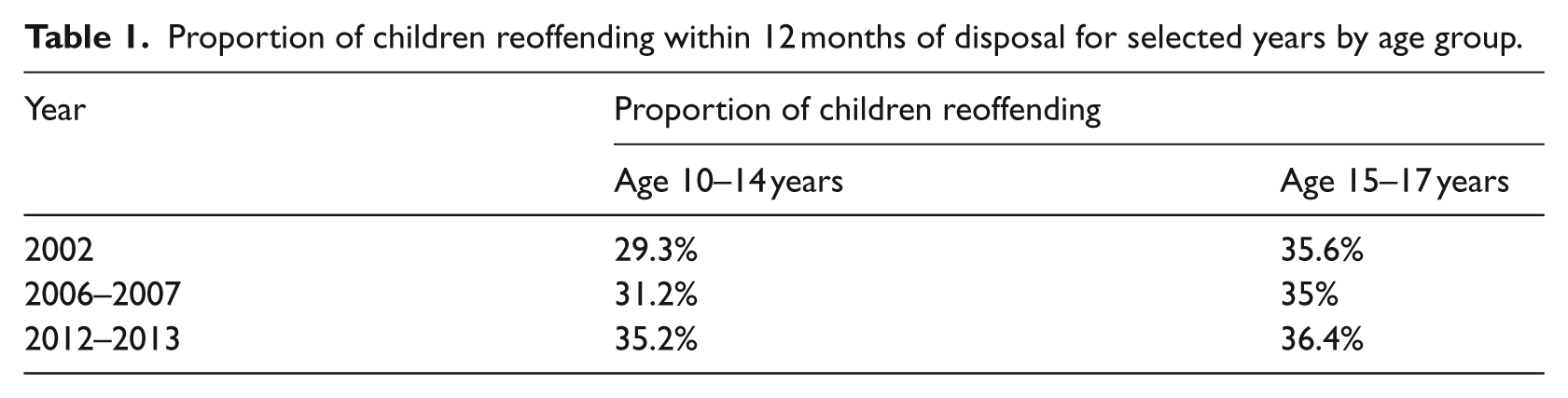
By comparison, reoffending rates for young adults are lower and have tended to fall: between 2002 and 2012–2013, the recidivism rates for young people aged 18–20 years declined from 33.5 to 30 per cent; the equivalent figures for those aged 21–24 years were 31.6 and 27.1 per cent.
Part of the explanation for the rise in recidivism for children is that the characteristics of those who receive a formal youth justice disposal have changed. Since 2002, the proportion of such children with no previous offences has fallen, by 9 percentage points, while the proportion who have three or more antecedent offences has increased by 8 percentage points. This shift is largely a consequence of a marked reduction of the number of children entering the system (of 61% since 2002), with the result that many of those have no antecedent history, or who commit less serious offences, have been diverted from a formal sanction. This dynamic impacts on reoffending statistics because, as one might anticipate, children with a formal history of offending have higher rates of recidivism. As the analysis notes,
In the 12 months to March 2013, there were about 3,300 offenders with 11 or more previous offences and they had a binary reoffending rate of 75.6%, which is more than double the overall rate.
Conversely the reoffending rate for children with no previous disposals was just 23 per cent.
The fall in throughput has also led to a shift in the age distribution of children entering the youth justice system. Younger children are more likely to be diverted, leading to an increase in those in the 15–17 age bracket, from 64.4 per cent in 2002 to 75.6 per cent in 2012–2013. Those younger children who continue to receive a formal sanction are accordingly particularly more likely to have been in trouble previously or to have committed serious offences than their counterparts in 2002, accounting for the sharper rise in reoffending for that group. Over the same period, the decline in the number of girls – who have lower reoffending rates than their male peers – has also been sharper with the former accounting for 23 per cent of the cohort in 2002 and 20.5 per cent in 2012–2013. The higher proportion of males in the cohort will thus have contributed to the rise in recidivism.
There is considerable variation in the 1-year reoffending rate between youth offending team (YOT) areas, ranging from 53.2 per cent in Cardiff to 21.2 per cent in Wokingham in 2012–2013. As shown in Table 2, areas with higher rates of recidivism have tended to see increases over the 10-year period, while those with lower rates of reoffending have mostly achieved falls. The analysis confirms that a large part of this variability reflects the characteristics of children managed by the different YOTs.
One year binary reoffending by YOT area for selected years: five highest and five lowest reoffending rates.

The binary rate of reoffending is a rather blunt measure since, not only is it susceptible to changes in the characteristics of children in the system, but it also fail to capture shifts in the frequency of reoffending and the number of reoffences. When these are considered, the picture looks somewhat different. The number of proven reoffences has fallen year on year since 2006–2007, yielding a reduction of two thirds by 2012–2013. This decline is largelyan artefact of the smaller youth justice population. The frequency of reoffending (i.e. the number of reoffences per child in the cohort), perhaps a more useful measure, fell consistently between 2002 and 2007–2008, but has risen in each of the subsequent years to a level close to that at the start of the 10-year period.
National analysis of reoffending data, for those aged 10–17: England and Wales, is published by the Ministry of Justice and Youth Justice Board, and is available at: www.gov.uk/government/statistics/national-analysis-of-re-offending-data-for-those-aged-10-17.
Youth Justice Referrals in Northern Ireland at a 7-Year Low but the Number of Children in Custody Rises
The youth justice system in Northern Ireland is largely restorative, centred on the use of youth conferencing – either as a diversionary or court-ordered intervention – as the most common disposal. The purpose of the conference is to agree a plan which is subject to the approval of the prosecution service or the court, depending on the source of the referral. All youth justice interventions, including conferencing, other community orders and custody are delivered by the Northern Ireland Youth Justice Agency, an Executive Agency established in 2003.
During 2014–2015, as shown in Table 3, there were 1563 referrals to the Youth Justice Agency, involving 873 young people, lower than at any point in the last 7 years. The decline in the number of children has been much more rapid than the fall in referrals (23.6% compared with 4.5%), indicating that each child is more likely to attract multiple referrals than previously. The proportion of referrals for diversionary conferencing has declined from 52 to 42 per cent over the 7-year period. The Youth Justice Agency suggests that this may be a consequence of the introduction of Youth Engagement Clinics, piloted from 2012 onwards and operating in all but one police district at the beginning of 2015. The clinics, established in response to a recommendation of a review of the youth justice system in 2011 that a greater range of non-formal options should be available for lower level offending, has encouraged an increase in the use of restorative cautioning and informal warnings.
Referrals to the youth justice system and number of children involved.

Despite the contraction in the youth justice population, there has been no associated fall in child imprisonment. The population of the Juvenile Justice Centre, Northern Ireland’s custodial facility for children, was higher in 2014–2015 than in 2008–2009 – an average of 199 children in detention compared to 153. This rise is largely associated with an increase in admissions.
Youth Justice Agency annual workload statistics 2014/15, by N. O’ Neil, is published by the Department of Justice and is available at: www.dojni.gov.uk/publications/sb-12015-youth-justice-agency-annual-workload-statistics-2014-15 Details on the implementation of Youth Engagement Clinics are given in Monitoring of the progress on implementation of the youth justice review recommendations, published by Criminal Justice Inspection Northern Ireland, is available at: www.cjini.org/TheInspections/Inspection-Reports/Latest-Publications.aspx?did=1652.
School Children with Mental Health Needs in Two US States Provided with Treatment to Divert Them from the Juvenile Justice System
The prevalence among children processed by the criminal justice system in the United States of psychiatric disorders is high. According to research published by the Office of Juvenile Justice and Delinquency Prevention in September 2015, which draws on a longitudinal study of 1829 children arrested in Illinois between 1995 and 1998, 68 per cent of those processed by the juvenile court and 66 per cent of those appearing in the adult court (where jurisdiction had been waived) had a diagnosable psychiatric condition. These figures are significantly higher than those for adult offenders, and prevalence was especially marked in children given custodial disposals.
Moreover, only 15.4 per cent of detainees with major mental health disorders received any form of treatment. Almost one third of those who did not were unsure from whom they should seek support and a further 20 per cent considered that it was too difficult for them to get the help they needed.
Given such evidence, the Mental Health/Juvenile Justice Action Network, covering eight States, adopted early diversion as its first area of focus in 2008. Two member states, Connecticut and Ohio, developed school-based diversion models that identified children with a suspected mental health disorder who were at risk of referral to juvenile courts or probation and linked them to appropriate services modelled on WrapAround Milwaukee’s Mobile Urgent Treatment Team, providing a clinical response to school-based problems that had a mental health dimension. This approach contrasted with ‘zero tolerance’ policies that had emerged in many schools during the 1990s and had contributed to the criminaliation of disruptive behaviour that would previously have been dealt with internally,thereby creating a ‘school-to-prison pipeline’. The intervention was designed to deliver a treatment-based response to specific incidents, including violence, or chronic problems such as absenteeism, by providing both training for school staff and individual case management within schools.
Over a 3-year period, the schemes in both States demonstrated reductions in juvenile arrests and court involvement while enhancing mental health provision available to children and their families through schools.
Detained youth processed in juvenile and adult court: psychiatric disorders and mental health needs and Perceived barriers to mental health services among detained youth are both published by the Office of Juvenile Justice and Delinquency Prevention and are available at: www.ojjdp.gov/pubs/248283.pdf and www.ojjdp.gov/pubs/248522.pdf respectively Schools turn to treatment, not punishment, for children with mental health needs by Giudi Weiss, Kathleen Skowyra, is published by ModelsforChange and is available at: www.modelsforchange.net/publications/510.
Legal Representation of Children in Conflict with the Law in England and Wales Frequently Undertaken by Advocates Who ‘Lack Knowledge of Youth Justice Law, Procedures and Provisions’
A study commissioned by the Bar Standards Board, responsible for the regulation of barristers in England and Wales, and the Chartered Institute of Legal Executives, the governing body for legal executives and other paralegals, considered two research questions: first, what knowledge, skills and attributes are required by advocates in youth proceedings to work effectively with defendants and witnesses; second, to what extent do youth advocates currently have these requisite knowledge, skills and attributes. Published in November 2015, the research adopted a multi-faceted methodology that included a survey completed by 204 barristers or barrister pupils and seven chartered legal executives, follow-up interviews with 34 of those who had completed the survey, interviews with 30 court-based youth justice professionals (YOT workers, the judiciary and legal advisors), face to face interviews with 25 young defendants and observations of proceedings in four youth courts and five Crown Courts.
As a consequence of the commissioning arrangements for the research, solicitors were not included in the survey or interviews, but evidence provided by young people and youth justice professionals, as well as the observational data, did not distinguish professional status. At least some of the findings are accordingly likely to be relevant to all forms of advocacy in youth proceedings: some barristers did acknowledge that solicitors who spent more time in the youth court might have a more in-depth knowledge in this area; others, however, highlighted the lesser training of solicitors to suggest that they tended to perform less well.
The report notes the body of evidence confirming that children in conflict with the law are characterised by a range of needs and vulnerabilities, with almost a third experiencing mental health difficulties and 6 in 10 having a communication disability. It cites research indicating that representing child defendants is
a specialist skill, and should be recognised as such by practitioners, judges, training providers and regulators … Advocates must have sufficient knowledge and training to identify where a commonly experienced vulnerability exists …
The statutory provisions which apply in youth proceedings are also different to those that pertain in the adult court and in some respects are arguably more complex.
In spite of a clear need for expertise, 60 per cent of respondents to the survey had not received any specialist training in youth advocacy (a further 11% could not recall whether or not they had received such training). At the same time, and perhaps unsurprisingly, a large majority considered that they had the necessary skills (78%) to communicate effectively with children in the youth court and a sufficient knowledge of the youth justice system (52%) to advocate effectively in that venue. (Self-reported ratings of knowledge and skills to represent children in the crown court were considerably higher.)
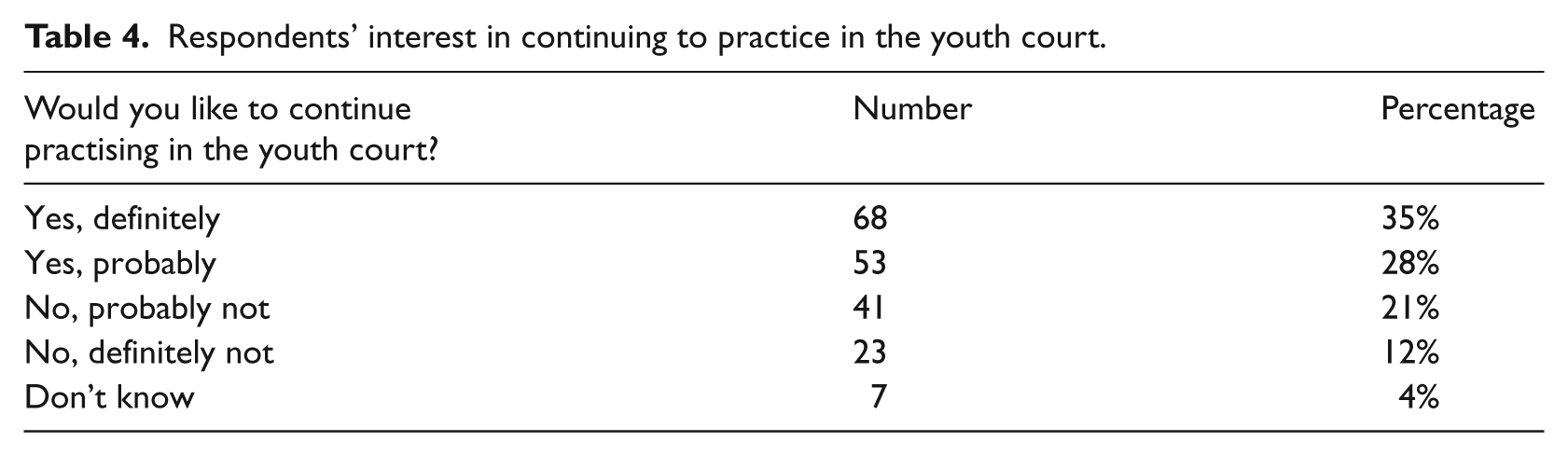
Although the large majority of respondents had experience of representing children, youth court practice was not universally popular. As indicated in Table 4, a third indicated that they had little interest in continuing to practice in the youth court. Among the reasons given, were that such work had lower status, was stressful and less well paid. None cited a lack of appropriate knowledge.
Respondents’ interest in continuing to practice in the youth court.
While the survey suggested that respondents were confident in their own ability to advocate effectively in youth proceedings, follow-up interviews indicated that perceptions of the standard of advocacy by others was not so favourable. Indeed, the large majority of interviewees were critical of existing practice. Such concerns as were expressed by legal professionals were echoed by other court practitioners. Common reservations about the quality of provision included the following:
A lack of knowledge on the part of advocates of youth specific legislation;
Poor communication with child defendants;
A failure to recognise the importance of youth advocacy to children’s futures given its low status, compounded by the fact that the youth court is often used as a training ground for inexperienced advocates;
Poor preparation as a consequence of heavy caseloads and low remuneration for work in the youth court;
More able lawyers focusing on higher status cases.
The 25 child defendants interviewed for the study typically had extensive experience of appearing in the youth court and were accordingly able to provide information on their perceptions of the quality of the legal representation they had received. Most reported a varied experience with some advocates described as good and others poor. Frequently, the defining characteristic that determined which category lawyers fell into was whether the child thought they cared about what happened to them andwhether they worked diligently on their case. Childrenalso noted a lack of experience among some advocates and a failure to communicate in a manner that was comprehensible to those whom they were representing.
Drawing on the research findings, the authors identify a number of elements of effective advocacy. First, good-quality representation requires a specialist knowledge: of the law as it applies to youth remands, mode of trial and sentencing; of the reality of the lives of children who come to the attention of the youth court and of their vulnerabilities and needs; and of the broader youth justice landscape, including the role of the YOTs and the range of relevant services that might be available to support particular disposals. Second, the ability to communicate and build relationships with child defendants is a pre-requisite of effective representation. This involves taking the time to get to know defendants, patience, recognising constraints on children’s ability and having a willingness to give instructions and communicating in language that was understandable and understood. Finally, there is a need for professionalism, construed as proper case preparation including: appropriate liaison with other relevant agencies such as YOTs; being committed to getting the best outcome for the child, or ‘demonstrating passion’; and arguing confidently on behalf of the child in court.
The report also notes a range of factors that can operate to impede the development of the constituents of effective advocacy, including the following: a lack of training opportunities in relation to youth justice issues; the continued formality and adversarial nature of court proceedings and, on occasion, of the court setting; a focus on reducing delay at the expense of ensuring the most appropriate outcome; a tendency on the part of the legal profession to undervalue youth proceedings and their consequent status as a training ground; and a legal aid structure that does not acknowledge the greater time commitments of providing effective representation to children by comparison with adults.
Central to a range of recommendations aimed at improving the effectiveness of advocacy in youth proceedings is a proposal to formalise youth justice as a specialism through:
‘The introduction of mandatory training and a licensing system for youth justice advocates …;
A requirement on the Legal Aid Agency only to contract licensed solicitors’ firms and licensed barristers for work in youth proceedings, and on solicitors’ firms only to instruct licensed barristers’.
The youth proceedings advocacy review: final report, by Ali Wigzell, Amy Kirby and Jessica Jacobson, is published by the Institute for Criminal Policy Research and is available at: www.icpr.org.uk/publications-team/courts,-sentencing-and-attitudes-to-justice/the-youth-proceedings-advocacy-review-final-report.aspx.