



Abstract
Technology has ushered in a new era of intelligence-led and ‘big data’ policing, and police gang databases are part of this paradigmatic shift. In recent years, however, gang databases have come under intense public scrutiny. For example, Amnesty International and others argue that London’s Gangs Matrix is discriminatory and violates data-protection laws. This article draws on evidence and examples from a wide range of sources – gang legislation, surveys of young people, police gang records and research on gangs – to put the Matrix controversy into broader context, and to adjudicate between common validity and civil liberties critiques of gang databases.
The London Metropolitan Police Service (hereafter, the Met) maintains a database of purported gang members, termed the ‘Gangs Matrix’ (hereafter, the Matrix). The Matrix was launched in 2012 as part of the UK Government’s ‘war on gangs’ (Densley and Mason, 2011; Fraser et al., 2018), although there is precedence for UK gang databases before that, with the National Football Intelligence Unit files on football hooligans in the 1990s (Garland and Rowe, 1999). The Matrix is a risk management tool used to respond to the problems associated with the estimated 200 gangs in London, such as the 110 gang-related homicides that occurred between 2016 and 2018 (Mayor’s Office for Policing and Crime (MOPAC), 2018: 10). At any given time, there are an estimated 3000–4000 individuals listed in the Matrix from a London population in excess of 8 million.
A recent Amnesty International UK (2018) investigation raised serious concerns about the Matrix. About 80 per cent of the individuals found in the database were Black, compared with 13 per cent of London’s population, and many had a ‘zero-harm’ score, reflecting the lowest risk of committing violence. A subsequent review of the database for the Mayor of London (MOPAC, 2018) found that too many Black people were in the Matrix compared with their likelihood of offending or their chances of being a victim. The regulatory Information Commissioner’s Office (ICO) (2018) further concluded that the list of gang suspects had breached data protection laws. The net result has been calls from civil liberties groups to either reform the ‘racist’ Matrix or abolish it altogether (Scott, 2019; Williams, 2018).
Of course, controversy over police gang databases is neither new nor exclusive to London (Huff and Barrows, 2015). In recent years, cities across the United States – where gang databases originated – have faced a range of similar criticisms, including how people came to be included on gang lists, how they could be removed, the overrepresentation of racial and ethnic minorities, and the way in which information was stored securely (Durán, 2013; Jacobs, 2009; Klein, 2009; Muniz, 2014; Pyrooz and Densley, 2018). Gang databases are among the most controversial issues to have emerged in the broader discussion surrounding ‘big data’ and intelligence-led policing (Ferguson, 2017; Ratcliffe, 2016).
The aim of this article, therefore, is to better situate the debate surrounding the efficacy of the Matrix. As Bryan and Arditti (2018) observe, the evidence-base for and against the Matrix is ‘methodologically weak’ and ‘limited to single, often uncorroborated sources’, hence why it is necessary to take stock of what is known about gang databases in general in order to chart directions forward. We acknowledge the limitations of exporting research findings from the United States to the United Kingdom, but begin by discussing why police document gangs and gang members in the first place. Next, we detail the common critiques of gang databases in London and elsewhere. We then draw on evidence and examples from a wide range of sources – gang legislation, surveys of young people, police gang records, and research on gangs – to provide broader context on gang databases and to adjudicate between common critiques of them. We find there is merit to civil liberties concerns and claims that gang data are invalid and unreliable, but the picture is more complex than law enforcement or advocacy groups make it out to be. We conclude that eliminating gang databases entirely could have the unintended consequence of making it more difficult to understand and respond to violence in communities, but there are steps that could and should be taken to improve gang databases in the future.
Why Do Police Document Gangs and Gang Members?
Starting with the premise that a gang is either an artificial construct or one that is impossible to define for any practical utility, many critics take aim at how and why the concept forms the basis of police prioritisation in the first place (Hallsworth, 2013). Some argue criminologists and practitioners alike focus too much on gangs and not enough on youth crime and violence, some of which is gang-related (e.g. Abt, 2019; Kennedy, 2011; Sullivan, 2005). This is the ‘red herring’ argument – gangs are the shiny object that distracts us from the bigger problem of youth violence.
But the fact is that gang members account for a disproportionately large share of crime and violence (Pyrooz et al., 2016), and in London especially, gangs are the ‘driving force’ behind an estimated 60 per cent of all shootings resulting in injury and 30 per cent of all homicides (MOPAC, 2018: 4). As can be observed in Figure 1, youth homicide in London is very much a gang issue. Gang-related violence is also ‘significantly more likely to result in serious injury’, with 57 per cent of gang-related stabbings featuring a serious or fatal injury, compared with 34 per cent for non-gang-related stabbings (MOPAC, 2018: 10). Beyond street violence, ‘the harm of gangs extends further . . . [to] violence against women and girls, acquisitive crime and drug supply’ (p. 4). The MOPAC is of course a political organisation publishing data for public consumption, which may be limited by partiality. Such criticisms notwithstanding, few would claim that gangs are the youth violence problem in London, but even fewer should claim that the violence associated with gangs is merely a sensationalised distraction (Densley, 2013).

The frequency and prevalence of gang and non-gang homicides in London, January 2008 to April 2018 (N = 1242 homicides). Primary axis refers to the count of homicides; secondary axis refers to the prevalence of homicides that are gang-related. Gang homicide N = 265; non-gang homicide N = 977.
The numbers are even more striking in the United States, where there are around 2000 gang-related homicides every year, which amounts to about 13 per cent of all homicides (National Gang Center, 2012). The gang-related homicide rate in the United States alone (about 2 per 100,000 persons) exceeds the total homicide rate in nearly every European Union country. National Gang Center (2012) data also show that gang members constitute one-fifth of 1 per cent of the US population, revealing an exceptionally high level of disproportionality in the violence attributed to gangs. There are, of course, individual- and macro-level explanations for such violence (Decker, 2007; Papachristos, 2009). Still, those explanations do not negate the fact that violence drives police strategies (Abt, 2019; Kennedy, 2011). Disputing whether or not gangs are sensationalised does little to comfort a mother who lost her child to violence.
Law enforcement employ a range of strategies in response to the criminal and violent activity associated with gangs. Sometimes, these strategies place police at the core of the intervention, other times they are a partner in a broader collaborative. But regardless of whether focused deterrence (Braga et al., 2018), gang crackdowns (Ratcliffe et al., 2017), comprehensive strategy (Gebo et al., 2015) or civil gang injunctions (Ridgeway et al., 2018) are deployed to respond to gang violence, all strategies share a common problem: they need data on gangs and gang members. They need this information to ‘audit’ (Papachristos, 2012) the gang landscape of cities, target offenders with deterrence messaging (Deuchar, 2013), and flag gang members who might benefit from social services or even leave gang life, if given the right nudge (Roman et al., 2017).
Where do the data come from? Who is responsible for gathering it? Hypothetically, gang audits may be conducted without law enforcement assistance – community groups and the gang members themselves know the lay of the land (e.g. Lauger, 2012; Stuart, 2016; Tita et al., 2005). But arguably the best intelligence – owing to resources and more comprehensive and systematic methods of measurement – is derived from law enforcement records (Katz and Webb, 2006). In particular, specialised police gang units, which have been part of police departments like Chicago since the late 1960s (Shabazz, 2015), spend the bulk of their time gathering intelligence by monitoring gang graffiti, tracking gang violence and individual gang members (Langton, 2010). These units, as some have argued, ‘if properly oriented, have great potential to reduce gang violence problems’ (Braga, 2015: 309; see also, Decker, 2007). The intelligence gathered by these units, in turn, is entered and maintained in what is known as a gang database or Matrix.
As Jacobs (2009) noted, ‘long before computers were so widespread, individual police offices and the gang intelligence units of big city police departments maintained intelligence files on gangs and gang members’ (p. 705). By the early 2000s, however, computerised gang databases were commonplace in large cities (Barrows and Huff, 2009). Nearly every gang unit (93%) included in the Bureau of Justice Statistics 2007 survey of 365 policing agencies tracks gang members, mostly using computerised systems (91%) but also paper systems (46%) (Langton, 2010: 5). A total of 12 US states have since passed legislation pertaining to the development and use of gang databases, including how data should be gathered, stored and shared (see National Gang Center, 2017).
The information that is generally found in gang databases focuses on the characteristics of individuals and groups. For example, the St. Louis, Missouri, city and county gang database includes individual details such as a person’s name, contact information (e.g. residence, phone number), demographic information (e.g. age, gender, race, height and weight), identifying marks (e.g. tattoos), socioeconomic information (e.g. employer, marital status), criminal history, gang affiliation, date entered into the database and information used to validate individuals as gang members. Group details include the evolution of gang symbols, the location of gang turf and a gang’s alliances and rivalries. Law enforcement argue these data increase officer safety and help solve gang-related crimes, which is especially important because the burden of unsolved crimes falls disproportionately on the most dangerous and vulnerable communities (Ryley et al., 2019). Unsolved crimes erode trust in the police, driving some victims to join gangs for extra-legal protection or to seek their own justice (Leovy, 2015). The question, therefore, is do these supposed advantages of gang databases outweigh the disadvantages?
What Are the Criticisms of Gang Databases?
There are four main arguments against gang databases, which can be summarised in broad categories of validity and civil liberties concerns. First, gang membership is not measured accurately (Asher, 2017). Support for these claims is bolstered not only by the lack of a universal definition of a gang, but also subjective and overbroad interpretations of gangs and gang membership (Curry, 2015). Who gets counted as a gang member, and whether those counts include people who are not identified as ‘members’ of gangs but who are ‘associated’ with gangs, can vary widely across countries, states, cities and even neighbourhoods, a point raised by Amnesty International UK (2018). A 2016 audit of California’s gang database, CalGang, for example, infamously revealed that babies and bona fide ex-gang members were listed as gang members, prompting legislation to overhaul it (California State Auditor, 2016). Part of problem is the criteria used to document gang members. ‘Hanging out’ with gang members in person or on social media can create guilt by association (Lane et al., 2018; Patton et al., 2017), evidence that could contribute to being labelled as a gang member. If the police perceive that ‘any black kid is in a gang’ (Manasseh, 2017; see also, Densley and Stevens, 2015); moreover, they naturally overcount that gang members and gang databases represent modern-day net-widening.
Second, and related to the questions of validity, people of colour are overrepresented in gang lists and this gives the perception of discrimination. Racial disparities were the primary driver behind the abolition of Portland, Oregon’s 20-year-old gang database (Bernstein, 2017). In New York, less than 1 per cent of the 17,441 people in the gang database were White (Khan, 2018). In Chicago, under 5 per cent of the 128,037 people entered in the gang database between 1999 and 2018 were White. 1 Critics say these numbers reflect an entrenched (over)policing philosophy that has always criminalised the most vulnerable and marginalised populations (Vitale, 2018). Put simply, the police gang practices are highly racialised; racial and ethnic minorities are gang members while Whites are not. Horror stories from Denver, Colorado (Johnson, 1993), and Los Angeles, California (Stolberg, 1992) revealed that nearly two-thirds and one-half of all young Black men in these respective cities were labelled as gang members, helping fuel suspicion that gang databases are not only invalid, but a racist tool employed by elites to suppress minorities (Williams, 2018).
Third, gang databases are often kept secret (Winston, 2016); therefore, there is a lack of due process surrounding placement in databases. People listed in gang databases are rarely made aware of the designation and have little to no recourse to challenge it. The California State Auditor (2016: 36), for example, found that ‘agencies have failed to ensure that CalGang records are added, removed, and shared in a way that maintains the accuracy of the system and safeguards individuals’ rights’. Questions of due process extend beyond whether or not someone is in a database and to how long they should remain in it. It is not uncommon for law enforcement officials in the United States and, for that matter, the general public (Howell, 2007; Pyrooz, 2014), to hold the view that ‘once a gangbanger, always a gangbanger’, hence the lack of motivation to institute sunset periods to automatically trigger removal.
Fourth, and related, the (collateral) consequences of being named in a gang database can be serious (Jacobs, 2009). A gang designation can immediately escalate a routine stop by police and the stigma and scrutiny of being named in a database can far outlast actual affiliation with a gang. In an era of data-driven policing (Ferguson, 2017), these concerns are important, especially because who has access to gang data is not always defined within law, and the data can be shared with educational, housing and immigration authorities. As a form of extra-judicial punishment disproportionately directed at poor people of colour (Rios, 2011), this can be destructive if not properly managed. One Chicagoan living in the United States illegally was entered into a gang database simply for ‘loitering’ in a neighbourhood with high gang activity and wound up in deportation proceedings (Felton, 2018).
What Does the Scientific Evidence Say?
There is merit to all of the above criticisms, but a review of the international evidence shows things are more complex than the talking points and short media clips to which they are often reduced. The sections that follow examine each of the aforementioned criticisms, and adjudicate between criticisms of gang databases and the empirical reality found in gang research.
Gang membership is not measured accurately
The Matrix is comprised of separate matrices owned and operated by each individual London borough (London has 32 local authority districts). According to the Met’s Operating Model and Guidance, the threshold for inclusion is, ‘someone who has been identified as being a member of a gang and this is corroborated by reliable intelligence from more than one source (e.g. police, partner agencies such as local authorities)’ (MOPAC, 2018: 20). The first question this statement raises is what is a gang? The Met define one as:
A relatively durable, predominantly street-based group of young people who:
See themselves (and are seen by others) as a discernible group;
Engage in a range of criminal activity and violence.
They may also have any or all of the following features:
Identify with or lay claim over territory;
Have some form of identifying structure feature;
Are in conflict with other similar gangs.
Credited to the Centre for Social Justice (2009), scholars will notice that this definition is derived in part from the consensus Eurogang definition (Klein et al., 2001; Weerman et al., 2009), which unlike most gang definitions has been subject to years of empirical testing, including in the British context (e.g. Matsuda et al., 2012; Medina et al., 2013; Rodríguez et al., 2016; Smithson et al., 2012). One important distinction in the Met include, as implied definers, some descriptors of gangs (e.g. territory, structural features, conflict; see Klein and Maxson, 2006) that are potentially more common or visible among predominately Black youth collectives than their White or Asian counterparts (Van Hellemont and Densley, 2019) – a potential source of bias.
Because the Matrix scores individuals who are in a gang, not the gangs themselves, questions remain about how and why someone is identified as being a gang member, not least because research finds that membership falls on a spectrum of ‘embeddedness’ and is not necessarily a simple in or out dichotomy (Pyrooz et al., 2013). The phrasing ‘who has been identified as’ in the Met guidance also seemingly discounts individual self-nomination, a common and reliable measure of gang membership (Decker et al., 2014; Esbensen et al., 2001). Furthermore, ‘corroborated by reliable intelligence from more than one source’ sounds robust, but it is unclear what, precisely, is used to ‘corroborate’ someone as a gang member. This is important because in the US context, specific items, often codified in law, are used to operationalise gang membership.
In California, for example, someone who meets two of the following criteria can be designated as a gang member: admitting to gang membership (used in 58% of cases), associating with documented gang members (44%), having gang tattoos (43%), frequenting gang areas (30%), wearing gang dress (25%), an in-custody classification interview (24%), arrest for offences consistent with usual gang activity (11%), displaying gang symbols or hand signs (7%), identification by a reliable informant/source (6%), or identification by an untested informant (1%) (California State Auditor, 2016: 15). In the best examples, therefore, law enforcement maybe more conservative in their measures of gang membership than even gang researchers. In the worst examples, law enforcement may rely on highly questionable criteria, such as wearing gang attire, associations and informants. Although a common approach to operationalising gang membership, the fact that ‘police and partner agencies’ are listed as examples of intelligence sources for the Matrix, however, gives rise to suspicion that it is built on subjective opinion and circular logic alone – not exactly the types of procedures that inspire confidence in its validity.
Therefore, are the ‘right people’ even found in the Matrix? When individuals are placed in the Matrix, they are assigned an automated risk score, known as a ‘harm score’ (MOPAC, 2018). This score is based on police information about past arrests, convictions and any other relevant intelligence, plus data from the Youth Offending Service and other partner agencies. Once a harm score has been assigned, each so-called ‘gang nominal’ is then labelled as Red, Amber or Green. Those with a red label (about 4% of the Matrix) are deemed most likely to commit a violent offence, while green nominals (about 65%) pose the lowest risk.
About 15 per cent of the people on the Matrix had a harm score of zero for the duration of their time on it, meaning the police had no record of them being involved in a violent offence (MOPAC, 2018). The Met argue these people still were included owing to an elevated risk of violent victimisation; indeed, 75 per cent of individuals on the Matrix had been victims of past violence, which is consistent with theory and evidence on the nexus of gang membership, offending, and victimisation (e.g. Taylor et al., 2008; Wu and Pyrooz, 2016). The rationale for including persons not involved in violence in the Matrix was also to engage those who were thought to be in a gang but have not yet been drawn into gang violence, thus following a preventive public health model of violence interruption (Van Dijk et al., 2019). In theory this makes sense, but questions remain about whether or not green nominals are truly ‘gang members’ and whether the risks associated with the label outweigh the benefits for them, valid concerns in light of the violation of data protection laws (ICO, 2018).
There are several key findings worth highlighting among the 7000 people who appeared in the Matrix at some point between June 2013 and May 2018: 96 per cent had at least one sanction (i.e. offences for which the individual received a conviction, caution or warning) in their lifetime; 71 per cent had at least one sanction for either violence against the person or weapons offences in their lifetime; 90 per cent had been sanctioned for at least one offence of any kind prior to their inclusion (67% for violence); and about one-third were in custody while on the Matrix (MOPAC, 2018). How one interprets these figures is telling for their position on the utility of gang databases. Advocates for the Matrix point to these figures as evidence that the ‘right’ people have been targeted. Critics of the Matrix point to the same figures as evidence of net-widening – how is it possible for someone to be a gang member (the denominator) and not a convicted criminal (the numerator)?
In the US state of Minnesota, someone has to commit a gross misdemeanour or felony to even be entered into a gang database and if within the 3-year period they have not been arrested or convicted of another crime, they must be removed (Bumgarner et al., 2016). Still, empirical studies consistently reveal that not all gang members are criminals and not all criminals are gang members. To further illustrate this point, we analysed data from the US National Longitudinal Survey of Youth, 1997 (NLSY97; Bureau of Labor Statistics, 2014). The NLSY97 consists of a representative sample 8984 youth between ages 12 and 16 years old (born between 1980 and 1984) and interviewed about gang membership and arrest annually from 1997 to 2005. Three points are worth highlighting based on the results we present in Figure 2:
The likelihood of arrest nearly doubles when someone joins a gang and remains rather stable in the succeeding years when someone remains active.
In any given year, the most of active gang members are not arrested.
A rather large proportion of gang members report having never been arrested in their lifetime – that proportion declines with each additional year of gang members.
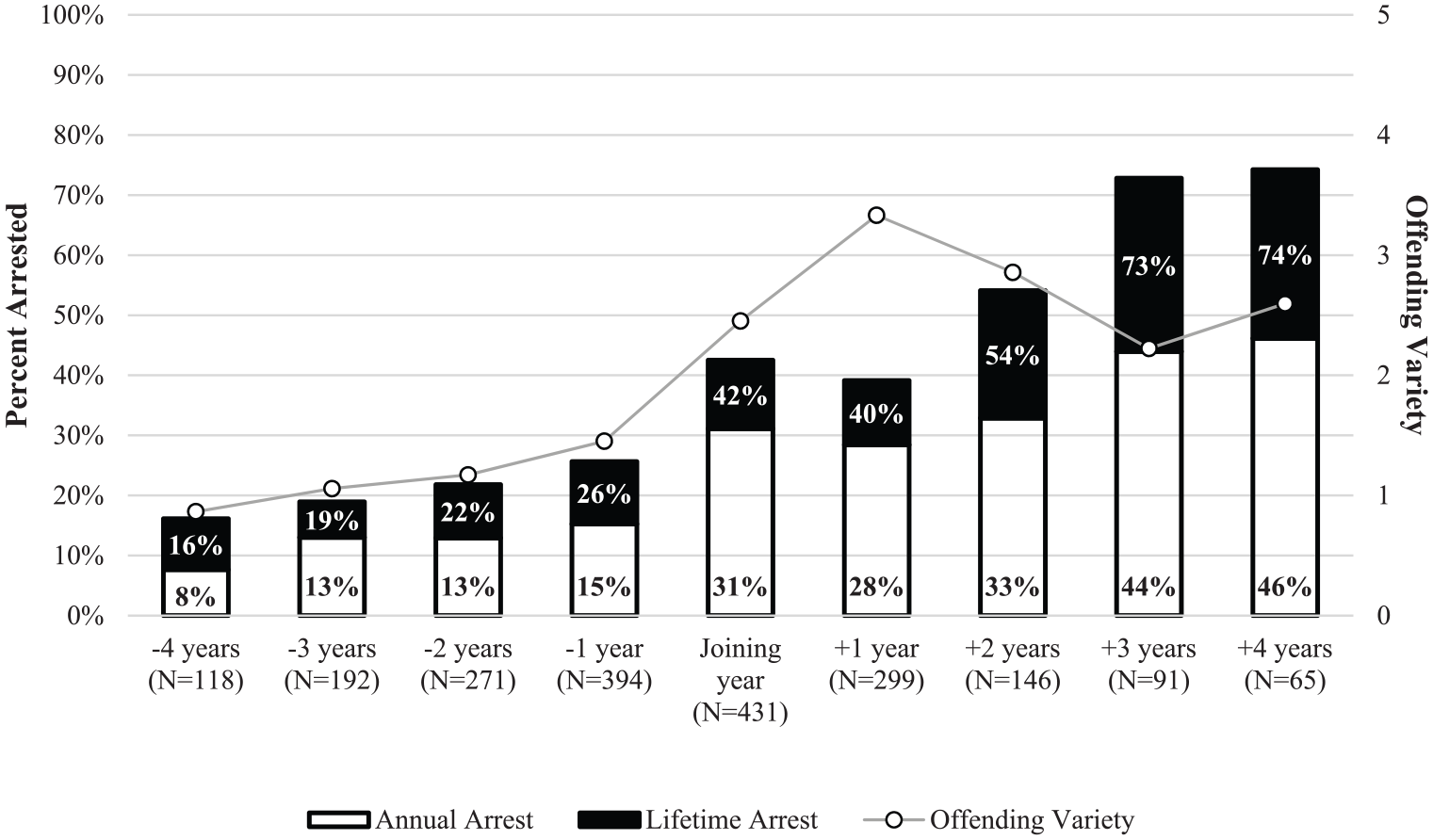
Annual arrest, cumulative arrest, and offending before and after the onset of gang membership, NLSY97. Panel data are from the first seven (offending) and nine (arrest) waves of the National Longitudinal Survey of Youth, 1997. White bars refer to the proportion of prospective and/or current gang members arrested in the recall period (typically 1 year); Black bars refer to the proportion of prospective and/or current gang members arrested in their lifetime. Mean offending variety scores consist of the sum of seven dichotomous (0 = no, 1 = yes) measures of property, instrumental and violent offending self-reported over the recall period. The sample size is dependent on the onset of gang membership relative to the number of waves in the study.
Of course, these findings will lead some to expect that labelling accounts for the effect of gang membership on arrest. And these data have been examined to this end (Tapia, 2011). However, it bears pointing out that offending matters much more than gang membership in predicting the likelihood of arrest. Indeed, we estimated a fixed effects model regressing arrest on a dichotomous measure of gang membership and a 7-item variety score of offending (controlling for exposure period and linear and quadratic time trends). Active periods of gang membership were associated with a 4.28 per cent point increase in arrest (t = 3.06, p = .002). In contrast, a one-unit increase in the variety score of offending was associated with a 7.13 per cent point increase in arrest (t = 19.23, p = .000). 2 This does not fully counter a labelling argument, but it does significantly deflate the ability to attribute the link between gang membership and arrest to labelling practices.
While police gang data are routinely criticised, moreover, US research finds them reasonably accurate. For example, police data on gang homicides fluctuate yearly with newspaper articles on gang violence (Jensen and Thibodeaux, 2013) and are reported consistently (Katz et al., 2012), especially in agencies with specialised police gang units (Decker and Pyrooz, 2010). There is also high, but not perfect, correspondence between self-reports of gang membership and the names found in gang databases (Curry, 2000).
This observation extends from ‘the streets’ to ‘the institutions’, which is important because as of August 2018, over 35 per cent of the individuals in the Matrix were under custodial control (MOPAC, 2018). In lieu of maintaining its own gang database, the UK National Offender Management Service has an information-sharing agreement with law enforcement (Setty et al., 2014), but in the United States, bespoke prison gang databases are subject to intense scrutiny (Pyrooz and Mitchell, 2019; Toch, 2007). Two studies have looked at the correspondence between official records and self-reports of gang membership in US correctional institutions. In California, focusing on juvenile institutions, Maxson et al. (2012) observed that official records and self-reports comported 71 per cent of the time. In Texas, focusing on adult prisons, Pyrooz et al. (2019) found that official records and self-report data on gang membership told the same story 82 per cent of the time. Although these authors did not identify perfect correspondence, this is a reasonable rate of overlap that either exceeds or is equivalent to measures such as religious preference, skin colour and misconduct.
And then there is the question of overcounting. Are police engaging in net-widening practices (Cohen, 1979) that ultimately entrap young people? Even though only around 70 per cent of police gang units audit their gang databases for deceased, incarcerated or inactive gang members (Langton, 2010), the US data suggest that law enforcement likely undercount gang members. Pyrooz and Sweeten (2015) compared reports of juvenile gang members from the National Gang Center, based on a representative survey of law enforcement agencies, to the self-reports of gang membership from juveniles in a representative survey of youth, finding that the police may underestimate juvenile gang membership by 70 per cent. This should not come as a surprise to criminologists. After all, police undercount crime in nearly all forms, known as the ‘dark figure’ of crime, hence the reason why official records and self-report surveys combine to best represent the reality of crime in countries like the United States (e.g. Lynch and Addington, 2006).
Racial and ethnic minorities are overrepresented in gang databases
While race is never explicitly stated in the definition, critics argue that the term gang is itself highly racialised (see Gunter, 2017; Williams and Clark, 2016), which, in turn, results in conscious or unconscious bias against the young men of colour who find themselves overrepresented in gang databases. About 13 per cent of London’s population is Black, compared with 80 per cent of people listed in the Matrix, a striking disparity. And it is from this finding that Amnesty International UK (2018) and others (Williams, 2018) conclude that the Matrix is ipso facto discriminatory and that police officers are racially biased in their decisions to label gang nominals.
However, comparing the percentage of Blacks and Whites in the Matrix to the percentages of Blacks and Whites in the general population is not really the right comparison. To begin with, the Matrix population is not distributed evenly across London’s 32 boroughs. In some boroughs, there are as few as three individuals on the Matrix, in others 300. By definition, gangs in London also are comprised of ‘young people’, hence three-quarters of those on the Matrix are under the age of 25 (MOPAC, 2018). In some of the inner-London boroughs where gangs are most active and the Matrix is most widely used, Black people under 25 account for close to 40 per cent of the population (MOPAC, 2018). Coid et al. (2013) found one in five Black men aged 18–34 were gang members in the London borough of Hackney alone. Therefore, boroughs and demographics loom large in the interpretation of citywide observations of disparities. The real question is whether Black young men are labelled gang members more than their White counterparts given their presence in gangs and in situations where crime and police interactions are likely to occur. The evidence in this regard appears to run counter to Amnesty International’s report.
The MOPAC (2018) audit found that the distribution of the Matrix population does generally reflect the geographic distribution of gangs and serious violence in London. Gangs and serious violence also are clustered in the areas of London with the highest concentrations of Black residents; however, these are the most multiply deprived areas of the city, which presents a very different causal mechanism. Why crime rates are different across places and races is a complicated question rooted in historical and structural factors beyond the scope of this article (for a discussion, see Sampson, 2019; Sampson et al., 2018). All we can say here is young Black males are disproportionately represented as both victims and offenders in all serious violence in London, not unlike what is observed in the United States (e.g. Cooper and Smith, 2011).
As offenders, for example, young Black males were identified as responsible for more than half of all serious violence from 2016 to 2018, including 70 per cent of firearms discharges and 68 per cent of youth homicide (MOPAC, 2018). As victims, data from a major London trauma centre reveal that from 2010 to 2016, 68 per cent of emergency admissions for firearm-related injuries were young Black men (Norton et al., 2018). These disparities, especially when found across various data sources (e.g. Ager, 2018), are hard to reckon with.
Of course, differences in involvement in violent or criminal situations between Black and White Londoners may explain away some – but certainly not all – disparities found in the Matrix. The implication is that the overrepresentation of Black and minority ethnic people in gang databases is not solely an artefact of how police collect information. Indeed, another factor is the racial composition of gangs themselves, or reporting on the validity of measuring gang membership.
With regard to gang composition, a representative study of young people in the United States (aforementioned NLSY97 data) revealed that Blacks and Latinos are twice as likely as Whites to self-report as gang members in adolescence and three to four times more likely in adulthood (Pyrooz, 2014). Age is important here because gang databases are overwhelmingly populated with young adults, not juveniles (although in London, the proportion of new additions under age 18 exploded from 26% in 2012 to 56% in 2017). With regard to validity, there were negligible racial or ethnic differences in correspondence in official records and self-reports of gang membership among prisoners in Texas (Pyrooz et al., 2019). Thus, the research indicates that at least some racial and ethnic disparities in gang data should be expected, and that the source of the disparities is largely reflective of the realities of gangs. We are not aware of a sound empirical study that offers a racial invariance argument rooted in neighbourhood disadvantage (e.g. Sampson et al., 2018; Papachristos and Hughes, 2015; Vigil, 2002) or micro-level explanations (e.g. Curry et al., 2014; Densley, 2015; McGloin and Collins, 2015), but we expect the leading explanations found in gang research will account for any inherent risk to young Black Londoners.
Collateral consequences and the omission of due process
In both the United Kingdom and United States, multiple pieces of legislation place a duty on the police and other public bodies to share information for the purposes of crime reduction, safeguarding, and promoting welfare and wellbeing. Often, it is pursuant to these aims that information about someone in a gang database is shared between agencies outside of law enforcement. However, there are collateral consequences associated with this, which can extend to criminal convictions and, in 34 US states, sentencing enhancements (Kennedy, 2009). Studies show that gang affiliation may affect pretrial and prosecutorial outcomes (Caudill et al., 2017; Howell, 2011).
In 2018, the ICO ruled the Matrix had been so poorly managed that it failed to properly differentiate between gang offenders and their victims. As a result, the Met was sharing information with other statutory agencies without fully explaining who on their secret lists posed a serious risk of violence. Agencies receiving the information, in turn, did not know that some of the people on their radar were in fact merely repeat victims or associates of more serious gang members wrongly labelled as gang criminals and therefore potentially deprived of access to education, employment, and training opportunities, or housing and other social services. The ICO (2018) concluded that such excessive processing of data breached data protection laws. Indeed, one unredacted list of gang members emailed to others by a local council member was leaked on social media and ended up in the hands of rival gangs (BBC, 2019).
The root cause of this problem was that each of the 32 London boroughs operated their own Matrices, which were then compiled centrally to form a larger pan-London Matrix. The Met’s operating model that governed the use of the Matrix across the Metropolitan area was inconsistently applied across the boroughs, to the extent that some of them operated informal lists of people who had been removed from the master list. That is, the Met continued to monitor people even when intelligence had shown that they were no longer active gang members – a problem well documented in gang research (Decker et al., 2014). Moreover, some of that monitoring occurred via social media and there are legal and ethical questions about whether police can enter into an online relationship with an alleged gang member (e.g. by ‘friending’ them on Facebook) without first disclosing their true identity.
Amnesty International UK (2018) first highlighted the problems in maintaining the currency of the Matrix, particularly in removing from the database those individuals who no longer deemed to be a risk, or at risk. The lesson here is that gang databases require stricter, more consistent rules for who is a gang member and who is not. The operating model sets out that the Matrix should be reviewed quarterly and that individuals remain on the Matrix for no longer than is necessary (MOPAC, 2018). The median length of time spent on the Matrix was 25 months across a 5-year period (MOPAC, 2018), which is surprisingly consistent with the average duration of gang membership found in longitudinal studies of gang members, summarised in Table 1.
Empirical research on the duration of gang membership.
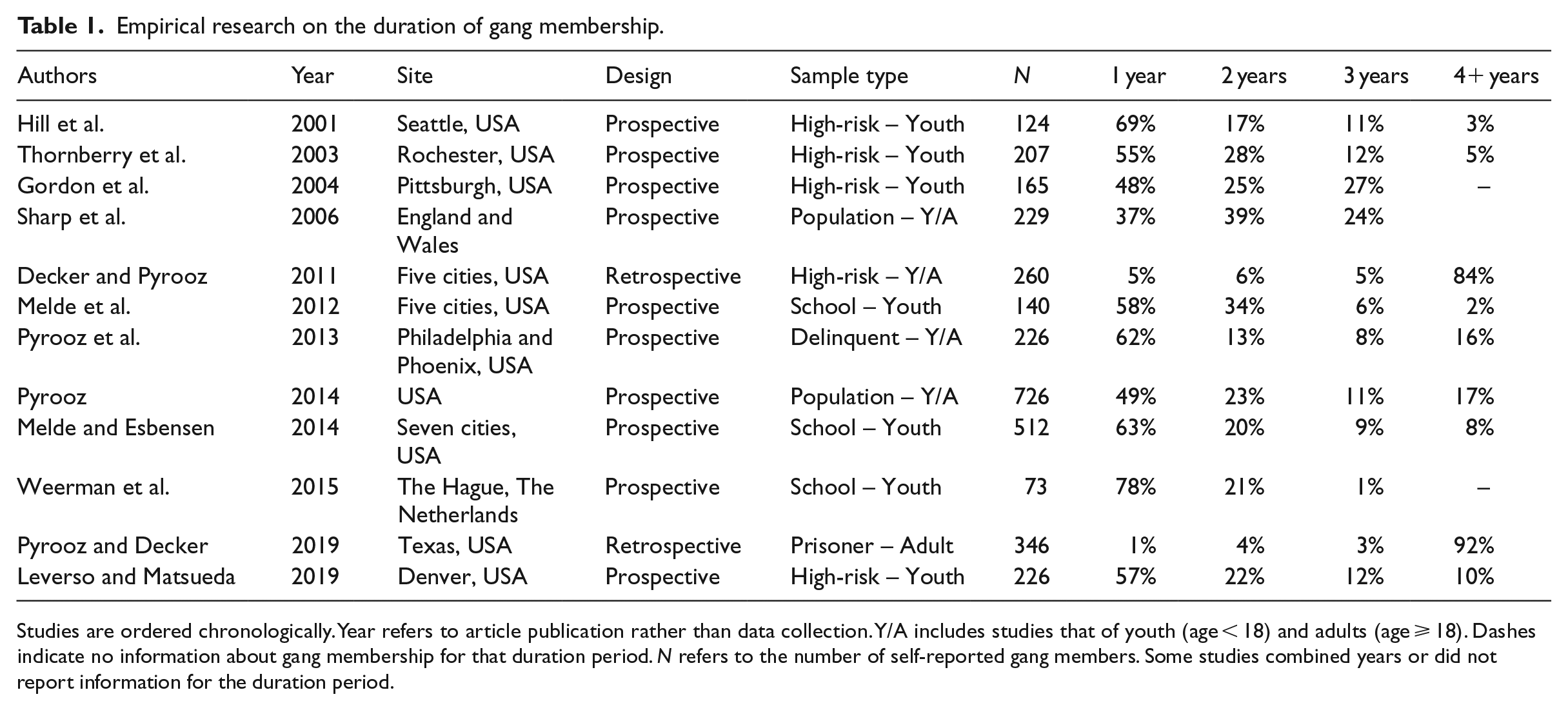
Studies are ordered chronologically. Year refers to article publication rather than data collection. Y/A includes studies that of youth (age < 18) and adults (age ⩾ 18). Dashes indicate no information about gang membership for that duration period. N refers to the number of self-reported gang members. Some studies combined years or did not report information for the duration period.
The Matrix’s alignment with research expectations is more by accident than design. However, in California, empirical research serves as the benchmark for assessing how long is too long spent in a gang database. In Assembly Bill No. 90 (AB90), which was approved by Governor Jerry Brown on 12 October 2017, is the Fair and Accurate Gang Database Act of 2017. The act established that ‘Retention periods for information about a person in a shared gang database that is consistent with empirical research on the duration of gang membership’ (Penal Code 186.36 (L2). California is unique in this regard, however. A total of 2–5 years of placement in gang databases is the standard in some US states, and no sunset periods of gang membership are the rule in others (National Gang Center, 2017). Of course, 5 years is the limit for criminal intelligence records set out by federal regulations in the United States before they need purging (unless reviewed and updated). The key takeaway here is that through the inclusion of regular audits, databases can better reflect the fact that gang membership is a temporary status, and that even the ‘worst of the worst’ are not beyond redemption.
Another major change occurred with the AB90 in California, which is equally if not more consequential than sunset periods: law enforcement is required to notify individuals in writing when they are entered into a gang database and allow purported gang members the opportunity to challenge the designation. An audit of its database, CalGang, led California to create a legal process for alleged gang members to ‘signal’ (Densley and Pyrooz, 2019) via written documentation that they are in fact not a gang member. Law enforcement must, in turn, review the evidence submitted and, within 30 days, make a determination in writing. If a law enforcement agency denies an individual’s request to be removed from a database, moreover, the individual can still appeal the decision in court. This stands in contrast to long-standing practices surrounding the CalGang database, as well as gang databases throughout the United States.
A related question about the rights of data subjects pertains to whether or not individuals who are listed on gang databases must be specifically informed of that fact. In California, people have the right to know, but this is controversial because disclosing information about persons on a gang list to those persons may compromise the ability of law enforcement to build a criminal case (Jacobs, 2009). AB90 states notification is unnecessary if it were to compromise an active criminal investigation or the health or safety of a minor. Intelligence is, after all, considered intelligence because it is private information. It is rare to hear criticism of the UK National Crime Agency or INTERPOL covertly tracking organised criminals, yet the fact that London’s Matrix is secret remains contentious. In recent years, states and cities in the United States have moved towards greater transparency, with a view to balancing the rights of the public to access information about police gang databases and understand how they operate (e.g. what they mean to those on them, and how individuals’ data are processed and stored), while at the same time preserving operational effectiveness in reducing harm and protecting the public. This, it seems, is the way forward.
Concluding Remarks
This article has explored the function and operation of London’s Matrix and examined the major criticisms levied against it in respect of the standard and precedent for gang databases in the United States and the best empirical evidence about gangs and gang responses. We find that while many of the concerns about the Matrix are justified, and comparable to fears about databases in other contexts, the picture is complicated. There is value in collecting gang data, provided it is collected right and used with caution. This really is the crux of the issue. The opposite of bad data is not no data, but good data. In 2012, the US Department of Justice defunded the only validated national data source on gang activity, the National Youth Gang Survey (Asher, 2017). Between the pull-out of federal support for gang data and the growing movement to eliminate gang databases at the state- and city-level, researchers and law enforcement now have less data on gangs.
Data gaps make it difficult to know what gangs are doing, when and where they are doing it, and why. Missing data make it difficult to learn about the contagion of gang violence, as well as its spatial and temporal properties (e.g. Huebner et al., 2016; Papachristos, 2009; Valasik et al., 2017). Missing data leave law enforcement and community partners hamstrung in their efforts to reduce violence in communities – to identify perpetrators and victims and intervene accordingly. And missing data make it impossible to factcheck politicians who make claims about gangs to advance their political agendas. After all, absence of information about gangs is not evidence of absence. In the 1980s and 1990s, gangs proliferated outside of the urban core of US cities. At the same time, public officials denied their existence (Klein, 1995). It took gang-related assaults on the mayor’s son and governor’s daughter in Columbus, Ohio, for that city to recognise its gang problems (Huff, 1989). London must learn from this history in order to avoid repeating it. If used correctly, gang databases can be part of the solution to violent crime.
The above said steps need to be taken to address legitimate concerns. The status quo is not an option. From London to Los Angeles, gang databases must function in a way that upholds the civil rights of those included in them, and without any unlawful discrimination. Police must ensure that the right people are entered into the database in the first place, and that people are added and removed in a standardised way, consistent with empirical research on gangs. Criteria for entry should be consistent and codified, and the databases should be audited regularly so that individuals do not stay in them any longer than necessary and that once removed, the gang label does not follow them indefinitely. People entered into gang databases should also have the right to appeal their designation. Gang databases must also comply with data privacy laws and data protection best practices, ensuring that any sharing of personal information is necessary and proportionate. And the function and operation of gang databases should be as transparent as possible, with appropriate oversight. These simple steps can improve the efficacy of gang databases as well as build public trust in their use.
Footnotes
Funding
The author(s) received no financial support for the research, authorship and/or publication of this article.
