



Abstract
During the last decade, the federal government, states, and school districts implemented changes in school discipline policy to shift schools’ reliance from punishment and exclusion toward prevention, intervention, and restoration. In order to assess the impact of the last decade of reforms on attempts to decrease punishment and increase equity in schools, we examine nine large metropolitan districts that both revised their Codes of Conduct to limit their reliance on exclusionary discipline and implemented schoolwide behavioral and/or restorative programs. We find that while reforms are associated with decreases in students’ experience of three of four exclusionary discipline outcomes from 2009 to 2015, these benefits tend to accrue to the least vulnerable students – White students without disabilities. One explanation of this finding is that colorblind, risk-based, carceral assumptions of school and state policies undercut efforts to increase equity in school discipline.
Keywords
Introduction
After remaining relatively stable for nearly a century, the United States’ carceral systems mushroomed during the last quarter of the 20th century (Garland, 2001; Western, 2007). Youth criminalization was crucial to this escalation. Through partnerships with the juvenile legal system and the growing acceptance of both the neoliberal ideology of the management of at-risk and risky individuals and the neo-conservative ideology of just deserts, public schools became ever more punitive through the 1980s and 1990s (Beck, 1992; Kang-Brown, 2014; Shollenberger, 2015). Consistent with neoliberal mentalities, district, state, and federal education policy and practice shifted, increasingly adopting crime control paradigms that viewed students as problems and risks to be managed, and cost–benefit analysis, risk management programs, and situational crime-preventive schemes as the best solutions (Clarke, 1983, 2008; Madfis, 2016; O’Malley, 1998; Rose, 2000). The result was school criminalization: a punitive shift in the ways policymakers and school actors think and communicate about the goals of education, including the day-to-day practice of educators and staff, mandatory discipline policies, punishing school architecture, law enforcement inside of schools, camera surveillance, metal detectors, searches, lockdowns, and referrals to law enforcement. These shifts lead students toward contact with youth criminalizing systems and lock-ups and reflect the environments of prisons onto educational systems (Hirschfield, 2008; Meiners Erica, 2010; Wacquant, 2001). One materialization of school criminalization was a spike in the use of exclusionary discipline – punitive responses that remove kids from classrooms. The number of students suspended at least once increased 69 per cent between 1973 and 2011 (Kang-Brown, 2014). During the height of exclusionary discipline use in the 1990s, one in three students and nearly one-half of Black students were suspended at some point (Shollenberger, 2015).
Then, influential segments of the public, policymakers, and politicians realized that mass youth incarceration was not achieving its stated goals, instead often making communities less stable, less safe, and more unequal (Davis, 2003; Western, 2007). Community activism, overwhelming evidence that exclusionary discipline was being used in disparate ways and has long-term deleterious impacts on kids throughout their life-courses, and three Obama-administration initiatives provided the backbone of a broad-based backlash against the punitive zeal of the 1980s and 1990s (González, 2012; Shollenberger, 2015; US Department of Education and Civil Rights Division, 2014). Community organizations – including Padres & Jóvenes Unidos in Denver, Power U in Miami, VOYCE in Chicago, and others across the United States – organized locally for revised Codes of Conduct that limit exclusionary discipline and for the introduction of restorative responses, which seek the transformation of people who have engaged in harmful behavior through reconciliation with those whom they have harmed (APA Zero Tolerance Task Force, 2008; González, 2012). Simultaneously, scholars published studies documenting the long-term injurious consequences of exclusionary discipline, particularly on academic and carceral outcomes. These studies find that, students who experience exclusionary discipline have decreased academic achievement, are less likely to complete high school, less likely to enroll in college, and less likely to complete college compared to academically and behaviorally similar students (Cholewa et al., 2017; Fabelo et al., 2011; Marchbanks et al., 2015; Morris and Perry, 2016; Rumberger and Losen, 2016). Likewise, students who experience exclusionary discipline are more likely than otherwise comparable students to be arrested in the following year and on probation or in prison at some point as an adult (Mowen and Brent, 2016; Rosenbaum, 2018; Shollenberger, 2015).
Federal policy initiatives also led to policy changes in local districts. First, the Departments of Education and Justice launched the Supportive School Discipline Initiative in 2011 to help schools move away from exclusionary discipline. In 2014, the Departments of Education and Justice released a Dear Colleague letter, warning that schools unlawfully discriminate if their school discipline policies and practices result in disparate impact even if those policies and practices are facially race neutral; this letter was coupled with the ‘Rethink School Discipline’ Guidance (US Department of Education and Civil Rights Division, 2014). The Dear Colleague letter was notable for challenging the Courts’ colorblind interpretation of the 1965 Civil Rights Act, which – while sometimes contested through dissents – was consolidated through a series of decisions in the mid-1970s (Freeman, 1978; Gotanda, 1991). Finally, in 2015, Congress reauthorized the Every Student Succeeds Act, which seeks to curtail the overuse of exclusionary discipline. As of the 2015–2016 schoolyear, 23 of the 100 largest school districts nationwide had implemented policy reforms limiting exclusionary discipline (Steinberg and Lacoe, 2017). Concurrently, the proportion of all students who experience out of school suspension fell from 5.6 per cent in 2011–2012 to 4.7 per cent in 2015–2016 (Kamenetz, 2018).
Research design
In order to understand how changes in school policy and practice are associated with levels of and equity in exclusionary discipline, we undertake a five-step evaluation. First, in a section entitled ‘No new tools’, we examine two districts that limited exclusionary discipline without successfully implementing whole-school preventive or restorative programs in order to see if limits alone can lead to decreases in schools’ use of exclusionary discipline. Second, in a section headed ‘Changing school climate’, we evaluate two programs that studies find increase academic achievement and student engagement, decrease student–teacher conflict and student disruption, and decrease teachers’ use of exclusionary discipline: Whole School Positive Behavior Interventions and Supports (WSPBIS) and Whole School Restorative Justice (WSRJ) (Anyon et al., 2016; Bradshaw et al., 2012; Karp and Breslin, 2001; McIntosh et al., 2018). Third, in a section headed ‘Culturally responsive?’, we examine whether and to what extent districts’ implementation of revised Codes of Conduct plus either WSPBIS and/or WSRJ target the mechanisms that produce racial disparities in youths’ odds of experiencing exclusionary discipline. Fourth, in our ‘Outcomes’ section, we evaluate changes in rates of and disparities in four discipline outcomes – out-of-school suspensions, expulsions, referrals to law enforcement, and school-based arrests – in all nine districts as they implement revised Codes of Conduct and whole-school preventive and restorative practices. We end with a section headed ‘Ending disparities’ that briefly discusses how districts can create school policies to promote the achievement of all students, reducing overall levels of and combatting inequities in exclusion.
Data
We examine the relationship between district characteristics, school discipline policies, and school discipline outcomes from 2009 to 2015 in nine metropolitan school districts, each of which altered their school discipline policies in an attempt to move from punitive responses toward intervention and restoration. These districts are Baltimore City, Chicago, Denver, Miami-Dade County, and New York City Public Schools and Los Angeles Unified, Oakland Unified, Philadelphia City, and Syracuse City School Districts. 1 Data on districts and their discipline outcomes are from the Civil Rights Data Collection, 2009-2015 (CRDC), which is available publicly through ED.gov. We gathered data on the cities in which each district is located using the 2010 US Census. Data on districts’ discipline policies from 2005 to 2015 comes from Codes of Conduct, districts’ websites and reports published by foundations and community organizations. We record seven policy changes. The first three are moves away from exclusionary discipline: prohibitions on suspensions for young children, prohibitions on suspensions for categories of student behavior that students of color and disabled students are disproportionately likely to engage in such as truancy or disproportionately sanctioned for such as disobedience, and broad reductions in mandatory expulsion policies. The last four capture attempts to respond preventively and restoratively to student behavior: districts’ trauma-informed teaching policies, implicit-bias training policies, implementation of WSPBIS, and the implementation of WSRJ.
We use the U.S. Department of Education’s definitions of school discipline outcomes. Out-of-school suspensions occur when school actors temporarily remove a child from her regular school for at least half a day but for less than the remainder of the schoolyear. Expulsions occur when school actors remove a child from her school for the remainder of the year. Referrals to law enforcement occur any time school actors refer a student to law enforcement for an incident that happened on school grounds, during a school event, or while taking school transportation. Finally, school-based arrests occur when school safety agents or police arrest a student for any activity conducted on school grounds, during off-campus school activities, or due to a referral by a school official (US Department of Education, 2016). Table 1 displays information about schools, teachers, and students in 2015.
Demographics and discipline outcomes of districts, 2015.

Data comes from the Civil Rights Data Collection, the US Census, 2010 and Student Code of Conducts from each district from 2005 to 2015. The nine metropolitan districts are Baltimore City (BCPS), Chicago (CPS), Denver (DPS), Miami-Dade County (MDCPS), and New York City Public Schools (NYCPS) and Los Angeles Unified (LAUSD), Oakland Unified (OUSD), Philadelphia City (PCSD), and Syracuse City School Districts (SCSD). IDEA is the Individuals with Disabilities in Education Act; Section 504 is a part of the Rehabilitation Act of 1973 that prohibits discrimination based upon disability. The per cent of students covered by the IDEA or the 504 is an estimate of the per cent of students with disabilities.
No new tools
Seven states and 15 large metropolitan districts substantially revised state laws or Codes of Conduct in order to limit the use of exclusionary discipline. 2 Several districts that enacted revised Codes to limit the use of exclusionary discipline did not successfully implement schoolwide programs to prevent and restoratively intervene in conflict. This left teachers in a lurch, with few tools to deal with either disruptive behaviors of students or negative relationship patterns between teachers and students. One consequence of leaving teachers without new tools for responding to disruption or conflict is that school actors may fail to comply with legislative or Code mandates to limit their use of exclusionary discipline.
This happened in Philadelphia, which enacted a revised Code of Conduct mandating limited use of exclusionary discipline in the 2012–2013 schoolyear. The revised Code prohibits teachers from sanctioning students to out-of-school suspension for conduct violations like failing to follow classroom rules or using profane or obscene language or gestures. For public displays of affection and inappropriate use of electronic devices, teachers can only sanction students to out-of-school suspension after first responding in other ways. While Philadelphia began implementing WSRJ in 2001, they struggled with implementation until receiving grants that helped them approach districtwide implementation in 2019–2020. In 2016, only 18 per cent of Philadelphia schools fully complied with the revised Code; 60 per cent partially complied, reducing but not eliminating their use of out-of-school suspensions for conduct violations, and 32 per cent of schools did not limit their use of exclusionary discipline for conduct violations at all (Blad, 2017). One explanation for the compliance failure is that the revised Code limited the use of exclusionary discipline without providing teachers or administrators training in new tools. If so, compliance should increase now that the district has implemented WSRJ.
Miami-Dade revised their Code of Conduct in 2012, 2015, and 2019 – the first two times in a move toward intervention and restoration. 3 The 2015 Code revisions created Student Success Centers to replace out-of-school suspensions; since sanctioning students with days in a Student Success Center removes students from their regular school, this new discipline practice still fits the Department of Education’s definition of out-of-school suspensions. Four out of five youth who have been sent to Student Success Centers say they received no academic assignments while there (Power U Center and Advancement Project, 2017). As this policy removes youth from their classes, often without educational materials, youth experience many of the same consequences as those who receive out-of-school suspensions. Moreover, school actors are more than twice as likely to send Black students as they are White students to Student Success Centers. This is not surprising, as Miami-Dade does not require teachers to take any anti-bias or trauma-informed teaching training and continues to rely on race-neutral framing of school discipline reform. Miami-Dade committed to restorative practices in 2012, but stopped training in 2014 when they ran out of funding. Without programs that address the whole school, districts are unlikely to change schools’ climates – the quality and character of school life – and without this, shifts away from exclusionary discipline are likely to have limited success (Bradshaw et al., 2009).
Changing school climate
Several studies find that both WSPBIS and WSRJ increase academic achievement, decrease teacher–student conflict and student disruption, decrease administrators and teachers’ use of exclusionary discipline, and – after several years of high-fidelity implementation – improve school climate (Anfara et al., 2013; Bradshaw et al., 2009; McCluskey et al., 2008; Muscott et al., 2008; Yusem and McClung, 2014). However, while both WSPBIS and WSRJ investigate why students engage in disruptive or harmful behavior and address that issue instead of the behavior itself, WSPBIS teaches students to follow rules while WSRJ involves students in the creation of shared norms. WSPBIS is a three-tiered model that uses data to predict student disruption and conflict and then manage the risk of these student behaviors by creating clear expectations for conduct and consistently and positively acknowledging students when they meet those expectations (Sugai and Simonsen, 2012). 4
In the first tier of WSPBIS, teachers design classrooms that minimize the risk of student disruptions and student–teacher conflict, develop and teach predictable routines, and teach three to five behavioral expectations. Teachers provide opportunities to respond, use prompts and provide specific praise; positive reinforcement may lead to supportive relationships between teachers and students. Since WSPBIS does not allow students to question the value of the behavioral expectations, we question the extent to which the relationships fostered through WSPBIS will be meaningful and enduring. If many students still engage in problematic behavior after Tier One implementation, teachers change their classroom WSPBIS practices and request support staff. If a few students still engage in problematic behavior, teachers send them to Tier Two, which provides targeted group support. However, many schools only implement WSPBIS’ first tier, failing to provide support to middle- and high-need students (Bradshaw et al., 2012).
Unfortunately, risk factor data are much more suited to generalizations about groups than predictions about individuals (Armstrong, 2006) and even accurate data on the riskiness of a group characteristic leads to disproportionate punishment of people in the targeted groups (Harcourt, 2007). Moreover, the embrace of policies built on the identification of risk factors associated with future offending has the consequence of stigmatizing already marginalized groups and of imposing mechanisms of governmentality upon these groups (Armstrong, 2006). This becomes clear when we see that although the PBIS website recommends that schools provide students in Tier Three individualized intensive supports, Los Angeles web-documents recommend exclusionary discipline for these youth (Sugai and Simonsen, 2012). Moreover, WSPBIS uses data-based inquiry to identify hot spots of disciplinary conflict or disparity and target interventions to these spots. This method is common among police. Reviews of hot spot policing find that this method decreases crime, as measured by police arrests (Braga, 2005) and that hot spot policing disproportionately impacts disadvantaged Black and Latinx neighborhoods and decreases the legitimacy of the police among Black and Latinx people (Kochel, 2010). This may be because police’s racially saturated ideas of what constitutes a criminal problem are determinative of how hot spots are defined (Beckett et al., 2005, 2006). Applying these ideas to classrooms, school actors may be disproportionately likely to see Black, Latinx, and disabled students’ behavior as problematic. While multi-tiered systems of support may increase equity, WSPBIS is in practice neither multi-tiered nor a system of support in many districts. Instead, it is a system of behavior regulation – one that focuses on positive reinforcement before (but not rather than) punishment and exile. WSPBIS views students as risks to be managed and embodies many values that resonate with school criminalization and the risk factor prevention paradigm – individual accountability and belief in a meritocracy. It is a softer and wider system of control that overlays rather than replaces the older system (Lipman, 2010).
Genuine policies of inclusion must engage with young people through democratic principles of participation and commitment to them as citizens (Armstrong, 2006). WSRJ works toward this goal through conversations about how all of our behavior impacts others and through the work of repairing harms (Davis, 2003; Karp and Breslin, 2001; Lewis, 2009). While WSPBIS teaches students to follow rules that adults make for them, WSRJ teaches students to understand the difference between rule-violations and real harms through their own engagement in difficult dialogues and restorative practices. Like WSPBIS, WSRJ programs are tiered and integrated into the day-to-day functioning of the classroom and school; this differentiates them from more casual uses of restorative practices by individual teachers or staff (González, 2012). In contrast to WSPBIS, school actors place events rather than students in tiers, avoiding issues of stigma. In the first tier, teachers regularly involve students in community-building circles and use prompts to let students talk about how they feel about something that happened that day, thus fostering social and emotional learning and building supportive relationships. Tiers Two and Three provide opportunities for creating and enforcing shared norms. In the second tier, students reflect on disruptive behaviors in order to create shared values and practice restorative responses. In the third tier, youth who experienced harm, youth whose behavior was harmful, and their immediate community engage in an extended conversation about the harm and its consequences, with counseling available for involved youth. If a suspension occurs, classes hold re-entry circles to support students when they return (Chicago Public Schools, 2018; Yusem and McClung, 2014).
Rather than further exiling the student and thereby increasing the potential for resentment, disengagement, and collateral consequences, schools use restorative responses to crime, bullying, and disciplinary violations – accentuating contextual accountability, fairness, and situational responses to unique events, while emphasizing and building on relationships. Many aspects of schools are well suited for restorative practices; the community is well defined, making long-term restorative processes sustainable. However, schools also present unique challenges. Members of a school community see each other daily; if restorative processes do not fully address students’ conflicts – and the needs that may be at the roots of their discord – these conflicts often escalate (González, 2012). Unlike WSPBIS, WSRJ frame students’ accountability in the context of both the complete incident and the students’ complete lives. Did a student defend himself from a bullying incident or sexual assault? Did a student bring a prohibited substance to school because she is self-medicating in the aftermath of an experience of a trauma? In cases like these, attributing blame is rarely helpful and often counterproductive (INCITE! Women of Color against Violence, 2006). Due to its use of participatory norm creation and its focus on students as participants of a democratic society, WSRJ holds the potential to be transformative if teachers are given two resources Oakland teachers say they most need: time to incorporate more restorative practices into their day-to-day pedagogy and more training (Yusem and McClung, 2014).
Chicago, Denver, and New York City Public Schools have low fidelity implementation of WSRJ. Denver and New York City also have low-fidelity implementation of WSPBIS. Chicago began implementing WSPBIS in 2006 and now has districtwide implementation. Chicago trained staff at 74 of 660 schools (11%) in restorative practices, but only a handful of schools have implemented WSRJ. Moreover, Chicago has the most militarized school district in the nation, with 46 (7%) schools having Junior Reserve Officers’ Training Corps (JROTC) programs that ‘may enforce conduct and consequences consistent with the military nature of the schools’ (Nguyen, 2016). Students in these schools will likely not benefit from any movement away from punitive responses the rest of Chicago makes. Beginning in 2005, Denver partnered with Padres & Jóvenes Unidos to implement restorative practices in selected pilot schools and has since expanded them to 15 of 162 (9%) schools in the district (Anyon et al., 2016). Denver began implementing WSPBIS in 2011; it does not have districtwide implementation. New York City first implemented WSPBIS in 2006 and has a pilot program that implemented WSRJ in five schools in 2017. The district has not developed a plan for districtwide implementation of either whole-school program.
In contrast, Baltimore, Los Angeles, Oakland, and Syracuse each trained at least a quarter of their teachers in restorative practices and/or implemented WSRJ in at least a quarter of their schools. Baltimore began districtwide implementation of WSPBIS in 2006 and of restorative practices in 1997, first implementing WSRJ in 2007. They expanded the implementation of WSRJ to 14 of 180 schools (8%) in 2013; each of these schools has a full-time restorative justice coach to help ensure consistent implementation. As of 2017, school actors at more than 26 per cent of schools (50 of 191) have received training and are implementing restorative practices (Lee, 2017). Los Angeles rolled out their districtwide implementation of WSPBIS between 2007 and 2015 and of WSRJ between 2015 and 2020. The districts’ training schedule for WSRJ/WSPBIS in the 2019–2020 schoolyear includes trainings at 150 schools for Tier One (community building) and 157 schools for Tiers Two and Three (harm/re-entry). After these trainings, the district will have implemented at least Tier 1 of WSRJ in all of their schools. Oakland began implementing WSRJ programs in 2005 and 24 schools had implemented WSRJ by 2014 (Yusem and McClung, 2014). Currently, Oakland has implemented WSRJ at 40 of 118 schools (34%) with six schools practicing trauma-informed restorative justice. Oakland began implementation of WSPBIS in 2014. Syracuse introduced restorative responses in 2014 and WSPBIS in 2015. As of 2016, 94 per cent of teachers and administrators have been trained in restorative practices (Skiba and Losen, 2016).
Instead of relying on either WSPBIS or WSRJ to shift school culture, New York City is implementing a variety of reforms aimed at protecting student safety while limiting punishments and concentrating their efforts in the most punitive schools. Starting in 2015, New York City trained staff from 64 schools (3% of schools) in restorative practices and social and emotional learning pedagogy, which is now taught in all early learning and pre-kindergarten classes (Antoine-Abiala, 2019). New York City also recently turned 200 of its schools into community schools with onsite health clinics; 56 of these schools had mental health clinics as of 2017 and 50 more are slated to get mental health clinics by 2020 (5% of schools). In addition, over 12,000 staff members (16%) have received brief mental health trainings, akin to mental health first aid, to help staff recognize warning signs of psychological distress and to be able to intervene positively for students (McCray et al., 2017). Finally, New York City’s program, Single Shepherd, provides an additional counselor and social worker for the 46 neediest schools (2.5% of schools) who follow students from middle through high school, getting to know both students and their families, helping students with social-emotional and academic skills, college applications, and career goals (Disare, 2016). Even cumulatively, these trainings and resources reach only a small proportion of New York City schools. However, the district’s focus on the neediest schools may magnify these programs’ effects.
Culturally responsive?
Risk societies are preoccupied with controlling the future and producing safety, at least for some (Beck, 1992; Giddens, 1999). They conceptualize youth in conflict with the law as ‘responsible subjects of a moral community guided – or misguided – by ethical self-steering mechanisms’ (Rose, 2000). Risk factor prevention paradigm presents social problems in terms of individual and micro-social risks which occur and are perpetuated within those domains (Armstrong, 2004, 2006). As a result, risk factor research drives policymaking down the road of individual adaptation rather than social reform. For example, several researchers recognize poverty as a factor associated with high risk but then recommend policies to counter this risk through interventions aimed at supporting individuals rather than, for example, through economic redistribution (Garside, 2009; Turnbull and Spence, 2011). When studying youth in conflict with the law, policymakers focus their attention neither on the causes of criminalized behavior nor on criminal legal policy but instead on a policy of containment (Beck, 2003).
This stands in contrast to policy that works to address structural causes of the students’ behavior, which would direct attention away from identifying and intervening in the lives of risky individuals and families and toward addressing the socio-structural factors that shape their riskiness (Garside, 2009; Marmot, 2005). Four socio-structural factors that work to maintain inequity in school discipline are residential segregation and its link to criminalizing and punishing systems, resource allocation that prioritizes punishment, race-neutral policy with racially disparate impact, and the influence of implicit bias on individual-level decision-making (Lacey and Soskice, 2015; Simon, 2009; Tonry, 2011). This section examines how each of these four mechanisms works to maintain inequity in school discipline and our districts’ attempts to combat them.
First, the distribution of punitive and rehabilitative sanctions varies widely across districts, with districts with more Black and Latinx youth being more likely to partner with the juvenile legal system, adopt broader zero-tolerance policies, and use more exclusionary discipline (Welch and Payne, 2012). All nine districts we evaluate are majority–minority districts, meaning most of the students they serve are youth of color. Because most students enrolled in these districts are Black or Latinx, programs that successfully reduce these students’ rates of experiencing exclusionary discipline will decrease national and state levels of racial disparities in these outcomes (Eitle and Eitle, 2004; Mizel et al., 2016; Parker et al., 2005). However, in the cities where these districts are located, Blacks’ median incomes are no more than half and Latinx’ median incomes are between half and two-thirds of Whites’ median incomes. In addition, these cities are heavily segregated; in each city, between 60 and 87 per cent of Whites would need to move in order to achieve integration (Frey, 2010). Due to the high levels of inequality and segregation in each of the cities in which these districts are located, it is unclear if all students will equally benefit from reductions in exclusionary discipline that reforms produce (Eitle and Eitle, 2004; Mizel et al., 2016; Parker et al., 2005).
Second, districts allocate large proportions of their budgets to punishment, including the salaries of school safety agents – cops in schools – and the installation and maintenance of metal detectors and security cameras. The presence of school safety agents is associated with a three- to five- fold increase in students’ likelihoods of being arrested on school grounds (Theriot, 2009) and there is no evidence that having police in schools make schools more safe (Whitaker et al., 2019). In response, Syracuse’s 2014–2015 Code of Conduct introduced an agreement with school safety agents aimed at limiting police involvement in disciplinary matters (New York State Education Department (NYSED), 2016). In 2019, Chicago Public Schools and the Chicago Police Department announced an agreement that requires school safety agents to have new selection criteria (one that considers disciplinary backgrounds) and training (on de-escalation, implicit bias, and restorative justice) and to allow schools to opt out of having school safety agents. New York City Public Schools partnered with the New York Police Department to train school safety agents in Tier Three restorative practices, collaborative problem solving, and conflict resolution; additionally, 2000 staff members at 100 schools were trained in therapeutic crisis intervention (McCray et al., 2017). Another New York City pilot program gives school safety agents in 71 schools the discretion to hand out warning cards to students instead of issuing criminal summonses for disorderly conduct or possession of small amounts of marijuana. When the program was implemented in 2017–2018, the number of arrests and restraints on school property decreased by six and three per cent, respectively. However, the number of summonses issued increased by six per cent, suggesting that school safety agents were not consistently using their discretion to issue citations. Students who receive summonses and miss their court dates often have warrants issued for their arrest; as such, moves from arrests to summonses may obscure rather than reduce youth’s criminalization.
New York City’s 2017–2018 schoolyear was the safest on record, with incidents of school violence at a record low and the number of city schools remaining on the persistently dangerous list – a federal designation – dropping from 27, two years earlier, to two. These numbers suggest that the program results in an overall decrease in the number of youth whom the school safety agents punish for disorderly conduct or possession of small amounts of marijuana in any way and in how far into the criminal legal web these youth are thrown without jeopardizing students’ safety (Harris, 2017). Districts implemented these reforms after 2015; thus, this study does not measure their effects. Moreover, none of these districts limited the number of school safety agents on their campuses as part of their reforms, even as they become ubiquitous; Baltimore, for example, employs a school safety agent for every 33 students. In 2020, Minneapolis Public Schools became the first large metropolitan district to sever its contract with the police in response to renewed community demands in the wake of the police killing of George Floyd (Faircloth, 2020).
Third, while formally race neutral – proscribing that all students who engage in a particular behavior receive the same sanction, Codes of Conduct and zero-tolerance policies are often racial coded. They require more severe punishments for behaviors youth of color and disabled youth are more likely to engage in (truancy) or behaviors that teachers are more likely to police when engaged in by students of color and students with disabilities (disobedience) (Fuentes, 2012; Schlesinger, 2011). The federal 1994 Gun Free School Act (GFSA) requires mandatory expulsions for students who bring a gun to school. In response to this Act, zero-tolerance policies proliferated and districts expanded the list of infractions that trigger mandatory expulsions, including racially salient behaviors. All nine districts we examine had expansive zero-tolerance policies in the late 1990s and early 2000s but have since substantially reduced the scope of their zero-tolerance policies to compliance with the GFSA. Chicago began this move in 2006; Denver, Miami-Dade, and Philadelphia followed suit in 2008, 2009, and 2012, respectively. Baltimore, Los Angeles, and Oakland are in states that substantially limited zero-tolerance policies to basic compliance with the GFSA in 2014. Syracuse and New York City limited their zero-tolerance policies to compliance with the GFSA in 2014 and 2015, respectively. These limits on mandatory expulsions garner much attention but only help reduce racial disparities in school discipline outcomes when Code revisions also tackle undoing the hyper-punishment and policing of racially coded behaviors by prohibiting suspensions for disobedience and truancy and for young students. For example, Denver, Los Angeles, and Oakland now prohibit punitive responses to truancies. Miami-Dade and New York City have created supportive responses to truancy. New York City’s Engagement Center provides students who are chronically absent a school-based mentor of their choosing and a Center-based advocate, who both meet with the student and direct them to services.
Another example of combatting formally race neutral but racially saturated discipline is trauma-informed teaching. Racially oppressed youth are more likely to experience trauma than are White youth. Over three-quarters of youth in our districts have witnessed violence and two-thirds have experienced violence (McInerney and McKlindon, 2014). Teachers who are not familiar with trauma often perceive its manifestation as a behavioral problem and discipline students accordingly. This contributes to racial disparities in students’ odds of experiencing exclusionary discipline. Districts should provide school staff training on how trauma manifests for kids while they are at school and provide kids and their families with schools that have counselors, nurses, school psychologists, and social workers. While each of these nine districts assert that they use trauma-informed responses, some simply set aside a room that schools either allow students to voluntarily go to during instructional time if they need a cool-down moment or that teachers mandate students go to during moments of teacher–student conflict or when students act out (Baltimore and Denver). When school actors mandate students to cool-down rooms, this practice is nearly indistinguishable from in-school suspension; even when students go to cool-down rooms voluntarily, the effects may mirror those of in-school suspension, as students are still missing instruction. In 2018, Chicago teamed with Chicago Children’s Advocacy Center to train 46,000 school actors on sexual violence prevention and response. Unfortunately, the training was limited to a half-hour webinar focused on responding to acute events of sexual violence. Trauma-informed pedagogy should not be limited to responding to acute incidents of abuse but rather about recognizing how structural oppression creates ongoing trauma for many vulnerable kids and understanding how this may influence their behavior; Chicago’s myopic focus falls short. Community School Initiatives like those currently being developed by New York City may embody a more robust response to students’ experiences of trauma (Castrechini and London, 2012). In New York City’s community schools, counselors address students’ mental health problems including behaviors caused by stress or trauma, often through referrals to services in the community, and allow educators to keep their focus on academic instruction (Fehrer and Leos-Urbel, 2015).
Finally, as a result of implicit bias, school actors disproportionately refer to the office, suspend, refer to law enforcement, and expel Black, Latinx, and disabled students compared to academically and behaviorally similar non-disabled White students in the same schools (Mizel et al., 2016). To counter this, districts should implement developmentally differentiated responses to student behavior, prohibiting suspensions for youth in elementary school and for behaviors that are highly discretionary such as students’ disobedience, and implement training programs to reduce school actors’ implicit biases (Bradley and Renzulli, 2011; Ko et al., 2008; Mowen and Brent, 2016; Whitaker et al., 2019). Because suspensions have cumulative harmful effects on academic achievement, school completion, and later criminal legal system involvement, ameliorating racially oppressed youths’ high odds of being suspended while in elementary school can stop a chain reaction of negative cumulative consequences (Cholewa et al., 2017; Rosenbaum, 2018; Shollenberger, 2015). As of the 2018–2019 Code revisions, Baltimore and New York City join Los Angeles and Oakland in prohibiting in- and out-of-school suspensions for kindergarten through second-grade students (Losen and Whitaker, 2017; NYSED, 2016). Chicago bans out-of-school suspensions and Miami-Dade bans the use of Student Success Centers – their replacement for out-of-school suspensions – for youth in elementary school. In another attempt to limit the impact of implicit bias, California enacted legislation in 2018 prohibiting school districts from using out-of-school suspensions for students who teachers write up for being willfully disobedient – an ambiguous category used for everything from dress-code violations to eating and talking in class. New York City, Philadelphia, and Syracuse have similar bans. New York City’s 2012–2013 Code revisions mandate that teachers cannot suspend students for one-time, low-level infractions, and the 2015–2016 Code of Conduct requires that principals get approval from the Education Department’s central office before suspending students for insubordination (New York City Department of Education [NYCDE], 2018). Since suspending youth for willful disobedience is highly discretionary, it is not surprising that racial disparities are particularly high among youth suspended for this infraction (Albonetti, 1991).
Schools can implement anti-bias trainings to counter school actors’ implicit biases. Denver implemented a required culturally responsive professional development unit for all new teachers coming to the district and is hoping to implement this requirement for all school staff in the district. The district currently hosts a number of programs that are open to teachers but not required of them, which range from three-hour workshops to two-day programs focused on strengthening equity and inclusion practices (Denver Public Schools (DPS), 2017; Silver, 2019). One-time trainings have impacts that are likely to be contextual and short-lived. To ‘break the prejudice habit’, a person must be aware of her prejudice, desire to reduce her prejudice, understand when and where her prejudices may operate, and understand how to use tools that replace biased responses with just responses and how to do so consistently (Devine et al., 2012). Trainings have long-term impacts when they last several months, and participants get specific feedback on developing and implementing tools for breaking their own specific implicit bias (Lai et al., 2016). Finally, trainings should teach about structural sources of oppression and be paired with institutional change (Vaught and Castagno, 2008). Denver’s trainings can approach this ideal for teachers and other school staff who attend them regularly, taking advantage of the talks, two-day trainings, and other offerings. However, since these trainings are voluntary, many teachers will not attend any, and some teachers will only attend one training. At best, the presence of regular cultural sensitivity trainings may produce a cultural shift in teachers’ understanding of the social problems manifested in their classrooms – particularly once enough teachers, and enough teachers with sway, have attended trainings to shift the understanding of the causes of inequity among teachers who have not attended trainings.
All of our districts are heavily segregated with large racial inequalities and continue to allocate resources in ways that prioritize punishment. Many of our districts continue to embrace race-neutral policies and most fail to require regular anti-bias trainings. As such, we expect inequities in school discipline outcomes to continue despite enacting reforms meant to decrease both levels of and inequities in school discipline.
Outcomes
On average, students’ rate of experiencing out-of-school suspensions and school-based arrests decreased from 2009 to 2015 in these nine districts (Figure 1). The only district where out-of-school suspensions increased was Philadelphia. Students’ rates of school-based arrests are highest in New York City and Philadelphia, and while there was an average decrease in this outcome, rates increased in Miami-Dade, Oakland, and Philadelphia. Students’ rate of being expelled also decreased, but not as notably. Most of the districts we examine report never expelling students without providing educational services, but students’ accounts in reports prepared by community organizations contest this (Power U Center and Advancement Project, 2017). Finally, students’ rates of school actors referring them to law enforcement increased during this period – especially in Baltimore, Chicago, and Oakland. This increase in referrals to law enforcement across districts makes sense; while policies about how cops in schools should respond have changed somewhat, their presence and involvement has not (Mbekeani-Wiley, 2017; Whitaker et al., 2019).
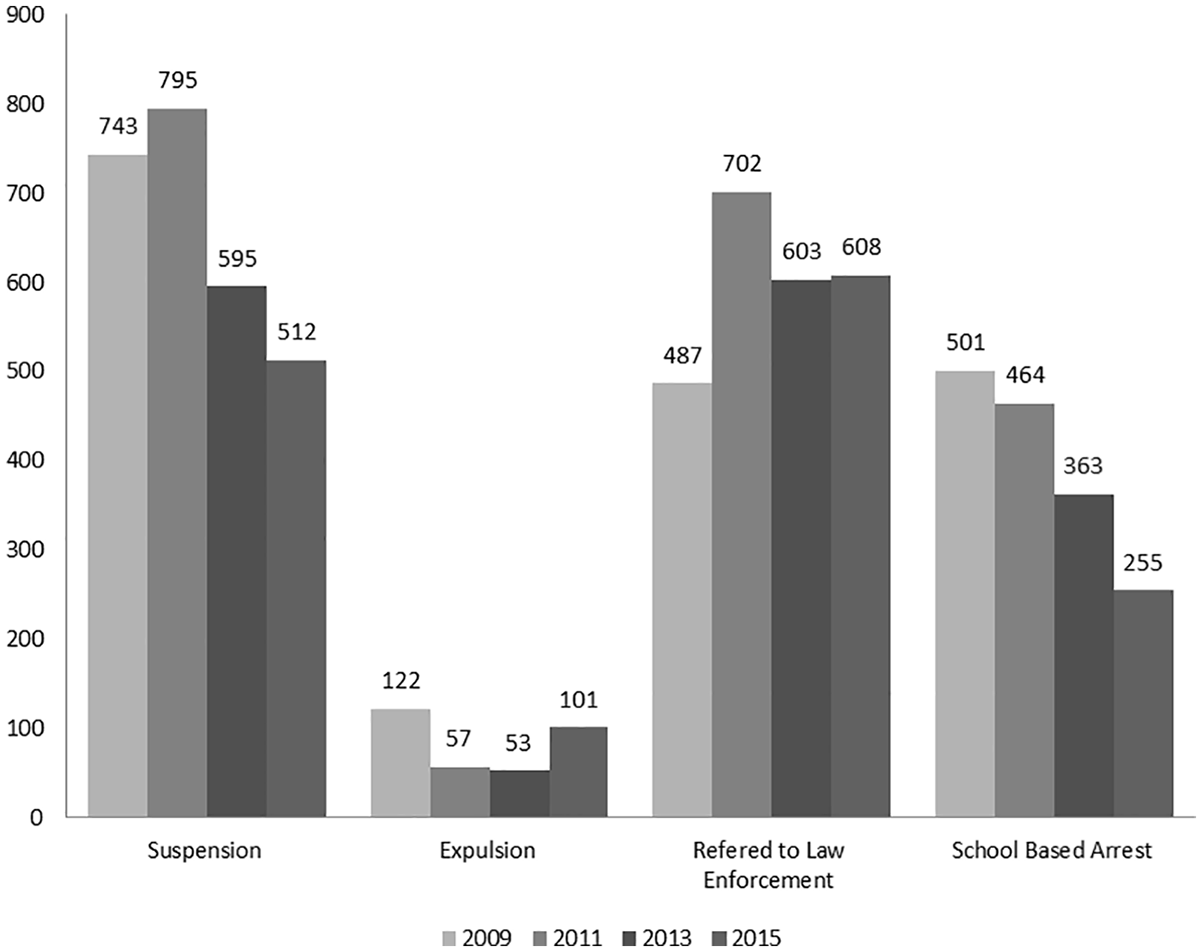
Trends in school discipline rates in nine metropolitan districts limiting school discipline. Miami-Dade SUSP number is the number of youth who school actors removed from school and sent to Student Success Centers.
In contrast to rates of discipline outcomes, disparities disadvantaging Latinx and disabled students’ likelihoods of experiencing exclusionary school discipline have stayed the same or increased (Figure 2). Disparities disadvantaging Black students’ likelihoods of experiencing school discipline stayed the same or increased, while disparities disadvantaging Black students likelihoods of experiencing school criminalization decreased. Even after this decrease, anti-Black disparities remain the largest disparities for all four outcomes. School actors remain five times more likely to suspend Black students than White students throughout the period. School actors were 14 times more likely to expel Black students than White students in 2009 and 26 times more likely to expel Black students than White students in 2015. In 2009, school actors were 11 times more likely to refer Black students to law enforcement than they are to refer White students; by 2015, school actors were seven times more likely to refer Black students to law enforcement. Finally, school safety agents and police were 27 times more likely to arrest Black students than White students in 2009; they were 20 times more likely to arrest Black students in 2015. Disparities that disadvantage Black students are particularly high across discipline outcomes in Chicago, the nation’s most segregated city; all nine districts have median to high levels of anti-Black disparity in at least one outcome.
School actors remain three times more likely to suspend Latinx students than White students throughout the period. School actors were eight times more likely to expel Latinx students than White students in 2009 and 10 times more likely to expel Latinx students than White students in 2015. In 2009, school actors were four times more likely to refer Latinx students to law enforcement than they were to refer White students; by 2015, school actors were six times more likely to refer Latinx students to law enforcement. Finally, school safety agents and police were twice as likely to arrest Latinx students as White students in 2009; by 2015, they were 13 times more likely to arrest Latinx students. Disparities that disadvantage Latinx students are highest across discipline outcomes in Los Angeles and Miami and lowest in Syracuse and Philadelphia.

Trends in racial and ethnic disparities in school discipline in nine metropolitan districts limiting school discipline. Miami-Dade SUSP number is the number of youth who school actors removed from school and sent to Student Success Centers
School actors went from being 70 per cent more likely to suspend students with disabilities than students without registered disabilities in 2009 to being twice as likely in 2015 (Figure 3). State and federal laws protect students with disabilities from expulsions, making districts particularly likely to send students to alternative schools in lieu of expulsions. These nine districts expel students with disabilities at higher rates than students without disabilities in 2011 and 2013, but not in 2009 and 2015. This lack of a clear pattern may be the result of districts’ struggles to find alternatives to expulsions for students that fit with their policy, practice, and resources. In 2009, school actors were 40 per cent more likely to refer students with disabilities than students without disabilities to law enforcement. By 2015, school actors were twice as likely. Finally, school safety agents and police were 70 per cent less likely to arrest students with disabilities in 2009 but 20 per cent more likely to arrest students with disabilities in 2015.

Trends in disability disparities in school discipline in nine metropolitan districts limiting school discipline. Miami-Dade SUSP number is the number of youth who school actors removed from school and sent to Student Success Centers.
Ending disparities
Recognizing that supportive schools are safer than punitive schools, districts throughout the United States are revising their Codes of Conduct and implementing WSPBIS or WSRJ to help them shift from punitive responses to preventive, restorative, and trauma-informed responses. However, while research may guide or justify particular policy initiatives, it is rarely if ever the single determining factor. Beyond research lies politics, moral judgments, and ideological commitments (Armstrong, 2004). Districts may have begun reform without thoroughly interrogating the roots of the punitive turn and incorporate reforms that still rest on risk-based, neoliberal, carceral foundations. WSPBIS is a prime example of this as are some of the carceral responses to trauma, such as those Chicago chose. Moreover, even when districts attempt to address the roots of racial disparities in exclusionary discipline – for example, by limiting school actors’ punishments of students for behaviors that stem from trauma – their responses are often narrow and compliance driven. Shifts from punitive toward rehabilitative policies have only achieved decreases in racial and ethnic disparities in districts with low levels of structural inequality (Mowen et al., 2017). As such, policymakers interested in addressing equity should follow four steps to design race conscious policies that address the structural causes of inequity.
First, districts should divest from school criminalization, removing cops and metal detectors and ending arrests and summonses for non-criminal behavior such as cursing and dress code violations and for misdemeanors. Second, districts should reallocate the millions of dollars spent on policing and security – from US$2.3 million a year in Miami-Dade to US$398 million a year in New York City – to hire guidance counselors and social workers, provide free transit cards to students, and implement WSRJ and culturally competent curriculum (Mbekeani-Wiley, 2017; Power U Center and Advancement Project, 2017; Urban Youth Collaborative, 2017). Buffalo paid US$100,000 per school to implement WSRJ; Oakland paid US$420 per school actor trained. If it costs US$100,000 per school, Miami-Dade could institute WSRJ in a third of their 67 high schools using only the money the district currently spends on salaries for school safety agents. If it costs US$420 per school actor trained, Miami-Dade could train one-third of all of the teachers in the district – likely enough to produce a culture shift (Power U Center and Advancement Project, 2017). Third, districts should end school and legal punishments most likely to disadvantage racially oppressed and disabled students. In particular, districts should eliminate suspensions for youth in elementary schools (Cohen and Casey, 2014) and for willful disobedience (Albonetti, 1991), limit out-of-school suspensions to five days (Abrams, 2010) and limit arrests and summonses at school to times when there is a real and immediate threat to a student, teacher, or public safety (Mbekeani-Wiley, 2017). Moreover, districts and cities should expunge students’ criminal and discipline records and clear their unanswered summonses, as prior records are crystallizations not only of students’ past behaviors but also of discriminatory policy and school actors’ bias (Frase, 2017). Fourth, districts should increase shared governance by involving students, parents, and the community in decisions about school discipline policy and increase transparency by collecting and publicly releasing data on how they respond to student disruptions or conflict – including alternatives such as the Student Success Centers in Miami and Alternate Learning Centers in New York City. Syracuse has increased shared governance, while Chicago and New York City have increased their transparency in discipline practices; each offers a model for other districts. Districts that do each of these things – divest, invest, decriminalize, and share governance – have the best chance of reclaiming schools as a place where all youth can thrive.
Footnotes
Funding
The author(s) disclosed receipt of the following financial support for the research, authorship, and/or publication of this article: The authors wish to acknowledge generous support from DePaul University, who supported this research with a Faculty Research and Development Summer Grant.
