




Abstract

‘Service, Strategic and Political Leaders’ for Local Government in England Call upon the Government to Review the Minimum Age of Criminal Responsibility
A policy position paper published, in November 2021, by the Association of Directors of Children’s Services, the Association of Youth Offending Team Managers and the Local Government Association, argues that ‘urgent action’ is required to reform current arrangements in England and Wales, if the youth justice system is to be one that ‘works for children’.
The paper recognises some significant progress has been made since the establishment of a functionally distinct youth justice system by the Crime and Disorder Act 1998. In particular, the number of children receiving a formal youth justice disposal (police caution or conviction at court) fell by three quarters in the decade from 2009. Corresponding reductions in the number of children in custody have also been achieved. In addition, the Youth Justice Board for England and Wales has adopted ‘Child First’ as a guiding principle for the youth justice system, based around the tenets of:
Prioritising the best interests of children;
Promoting children’s individual strengths and capacities to develop their pro-social identity;
Encouraging children’s active participation, engagement and wider social inclusion; and
Promoting a childhood removed from the justice system, through diversion and minimal intervention.
However, these gains, the authors maintain, should be set against a range of enduring challenges which, in some instances, have become more pronounced as the number of children entering the youth justice system has fallen.
There are clear indications that children who continue to receive formal sanctions have extremely high levels of need, with 88 per cent assessed as having concerns in relation to safety and wellbeing. The authors draw on recent research which analysed a sample of 80 children on youth offending team caseloads and, in the process, established ‘overwhelming evidence of poverty, abuse, loss adversity and probable trauma for the children studied’. All 25 girls within the cohort examined had been referred for suspected sexual exploitation and just one child had no recorded abuse or childhood adversity.
The paper also notes that the processing of children accused of offending has been subject to increasing delay, exacerbated, but not wholly explained, by the Covid 19 pandemic. A combination of the increasing use by the police of ‘release under investigation’, pending a decision as to whether or not to charge the child, and court closures, have both increased the risk that children will reach their 18th birthday before their case is concluded, leading to the imposition of adult sentences and the application of adult criminal record and disclosure provisions.
As throughput has fallen, the overrepresentation in the youth justice system of children from minority ethnic backgrounds has worsened, particularly for children in custody. In May 2020, over half of the population of the children’s secure estate came from a minority ethnic group. While addressing disproportionality has been a national priority for several years, Black and ethnic minority children continue to be ‘less likely to receive an out of court disposal and are more likely to be remanded’ to custody.
The treatment of children deprived of their liberty is an ongoing cause of major concern: levels of violence and physical restraint have risen dramatically. Episodes of self-harm were 35 per cent higher in the year ending March 2020 than in the previous 12-month period. Moreover, the proportion of children remanded to the secure estate had risen, relative to those serving custodial sentences: in June 2021, almost half (48 per cent) of those in custody were on remand.
There has moreover been a ‘disinvestment’ in youth justice provision which is aggravated by reductions in resources to youth work and wider children’s services. The annual grant from the Youth Justice Board to local youth offending teams fell from £145 million in 2011 to less than £72 million in 2019, impacting on staffing levels and the ability of youth justice practitioners to engage in diversionary and preventive interventions. Over the same period, there has been a corresponding decline in funding for broader local government provision which, the authors of the report maintain, is a ‘false economy’ given growing concerns about rising knife crime and child criminal exploitation.
The report argues further that in many respects policy and practice is in tension with the Youth Justice Board’s adoption of a child first philosophy, so that the scope for implementing a genuinely child first agenda is subject to substantial limitations. The authors cite a recent evaluation undertaken, on behalf of the Youth Justice Board, which points to a continued incongruence between child first aspirations and aspects of guidance and practice frameworks which persist in encouraging a ‘child unfriendly risk management model’. Examples provided include the prescribed use of a designated youth justice assessment tool and the focus on criminogenic needs and risks to others in the criteria for the inspection, by Her Majesty’s Inspectorate of Probation, of work by youth offending teams. The authors of the position paper build on this critique, pointing out that children in conflict with the law tend to fall between the gaps in governmental departmental responsibilities, a weakness intensified by responses to the Covid 19 pandemic. For instance, while, during lockdowns, youth justice staff were recognised as critical workers, the children on their caseloads were not automatically considered to be vulnerable. Responses to the pandemic in relation to the custodial estate did not distinguish adults and children, so that the latter were not afforded the same priority as vulnerable children in the community. The conflict between child first aspirations and the youth justice framework is shown ‘most obviously’, the authors argue, in the minimum age of criminal responsibility which, in England and Wales, stands at 10 years. The paper contends that this is clearly ‘out of line with other domestic legal minimum ages’ and in tension with international children’s rights obligations.
The report identifies several ‘domains for change’ that would help to achieve a more child-centred youth justice. These include a more inclusive education system that would reduce the use of school exclusion and ‘off rolling’, both of which are associated with a higher likelihood of criminalisation. Health partners should cooperate to ensure the availability of services for children to address emotional and behavioural needs and substance misuse. Greater flexibility within children’s services to share learning, expertise and skills across youth justice and children’s social care, and the possibility of integrated planning and assessment frameworks, would reduce the potential for children to be failed by a lack of clarity about where responsibility lies, and allow a more joined up approach to child criminal exploitation.
The paper concludes with a range of recommendations designed to fashion a youth justice system that ‘works for children’. These include:
The development of a cross-government vision for children which clearly articulates the role of each department and ensures that prime responsibility for youth justice rests with the Department for Education rather than, as at present, the Ministry of Justice;
A review of funding for youth offending teams;
Exploring the possibility of additional entitlements to support, up to age 25 years, for children in conflict with the law;
A review of the minimum age of criminal responsibility to align with other domestic age thresholds and international standards.
A youth justice system that works for children is published by the Association of Directors of Children’s Services, the Association of Youth Offending Team managers and the Local Government Association, and is available at: https://adcs.org.uk/assets/documentation/ADCS_AYM_LGA_A_Youth_Justice_System_that_Works_for_Children_FINALx.pdf
The ‘child first’ vision and its constituent principles are described in the Youth Justice Board’s Business Plan 2021-2022, available at: Youth Justice Board Business Plan 2021-2022 (publishing.service.gov.uk)
The analysis of 80 children in youth offending team caseloads is reported in Punishing abuse: children in the West Midlands criminal justice system, by Alex Chard, published by the West Midlands Police and Crime Commissioner and available at: https://www.westmidlands-pcc.gov.uk/wp-content/uploads/2021/03/Punishing-Abuse.pdf?x52165
The suggestion that child first aspirations may be limited by a continued adherence, in some contexts, to a risk management approach is given in The child first strategy implementation project: realising the guiding principle, by Stephen Case and Ann Browning, published by Loughborough University and available at: https://repository.lboro.ac.uk/articles/report/The_child_first_strategy_implementation_project_Realising_the_guiding_principle_for_youth_justice/16764124/1.
Research in England and Wales Finds ‘No Evidence’ That Mixing Children Placed in Secure Children’s Homes through Justice and Welfare Routes Increases the Risk of Sexual Abuse
In 2019, a report published by the Independent Inquiry into Child Sexual Abuse (IICSA) found that there were 990 alleged incidents of child sexual abuse in custodial institutions, in England and Wales, between January 2009 and December 2017. Children deprived of their liberty through the youth justice system may be placed in three types of establishment: young offender institutions (YOIs); secure training centres (STCs); and secure children’s homes (SCHs) which accommodate children detained under welfare legislation as well as those deprived of their liberty for offending. Although the latter form of provision accounts for just 10 per cent of custodial placements, IICSA data suggested that around one in four allegations of child sexual abuse related to the SCH sector.
The report acknowledged that this overrepresentation might be explained, in part, by the fact that children in secure children’s homes may feel safer than their counterparts in STCs and YOIs and may accordingly be more likely to disclose incidents of abuse since ‘the staff/child ratio is higher than the ratio in YOIs and STCs, with more opportunities to build positive relationships’. Nonetheless, given the ostensibly higher levels of abuse within SCHs and the fact that other children were identified as perpetrators in 50 per cent of cases, IICSA expressed concern about the potential for placing children who had engaged in sexually harmful behaviour alongside those who may be vulnerable to abuse in those SCHs which accommodate children subject to youth justice disposals and those secured on welfare grounds. In this context, IICSA recommended that the Department for Education ‘conduct a full review of the practice of placing children for justice and welfare together in SCHs to see whether this increases risk of sexual abuse to children’. The recommendation was accepted, and the review was duly published in May 2021.
The review authors begin by considering the data provided by IICSA, noting that while 98 of the 121 allegations involving another child as perpetrator occurred in SCHs that accommodate children through the justice route, those homes account for around three quarters of total capacity. As a consequence, allegations would appear to be fairly evenly distributed across different types of SCHs and the figures do not therefore suggest that children are necessarily safer in welfare only establishments.
Data provided to the review by Ofsted, the agency responsible for inspection of children’s homes including SCHs, indicated a much lower prevalence of allegations of sexual abuse than suggested by IICSA. SCHs are required to notify Ofsted of any serious incidents within the establishment, including suspected or actual episodes of sexual exploitation or abuse. Such reports indicated that there were just 29 incidents of sexual harm where another child was the perpetrator between 2009 and 2019. Of these, 18 were withdrawn, unsubstantiated or led to no further action once investigated by the police and the local authority. While it is hard to draw conclusions from such small numbers, the available statistics provide no reason to consider that children in welfare only facilities were safer from sexual harm.
The authors acknowledge that accounting for the large discrepancies between the two sets of figures is difficult. However, interviews with a range of 32 stakeholders (21 staff working in SCHs and 11 respondents from relevant national organisations) indicated a consensus that while SCHs are closed institutions, relatively isolated from the wider community – factors which may increase the risk of abuse occurring – they are also characterised by high levels of monitoring and scrutiny, where children are, as one interviewee put it, ‘watched like hawks’. Children are rarely left unsupervised, and the homes have extensive CCTV monitoring in all areas except children’s bedrooms and bathrooms where they would not be together. Respondents also confirmed a perception that there are significant opportunities that facilitate disclosure by children and that, while the possibility of under-reporting cannot be excluded, it is accordingly unlikely that large numbers of incidents would go undetected.
The authors also review other evidence presented by IICSA in two previous reports. A ‘rapid evidence assessment’ concluded, on the basis of the available literature, that children in secure accommodation through justice and welfare pathways share similar characteristics and that the legal route by which they are secured does ‘not accurately reflect the level of risk a child may pose to his or her peers’. At the same time, some studies suggested that placing children who had offended alongside those detained on welfare grounds could make the latter anxious. A later qualitative study, conducted by IICSA, which included interviews with children in SCHs, found that they were concerned about the backgrounds of other children with whom they were placed, and, in particular, would be anxious if other residents were alleged to have committed a sexual offence. However, this appeared to be associated with the wider stigma attached to such behaviour rather than a fear of sexual victimisation. While the unpredictability of other residents’ behaviour, as a consequence of mental ill health, was a concern for children in SCHs, the risk of child sexual abuse did not feature ‘as a significant issue’. Indeed, children tended to perceive the latter risk to be low. The authors of the review conclude that these two reports provided ‘no clear evidence’ that mixing justice and welfare children increased the risk of child sexual abuse.
Further interviews with stakeholders confirmed that, in deciding whether to accept referrals, SHCs were mindful of the potential problems that might arise where there was a high concentration of sexually harmful behaviour and that the impact on the resident population was considered at the point of admission. But this was also true of other forms of challenging behaviour, such as for instance, self-harming, where high levels of such behaviour could encourage children to compete with each other. Nonetheless, respondents did not consider that a history of sexual offending would, in itself, make SCHs reluctant to accept a referral, in part because the opportunities to replicate such behaviours within the secure setting were limited.
Stakeholders confirmed previous evidence that children placed in secure accommodation, whether through the welfare or justice route, tended to have similar backgrounds and that both groups were characterised by extremely high levels of vulnerability. Indeed, which pathways children followed into a secure placement was frequently a matter of contingency, determined by local approaches to dealing with children who posed a risk to themselves and others and the implementation of thresholds. Shifts in policy could influence which legal framework was utilised. For instance, attempts to reduce the over-criminalisation of children in care had made it more likely that welfare secure placements would be sought for this group of children even where they might otherwise be at risk of a custodial sentence for their offending behaviour. Similarly, an emerging understanding that gang-associated children were frequently victims of child criminal exploitation increased the likelihood that detention would be sought on welfare grounds. Conversely, in areas where there was a reluctance to use welfare secure placements, or at times – such as the recent period – when there is a shortage of such placements, children who might otherwise have been placed in secure accommodation under welfare legislation might remain in the community until deprived of their liberty through the youth justice system. As one respondent put it,
children placed on a criminal route, could quite easily have come in on welfare route, and children placed on the welfare route could quite easily have come in through the criminal route.
In this context, it was unsurprising the SCH staff frequently reported cases of children who had first been placed on welfare grounds and then returned, at a later date, subject to a custodial remand or sentence. Equally, it was not uncommon for children who had initially been placed on offending grounds to be secured subsequently through welfare legislation.
The review also found strong evidence that the risk which children posed to their peers in secure accommodation was not dependent on whether they had a justice or welfare categorisation. There was a clear consensus among respondents that the main risk posed by children to other residents was violence and that the justice cohort were no more likely to exhibit violent behaviour than their welfare counterparts. Indeed, some practitioners considered that aggression was more common among children placed on welfare grounds. One SCH, which accommodated equal numbers of welfare and justice children, reported that more than 90 per cent of restraints, frequently a consequence of a violent incident, involved welfare children.
The risk of sexually harmful behaviour was perceived as being considerably less likely than violent victimisation. But even where such risks were identified, there was no reason to consider that justice children were more likely to manifest them. Data provided to the review indicated that less than one in five children placed in SCHs on justice grounds had committed a sexual offence whereas 17 per cent of children subject to welfare placement had a recorded history of sexually harmful behaviour.
The review concludes that there is ‘no quantitative or qualitative evidence to suggest that that mixed SCHs have difficulty in keeping children safe’. In the light of these findings, there was no need to consider an alternative model to mixed justice and welfare placements. Moreover, respondents articulated a range of reasons why discontinuing such placements might be counterproductive. These included:
An increased concentration of children with particular forms of challenging behaviour within individual establishments if the pool of referrals was more limited;
Placement of children further from home;
A potential for greater stigmatisation of children placed through the youth justice route, particularly those in custody for sexual offending.
As a consequence, at least some stakeholders considered that children would actually:
benefit from greater integration of the justice and welfare systems – and the inclusion of mental health services. Sexual Abuse of Children in Custodial Institutions: 2009-2017 Investigation Report is published by the Independent Inquiry into Child Sexual Abuse, and is available at: https://www.iicsa.org.uk/reports-recommendations/publications/investigation/custodial The government response to the Independent Inquiry into Child Sexual Abuse’s Investigation Report Sexual Abuse of Children in Custodial Institutions: 2009-2017 is published by the Ministry of Justice and is available at: https://www.gov.uk/government/publications/sexual-abuse-of-children-in-custodial-institutions-government-response Secure children’s homes: placing welfare and justice children together: research report, by Di Hart and Ivana LaValle, is published by the Department for Education and is available at: https://dera.ioe.ac.uk//37885/1/Secure_children_s_homes_placement_review_report.pdf Child sexual abuse in custodial institutions: a rapid evidence assessment, by Ellie Mendez Sayer, Holly Rodger, Claire Soares and Rachel Hurcombe, is published by IICSA and is available at: https://www.iicsa.org.uk/document/child-sexual-abuse-custodial-institutions-rea-full-report Safe inside? Child sexual abuse in the youth secure estate – Summary report, by Claire Soares, Rachel George, Laura Pope and Verena Brähler, is published by IICAS and is available at: https://www.iicsa.org.uk/document/safe-inside-child-sexual-abuse-youth-secure-estate-summary-report.
Indigenous Children in Australia Are 16 Times as Likely to be under Youth Justice Supervision as Their Non-Indigenous Counterparts
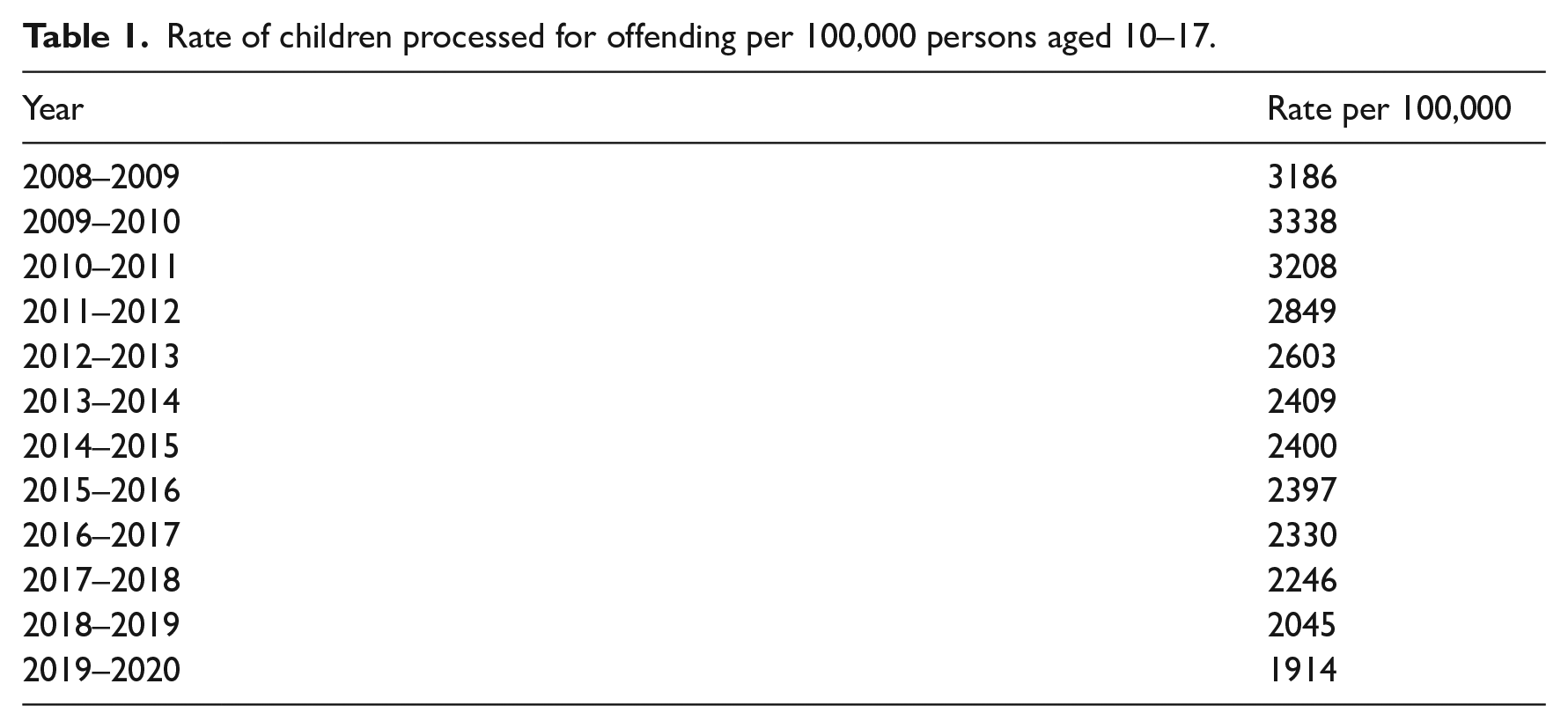
The most recent available data show that, in 2019–2020, 46,949 children aged 10–17 years were proceeded against by the police for offending in Australia. In line with many other jurisdictions, this represents a substantial decline of more than a third over the last decade: the equivalent figure for the number of children proceeded against in 2008–2009 was 71,421. As indicated in Table 1, there has, over the same period, been a corresponding fall in the rate of children processed as offenders, expressed as a proportion of 100,000 10- to 17-year-olds in the general population.
Rate of children processed for offending per 100,000 persons aged 10–17.
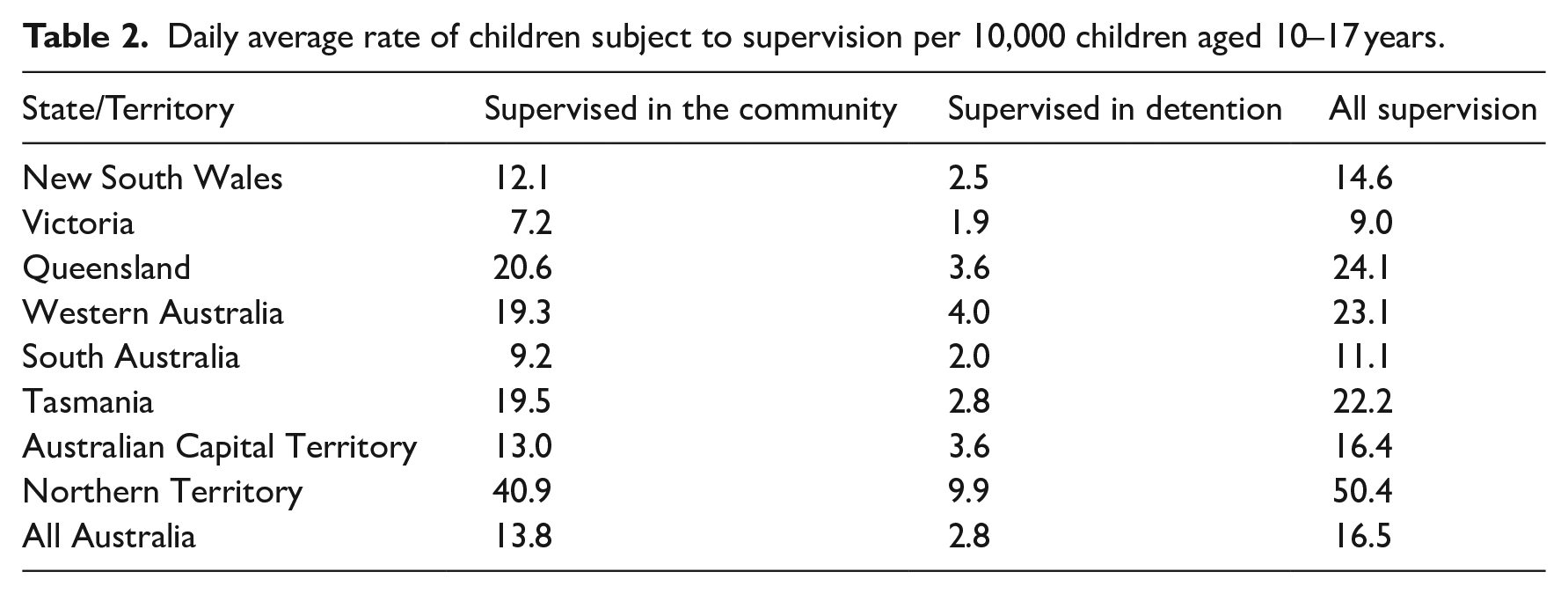
A recent analysis, published by the Australian Institute of Health and Welfare, indicates that, during 2019–2020, an average 5323 children were subject to youth justice supervision on any given day, equivalent to 16.5 per 10,000 children in the relevant age range. This figure includes those supervised within the community and in detention, and those subject to supervision at the remand stage and pursuant to sentence. The majority of these children were supervised in the community (4490 against 863).
There were, however, considerable differences between states and territories, both in terms of the overall rates of supervision and the relative distribution of supervision in the community and in detention. As shown in Table 2, while the rate of supervision across Australia was 16.5 per 10,000 children, this figure ranged from 9.0 in Victoria to 50.4 in the Northern Territory. There was a corresponding variation in the rate of children subject to supervision in detention from 1.9 in Victoria to 9.9 in the Northern Territory, compared with an overall rate of 2.8 for Australia as a whole.
Daily average rate of children subject to supervision per 10,000 children aged 10–17 years.
Aboriginal and Torres Strait Islander children have a long history of overrepresentation in the Australian youth justice system. While such children account for just 6 per cent of the total population in the 10–17 age range, half of those subject to youth justice supervision, on an average day in 2019–2020, were of Indigenous origin. Expressed as a proportion per 10,000 children of the relevant age, the daily supervision rate for Indigenous children was 149.3 compared with 8.5 for non-indigenous children. The former group were accordingly more than 16 times as likely to be subject to youth justice supervision. This level of overrepresentation was substantially higher for Indigenous children in detention who were more than 18 times as likely to be subject to such supervision as their non-Indigenous counterparts. These higher levels of representation were reflected in the average age at which minority children first entered supervision:
nearly 2 in 5 (38%) Indigenous young people under supervision in 2019–20 were first supervised when aged 10–13, compared with 1 in 7 (14%) non-Indigenous young people. The most common age for first entry to youth justice supervision for Indigenous young people was 14, compared with 15 for non-Indigenous young people. The fall in the number of children processed for offending is given in Recorded Crime–Offenders 2019-20, published by the Australian Bureau of Statistics and available at: https://www.abs.gov.au/statistics/people/crime-and-justice/recorded-crime-offenders/latest-release#data-download Data on children subject to youth justice supervision is contained in Youth justice in Australia 2018-20, by Josh Sweeney, Callin Ivanovici and Sally Woodhouse, published by the Australian Institute of Health and Welfare and available at: https://www.aihw.gov.au/getmedia/e593cc05-884c-4a47-bce6-0dcc76fc1a66/aihw-juv-134.pdf.aspx?inline=true.
More than a Quarter of Black and Mixed Heritage Boys on Youth Offending Team Caseloads, in England and Wales, Report That Youth Justice Interventions ‘Rarely or Never Met Their Needs’
In common with many other jurisdictions, the criminal justice system in England and Wales is characterised by a significant overrepresentation of minoritised communities. A government commissioned review, published in 2017, suggested that the youth justice system constituted the area of ‘biggest concern’. While children from minority ethnic backgrounds make up 18 per cent of the 10–17 population, in 2019–2020 such children accounted for 27 per cent of those receiving a formal criminal justice sanction. Moreover, it is evident that disproportionality has worsened over time despite the considerable policy attention devoted to it: the equivalent figure a decade before was 14 per cent. This growing disparity is particularly marked for children in custody. In the year ending March 2021, 52 per cent of the population of the secure estate for children were from a minority background. During the last year, the number of custodial sentences imposed on all children fell by just under 40 per cent, but the equivalent decline for minority children was considerably lower, at 30 per cent, and for mixed heritage children was only 10 per cent. As the above figures suggest, the picture varies by ethnic background. While overrepresentation is highest for black and mixed heritage children, Asian children have consistently been underrepresented among those receiving a substantive youth justice disposal relative to the composition of the general population. Overall data for ethnic minorities as a whole thus tend to obscure the extent of disproportionality for some groups.
Given this pattern, a thematic inspection, published by Her Majesty’s Inspectorate of Probation in October 2021, focuses on the experiences of black and mixed heritage boys in the youth justice system. The report acknowledges that black and mixed heritage girls are also overrepresented; however, the extent of disparity is less pronounced, and the substantially lower number of girls in the system would have made it difficult to draw conclusions. The inspection examined the quality of work delivered by nine youth offending teams (YOTs) (multi-agency partnerships responsible for delivering services to children within the youth justice system), selected on the basis of the size, and overrepresentation, of black and/or mixed heritage boys on their caseloads.
Interviews with 38 black or mixed heritage boys established that most understood their offending as being grounded in ‘their environment and the influence of their peer group’. Such children came disproportionately from the poorest areas and lived in large, densely populated, estates and, as a consequence, had limited control over whom they mixed with or the influences to which they were subject. They were accordingly more vulnerable to child criminal exploitation and had fewer options than their counterparts from more affluent backgrounds.
Children reported experiences of, what they perceived to be, discrimination within, but not limited to, the criminal justice system. In particular, they conveyed a ‘fatalistic acceptance’ that they would be treated differently because of their ethnicity, referencing disproportionate police stop and search which, to many, had become a ‘normalised and an accepted part of everyday life’. Respondents were more positive about their relationships with YOT staff and most considered that they were treated fairly in that context: none of the boys interviewed thought that they had been discriminated against because of their ethnicity in their contact with the YOT. The large majority reported that the staff skills and knowledge, and their ability to develop meaningful relationships with the children they worked with, was more important than whether they came from the same ethnic background.
Nevertheless, many of the boys expressed reservations about the programmes delivered by the YOT. While a quarter indicated that their needs were fully met, a slightly higher proportion considered that youth justice interventions ‘rarely or never’ did so. This group struggled to understand the relevance of the input they received; many indicated that they already understood the consequences of their actions which was the focus of much of the work they were required to do, rather than concentrating on helping them to deal with the underlying challenges which they believed had led to their involvement in offending.
Analysis of 114 case files found that children and their families were encouraged to contribute to their assessments and intervention planning. Court reports were proportionate and contained appropriate recommendations. YOT staff were also successful, in most instances, in forming good relationships with children they supervised, and encouraged them to engage and comply with the expectations of court orders. However, the overall quality of assessments was undermined by a lack of attention to issues of diversity. Although most staff acknowledged that many black and mixed heritage children would have experienced discrimination, the impact of that experience or the implications for planning interventions was rarely explored.
Reports of unmet need for black and mixed heritage children prior to entry to the youth justice system were central to the inspection. Sixty per cent of the sample of children had been excluded from school; one third were recorded as having been victims of child criminal exploitation; and a similar proportion had been subject to Children in Need or Child Protection plans. There was a general consensus among YOT staff that ‘had problems and difficulties been addressed earlier in the children’s lives, there could have been a different outcome for them’.
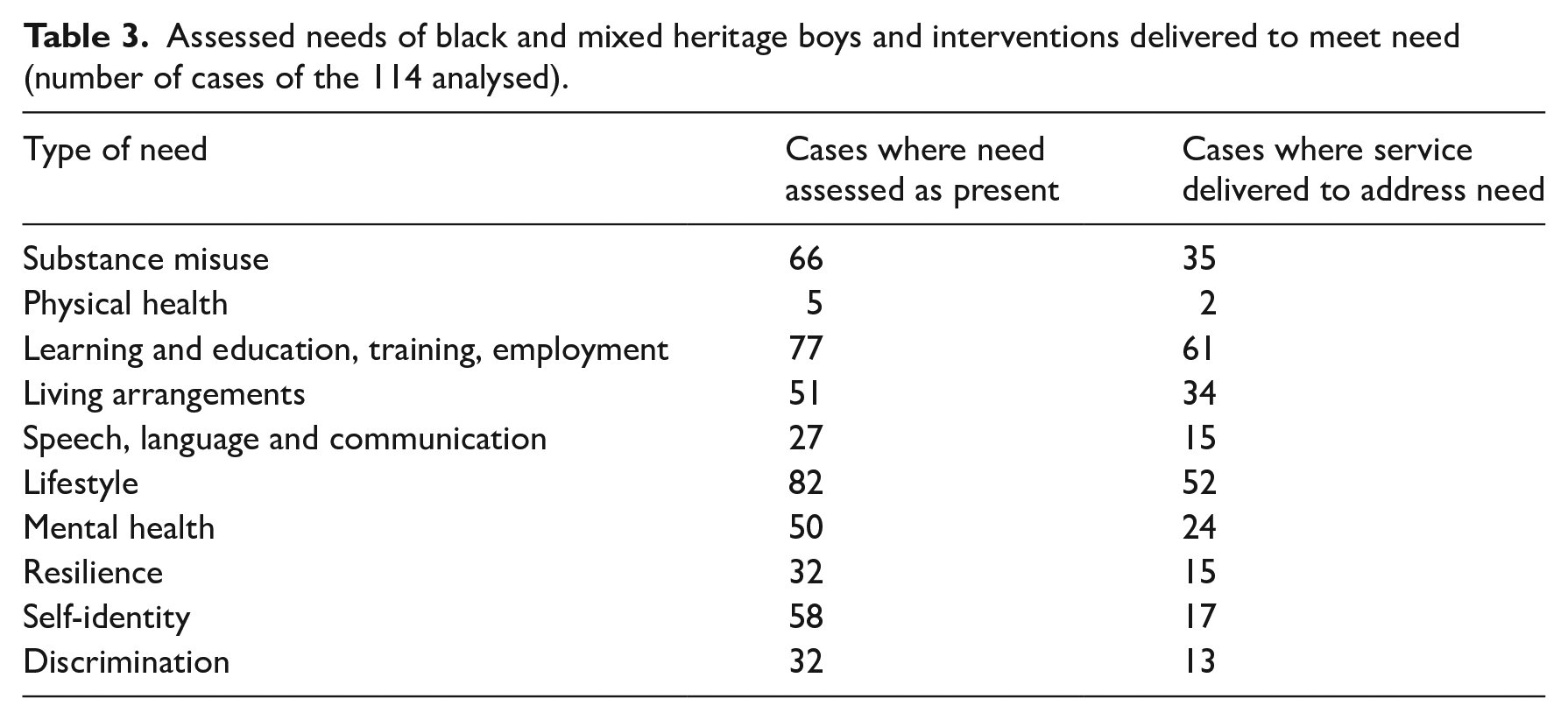
Nonetheless, there was a mismatch between children’s needs as determined through youth justice assessment and intervention to meet those needs. As shown in Table 3, the shortfall in services provided was particularly stark in relation to issues of mental health, self-identity and discrimination.
Assessed needs of black and mixed heritage boys and interventions delivered to meet need (number of cases of the 114 analysed).
The thematic inspection concludes with a broad range of recommendations for different agencies. These include:
Dissemination, and effective use, of more detailed statistics, including data on stop and search, broken down by age, gender and ethnicity;
Revised guidance on youth justice case management to include diversity and overcoming structural barriers;
Greater clarity at the local level on the YOT’s vision for improving outcomes for black and mixed heritage boys, ensuring that this vision is understood by practitioners and partner agencies; and
The publication of data, disaggregated by different ethnic groups, showing how well individual YOTs address disproportionality to encourage good practice.
The assessment that racial disparities in the youth justice system are the biggest concern is contained in An independent review into the treatment of, and Outcomes for, Black, Asian and Minority Ethnic individuals in the Criminal Justice System, by David Lammy, published by the Ministry of Justice and available at: https://www.gov.uk/government/publications/lammy-review-final-report
Figures on ethnic minority overrepresentation in custody are derived from Understanding racial disparity, published by the Youth Justice Board and available at: https://www.gov.uk/government/publications/understanding-racial-disparity.
The experiences of black and mixed heritage boys in the youth justice system: a thematic inspection, is published by Her Majesty’s Inspectorate of Probation and available at: https://www.justiceinspectorates.gov.uk/hmiprobation/wp-content/uploads/sites/5/2021/10/The-experiences-of-black-and-mixed-heritage-boys-in-the-youth-justice-system-thematic-report-v1.0.pdf