



Abstract
English government policy advocates providing greater choice-making opportunities for service users and their families. However, there is a gap in our knowledge about the role family, especially parents, and also friends play in the choice-making processes of disabled young people. Drawing on data from an English longitudinal study, this article begins to address this gap by exploring disabled young people's shared choice-making with parents and peers. Using qualitative data from 27 interviews with disabled young people with degenerative conditions, it demonstrates that young people want to participate in making choices about their own lives but choices are often made with other people, especially parents and peers. Processes of choice-making are diverse. Parents and/or peers are involved at different stages and in varying degrees with young people depending on personal circumstances. For example, circumstances such as young people's age and experience and the type of choice and its perceived seriousness. Recognizing this complexity and the importance of a holistic approach to choice-making, the article concludes with some practice suggestions.
Keywords
Introduction
Little is understood about processes of shared choice-making amongst disabled young people and other people, particularly the roles that non-professionals play (Beresford and Sloper, 2008). This is an important issue given that disabled young people, especially those with degenerative conditions, typically face many (sometimes significant) health and social care choices (Wright et al., 2009). This article begins to address this gap by exploring the views and experiences of disabled young people with degenerative conditions related to making choices with parents and peers about their health and/or social care, their leisure activities and post-school options. Shared choice-making is important to explore as choice-making often involves others and questions concerning the role of other people therefore arise. This article explores when and why parents and peers are involved and how their involvement is viewed by the person making the choice.
Background
Extending choice to adult service users, especially health and social care users remains central to policy in many western countries (see for example, Arksey and Kemp, 2008; Lord and Hutchinson, 2003; Ottmann et al., 2009). The importance of choice-making for children/young people and their families, including disabled children and young people has also been recognized (Tisdall, 2006; UK HM Treasury, Department for Education and Skills, 2007). However, giving more choice is not simple, as real opportunities need to exist (Beresford and Sloper, 2008).
Shared choice-making in families
Within choice-making, the role of other people is recognized. Shared choice-making is discussed in broad sociological theories associated with late modernity. For example, there is Giddens' (1992) helpful theory of the democratization of the family and increasing intergenerational relationship equality. Although influential, this ‘grand’ theory has been critiqued (see Jamieson, 1999; Smart, 2007) as partial, ignoring, or at best, ‘glossing over’ micro-level relationships and continuing differences, such as gender. Furthermore, Beresford and Sloper's (2008) review of psychological theories of choice-making highlights the relative dearth of theoretical models of shared choice-making in close relationships, especially in choice-making between parents and their children.
However, within the research that does exist, there is a suggestion of a complex situation of both democratization and continuing differences as noted in the sociological literature. For example, in the UK, Butler et al. (2005) highlight the importance of the concepts of ‘fairness’ and ‘democracy’ when children make choices with their parents. Butler et al. found that children (predominately non-disabled) may want to be consulted by their parents about family based choices such as holidays. However, parents taking an active choice-making role were more likely to be accepted by young people when parents were considered ‘competent’ and ‘knowing’. Butler et al. also report gendered roles with mothers, rather than fathers, frequently more involved and leading in their child's choice-making (Butler et al., 2005).
Disabled children and choice-making
However, choice-making for some people is viewed as more complicated. For disabled people, especially children and young people with learning disabilities, their ability to make choices has been questioned. This is because children can be viewed as potentially irrational and unknowing (Mayall, 2006) and, as people with learning disabilities, they are regarded as particularly likely to lack competence to make choices (Kearney and McKnight, 1997). However, the idea that people with learning disabilities (irrespective of age) cannot make choices has been challenged. In reviewing the international literature, Cannella et al. (2005) concluded that people with significant learning disabilities can, depending on the complexity of the choice and support received, make choices or at least indicate preferences.
Shared choice-making by children with chronic illnesses
Most research on chronically ill children and shared choice-making focuses on health or treatment decisions. The importance of a whole-family approach to shared choice-making involving patients, parents and professionals is highlighted within family centred health care theory (Rosenbaum et al., 1998; Smith et al., 2002). However, past research has focused largely on professional practice and parental roles. Children's voices and perspectives (especially younger children with chronic illnesses) are absent or limited (Coyne, 2008; Moore and Kirk, 2010). There also appears to be limited research on the role of other people apart from family such as peers. In the literature that does exist, the focus is on the role of peers (Antle et al., 2009), especially peers with similar health conditions (Beresford and Sloper, 1999) providing emotional support or as a source of information to chronically ill children.
Alderson and Montgomery's (1996) English research of young people facing surgery decisions provides important insights into family choice-making. Alderson and Montgomery found that children differed in the roles they wanted to adopt in choice-making processes and the roles they wanted their parents to play. Some wanted to be the main decider, others wanted to share choice-making, and a minority wanted to defer responsibility to another person. Interestingly, age did not typically directly affect the young person's preferred role in the choice-making process. Other research, such as Miller's (2009) US based study of children managing chronic illness has highlighted how the type of choice children face can affect the role they want to play in making choices about their illness and its management. Choices viewed as serious led to increased levels of parental involvement, something usually desired by both child and parents.
Miller (2009) and Alderson's (Alderson and Montgomery, 1996) research highlights the complexity of shared choice-making by chronically ill children and young people. The study reported here further explores some of these complex issues and demonstrates the importance of listening to those previously marginalized, especially young people with learning and/or communication impairments.
The choice and change project – sample and methods
Sample characteristics and interview format

Four participants were British Pakistani.
Age at first interview.
The data reported in this article were collected during the first round of interviews conducted during spring/summer 2007. A core topic guide with different modules was used across the study. The round one topic guide contained a shared choice-making module. Subsequent interview topic guides did not discuss shared choice-making in such depth or with any consistency across the sample of young people.
Two methodological approaches were used. Verbal semi-structured interviews for young people with no significant learning and/or communication impairments and symbols based interviews for young people with significant learning and/or communication impairments. For brevity and clarity, the term young people will be used to refer to disabled young people with a degenerative condition. For those young people with additional learning and/or communication impairments they will be referred to as young people with LCIs.
The verbal interviews
A semi-structured topic guide was used to explore young people's perspectives on the processes of decision-making in relation to two recent choices they had made, including the role of others in the decision-making process. The topic guide was piloted with two young people. Individual interviews (60–90 minutes) were conducted with 15 young people. All were audio recorded with the young people's consent and, where appropriate, parents’ consent.
Symbols-assisted interviews
Topics explored in the verbal interview guide were simplified and then represented on a series of symbol based (using Boardmaker® symbols) Talking Mats® (see Murphy, 1998). The Talking Mats® were used with young people who had a significant learning impairment and did not use speech. They also facilitated a simple verbal interview for those with a learning impairment but some speech. The Talking Mats® were piloted with five children. Each Talking Mat board® presented a question (in simple English text and Boardmaker® symbols). Also attached to the board were a set of possible answers (again presented in English and Boardmaker® symbols). The young person indicated their response to the question and the chosen symbol(s) was/were detached from the board. The young person's choices/responses were collected together on a separate board, here, called a personal symbols board. Symbols were collected together on the personal symbols board(s) to make viewing young people's responses easier. The interview focused on one choice (chosen by each young person) and included topics exploring the process of choice making, including others involved in choice-making. Twelve young people with LCIs were interviewed with the aid of Talking Mats®. All the young people chose to be interviewed with a parent or carer present. Learning from Murphy et al. (2005), photographs of each participant's personal symbol board(s) were taken as a record of the interview. Copies of the photograph(s) were also sent to each participant.
Some ethical issues
Recognizing the potentially emotional nature of the interviews, the researcher sought (in a similar manner to Stevens et al., 2010) to facilitate a supportive environment in a number of ways. This included using an age/ability appropriate warm-up exercise with younger participants (under 16 years) and those with LCIs. These young people completed (with varying degrees of support) a short pre-prepared cartoon style booklet, ‘All about Me’ with the researcher. The researcher was also flexible in terms of the timing of interviews and ‘fitting in’ with family routines; and participants could choose where they were interviewed (usually their home). Concepts of privacy and confidentiality were explained to the young people using simple and familiar terms/examples (symbols were used when appropriate).
The presence of parents/carers in the interviews with the young people with LCIs could be construed as impacting on these young people's responses and accounts (Nind, 2008). However, on balance, their presence was beneficial. For some young people it enabled their participation, as communication was frequently aided by parents/carers’ knowledge of their child's individual communication mode/preferences. Parents/carers’ presence was also clearly wanted by all the young people with LCIs. Trying to balance the issue of parent/carer presence, the researcher was particularly sensitive to young people's non-verbal cues. The researcher also found that encouraging parents/carers to hold up Talking Mat® questions or personal boards limited their opportunity to influence participants.
There were also opportunities for participants to take interview ‘breaks’ if they became emotional or just tired. The researcher always concluded interviews on less emotional areas and informed young people of post-interview support (if they wanted it) arranged by the researcher at the hospice they attended.
As Nind (2008) suggests, consent was discussed before interviews took place and information was provided in a medium appropriate to each young person's abilities (e.g., written, symbol based). Interviews were audio-recorded with young people's consent and where appropriate, their parents’ consent. However, consent was ongoing throughout each interview. The researcher was sensitive to any non-verbal cues, such as participants’ body language indicating that they might not want to continue. These non-verbal cues were particularly important in the interviews with young people with LCIs. For more information about symbol based methods used (especially Talking Mats®) and project issues, see Mitchell (2010).
Analysis
The verbal interviews were fully transcribed and coded using the software package MAXqda. The coding framework was based on key project themes including ‘the role of others’ in decision-making. Data were summarized onto a series of thematic charts based on Framework Analysis (Ritchie and Lewis, 2003). All members of the wider project team discussed emerging themes and checked each other's charts for comprehensiveness and consistency.
The symbols-based interviews were also recorded (researcher gave a running commentary on participants’ symbol choices). These commentaries, along with field notes and photographs of young people's personal boards created during their interview, were used to document participants’ views and experiences. Simpler versions of the charts used to summarize the verbal interviews were used to summarize the symbols-assisted interviews. This approach of drawing together a range of data (verbal, symbol and photographic) has been recommended by Nind (2008) and Cameron and Murphy (2002).
Results
Findings are presented in two broad areas: shared choice-making with parents and with peers. The type of choices participants discussed is documented in Table 1. The results are young people's personal presentations of events, that is, how they viewed parents’ and peers’ involvement. They are thus the young people's rationalizations of past and present events and may differ from parental and peer interpretations.
Parents’ roles in the choice-making process
Young people felt that parents often did not initiate choices. For instance, amongst the young people without LCIs, five described how they had initiated the choice to go to college/university, and six explained that their doctor had initiated a health choice (spinal surgery, gastronomy). However, regardless of who had initiated the need to make a choice, participants (both with and without LCIs) wanted their parents to be involved in the choice-making process.
Choice-making with parents was thus presented as ‘the norm’. Parents’ involvement varied from leading the choice-making process to assuming a less leading role. Even the young people who felt they took an active and relatively independent role in choice-making processes reported, to varying degrees, their parents’ involvement. Decisions were not made without some input from their parents even if this was just described as ‘talking to Mum and Dad’. I listened to her [Mum] as well but it was always my final decision. (YP-8)
Among the sample of young people without LCIs, the degree to which parents (especially mothers) were involved, and the importance young people attached to their input, had changed over time. Over half of the young people specifically noted there had been greater parental input in choices which had been made when they were younger, recognizing the importance of age and their own developing maturity. Well now as I’m getting a lot older they’ll [family] listen to me but like when I were younger, five or six like, me mum had to make decisions for me and so did the hospital but now, like when I got to, like 10, that's when me mum and our [brother] started saying like ‘no, do you want to do this?’ (YP-4)
However, age was not the only or always the most important factor in determining the type or level of parental involvement. Other factors played a key role in the ways and extent to which parents shared choice-making with their child, these included the nature of the choice and the stage in the choice-making process. These factors will now be discussed.
The nature of the choice
The type of choice young people faced and its perceived seriousness was discussed by participants. Among young people without LCIs, choices with important or significant consequences or implications (for example, health decisions such as spinal surgery and gastronomy choices, and post-school decisions such as choosing a residential college or university) were described as ‘big’ decisions. In these choices, parental involvement was expected and wanted. This contrasted with other types of choice, such as leisure choices which were viewed as more ‘everyday’, where parental involvement was more peripheral. Expectations and a desire for more parental help in choices viewed as important cut across participants’ different medical conditions.
The other factor influencing young people's preferences was the stage in the choice-making process. Parental involvement in information gathering stages (seeking/obtaining information, talking to or finding the right/necessary people) was desired and welcomed by young people without LCIs, irrespective of their age. After these information gathering phases, parents tended to be less involved as young people then used the information gained to help them reach a decision.
In contrast, amongst the young people with LCIs, increasing chronological age per se was not strongly associated with changes in the roles parents played in choice-making. This was particularly the case where the young person had severe cognitive impairments.
Which parent helped?
For young people with and without LCIs, a traditional gender divide was apparent in which parent they shared choice-making with. Among the young people who discussed parental involvement, all emphasized the importance of talking with their mother, fathers were more peripheral, as this young person communicated through the Talking Mats® (Figures 1 and 2).
Does anyone help you make choices about doing fun things? Yes or no? [young person chooses symbols] So we’ve got ‘Mum’ and ‘Dad’, ‘friends’ and ‘carers’. You have lots of people help you. Now, I’d like you to choose the person who helps the most, one person [young person chooses] ‘Mum’… (Researcher talking with YP-24) Talking Mat® Question. YP-24 Personal Symbol Board (symbols circled are the young person's responses to Figure 1's question).
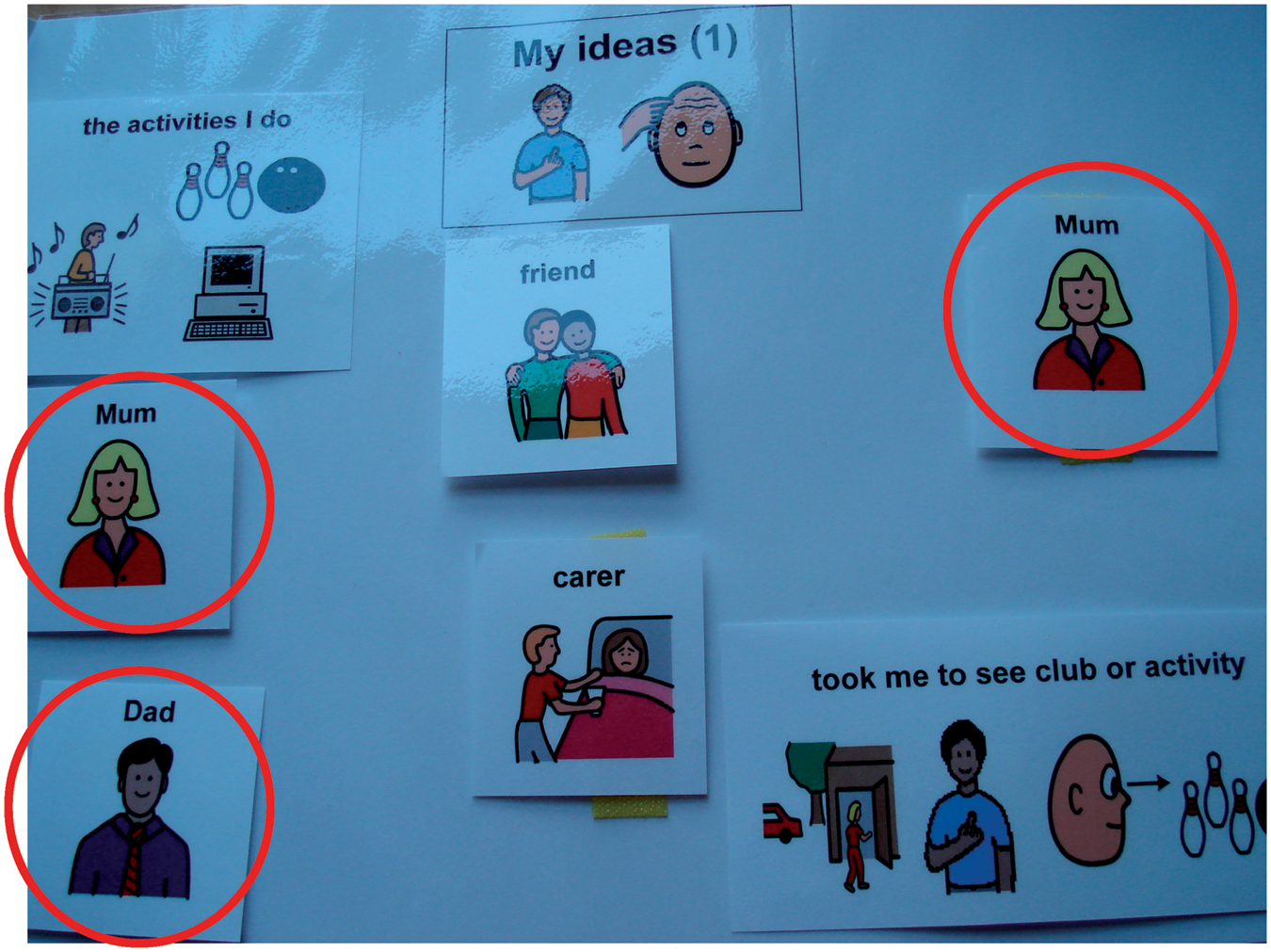
Mothers’ involvement was ascribed to be greater for two reasons by young people without LCIs. They were more likely than fathers to be available to attend meetings or take the young person to visit different choice options. Emotional reasons were also noted, ‘talking to Mum’ was felt to be easier. I feel I can talk to me mum more about what I think, what decision I’m thinking about making. I feel I can talk to me mum a lot easier than anybody else. (YP-10)
However, both groups of young people (with and without LCIs) were generally happy with their parents’ involvement and did not appear to feel threatened or stifled by this. Only one older young person (22 years) had reservations and suggested conflicting ideas indicating that his father did not always listen or listen ‘enough’ to him.
Being listened to
For young people with and without LCIs being listened to by other people, especially parents, was important. Being listened to and included in choice-making processes was a key area explored in the symbols-based interviews (Figures 3 and 4). Nearly half of participants with LCIs felt that ‘people talking to me’ helped – it made choices ‘easier’. How do you know they’re [Mum and carer] listening to you? [young person chooses symbols] you’ve chosen ‘looks at you’, ‘talks to you’ and ‘writes down what you say’… (Researcher talking with YP-23) Talking Mat® Question. YP-23 Personal Symbol Board (symbols circled are the young people's responses to Figure 3's question).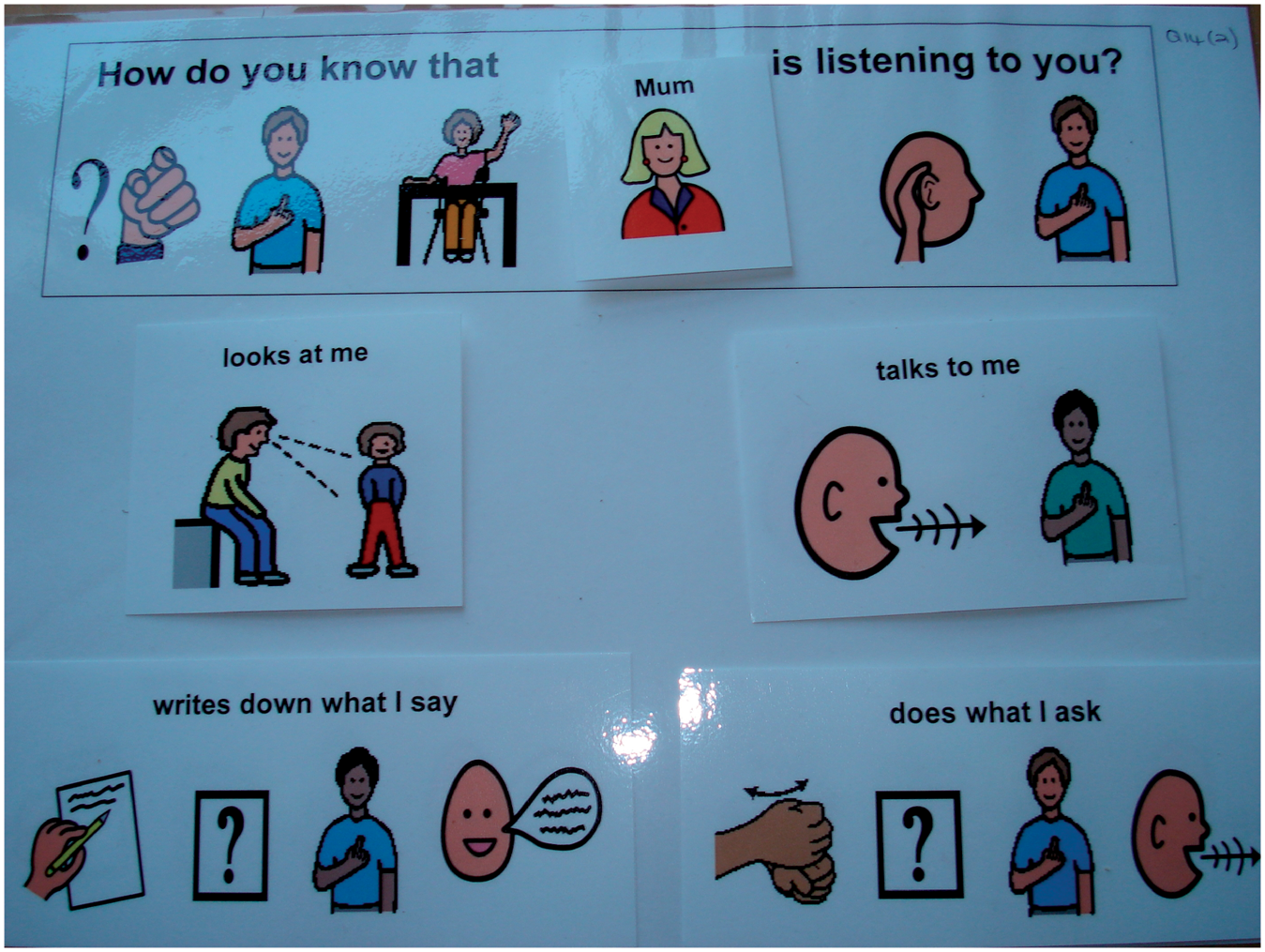
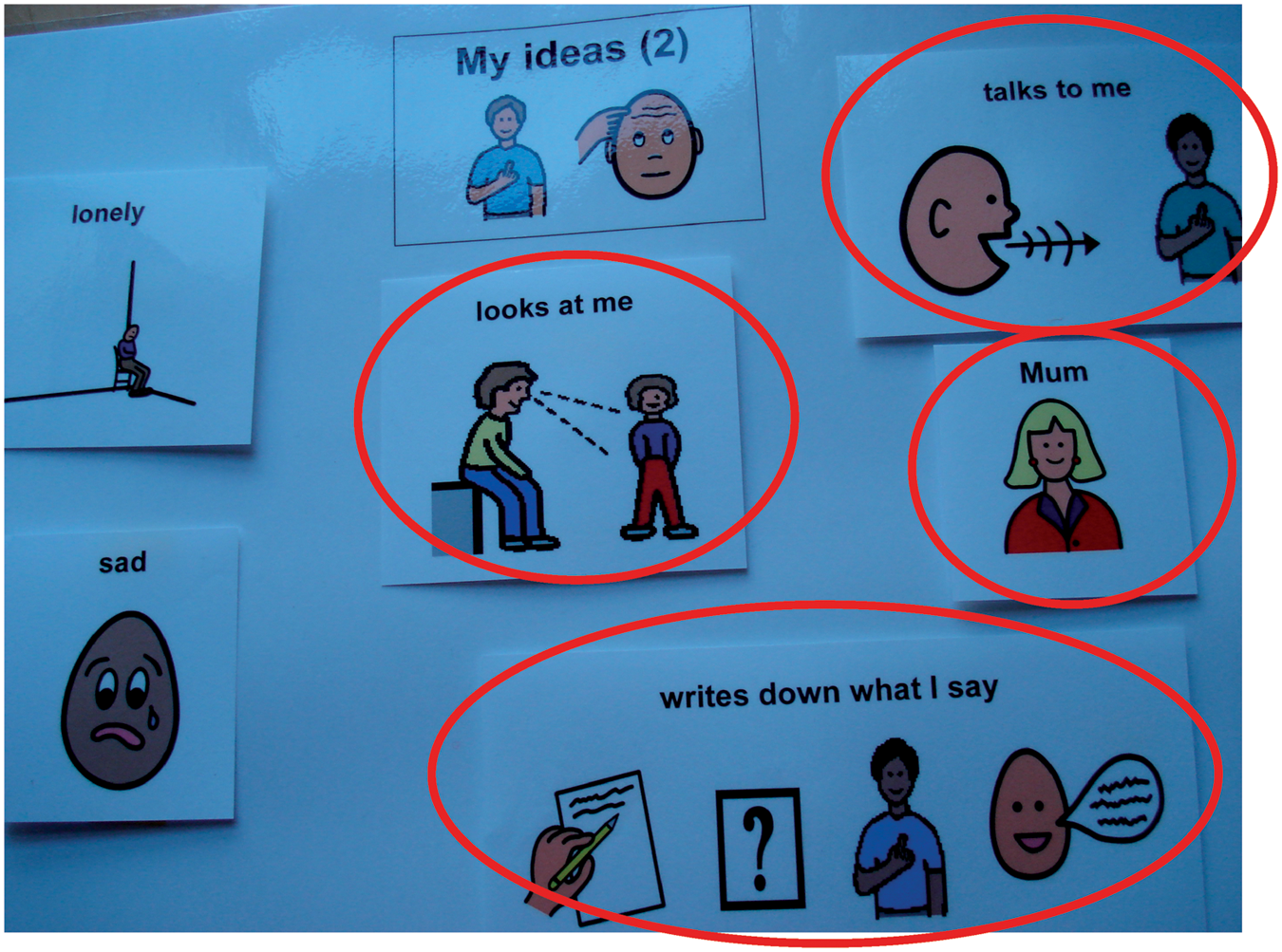
However, being included involved more than talking. Parents helped young people with LCIs make choices by taking them to visit different choice options, such as colleges or leisure clubs/activities. These visits provided concrete, experiential information and appeared to aid understanding of different options. It also provided opportunities for young people to express their feelings. ‘Being listened to’ made all these young people feel ‘happy’ and some also felt ‘proud’, ‘grown-up’ and ‘clever’ (Figures 5 and 6).
Talking Mat® Question. YP-27 Personal Symbol Board (symbols circled are the young person's responses to Figure 5's question).
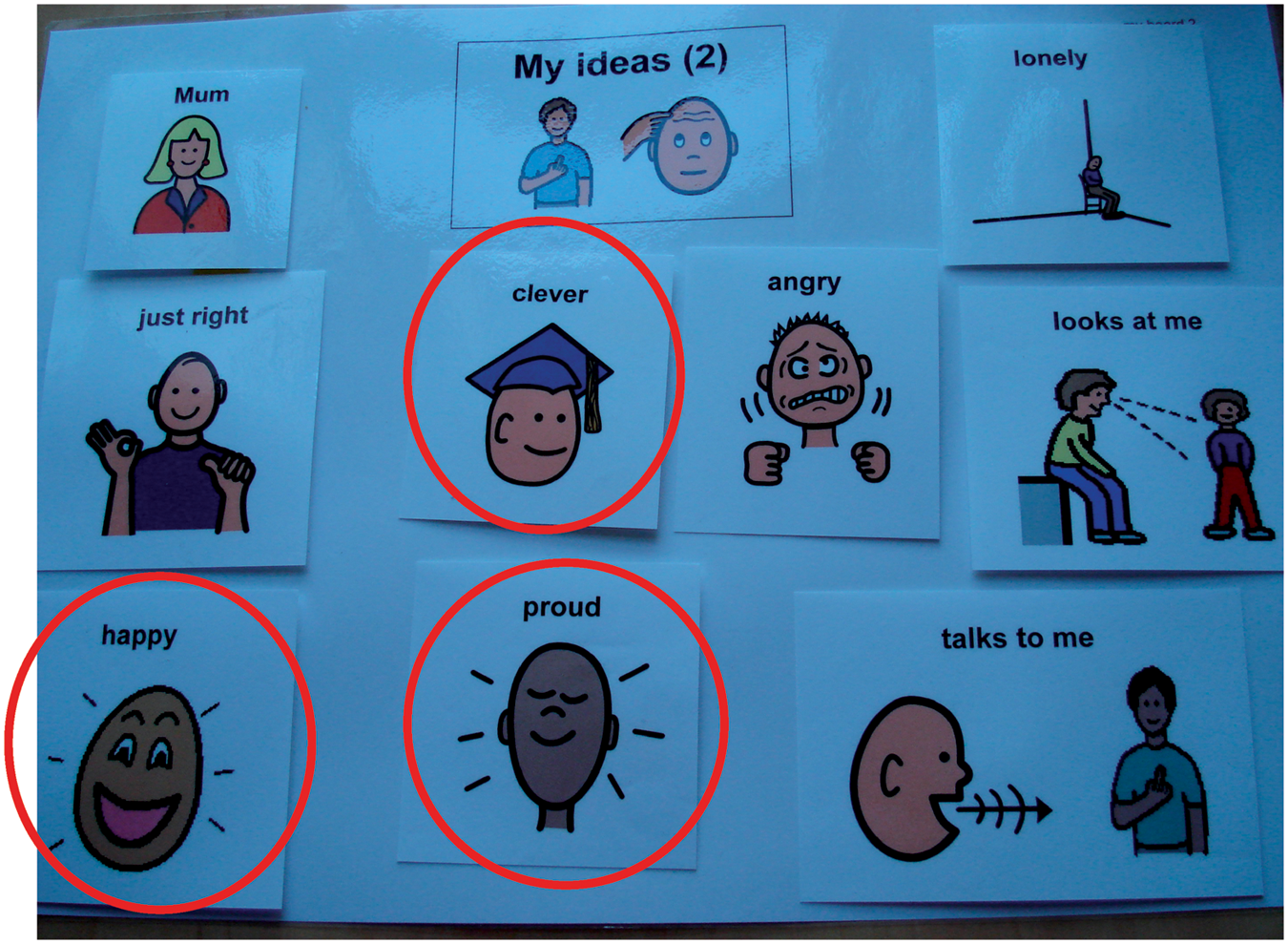
Researcher: How do you feel when people listen to you about the choices you make, doing fun things? Do you feel ‘happy’?
YP-27: ‘Happy’
Researcher: ‘Sad’?
YP: ‘Happy’
Researcher: OK, we’ll put the ‘happy’ one. ‘Surprised’, ‘proud’, ‘grown-up’, ‘safe’, ‘confused’ or ‘clever’?
YP: ‘Clever’
Researcher: You feel ‘clever’ when people listen?
YP: Yeah
Researcher: What other things?
YP: I feel ‘proud’.
Value of shared choice-making
All the young people identified a number of reasons why they wanted and valued shared choice-making with others, especially parents. This was explored in more depth in the interviews with young people without LCIs.
Shared responsibility and emotional support
A key benefit to sharing decisions with parents was emotional support and a sense of sharing responsibility for choice-making, sometimes even passing over this responsibility to other people, especially ‘Mum’. Emotional support was often ongoing: … my Mum's always supported me in anything that I’ve done. So I think my Mum is the person that helps me the most, you know, more emotionally than anything … my Mum's basically the one who said ‘If you don't want to go to university, don't go and if you want to go, then go. (YP-6)
Six young people described times when they had not wanted to assume choice-making responsibility. This was linked to a fear of making the ‘wrong’ decision, especially if the choice was viewed as risky, such as choices involving surgery. ‘Talking over’ choice options gave reassurance and could help relieve some of the choice-making pressures participants said they sometimes experienced. When choice-making was regarded as stressful and/or frightening, passing the choice-making role onto parents (especially ‘Mum’) was viewed as a positive rather than negative or potentially disempowering act: … cos lots of decisions [around university] to be made … more exciting than scary cos I’ve got people [parents] behind me that are willing to help me as well. So it's not that, not that scary as it could be if, say, I was on my own making these decisions, that would, that would be scary … I don't like making decision on my own cos I’m worried about making the wrong ones … I do like to have somebody to, help me make decisions… (YP-15)
Parents’ knowledge and understanding
Parents’ knowledge and understanding also emerged as another preferred benefit to sharing choice-making discussed by the young people. For those concerned about making the ‘wrong’ decision, tapping into parents’ knowledge and understanding was particularly valued. Indeed, over half of the young people without LCIs (especially the younger ones) felt their parents were more knowledgeable than they were themselves, especially in terms of general knowledge of professional practices and/or standard procedures. In addition, these young people believed their parents had a good or sometimes even better understanding of their health condition and its management than they (or even professionals) had. I don't really mind me Mum making me choices for the medical areas, I leave that up to her … because I think my Mum knows what I need medical wise, I don't really know that much about it really. (YP-12)
Trust
An emerging finding from the young people's interviews (both with and without LCIs) was the importance of trust and trusting their parents’ knowledge and ideas. The young people felt that their parents knew what was ‘best for them’ and routinely put their best interests first. They ‘trusted’ their parents’ knowledge and advice and this was valued. I mean I do listen to mum a fair bit, I mean it's my decision in the end but I do listen to mum a lot … cos she's very clever, I don't know it just, well she's my mum and she knows best … yeah, I trust my mum's opinion. (YP-1)
Holistic approach
Amongst the young people without LCIs (irrespective of age) parents’ ability to help them take a more holistic approach to choice-making was valued. In particular, parents encouraging them to consider all factors that needed to be taken into account when making a decision. For example, one young person recognized the value of his mother's practical knowledge and concern about health and care issues when making university choices. She [Mum] would always think of the care and safety side and the medical side, whereas I look at the education and the lifestyle side and between us we’ve come across the best university really. (YP-8)
Parents as intermediaries
For young people without LCIs who felt they lacked confidence or necessary communication skills when discussing different choice options with professionals, parents acting as intermediaries or negotiators was also valued. … it’s just that I get a little confused with me medication and me tablets and tha t … I’m like I can't think what they are and even now I’m getting confused so then she’ll [doctor] ask me Mum and me Mum will say all this, that and the other, whatever it is. (YP-4)
Parents’ changing and evolving role in choice-making
All the young people (with and without LCIs) felt their parents would continue to be involved in making choices with them. This is despite the fact that they were all teenagers (or young adults) approaching or within the transition to adult services and adulthood. Most participants (with and without LCIs) were generally happy at the prospect of continued parental involvement but felt the degree of input would or could change. Indeed, only one young person expressed mixed emotions, including some frustration. However, young people felt their own degree of input would increase as they got older. Despite this, data from interviews with young people without LCIs revealed that the level of involvement anticipated and/or wanted regarding future decisions varied. As before, it depended on the type of choice being made or the young people's own perceptions and expectations of their role. For example, almost all those who discussed surgery choices wanted parents to continue playing an important role. In contrast, in many leisure choices, young people expected reduced or minimal parental input as they grew older.
Half of the young people (with and without LCIs) who discussed future shared choice-making with parents expected that their parents, as they got older, would treat them as more ‘grown-up’, encouraging them to take a more active role. Among the young people without LCIs they also felt that they would become more confident in their own choice-making ability and more ‘knowing’. This was viewed as a cumulative process of gradual confidence building associated with their parents’ general approach to involving them (from an early age) in decision-making. …as I grew older and became a teenager and other teenagers were making their decisions for things in their life, my mum and dad let me choose. (YP-8)
The role of peers with similar conditions
Peers with similar conditions were viewed as an important source of information and were actively invited into the choice-making process at key points by half of the young people (with and without LCIs). As with parents, this was usually at the start of choice-making when information was being collected and/or different options considered (both factual and personal opinions and experiences). Young people often sought advice from peers when they attended leisure activities or short breaks.
Young people without LCIs felt that peers with similar conditions could be a source of ‘inside information’ and/or emotional support. ‘Inside information’ was regarded as ‘lived’ or experiential information from a person who had previously faced a similar choice. This was valued as it was a type of information which the young people felt professionals or parents could not provide. Yeah, I mean they [friends] told me a bit more about it [spinal operation] like how they'd [doctors] do it and stuff … you know, before I actually have the operation when I’m in theatre … at the time I found it really useful speaking to my friends cos they’re like, you know they understand more … (YP-14)
Peers could also act as positive role models for young people (for example, those who had gone to college/university), demonstrating a ‘can do’ approach and success. I talked about college … I found it very useful cos it were him that kind of inspired me to go to a residential college. (YP-010)
At the same time, the opinions or experiences of others with similar conditions were not always unquestioningly followed; personal preferences and individual contexts were recognized. As one young person explained: … they’re [other young people] not you and you’re not them … but it's good to have the information either way. (YP-15)
Discussion
This article has explored how a group of English disabled young people with degenerative conditions, including those with LCIs, involve parents and peers in the decisions they make.
The findings demonstrate that young people, irrespective of whether they have LCIs or not, want to be involved in making choices about their lives but they also want to share choice-making with others, including non-professionals, such as parents and peers. Discussions with the young people (especially those without LCIs) highlighted that they do not always adopt one specific approach to choice-making. There is not a single pattern that can be applied or is wanted by the young people. The involvement of others is rather complex and diverse with parents and peers involved at different phases of the choice-making process and to different degrees.
This reiterates a conclusion from Alderson's (Alderson and Montgomery, 1996) study of young people facing surgery choices where young people similarly wanted a range of shared choice-making with parents. The young people (especially those without LCIs) in this sample also described a range of parental involvement. Some felt they had largely taken control, others described shared choice-making, and a minority even reported handing choice-making over to parents. All these different approaches could be helpful. A greater diversity in the role young people reported parents playing and the degree of control they felt they had assumed in choice-making was described by young people without LCIs. The level of understanding among the young people with LCIs and methodologically, the structured nature of the Talking Mat® interviews made it difficult to explore if this was also the case for young people with LCIs.
Shared choice-making was largely viewed as a positive experience by the young people, irrespective of whether they had LCIs. In line with Alderson's findings (Alderson and Montgomery, 1996), a range of factors such as – age, the type of choice and its perceived seriousness, and personal experience/knowledge, influenced young people's perceptions of, and their preferences regarding, the role of parents and peers. Among the young people able to express themselves most clearly, the involvement of others in choice-making was context bound. It was based on each young person's preferences, their evaluation of the specific choice they faced, and, as has been highlighted by previous research, (Butler et al., 2005; Coyne, 2008; Miller, 2009; Moore and Kirk, 2010), the parent/child relationship. However, despite this personal diversity, the results demonstrate a number of common themes and issues.
Importance of others
This study supports previous research which has shown that parents play an important and ongoing role in young people's choice-making processes (Alderson and Montgomery, 1996; Butler et al., 2005; Miller, 2009; Moore and Kirk, 2010). Amongst those without LCIs, differences in age (moving towards adulthood) and type of choice (especially choices viewed as important) were found, but most participants shared, to varying degrees, decision-making with parents, especially their mother. This was often ‘the norm’ and almost taken-for-granted. A recurring theme amongst a number of the young people (with and without LCIs) was also that peers with similar conditions were used and valued as alternative, sometimes even unique, sources of help, information and emotional support. This confirms Antle et al. (2009) and Beresford and Sloper's (1999) past research on the value of peers as sources of information and emotional support for chronically ill young people.
Knowledge and experience
The knowledge and experience that other people could provide was clearly recognized and valued by the young people, particularly those without LCIs. Recognizing one's own limited knowledge or inexperience was not, as others (Alderson and Montgomery, 1996; Butler et al., 2005 and Miller, 2009) have also noted, necessarily negative. Here, utilizing other people's knowledge was regarded as positive and frequently provided an important heuristic, helping young people make sense of and manage complex choices and diverse options. Different types of knowledge (medical knowledge, parents’ knowledge of young people's needs and ‘best interests’, and peers’ experiential knowledge) were valued. This study also demonstrates that these diverse types of knowledge played varying roles in different choices at different points of the choice-making process. This was underpinned by the importance young people placed on ‘trust’, especially, trusting (as noted by Alderson and Montgomery, 1996; Butler et al., 2005) both the person and the knowledge they gave. For information and provider input to be accepted, the young people needed to view it as legitimate: that is, relevant, helpful and trust-worthy.
Role of parents in the future
The future role of others in choice-making is important, as many of these young people were moving towards adulthood. Some of the choices discussed (such as going to college/university) were clearly part of this transition. The findings suggest that young people (with and without LCIs) want to continue making choices with other people, especially parents, but the majority (especially those without LCIs) also anticipated that their own level of input in the choice-making process would increase as they got older. This was frequently based on older young people (without LCIs) contrasting their parents’ current level of involvement with what had happened when they were younger when parents were felt to have been more actively involved. These changes in role were often perceived as a dual process involving parents’ recognizing and respecting their son/daughter's developing maturity, and the young people themselves becoming more confident and feeling more competent in their choice-making ability (see also Miller, 2009). However, choice-making, especially for young people without LCIs, was viewed as a cumulative learning process with no set ‘age limits’ as to when full responsibility for making choices should or would be assumed. Despite this general aspiration towards more control and assuming an increasingly lead role in choice-making, it is important to note that the nature of the choice also affects whether or not young people feel they want to make a decision by themselves. As noted above, young people welcomed parental involvement in choices regarded as important.
The importance of young people being in control in terms of ‘who’ and ‘how’ others were involved in choice-making has been highlighted by Brannen et al. (1994) in their study of young people (predominately non-disabled) making a range of health related choices. Here, involving others was viewed as acceptable by young people if they could choose ‘when’ and ‘how much’ they wanted others to help. Similarly in this study, making choices with others, especially their mother was not necessarily associated with a sense of losing control. For the young people in this study, especially those without LCIs, being ‘in-control’, as Miller (2009) has also noted, does not always mean making choices alone.
Some implications for practice
The findings from this study have practice implications. Practitioners should recognize the role of others in choice-making and work in a holistic and sensitive manner to support this. Practitioners need to work with the young person, listening to their wishes, and also work holistically with each family, respecting parent/child relationships (and their changing nature) and being responsive to each member’s needs. It is recognized that this is extremely complex, especially for young people with LCIs where their competence may be questioned by adult society (see Alderson, 2007).
This is further complicated during the teenage years, especially for disabled young people, as practitioners seek to balance young people's right to autonomy and making choices with their right to protection. There is also practitioners’ own ‘duty of care’ (Alderson, 2007). These considerations mean that when and how much to involve parents is open to interpretation. However, results here have demonstrated that when making choices, many disabled young people with degenerative conditions, irrespective of whether they have LCIs, want and expect their parents continued involvement. It is important that professionals recognize and respect this. This is particularly pertinent to practitioners working in adult services where parental involvement may not always be perceived as helpful to young people.
These findings also suggest that practitioner awareness becomes particularly important when working with some families, for example, families where parents do not feel able or are not willing to support their son/daughter during their choice-making. In these situations, practitioners, such as social workers need to consider who and/or how will the important role that parents play in young people with life-limiting conditions choice-making be supported?
Finally, practitioners need to recognize the role peers can play in disabled young people's decision-making, especially as a source of information. Facilitating opportunities for disabled young people with degenerative conditions to learn and hear from peers with similar conditions’ about their choice-making experiences is important. For many young people in this study, short-breaks and leisure activities provided time and space to do this. Practitioners can play a key role helping young people access these services.
Study scope and considerations
This was an exploratory study of a small group of disabled young people with degenerative conditions (13 to 21 years at initial recruitment) some of whom have pronounced LCIs. It must be acknowledged that the sample was also self-selecting. It may be that young people choosing to participate in this research have different choice-making experiences to other disabled young people. This may have influenced this sample of young people's attitudes to the role they wanted their parents and peers to take in choice-making and the role this sample of young people felt they had taken. Furthermore, it must be acknowledged that these are young people's subjective rationalizations of events, in some cases, retrospective recollections. As past literature (Kirchler et al., 2001) has shown, reporting what actually happened and what is presented to others can differ, especially over time.
Data were collected via face-to-face interviews. For those with LCIs, using more ethnographic methods and spending more time with participants may have generated richer data (Nind, 2008), but this was not feasible due to time and resource limitations. Variations in the depth of data obtained (between those with and without LCIs) must also be recognized. In addition, the possible impact of the presence of parents/carers at the interviews of young people with LCIs should be borne in mind. As noted earlier, this was on balance felt to facilitate communication between the researcher and the young people, and was also wanted by the young people. However, findings and conclusions drawn should be read in light of parents/carers’ presence and the danger of guiding young people's responses. Despite this, the data from those with LCIs clearly express their ideas and presents the experiences of a previously ignored group. Although data reported focuses on some very individual choices, the choices discussed here raise issues which have important wider consequences and practice implications, especially whole family working during the transition years.
Furthermore, the study highlights the importance of parents and peers experience and expertise. Future research could explore this further, especially, the different kinds of expertise parents and peers can bring to shared choice-making with disabled young people.
Footnotes
Acknowledgements
The author would like to thank the young people and their families who participated in the study and also the practitioners who assisted the researcher. The author would also like to thank all members of the Choice and Change project team: Hilary Arksey, Kate Baxter, Bryony Beresford, Janet Heaton, Caroline Glendinning, Parvaneh Rabiee and Patricia Sloper. Special thanks to Bryony Beresford for all her helpful comments and suggestions whilst reading drafts of the article. The Choice and Change research project is funded by the English Department of Health Policy Research Programme. The views expressed here are those of the authors and not necessarily those of the funder.