




Abstract
We set out to assess the processes by which a personal empowerment-oriented intervention based on learning spaces and the Rahyab problem-solving model can help newly married women in Iran to gain more control over their life situations. Learning to use the problem-solving model independently was an important component of this seven months’ educational program. A descriptive field study design based on qualitative methods was employed for data collection and analysis. The analysis of these processes showed how, through group and individual interventions, these women could influence their intimate relationships by altering their thoughts, their management of emotions, and their overt behavior. We invite more research on how empowerment-oriented interventions can be used to support newly married women as a part of family educational programs.
Introduction
A recent survey (Darling and Turkki, 2009) examining family concerns in 50 countries concluded that because of globalization, today’s families live in a world that is complex, interconnected, and continuously evolving because of rapid transformations in the economy, environment, technology and migration. Changes in families and family functioning within dynamic environmental conditions necessitate the lifelong acquisition of new knowledge, skills, and abilities to minimize risks and maximize opportunities for healthy life choices. These needs can be met through continual learning with a clear purpose and connection to the real world. The researchers suggest that a critical challenge for family life educators is to create programs that enhance individual, family, and social well-being.
Iranian families confront a number of corresponding challenges (Moghadam et al., 2009). There is a decrease in marriage rates and an increase in divorce rates, paralleling a growing general population (Bankipour Fard et al., 2011). Statistics in Iran display a 23 percent increase in marriage rates, but an 86 percent increase in divorce rates between 2005 and 2011. The highest divorce rates were associated with young couples; women between 20–29 years and men 25–34 years of age. In addition, the divorce statistics show that most of the couples who get divorced were in the early years of their marriage; in fact on average divorces happened less than five years from the date of the wedding (Iranian National Organization for Civil Registration, 2011). According to Khojastehmehr and Takrimi (2009) there is a consensus about the factors that lead to divorce. Earlier, social and economic factors like unemployment, alcohol, and drug abuse amid men were regarded as the main influence on divorce among Iranian women. However, today, the main reasons behind divorce are ‘a more general dissatisfaction with neglect of emotional and affective needs, husband’s lack of communication skills and personal and family incompatibilities’ (p. 3762).
The rise in divorce among Iranian women could be a sign of women’s emancipation. At the same time, divorce is considered a social problem because of the practical consequences for divorced women and children in a still traditionally organized patriarchal society. Because of women’s lack of employment opportunities and a lack of support for women in Iran, divorce can lead to psychosocial and economic problems for both women and children that are not as prevalent in the West. The rate of remarriage is much lower among women than men. Further, cultural factors create lower chances of remarriage for divorced women in Iran; most Iranian men prefer not to marry a divorced woman. The best alternatives for an Iranian divorced woman, in an effort to escape poverty, could be to seek out widowed men (older than her, with children from a previous marriage) or to marry a man who already has a wife. That is, to become the (legal parallel) second wife of a man. These preconditions make remarriage for divorced women so difficult that they may prefer to remain unmarried, but then they are faced with economic insecurity and weak social supports. On the other hand, divorced women often face the problem of social control on the part of their father and brothers. Due to financial problems and family prejudice, they develop difficulties in living alone and often find themselves dependent on a male (Aghajanian, 1986; Aghajanian and Moghadas, 1998). Considering these structural realities, Iranian women have a very difficult decision to make in regards to divorce and in trying to find the best avenue within systems of patriarchal control. Thus, the decisions they face require the careful consideration of consequences, as well as the support necessary for making educated choices in their lives.
According to Behzisti (2008), the largest social welfare organization in Iran, abundant changes in society have led to the occurrence of family problems for which prevention is the most preferable intervention. The Behzisti program is based on three premises: (a) people need support in meeting social problems, (b) education can prevent social problems, and (c) people can always learn irrespective of their age. Behzisti considers premarital education programs and several different family arrangements in their mission statement, including recently married couples. Their program addresses a range of issues, from communication and solution-focused skills to sexual behaviors and roles.
Bodenmann and Shantinath (2004) report that family education programs traditionally address couples and seek to help them enhance their communication and problem-solving skills with the aim of improving the quality of their relationships. However, Long et al. (2006) take on a more individualistic view and propose that marriage education programs should assist both partners in (a) understanding their emotions more clearly, (b) recognizing the behaviors that should change, (c) providing specific skills training, and (d) helping individuals implement these skills on a regular basis. Our program builds on this foundation, but places primary focus on empowering women and helping them to make independent choices in their marital relationship and their daily lives. In Iran, women and children are considered vulnerable groups, and thus, empowerment-oriented social work is especially important. We see empowerment as a process of gaining control over one’s life by learning the necessary knowledge and skills required to improve their life-situations (Payne, 1997; Saleebey, 2006).
According to Thompson and Thompson (2001: 65) ‘the social worker is called upon to use his or her skill to help people empower themselves, both individually and collectively’. They add that conceptualizing power takes place at three levels; the personal, cultural and structural. In this article we focus on empowerment at the personal level. However, in line with Thompson and Thompson (2001: 69), we indicate that personal empowerment is a ‘prerequisite’ for other forms of empowerment – further developments are unlikely if individuals do not recognize and, take advantage of, those aspects of their life over which they have direct control. At the same time, it is important to note that personal empowerment can be a shared experience and does not have to be restricted to isolated individuals.
On the basis of the second author’s research (2010) on educating Iranian families in Sweden and the first author’s social work experience with families, especially women in Iran, we organized a series of intervention projects focusing on women in pressing life situations. These address single mothers, newly married women, and female adolescents respectively. The aim of this study is to explore the process of personal empowerment among newly married Iranian women through an intervention that is based on group and individual learning spaces and the implementation of a structured problem-solving model. Our starting assumption was that on the basis of sociocultural traditions and restraints, the presence of men in the intervention setting would affect how freely Iranian women could express their ideas. We focused on creating a more explicit consciousness about the participants’ self and social relationships. We also taught the problem-solving model so that women could use it independently and make more effective decisions over a long-term basis. The project was neither in favor of nor opposed to divorce. Using the Rahyab model, individual and group sessions were intended to foster awareness about different issues and surrounding social conditions, so that they could create a balance between self and others, and make more informed decisions across various situations.
Method
A descriptive field study design (Heppner et al., 2008) based on qualitative methods was employed for the data collection and analysis. We performed a content analysis on the data that was collected from participants during and after the intervention. The intervention was performed by the first author and the participating women, and the data for the evaluation of each session was provided by the participating women.
Participants
Sociodemographic characteristics of the participants.

The intervention
The Rahyab model.
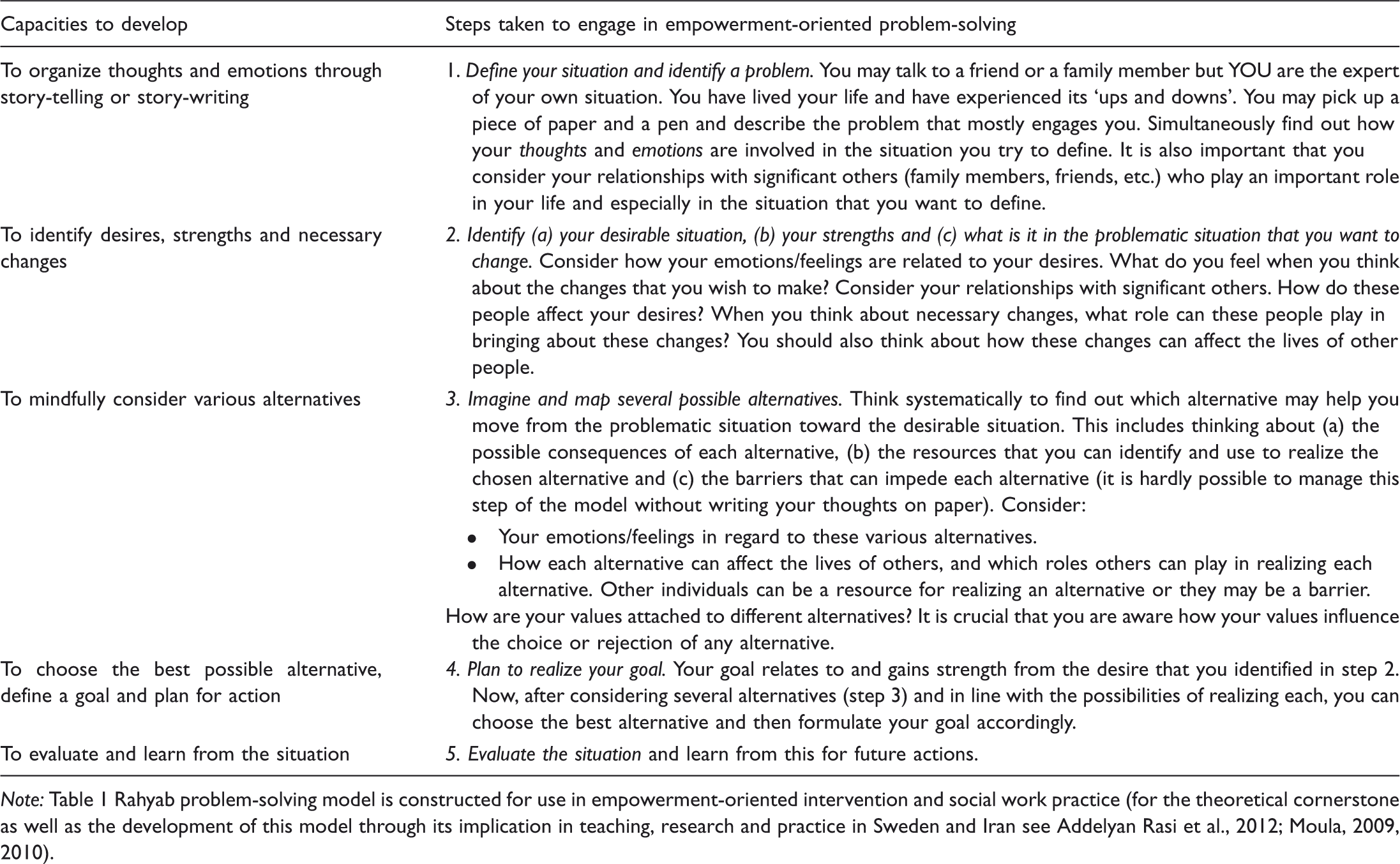
Note: Table 1 Rahyab problem-solving model is constructed for use in empowerment-oriented intervention and social work practice (for the theoretical cornerstone as well as the development of this model through its implication in teaching, research and practice in Sweden and Iran see Addelyan Rasi et al., 2012; Moula, 2009, 2010).
A person-in-environment formula (Addelyan Rasi et al., 2012; Moula, 2009) outlines the socio-cognitive approach to goal-directed behavior, and helps visualize the conceptual basis of Rahyab (see Figure 1, below). A central tenet of this formula is that cognitive and emotional factors in the individual interact with environmental factors to determine the probability of achieving life goals. Correspondingly, habits invoke a dichotomy between conscious, voluntary control over behavior, reflected in the higher-order deliberative behavioral control, and lower-order behavioral control that is scarcely available to the consciousness (Graybiel, 2008). This means that increasing cognitive control whilst consciously exploring one’s emotions and habits helps to better mediate and control their influence, increasing the ability to deal with environmental resources and obstacles, and more effectively achieve life goals.
Moula’s socio-cognitive formula of person-in-environment.
The intervention procedure included group and individual sessions. Group sessions were aimed at teaching reflective thinking to clients and developing their capacities to express their thoughts and feelings. These sessions were offered once a week and participants used Rahyab to solve fictive problems and scenarios that were suggested by the participants themselves. A form was distributed at the beginning of each group session, and participants had 15–20 minutes to write down what they thought about that scenario. For example, one question asked ‘What would you do if you found out that your husband had a secret relationship with another woman?’ Later, participants presented their ideas, and a discussion took place. This was designed to help each participant think individually and discuss her own ideas with others. At the end of each session, each participant wrote down and discussed ‘what I have learned from this session’.
Individual sessions were devoted to discussing the participants’ private lives and problems. Rahyab was used to meet the difficulty that the participant herself chose to discuss. Empowering dialogues between the social worker (first author) and the participant were focused on the systematic application of Rahyab’s steps. Each step was meant to develop a particular capacity. Through such meetings, a participant learned to organize her feelings and thoughts through storytelling, discussing desirable changes (steps 1 and 2). Later, the dialogue between the two experts – the social worker is the expert of using and teaching Rahyab and the participant is the expert of her own life – continued with the aim of finding possible alternatives for action (step 3). In this step, the social worker could provide suggestions, but the participant chose what she considered to be the best option. After that, the dialogue continued, as the participant was encouraged to develop plans for action on the basis of what was chosen. Sometimes one session was enough to ‘go from step 1 to 4’ and sometimes it concluded at step 1 or 2. Like the group sessions, the participant finished by writing down and talking about ‘what I have learned from this session’. Participants were encouraged to continue to think and write through their problems according to the steps of the model at home, which would inform the subsequent session.
Data collection
The intervention project started in July 2008 and ended in February 2009. In line with Rahyab, two forms were designed for collecting data in the sessions. Participants used these forms to report their thoughts, emotions, relationships, desires and goals. In total, 19 group sessions were arranged. The first author put in approximately 10 hours a week over a period of seven months, totaling 300 hours of intervention. The women’s evaluations and other texts produced during the intervention were collected and used for analysis. Through a semi-structured questionnaire, additional qualitative data were collected at the end of the project. Here, all women were asked to evaluate their achievements and state what they had learned.
Data analysis
Patton (2002) argues that content analysis is a suitable method for the examination and categorization of data when the primary material is available as text rather than observation-based field notes. In this study, the data consists of participants’ texts. Because meaning is interpreted from the content of textual data attained from real-world settings, our content analysis adhered to a naturalistic paradigm, but focuses primarily on language through a contextual interpretation of the text. Our content analysis described what happened during the project, including (a) what personal, social and sexual relationships the women had chosen to address in the project and (b) what changes might positively influence these relationships.
We used an inductive procedure, such that our categories emerged from analyzing the data. We focused on learning from the participants’ comments and texts more than we relied on pre-existing theory. The two researchers well versed in Persian initiated the process by reading through the entire set of data in their native language, uncovering and discussing preliminary themes. This was done to identify ideas grounded in the language of the participants. We then used open coding to break down, investigate, compare, conceptualize and categorize the data. The same two researchers coded the texts separately, and then integrated their results. This process continued until both researchers were satisfied, concluding that the coding scheme covered the entire data set.
We strived for validity throughout our research project by relying on prolonged engagement, persistent observation, and triangulation. Prolonged engagement was accomplished by spending enough time in the field gathering data, and striving to acquire a sufficient understanding of the participants’ experiences during the seven months in individual and group sessions. Persistent observations were performed throughout the group sessions (once each week) and the individual sessions. Following Patton (2002), we achieved triangulation by several complementary means. First, the triangulation of data sources; by comparing and cross-checking the consistency of information derived at different times and by different means. In this study, we used dialogues gathered in individual sessions, discussion in group sessions, participants’ texts, and the researcher’s memos and logs. Second, we achieved triangulation by comparing multiple researcher analyses. Two coders coded the texts separately before integrating their results. The analysis was improved by two other researchers who collaborated to help conceptualize the research data.
Results
We present the primary learning processes and secondary action-oriented processes that helped women to discuss their problems, explore possible solutions, and make decisions that brought about positive change in their lives. Reflective thinking was a theme that ran through each of the women’s experiences, enabling clear analysis and focused decision-making, which was essential to a sense of empowerment for the women.
Primary learning processes
We identify three primary learning processes by which the women internalized knowledge and skills in the intervention: (1) acquiring knowledge about newly married women’s common problems and problem-solving strategies; (2) the self-management of emotions; and (3) the reflection of one’s life processes over time and through changing contexts.
Knowledge about newly married women’s problems and problem-solving strategies
The group sessions created an opportunity to reflect on and learn from each others’ experiences. These reflections led to new insights and established self-efficacy as a predisposition for taking action. Vida and Shirin explained that the group sessions were useful for comparing different opinions about similar challenges. Shirin added that even if she does not have similar problems right now, she can learn from that and use those lessons in the future. Leyla said that in the beginning ‘I was confused and I thought of my problem as a big disappointing challenge but when the group sessions started I realized that others had problems like me’. Negar emphasized that group sessions were useful because she realized that she was not the only newly married woman who had a problem; she shared many problems with the other women. Tara reflected on the issue of pluralistic understanding of one and the same issue and meant that it was interesting for her to realize that there could be several meanings for one single phenomenon.
Reflections on the self-management of emotions
The individual sessions provided the women a means to reflect over the self-management of their emotional life. Sadaf stated that she is a ‘sensitive and negative person’ and makes decisions on the basis of her ‘emotions and not logic and wisdom’. She also indicated that she expects others to accept what she says and becomes angry if someone challenges her ideas. We wondered how much of these thoughts were internalized from what others had told her, and recognized that empowering her to make clear logical decisions for herself might help practically but also restore her self-esteem. During the project, Sadaf decided that she needed to gain more influence over her thoughts and behavior to effectively decide when she has to stand by her own ideas, and when it is better to compromise.
Tara indicated that her main problem was that she is scared of the dark and being alone at home. Tara suffered from this situation and decided to work on it through Rahyab. Following the first step of the model, she tried to define her situation and problem, and noticed that this related to her feelings of insecurity. She said as a child she had been afraid of her mother. Her mother used to beat her and her sisters and brothers when they were children. She also ‘jailed’ them for one or two hours in a dark place. Finally, she said that she has realized that the reason for her fear of the dark and being alone is a feeling of lack of security which has its roots in her relationship with her mother. Tara also indicated her desire for independence: ‘I want to be able to sleep alone at nights’. She decided to think about trying to sleep alone. In the next individual session, Tara cheerfully stated that she could sleep at home alone five times and she is not afraid of darkness and being alone anymore.
Another participant, Shirin, had problems with her step-father, and they did not talk to each other. She wrote that: I feel that he has taken my mother from me … I wish that he could treat me like he treats my sister and brother, and now … I don’t feel happy to be at gathering occasions with others but when I have to be present in such occasions, I don’t speak to anyone and for instance I watch TV and I think that my self-confidence is low and I have problem in presenting my feelings to others … I hate men especially if they are fathers and respect their daughters. I couldn’t tolerate such scenes [a lovely scene between a father and his daughter] and I weep.
She classified her problems into three parts; (a) low self-confidence; (b) lack of constructive communication with others; and (c) her problem with her step-father. Later, she used Rahyab to meet each problem. Shirin concluded that: Through this project I could better understand myself and problems and learn how to meet realities in my situations … I decided to communicate with my father … I learned to love others and accept them as they are and if there is a problem I as well as others could have a role in the creation of the problem. Now, my opinion and behavior has changed and I am more social than in the past. I express my feelings better with my close relatives.
Reflections on life processes over time and in context
Writing down narratives from their lives provided the women a means to reflect on their life decisions from a bird’s eye perspective and an elongated time frame. For instance, Negar explained that ‘writing down problems is hard but it helps to decrease stress and [through writing] we can manage problems easier. Consequently, we don’t see them as big problems [any longer]’. Negar added that writing teaches us to have an open mind and find better solutions. Another woman, Tara, says that she has learned that writing down her problems really helps her to identify the main problem, find different alternatives, and choose the best possible solution. Shirin wrote ‘when we write down different alternatives our mind has to think which option is better’. Leyla wrote that she learned that if she uses the model it helps her to better know her problems, and find a proper solution. She also realized that if she does not think clearly, and lets issues go through her mind quickly, then she cannot find a proper solution. However, Leyla expresses her difficulty in using a paper and pen which means that the new program takes time and demands patience.
Secondary action-oriented processes
In this section we present the secondary, action-oriented processes that the women used to resolve their relationship problems in practice. By participating in the primary learning processes, these secondary processes could be utilized effectively in the various problem-based contexts of their lives. These secondary action-oriented processes include (1) establishing a dialogue for change, and (2) using sex-related knowledge as a basis for reclaiming sexual integrity.
Establishment of dialogue for change
It is important to note that none of the women in the study reported being abused by her husband. These women expected that their participation would enable them to strengthen their self-efficacy as well as improve their relationships on the basis of dialogue and mutual understanding. For example, Negar realized that loving her husband does not mean that she must forget her own rights. In changing relationships, both partners’ wishes, strengths and weaknesses should be considered. She specified that ‘In our common lives, each has 50 percent responsibility, but because I am not calm and become angry, I cannot talk to my husband in a proper way’. A common theme emerging in the research is that despite extremely challenging social environments, the women prefer to cultivate a sense of personal responsibility, and empower themselves with a belief that individual change can bring about positive results in their lives and relationships. However, Negar does not recommend self-sacrifice. For example, she indicates that: I decided to talk to my husband and tell him that I have put away much of what I wanted to do just because I love him and so I expect to get much happiness in our common lives … I, more and more, came to the conclusion that my husband and I are free and independent human beings that share a common life and can trust each other.
Another woman, Sara, reflected on her husband and his family. For example, she indicated that she needed to learn some skills and understand which barriers impede against a good relationship with her husband. Sara added that: I learned that I should talk to my husband and we should not let our close relatives intervene too much in our life … I learned three different ways of having a proper relationship with my husband’s family: (a) have patience and not take things so hard, (b) have more self-esteem, and (c) ask my husband to help me in this matter.
We should point out that women seem to feel the onus of responsibility for fixing their relationships. One might question whether this is the result of logical calculation, or rather the transmission and burden of cultural expectations. Is this guilt overblown given their unfair social environment, or a fair-minded analysis of the situation enabled by the model? Women are encouraged to be the decision-makers and experts of their own lives. Rahyab does not allow us to preach, judge or give guidance for or against any set of cultural norms or traditions. Rather, we provide the tools for careful rational analysis of the situation for the purpose of problem-solving, and allow women to be the directors of their chosen actions. Therefore, following Rahyab’s steps, a chosen act – based on an individual’s own desires and goals – can be in line or against a cultural expectation. For example, in Iranian society divorce may still be condemned in many situations, but a woman can use Rahyab and come to the conclusion that she wants a divorce.
Sadaf had a problem with her mother-in-law, since they did not have good open communication. When her mother-in-law said something that Sadaf did not like, she was quiet but showed that she was sad and did not like to be with her mother-in-law. During the project she judged that her behavior was not ‘proper’, so she changed it. Now she has more open communication with her mother-in-law and ‘by polite open communication, expressing what I do not like and she could understand and leave me alone’. Most participants indicated that learning to communicate dialogically improves their relationships with their husbands.
Acquisition of sex-related knowledge to support sexual integrity
One of the issues that women discussed during the group sessions was how to influence sexual relations with their husbands. For example, Tara indicated that she realized her own problems, and found some ways to influence her sexual relationship with her husband. Another participant, Zohreh, also mentioned that she had problems in this regard, and during the project, she realized what the roots of the problem were. She recognized that the satisfaction of her sexual needs was downplayed in comparison to her husband’s needs and decided to contact an expert in order to influence this part of her relationship. She also realized that she should talk more openly with her husband. Another issue for some of these recently married women was how to stop close relatives’ curiosity about their sexual relationships with their husbands. For example, Elahe expressed that her sexual relationship with her husband is a private matter, and that their relatives should not get involved. Elahe continued to state that ‘medical and physiological information’ helped her to influence her sexual relationship with her husband. These women realized that they can learn how to influence this part of their relationship by acquiring knowledge about the functions of the human body. For example, Sara emphasized that sexual education is important and newly married couples should learn some ‘sexual skills’. Another participant, Shirin expressed that she learned to openly talk to her husband about her wishes in her sexual relationship.
Discussion
The results show primary learning processes and secondary action-based processes that newly married Iranian women adopted. These were enabled by participating in a personal empowerment intervention to help influence their intimate relationships (see Figure 2). The primary learning processes correspond to those reported from previous similar intervention studies. For example, with reference to the Early Mothering Project, Barret (2006: 228–235) emphasizes the importance of ‘the therapeutic potential’ of women’s ordinary talk. Partially echoing these experiences, we find that individual sessions are necessary for issues that are more sensitive and private, which cannot be discussed in group sessions. We also found that encouraging participants to pick up a paper and pen and ‘rewrite’ their life-stories in their own words helped organize their thoughts. Social constructionist therapists Epston et al. (1992: 108) call this ‘re-authoring therapy’ and explain that: A re-authoring therapy intends to assist persons to solve problems by: (1) enabling them to separate their lives and relationships from knowledges/stories that are impoverishing; (2) assisting them to challenge practices of self and relationships that are subjugating; and (3) encouraging persons to re-author their lives according to alternative knowledges/stories and practices of self and relationships that have preferred outcomes.
Summary of aim, intervention structure, processes and outcomes.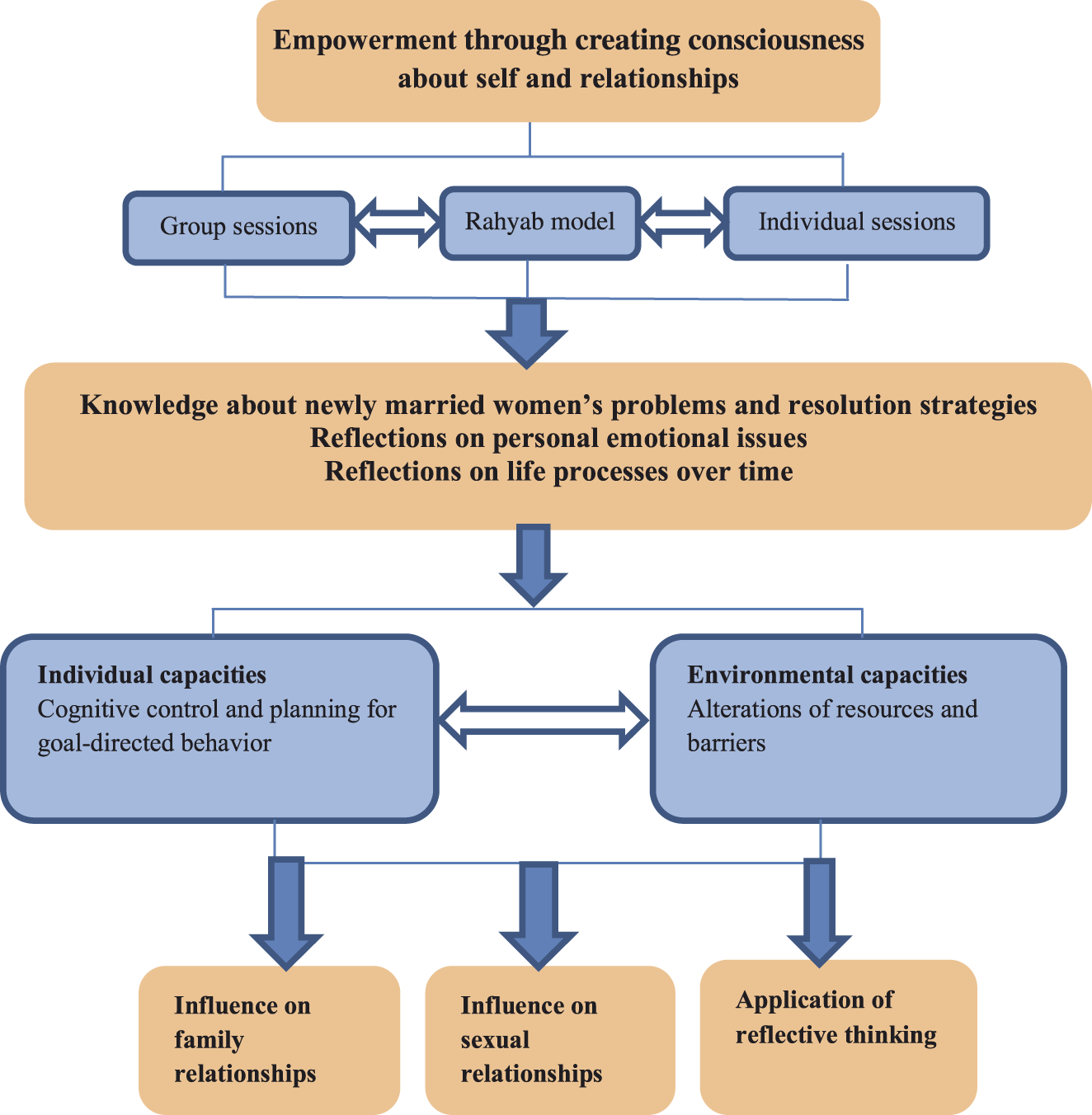
Psychologist Cozolino (2002) emphasizes the cognitive and organizing power of storytelling. He argues that storytelling weaves together feelings, thoughts and actions in ways that organize both one’s internal and external worlds. Our data show how writing down life stories helped organize the clients’ thoughts during the intervention. For example, one of the women learned that one can have several problems at once, and hence, it is good to classify them. Carefully classifying problems helps clients to find a good solution by meeting each specific problem in the best possible way. Or, as one of the women indicated, writing down problems helps identify different alternatives to choose the best option.
Due to the design of the intervention, which included both individual and group sessions over a period of seven months, we had to work with a relatively small convenience sample. This makes it difficult to generalize the results beyond this group of women. However, a methodological strength is our study’s validity. Prolonged engagement with the clients and persistent observation within the intervention process greatly enhances the credibility of our findings. This was accomplished by dedicating enough time to gathering data, coming to understand the participants’ experiences, as well as incorporating different forms of triangulation (both empirical and analytical) to help ensure that our results were trustworthy and authentic.
The fact that we only worked with women may be considered a limitation from the point of view of couples and family therapy. This restriction might be surpassed in future interventions, by extending the sessions to couples and two social workers (a male and a female). Further, three types of group sessions might be utilized: (1) a series of male-only sessions, (2) a series of female-only sessions, and (3) joint sessions with all participants and both social workers. In the intervention reported for this study, we focused more on empowering women, as individuals, to expand their capacities, skills and resources to gain control over their lives. This was done at the expense of using a fully holistic and integrative approach of family therapy. While supporting the proposal of Long et al. (2006) to assist both partners in marriage education programs, we placed primary focus on empowering women and helping them to make informed but independent choices in relation to their marital relationships and their everyday lives. This is because in Iran, women and children are considered particularly vulnerable groups who are especially in need of safe learning spaces to enable the freedom of expression, communication, and empowerment that comes out of this. Empowerment-oriented social work with these two groups is especially important, and a mutually supportive, non-coercive environment is essential for this type of empowerment based approach to work effectively.
This intervention design is well in line with the general goals of marriage education programs suggested in Long et al. (2006). That is, partners should strive to individually understand their emotions more clearly, recognize behaviors they must change, and learn and train specific skills on a regular basis. The intervention in this study included three parts: (1) individual sessions, (2) group sessions, and (3) learning and applying an empowerment-oriented problem-solving model. First, it should be noted that none of these three practices are especially Iranian. Individual sessions with clients are common practice in social work. Group sessions for clients who share the same challenge are also common. Further, Rahyab, which was first constructed and used in Sweden, has much in common with many other problem-solving models in social work and other helping services. However, creating learning spaces with group and individual sessions, and using these to teach an empowerment-oriented problem-solving model for independent use is a novel approach. Furthermore, when dealing with populations who are especially vulnerable, particularly Iranian women who face cultural and economic pressure, these empowerment-focused methods are crucial to bring about positive change.
Scrutinizing this intervention in Iran raises some important questions about what in social work is local and what is universal. Definitive answers can only come from further research and practice. However, our findings support interventions that focus on cultivating learning spaces that enable empowerment, and trying to expand clients’ long-term and independent problem-solving capacities. ‘Quick fix’ policies and practices can lead clients to become too dependent on continuous support from social workers. At times, it was difficult to determine whether the women’s ultimate decisions through Rahyab were the ‘right ones,’ and how much their interpretations and willingness to take responsibility were the result of normative pressures from their social and cultural environment. However, it is not our role to dictate how women should lead their lives. Rather, the focus is on empowering women and equipping them with the skills necessary to clarify and analyze their problems and formulate their own decisions and actions.
This study provides some insight into the processes that mediate empowerment, and we invite others to pursue similar types of research to further investigate the potential of this form of intervention. Empowerment is clearly an important goal of social work (DuBois and Krogsrud Miley, 2005; Turner, 2011), and our project contributes to this by fostering educational spaces where clients in need can learn how to use an empowerment-oriented problem-solving model to better address challenges in their lives. Our results are encouraging and might be used to plan future studies that are focused on the effectiveness of such interventions across other national, cultural, and problem-based contexts. Such studies might better assess the use of the Rahyab model in other settings, and consider the widespread distribution of this model in the social work field.
Footnotes
Funding
This research received no specific grant from any funding agency in the public, commercial, or not-for-profit sectors.
References

 . Available at: http://www.behzisti.ir/Documents/Show.aspx?id=244