



Abstract
This article explores participant observation as a research method and more specifically addresses the intriguing situation of the researcher’s role in interacting with participants in the setting. The materials used in the analysis are field notes from participant observations focused on staff at two eldercare units in a mid-sized city in Sweden. Because limitations when referring to Raymond Gold’s roles of participant observations are known but sparsely described and discussed, this text attempts to provide that description and discussion. The specific question posed in the article is, (How) do roles for the researcher in participant observations change during the course of fieldwork? Randall Collins’ theory on interaction ritual chains is used as an analytical tool to identify symbols in the two staff groups. The examples chosen from the field are symbols displayed at the units, which moreover illustrate that the researcher’s roles in participant observations not only change once or twice during the course of fieldwork but also change continuously. Consequently, fieldworkers shift roles in different situations when observing a variety of people and settings. Observations are developed in the interaction between the researcher and the participants; therefore, referring observations to a number of roles is restrictive and limiting.
Introduction
I am sitting in the staff room at ‘Stonewood Manor’
1
accompanied by care workers and a nurse who is working as a substitute. As we have not met before, the nurse asks who I am and what I do there. I describe my presence, and Julia, one of the staff members, fills in: ‘Yes, she wanted to study staff and they sent her here, to the very worst ones!’ Laughs. ‘We call her the Shadow.’ (Care worker at Stonewood Manor)
As I entered what would be my research field, studying staff competence at two eldercare units in Sweden, a new and unexpected area of interest emerged: the method of participant observations. This issue at first seemed challenging and then demanding. The field notes as material for this study were collected through participant observations at two eldercare units in a mid-sized city in Sweden. The observations involved staff working with the elderly residents, specifically in talking about knowledge and competence in daily work.
Participant observation as a qualitative research method is widely used and is a central method within several disciplines in the social sciences (Fangen, 2005). This method has been described as ‘the most scientific method’ by Gans (1999) because ‘it is the only one that gets close to people’ and ‘it allows researchers to observe what people do, while all the other empirical methods are limited to reporting what people say about what they do’ (p. 540). Fieldwork as the data collection method of ethnography has a long history (van Maanen, 1988). Although ethnographic fieldwork or participant observation is frequently used as a data collection method and much has been written about the outcome of these studies, little is known about the nature of the researcher and the roles a researcher can inhabit in these situations. When writing about roles, the focus is mainly on collection and interpretation of data rather than on the roles of the researcher (Wellin and Fine, 2010). Gold’s (1958) classification of roles in participant observations into four categories is a widely used reference. Although this classification may provide the aspiring researcher with an important starting point when engaging in participant observations, it is not enough when it comes to truly trying to understand the situation for the researcher in the field. Writings about the roles in participant observations are not problematized in a way that actually prepares a researcher and does the method itself justice.
This article explores participant observations as a research method and as a practice, and the situation of my role as a researcher as it developed with the interaction between the participants in the study and me as the observer. The more specific initial question posed is, (How) do roles for the researcher in participant observations change during the course of fieldwork?
Context and theoretical framework
Preparations for my observations consisted in part of reading the work of researchers experienced in ethnographic studies or participant observations: Fangen (2005), Fine (2003), Gans (1999), Gold (1958), Bryman (2001), and Hammersley and Atkinson (2007), among others. These readings did not leave me equipped with all the answers or knowing what to expect when entering the field; rather the opposite was the case. Tinney (2008) describes similar feelings about the difficulty preparing for her observations in eldercare homes in Australia. As Karp and Kendall (2001) point out, the nature of fieldwork is not presented with consensus: Every experience is unique, as each fieldworker brings a history and background into the field.
Fully aware that my presence to some extent would interfere with the staff and also with the residents to some degree, I was anxious about the observations. I primarily relied on Gold’s (1958) classic work on fieldwork roles in observations (though Gold gives credit to Buford Junker with whom Gold worked in a research team (Gold, 1958: 217)). The classification entails four roles in fieldwork. The first role is the complete participant: The observer is in the social setting as a member, the other members do not know the identity of the observer, and observations are made covertly. The second role is the participant as observer: The observer is an active member of the social setting, and the other members are aware of the identity of the observer and his/her presence as a researcher. For this second role, Gold acknowledges the risk of identifying with the participants and ‘going native’—a classic term in ethnography that results in the observer’s identifying with participants and losing the distance needed to observe and analyze. The observer as participant is the third role: The observer is mainly an interviewer and does not engage much in the activities. The fourth and final role is that of the complete observer, who does not interact with the participants. This last role might not be considered preferable in participant observations or ethnography (see Bryman, 2001, for further comments). Because of the widespread use of these roles that Gold described, I chose them as my starting or reference point. In spite of their common use, however, Gold’s roles lack variation and flexibility, as Emerson (1981), for example, has noted. They also neglect situational factors (Adler et al., 1986).
There are other ways of explaining the roles in participant observations; Kostera (2007), for instance, differentiated between participant or non-participant observations. Spradley (1980) lists the degree of involvement in Participant Observations, moving from Complete to Active to Moderate to Passive and finally to Non-Participant. Another relevant term in this context is ‘shadowing,’ as discussed by Czarniawska (2007), Erlingsdóttir (1999), and Kostera (2007), which implies a withdrawn and discreet role.
Adler and Adler (1987) differentiate fieldwork roles from more observational fieldwork. The authors distinguish among the Chicago School, ethnomethodology, and existential sociology when drawing a map of the history of fieldwork. A criticism of the Chicago School is that this view leads to an absolutist approach to fieldwork, emphasizing researcher impartiality too much. This emphasis results from the influences of positivist thinking on objectivity and the need for detachment in science. Ethnomethodology is a broad concept, partly built on the phenomenological philosophy of Husserl and Schutz. It aims at an understanding of the studied field by engaging in the lived order, the life under consideration (Pollner and Emerson, 2010). Pollner and Emerson make a distinction between early and recent ethnomethodology. Where the emphasis on the lived order used to be the ordering or the practices that organize it, recent ethnomethodology focuses more on living the order (p. 124). This distinction is made while comparing ethnomethodology to ethnography, where ethnography is described as keeping more of a distance towards the studied field. Ethnomethodology thus aims at a closer relationship, similar to how Adler and Adler (1987) describe existential sociology. Existential sociology is based on the philosophy of existentialists like Heidegger and Sartre as well as the phenomenology of Husserl and the hermeneutics of Dilthey. This framework involves the researcher’s becoming an insider in fieldwork, thus creating the risk of going native. As an alternative to one of these three views, Adler and Adler suggest and prefer a combination of ethnomethodology and existential sociology, which recognizes the essential need for the fieldworker to interact with participants.
As I completed my observations and continued my analyses, I linked my work to that of the sociologist Collins (2005, 2008), in particular his theory about interaction ritual chains. In discussing interaction ritual chains, Collins presents the following definition: ‘a mechanism of mutually focused emotion and attention producing a momentarily shared reality, which thereby generates solidarity and symbols of group membership’ (Collins, 2005: 7). The focus in Collins’ (2008) perception of the world is the notion of the interaction and group dynamic in society as the departure point. Interactions are the focal point rather than the individuals involved in them. Groups in society are held together not by rational agreements but rather by deep emotional processes creating emotions in the group: Emotions then serve as the glue. Emotions and energy develop through activities consisting of interaction rituals, in a setting of two or more people where everyone shares a focus as well as emotional experiences. The result of the rituals can be symbols, such as words and language used within the group. Symbols also signify the clear boundaries between group members and others not belonging to the group. The interaction ritual chains seem especially appropriate in this context, given the added element of ‘emotions.’ Rituals create symbols in first-order, face-to-face interaction, which constitutes the starting point in an array of further second- and third-order circuits in which symbols can be re-circulated. Once infused with situational emotion, symbols can be circulated through networks of conversation, and internalized as thinking within the individual circuits of the mind. (Collins, 2005: xii)
Materials and methods
My first contact with the first eldercare unit was in 2008; I spent five months going to the unit for observations. The observations at the second unit began in winter 2009 and ended in fall 2010, also lasting five months. I spent two to three days per week at each unit with days and times alternated for better insight into the different tasks scheduled. This scheduling allowed observation of all shifts and all days of the week. On average, I spent about 80 hours per month in the field for a total of around 800 hours. In addition, I am still in contact with both eldercare units for continual information exchange and updates. The collected data consist of notes from these observations as well as formal interviews and informal conversations (small talk) with staff during the observations. Both eldercare units are part of the public care system in the municipality chosen for the project. The field notes along with this text are a part of a larger project, my dissertation.
A regional ethics committee approved this study, and at both units, all staff members agreed through their managers to my presence, having been informed about my presence and the aim of my study before my arrival. Both managers informed me that everyone had approved my being there and that they were looking forward to the project, so if any of the staff members felt discomfort or objected to the presence of a researcher, that information was not passed on to me. At both eldercare units, I sent out two information letters before my arrival, one addressed to staff and one to the residents and/or their family members. In both letters, I enclosed my contact information so that I could address any questions or thoughts. In the letter to the residents and/or family members, I also specified a time when I would be available at the eldercare unit to talk to them and answer their questions. At both eldercare units, no one approached me at the specified place and time. The residents and their family members whom I talked with during the observations about the purpose of my stay with them expressed an interest and a positive attitude about the study. Nevertheless, I do not fully know what staff members thought about my presence before and during my time as a participant observer. I admire their openness throughout the project while subjecting themselves to what I can only imagine must have felt like an intrusion in their work.
Gold’s ‘observer as participant’ role has been questioned as an ethnographic approach for the potential flaw of keeping too much distance from the participants in the setting (Bryman, 2001) but initially seemed most appropriate for this project. Because the purpose was to acquire as much information and as many direct quotes as possible during the observations and to capture situations into rich field notes, simultaneously engaging in daily activities seemed like a difficult prospect. I focused on ensuring that I could take notes during the field studies in order to register quotes from participants. On the other hand, I was clearly noticeable in the setting: Anyone who enters as a new member is noticed and recognized as a stranger and then after some time becomes a member. Having some experience in the eldercare sector (as an assistant nurse and later as a manager), I expected to be accepted eventually and then not noticed much during my stay. Further, I expected to be invited into the interaction in various situations of the daily life at the eldercare units, typically by the residents. Because they would have seen it as strange or impolite of me to decline, I decided to accept and participate at times. My strategy during the observations, therefore, was not to actively include myself but to participate or respond to questions when staff or residents invited me to do so. My intention initially was thus to stay in the periphery as much as possible to study and take careful notes.
After completing the observations, my analysis initially entailed reading and transcribing the field notes. The interaction ritual chains (Collins, 2005) became my tool for analysis of the field notes. The identified symbols in the groups of staff are illustrated by examples that I translated from the field notes. These examples were further discussed with another dual-language speaker. Because this article aims at exploring participant observations as a research method and the role of the researcher, the chosen examples reflect this aim. They also relate directly to the question I posed: (How) do roles for the researcher in participant observations change during fieldwork?
Member checking (Sandelowski, 2008) or member validation (Sherman Heyl, 2001) as a way of ensuring validity in qualitative research is a debated issue (see also Foote Whyte, 1993). In this study, I see member checking not as a separate activity but rather as a part of the observation process. I would ask follow-up questions of the staff members to clarify things they had said or situations I had observed. The interpretations are, however, mine. I recognize the complexity of presenting situations in a way that everyone in the setting would agree with. Consequently, one cannot strive to give a true picture but rather can give only one version of these situations.
Setting: Daily life at Bayside Park and Stonewood Manor
The first unit, Bayside Park, is a unit for people with dementia. Ten older people live in their own apartments in the unit, connected by a kitchen and common area. Bayside Park is a locked unit, and my physical access to it depended on the staff. Although the apartments were kept unlocked, staff entered them only when the resident was present. During my observations of staff in their work, I would accompany them into the apartments. The second unit, Stonewood Manor, 1 also consists of separate apartments for older people but is not restricted to people with dementia. It is a bigger unit than Bayside Park, with apartments connected to the elderly residence. My access to Stonewood Manor also depended on staff; I would follow them to different apartments and had to ask them to unlock the staff toilet, as needed. At both Bayside Park and Stonewood Manor, I had no place to withdraw during my time in the field.
My examples from the field
Because I spent hours and long days in the two staff groups, I soon became a recognized visitor and later just ‘someone’ or ‘even one of them.’ My presence included me in the groups and affected staff as well as the interaction in the groups. Coming in as the observer, I was initially excluded in the interaction rituals in both groups. Although I had some experience working in the field of eldercare, each place was new and each group of staff had their own rituals and common language. It did not take long, though, before the characteristic joking was also directed towards me. Lennox Terrion and Ashforth (2002) have analyzed the effect of humor in shaping a developing group, and Witkin (1999) has described the function of humor in social work as crucial. After spending some time doing observations, I realized that I was no longer thinking about how to react. Instead, I was focusing on the interactions in the group and reacting instinctively in each situation; instinctively, or with a ‘gut feeling,’ as Lipson (1994) discussed and emphasized.
The flexibility I initially chose for my roles for the participant observations both enabled and averted interactions between the staff and myself in the observations. The interaction first and foremost seemed to relate to the attitude and positioning of the staff members, in addition to the attitude of the residents, as the examples will illustrate. Some of the staff members would interact with me and ask me questions as well as share their experiences from work. They approached me and let me partake in their everyday life at the units, seeming to appreciate meeting me as someone showing interest in their work and their situation. Other staff members kept a distance throughout the observations and did not initiate any kind of conversation with me. A few of those staff members even seemed uncomfortable with my presence, asking me what I was writing in my note pad. Moreover, the duality of the flexibility I chose is illustrated on the one hand by the rewarding conversations the staff initiated, in terms of reflections shared, and on the other hand by the sense that some staff found the observations restricting; one staff member said that she found it difficult to explain to a resident who I was. The more I read the field notes and reflected on situations that occurred during the observations, the more I realized how complex these situations were.
Interaction symbols and initiation of various observer roles.
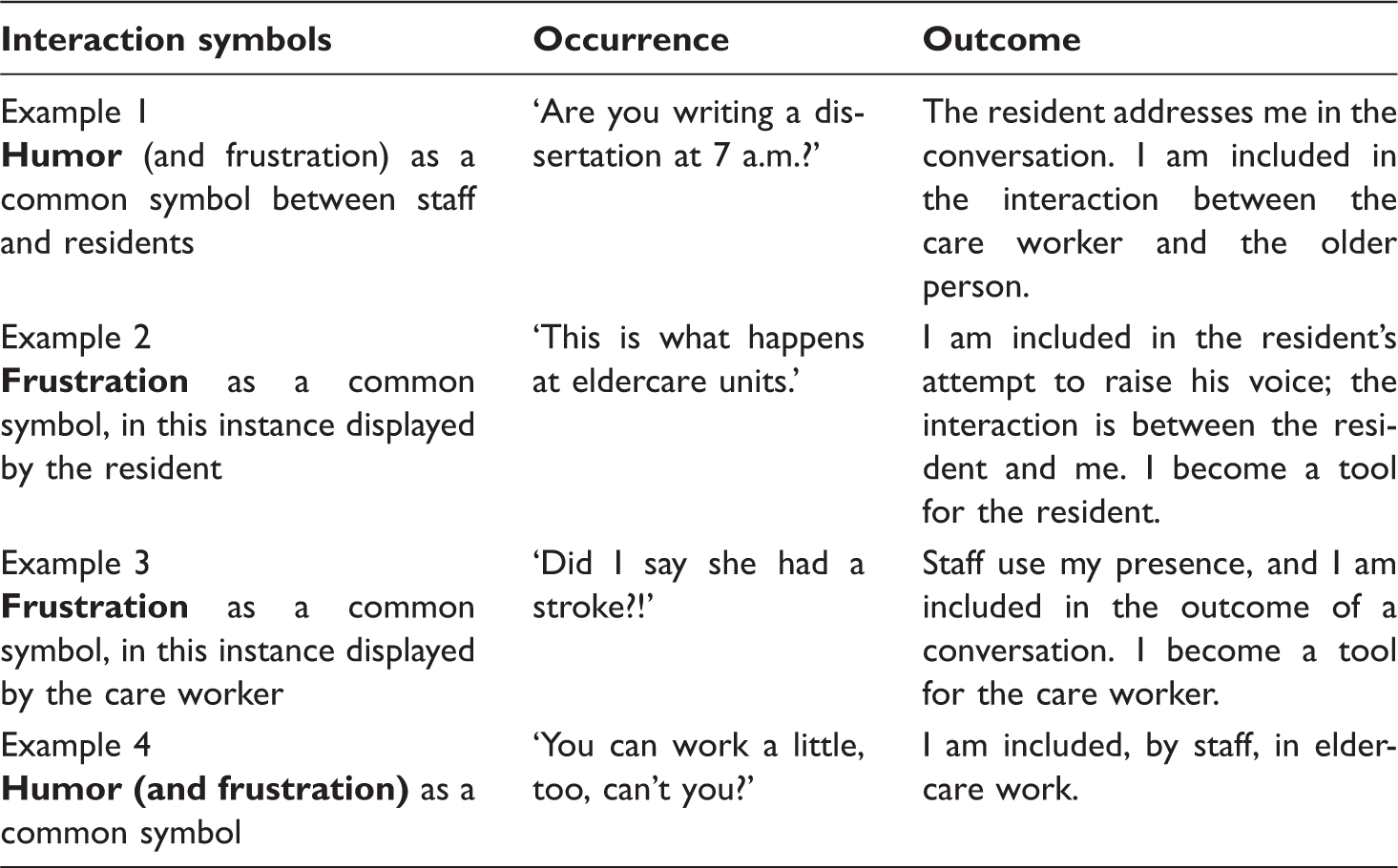
Example 1: Are you writing a dissertation at 7 a.m.?
For an observer to be able to observe, s/he must initially and continually interact with the participants. As the observations progressed, these interactions became more evident. My presence not only affected and included the two groups of staff, which was my main interest for being in the field, but it also affected and included the elderly residents. When I was observing staff and their knowledge, methods, and skills in daily work, the residents were (of course) almost always present. Regardless of my initial intentions to focus solely on the staff, the residents were also involved in the interactions and therefore included in the outcome of these situations. The example below demonstrates this involvement. It is early morning at Stonewood Manor. I am following Elsie, who has worked there for more than 10 years. We continue to Kristian, a man in his eighties, who is lying in bed when we arrive. Kristian: ‘There is so much washing-up to do here, talk to a bunch of fools who just say that “we are coming, we are coming!” I am a mess here.’ (Kristian has used the emergency button and talked to staff before we got there.) Elsie: ‘Yeah, yeah. No, we are not fools. We have more people to go to.’ Kristian: ‘So who are you who is just sitting there writing?’ (Kristian turns to me) ‘… Observe, go ahead and work instead! … Damn you should come here at night instead, they are one staff for the whole fucking company! I am not mad at you, I am mad at the system!’ Elsie and Kristian go into the bathroom, they continue to talk about me. Elsie: ‘No, but she is not here to work, Kristian.’ Elsie leans out from the bathroom and asks me if it is a dissertation I am writing. Me: ‘Yes, it is.’ Elsie: ‘She is writing a dissertation, Kristian, about how we use our skills in our work.’ Kristian: Laughs. ‘At seven in the morning?’ Elsie: Laughs. ‘Yes, that’s good isn’t it!’
Example 2: ‘This is what happens at eldercare units’
This second example is from a situation at the second eldercare unit, Stonewood Manor. It is late afternoon, around 5 p.m., and I am following two care workers as they start to prepare for the night. As we arrive at a resident’s apartment, I walk in with the two staff members. I am finishing some writing in my notepad about the previous resident, hurrying so I can focus on this new situation, but before I have a chance to say something to the older man, he addresses me. ‘Hello, what’s your name?’ The older man sitting in a wheelchair turns to me. I tell him my name and what it is I do there, that I am observing the staff working for him. Roland has physical injuries after a car accident that happened in his youth; he is now 75 years old. One of the staff members takes him from his bedroom to the toilet and while driving his wheelchair, she hits the door frame. Roland turns to me: ‘This is what happens at elderly care units. No respect for paint. I have repainted several times.’ (Care worker at Stonewood Manor)
Example 3: Did I say she had a stroke?!
The following sequence took place at the second eldercare unit (Stonewood Manor) where I did participant observations. It is part of the daily routine for the care workers to have coffee together around 9.30 a.m., when everyone gathers in a small staff room. Before the coffee break, I had spent the morning, from 6.45 a.m., together with Elsie, who is one of the staff members. It is morning and we are having coffee in the staff room at Stonewood Manor. There are a couple of staff members there as well as a nurse and a nursing student; the small room is rather crowded. This is a short coffee break around 9 a.m. where all the staff meet before they go back to the morning routines. Today I am accompanying Elsie, one of the care workers. Marie, the nurse, starts to talk about Irene, an older woman living at Stonewood Manor, saying that she was not feeling well last night. According to another care worker, Elsie had told Irene that she had a stroke, making Irene very upset and worried. Elsie wants my attention, she is waving her hand and saying loudly: ‘Hello, wake up! Did I tell Irene that she had a stroke last night?’ As I had also been present in the morning when Elsie was helping Irene, I had heard Elsie tell Irene just the opposite; that she probably didn’t have a stroke. I tell everyone what had happened and what Elsie had actually told Irene. Elsie triumphantly says: ‘That’s right!’ (Care worker at Stonewood Manor)
Example 4: You can work a little too, can’t you?
The following example took place at the first eldercare unit, Bayside Park. I had not been observing staff there for very long, and on that morning, I was accompanying Anna, one of the care workers. I am following Anna at Bayside Park, who has worked in eldercare for more than 20 years. We walk into the apartment of Richard, a man in his eighties who has dementia. Richard is sitting in a wheelchair. Richard needs help to the toilet, and Anna gives me a pair of plastic gloves so that I can help out as well. While Richard is sitting on the toilet, we make the bed and tidy up his room. As he is ready for his shower Anna takes out a pair of rubber boots and a plastic apron—for me. ‘Here, you can work a little too can’t you?’ I put on the plastic apron and rubber boots and take Richard into the shower. After we have helped Richard and return to the kitchen where other staff members and residents are sitting, Anna laughs and tells them that I have really worked now. (Care worker at Stonewood Manor)
I had decided beforehand that my strategy during the observations was not to include myself actively in a situation but that when invited by staff or residents, I would accept, participate, and respond. Therefore, standing in the shower felt like the correct thing to do at that moment, although it was surprising. As the observations proceeded, I realized that this strategy of participating in situations as a response to the care workers’ requests might not be best after all: I was giving the power to decide about my role in these situations to the different staff members. Looking back, I am certain that other staff members also wanted to ask me to get into the shower but did not dare to ask.
The four examples above of interaction between me and care workers and residents did not occur in this time order. Rather, as the analysis proceeded, I chose these examples as they stood out and together formed and illustrated spectra of these situations. In fact, the last example, example 4, occurred after only some weeks of participant observations at the first eldercare unit. I was rather taken by surprise at how distinct the care worker was in directing me and including me in the practical work. As time went by at both eldercare units, I realized that this inclusion of me in the observations was not mainly a result of staff members getting to know me and being more comfortable with me. It was not a deepening of the observations in terms of being more acquainted with the procedures. Rather, it seemed to be all about the care workers and their personal view of my obligations or work task. The same individual perspectives were involved with the residents addressing me and including me in the various situations. They might have just met me but still addressed me and included me in various situations.
Reflections
Gold (1958) describes the four different roles in fieldwork as ‘social interaction devices’ (p. 217). This description emphasizes the importance he assigns the researcher doing fieldwork, where the researcher is the main conduit through which important data are collected. In the description of the interaction devices, a parallel can be drawn to a mechanical device. This view of the fieldworker’s role as something static implies an ability to distance oneself from impressions and to stick to a chosen role at all times. This option seems neither possible nor desirable.
The roles of the researcher in participant observations not only change once or twice during the course of fieldwork but also change continuously. Consequently, fieldworkers are required to shift roles in different situations when observing a variety of people and settings. Moreover, the fieldworker must be aware of his/her influence in these shifts. When Gold (1958) talks about the need for a fieldworker to select and play a role, the underlying assumption is that merely one role is sufficient. In this study, my experience was that this was not the case. The ambition to understand people and a setting means a need to be open and flexible in the interaction. The researcher alone does not merely choose or shift the role or roles but the participants do, as well, as developed in the interaction with them. This need for multiple roles and their change is thus not simply the result of my positioning as the researcher. The roles are mainly a response to the participant interaction in the study, in this case the care workers and the residents at the two eldercare units.
Adler et al. (1986) state that Gold’s traditional roles of fieldwork neglect to recognize the situational factors that ‘help shape the nature of fieldwork roles’ (p. 372). The combination of ethnomethodology and existential sociology as the background or inspiration for the participant observations, as suggested by Adler and Adler, can encourage or enable the interaction desired for the observations. These interactions provide rewarding insight into the setting studied.
Peter Kloos (1969) presents another dimension to this discussion and speaks to the dilemmas in which fieldworkers can find themselves. Kloos’ definition of fieldwork is ‘that research situation in the social sciences in which the investigator goes to live in close contact with the group he wishes to study—makes the investigator both an observer and a participant inhabitant of the community’ (1969: 509). When discussing role conflicts in social fieldwork, Kloos refers to three reference groups evident to a fieldworker: the group studied, his own society, and the scientific community (1969: 509). Kloos argues that in the field, conflicts may arise among these reference groups at various times, creating a conflict for the fieldworker and causing emotional strain. While avoiding these conflicts altogether is not possible, a fieldworker should recognize them and the strain they cause.
The two groups of staff both displayed an array of symbols that constitute boundaries between them and others, in line with Collins’ (2005) theory on interaction ritual chains. As the observer, I was initially excluded from the interaction rituals and the group solidarity as accentuated by mutual symbols. The common language was unfamiliar to me, as were the jokes between the staff members, and it was evident that I was an outsider observing groups closely. However, this period of time was short. It did not take long before I started to recognize the familiar patterns of behavior and interaction towards each other and also towards me. Jokes and laughter can be a rite of passage; they were symbols for both groups, and I was included in internal jokes. Furthermore, the jokes could be interpreted as a way of dealing with the discomfort some felt about my presence in their safe environment. The fact that I was included in the interaction with the care workers might not have surprised me, but the short time that passed before I was included did surprise me. Initially, the frequency of my being included in the group interaction chains caught me off guard. Before long, I was ‘the Shadow,’ as a joke between the care workers and myself. The response from me in these situations in which I was asked or told to participate by either staff or residents was not always straightforward and easily decided. In the words of Tinney (2008), ‘I was occasionally faced with requests to help either residents or staff, which I found difficult to refuse but difficult to fulfill’ (p. 222). This quote illustrates just how complex the situations in participant observations are. Decisions about the deepening of involvement must be made throughout the process of participant observations; it is not possible to decide beforehand on a strict role that will work in every situation and every interaction with participants in the study.
Concluding remarks
This article explores participant observations as a research method and as a practice. The initial question was, (How) do roles for the researcher in participant observations change during the course of fieldwork? The issue holds no simple answer. The question rather contains more questions within itself: What is the environment observed, who is observed, and, finally, who is the observer? There is no final answer to the role of the observer but rather a number of answers and several roles. Linking Collins’ (2005) theory on interaction ritual chains to the examples from the field provides an understanding of the importance and necessity of interaction between the participant observer and the group being studied. Furthermore, acknowledging the symbols used in a setting also gives an understanding of how this interaction is developed and how much it varies. The participation takes different shapes and forms in different situations with different participants.
I argue that participant observations change in the interaction between the researcher and the participants and that therefore referring observations to a number of roles is restrictive and limiting. Participant observations are a process and should be recognized and respected as such: a process requiring the full devotion and sensitivity of the researcher.
I introduced this text with a quotation from my field notes, and it will end with the same quote: I am sitting in the staff room at ‘Stonewood Manor’
1
accompanied by care workers and a nurse who is working as a substitute. As we have not met before, the nurse asks who I am and what I do there. I describe my presence, and Julia, one of the staff members, fills in: ‘Yes, she wanted to study staff and they sent her here, to the very worst ones!’ Laughs. ‘We call her the Shadow.’ (Care worker at Stonewood Manor)
Footnotes
Acknowledgement
The author wishes to thank Professor Elisabet Cedersund for invaluable feed back and comments.
Funding
This research received no specific grant from any funding agency in the public, commercial, or not-for-profit sectors.