




Abstract
One unexpected finding from the postdoctoral fellowship I conducted on the needs and experiences of ethnic minority families in the New South Wales (NSW) child protection system in Australia, was that reports of inadequate supervision seemed high compared to their Anglo-Australian counterparts. The aim of this article was to explore this finding further. This article argues that cultural differences between individualist and collectivist cultures (which families from ethnic minority backgrounds tend to be) contribute to the differential rates of prevalence in reports of neglect. Specifically, the greater role of extended family and community in sharing parenting responsibilities (and thus the inferred reduced care from primary caregivers) and the responsibility levels of children at younger ages (and thus the inferred lack of capacity to self-care) may be contributing to reports of neglect in families from collectivist backgrounds. However, this article also argues that collectivist values that influence what is seen to be adequate parental supervision are not, in the main, harmful (especially if it is the only report for a family) because they do not normalize or perpetuate risk of harm to children. The sample size in this study is small and so caution should be exercised. Nevertheless, this article highlights that caseworkers should be careful not to mislabel the behaviours of parents from collectivist backgrounds as neglectful, because to do so is to use one standard of parenting by which to judge all families and the problems with an absolutist approach to child protection are well known indeed.
Keywords
Background
In 2007, I was awarded a three-year postdoctoral fellowship by the New South Wales (NSW) Department of Human Services (DHS) in Australia to explore the needs and experiences of Culturally and Linguistically Diverse (CALD) families in this state’s child protection (CP) system. It was a long journey. The project was comprised of three extensive stages – a literature review, a review of 120 case files of children from six cultural groups, and the conduct of semi-structured, in-depth qualitative interviews with 29 CALD or ‘ethnic minority’ families as I prefer (Sawrikar and Katz, 2009) involved in the CP system and 17 caseworkers that service all families in the CP system. The findings of each stage were written up in the form of reports to government and the main findings were submitted for publication in peer reviewed journals.
While I learned a lot about how much knowledge and interest there currently exists on the very important issue of how to appropriately, effectively and sufficiently address cultural diversity in child protection matters, I also learned about gaps in the current knowledge and research base. One such gap came from an unexpected finding in this study. As it was not the focus of my work, I did not think that I had substantial evidence or empirical rigour to warrant the publication of a full paper, so I initially decided not to pursue it. It had been published in the report to government, so I felt that at least somewhere the finding had been noted. But that it had not been fleshed out or given proper highlight continued to bother me. It is for this reason, three years after the project had finished, that I have decided to come back to it and explore this particular finding further.
The unexpected finding: The apparently common prevalence of ‘inadequate supervision’ among ethnic minority families
The literature review aimed to be exhaustive, covering a range of topics and issues related to culturally appropriate child protection practice. It explored the theoretical tension between cultural absolutism and cultural relativism, it surveyed the known literature on the prevalence of each type of abuse and neglect (e.g. physical abuse, inadequate supervision etc.) across cultural groups and discussions on (cultural and other) reasons that may underpin these differences, and it explored more practical issues like the effective use of interpreters and the benefits and detriments of matching clients and workers by race. It also documented useful resources such as seminal books and online resources for practitioners in the field and proposed a set of recommendations for those involved in policy development. In all the review, cultural differences in neglect did not get a mention. It is for this reason that the finding that reports of ‘inadequate supervision’ as seemingly common in some ethnic minority groups, especially compared to their Anglo-Australian counterparts, was unexpected. Such a finding had not been previously reported in the literature and so I was not ‘on alert’ to look out for it.
In the second stage of the study, 120 case files of children from six cultural groups were reviewed in depth. These were: (i) Anglo-Celtic (n = 20), (ii) Aboriginal (n = 20), (iii) Chinese (n = 20), (iv) Pacific Islander (Samoan and Tongan; n = 10 each), (v) Lebanese (n = 20), and (iv) Vietnamese (n = 20). The last four of these groups are considered to be ‘CALD’ in Australia because they are differentiated from the Anglo mainstream and Indigenous people (Sawrikar and Katz, 2009). These four CALD groups were selected because they have a high representation in Australia’s general population (e.g. people of Chinese, Lebanese and Vietnamese background; Australian Bureau of Statistics (ABS), 2007) and/or in the NSW child protection system (e.g. people of Lebanese, Samoan, Tongan, and Vietnamese background; DHS’ Multicultural Services Unit (MSU), personal communication, 2007).
The case files were comprehensive, scoping for a number of variables. Demographic variables included: (i) number of volumes per case file, (ii) child’s place in the CP system (child protection, early intervention, out of home care, restoration, or case closed), (iii) sex, (iv) age, (v) country of birth, (vi) main language/s spoken at home other than English, and (vii) main religion at home. They were also scoped for variables related to this project (and which were informed by the literature review) including: (i) types of abuse (physical, sexual, or emotional) and neglect (neglect of basic needs, neglect of education, and inadequate supervision) reported and their frequency, (ii) types of strengths reported, (iii) types of assistance children and families received from NSW DHS (e.g. referrals to parenting programs, rent assistance, paying for children to attend behaviour management camps etc.), (iv) examples of intervention that could be construed as culturally appropriate and culturally inappropriate, and (v) examples of intervention that could be construed as a personal, organizational, or institutional barrier to culturally appropriate practice. This article focuses especially on the frequency of inadequate supervision reported in each cultural group.
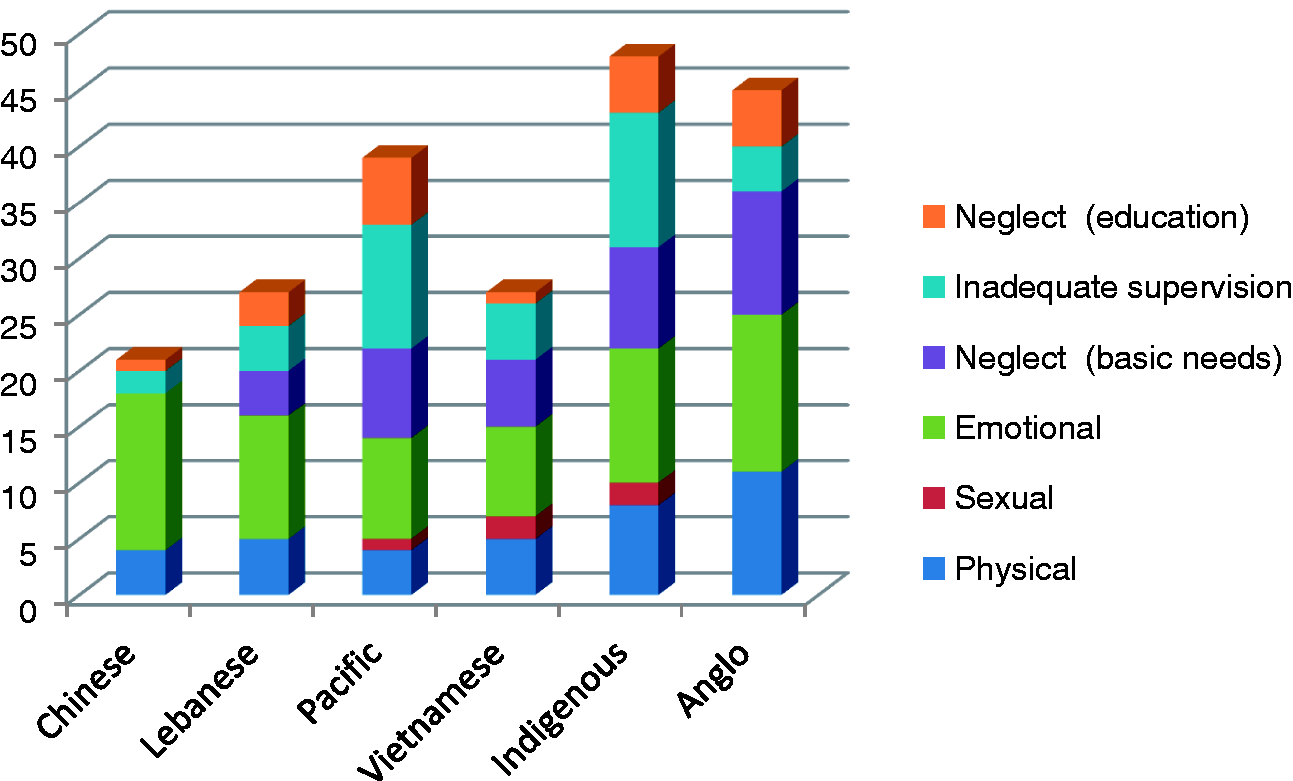
As can be seen from Figure 1, the primary type of abuse or neglect reported for the four CALD groups was physical abuse. The primary type of abuse or neglect was defined as the most frequently occurring type or the most recent type if there were equally two most frequently occurring types. Figure 1 also shows that sexual abuse was the primary type of abuse or neglect reported among Anglo and Aboriginal families. These findings have been discussed at length elsewhere (Sawrikar, 2013), and as they are not the focus of this article they will not be discussed in more detail here. Figure 1 also shows that emotional abuse is somewhat commonly the primary type of abuse or neglect in some ethnic minority groups, especially families of Vietnamese and Lebanese background, and a common secondary type of abuse or neglect in families of all cultural backgrounds (also see Figure 2). This finding certainly warrants further discussion but is not within the scope of this article. The finding of interest here is that of ‘inadequate supervision’. Figure 1 shows that inadequate supervision is somewhat commonly the primary type of abuse or neglect in some ethnic minority groups, especially those of Chinese background.
Primary type of abuse and/or neglect by cultural group. Secondary types of abuse and/or neglect by cultural group.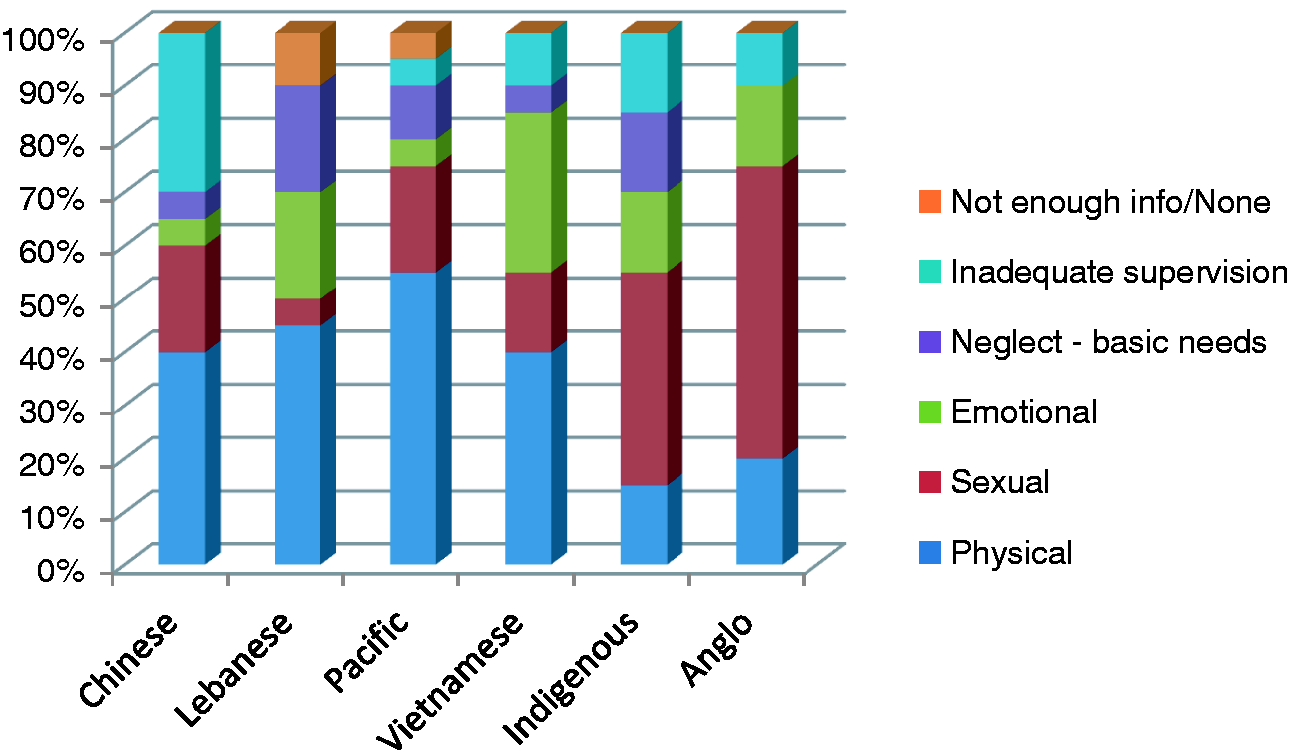
Families of Chinese background began migrating to Australia a long time ago, during the Gold Rush in the 1850s, but also in two distinct and large waves – one, after the abolition of the white Australia policy in the 1970s and two, in the 1990s when highly skilled, family and international student visas began to increase. Thus, they are not a newly arrived migrant group. Nevertheless, lack of awareness of the risks associated with leaving children unattended in Australia may play some role in the prevalence of these reports because it is common among migrant groups who undergo the process of acculturation to be unaware of cultural norms of the host country and/or to have a desire to preserve one’s own identity and way of life in a foreign culture, even if migration occurred many years ago (Phinney et al., 2001). However, in addition to processes typically involved in migration, culture may also be playing a role as to why parents of Chinese background leave their children to self-care at ages considered too young by Australian legal and social standards. The cultural paradigm of collectivism will be used in this article to establish the cross-cultural prevalence of this type of neglect (and is discussed in more depth below).
The secondary types of abuse or neglect reported in each case file were also calculated. This was defined as the second most frequently reported type of abuse or neglect where more than one type was reported. As there can be multiple secondary types of abuse or neglect, a frequency axis was used instead of a percentage one (see Figure 2). Pertinent to this article, Figure 2 shows that inadequate supervision was a common secondary type of abuse or neglect especially among families of Pacific Islander background. Again, they are not a newly arrived migrant group and so similar processes and factors relevant to families of Chinese background may also be occurring. In short, both migration- and culture-related factors may be contributing to ‘inadequate supervision’ among some ethnic minority groups.
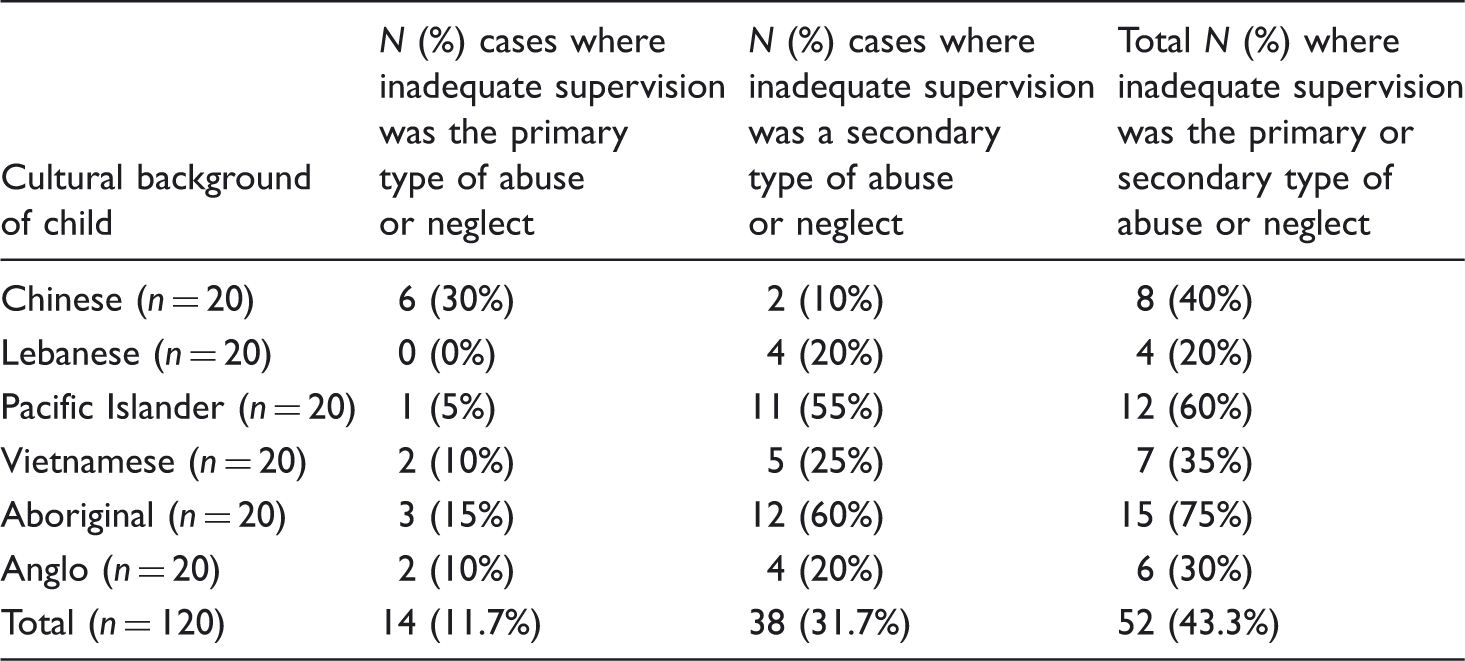
Frequency (and percentage) of inadequate supervision as primary and/or secondary type of abuse or neglect by cultural group.
This begs the question (in the same way that cross-cultural differences in physical abuse beg the question): Does culture underpin the differential rates of prevalence across cultures? If the answer is ‘no’, then it means that either non-cultural factors relevant to the experience of ethnic minority groups (for example, migration or poverty) play some role and need to be identified, or that there is a reporting bias by caseworkers and reasons why this bias is occurring need to be explored. If the answer is ‘yes’, then the specific characteristics of culture that are having an effect on rates of inadequate supervision, need to be identified. This in turn however means that ‘culture’ itself needs to be identified and the literature is well established on how difficult this is (Elliott and Urquiza, 2006; Korbin, 2002; Markward et al., 2000; O’Hagan 1999).
I have argued elsewhere (Sawrikar and Katz, 2013) that just because the term ‘culture’ is ultimately vacuous – because it cannot be pinned down and reified – does not mean that we should be at a loss to involve this ‘nebulous’ concept in our discussions. Indeed, culture is still somewhat implicitly understood across people and time, but moreover, it is necessary to talk about in the field of culturally appropriate engagement with ethnic minority families in the CP system.
So, slight segue way into what ‘culture’ is. I acknowledge that this is highly speculative, but I feel that for any person (and academic) from a minority ethnic group for whom collectivism is a norm and way of life, the distinction between individualism and collectivism to help define and describe culture is one that is both comfortable and useful to us. I say this because I have had very harsh reviews of manuscripts I have submitted in which I use the distinction between individualism and collectivism as a useful heuristic for making sense of this word ‘culture’, because of discomfort from (self-identified) Anglo-Celtic reviewers offended by the assertion that family is not as important in individualistic cultures.
While I do not dismiss the value and validity of the offence, it also does not make me question the validity of the cultural distinction either. To me, the dichotomy is useful because it captures, at a fundamental level, what it means to be culturally different; what it means to be a cultural minority. Such criticisms of this heuristic dichotomy place real and inhibitive pressure on the capacity of ethnic minority groups to advance knowledge and understanding of their culture and how it differs from the Anglo-Celtic mainstream. This knowledge is crucial in a context as serious as child protection because the lives and futures of children and families from ethnic minority groups – to which their culture is in every aspect a minority to mainstream norms and values – are in the hands of human service workers they may encounter.
By analogy, the correlation between depression and anxiety typically varies between 0.4 and 0.7 across a wide range of patient and non-patient samples (Lovibond and Lovibond, 1995). Given that sometimes high correlations can be obtained, it could be argued that the two constructs are so similar that the difference between them is small. But stepping away from the maths, it becomes clear at a commonsensical level that these constructs are in fact distinct and that it is useful to distinguish between them in clinical and theoretical practice. In the same way, intra-group variation can be so wide that it may become easy to identify members of the collectivist group who look more like individualists and vice versa, but naming exceptions to the rule (even if there are many) does not negate the rule; sometimes you have to come back to basics before you can discuss the deviations.
So, just to define these key terms, individualism is a cultural paradigm that sees the individual to be the basic unit of society whereas collectivism sees the family to be the basic unit of society (Bond, 2002; Hofstede, 2001; Triandis, 1990). Individualistic cultures value independence, autonomy, initiative and uniqueness; emphasize that individuals have the right and responsibility to look after themselves; stress horizontal relationships based on equality; and tolerate deviations from the norm to a greater extent. Contrarily, collective cultures value social order, harmony, support and roles; in collective cultures the family provides security in exchange for loyalty and obedience; inequality (usually based on age and gender) is seen as appropriate and acceptable; and members tend to be more homogenous as deviations from the norm are not tolerated as greatly (Sawrikar and Hunt, 2005).
The most important limitation of this generalization (and which ‘harsh’ reviewers in the past have rightly responded to), is that people from the Anglo majority have a sense of belonging and obligation towards their families, and people from minority ethnic groups are still individuals whose sole preserve is not just to benefit the familial group. This is because all cultures have elements of both individualism and collectivism, but tend to be high or low on each, forcing them to sit in a category when simple heuristics that transform their low and high scores into a category are used. Historically, the greatest causes of the erosion of collective family care for children in all cultures has been urbanization and migration, indicating that all cultures have had experience of collective approaches, and that collectivism (in a more nuanced approach to culture) is a question of scale and generational understanding.
Despite this limitation, however, the heuristic dichotomy of individualism and collectivism is still seen as useful. Firstly, it is consistent with other seminal researchers in the field (e.g. Al-Krenawi and Graham, 2001; Hesketh et al., 2000; Maitra, 2005; Munford et al., 2009; Owusu-Bempha, 1999; Shalhoub-Kevorkian, 2005) and so its use here is not unusual or odd.
It is also seen as useful because the attempt to integrate different cultures during the process of acculturation is on-going across time, context and generation, suggesting that the culture of origin is ever-present in the everyday lives of (at least first and second generation) minority ethnic groups. That is, the distinction between individualism and collectivism has heuristic utility and indicates that there are fundamental and basic cultural differences between minority ethnic groups and the Anglo majority.
Finally, and perhaps most importantly, the distinction between individualism and collectivism is useful because it helps reveal the tension between cultural absolutism and cultural relativism in child protection practice. Cultural relativism leaves children vulnerable to risk of harm because the lack of a universal benchmark means that harmful parenting is allowed to continue in the name of being culturally acceptable (Gough and Lynch, 2002; Korbin, 2002). However, cultural absolutism also leaves children vulnerable to risk of harm (Koramoa et al., 2002), as well as systematic disadvantage (Shalhoub-Kevorkian, 2005), because it claims that a colour-blind approach can protect all children from harm equally, when in fact all it does is disregard how much culturally informed parenting practices impact on the development of children as well as disregarding differences in social, economic and political power between different ethnic groups.
The enormity of harm that can come to children should child protection workers and systems ‘get it wrong’ in terms of appropriately and sufficiently taking culture into account, means that multicultural countries like Australia must become and remain highly skilled at culturally competent child protection practice. Part of this involves accurately understanding the experience and needs of ethnic minority families, and the use of individualism and collectivism as heuristic definitions of culture are seen to assist in this goal.
I have spent some time going over my ‘relationship’ with the dichotomy between individualism and collectivism simply to say that the four CALD groups in this study have in common a collectivist culture; it is this which distinguishes them from their Anglo-Celtic and individualist counterparts. This is important to establish because if culture is going to be seen as a contributor to differential rates in inadequate supervision, then we need to be able to identify what culture is and what specific aspects of culture are contributing. For this purpose, I will be comparing individualist and collectivist cultures.
I would also like to point out that the data in Table 1 shows that inadequate supervision is an even more common primary and secondary type of abuse or neglect reported among Aboriginal families compared to ethnic minority families. This is consistent with other research that shows that Indigenous Australians have a much more laissez-faire approach to parenting than Anglo Australians, and this often leads to accusations of neglect (Lancy, 2012). However, I see that the search for explanations of this prevalence (cultural or otherwise) are not best determined by comparing Aboriginal families to either ethnic minority or Anglo families. This is because the experiences of Aboriginal families, both generally in the country and specifically in the CP system, are so unique and uniquely traumatic that they cannot (and should not) be compared. As first nation people displaced by colonization and scarred by the intentionally assimilationist policies underpinning the experience of the Stolen Generation, in which Indigenous children were purposely removed from their own families and placed with white families to help ‘save’ them from their ‘primitive’ black parenting, it seems obviously inappropriate to me to search for cultural and other explanations for the prevalence of ‘inadequate supervision’ among Aboriginal families by comparing them to their ethnic minority and Anglo counterparts.
In contrast, it does not seem inappropriate to compare the cultures and experiences of ethnic minority and Anglo families, because both are migrant groups that have not been displaced from their own country or had such an historically identifiable and irreversibly traumatic experience with the CP system because of cultural differences in what is considered to be ‘good parenting’. Still, the intergenerational trauma that has transpired since the Stolen Generation does teach us that culture and cultural differences should never be ignored in multicultural countries like Australia, or cultural judgments about what ethnic minority families consider to be ‘good parenting’ may become another example of the disempowerment that follows from the prevention of self-determination.
Fleshing out the finding with qualitative data
So back to the question in this article: Does culture underpin the differential rates of prevalence across cultures in inadequate supervision, or is the difference attributable to other factors most especially a possible reporting bias from caseworkers? To help answer this question, I now wish to look at all data that directly or indirectly relates to inadequate supervision obtained from the qualitative interviews.
One family participant said, In my country [Lebanon], [the] schools [are] not very close [by] but [the] kids [still] go alone. [When I was a child], I go alone when I [was] six years old. (ARB_1)
This comment was not provided in response to a direct question on inadequate supervision but was offered in reply to a broad and open-ended question about how children are typically raised in the participant’s country of origin. It suggests that it is normal in Lebanese culture (one that represents collectivist cultures more generally) for children to self-care without parental supervision at ages younger than what is considered normal among their Anglo-Australian counterparts.
This assertion is corroborated by two caseworkers. One said, Here in Australia, age is the primary factor that makes you a child, [but] in a lot of other cultures, responsibility level is what makes you a child or an adult ... [So] we can’t just say it’s inadequate supervision because a 12 year old is left caring for a four year old. It can’t be blanket rules [like that]. (CW_8)
A second caseworker said,
In Australia we have the belief that children under the age of 16 shouldn’t be left alone, or the sibling shouldn’t be taking care of the younger sibling. So in some cases, [CALD] parents have been charged with neglect even though that’s normal in their culture. But it’s not normal for the culture we [are] living here. (CW_12)
In collectivist cultures, where family members are socialized more to promote the goals of the family group than to individuate, domestic/familial responsibility (such as cooking and cleaning) is given to children at younger ages than their individualist counterparts (Buda and Elsayed-Elkhouly, 1998; Dwairy, 2002; Florian et al., 1993; Markus and Kitayama, 1991). Thus, culture is implicated in ‘inadequate supervision’. Specifically, some collectivist cultures may see that their younger but more responsible child is at an age where it is appropriate to leave them alone for some period of time.
These quotes, however, also show that there could be a reporting bias among caseworkers because definitions of neglect are failing to take into account cultural diversity in parenting and family functioning. Indeed one of the two aforementioned caseworkers went on to say, Neglect is an area where we could do more work on what’s culturally appropriate and what’s not … We need to become a lot more educated about what is it in that culture, in that family, that makes that child a child? Is it neglect or is that child capable of supervising a younger sibling? Does that child have any money? Does he have access to a phone? Does he know the neighbours? Does he know who to call? Does he know the phone numbers? Does he know emergency? We need to be getting into all the real detailed things as to whether or not that child’s at risk. (CW_8)
Unlike the family participants – none of whom spoke directly of inadequate supervision – more (specifically six of the 17) caseworkers made mention of this type of neglect to a greater or lesser extent. For example, in response to the open-ended question, ‘Why do you think CALD families enter the child protection system?’ one caseworker said:
A lot [has] to do with parenting issues. Sometimes we are talking about inadequate supervision, sometimes we’re talking about discipline. (CW_3)
Although only a sample size of one, this caseworker was summarily indicating what she saw to be the two most pertinent parenting issues for ethnic minority families.
Another caseworker who mentioned inadequate supervision to a lesser extent said, Parents [are] not looking after them [their own children]. It’s a cultural thing. It might be like a neighbour across the road who is from the same culture looking after the kids. The parents not being that primary caregiver, that gets reported [as] inadequate supervision. (CW_16)
Importantly, this quote shows that in addition to differences in the age and responsibility levels of a child, there is another aspect of collectivism that influences parenting; that the care of children relies on extended family and community because it is a group-based culture.
This differs from a model of parenting that sees the sole or primary responsibility of caregivers from the nuclear family to be appropriate or normal, and which is emphasized in individual-based cultures like Australia. Indeed, several family participants (n = 9 of 29; 31%) noted that it was normal for family responsibilities and child rearing to be shared among community members. As an example, one participant said, To be honest, it’s hard to raise kids in this country. It’s much easier and better in my country [Lebanon]. If you live in the street now [in Australia], whatever my daughter do outside, no one cares. In my country, everyone interested. Like your neighbour watching your kids. Same, if I see any of my neighbours doing anything wrong, I jump and say ‘that’s no good’. Everyone cares. In this country, no. (ARB_9)
Thus, it is possible that a cultural misunderstanding could contribute to an apparent neglect in families of collectivist cultures (and thus a reporting bias) simply because shared parenting by adults from the same culture is being reported as inadequate supervision.
In short, caseworkers may incorrectly report some ethnic minority families as neglectful, failing to provide their children with adequate supervision, because they are unaware of community-based ways of parenting in collectivist cultures, or because they judge the adequacy of supervision by who is providing that care (i.e. primary caregiver or not) or the age of the child (from which they may incorrectly infer their level of responsibility). However, some parents are just doing the best they can, working hard to ‘make ends meet’, and raising their children in the way they were raised but in a foreign country that has risks they may not be aware of or underestimate. As an example, one caseworker said, When I was working in one particular area, we used to get a lot of Korean families [who had] just moved out here. Normally, what would happen is that the parents work, and the children stay at home with the grandparents. Now the grandparents are no longer here, we have little ones cooking, left at home on their own. So we were constantly [saying] a standard spiel, ‘in this country, children not to be left alone under the age of … because they might burn themselves, be it access to hot water, no parents around’. (CW_17)
In these kinds of instances, it is important not to label these parents as neglectful or their children as ‘parentified’. To do so is to implement a standard of parenting and family functioning that is ignorant and inconsiderate of both culture and migration. Indeed, this caseworker demonstrated cultural awareness of the important role of grandparents in raising children (because age is revered in the hierarchical culture of collectivism) but also of typical experiences for migrants from collectivist cultures, specifically that extended family often visit for extensive periods of time. This kind of cultural awareness is demonstrative of cultural competency.
In addition, this caseworker demonstrated culturally appropriate engagement because she did not judge cultural differences in parenting but instead emphasized that education about the risks of leaving children unattended is what is required. Arguably, mislabelling culturally normative parenting as neglectful may be particularly important when there is only one (and therefore primary) type of abuse or neglect reported because families in these kinds of circumstances are very different to those who also have drug and alcohol or mental health issues, for example, that inhibit their capacity to provide adequate care to their children.
Two other caseworkers also made the need for educating ethnic minority families explicit. One said, A lot of cultures need to be re-educated about CP legislation in Australia. We need to explain that although you’ve come from a country where responsibility level determines what an adult is, here, because of the way things are structured, because of learning in the education system, because of learning in communities and what children are exposed to at that age, it’s not appropriate to leave them. To make these sorts of decisions, because of these reasons, and are really nutted out for that family. (CW_8)
Similarly, another caseworker said,
I worked with [an African-background mother]. She left her children unsupervised for hours and hours, but that’s what she did back home. She couldn’t understand why it was an issue for us. I don’t know how you get around that, because there’s potential for risk in terms of the children accessing the stove or whatever and that’s really basic. I think how it’s communicated, ultimately, that’s going to make the difference. (CW_15)
Interestingly, one family participant of African background said,
Some items, especially electricity, gases, these sort of things, we don’t have them in Sudan. If you learn how to use them, and prevent children not to get into [them], that’s the most important thing … In Sudan, we were staying in the bushes, so you can protect your child from snakes, reptiles, fire, these kind of things … Now, we don’t have those here. (AFR_1)
This quote importantly shows that some ethnic minority families, even among newly arrived migrants, are familiar with or aware of the risks of leaving children unattended in Australia compared to their country of origin.
Discussion and conclusion: Wrapping it up
I have argued in this article for the heuristic value and importance of dichotomizing cultures into individualist and collectivist ones because it helps reveal the problem of using a culturally absolutist approach to child protection practice – one that fails to sufficiently, appropriately or effectively take into account the role of culture in the way ethnic minority parents raise their children. As such, the need for discourse that helps accurately capture the cultural needs of ethnic minority families is crucial to good practice, and I see the terms individualism and collectivism offering this.
Since more caseworkers mentioned inadequate supervision in the interviews than did the family participants, it seems that ethnic minority families may be significantly underestimating the extent to which child protection workers consider inadequate supervision a serious issue. However, the results also showed that there is a serious need for education at the institutional level of CP systems about inadequate supervision so as to improve its cultural competency. Specifically, the system needs to understand cultural differences in the way collectivist families parent their children if it is to avoid judging these parents as harmful, or worse yet, intervening in the role of ‘child protector’ when the child is not actually at risk (Shalhoub-Kevorkian, 2005). Such intervention would be unnecessarily harmful to the child and their family. Perhaps there is an ‘institutional bias’ in the assessment criteria for inadequate supervision as a form of neglectful parenting? If so, this criteria needs to be revised so that it is culturally sensitive. The findings also show that it is important for caseworkers to educate collectivist families (whether they are old migrants or newly arrived) about the fact that the risks associated with inadequate supervision may differ in Australia compared to their country of origin; taking the time to sensitively and respectfully communicate these possible risks is important to good practice in a multicultural context.
Importantly, there are a vast range of reasons for why ethnic minority families enter the CP system, and many of them reflect non-cultural factors. For example, physical abuse is a cultural issue when ethnic minority parents cite that physical discipline is culturally valued and acceptable (e.g. Pelczarski and Kemp, 2006; Rhee et al., 2011), and inadequate supervision is a cultural issue when collectivist children are left unsupervised by primary carers at ages younger than their counterparts because they are seen as sufficiently responsible to care for themselves. However, structural issues such as differences in the role of the state in child welfare and family functioning between Australia and the country of origin (Babacan, 2006), and systemic issues such as socio-economic disadvantage among minority groups (Cahn, 2002; Chand, 2005; Fontes, 2005; Webb et al., 2002; Westby, 2007), can also bring ethnic minority families into the CP system, and these are not cultural issues. Thus, it is important caseworkers do not overlook the role of non-cultural factors, else there may be a risk of pathologizing the collectivist culture as if this were inherently harmful to the child and the primary reason for their family’s dysfunction. It also shifts responsibility onto the parent for issues they may otherwise have little control over.
Importantly, some methodological limitations need to be acknowledged. While the total number of case files reviewed in this study was large, the number of case files per cultural group (n = 20) was small and so caution needs to be exercised when making inferences from this data about prevalence rates in the wider community. Also, the qualitative data in this study was rich in complexity, allowing for the full identification of all relevant variables to the topic of culturally appropriate child protection practice with ethnic minority families. The sample size was also sufficient for qualitative research (n = 46) because interviews were conducted until thematic saturation had been reached thereby contributing to the validity (or confirmability) of the data. Nonetheless, future research that focuses on the specific issue of inadequate supervision needs to be conducted. At the very least, this data could be a starting point for a more thorough empirical investigation into the nexus of culture and neglect. Notwithstanding, this study has uncovered an important issue and one that warrants substantial future research to help address a current gap in the literature about cross-cultural differences in inadequate supervision.
I think what bothered me so much about the unexpected finding that inadequate supervision seems to be commonly reported among ethnic minority families was that there seemed to be nothing particularly obvious or overt about these parents’ intentions or behaviours as being harmful to their child; they were simply being labelled as neglectful because their children were considered too young to be left alone by mainstream and individualistic standards. As a counter example, I did not have this reaction to the prevalence of physical abuse among these same ethnic minority groups. Often in these cases, parents do not intend to cause harm and/or cite the cultural norm and value for the use of physical discipline, yet harm is still obviously or overtly caused (including the ‘invisible’ emotional abuse that can result from physically abusive parenting). Of course, just because harm from inadequate supervision is not always visible or intended, that does not mean that harm has not been caused. For example, some may argue that ‘latchkey kids’ are emotionally abused (Grover, 2009). So while I am aware of and fully appreciate the difficulties and challenges that caseworkers face as they try to tease out all these possibilities in their risk assessments, I still hold that it is important to ensure that caseworkers are aware of the risks that come with not taking culture into account appropriately or sufficiently at all.
My original question in this article was ‘does culture underpin the differences in rates of inadequate supervision across cultures?’ and the answer to this question was yes. Cultural differences in the role of extended family and community in sharing parenting responsibilities, and the responsibility levels of children at different ages, contribute to reports of neglect in families from collectivist backgrounds. But I think the question should have been ‘are differential rates of prevalence in inadequate supervision across cultures due to collectivist cultural values about parental supervision that normalize and perpetuate risk of harm to children (in the same way that cultural values about physical discipline normalize and perpetuate risk of harm of physical abuse to children)?’ because the answer to this question is no. Culture is involved in explaining the parenting behaviours of families from collectivist backgrounds but not in explaining their neglectful parenting behaviours. And I think this was what was bothering me all this time.
Footnotes
Funding
I would like to acknowledge the New South Wales (NSW) Department of Human Services (DHS) in Australia and the Social Policy Research Centre (SPRC), University of New South Wales (UNSW), who provided joint funding for this project. The funding bodies were not responsible for any part of the study design, data collection, analysis and interpretation or report writing; these responsibilities rest solely with the author of this manuscript. This manuscript is a short version of part of the results sent to the Department in the form of reports. Thus, this manuscript has not been published previously and is not under consideration for publication elsewhere but is part of a published Governmental report. I would also like to thank the two anonymous reviewers for their constructive comments and feedback on an earlier version of this article.
All four reports that constituted the main deliverables of the Postdoctoral Fellowship can be found at the following websites:
https://www.sprc.unsw.edu.au/media/SPRCFile/20_Report_Cald_Families_LitRvw.pdf
https://www.sprc.unsw.edu.au/media/SPRCFile/20_Report_Cald_Families_LitRvw.pdf
https://www.sprc.unsw.edu.au/media/SPRCFile/20_Report_Cald_Families_LitRvw.pdf
https://www.sprc.unsw.edu.au/media/SPRCFile/17_CALD_families_in_CPS_Final_Report.pdf
Declaration of conflicting interests
There are no known conflicts of interests to declare.