



Abstract
Sibling abuse is extremely common, yet child welfare does not provide statutes for its identification and workers are not trained to identify its occurrence. This retrospective study explored adults survivors’ experiences of childhood and adolescent sibling abuse and the family environment that engendered hostile sibling relationships. The varying parental responses from punitive to neglect to collusion with the perpetrator resulted in feelings of helplessness and worthlessness in the victim. Personal narratives of survivors highlight the sibling abusive experience and underscore its devastating repercussions. Recommendations are presented for child welfare to establish sibling abuse as a phenomenon in need of recognition and include siblings in risk assessment.
Introduction
Sibling abuse has been identified as the most common form of family violence (Button et al., 2008; Reid and Donovan, 1990) in the USA, occurring more frequently than parent–child abuse or spousal abuse (Graham-Bermann et al., 1994). However, without current and national statistics to support this, sibling abuse continues to be under-recognized. No consistent national law exists regarding sibling abuse since many states do not have statutes that distinguish it as separate from incest. As a result, both mandated reporters and child protection service caseworkers have limited guidance on how to interpret child abuse statutes (Kominkiewicz, 2004) and cases of sibling abuse go undetected. Parents who are not knowledgeable of the traumatic effects of abuse by a sibling may inadvertently perpetrate neglect, by failing to address the behavior.
Particular aspects of the traumatic effects of physical or emotional sibling abuse remain relatively unexplored in the literature, despite findings that its effects may be devastating and long-lasting (Caffaro and Conn-Caffaro, 1998; McLaurin, 2005; Wiehe, 1997). The current sibling abuse literature focuses on sibling incest and assault (Caffaro and Conn-Caffaro, 1998), children in foster care (Linares, 2006), personal experience and perceived acceptability of sibling aggression (Hardy et al., 2010), learned helplessness in adult survivors (McLaurin, 2005), and feelings of guilt and shame in both survivors and perpetrators (Garey, 1998). These studies were largely quantitative, had small sample sizes (McLaurin, 2005), and included sexual abuse (Caffaro and Conn-Caffaro, 1998; Garey, 1998; Linares 2006; McLaurin, 2005), making it difficult to distinguish the contributing factors and consequences of sibling sexual abuse from emotional or physical abuse.
In the most comprehensive study to date (Wiehe, 1990), victims of sibling abuse were found to experience low self-esteem, depression, anger with the perpetrator, and difficulty with interpersonal relationships (Wiehe, 1990). Survivors were characterized as “overly” sensitive, depressed, engaged in self-blame, and experiencing problems in relationships with the opposite sex, including repeating the victim role in relationships, feeling distrustful, fearful, and suspicious (Wiehe, 1990). Wiehe’s groundbreaking research sampled individuals with a history of sexual (67%), physical, or emotional abuse by a sibling while growing up. Mailed, anonymous questionnaires were used to gather data that limited exploration and opportunities for clarification, depth, and emergent flexibility. The current article supports Wiehe’s findings regarding parental (mis)management and provides a unique lens into the emotional and psychological effects of parental responses on the victim.
Study purpose
This qualitative study began with an interest in characterizing physical or emotional sibling abuse from the perspective of survivors. This research explored how victims of sibling abuse internalize their experiences and the effects of this experience in adulthood. The family was of critical interest to understand the person-in-environment and psychosocial factors that may contribute to the existence and perpetuation of sibling abuse. The risk factors uncovered demonstrate that sibling abuse is a phenomenon in need of dire attention by the field of child welfare.
Sexual abuse between siblings was not a topic of this study due to an interest in learning about the emotional impact of physical and emotional sibling abuse. Additionally, incest is recognized by the field of child welfare in the USA and more greatly represented in the extant literature (Caffaro and Conn-Caffaro, 1998).
Defining sibling abuse
There were initial concerns about identifying subjects for a study focused on sibling abuse, a phenomenon that had little societal recognition. Initial apprehension about participants being able to self-identify as victims of abuse by a sibling was confirmed when subjects questioned the validity of qualifying their own experience as abusive, despite feeling that what had happened was not normative. Informants expressed unease about participation due to not having sufficient evidence to convey the depth of pain they had suffered. Throughout childhood, these victims felt isolated in their attempts to make meaning of their sibling relationships and its effects. Longstanding societal oversight of sibling abuse contributed to survivors’ uncertainty in terming their relationship with their siblings as abusive.
In a study exploring perceptions of violence within sibling relationships the majority (70%) of 218 college-aged students sampled experienced or perpetrated severe sibling violence but did not identify their experience as a form of violence (Kettrey and Emery, 2006). Terms such as “conflict,” “rivalry,” “aggression,” “violence,” and “abuse” were used interchangeably to describe physical violence among siblings who depicted the degree or intensity of this behavior (Kettrey and Emery, 2006). Feelings of isolation may stem from language which invalidates the abusive sibling experience (Kettrey and Emery, 2006) and contributes to victims’ doubt about the legitimacy of their experience.
Rapoza et al. (2010) studied ethnic perspectives of sibling abuse. Their research assessed extreme, moderate, and mild cases of sibling abuse and found gender and ethnic differences in the interpretation and experiences of psychological aggression. Women were more likely than men to identify physical aggression as extreme abuse. Asian Pacific Americans were more likely to indicate experiences of physical aggression in their examples of mild abuse and psychological aggression in their examples of severe abuse, while Europeans reported more experiences of sexual abuse. This research highlights the cultural variation and range of perspectives on behavior which constitutes abuse. Cultural norms add another layer to the challenge of child welfare workers—and parents—in recognizing sibling abuse as abuse.
Whipple and Finton (1995) defined sibling abuse as an act where the abusive sibling gains a sense of control and minimizes the other sibling’s self-esteem. Although a single act of violence may be deemed abusive, sibling abuse generally differs from sibling rivalry because the harmful acts are perpetual, consistent, and severe. Previous researchers have qualified physical sibling abuse that result in injuries such as bruises, welts, abrasions, lacerations, wounds, cuts, bone fractures, and other evidence of physical harm or injury (Hart et al., 1987; Wiehe, 1990). However, physical evidence of injury is not the only indicator of physical abuse, which could also include behavior that is physically intrusive, physically painful, and experienced as physically overwhelming. Emotional abuse involves active expressions of rejection and actions that deprecate the sibling, including verbal denigration and ridicule, actions or threats that cause a sibling extreme fear and anxiety. Another form of emotional abuse occurs when a sibling uses another for advantage or profit (Schneider et al., 2005).
Both the extant literature and self-reported experiences of the participants operated as a working definition of sibling abuse, which respondents’ descriptions further shaped. A general criterion of enduring ongoing physical or emotional acts from a sibling during childhood or adolescence determined inclusion in the study. Participants must have been denigrated or ridiculed by a sibling; emotionally bullied; physically harmed or threatened; and often felt fearful and/or anxious around their sibling. However, the subjective interpretation of sibling abuse was necessary to allow room for discovery and allow a definition of the phenomenon to grow out of the incidents subjects reported. Operational definitions emerged which subsequently included the emotional experience of sibling abuse, its resonance, and consequences.
Methods
Conducted in the phenomenological and grounded theory approaches of qualitative research, this study used purposive sampling and in-depth interviews with adults over the age of 21 who were victims of sibling abuse as children and through adolescence. The purpose of this research was to understand how as adults, childhood victims experienced sibling abuse. Of particular interest was the nature of the parent–child dynamics within the family system that may have contributed to its occurrence.
Sample
Through a purposive recruitment strategy, participants 21 years of age or older self-identified as survivors of sibling abuse and were recruited through flyers sent to personal and professional email contacts and posted at graduate schools of social work, colleges, community centers, churches, and synagogues. Advertisements were also placed on an online community (www.craigslist.com) and in the National Association of Social Workers (NASW) quarterly bulletin. The researcher had no relationship or contact with participants prior to the interviews and no subsequent contact. Subjects were able to end the interview at any time or not respond to particular questions. Each participant was provided with a resource list including therapy services and hospital emergency rooms should any material arise that provided them extreme discomfort.
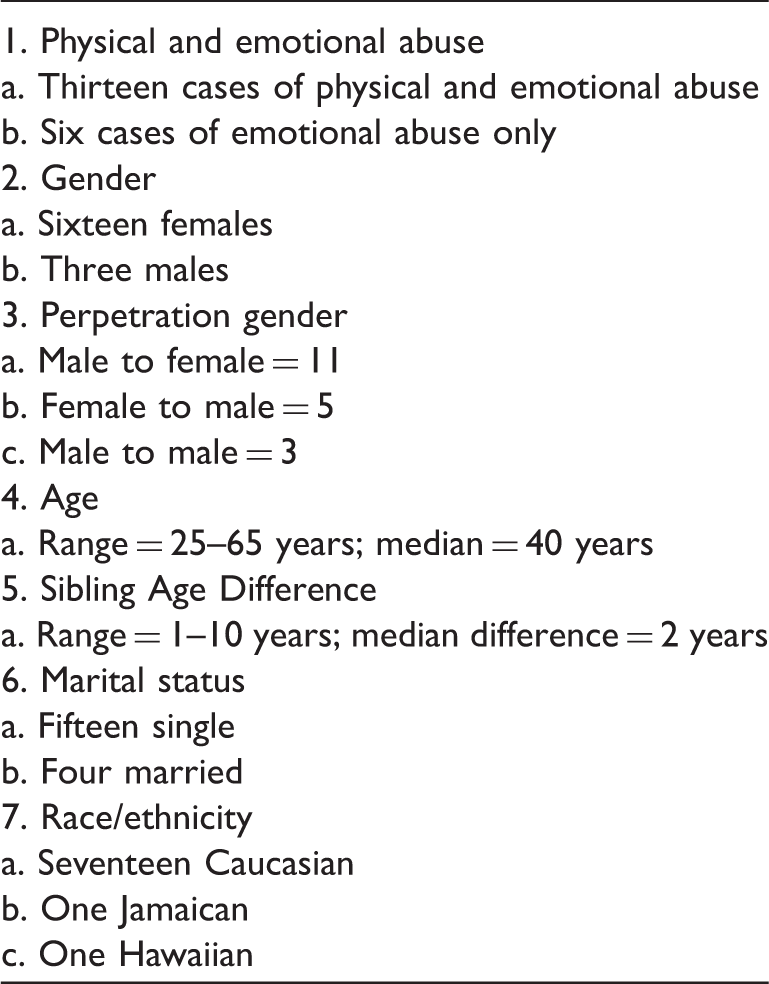
Characteristics of the participants.
Data gathering instrument
A semi-structured interview guide was constructed from an interest in learning how survivors of sibling abuse made sense of and internalized their experiences. It drew on sensitizing concepts from both psychodynamic theory and empirical research conducted to date on this subject. Family systems theory guided exploration around parental reactions to the abuse, the parental relational system, and factors that may have contributed to the evolution and perpetuation of sibling abuse.
Through a more open-ended nature of inquiry, participants provided rich and descriptive insight into their experiences. Emergent flexibility allowed subjects room to introduce material. I ensured coverage of important domains without overly directing the flow of the interview, a strategy that gave informants maximum control over its course.
Abusive experience and family climate section of the interview.

Data analysis
As the interview process unfolded, the researcher coded transcripts of the audio-taped interviews. Uncovering themes led to further revisions of the interview guide. The analysis took place in the context of existing theory and the findings from the literature. Although phenomenological analysis revealed the essence of the sibling abuse experience, a grounded theory informed analysis elucidated the ways in which the abusive experience shaped the development of specific relationship patterns. As well, variations in themes were determined regarding the family environment and parental responsiveness.
Units of meaning developed phenomenologically to produce expressed, unique meaning that represented the essence of the discourse through the scrutiny of every word, phrase, and sentence (Hycner, 1999). Examination of the nature of the responses determined a general sense of the meaning-making experience of sibling abuse. Analysis moved from reliance on the actual words of the participants to uncovering the layers of meaning and involved the selection of words or phrases that provide specific relevance to the research interest (Hycner, 1999).
Statements made by the respondents at various points in the interview were “clustered” to develop thematic material and memos helped integrate understanding of events and processes (Miles and Huberman, 1994). Successive readings contributed to further understanding and organization of the data as repetitive patterns emerged (Hycner, 1999).
The iterative process broadened the scope of emerging material. This analysis resulted in data-driven sub-themes and dimensions. Simultaneously, constant comparison incorporated into the phenomenological interpretation to organize and understand concepts that surfaced. This offered a path towards refinement and saturation (Bowen, 2006).
Sample size or representativeness was not relevant to the purpose of the research. Rather than generalize findings to larger populations of sibling abuse survivors, the aim of this study was to illuminate the world of the participants and produce knowledge about a unique phenomenon of the human experience (Holroyd, 2001).
Findings
Descriptors of physical and emotional abuse
The participants in this study identified sibling abuse as physical or psychological torment involving brutal physical force or emotional devastation. It created feelings of helplessness as victims were unable to protect themselves or gauge and anticipate actions that incited an assault. Abusive sibling acts engendered a pervasive state of fear and vulnerability; they resulted in hyper-vigilance and feelings of loneliness and isolation when it occurred and which endured into adulthood.
All of the survivors interviewed experienced physical or emotional abuse from a sibling for at least five years. The abuse often began when the victim was 6 years of age, but could begin anywhere from age 3–11. Several participants experienced abuse for as long as 16 years, from early childhood through late adolescence. Commonly, the abusive behavior continued until the abusive sibling moved out of the home, often around the age of 18. In some cases, the abuse continued into adulthood. Every participant expressed feeling terrified and powerless to stop the onslaught. Despite its consistency, the abuse was unpredictable. The period of maltreatment coupled with its severity contributed to the operationalization of the abuse experience as “enduring and intense” and was reflected through survivors’ descriptors of their sibling’s behavior as “a profound emotional hurt” that is “psychological torture,” “traumatic,” “debilitating,” “very damaging,” “tragic,” “devastating,” and “relentless.” Narratives revealing the critical incidents of abuse portray the overwhelming power exerted by one sibling onto another through emotional denigration or physical force: He would push me down and I would lose all my air and couldn’t breathe. He would slam the door on my fingers and break them. He’d hit me, punch me, slap me. I would lock myself in the bedroom and he still smashed the mirror, stood on top of my bed, held me down, and punched me – and I was black and blue for a long time after that. My brother had me touch this electric fence, it knocked me over, and he thought that was very funny. I was probably about four or 5 years old. He also put my head in a bucket of ammonia. He made me take a big smell of it and I choked and fell over. My brother would take out his misery on me – he would wrestle me to the floor and spit on me. He would hit me often and hang me out off the second floor balcony from my heels. I was scared he would kill me. I was helpless. There was nothing I could do to make him stop. I was so excited for my father to come to parent’s day at school. I was saying to my sister ‘I wonder if Daddy is here’. She said ‘he doesn’t love you as much as he loves me, he doesn’t love you much at all. In fact when mommy was pregnant with you he said throw it away, terminate it, destroy it. He didn’t want you. And he doesn’t want you now’.
Family environment and parental modeling
In the families of these informants, limited social and economic resources and marital strain made it difficult for victims to obtain critical support inherent to development. Parents were unable to model positive communication or manage interpersonal conflict and emotional turmoil productively. This inhibited their children’s ability to modulate their own emotional experiences and mitigate the effects of abuse. My dad was in the war and he learned to shut off his feelings. Any time I have gotten very emotional- like when my parents got divorced, I don’t know if it was said explicitly, but I was definitely not allowed to feel or mourn. It struck me how in my family we have this culture of not acknowledging pain, not acknowledging emotion.
Shared conditions of a chaotic, hostile, and unpredictable home environment engendered a desire among victims to bond with their sibling. Even so, the abusive sibling was not interested in forging a friendship; instead, they became assaultive.
The failure of a parent(s) to respond to the needs of the abused sibling compounded the effects of sibling abuse. Tamar described her mother’s emotionally and physically abusive behavior as a response to her cry for help. She said her mother would smack her when she complained of injury from her brother. “I was in the backyard once, and my brother was pinching and grabbing me so I smacked him back. My mother saw from the window and alluringly said ‘Tamar, come hoooome, I have something special for youuuu’ and then she beat the crap out of me.” Meanwhile, her father responded to her request for help by physically abusing her brother. This led her brother to take out his anger on her again, and Tamar would become a victim of his abuse yet again. Tamar failed to experience a holding environment and good-enough mothering (Winnicott, 1971). As a result, she lost all hope for protection from within her family.
Victims who encountered a passive response from parents had similar emotional responses to those whose parents were punitive. Rather than attributing limitations to their parents, children inevitably interpreted parental inaction as an indication that they did not warrant any help.
Child abuse
Parent–child abuse occurred in more than half of the informant’s homes. For some victims, parent–child abuse resulted directly from the sibling abuse. In other cases, it was inherent in the family system. In some instances, both children were targets, and the victim desired to bond with the sibling abuser. It would have been nice if the two of us could have formed a bond against all of the stuff that was going on around us. As a kid, Brett’s abuse of me felt like a betrayal—we were in it together with my parents’ abuse of us but he didn’t reciprocate the desire to bond. I loved him, and it felt crappy. I wanted to trust him. I worshipped her. There is nobody on earth I have more fun with than my sister. She is very funny, fun, playful. I never laughed so hard except with her. So when it’s good, it’s really good. But then she would flip. We would literally be playing and I would be having the best time ever and she would scream ‘Get out! Get out of my room!’ and start pounding on my head. What did I do to deserve that?! I idolized my brother. Even as I got older and started dating, I would always measure every guy to him. He was wild, funny, and handsome. He would come home, and I would want to hear all about his adventures and he would just walk into the room, shove me, and tell me to get the f*@# out. Every day was Groundhog Day. And stupidly, each time I would expect something different. I was completely humiliated – like a dog waiting to be pet and then kicked instead, tail between legs. My bubble just completely burst. He hated me. I mean, detested me. And I couldn’t figure it out. I just grew up assuming I was loathsome.
Child neglect
Participants related painful accounts of physically or emotionally absent parents. For these victims of sibling abuse, a passive response from parents had the same effect as a punitive one. Survivors reported that without effective parental intervention, they thought that they must have done something to provoke the sibling's abuse. Rather than attributing limitations to their parents, children inevitably interpreted parental inaction as an indication that they did not warrant any help. In actuality, the parents may have been unable to influence the abusive children’s behavior: There was no telling my parents about my sister’s abuse. When they came home, I was so ashamed of myself that I had swung first even if it was in self-protection. My sister told my stepmother that we had a fight and she said ‘you girls are really selfish – I wish that I could leave you alone for an hour and not worry that you are going to get into a fight and do something to the house’. There was no punishment for my sister and no alternative plan for me. It was as though it was our fault for being there. My mother would take me and my father would take my brother and pull us apart– and my parents didn’t protect me. They would say ‘the two of you … ’ And I would say ‘but my hand is broken’. To this day, my mother is in denial about it all. My parents’ response was ‘you provoke him … the two of you this, the two of you that’. It wasn’t really handled. It wasn’t acknowledged as anything other than sibling fighting. What is interesting is that occasionally my mother would overhear my sister screaming and cursing, step in, and say ‘you cannot talk to your sister that way.’ And my sister would continue doing what she was doing. She could not stand it that we were fighting but she sure didn’t handle it in any way that made it stop.
Survivors shared feeling unprotected and fearful of further repercussions when they informed a parent who was then ineffective or incapable of managing their sibling’s behavior. Taking action to recruit parental involvement led their sibling to feel betrayed and heightened the anger directed at the victim. When parents could not provide a safe environment for their children, it produced confusion among victims. They could not understand why parents had not protected them or even at times encouraged the abuse. They felt unlovable, and assumed they deserved the maltreatment. One night my brother came into my room, closed the door, stood in front of it so that I could not leave the room, and started yelling at me in an attacking manner. He wouldn’t stop. I yelled to my mom and said ‘Daniel won’t let me out’. She replied ‘I think he has important things to say’. I ran to the door and out of the house and Daniel came after me. I threw my keys at him but he tackled me. My mother came out of the house and her reaction was to go pick up the keys. He started dragging me across the street back to the house and I was yelling ‘Help, this is abuse’ … and no one helped. My brother would jump on my foot to break my toe
Favoritism
The informants in this study described parental preference for one sibling, as well as the limited physical or emotional availability of one parent, as a major contributing factor to the competition between siblings. When parents favored them, victims thought it fueled their sibling’s competitive and aggressive nature. Most, however, experienced their abusive sibling as the favored child. The bond between a parent and the abusive child had dire emotional consequences for the victim. In some cases, survivors reported a parent blatantly conspired with the abusive sibling to provoke maltreatment, while others experienced the favoritism in more subtle forms. Nonetheless, all of the survivors reported a perceived alliance between a parent and sibling increased their sense of worthlessness. We were at a party and my mother said to a friend, ‘the first one is always special, right?’ ‘Jack was always my favorite’. I remember looking at my brother Matthew, and he was like a deer in the headlights. I was thinking ‘didn’t he know that?’ Our whole life told us that. It was ‘Jack you are so smart, going to do great things in life’. Matthew got the “you are true blue and loyal and wonderful but kind of dumb’. With me, it was ‘you are a girl and girls get married’. My mother had a few miscarriages after I was born. When my brother was born, he was very ill. My mother would say to me ‘you know you have to remember Brett was a wanted child’ the indication being that I was not. In fact, she thought I was not really her baby. She though the hospital had gotten us mixed up and I was literally the wrong person, which sometimes I wish were true. There was always this thing about how wonderful Douglas was. He is sooo wonderful. The world revolved around him before I was born, and it still revolves around him. My mother stopped being social with my father and didn’t have any friends, so Douglas was like her best friend. They would exclude me and were actually cruel about it sometimes, patronizing me and rejecting me, and I never got old enough to be part of their relationship. That was extremely damaging.
Discussion
The 19 participants in the study shared their experiences growing up with their family and the complexity of their relationships with their siblings and parents. These survivors, like most siblings, innately desired a strong bond with their abuser, which exacerbated their experiences of abuse and the emotionally painful ramifications. Findings indicated that the abusive sibling relationship, intensified by the lack of parental responsiveness, has a significant effect on the victim’s self-esteem and resonates throughout adulthood. Internalized messages of inferiority and worthlessness contribute to challenges in perception regarding their experiences as real and valid.
Closed systems
This study revealed family dynamics that prevented most victims from seeking help outside of the family and these evidently are a factor in keeping sibling abuse under the radar. Because of parental emotional unavailability and unresponsiveness to the sibling abuse, victims felt alone and isolated. Informants did not bond with family members and they were insecure in their peer relations outside of the home. The closed family system is difficult to penetrate. It creates fixed parameters, which limit exposure to the outside world. Often, because of shame and embarrassment, victims kept outsiders at a distance which posed challenges for community members or peers to recognize the need for intervention. Victims who “successfully” recruited parents to intervene in the sibling abuse incurred punitive repercussions because their siblings retaliated. These factors may account for why sibling abuse as a form of family violence has received so little attention from researchers or mental health and child protection workers.
Parent–child abuse
This study has uncovered the presence of parent–child abuse in many of the homes in which sibling abuse persists. Yet, it is startling that there are no national statistics on sibling abuse. The claim made in the 1990s that sibling abuse occurs more frequently than parent–child abuse or spousal abuse (Graham-Bermann et al., 1994) remains unsubstantiated. In 2008, an estimated 3.3 million children were allegedly abused or neglected and underwent investigations or assessments by state and local child protective services agencies (Department of Health and Human Services, 2010). With the extreme numbers of children victimized by parent–child abuse annually, we can presume that there are copious cases of sibling abuse that continue to go undetected. It is difficult to discern the effects of sibling abuse from other co-occurring factors such as parent–child abuse. Although the findings regarding sibling abuse may not be pure, co-occurrence is in and of itself a critical finding, particularly to the field of child welfare. Future study of families involved in the child welfare system may provide further information about risk factors and agency-wide responses to sibling abuse. In fact, exploring child welfare from an evaluative lens may help to uncover the obstacles to the development of new policies around risk assessment and detection of sibling abuse.
Parent–child neglect
Not only was parent–child abuse present in the families of the respondents, but parent–child neglect was also an element in all of the homes. The absence of a parental presence and parent–child relationships characterized by favoritism, alliances, and role confusion led siblings to compete for scarce emotional resources without having negotiation skills to deter it from escalating into brutal conflict.
Parental neglect also occurred by virtue of the lack of parental responsiveness to the sibling abuse which overtly or inadvertently accepted or condoned children victimizing siblings. In addition, when abused siblings attempted to seek help from a parent, they became vulnerable to physical or emotional repercussions from their sibling or from a parent. Responses ranged from abusing the child perpetrator or even abusing the child victim.
Family systems theory has primarily addressed parent–child abuse and father–daughter incest (Caffaro and Conn-Caffaro, 1998), but not sibling abuse. All children become involved in the emotional process of their parents to some extent (Bowen, 1978). The current article approaches sibling abuse through a family systems lens which focuses on the interrelatedness among members of the family system and the processes between the family and its environment. It takes into account the parts of the system and the ways in which these parts influence each other and the whole system (Chibucos and Leite, 2005; Minuchin, 1985). The range of parental (un)responsiveness compounded the devastating effects of abuse from a sibling and shaped the personal values of the victim. The family’s construction of reality influenced how survivors thought families are supposed to function and affected the way they related to the outside world.
Race and class
Caucasian participants were overrepresented in this study. Since this study uncovered the presence of parent–child abuse in over half of the homes of the participants, and child welfare disproportionately involves black children and families, it is likely that there is a high prevalence of sibling abuse in black families. In this study, the representation of Caucasians may be due to where outreach was conducted (i.e. graduate school of social work). However, this may further reflect the underrepresentation of Caucasians in the child welfare system.
Survivors who reported being raised middle class were also overrepresented in this study and may not represent a random sample of sibling abuse survivors. Although middle class, they were impoverished by virtue of scarce resources, poor social capital, single-parent status, mental health issues, and economic pressures. Victims of sibling abuse who are Caucasian or do not live at the poverty level may be at high risk to remain in the background. Yet, often overlooked are potential victims of sibling abuse living in poverty and already involved with child protective services. Families living in poverty face inadequate educational resources and inadequate health care, and are at increased risk of family violence. One might assume that the participants in this study are connected to adequate economic and social resources by virtue of their middle class upbringing. However, the secrecy of sibling abuse and the closed family systems in which it occurs impede access to potentially available resources. Additionally, the lack of societal (and professional) awareness of the phenomenon prevents its detection for those cultures and classes of society with accessible resources.
Future studies should utilize recruitment methods that have the potential to capitulate greater cultural representation of the sibling-abused population and greater variation of class, gender, and employment. Most importantly, variations in perceptions of qualifying sibling abuse (Kettrey and Emery, 2006; Rapoza et al., 2010) highlight the need to develop a more concise definition and the development of policy delineating outcomes and consequences of its identification.
Implications
The study revealed the extreme emotional and physical danger to the victim and the depth of damage in both childhood and adulthood. Without current statutes that identify sibling abuse as a formidable phenomenon or that adequately differentiate sibling abuse from sibling rivalry, there is no measure for mandated reporters, social service providers, or mental health practitioners to protect children.
Currently, the only way to bring sibling abuse to the attention of authorities is for a parent to file charges against the abuser on behalf of the victim (Eriksen and Jensen, 2006). Most commonly, sibling abuse may be uncovered when investigation into parent–child abuse unwittingly surfaces such. Identifying family dynamics that pose risk of violence between siblings is imperative for child welfare workers. We may begin by being open to the perspectives and potential injustices experienced by all family members. We must broaden our assessment beyond parent–child relationships. And we must be mindful when interviewing family members that any perception of victimization is his/her truth.