




Abstract
This paper analyses how men who were delinquent as adolescents experience themselves as fathers. The men who took part in a longitudinal study, all in their 40s, had severe adjustment problems as teenagers, and thus have a past that causes uncertainty about their parenting abilities in the present. The paper analyses the men’s affective investments in their ways of being fathers. Four analytical categories that address the men’s fathering experiences were identified as significant in the interviews. First unsettling relations and distance from their own children, which for many of the men appeared as a recurring pattern that resembled the relationships they had with their own parents. Second, several men emphasised capacities such as personal traits or strength that made them able to make a break with the past. Third, the importance of support from others was also recognised, particularly being able to share parenthood with the children’s mother and for some, receiving help from child welfare services. Fourth, a key finding is that all the men, independent of whether they live with their children or not, experience a fragile point of balance, that is, incidents such as a relapse into drug abuse or a break in their relationship with the other parent strongly affect their relationships with their children. The difficulties these men experienced as youth intersect with their experiences of their own capacities as fathers in the present.
Introduction
Policy and research interest in fathers have been evolving over the last two decades, and there are now several studies within social policy, sociology and social psychology dealing with fatherhood (Braun et al., 2010; Featherstone, 2009; LaRossa, 1997; Lupton and Barclay, 1997; Shirani and Henwood, 2010). Recent studies show that expectations for men as parents have changed over the last century, from a traditional position of men as distant breadwinners to notions of fathers as equal, nurturing, emotional and committed parents (Halford, 2006; Lupton and Barclay, 1997; Shirani and Henwood, 2010). In northern Europe, the model of ‘contemporary fatherhood’ that emphasizes fathers’ active and emotional involvement in their children’s lives has ostensibly replaced more traditional ways of fatherhood and has become a culturally shared ideal (Halford, 2006). In Norway, the ‘involved father’, someone who establishes an emotional relationship with their children and takes care of them, is often asserted in discourse as the ideal, although research has revealed that real-life fathering practices are sometimes more fluid (Ellingsæter and Widerberg, 2012; Hennum, 2002; Stefansen, 2011).
Sociological, environmental and behavioural factors, as well as personality characteristics of the parent, have been shown to be central factors in predicting parenting behaviour within the social and human sciences. Expectations of fathers’ active involvement in their children’s lives have become more explicit, and fathers, like mothers, spend time with their children in one-on-one activities (Lamb, 2010; Lamb et al., 1985). Not surprisingly, men’s involvement as parents influences not only their relationships with their children but also the family as a whole (Jia and Schoppe-Sullivan, 2011). Previous research has investigated the long-term development of parental behaviours, and several of these studies indicate that confidence as a parent is connected to one’s own experience of security as a child (Abidin, 1992; Dallaire and Weinraub, 2005; Kretchmar and Jacobvitz, 2002; Schroeder and Mowen, 2012). Both fathers and mothers change throughout adulthood in ways that influence their emotional, intellectual and social capacities, which subsequently may influence the way they attune to their children and thus how they go about raising them. Other life events such as divorce, family structure and occupational changes, job loss or the onset economic distress have also been shown to alter paternal and maternal approaches depending on the stress caused by such events (Schroeder and Mowen, 2012).
The aim of this paper is to explore how men with a troubled start in life experience being fathers and their relations with their children. More precisely, the paper analyses how men with severe adjustment problems during adolescence and a troubled upbringing in families with a high level of conflict experience being fathers 25 years later. This study is the only qualitative study ranging for over 25 years conducted in Norway that has investigated how adolescents with severe behavioural problems have transitioned to fatherhood. The study is important because it contributes to knowledge about how fatherhood experiences are processed and made personally relevant and inextricably linked to the past. With this article, we add to the understanding and importance of the phenomenon of fatherhood, given the steady need for knowledge within this field. Fatherhood is a topic generally less explored than motherhood, and there is little knowledge about fatherhood experiences related to this specific group of men who had severe behavioural problems in their adolescent. The analyses presented are based on interviews with 15 men who at different ages became father to one or more children. Aiming to understanding the way social contexts and experiences are processed and made personally relevant, the paper draws particularly on psycho-social perspectives that view social realities and personal experiences as inextricably linked, specifically through the study of meaning-making from participants’ own perspectives.
In the next part of the paper, the theoretical perspectives known to be psycho-social that were used in analyzing the interviews will be presented. Following this, we will outline the study, methods and analytical strategies before turning to the analyses of the men’s experiences of themselves as fathers and their relations with their children. Finally, we will discuss the implications for social work.
Theoretical framework
Our theoretical and analytical interest was in investigating how the men in our sample experience and perceive themselves as fathers. Following recent psycho-social thinkers such as Hollway and Jefferson (2000), Rudberg and Nielsen (2005), Wetherell (2012) and Venn (2009) in using psychological/psychoanalytic and discursive perspectives ‘to inform’ qualitative interviewing in the analysis of our interview data, we explored how men with a troubled start in life experience fatherhood. We wish to advocate bringing together the perspectives mentioned above and especially focusing on ‘affect’ in the qualitative data analysis because feelings and affect were particularly communicated both explicitly and between the lines in the interviews.
Briefly, psycho-social theories cut across sociology, psychology and social psychology. These perspectives aim to bring an interdisciplinary understanding to theorizing the interrelationships between the emotional and the social within socio-cultural, discursive and psychological contexts. Wetherell (2012) describes the psycho-social approach as a desire to develop a pragmatic way of thinking about affect and emotion as bases for social research that unite the process between the individual and the social. For example, how men comprehend and approach fatherhood can neither be reduced to individual psychological and emotional aspects nor to social explanations such as structural or discursive mechanisms. Instead, a psycho-social approach enables the process of joining these explanations.
Similarly, Venn (2009) theorizes the psycho-social as ‘the affective machinery that binds subjects to particular socio-cultural complexes’ and outlines the challenges that are embedded in finding ways to theorize the interrelationships between the emotional and the social. Thus, attending to ways in which public discourse becomes a psychological reality for the person who experiences it should also address the ways that discourses generate feelings and affects, such as feelings of mastery, failure or of not fitting in.
All men who become fathers must somehow relate to prevailing notions of fatherhood and ideas about what ‘a good father’ is considered to be. The common denominators of the men taking part in this study suggest that their difficult past and social surroundings raise questions about how they will perform fatherhood due to their previous history that creates uncertainty. In addition to having to relate to current expectations of fatherhood, these men must find ways of dealing with the possibility that they will be viewed as fathers according to ‘who they were’ in their past. Their past may represent an imminent risk of causal explanations, meaning that their difficulties in meeting the expectations of a ‘good’ father will be explained in terms of their troubled past. This risk of being ‘trapped’ in causality, where failure or success is explained either as ‘according to’ or ‘despite’ one’s past, is an anchoring point in the interviews. Although not necessarily explicitly described, fears and insecurities of not being capable of being a good father for their children because of their past are thematized in a variety of ways in the interviews.
Methodology
Current study and method
This paper is based on a qualitative longitudinal study with 85 participants, 54 men and 31 women who as adolescences had severe adjustment problems (Helgeland and Waal, 1989; Helgeland, 2007, 2009). The participants were recruited through their participation in a state-initiated child welfare programme arranged to investigate alternatives to imprisonment for adolescents with antisocial behaviour such as truancy, criminality, prostitution, drug abuse and vagabonding. The project which was called ‘Alternative to imprisonment’ was an outcome of the Norwegian government’s desire to increase the minimum age for imprisonment from 14 to 15 years old. Instead of going to prison, the adolescents were moved to different kinds of child welfare initiatives. The participants were recruited for the longitudinal study and interviewed at four ages: the first when they were at the age of 14–15 (T1), the second when they were at the age 20 (T2), the third when they were at the age 30 (T3) and last around the age of 40 (T4). The first interviews were conducted through the child welfare programme Buskerrud project at T1 when the participants were 15 years old. After this, the interviews (T2-T4) were only part of the longitudinal research study and no longer a part of the welfare programme.
The study was approved by the ethical board in Norway at every timespan. After the state-initiated child welfare had ended (T1), the project leader was allowed access to the names of the participants for further research by keeping a list locked down with pseudonyms. At each timespan, the informants were also asked and had signed an agreement to be contacted again for possible participation in the next follow-up.
In the last interviews conducted when the participants had reached their forties (T4), 18 of the 54 male participants had passed away from various causes such as overdoses and suicides. Previous interviews conducted with participants who had died were not used. We were unfortunately not able to reach another 19 of the male participants within the time limit of this project. Two of the remaining 17 men refused to participate, which means that the study is based on interviews with 15 men. Thus: 54 men at T1 – 36 still alive at T4 – 19 out them were not reached – among the remaining 17, two refused to participate – i.e. 15 interviews.
The analyses presented in this paper are based on qualitative, in-depth interviews with 15 men who at the age of 40 had children. Their living arrangements differed: six men were living with their children on a regular basis, while five spent time with their children every other week or sporadically. Another four had experienced out-of-home placement of their children by the child welfare service. Of the 15 fathers, eight were working and seven were unemployed and living on social welfare benefits. Five of them suffered from different kinds of drug or/and alcohol abuse.
Most interviews were conducted in the private homes of the participants, but some at a café or workplace. The interviews lasted for approximately 2 h. They were tape-recorded and transcribed shortly after. The participants were asked to discuss parental experiences from their everyday lives, e.g. how they arranged a day with the children including morning rituals, taking them to school, leisure activities and evening rituals. If the men were not providing daily care, they were asked to talk about the last time they spent time with their children and to elaborate on what they did. The participants were also asked to reflect on how they perceived themselves as fathers following an interview guide (Gubrium and Holstein, 2001).
Analytical strategies
The analyses presented in this paper draw on data from retrospective qualitative interviews. In the initial analysis, every section containing fatherhood descriptions was coded under different headings. After carefully reading and considering different dimensions, attention was focused on the ‘whole’ narrative, the meaning produced, the links between parts of the accounts and the unsaid as well as what was said (Hollway, 2008). We paid particular attention to how the men drew on experiences from their own childhood when describing their perceptions of themselves as fathers in the present. When analysing the interviews, we became aware of the ways in which the men related to discourses on fatherhood, such as discourses on closeness between parent and child, parents’ responsibility to make their children feel safe and secure and notions of parental involvement in their children’s activities.
For the men, relating to such discourses involved processing emotions or affects that were expressed in the interviews. These were issues that were emotionally loaded, and which sometimes appeared difficult for the men to talk about. By carefully analysing the interviews, we became aware of four analytical categories that in different ways pointed to how the men experienced themselves as fathers and their relations with their children. Through the analysis, we were especially interested in the psycho-social investments that the fathers deal with years after being subjected to a troubled upbringing.
Findings
A fragile point of balance.
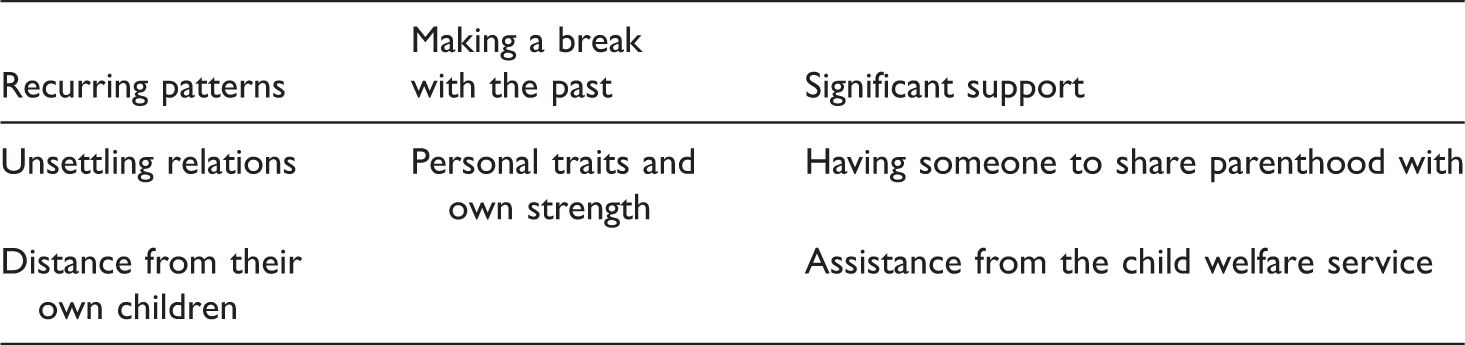
Recurring patterns
These patterns describe repeated unstable relations during the life course and complicated feelings imbedded in the fathers’ accounts.
Unsettling relations
When asked to talk about their experiences of fathering, the men often started to talk about their childhood and their relations with their own parents. This involved emotions related to their upbringing which for many were a sense of grief and feelings of a ‘lost childhood’. All the men were exposed to difficult living conditions and family relations early in life, and for some, these emotionally difficult relations with their parents continue into adult life. These parental relations were often linked to how the men perceived themselves as fathers in relation to their children.
Distance from their own children
To distance yourself from your children could be seen as a solution in the practice of fatherhood when you have explored the difficulties in your own childhood. One of the men, Lars, was brought up in a dysfunctional home where he was physically and mentally abused by his parents. His mother drank heavily and his father was violent. When interviewed at the age of 40, Lars was not married but had a girlfriend living with him in a cottage in the woods. He had one daughter from an earlier relationship. When recalling his childhood home and his relationship with his parents, he says in a sore tone of voice, ‘There were no boundaries, no control and love’. Lars was neglected at home and placed in several orphanages and foster homes before eventually moving into a treatment community at the age of 15. Describing how he recalls living with his parents evokes bitterness and resentment; things could be better today, he says, if he had received help earlier on: Lars: To live with my parents you mean? Well, if you have a psychopath as a father and then you have a mother who drank and was a shallow whore, well that was my life at home … we [his brother and he] both should have been living in foster homes from that moment on, because then it might have worked out well for the both of us. Lars: She [the mother] didn’t want me to have contact with them, but in the end it is my daughter, and she should know who her father is. So they came to see me during the summer. I didn’t like it at all. It’s been too long; it’s been eight years.
Another father, Johnny, has an additional way of exposing vulnerability connected to his past. Johnny came from what he defined as ‘a respectable home’, but beneath the surface were conflicts, violence and sexual abuse throughout his upbringing. Johnny felt he had a strained relationship with his parents and that he was always the one they blamed. Johnny was molested by an older brother, and near the age of 15 (T1), he was placed in a youth centre and later in a foster home. Looking back, he describes his behaviour as a ‘cry for help’ to get out of the unbearable situation at home: Johnny: I was beaten and always the one to blame for things … my mother and my brother, they always placed the blame on me … . I was also spanked sometimes by my father, too, but I think he felt pressured to do it, because he was the primary caregiver of the family. But he did actually have empathy unlike my mother who did not whatsoever. It’s kind of ironic that she actually worked with health care. Johnny: It’s terribly complicated with my daughter – she has experienced a lot. She had a mother who took her own life. She has had a hard time because of it. And maybe – I do not know – it has something to do with the fact that I have been relatively absent … but she was very rebellious. She did not respect us at all … . And when we argued, she began to cry and yell. It was like completely unprovoked. … Now I think she probably is angry. If I try to contact her now, well it’s just making things worse. … She has chosen it herself.
Most fathers had painful memories from their childhood involving abuse and neglect, and many described their relationships with their own parents with disappointment and resentment. Years after, many still find it difficult to hide the disappointment of being abused, betrayed or ignored. However, they are also disappointed about their relationships with their own children, and many feel they have been rejected and excluded from their children’s lives. These fathers seem to be unable to break the pattern of their own childhood experiences that position them out of harmony with ideas of what a father is expected to do. Being distant thus evolves as a recurring pattern for several of these men. They might be familiar with parenting discourses about closeness between parent and child and the parents’ responsibility to make sure their children are taken care of, yet it seems these fathers have problems meeting these expectations.
Making a break with the past
While many of the men describe their relationships with their own children as difficult and tense, a few of the men describe involvement with their children, making a break from the past and distinct changes from their own childhood. Different from their own relationships with their parents, they have developed strong emotional ties with their children.
Personal traits and own strength
Similar to Lars and Johnny, another father, Axel, experienced a lot of chaos and insecurity in his upbringing. However, Axel stands out as an analytical contrast to most of the other fathers. Axel has been married for many years to the same supportive woman, sharing the responsibility for their children. Coming from a well-resourced home with a violent father, Axel was regularly abused physically and psychologically. At school, he became a rebel and was into drugs and crime at an early age. Axel lived alone with his father for a while, but when he was 16 years old, he moved to a foster home. Comparable to most fathers, Axel expresses emotions relating to a difficult childhood. Yet, when talking about his three children, Axel emphasises his commitment to them and says he wants to do things differently than what he experienced in his childhood. For example, unlike his own parents, he is concerned about his children’s future plans in life: Axel: I get up in the morning, make four lunch boxes, and then I drive them off to school. … But you don’t want to do too much either. I heard a lot you know, and it’s not good to help them out in every single area. Then they won’t get independent … . In my case, when I got out of school, there were no questions of anything like that at all. I was not accepted to vocational school … I do not think I got in there. But it was because no one followed me up. Then again, it is perhaps not surprising when you are not on ‘solid ground’.
Axel links his success to internal stable characteristics: he is more offensive and keeps himself from being a victim. He is cautious not to let his past influence his relationships with his children. It appears as if the past of many of the other fathers has become an ongoing burden. However, Axel is proud of having managed not to repeat the pattern. He is being actively involved in his children’s lives and is providing for his family in ways that evoke harmony with the leading fatherhood discourse. Axel represents an analytical contrast to many of the other fathers, even though he also reflects a soreness connected to his childhood. His approach to fatherhood can be seen to reflect what may be called a ‘self-starter’ father, one who is proud and uses his vulnerability to ‘fight’ instead of ‘resign’ or ‘withdraw’: Axel: I have always managed on my own, all the way since I was a kid. I am a strong, positive man … Some know about my past, but it’s not something I brag about, although there is something good about having these experiences, at least in a way though … I don’t let the kids hang around in the town centre. What are they doing hanging around in the centre? They don’t need to be down there. It’s only a place for kids that don’t have a caring home, and no one who takes care of them.
Significant support
Important relationships in the fathers’ everyday lives such as with the mother of their children or their current wife/girlfriend or support from the child welfare services seem to be vital for how the men experience fatherhood. These relational ‘ties’ are important elements in their narratives of fatherhood, and they enable us to follow how these men approach fatherhood in everyday parenting contexts.
Someone to share parenthood with
An essential element for fatherhood appears to be having someone to share the responsibility with. One of the fathers, Erik, emphasises the significance of support from his children’s mother as an extensive help for his fathering. He was living with his wife and three children when we interviewed him. He had been abusing tablets for many years, had several criminal sentences behind him due to his violent behaviour and had recently started taking methadone on a regular basis. Erik has been married to the same supportive woman for 20 years. Despite his criminal behaviour and drug abuse, he has lived with his family throughout this time. He has maintained work and provided for his family, although his parental achievement is extensively supported by his wife: Erik: I was sick and it got really bad. I had a bad temper … And she [the wife] doesn’t tolerate any kind of drug. She is very clear about that. So then we crash … It is not like that [hitting], even though it has happened, but it’s really not like that. But my kids, they had a really hard time, and they had a bad experience … others might not see me being influenced by drugs, but she does, so she is very loyal towards our kids. She would not accept anything, and so after that, everything went through the child welfare services. It was like – either me or the kids for her.
Another father, Thor, is like Axel, very involved as a father, and he takes the leading parental role together with his children’s mother who represents the significant supportive other. The pride of managing to run a family life where things work out well and where the parents take part in their children’s lives is evident in several interviews. Thor had been living with his children’s mother for over 20 years and was doing well. He was working in his own business, providing and caring for his family in line with contemporary fatherhood expectations: Thor: I watch out, it is very important to do that. They have to have clear rules. First they have to do their homework. And I help them as good as I can. And after that my wife takes the rest of the night, making sure they don’t watch television or play with computer games all night. Simon: We have no particular contact at all. And that is as far as Helen [mother] is influencing it. And of course I have major problems with that. But I have decided to respect that, because I think it simply comes from Helen. Helen chooses to have stability and peace around them. And he lives with her.
Assistance from a child welfare service
However, relational support does not always have to be a next of kin. Child welfare services can also be essential external supports for managing fatherhood. Christian has extensive help from a child welfare service that has been a significant support to his fathering. Christian has been a dedicated caregiver living with his daughter and her mother from the day his daughter was born. Both parents receive social security benefits and extensive initiatives from the child welfare service to parent their daughter, such as parenting guidance, assistance in school, and weekend home and after school programmes. They received parenting guidance even before their child was born. Though Christian did not approve of being contacted by the child welfare service at that point, he displays gratefulness for it in retrospect: Christian: So the public nurse said that we should have assistance from the child welfare service before the child was born. We needed a special person there we could contact. But I said, excuse me, let me have my daughter first before you push us into something.
A fragile point of balance
How the fathers experience balance in their lives has an impact on how they manage to cope with their background and relational support from others. This overarching empirical category is thus all-embracing and influences the other categories presented so far.
Some fathers had problems with drug abuse. Such behaviours contribute to a sense of unsettledness, causing distress which disturbs their lives and confirms that they are not capable of being fathers in ways that are recognized and acknowledged as ‘good’. Michael, the father of eight children, was living with his wife and children as a family and had been an engaged father for 10 years when he was contacted at the age of 30. When we interviewed him at age 40, he was living with another woman, and the two of them were using methadone after abusing heroin for nearly the last 10 years. None of his children was living with him. They either lived with their mother due to a custody placement arranged by the child welfare service, or they had moved out and were living on their own as adults. Michael told us that he had started using drugs again after many years without taking anything: Michal: I guess one by one moved out then after a while. I had problems with drugs in my youth, and I didn’t start to use them directly, but I began to take sedative tablets in the evenings, because I was so tired after a long day [this was when he was living with all the children as a single father after his wife left him]. So I got relaxed at night and it calmed me down, but I should have known then that this was a vicious cycle to get into.
Conclusion
This paper has analysed how men who were delinquent as adolescents experience themselves as fathers. Common to the men is that they had severe adjustment problems as teenagers, and thus a past that creates uncertainty and insecurity as to how they will be as fathers. In exploring these processes, the paper has analysed the men’s affective investments in their ways of being fathers through different analytical categories.
Recurring patterns look at the fathers’ hurt feelings related to their own parents and how those feelings affect their relationships with their children, including such behaviours as withdrawing or keeping at a distance from them. It is reasonable to expect the next generation, the children of these men, to be in problematic situations based on the fathers’ stories. For some of the men, issues from the past seem to be unavoidable and emerge as a recurring pattern in their adult lives that effects their own children. However, as an analytical contrast, we have also seen that while many of the men describe their relationships with their parents and children as conflicted and tense, a few of them are actively involved in their children’s lives, making a clear break from the past and distinct changes in their way of being fathers. The fathers’ significant support demonstrates that important relationships in their everyday lives such as with the mother of their children, their current wife/girlfriend or a child welfare service appear to be central to how the men approach parenting. An essential element in fatherhood is having someone to share the responsibility or having help from a child welfare service. Support is thus fundamental for how fathering emerges and develops. A fragile point of balance represents an all-embracing analytical category found when exploring fatherhood among these men. We have seen that it overarches the other three analytical categories. Some fathers had problems with drug abuse. Such behaviour contributes to a sense of unsettledness, causing distress that disturbs their lives and confirms that these men are not capable of being fathers in ways that are acknowledged as ‘good’. It would be interesting to consider what picture would be given if, hypothetically, all the children of these 54 men were sought out and interviewed about the role of their fathers in their upbringing. What this study has shown, however, is that the analytical categories presented in this paper can be seen as tools for looking at how these fathers embrace fathering quite differently. The findings add to results of much previous work on fatherhood in social work. According to our theoretical perspectives, how these men comprehend fatherhood can neither be reduced to individual, emotional or psychological aspects nor to social explanations such as structural or discursive mechanisms (Hollway and Jefferson, 2000; Venn, 2009; Wetherell, 2012). Making changes is essential for fathers who want to break away from the past. The past, however, remains active in their capacities of being fathers.
A few fathers acknowledged the value of closeness between parent and child and making sure their children feel secure and taken care of. This involves feelings about the fathers’ own upbringing and how they influence present-day parenting practises. Exploring this processing is effective in the effort to understand fatherhood. The psycho-social approach looks particularly at affects that are evoked from the past and entangled in dominating and prevailing discourses in settings and contexts. Because this approach recognizes that affects are inextricably linked with ongoing meaning-making and discourses of fatherhood, it has made us aware of specific mechanisms that have had an impact on these men’s approach to fatherhood. The men are not only influenced by current expectations for parenting in the discourses of fatherhood, but they also carry with them emotions and vulnerability that are related to their past. They have to acknowledge that others, may be even themselves, raise questions about how they will perform fatherhood due to their previous history that creates uncertainty. The men in this longitudinal study might be predicted to have difficulties as fathers because of their own childhood experiences and troubled past, reflecting a typical causal understanding. Nonetheless, the analysis has revealed that these fathers represent a more complex reality. Overall, we have found that the men within this special group illustrate a picture that is more complicated and varied than a causal explanation.
This article argues that balance in life has a general influence on the fatherhood experiences in this group. Unstable relationships during the life course can cause complicated feelings that are imbedded and seen to affect the men’s accounts of fatherhood years later. Furthermore, support from significant relationships appears to be essential, and believing in oneself is fundamental. We argue that this analysis, with the uniqueness of the longitudinal study, is valuable because it allows for an understanding of the cultural context and interpersonal processes as well as providing a richer understanding and expanding the knowledge of fatherhood, specifically through study of meaning-making from the participants’ own perspectives. Following psycho-social theories has enabled us to see that these fathers’ parenting approaches are inextricably linked to their past, to their emotions and to different discourses. For the men, emotionally demanding processes have been seen as essential for investigating their experiences of fatherhood. The findings relate to the field of social work and may help in understanding the way that lack of support and care in one’s own childhood may be repeated in one’s own parenting years later.
Footnotes
Limitations
Some men between the ages of 30 and 40 who we did not manage to reach might have children. This is a limitation to the article. It is unfortunate that we did not manage to reach all, but we argue that the 15 interviews used in this qualitative, in-depth exploration were sufficient for our focus on one small part of the material in order to do an exhaustive analysis of the phenomenon of fatherhood.
Funding
The study was funded by the Norwegian Research Council and Oslo and Akershus University College.