




Abstract

Re-envisioning Central Bark
In April, local news media covered the opening of “Central Bark” at Detroit Metropolitan Airport (DTW) (Abbey-Lambertz, 2014; Osborne, 2014). DTW is the closest major airport serving my hometown, and Central Bark is a newly created spot inside the Delta airline terminal designated as a bathroom (or “relief area”) for dogs. The semi-enclosed space has patches of grass (both artificial and real), is adorn with red fire hydrants, and has a flushing system to rinse the entire area down. Plastic bags are available for disposing of solid waste and a sink for washing human hands.
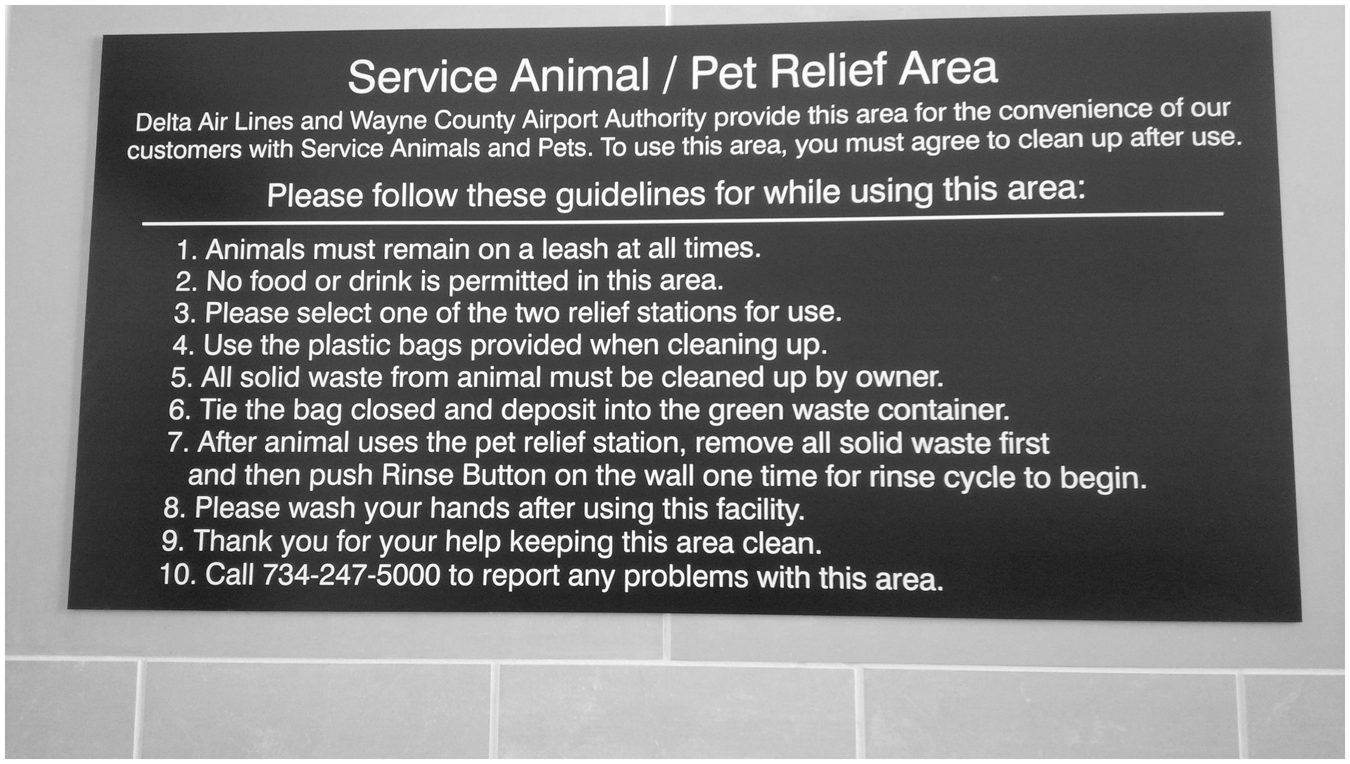
It seemed like such a novel—if somewhat frivolous—attraction that I urged my good friend, former colleague, fellow animal lover, and QSW reviewer, Debra Nelson-Gardell to visit Central Bark as she flew back home to Alabama after a conference at my University. “Send me a picture”, I begged. Deb rewarded me with no fewer than four images sent from her BlackBerry. Since it might be hard to imagine Central Bark, I include two of her photographs with this essay (see Figures 1 and 2). After all, a picture is worth a thousand words.
Grass Patch and Flush Button. Source: Photograph by Debra Nelson-Gardell. Central Bark Rules. Source: Photograph by Debra Nelson-Gardell.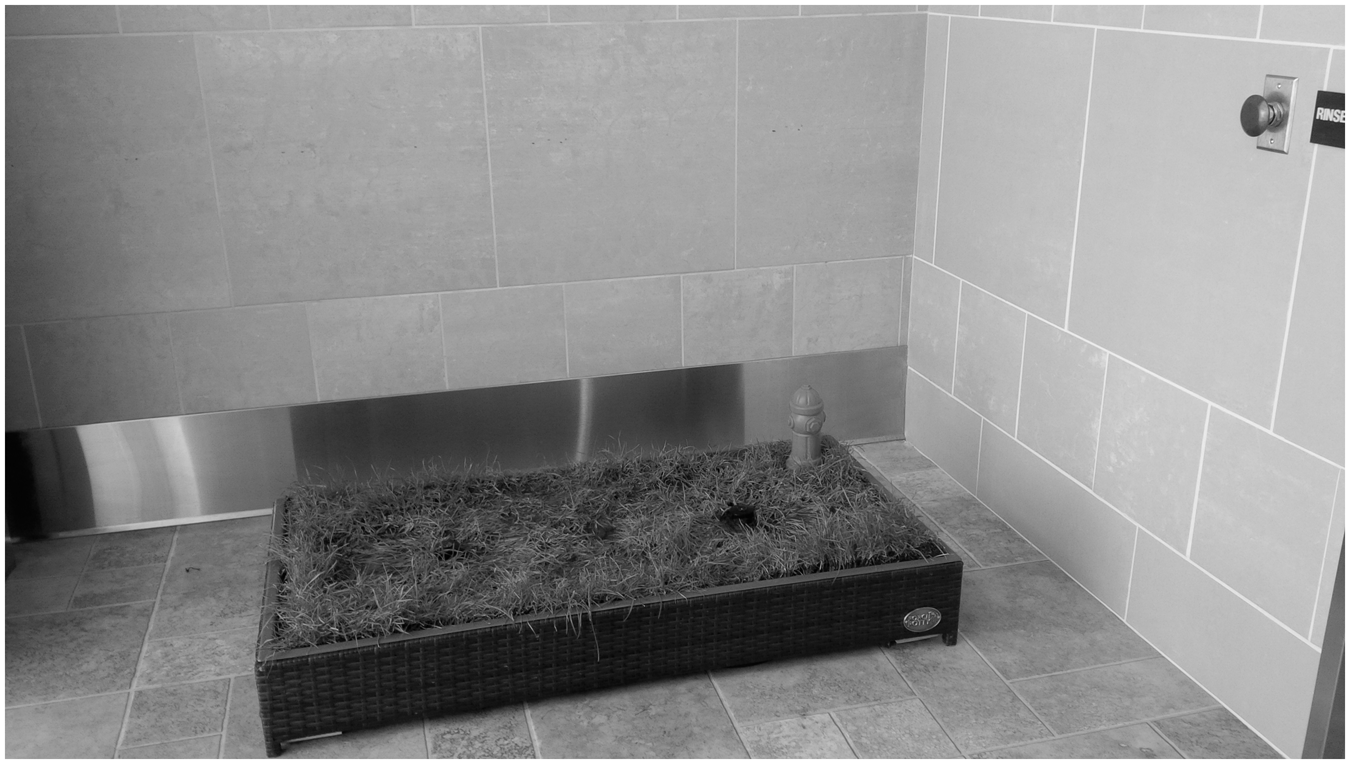
Aside from making a mental note of the opening of Central Bark, I hadn’t paid too much attention to the substance of the media articles. I returned to them, Deb’s images in hand, expecting to be entertained by some verbal fluff about pampered pets traveling with overindulged owners. I quickly sobered up. The articles focused, seriously, on service dogs.
In the United States, the American’s with Disabilities Act (ADA) is a piece of federal legislation, which prohibits discriminating against individuals with physical and mental disabilities. Among its mandates, the ADA requires that all public buildings be accessible. Since its original enactment in 1990, the ADA has transformed the architectural and public landscape in the United States in ways that are beneficial to all of us. An easy example is found in the rubber matted “curb cuts” (which I’ve learned are called “dropped curbs” in the U.K. and “kerb ramps” in Australia). Since the 1990s, as city streets were repaved or sidewalks replaced, curb cuts were added. Today, they are everywhere and are used not just by those in wheel chairs but by people with canes, walkers, baby strollers, rolling luggage, and shopping carts. Inevitably, bikers, roller bladers, and able-bodied pedestrians veer toward them as well. They make life one dropped step easier for all of us.
Similarly, federal regulations promulgated by the Nondiscrimination on the Basis of Disability in Air Travel. U.S. Department of Transportation, 2003 (located at 14 CFR Pt 382), require that public airports comply with a variety of rules ensuring access for individuals with disabilities. The regulations include sections on parking lots, airline terminals, and aircraft. There must be accessible pathways, inter-terminal transportation, and available service equipment.
The ADA limits the definition of “service animals” to dogs (although the DOT has a more expansive definition and includes other animals as well), “that are individually trained to do work or perform tasks for people with disabilities” (Service Animals, US Department of Justice). Of course, these remarkable dogs are trained for specific tasks, depending on the mental or physical disability of their owners, including guiding the blind, alerting the deaf, protecting those prone to seizures or anxiety attacks, retrieving things or performing other tasks for those with mobility limitations and the like. Obviously, service animals are not pets; they have serious jobs. In fact, service dogs are often a working extension of the person at the other end of the harness.
While federal law requires that airports be fully accessible for individuals with disabilities, relatively little attention has been paid to the needs of their canine companions. A number of U.S. airports direct people, traveling with dogs, to patches of grass or concrete located outside the airline terminals which are designated as “relief areas”. This means that during flight layovers, person and dog must exit the building and return through airport security again (presumably towing carry on luggage the whole way). So dogs, traveling through commercial airports, face a real problem when they fly. If their owner doesn’t have the time to scoot outside and return for another round of security checks, the dog must just hold on for the whole trip. As one supporter of Central Bark, Deb Davis noted, we would not expect a human passenger to do without convenient rest rooms during their trips, why expect it of dogs? (Abbey-Lambertz, 2014). It’s as if you bought an airline ticket but were told you couldn’t use the rest room, she argued (Abbey-Lambertz, 2014).
Of course, the traveling experience of a service dog can be generalizable to other canine passengers. This could include search and rescue dogs being transferred to the site of a natural disaster, police or military dogs being transported on commercial flights, as well as the family pet. Nonetheless, the case of service dogs is particularly compelling given U.S. federal law. In fact, not accommodating service dogs (or at least not thinking about their basic needs)—in addition to being cruel—is arguably an extension of discriminatory practices against the person at the other end of the tether.
I hadn’t really considered all this when I asked Deb to snap photographs of the relief station at DTW. I had seen it as a novel tourist attraction, a place for pilgrimage while passing through. However, as I considered the plight of a subset of travelers who are literally leashed together, I was forced to grapple with my own privileges and to recognize how they detrimentally colored my initial understanding. For example, I am able-bodied. I hadn’t paused to think carefully about what it’s like to travel without this privilege. I am a dog owner. I hadn’t thought seriously about what it is like to travel with an indispensible working dog, as opposed to a personal pet. Finally, I am human. I never considered what any of this might be like from a dog’s perspective.
My attitude toward Central Bark at DTW shifted dramatically. Rather than seeing it as a novel gimmick, it suddenly seemed to embody outside-the-box progressive thinking, a step toward greater inclusivity, and an example of cultural sensitivity and awareness. I don’t doubt it is also a good business move for Delta Air Lines, but that’s not incompatible with these other social justice objectives.
Invisibility in visual methods and methodologies
So why discuss Central Bark in this editorial? It is because I received those photographs from Deb as I was marveling over the trio of articles that open this issue of QSW. All three include stunning, and moving, photographs. Each of the authors used the images differently, and creatively, in their research designs.
In the first, Chapman, Hall, Colby, and Sisler used an existing set of photographs not only to facilitate difficult conversations but also to promote understanding among school teachers about the lives of the undocumented immigrant children in their classes. The photographs used by the research team chronicled the life of an undocumented immigrant family over time. However, study participants were asked to interpret the images before they were supplied with the actual human story behind the pictures. The subsequent exercise of making sense of the differences in initial perceptions and the actual lived experiences of the family raised awareness in the teachers about the plight of undocumented immigrants, and thus the students in their classrooms.
Second, in a narrative inquiry project, Sarah Kearns asked youth—those deemed in Scotland to be “at risk of social exclusion”—to pick images from a “set of 75 commercially produced photographs” that “tell you something about important times in growing up.” She further describes her methodology in the article, but my point is that the photographs were used as prompts, or tools, around which the youth were able to organize their own life narratives. Some of those photographs are reproduced in this article, along with captions written by the youth who picked them.
In the third article, Moshoula Capous Desyllas used a methodology known as photovoice. She sought to, “understand sex workers’ lived experiences through their own artistic self-representation”. So in this study, the participants captured the photographic images, and provided some interpretation of the pictures, themselves.
All three articles are absolutely wonderful. They each work against social exclusion. They all depend on photographs, not as extraneous accompaniments but rather as critical components of the research design. So the photographs are indispensible to the project itself and a necessary part of reporting. Reading the articles, without the images, would make little sense.
The juxtaposition of these ideas and images forced me out-of-my proverbial box.
Had I not been thinking about Central Bark as the background context for re-reading the articles, it would never have occurred to me to think about who might be excluded from participating. I wouldn’t have thought to ask myself, “what if the photos weren’t visible to me?” Of course these articles, as in any visual methodology, assume sight. This includes sighted study participants as well as a sighted reading audience.
As editor, it never occurred to me to note that the study sample included only “sighted” individuals. It never occurred to me to ask an author to render an image as a textual description, in order to make it more accessible and inclusive to the blind. I never considered “being able to see” as a limitation of the methods. It never occurred to me to think of these interventions or findings as not generalizable to the blind. Able-bodied participants and able-bodied reading audiences were taken-for-granted.
Please understand, this is not a criticism of these wonderful articles. In fact, it was the very powerful nature of the three manuscripts that gave me pause to consider how much I would miss if the photographs were not part of the presentation. Nor is this an attack on visual methods more generally. It is just that my Central Bark experience forced me to wonder about the exclusionary nature of qualitative inquiry and practice. Might there be study limitations that remain invisible to us because our own abilities are so taken-for-granted?
Alternatively, I wonder do we have any methodologies that are uniquely designed for individuals with disabilities? If we adapt or modify our able-bodied and healthful methodologies, are we doing so from our own taken-for-granted, able-bodied assumptions? In other words, do able-bodied assumptions permeate our accommodations? Or are we designing studies and asking questions from the actual perspective of the person with the disability? This may sound silly; but I thought Central Bark was silly too, until I backed up and challenged my own privileges. In short, I am asking of the qualitative research and practice communities: are we thinking as progressively and inclusively as Delta Air Lines?
In this issue of QSW
In addition to the three articles mentioned, this issue contains some additional gems. First, Gillian Ruch’s offering takes an unusual stance by looking at—and challenging—the benefits side in the oft-used, but simplistic, benefit/cost approach to research ethics which generally guides institutional research boards of ethics. She notes that ethic boards’ focus on prevention of harm and tangible benefits (such as cash or gift cards), often overlook the less tangible and sometimes unexpected benefits that can result from community-based inquiry. Ruch finds both intentional practical benefits as well as unintentional relational benefits in her research.
Second, Cecilia Lindgren and Karin Zetterqvist Nelson tackle the complicated nature of making sense of international adoptions from the perspective of those adopted. Noting the movement toward open adoptions, this research team seeks to understand how adoptees make meaning of their histories. Although the researchers are careful to ascribe their complex and nuanced findings to intercountry adoptees, I can’t help but wonder if they would find similar narratives from adoptees within a country as well. They sum up their findings neatly in the article’s title, “Here and now-there and then: Narrative time and space in intercountry adoptees’ stories about background, origin, and roots.”
Next, Maria Appel Nissen’s thoughtful article, “in search for a sociology of for social problems” begins a conversation that we will continue later this year when we publish a celebration of the life work of Noel Timms (Interview with Noel Timms, 2014). Nissen calls for the better development of a sociology of social problems for social work and she sees a special role for qualitative inquiry in that project. She examines both the potential, as well as the obstacles to, developing an integrated theoretical framework, in particular grappling with the nettlesome problem of generating sociological theories about society. Significantly, she argues that, “In the search for a sociology of social problems one must focus on how context is shaped theoretically in time, and how it is based on various ontological conceptions of the social.”
Finally, Mary Dallas Allen contributes to the literature on focus groups by conducting them via telephone, rather than in vivo, both in urban and rural settings. Presumably her implications would also hold true for other kinds of long-distance technologies such as Skype or live chats. Allen notes the potential of including “participants who are in geographically distant communities” with this kind of method of inquiry. This is a particularly compelling finding when you consider how overrepresented urban settings are in social science research where it is comparatively easier to do.
We close the issue with a provocative set of book review essays provided by book review editor, Mark Hardy. He tackles nothing less than “reckoning with realism”! Mark’s short essay is followed by three extended book reviews that do just that, reckon—one way or another—with realism and qualitative inquiry. In the first, Ray Pawson reviews Joseph A Maxwell’s book, “A Realist Approach to Qualitative Research” identifying the central challenge as wedding the fact that there is “a world out there that exists independently of our beliefs and constructions” with the researcher’s own conceptual frameworks and theories about the phenomena or context studied. Pawson concludes that the tome is, “elegant, informative and supportive” and the product of “an accumulation of many years of fine scholarship.”
The table is turned in the second review in which John Hudson reviews Ray Pawson’s book, The Science of Evaluation: a Realist Manifesto. Among other things, Hudson notes that Pawson outlines his own, “realist response to complexity.” Pawson, ultimately admits that knowledge is always going to be partial and remains uncertain. So what is a realist’s response to that? “Live with it.”!
Finally, in closing, Hannah Jobling examines, “Qualitative methods for practice research” by Jeffrey Longhofer, Jerry Floersch, and Janet Hoy. Again, these authors grapple with applying a critical realism approach to qualitative inquiry and forward an argument about its significance for social work practice. Taken together, these delightful book review essays, and the books they report on, extend long-standing scholarly attempts to “reckon with realism.”