




Abstract
Although research in partnership with older people has been slower to develop than that with some other service user ‘groups’, there are a growing number of health and social care studies that have involved older people as co-researchers. We build on this existing evidence by addressing two key areas. First, despite the growth of participatory research with older people generally, some groups tend to be excluded. We focus particularly on a project in which older people with dementia and older people from a black and minority ethnic community were involved as co-researchers. They worked with academic researchers in all stages of the research process, exploring other older people’s experiences of transitions between care services. Second, recent literature suggests a lack of critical evaluation of involvement, arguing that researchers tend to emphasise the positives on the basis of retrospective narrative accounts of the process, rather than critically appraising the impact of involvement. This article offers a critical account of the impact of a participatory approach at different stages of a research project, evaluating this from the perspective of different stakeholders. In so doing, we engage with incisive critiques which claim that, far from empowering service users, much service user involvement activity contributes to their oppression. We conclude that participatory research with marginalised older people has the potential to achieve meaningful change at both individual and social levels. However, in view of its dangers and limitations, we argue the need for the impact of participatory research to be carefully evaluated from the perspectives of all parties in the process.
Introduction
There is a growing body of literature on the engagement of service users and carers as active partners in the research process (Frankham, 2009; Repper et al., 2007; Staley, 2009; Turner and Beresford, 2005) and their involvement is now a requirement of key research funders. Although research in partnership with older people has been slower to develop than that with some other service user ‘groups’, a number of studies within health and social care have employed older people as co-researchers, working alongside academic researchers in different stages of the research process (see for example, Clough et al., 2006; Miller et al., 2006; Reed et al., 2006; Ward et al., 2012; Warren and Cook, 2005; Williamson et al., 2010). Co-research in this paper refers to research that is ‘done with’ or ‘by’ older people through active involvement in the research process rather than ‘to’, ‘about’ or ‘for’ them as research subjects (Fudge et al., 2007).
We build on this existing body of literature by addressing two key areas. First, despite the growth of participatory research with older people generally, some groups of older people, such as those with dementia or from racial and minority ethnic communities, tend to be excluded. We focus particularly on our experience of a research project where we established partnerships with these marginalised older people. Second, more recent literature suggests a lack of critical evaluation of involvement, arguing that researchers tend to emphasise the positives on the basis of retrospective narrative accounts of the process, rather than critically appraising the impact of involvement (Barber et al., 2011; Brett et al., 2010). This article explores the evaluation of impact from the perspective of different stakeholders, thus offering a more nuanced view of its benefits and challenges. In so doing, we take account of incisive critiques that claim that, far from empowering service users, much service user involvement activity contributes to their oppression (Carey, 2009, 2010; Cowden and Singh, 2007).
The value of a participatory approach
As a profession that promotes ‘the empowerment and liberation of people to enhance well-being’ (International Federation of Social Workers, 2001), social work is naturally inclined towards participatory approaches. However, whether participatory research delivers on these aims cannot be assumed; indeed, ‘there is a danger that the “moral” argument for participation obscures the practical implications and realities of involvement’ (Doyle and Timonen 2009: 259).
Roy (2012: 15) argues that participatory research, ‘does not unproblematically guarantee better data, improved understandings, democratising processes within communities or power-free relations between academic, communities and statutory bodies’. Similarly, McLaughlin (2009: 1604) observes, ‘Too often, successful service user involvement has been identified solely in terms of whether service users have contributed to the completion of a research project’. He argues that we should not apply ‘a softer touch’ when critically assessing participatory research just because it has been undertaken with service users, but that, to ‘keep service user research honest’, we need to maintain a critical focus on both its outcomes and the nature of its knowledge claims (1604).
The limited attention given to the impact of involvement reflects, in part, the difficulties of assessing impact (Robinson and Webber, 2012). These include: difficulties of isolating the influence of ‘involvement’ specifically; difficulties of capturing outcomes that often occur only in the longer-term; and the lack of resources available within project budgets to evaluate the impact of involvement (Staley, 2009). Fudge et al.’s
1
(2007) review of 35 research studies completed between 1995 and 2005 which involved older people as partners in research, found that most provided anecdotal evidence of the authors’ reflections on the impact of working with older people as co-researchers, but only two conducted a formal evaluation of the process (Dewar, 2005; Ross et al., 2005). Fudge et al. (2007: 499) conclude, Where evaluations were conducted they tended to focus on the benefits of involvement to those who participated in the research rather than on the benefits for research questions, processes and outcomes.
We now summarise the limited evidence of the outcomes of participatory research with older people, considering this in terms of impact on data, participants and researchers.
Impact on data and participants
Studies that address the value of service user participation place primary emphasis on the enhanced quality of the data obtained from service user researchers’ ability to communicate and empathise with the interviewees on the basis of common experiences (Miller et al., 2006). Warren and Cook (2005) found that, in preparing for the interviews, older co-researchers were more likely to know what to ask if they had shared similar experiences to the interviewees. Furthermore, the interviewees appeared to feel more relaxed and at ease with a ‘peer’ interviewer, leading to richer, fuller data. In similar vein, Williamson et al. (2010) give an example of a participant dismissing the intended academic interviewer as looking like his granddaughter and turning his attention exclusively to the older co-researcher! However, other studies have reported some drawbacks to co-researchers sharing similar experiences to the people interviewed. Interviewees may assume understanding on the part of interviewers and therefore feel less need to be explicit in their responses (Staley, 2009) and not all older people want to be interviewed by someone from their own community (Warren and Cook, 2005).
Some studies involve older people in data analysis, as well as data collection (Clough et al., 2006; Miller et al., 2006; Reed et al., 2006; Ward et al., 2012; Warren and Cook, 2005; Williamson et al., 2010). This can assist in: identifying themes and selecting those most relevant to service users; questioning and modifying researchers’ interpretations; and adapting ways in which findings are reported (Barber et al., 2011: 610). Miller et al. (2006) noted that co-researcher involvement in concurrent data analysis enhanced their understanding of the data, enabling them to ask more pertinent questions in subsequent interviews.
Impact on co-researchers
In addition to benefits to the quality of data produced, there is some evidence of benefits derived by older co-researchers themselves. Research involvement can give them a sense of purpose and satisfaction that they are contributing to important changes, as well as increasing their knowledge, skills and self-confidence (Fudge et al., 2007). Benefits may extend beyond the life of the original research if co-researchers become part of more sustainable research (Clough et al., 2006; Dewar, 2005). However, such sustainability is rare and it is more likely that groups dissipate after the research project has ended if further funding is not forthcoming. This may leave co-researchers feeling disappointed about not being able to fully utilise newly developed skills (Warren and Cook, 2005).
In evaluating the benefits to co-researchers it is important to engage with their perspectives, rather than making assumptions about what they wish to gain from involvement. In their community-based participatory research with older people in Dublin, Doyle and Timonen (2009) found that older people’s priority was seeing the research findings translated into action, rather than seeking extensive involvement throughout the project.
It should be noted that opportunities to benefit from research involvement are unequally distributed as a result of barriers such as culture and language, lack of skills in research, poor health and lack of resources (Fudge et al., 2007). There are also potential costs to co-researchers to be off-set against benefits, including the emotional impact of listening to the experiences of others and feelings of responsibility for prompting the recall of distressing experiences (Staley, 2009). However, there is also evidence that these factors can be minimised with effective preparation and support mechanisms (Leamy and Clough, 2006; Warren and Cook, 2005).
This paper adds to evidence about the impact of working with older co-researchers by discussing the evaluation of a project on care transitions which focused particularly on older people who are often bypassed by participatory initiatives. We used a co-research approach because it accorded with the research team’s value base of promoting involvement and inclusion (Ray, 2007); we anticipated that the formulation of knowledge from different perspectives would generate a deeper understanding of our topic (Glasby and Beresford, 2006) and that the participants would feel relaxed and provide a full picture of their experiences if interviewed by an older person who shared similar experiences (Warren and Cook, 2005). We use ‘participants’ to refer to older people and carers who were involved as interviewees, and ‘co-researchers’ to refer to older people and carers who worked with us in designing the methods, carrying out interviews, analysing the data and reporting the findings. In the remainder of this paper, we give a brief overview of the project and the co-researcher role before presenting evaluations of impact from the perspectives of the different stakeholders, identifying the stages of the research process where they felt involvement had the greatest impact.
The care transitions project
Four study sites in different areas of England each adopted a distinct focus on one group of older people whose perspectives are underexplored in research and/or for whom care transitions are likely to be especially problematic. These were older people: with dementia; from a South Asian community; living in a rural area; or living in an urban setting with a low population of older people. The research looked at experiences of either transition into or between dementia services or admission to and discharge from hospital. Participants and co-researchers were older service users or carers who shared recent experience of the same transition.
Twenty-two co-researchers (11 older service users and 11 older carers) were recruited across the four sites. In each site, the co-researchers received training, preparation and payment for their role. This spanned all stages of the study, including: designing the research method and tools; identifying key themes and findings at the analysis stage; selecting findings to feed back to local service providers; and presenting findings at feedback events. In total, 50 older service users and 25 carers were interviewed either once or twice across the four sites.
The evaluation
Summary of evaluation data.
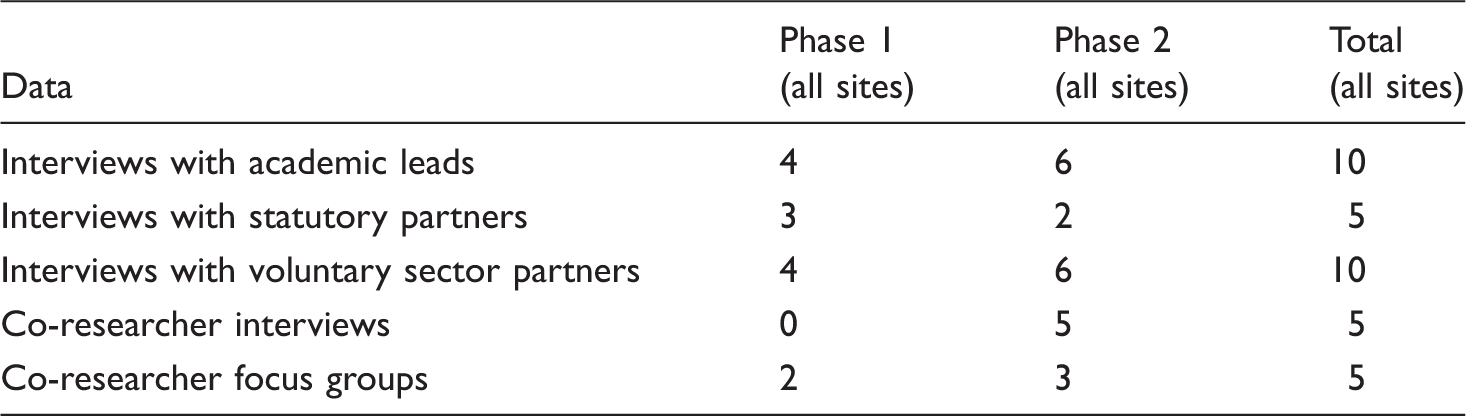
The study did not gather the views of research participants about being interviewed by another older person. We were limited in respect of timescale, budget and ethical considerations because evaluation of the co-research element was not built into the proposal at the outset.
Our interview and focus group schedules were guided by questions developed by the national organisation INVOLVE to review evidence of the impact of public involvement in research (Staley, 2009: 26). For all stakeholders the four main topics were: motivations to become involved in the project; experiences of being involved; views on the impact of having co-researchers in the study; and factors helping or hindering that process. All interviews and focus groups were digitally recorded and partially transcribed. Thematic analysis was used to identify recurring threads of meaning in the data; the purpose was not to generate theory but to ‘describe and understand how people feel, think and behave within a particular context and relative to a specific research question’ (Guest et al, 2012: 13). Two researchers independently identified themes in relation to each of the four topic areas outlined above before exchanging, discussing and agreeing on the analytic framework. In presenting the findings, quotations were selected on the basis that they amplified the theme and gave voice to co-researchers. With regard to the latter, we ensured that quotations included those by co-researchers with dementia, as well as carers. Although these may have been more limited in terms of verbal fluency and expressiveness, it was important to ensure that their contribution and voices were visible within the reporting of the findings.
Co-researchers’ perspectives
The themes from the analysis of both the interviews and the focus groups with co-researchers were highly consistent. Co-researchers saw the main benefit of their involvement as being to help participants feel comfortable in the interview situation and ‘open up’ about their experiences. Some saw this as resulting from the informal, conversational style they brought to the interviews. Others saw their proximity in age to the interviewee as important: I think they look at us and see we’re closer in age and think they haven’t sent a young whipper snapper to talk to us!
Where the interviewees were people from minority ethnic groups, having a shared language was very important: When they spoke in their own language, they felt comfortable to talk; they feel at ease and want to talk to you. Professional translators would not have been the same.
Many of the co-researchers talked about how the interviewees valued their shared experiences: Sometimes the carer would say ‘Did you find that?’ and wanted to know what we thought.
One co-researcher with dementia felt they helped the interviewee communicate more effectively: I was able to … reach out.
However, one co-researcher emphasised the significance of the capacity for empathy, rather than necessarily personal experience: [The research lead] is very empathetic and I believe they can fully understand the needs of the carers and users. Sometimes having had the experience can hinder the process. You come with your own personal baggage and that has to be dealt with. I’m not entirely sure that [the research lead] couldn’t have done this without us.
When analysing the data, co-researchers felt that their own experience helped them to understand the significance of issues from participants’ perspectives: Partly to do with the experience we’re all going through, perhaps you’re able to judge the authenticity of what other people are saying. You can say ‘Yes, this is what happens;’ a researcher could note it but someone who has experienced it puts a different understanding on it.
The overwhelming motivation for co-researchers to participate in the study was to ‘make a difference’ by improving services. They were therefore particularly eager to be involved in the dissemination of findings and implementation of change. The co-researchers felt that their way of ‘telling things as they are’ had some advantages: There’s a lot of politics in academic and council meetings but what we are, are straight talkers.
In each site, the co-researchers were involved in selecting interview extracts to present to service providers and managers at local feedback events where they read these selected quotations ‘verbatim.’ They felt that this made the findings more ‘real’ and ‘brought them to life’ and enabled them to highlight issues that were very significant to service users and carers but which could easily be dismissed as trivial by academic researchers.
In terms of the personal benefits of involvement, co-researchers referred to gaining knowledge, enhancing skills, developing networks and new opportunities for involvement. One co-researcher was invited to participate in a national reference group for a leading mental health voluntary organisation; all the co-researchers in one site became part of the research team on a follow-up project on the single assessment process; two of the co-researchers taught on a research module on a post graduate social work training programme and four of them worked with the academics on a follow-up project disseminating the findings of the research into practice.
A less tangible outcome of the co-research approach is the benefit that co-researchers derived from the relationships forged with one another and the academic researchers. Aside from the direct social value of interacting with peers and cooperating in and contributing to a shared project, there were also psychological and cognitive benefits. In particular, there is evidence that self-help and mutual support can help people with dementia preserve a positive identity (Clare et al., 2008) and this seemed to be the case for the co-researchers with dementia. The project helped them to own and affirm publicly their dementia identity in a way that they felt benefitted others, challenging negative expectations of both self and others (Tanner, 2012).
Statutory organisations’ perspectives
In all of the study sites, the statutory organisation representatives saw the co-research model as being a different and effective way of learning about the experiences of people on the receiving end of services whose voices would otherwise not have been heard. The feeding back of findings via the reading of narrative experiences was regarded as both powerful and refreshing: It added a lot more colour when we got the feedback than when we do it ourselves … . They give a much sharper message … . Some of our old ideas are a bit tired, paper surveys, customer satisfaction questionnaires.
There was acknowledgement that a different perspective might bring new ideas: We can start to do ‘out of the box’ thinking; when you hear things from people. We tend to over complicate things.
One manager recognised that the study was a ‘stark reminder’ of stories they might not otherwise have heard: Service providers often only want to hear positive experiences. Sometimes they want to close their ears to negatives. Now we’ve heard that sometimes the system is ramshackle.
The emotional impact of hearing individual experiences in participants’ own words (read by co-researchers) was emphasised by many of the statutory representatives. Some people who attended the feedback events said that they were moved to tears by some of the accounts, whilst others who read summaries of the findings, which included participant quotations, said that they could hardly bear to read them.
These face-to-face meetings between service providers and managers and co-researchers strengthened the accountability to service users and carers. The passion, conviction and clarity with which the co-researchers delivered key messages were seen as increasing both the authenticity and persuasiveness of the findings. As one service manager said, this was uncomfortable as it left them ‘nowhere to hide’ and also meant they had to acknowledge and address the issues raised.
In some areas the legacy of this model continues in on-going work where the agency has seen the potential for further work with the co-researchers. Indeed, one of the statutory organisations felt that the format of the feedback days could be used again in the future. However, there were some aspects of the co-research model that raised questions or concerns. Whilst two of the statutory representatives felt that participants may have been more open and honest with co-researchers as they shared similar experiences, another wondered whether co-researchers had led the discussion, seeking out experiences that matched their own.
Voluntary organisations’ perspectives
The voluntary organisation representatives agreed with other interviewees that the co-research approach had led to fuller and richer data. As the majority of the co-researchers had been recruited through the voluntary organisations, they were particularly aware of the positive impact of involvement in the research on the co-researchers, referring to gains in their confidence, knowledge, skills and social contact. The manager of the voluntary agency for people with dementia observed: (They) felt congratulated and validated. They found a new community outside the world of dementia. When people feel part of the world they can cope.
The involvement of co-researchers with dementia was seen as challenging negative stereotypes, both for people with dementia themselves, their carers and practitioners: (It) showed people there is life after dementia
The voluntary organisations acknowledged that where they had struggled to recruit research participants, the co-researchers had been able to draw on their wider links in the community. This was especially valuable in boosting the recruitment of participants from the South Asian community. The voluntary organisation representative pointed out that this enhanced their role, as well as the research, as it enabled them to extend their reach within the community, taking it ‘a step further’.
Like the statutory organisations, the voluntary agencies felt that the co-research approach added authority to the findings. However, they also saw this as a way of holding the statutory agencies to account. For example, one voluntary organisation manager had fed back to the statutory agency that the co-researchers felt let down that there had been no statutory representative present at a recent meeting to discuss the project findings, thus depriving them of the opportunity of a face to face meeting. Another voluntary organisation manager commented, I hope they’ll (co-researchers) be able to say ‘Come on [statutory agency], what have you done? ‘
The partnership approach adopted by the project was also seen as creating opportunities for dialogue between the agencies and the voluntary organisations felt that this was particularly valuable as the statutory agencies did not always listen very carefully to them.
Academic researchers’ perspectives
Academic researchers felt that co-researchers were sometimes sensitive to different issues. The research lead interviewing with a co-researcher with dementia felt that she focussed more readily on the feelings of the carer whilst the co-researcher ‘came at it from a different angle’.
In some instances, academics felt co-researchers were more adept at ‘tuning in’ to participants’ communications: In one situation I was struggling to make myself understood and get across the point that I wanted the person to focus on. [Name of the co-researcher with dementia] was able to do that in a way I wasn’t able to do.
However, academic researchers felt that there was a tension between the data generated through the interactions of co-researchers and participants in the interviews and the data required to answer the research questions. Research leads commented that they did not feel the co-researchers always had the skills to pick up on significant issues and explore them in depth so, in some cases: Some of the issues that surfaced were left hanging. I was left thinking you need to pursue this. But I never interrupted.
Although co-researchers had been given training in conventional interview methods, academic leads wanted to give co-researchers space to use their own skills and ideas. There was a resistance to trying to make them ‘pseudo-academic researchers’ since this would potentially undermine the specific and unique perspectives which they had been recruited to add to the study. This had direct consequences for the nature of the data gathered. For example, in the site working with people with dementia, there was much less information about services and much more about managing a life with dementia; in the site working with older people from a South Asian community, a prime focus was the nature of interactions with staff and how this made participants feel. None of the researchers commented on whether they saw this as ‘better’ or ‘worse’ data than had they conducted the interviews alone, but all acknowledged it was ‘different’, which in itself was part of the impact of working with co-researchers.
Academic leads felt that co-researchers’ contribution was particularly beneficial at the stage of feeding back the findings to service providers and managers. The use of real stories of transitions was a powerful medium for use in the feedback events, particularly when delivered by the older co-researchers themselves. One research lead summed up the effectiveness of the partnership between academics and co-researchers: The combination of me and them [co-researchers] seems to be a bit of a magic bullet in terms of impact. I do worry that if it was them on their own, their ability to access the key people in health to present to, at boards etc … they don’t operate in those sorts of environments … . Me standing up in front of a group of people saying this is what we heard, has no comparison to them saying it in the person’s words. Together we are quite a potent combination.
The participatory approach was seen as a strength of the research and a method that could be extended outside of the research context. As one academic observed: Another bit of the council is now getting interested in narrative interviews as an alternative way of collecting data. It’s like ripples, it’s starting to have a bit of influence.
Discussion
Whilst reports on the impact of participation are more likely to note the benefits than the limitations (Staley, 2009), it is nevertheless recognised that participatory research invariably incurs substantial additional costs, including researcher time to train and support co-researchers and the payments and expenses to co-researchers (Fenge 2010; Warren and Cook, 2005). This was undoubtedly the case in our project. There are also arguments that service user involvement in research represents ‘a different – and most probably more sophisticated – type of exploitation’ (Carey, 2010: 17) as service user discourses are appropriated and become a passenger on the vehicle of ‘welfare retrenchment’ (Cowden and Singh, 2007: 18). These two sets of issues – the practical and the ethical – demand that participatory research is examined critically in terms of both its processes and outcomes.
An acknowledgement of power differentials and a willingness to share professional power are fundamental to establishing successful research relationships (Ochocka et al., 2002; Schneider, 2010). Indeed, it is argued that participatory research is defined not by particular theories or methods, but by ‘who defines research problems and who generates analyses, represents, owns and acts on the information which is sought’ (Cornwall and Jewkes, 1995: 1668). In planning and carrying out the interviews, although the academic researchers were conscious of the power they held in terms of resources and responsibility for the outcomes, they invested considerable time and effort into promoting equality in their relationships with the co-researchers. They acknowledged the tension they encountered in the interview process between keeping the interview ‘on track’ and ceding control to the co-researchers to carry out the interview in their own ways. This tension is essentially between expecting co-researchers to employ recognised research skills on the one hand, and honouring and facilitating their unique contribution on the other (Reed et al., 2006).
More specifically, the academic researchers entered the field with reasonably clear expectations, based on previous research experiences, both about how a ‘good’ research interview should be conducted and also the type of information that was needed to answer the research questions. The co-researchers tended to adopt much more of a conversational approach, sharing their own experiences and views, and sometimes allowing the focus to drift away from the central theme of transitions between care services. Over time the academic researchers shifted in their understanding of the co-researcher role in the interviews. Rather than seeing it as about helping to extract ‘better’ information from participants, they came to see the role as more akin to a co-production of knowledge between co-researcher and participants. This sometimes left the academic researcher uncertain and uncomfortable about their own role and positioning in this process, as traditional roles and methods were challenged and compromised. In practice, each interview was different, with roles changing depending on the needs and preferences of the parties – both participants and co-researchers – and the dynamics between them. A key learning point was that if the research was to be genuinely participatory in practice, openness, flexibility, sensitivity and responsiveness on the part of the academic researcher were paramount requirements. This need for flexibility on the part of the academic researcher was particularly apparent in the case study site working with people with dementia and has been discussed more fully by one of the authors elsewhere (Tanner, 2012). Whilst there is a view that power will always be retained by researchers by virtue of their specialist knowledge and skills (Carey, 2010), this does not adequately take account of the complexity and fluidity of power relationships and the different ways in which power is manifested.
With regard to the presentation of findings, there was unanimous agreement amongst all parties in the evaluation that to have the co-researchers speaking the words of the participants was a powerful way of enabling, or compelling service providers to hear and register key messages. Many of the interviewees said there was ‘nothing new’ in the findings but, as other literature confirms, disseminating the findings in this way kept the older people’s stories intact and drew out meaning from the particular way in which the stories were told (Riessman, 1993). The narratives enabled practitioners and managers to identify with individual experiences and also to recognise the unique and diverse experiences, challenging any ‘one size fits all’ views (Reid et al., 2001). One of the service managers expressed surprise about the range of experiences – from very positive to deeply distressing – experienced by older people within one specific locality. This highlighted that the services accessed may be the same but the way these are delivered by key personnel is fundamental in determining people’s service experiences. This echoes McCabe and Bradley’s (2012) findings that the most important variable influencing service users’ experience of the quality of services is people. Presenting contrasting narratives from within one service locality was a potent means of conveying this message.
In terms of both the interview data and the selection and presentation of findings, our experience suggests that co-research can change the nature of the ‘evidence’ produced (Fenge, 2010). As Fenge (2010: 889) argues, participatory research, ‘demonstrates the resources and power within communities, who have been traditionally ignored and hidden, to lead research and knowledge generation about their lives’. However, she points out that participatory research can also suppress ‘variant truths’ (2010: 889). On a similar point, Roy (2012) warns of the danger of ‘imagined communities’, whereby researchers are accessing certain sectors of a diverse community but treating it as though it is homogeneous. Our co-researchers were recruited on the basis of sharing certain pre-defined characteristics with participants, namely older age, ethnicity (in one site) and experience of a similar care transition. This left vast scope for diversity between co-researchers and participants on other dimensions of difference. Co-researchers’ involvement in the recruitment of participants may have accentuated this as they are more likely to have recruited people similar to themselves in terms of certain social, economic and/or cultural parameters. We concur with Fenge (2010: 891) that ‘voices (emphasis added) can be silenced as well as enhanced by participatory methodologies’. For example, whilst one site focused on eliciting the experiences of older people with dementia, people with more advanced dementia and more severe cognitive impairments were not involved, either as co-researchers or participants. This may at one level confirm assertions that service user involvement ‘empowers those who expect to get the most in the first place, at the same time as it disempowers those with the lowest expectations’ (Cowden and Singh, 2007: 17). On the other hand, at a broader level the project achieved its aim of engaging with older people who have traditionally been excluded from research, that is, people from racial and minority ethnic backgrounds and people with dementia.
In relation to the voices that were included, obtaining evidence that the findings had a powerful emotional impact on service providers and managers is very different from demonstrating tangible changes in policy and practice that resulted directly from the project. This type of evidence is likely to take time to materialise; it is only now, several months after the conclusion of the research that we are starting to hear about specific changes in policy and practice that can be attributed to the research. For example, many of the issues raised in the site focusing on the experiences of older South Asian participants were about communication barriers. Following the research, a review of hospital interpreting services led to the creation of a Patient Feedback Volunteer role, with service users and local community members recruited to support patients to give feedback about their hospital experience.
On a more critical note, Harrison and Mort’s (1998) examination of organisational responses to service user groups is a salutary reminder of the need for caution in respect of evaluating the impact of service user involvement initiatives. They noted that although professionals and managers were ‘ostensibly overwhelmingly in favour of user involvement in general’ (1998: 65), they found reasons to be critical of the service user group activity and were highly selective in what they drew from it, disregarding certain views but taking forward those that were supportive of their own short-term goals and longer-term strategies. Harrison and Mort (1998: 67) observed that mechanisms of user involvement can therefore function as ‘technologies of legitimation’ for managerial agendas. Similar arguments have been put forward by Cowden and Singh (2007) and Carey (2010). There were glimmers of such processes in our research; for example one service manager talked openly about referring to our project findings when required to provide evidence of service user consultation. However, the fact that service user generated evidence was used to meet organisational and managerial requirements does not, in itself, preclude such evidence from also being to spur more radical ‘bottom up’ developments. Moreover, the processes employed can build capacity for further user-led activity.
We fully accept that some service user involvement may represent no more than tokenistic consumerism. At the same time, we share the belief that forging alliances with service users can challenge managerialist forces and promote more radical ‘knowledge’ and practice (Baldwin, 2011). In our research, for example, the conversations (rather than interviews) between co-researchers and participants shifted the focus of discussion away from service transitions and onto the impact of relationships with service providers. As one of the co-researchers with dementia commented early in the study, ‘When you say services, what you mean is people’. What mattered primarily was how they were treated by people and how this in turn made them feel as people. Whilst we cannot demonstrate this objectively, it is likely that interviews undertaken by academic researchers alone would have stayed much closer to the original research brief of exploring care transitions. Instead, the co-research model defined the issues in terms understood and prioritised by older people, namely the centrality of the relationships and human qualities in encounters with professionals (Beresford, 2011). As Beresford (2011: 15) goes on to argue, if social work is about advancing the rights and interests of service users, then we need ‘organisations, structures and activities’ in which ‘service users and their organisations are constantly involved and ever-present’, albeit via democratic, rather than consumerist, approaches. In this vein, research that claims to be ‘participatory’ may not be participatory at all in the terms defined at the start of this article. There is therefore a danger of rejecting participatory research for being exploitative and sustaining powerful minority interests when these are not problems intrinsic to participatory research, but rather reflect particular ways in which research may be generated, designed, funded and carried out. To allow participatory research to be summarily dismissed in this way is, we argue, as much of a threat to social justice and inclusion as not engaging with incisive critiques of its disempowering possibilities.
Conclusion
Our project findings, generated from an approach that worked closely with older people as participants and co-researchers, highlighted the significance of relationships and processes. Whilst this does not indicate a radical agenda in terms of major organisational or social change, highlighting the significance of micro-interactions for the quality of experiences of health and social care services and the impact on individual physical and psychological wellbeing may, nevertheless, ‘serve as a quiet revolution in shifting the balance of care’ (Ross et al., 2005: 274). Academic critics can, justifiably, accuse such research of supporting dominant discourses by drawing attention to micro issues about professional practice, rather than the need for institutional and organisational change. However, a counter-charge is that such critiques are in danger of discounting the experiential knowledge of service users about the significance of micro issues on the basis that they are victims of a form of ‘false consciousness’. In essence, a more powerful knowledge claim is then invalidating their experiential knowledge. Collective and shared understandings can arise from co-researchers working together on activities, such as making sense of research data and deciding which messages to present to service providers. This enables participatory research to move beyond being a form of surveillance and control of the individual subject (Carey, 2010) to affording opportunities for the development of critical consciousness and collective understandings (Leonard, 1997). It is these sorts of processes that Clare et al. (2008) demonstrate in discussing the impact of an internet self-help network for people with dementia; it helped participants to develop a shared social identity, challenging negative self and social perceptions, thereby contributing to social change. The emancipatory potential of this social dimension of participatory research requires further attention when evaluating its impact.
As academics and researchers we need to emphasise positive impact for our own interests and purposes; however, it remains the case that participatory research may have limited potential for social and political change on any significant scale. This is particularly the case for research commissioned by statutory bodies or ‘vertically-driven participatory research’, such as ours (Roy, 2012). In our experience, the motivation of older people to participate in research is largely about achieving change and making a difference. One question to be addressed is how far as researchers we should critically appraise the possibilities for change at the start of a project and discuss this honestly and openly with potential participants and co-researchers.
Even those who have delivered trenchant critiques of service user involvement conclude that we should retain a hold on its liberatory potential (Cornwall and Jewkes, 1995; Cowden and Singh, 2007) and that limited participatory initiatives are generally preferable to an absence of involvement (Harrison and Mort, 1998). As Beresford (2011:16) concludes, the fact that we cannot deliver ideal involvement ‘should never become an obstacle in the way of working for the best possible outcome’. Whilst measuring the extent or quality of the impact of co-researcher involvement remains illusive, we have, in this study, begun to explore the evaluation of impact from the perspective of different stakeholders. Our research has demonstrated some positive outcomes from a co-research approach with older people from the perspectives of older co-researchers, service providers and managers and academic researchers. We have also drawn attention to some limitations of the approach, both in the research processes and outcomes. Whilst we concur with others in advocating a cautious and critical stance when making claims for participatory research, both to those who are or may be involved in it and its end users, our final conclusion is optimistic. Co-research with older people can achieve change at individual and social levels through sustaining a sense of self, building confidence and skills, promoting affirmative social relationships and opportunities and challenging negative social attitudes. It can also challenge attitudes and change awareness amongst practitioners and service providers, prompting developments that shift services in more user-centred directions. More fundamentally, ‘participatory research is about respecting and understanding the people with and for whom researchers work. It is about developing a realisation that local people are knowledgeable and that they, together with researchers, can work towards analyses and solutions’ (Cornwall and Jewkes, 1995: 1674). Greater attention to evaluating the impact of participatory research from the perspectives of all parties will ultimately enhance both shared analyses and agreed or negotiated solutions.
Footnotes
Acknowledgements
We would like to acknowledge the vital contribution of all other members of the Care Transitions research team, including the co-researchers.
Funding
The research project referred to in this paper was funded by the National Institute for Health Research Service Delivery and Organisation Programme (Project No 08/1809/28).