




Abstract
A substantial body of theoretical work on meaning-making processes postulates that assisting clients in reconstructing their personal narratives in the aftermath of trauma helps survivors to integrate the traumatic experience into their identities and life stories. However, the relationship between trauma survivors’ (re-)construction of a coherent life narrative and their development of post-traumatic growth (PTG) has rarely been explored. In this study, I conducted life story interviews with 46 university students with trauma histories to examine: (1) How, and to what degree, trauma survivors (re-)construct a coherent life narrative; and (2) If and how this process is connected to the development of PTG. I found that survivors who were able to articulate a coherent story about their lives experienced more PTG, and I identified key characteristics of three stages of post-trauma change. I also found that trauma-related therapy, writing, informal conversations, and self-reflection played important roles in the narrative reconstruction process. I argue that some narratives are easier to reconstruct than others because not all narratives are equally valued in society. The presence or absence of narratives in the discursive environment, the reception these stories receive within society, and the access that individuals have to these narratives are influenced by the historical moment, social norms, politics, power, privilege, and individuals’ social locations. To promote empowerment and social justice, social workers should help trauma survivors to reconstruct their life stories, create spaces for the less-welcomed narratives, and engage in mezzo- and macro-level efforts to address social problems and inequalities.
Introduction
Narrative is critically important for both social work research and practice. Narrative assists social workers in generating knowledge, assessing clients’ needs and progress, evaluating therapeutic modalities, promoting trauma recovery, empowering marginalized groups, and pursuing social justice.
It is illuminating to examine narratives when they have been disrupted, requiring the narrators to recreate or reconstruct their life stories. A prime example of this occurs after individuals experience trauma. Following such disruptions, the processes through which narratives are created, structured, and performed become most apparent.
Symbolic interactionists have asserted that our interactions with our social environment, our reflections upon those interactions, our understanding of societal values, social norms, and others’ expectations, and our ideas about the identities we wish to “accomplish,” are an integral part of the process through which we develop a sense of self (e.g., Giddens, 1991; Mead, 1967). Far from static, this sense of self is continuously being shaped, evaluated, and reconstructed (Giddens, 1991; Polkinghorne, 1988).
Life course theorists have argued that life trajectories, once established, tend to simultaneously present and restrict various opportunities, thus maintaining that trajectory. Dramatic and jarring experiences—termed “turning points”—alter the probability of one’s life destination and open up new possibilities (Elder, 1998; Wheaton and Gotlib, 1997). This often involves substantial shifts in individuals’ identities, cognitive schemas, narratives, and life trajectories.
In this study, I examined how, and to what degree, trauma survivors (re-)construct a coherent life narrative. I also explored if and how this process is connected to the development of post-traumatic growth (PTG).
Background
A narrative-constructivist framework for understanding the impact of trauma
A constructivist epistemology posits that individuals do not merely internalize an objective external reality, but rather subjectively construct meaning from the “raw material” of their experiences (Neimeyer, 2001b). More than an individual process, the core structures of our sense-making apparatuses are shaped by the interplay of myriad biological, physiological, developmental, interpersonal, cultural, societal, and experiential variables.
Narrative theorists have built upon this epistemology by asserting that humans make sense of—or create meaning from—their lives by constructing credible, coherent accounts of the key events they encounter (Howard, 1989; Polkinghorne, 1988). This “master narrative” (Neimeyer, 2001b) is theorized to be central to humans’ identity-making processes (McAdams, 1993; Polkinghorne, 1988). Individual autonomy in constructing one’s life narrative should not, however, be overstated. Meaning is not constructed in a vacuum; rather, individuals draw selectively from a range of discourses validated by their families, social groups, communities, and cultures. Thus, individuals’ identities and life stories are perpetually shaped by historical, political, cultural, and social forces.
In daily life, the individual continuously encounters new events and situations that may potentially re-shape the story (and thus the self) and which either confirm or challenge the existing narrative (Polkinghorne, 1988). In most instances, new experiences are smoothly incorporated into the individual’s life story with minimal disruption to the master narrative. However, unanticipated, incongruous events—including trauma—may challenge the individual’s ability to create a meaningful account of life events and may be extremely difficult to integrate into one’s existing narrative (Neimeyer, 2001b).
Researchers have long documented that people coping with a wide variety of negative life events, ranging from cancer (Taylor et al., 1984) to the Holocaust (Frankl, 1959), seem compelled to make sense of the incident or find meaning in their experience. Neimeyer (2001b: 263) used a narrative-constructivist metaphor to explain this phenomenon: Like a novel that loses a central character in the middle chapters, the life story disrupted by loss must be … rewritten, to find a new strand of continuity that bridges the past with the future in an intelligible fashion.
Social work practice and narrative reconstruction
A substantial body of theoretical work on narrative and meaning-making processes postulates that assisting clients in reconstructing their personal narratives in the aftermath of trauma is a crucial step in helping survivors to integrate the traumatic experience into their identities and life stories (Calhoun and Tedeschi, 2006; Neimeyer, 2001a; Sewell, 1997). Numerous therapeutic modalities have been developed to facilitate the meaning-making and narrative reconstruction efforts of trauma survivors, including cognitive processing therapy (Resick and Schnicke, 1993), logotherapy (Guttmann, 1996), and narrative therapy (Freedman and Combs, 1996; Monk et al., 1997; White and Epston, 1990).
Researchers have documented that trauma-focused therapy is associated with increases in narrative coherence (Briere and Scott, 2006), which, in turn, is associated with decreased symptoms of post-traumatic stress (Amir et al., 1998), positive trauma recovery (Pennebaker, 1993), and increased general well-being (Stanton et al., 2002). Additionally, several well-controlled studies (e.g., Pennebaker, 1997; Smyth, 1998) have demonstrated that therapeutic journal-writing helps people to find meaning in adversity and enhances physical and psychological health. Moreover, Ullrich and Lutgendorf (2002) found that participants who wrote about both the emotional and cognitive aspects of their trauma experienced significant increases in PTG.
Post-traumatic growth: An overview
Post-traumatic growth, a construct first proposed by Tedeschi and Calhoun (1996), refers to positive life change following a traumatic experience. Often co-existing with elements of distress, PTG involves the development of individuals beyond their “previous level of adaptation, psychological functioning, or life awareness” (Tedeschi et al., 1998: 3).
Attempting to quantify the experience of growth following adversity, Tedeschi and Calhoun (1996) developed the Posttraumatic Growth Inventory, which measures five major domains of growth: (1) greater appreciation of life and changed sense of priorities; (2) warmer, more intimate relationships with others; (3) a greater sense of personal strength; (4) recognition of new possibilities or paths for one’s life; and (5) spiritual development. Other researchers have identified additional dimensions of growth, including improved cognitive and behavioral coping skills, increased personal and social resources (Schaefer and Moos, 1992), greater political awareness, increased assertiveness, independence, and autonomy (Burt and Katz, 1987), “psychological preparedness” for future adversity (Janoff-Bulman, 2006), maturational effects (Aldwin et al., 1994), and increased self-understanding (Burt and Katz, 1987; O’Leary and Ickovics, 1995). Many factors have been linked with higher levels of PTG, including receiving greater social support (Schulz and Mohamed, 2004), having the personality traits of optimism (Bellizzi and Blank, 2006) and extraversion (Tedeschi and Calhoun, 1996), and experiencing moderate levels of cumulative adversity (Jirek, 2011). Although positive transformation should never be an obligation placed upon traumatized individuals (Miller, 2007), it is nonetheless important for social workers to understand the positive post-trauma changes that some survivors experience.
In summary, a traumatic event throws a significant “plot twist” into one’s life story, threatens the narrative coherence of that story, challenges one’s sense of identity, initiates a “crisis of meanings” (Hagman, 2001), and may shatter assumptions about how the world works and one’s place within it. Trauma survivors must thus come to terms with their disrupted life narratives.
Paradoxically, trauma also provides individuals with an opportunity to revise their life narratives in positive ways (McAdams, 1993; Neimeyer, 2001b), redefine their identities and social roles (Hagman, 2001; Neimeyer, 2001b), develop more realistic and less shatter-prone schemas about the world (Janoff-Bulman, 1992), and experience personal transformation and PTG (Calhoun and Tedeschi, 2006; Tedeschi et al., 1998). As Calhoun and Tedeschi (2006) theorized in their model of PTG, if growth is to occur, survivors must engage in deliberate rumination—changing the cognitive schemas that have been invalidated by the crisis, and restructuring their life narratives to incorporate the trauma.
In this study, I examined: (1) How, and to what degree, trauma survivors (re-)construct a coherent life narrative; and (2) If and how this process is connected to the development of PTG. The relationship between trauma survivors’ development or reconstruction of a coherent life narrative and their development of PTG has rarely been examined through empirical research.
Methods
I define narrative research as an interactive process of storytelling, shaped by the immediate audience(s) and the broader social discourses, resulting in the production of co-constructed accounts which have sequence and consequence (Riessman, 2008; Riessman and Quinney, 2005).
Demographic and trauma-related characteristics by level.
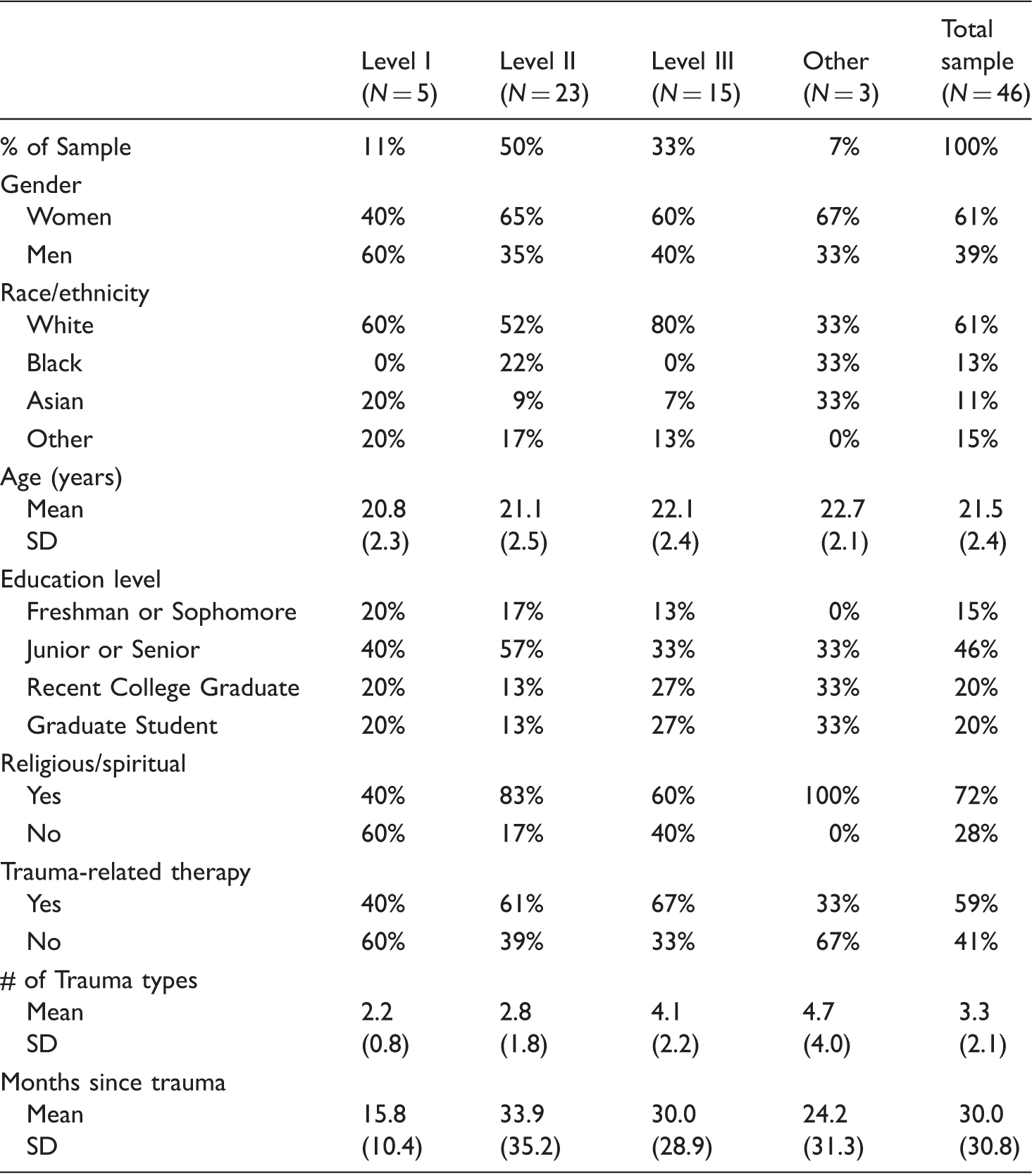
Note: Percentages may not total 100% due to rounding.
The in-depth, life story interviews lasted just over two hours, on average. I wrote detailed fieldnotes immediately following each interview. Interviews generally consisted of four sections: (1) an overview of the interviewee’s life story and major life events; (2) questions regarding the interviewee’s traumatic experiences, their impact, ways of coping with the trauma, and any experiences with helping professionals; (3) an exploration of the interviewee’s PTG; and (4) a wrap-up section that included questions regarding the interviewee’s future plans and additional topics that the interviewee thought were relevant. With respondents’ permission, all interviews were digitally recorded and subsequently transcribed verbatim. Ethical oversight for this study was provided by the University’s Institutional Review Board, all names used herein are pseudonyms, and potentially identifiable details regarding interviewees have been removed or obscured.
Data analysis involved a combination of thematic and structural narrative analysis (Riessman, 2008). Rather than fracturing interviewees’ accounts into thematic categories, I interpreted each life story as a whole and made comparisons across cases—looking for similarities and differences regarding topics gleaned from the existing literatures on narrative, trauma recovery, and PTG. I paid careful attention to the ways in which “the personal” linked with “the political,” particularly with respect to interviewees’ references to dominant discourses (Fraser, 2004). To systematically examine the relationship between trauma survivors’ (re-)construction of coherent life narratives and their development of PTG, I categorized interviewees with regard to the coherence of their narratives and the level of their PTG.
Based upon the research literature on PTG and an in-depth analysis of exemplars in my data, I identified three major characteristics of trauma survivors who exhibited high levels of PTG: (1) the individual experienced positive post-trauma life changes across a vast breadth of life domains; (2) the individual experienced positive post-trauma life changes to a great depth or degree in those life domains; and (3) the individual perceived the positive post-trauma life changes as being significant and meaningful.
Based upon the research literature on life stories and an in-depth analysis of exemplars in my data, I identified five major components of highly coherent post-trauma narratives: (1) the narrator articulated a continuous and detailed storyline, without constant prompting, regarding her or his life before, during, and after the trauma(s); (2) the narrator’s life story was intelligible, organized, and logical; (3) the narrator articulated a clear sense of self before and after the trauma—aware of both the continuity and the change of the self; (4) the narrator incorporated the trauma into her or his worldview or belief system; and (5) the narrator incorporated the trauma into her or his vision of the future.
Using these characteristics and components as a guide, I repeatedly listened to the interview audio files and read the transcripts and fieldnotes in order to categorize research participants as experiencing low, moderate, or high PTG and their life stories as having low, moderate, or high narrative coherence.
Findings
Analyses revealed that the sample could be divided into three categories: Level I included survivors exhibiting low narrative coherence and low PTG; Level II included survivors displaying moderate narrative coherence and moderate PTG; and Level III included survivors demonstrating high narrative coherence and high PTG. While not generalizable, approximately 11% of the research participants were best categorized as Level I, 50% as Level II, and 33% as Level III; 7% of the sample did not fit neatly into any category. 2 Table 1 describes the demographic and trauma-related characteristics of each Level in this sample.
To illustrate the characteristics of each Level, I present a case study of one exemplar per Level, highlighting aspects of her or his case that are representative of that Level as a whole. I also incorporate examples from other interviewees’ life stories to illustrate additional findings related to the roles of trauma-related therapy, writing, informal conversations, and self-reflection in trauma survivors’ narrative reconstruction processes.
Narrative coherence and post-traumatic growth: Three categories of trauma survivors
Level I—Individuals with low narrative coherence and low PTG
Mike is an 18-year-old, Caucasian student who had a “normal” relationship with his parents growing up. During high school, however, his family life became “erratic.” After a bout with cancer, Mike’s father became angry, drank heavily, and was harshly critical of Mike.
The major trauma in Mike’s life occurred during his junior year of high school, when his sister disappeared after she attended a sailboat race; three days later, her body was found in the water. Numerous questions surrounding her death remain unanswered. Mike imagines that she may have drowned accidentally, but he also suspects that she was killed by the man she was dating.
Since his sister’s death, Mike has struggled to cope with his emotions, primarily anger. Mike has never seen a helping professional and he neither feels the need nor desire to discuss his loss. Mike stated: I guess the person who brings her [his deceased sister] up the most is Tammy [his remaining sister]. Whenever I’m alone with Tammy, she always has something to say about her and it just surprises me that she always wants to talk about it or [is] able to talk about it. I just feel like I’m the one who wants nothing to say about it, forget about it.
Despite volunteering for a study on PTG, Mike acknowledged that he had not grown to a “great degree” in any area of his life thus far. Mike believed that the most important aspect of his personal growth was the fact that he had “handled” the difficult experiences in his life. He explained: “I’m still moving on, continuing on, so I’d say it’s made it clear that [I] can keep truckin’.”
Asked how he had managed to continue on with life, Mike responded: “Really just not stopping long enough to give myself too much time to think about it.” Mike might still be “truckin’,” but his worldview has become one of cynical resignation, summed up by his declaration: “life does suck.” When asked how he would ideally have handled this traumatic experience, Mike replied: I’d have to understand that that’s the way life works, I guess. Um, basically try to get over it. Suppress it, I guess. That doesn’t seem very healthy. I don’t know. There’s nothing I can do about it, so …
As the above quotes demonstrate, Mike’s basic philosophy on moving on after trauma was that one must adjust her or his thinking to incorporate the facts that “life does suck” and that that’s “the way life works,” suppress one’s feelings so that one can “try to get over it,” and then keep “going on with regular life” to avoid having “too much time to think about it.” Yet even as he articulated this formula, Mike was not convinced that it would work (hence one must “try” to get over it) or that this approach was “very healthy”—perhaps recognizing that these strategies had fallen short in his own life thus far.
Level I characteristics
To summarize, Level I trauma survivors, like Mike (as well as Cori, whose story is highlighted later), had not developed a coherent life narrative. They may have known who they were before the trauma, but they frequently did not know who they were afterward. They had difficulty articulating what happened to them and to their lives, or how it changed them positively and negatively. They usually realized that they had lost something big, but they did not recognize any gain from the experience. They had difficulty grieving their losses and moving forward. They sounded stuck, immobile, and at a loss for words. They were left with a worldview that was either depressingly cynical or completely in shambles. They did not know what to believe about the world, themselves, and others. They had a bleak or unformed vision of their futures and little sense of direction. They were often simply trying to survive their current, day-to-day lives. They had difficulty investing in others’ lives because they lacked extra emotional energy to give to others. They exhibited, at most, low levels of PTG in any area of their lives. In short, they seemed lost.
Level III—Individuals with high narrative coherence and high PTG
Jennifer is a 23-year-old Asian woman whose family moved frequently due to her father’s work. The major traumas in Jennifer’s pre-adolescence included being robbed and car-jacked at gunpoint, two incidents of inappropriate sexual touching, significant corporal punishment, and a home invasion and armed robbery at gunpoint. When Jennifer was twelve years old, her mother had a stroke that left her unconscious for several weeks. A few months later, Jennifer’s father had a heart attack that nearly killed him. With both parents incapacitated, Jennifer became the primary caregiver to her mother, father, and sister. She became “less of a kid”—more responsible, serious, mature, and focused. Jennifer quickly learned to manage the family’s banking, insurance, mortgage, and healthcare issues, in addition to innumerable ordinary household tasks.
Jennifer and her family moved to the U.S. when she was 16 years old. She struggled to learn English, work several part-time jobs, and continue caring for her parents. During her senior year of high school, Jennifer “started breaking down”; a psychologist identified her as being over-worked and suffering from depression and anxiety. In college, Jennifer found a counselor who helped her to reduce work responsibilities, focus more time on academics, and improve her self-care.
Jennifer has experienced substantial PTG. Recognizing that the future is uncertain, Jennifer tries to live each day with purpose and to interact with others such that she will not have regrets. Her growth was evident in her increased closeness with her family, her enjoyment of life’s little moments, her regular expressions of love toward those closest to her, and her efforts to be kind to everyone. Additionally, Jennifer’s experiences taught her that she is able to overcome much more than she thought possible.
Jennifer’s adversity also helped her to develop a clear vision for her future. Jennifer plans to become a medical missionary—working on international public health issues, helping the underprivileged, and giving people hope.
The most prominent theme in Jennifer’s life story was her Christian belief system. When asked how she made it through the adversity she faced, Jennifer pointed to her spiritual life as making the biggest difference. She stated: “I know that God loves me no matter what I’m going through, and that He’s gonna be always there for me, that He’s gonna be my strength.”
Not only has Jennifer’s faith helped her to feel loved and supported during the roughest times in her life, but it has also provided her with a way to create meaning amidst adversity. Jennifer explained: I always [thought] maybe there’s something that I can take out of this, and maybe He’s preparing me to be a stronger person for other people. Maybe because I went through this and I understand better, I can help others and I can be there for them, you know? So I just thought God [is] making me stronger, and just probably He has something great in store for me because I went through so many things.
Level III characteristics
To summarize, Level III trauma survivors, like Jennifer (as well as Neal, Hannah, Derek, Tracy, Lisa, and Leah, whose stories are highlighted later), had a highly coherent life narrative. They knew who they were prior to the trauma, how the trauma changed them positively and negatively, and who they were afterward. The individual’s identity before and after the trauma had continuity in many ways, and was different in other ways. These trauma survivors knew what they had gained and what they had lost. They appreciated the gains, grieved the losses, and moved forward with their lives. They had adjusted their worldviews, as necessary, to accommodate their new understanding about the world—a worldview that was neither naïve nor depressingly cynical, yet could incorporate traumatic events. They had a hopeful vision for their future and a sense of direction. Their future plans were often tied, in some way, to the trauma. Frequently, they developed what Herman (1992) termed a “survivor mission,” where they chose to devote their lives to helping other people who have been through similar experiences. Level III trauma survivors exhibited high levels of PTG throughout many areas of their lives.
Level II—Individuals with moderate narrative coherence and moderate PTG
Keanna is a 23-year-old African American graduate student, who was raised in the inner-city of a large urban area. Keanna has experienced numerous traumas, including child sexual abuse, an attempted rape, a major car accident, the paralysis of her best friend after a drunk driving accident, a close friend’s murder, and her cousin’s murder.
When asked how she coped with these traumas, Keanna explained that she prayed a lot, kept herself busy, put her energy into schoolwork, had “really good people” in her life as a support system, and told herself that “it could be worse.” Regarding the childhood sexual abuse, Keanna noted “I don’t think I dealt with it,” and she asserted that the area of sexuality in her life remains “a huge, complicated mess.” Keanna further stated: “Making new memories is a big deal ….‘Cause, eventually, the bad memories will get, like, smooshed to the back ‘cause of all the fun stuff.” In addition, Keanna observed that her mother and aunt served as role-models for dealing with adversity. Despite training to become a helping professional, Keanna has never sought counseling to assist her in coping with these traumas.
Keanna has experienced moderate levels of PTG in several areas of her life. Her traumatic experiences taught her that “life is short” and, therefore, precious. Keanna described her resulting sense of daily gratitude: Every morning I wake up and I just [say] ‘thank you, Lord.’ I’m awoke [sic]. I can see, I can walk, I can talk, I can hear. I’m getting in my car and my car started. I have a house [and] it didn’t burn down. Like, you know, just every little thing. I mean, ‘cause you never know.
Struggling to make sense of her life, Keanna oscillated between two somewhat contradictory ways of thinking about her experiences. She explained: Some days, I look at other people and I’m like, it’s just not fair! You live in this huge house in [a wealthy county]. Your parents are married. Your dad is a pediatrician; your mom is a lawyer. Like, you’re fine. You never wanted or needed for anything. You don’t have this sexual abuse past. Like, all your friends are fine. You guys have yachts and you’re living and you’re happy. You don’t realize that [other] people are struggling. And sometimes I’m like why was I born into this family that I was born into? I view myself as a part of something bigger. Like God has a plan for everybody. And so whatever His plan for me is, it means that I had to go through everything that I went through to be the person that I am now. And it’s gonna help shape whoever I am in the future.
Level II characteristics
To summarize, Level II trauma survivors, like Keanna (as well as Kristen, Joshua, Carrie, Alex, and Jesse, whose stories are highlighted later), fell somewhere in the middle of both the narrative coherence and PTG continua. In general, Level II trauma survivors were in the process of forming a coherent life narrative, but they had not fully accomplished this. They struggled with understanding who they were after the trauma and where their lives were going. They had difficulty grieving their losses or recognizing their gains. Their worldviews may not have made much sense, or they may have still been working through their questions about their belief systems. They usually recognized that they were moving forward, but they readily acknowledged that they were in the midst of a process of life change. They vacillated between feeling strong and focused, and feeling vulnerable, confused, and rudderless. Level II survivors demonstrated a moderate level of PTG in several areas of their lives. In short, their stories were complex, partially unformed, frequently contradictory, and definitely a work in progress.
The role of trauma-related therapy in trauma survivors’ narrative reconstruction processes
Several interviewees spoke at length regarding the important roles that helping professionals played in their processes of trauma recovery, cognitive and emotional processing, and development of a coherent, post-trauma life narrative. Neal, a 24-year-old, Caucasian, Level III trauma survivor was raised in a strict, conservative, non-mainstream religious group, which he referred to as a “cult.” At the age of 18, Neal chose to leave this community, which resulted in the loss of many relationships and the need to “rebuild” much of his life. He stated: “When I left the group, I had to start over completely. I had no sense of self. I felt utterly isolated.” Neal went through an “intense self-examination” process, during which he struggled with major depression. When asked how he rebuilt his life and coped with the trauma, isolation, and depression, Neal replied: Being able to identify what I would like to see different in my life, somehow seeing a glimmer of hope of making that thing happen, and then eventually starting to work my way out of it—something called cognitive behavioral therapy. I’ve always identified strongly with this idea that I can change my behavior and my thought processes. And CBT therapy is probably the biggest thing, if I had to sum it up. When I came to [the University], I went over to [the counseling center] and I did like three appointments with a psychologist there. And that was, like, really good. I mean there was lots of crying. It was the first time, though, that I’d ever talked about anything and then gotten anything out. And I just felt like there was a lot of, you know, release in that. I went to [the University counseling center] three times and saw a psychologist there. It was just nice to have somebody that I could tell things to who I knew wouldn’t tell anybody and just didn’t care if it was negative things. I had to talk to somebody about what I was going through because it was just driving me nuts and I had to figure out if what I was thinking in my mind made any sense, just to kind of help me work through things.
Although most interviewees (i.e., 21 of 27) who received trauma-related therapy found it to be beneficial, a handful—composed of four men and two women—did not. The most common reason for not viewing therapy as helpful was the trauma survivor’s belief that individuals have to solve their problems on their own. In sum, the data suggest that, for many trauma survivors, receiving trauma-related therapy helped them to process their emotional and cognitive reactions, articulate their traumatic experience(s), and reconstruct their life narratives.
The roles of writing, informal conversations, and self-reflection in trauma survivors’ narrative reconstruction processes
Although several interviewees echoed Derek’s reflections on the importance of therapy in helping them to “work through things” post-trauma, one-third of Level III survivors and 39% of Level II survivors developed at least moderately coherent life narratives and moderate levels of PTG without assistance from helping professionals. The three factors discussed in this section emerged spontaneously within the interviews, most often when participants were explaining how they coped with the trauma.
Some trauma survivors reconstructed their life narratives, in part, through writing about their experiences. Kristen, a Level II interviewee who attempted suicide, described writing’s role in her life: “Rather than getting worked up about it [difficulties in life] right away, I write. It’s kind of like I journal and write free-form, free-verse poetry. Actually, writing helps me a lot with that.” Similarly, Tracy, a Level III survivor of multiple traumas, explained how she began to cognitively process challenging life events: “I just went home and I spent like a week sitting around outside, and playing with my dog, and journaling a whole lot, and talking with my family, and crying all the time.”
Like Tracy, many interviewees also reconstructed their post-trauma narratives, in part, through conversations with family members, friends, or romantic partners. Lisa, a Level III survivor who had experienced multiple traumas, noted: “I’ve talked with enough people about it [the trauma] that it’s not new to have this conversation.” Neal, discussed earlier, also relied heavily upon his friends for assistance in maintaining his current life trajectory. He explained: There’ve been a couple times where I felt myself start to get negative and start to slide back. To make sure it doesn’t happen again, I will start talking. I will openly address the issues that I have. I learned that I need to have people in my life, friends that I can talk to, friends that have my best interest in mind. For the next month [after the assault], I sat in my basement every day. Didn’t do anything. Didn’t contact anyone. Went to work; came home. Watched movies and was in seclusion for about a month. That incident probably had the most positive effects on my life of any incident. It really took that incident to really wake me up and say, this is what you’re gonna do for the rest of your life. You know? You’re gonna go to college. You’re gonna get good grades. You’re gonna work hard. You’re gonna be honest. You’re not gonna drink. You’re not gonna do drugs. You’re gonna live a positive life from here on out.
Cultural narratives, collective traumas, and the discursive environment
The present-day U.S. is a society filled with pre-existing narratives that are widely available and readily understood (Plummer, 1995). In the current “discursive environment” (Frankenberg, 1993), there are numerous extant discourses, or cultural narratives, that individuals can draw upon when constructing their identities and life stories. Specific cultural narratives share numerous characteristics—including major characters, story arc, tone, themes, and resolution (McAdams, 2006; Plummer, 1995).
Some trauma survivors can connect their experiences to a larger, cultural narrative. For example, Jennifer drew heavily upon Christianity, which provided her with a positive life philosophy, comfort and confidence in difficult times, a framework within which to understand and give meaning to her experiences, and a ready-made script regarding how she should respond to adversity. In short, this cultural narrative buffered Jennifer from the ontological threat of having her pre-trauma assumptions about the world shattered, while also providing a “short-cut” in her process of reconstructing a coherent, post-trauma life story.
Leah, a 25-year-old, Caucasian, Level III trauma survivor, had a strong, non-religious philosophy of life: “That which doesn’t kill you makes you stronger.” She repeated this adage four different times during our interview. At age six, “everything changed” in Leah’s life when her mother was in a near-fatal car accident that left her “severely disabled.” Years later, during her first month of college, Leah was drugged and raped at a house party. Leah nonetheless referred to the following summer as being “cathartic” and transformational. She stated that she learned to enjoy spending time alone, gained self-confidence, and made a conscious decision “not to care what other people think” of her. Leah explained: I’ve always been really, really strong. And I’ve always been a firm believer of “that which doesn’t kill you makes you stronger” and to learn from everything. And as long as you like yourself now, then you shouldn’t regret anything because that’s what made you who you are now. And that’s pretty much what I live by.
Some traumatic events are experienced collectively, to some degree, by a society. Shortly after such events, a cultural narrative evolves. For example, Carrie, a Level II survivor of the attacks of 11 September 2001, compared her personal experiences, feelings, and interpretations regarding that day with those of other survivors in her social network. She also incorporated components she later learned through media coverage into her own account. In short, the cultural narratives that emerge from large-scale, collective traumas assist individual survivors in reconstructing a coherent life narrative.
Similarly, some traumas are experienced collectively, on a smaller scale, by a group or community; this, too, may prompt the development of a collective narrative. For example, Alex, a Level II trauma survivor, was driving a car filled with teen passengers, during his sophomore year of high school, when they were struck by a drunk driver. One of Alex’s close friends was killed in the accident. Alex recounted that “our group of friends was at his house the next day, with his parents and younger sister, and we were just kind of telling stories to, like, remember him.” Reflecting back regarding how he coped with this experience, Alex explained: I think that, like, that group of friends kind of bonded a lot from that and grew a lot closer. And I think that just being around those people who had gone through that with me was also comforting. Like, we didn’t always talk about him [his deceased friend], but if you felt like you needed to say something then you knew these people understand. And the memorial at the school was difficult, but it was kind of nice just because, like, you realize everyone there cared about him and is feeling his loss. The school was really impacted. And they even had like a big lounge at school the next day for people to just go if they needed time to reflect or, you know, talk about it. And I was, of course, a mess. [But] it didn’t take as long to heal from that [compared to the attempted rape she later experienced] because I was experiencing it collectively, you know, with a lot of friends who knew him as well and we kind of coped together. I mean, it was tough, but like I said we kind of healed together. [emphasis added]
Although there is an array of readily available cultural narratives within the discursive environment, not all narratives are equally valued or encouraged in a society. In fact, some stories have no accepted place in the discursive environment, are not validated, or are strongly discouraged. Cori, a Level I trauma survivor, remembered feeling “hollow” and “uncertain” after having an abortion, and she recounted having “bad dreams about making the wrong decision” about her pregnancy. However, other than confiding in her boyfriend (and in me), Cori did not feel comfortable talking about her experience. Jesse, a Level II trauma survivor, was sexually assaulted as a seventh-grader by his drama teacher. When prompted to discuss this trauma in the interview, Jesse was unsure where and how to begin; he later concluded his description of the assault by saying: “He’s [the teacher] an interesting guy. It was my fault—no it wasn’t, never mind, yeah.” And Neal, discussed previously regarding his experience leaving a religious “cult,” stated: “I always had a very difficult time talking about [it], you know. It took me years to figure out how to tell people about it.”
Whether currently or previously, these three interviewees struggled to put their traumatic experiences into words. Their narratives focused on topics that are relatively rare (in the case of Neal) or involved traumas (i.e., regretting one’s abortion, being a male sexual assault survivor) that are less validated in contemporary U.S. society. These examples also demonstrate that not every member of a society has equal access to all available cultural narratives. Rather, the presence or absence of narratives in the discursive environment, the reception these stories receive within society, and the access that individuals have to these narratives are influenced by the historical moment, social norms, politics, power, privilege, and individuals’ locations in the social structure (Plummer, 1995).
(The lack of) group-based differences across levels
When examining Table 1, there appear to be several demographic and trauma-related differences between the interviewees in Levels I, II, and III. To determine if any of these differences were statistically significant, I used a variety of inferential statistics (i.e., Fisher’s exact tests and Kruskal–Wallis tests, with post-hoc t-tests and the Bonferroni correction method, where appropriate). In short, there were no statistically significant associations between the Levels and gender, race/ethnicity, age, education level, having received trauma-related therapy, the number of trauma types, the age at first trauma, or the time since the (most recent) trauma. With a larger sample, however, group-based differences may become apparent.
Discussion
The primary finding of this study is that a significant relationship exists between narrative coherence and PTG among trauma survivors. The lack of demographic or trauma-related differences across Levels provides additional evidence that narrative coherence was an important factor in the development of PTG among this sample. Thus, narrative reconstruction appears to be an essential component of the trauma recovery process. While the phenomena of narrative coherence and PTG are both continua, it is nonetheless a useful analytical device to categorize survivors (i.e., Levels I, II, and III), so as to examine the key characteristics of various stages of post-trauma change. Moreover, this study also demonstrates that trauma-related therapy, writing, informal conversations, self-reflection, cultural narratives, and sub-cultural narratives play important roles in the narrative reconstruction process.
In contrast with the dominant, psychological lens typically used to research PTG, I argue that the social context—including cultural narratives, sub-cultural narratives, and the discursive environment—is a significant factor in the development of both narrative coherence and PTG. Just as most traumas are social problems, are the result of social inequalities, are experienced in socially patterned ways, and must be addressed at the level of social structures, institutions, and policies, so, too, trauma survivors’ narrative reconstruction efforts are social actions, that play a social role, and occur within a social context. This social context has real-life implications for trauma survivors and their efforts to reconstruct a coherent life narrative.
Implications for social work practice
At the micro level, a variety of therapeutic techniques aim, in part, to assist trauma survivors in reformulating their life narratives. Whatever the modality, after aiding survivors in establishing their safety (Briere and Scott, 2006; Herman, 1992), social workers should continue to help survivors to put their traumatic experiences into words (oral or written), to integrate the trauma into their life stories, to articulate their identities before and after the trauma, to identify the continuity and differences between those iterations of the self, to grieve the losses and commemorate any growth achieved, and to reconstruct a narrative that affirms the positive aspects of the self while also (re-)creating meaning in life and a hopeful vision for the future.
Traditional “talk therapy” is not the only route to narrative coherence, trauma recovery, and PTG. Therefore, practitioners should continue to develop creative techniques (e.g., writing a blog, creating a video) that may appeal to diverse populations. Clinicians should also encourage trauma survivors to engage in informal conversations, self-reflection, and writing about their life stories. Additionally, social workers must work diligently to open up spaces for the less-welcomed stories in our current cultural milieu and to validate clients’ emerging narratives. Nurturing such narratives is an important step toward empowerment and social justice.
At the mezzo and macro levels, social workers should promote social interventions and social reform—with, and on behalf of, vulnerable and marginalized populations—at the community, state, and national levels. Social workers’ roles may include engaging in community-based education initiatives, community organizing and outreach, program development and evaluation, policy analysis and advocacy, and lobbying for systemic social change. These large-scale efforts are crucial for addressing the social problems and inequalities that are the root source of many clients’ traumas and that hinder the process of narrative reconstruction.
How does gathering and interpreting narrative data generate knowledge in social work?
On a micro-level, this study demonstrates that the narrative data of trauma survivors reveal individuals’ degree of trauma recovery and PTG and, thus, the scope of remaining therapeutic work. Survivors’ narratives can also help social workers ascertain which therapeutic modalities are most effective in narrative reconstruction with specific population groups. Narrative data are, therefore, useful, for practitioners, for assessing client progress and stages of treatment, and, for researchers, for evaluating and making comparisons across modalities.
On a macro-level, this study suggests that gathering and interpreting narrative data illuminate which narratives are validated by a culture and which narratives are absent, discouraged, contested, or rejected. As a discipline that values social justice, groups that are marginalized, and voices that are stifled or disregarded by society, it is of paramount importance that social workers pay attention to the narrative gaps and silences, the unpopular narratives, and the narratives of the disenfranchised. These narratives (or their absence) generate knowledge that should inform our research, teaching, and practice.
Conclusion
There are limitations to this study that should be considered when interpreting the findings. First, because this research project was explicitly designed to explore the life narratives of young adults who, because of their educational accomplishments and self-identification of personal growth, might be considered the “success stories” of trauma recovery, this sample is not necessarily representative of the larger population of trauma survivors. Future research is needed to examine the narratives of trauma survivors who are older, less privileged, less educated, or lower functioning.
Second, it is important to note that some scholars have critiqued the assumption that narrative coherence is necessarily a positive or desirable characteristic in individuals’ stories (e.g., Freeman, 2000; Hyvärinen et al., 2010; Sartwell, 2000). For example, Hyvärinen et al. (2010) argued that this “coherence thesis” privileges Western, male, Caucasian, and middle-class discourses and practices, while also minimizing complexity, discouraging creativity, and excluding deviating experiences. Although a significant relationship exists between narrative coherence and PTG among trauma survivors in this sample, one must be mindful regarding how narratives are socially situated. Specifically, these narratives were constructed by (primarily) U.S.-born, highly educated, high-functioning, middle-class students in the early twenty-first century United States. Future research, with less privileged and non-Western samples, is needed to examine the relationship between narrative coherence and PTG in other social contexts.
Third, due to the limitations of cross-sectional data, this study cannot definitively demonstrate that Levels I, II, and III are progressive stages of post-trauma change, nor can it determine the precise nature of the relationship (e.g., sequential or, more likely, co-constitutive) between narrative reconstruction and PTG. Finally, it is noteworthy that I used an interview format that encouraged interviewees to emphasize their trauma recovery and PTG. Through this process, research participants may have reframed their life stories in more positive, linear, coherent, and future-oriented ways. Indeed, several research participants commented that they felt better about themselves and their lives after the interview. Inevitably, the research process is shaped by myriad logistical, personal, interpersonal, cultural, and political factors which influence and are integrated into the narratives of our research participants.
In conclusion, trauma disrupts individuals’ life stories, spurring trauma survivors to attempt to reconstruct a coherent life narrative. This is a vital part of trauma recovery and the development of PTG—processes in which social workers may play a significant role. However, some narratives are easier to reconstruct than others, which raises important issues regarding privilege, empowerment, and social justice. In short, post-trauma narrative reconstruction highlights the significance of narrative in social work and is a fruitful area of inquiry for practitioners and researchers alike.
Footnotes
Acknowledgements
The author would like to express her deepest gratitude to the forty-six trauma survivors who participated in this research project, to Daniel G. Saunders for his thorough feedback on an earlier version of this article, and to Nathan Passavant, Karin Martin, Beth Glover Reed, Jeffrey Morenoff, and P.J. McGann. The author also thanks the two anonymous reviewers and the special issue editors for their insightful feedback.
Declaration of conflicting interests
The author(s) declared no potential conflicts of interest with respect to the research, authorship, and/or publication of this article.
Funding
The author(s) disclosed receipt of the following financial support for the research, authorship, and/or publication of this article: This work was supported by the University of Michigan’s Horace H. Rackham School of Graduate Studies, School of Social Work, Department of Sociology, and Center for the Education of Women.