




Abstract
There has been a great deal written in recent years about the complexities of social work decision making and the need for a more ecological conceptualisation of the decision-making task in child welfare and protection. This article outlines some of the findings from a PhD study of secure accommodation decision making in Scotland which sought to understand the dynamics of local social work decision making in cases where children and young people pose a significant risk to themselves and/or others. Observations of decision-making meetings, interviews and focus groups were used to develop a multidimensional perspective on decision-making practices in one large urban local authority. Professional relationships were found to impact on information gathering, ‘thinking through’ decisions and managing emotions, ‘working’ the decision-making system to the benefit of your referral and having your assessment accepted by others. Trust emerged as an important quality in relationships between professionals who share decision-making responsibilities. Drawing on theories of trust, relationships and decision making, the article challenges the dominant rational choice model of social work decision making and develops new links between theory and practice by highlighting the importance of understanding the impact of professional relationships when seeking to improve social work decision making. The article also emphasises the need for further research to enhance our understanding of the multiplicity of ways that professional relationships can impact on decision-making practice and its outcomes.
Introduction
Forming judgements and making decisions is of crucial importance to most social work roles (Taylor, 2013; TOPSS, 2004) and interest in researching and theorising social work decision making has been steadily growing in recent years (De Bortoli and Dolan, 2015; Munro and Hubbard, 2011; O’Connor and Leonard, 2014; Taylor, 2006). Much of this research activity has been directed towards explicating the value of different models of decision making and exploring how social workers make decisions under conditions of uncertainty (Beckett et al., 2007; Helm, 2016; Keddell, 2011; Van de Luitgaarden, 2011).
There is a growing recognition in some of this literature about the crucial role relationships between professionals can play in decision making. For example, Munro’s system approach (2005) and Baumann et al.’s (2011) decision-making ecology highlight that decision-making behaviour has to be understood within its context. Relationships between professionals play an important role in shaping this ‘context’; the absence of supportive relationships with supervisors and colleagues have been shown to have a detrimental impact on decision-making practice and increase stress (Laming, 2009; Wagner et al., 2001). While we also know that relationships impact on communication between agencies (Darlington et al., 2004; Webber et al., 2013), there is still a dearth of empirical evidence about how relationships between colleagues in the same agency and across partner agencies impact on everyday social work decision making (Taylor and White, 2006).
In order to consider the impact professional relationships have on decision-making practices, it is important to be clear about what we mean by ‘relationships’. The Oxford Dictionary defines a relationship as ‘the way in which two or more people or things are connected, or a state of being connected’. Although most dictionary definitions highlight this notion of ‘connection’ as being crucial to relationships, relationships can also be described as good or bad, strong or weak, positive or negative, empowering or oppressive. In the struggle to understand and define what qualifies as a good, strong or positive relationship, trust has emerged as an important concept for theorists and researcher who study social relationships (Bachmann and Zaheer, 2006). Although acknowledging theoretical complexity, Mollering (2001: 404) suggests that trust can be defined ‘as a state of favourable expectation regarding other people’s actions and intentions’. This favourable expectation will likely involve an element of belief or faith (Giddens, 1990), as trust enters ‘where more exact knowledge is not available’ (Frankel, 1977: 38).
Misztal (1996), summarising a range of theoretical perspectives, suggests that trust is a crucial feature of all social relationship; ‘it is seen as essential for stable relationships, vital for the maintenance of cooperation, fundamental for any exchange and necessary for even the most routine everyday interactions’ (Misztal, 1996: 12). Trust is also ‘a very important resource in organizing individual and organizational relationships efficiently’ (Ward and Meyer, 2009: 399). For example, where trust is low within organisations and between organisations, more work must go into verifying and double checking the motives and outputs of others, slowing down the pace of work. Where trust is high, the work of one individual or team can be quickly built upon by others (Covey, 2006). Connell and Mannion (2006) highlight the increased operational significance of trust as multi-agency working and inter-professional teams become the norm across health and social care. Although concepts such as trust and confidence have been explored in relation to the social work role and relationships with service users (Smith, 2001), few studies of social work have explored how trust between professionals might impact on everyday social work decision making.
Drawing on empirical evidence from a study of secure accommodation decision making in Scotland this article will explore two related questions: How do relationships between professionals impact on decision making? How do qualities such as trust shape these relationships? The article will begin by providing a brief overview of the secure accommodation decision-making system in Scotland. It will then go on to outline the methodology and the findings of the study. It will conclude by discussing the implications for practice and future research.
The decision-making system
The motivation to explore secure accommodation decision making arose from the author’s own experiences of working as a residential officer in secure settings and as a child protection social worker. A review of previous research confirmed suspicions that had arisen from practice experience. Secure accommodation decision making has been found to be problematic across the UK because of inconsistencies in the quality of referral and evidenced risk, geographical variation in the thresholds for admission to secure accommodation, lack of involvement of children and young people in decision-making processes, varying views about the purpose and aims of secure accommodation, differences in the use of secure accommodation for young men and young women (Goldson, 2002; O’Neill, 2001; Pitts, 2005; Sinclair and Geraghty, 2008; Walker et al., 2006). Research also highlighted that decisions related to the placement of children in secure accommodation are some of the most stressful decisions faced by social workers, residential workers and others (Walker et al., 2006).
This study focused on referrals to secure accommodation through the community and the Children’s Hearing system, which is where most referrals to secure accommodation in Scotland come from (Scottish Government, 2014). Placement in secure through the courts was not explored in this study and will not be detailed here. The Children’s Hearing system is a unique system in Scotland for making decisions about measures to support young people under 16, and sometimes up to the age of 18, who may need care, protection or control. Decisions are made by a panel of lay volunteers from the community known as Children’s Panel members, with legal advice and support from a Children’s Reporter and assessment reports provided by a third party, usually the local authority social worker. In Scotland, children and family social workers are key initiators in secure accommodation decision making through the Children’s Hearing system. At the time that this study was conducted the process of secure referral in the study authority included two steps, although the order of these varied from case to case:
Refer the case to the Children’s Hearing to put in place the legal order to authorise the use of secure accommodation. Young people and their families must attend these meetings. Refer the case to the Secure Referral Group (SRG), a team of six senior professionals including the Head of the Residential Establishment (HRE). The SRG would review the case and make a recommendation to the Chief Social Work Officer (CSWO) about whether or not the young person should be placed in secure accommodation. Young people and families do not attend these meetings.
Secure orders obtained through the Children Hearing system, under the Children (Scotland) Act 1995 and more recently the Children’s Hearing (Scotland) Act 2011, are discretionary, which means they must be agreed by the CSWO and the HRE where the child is to be placed, in order to be implemented. In the study authority, and in a number of other local authorities at the time, the SRG was used to support the HRE and the CSWO in this decision-making work.
Methodology
This study sought to better understand the system, processes and concepts that determined the provision and legitimacy of secure accommodation for young people in one local authority area in Scotland. This article will explore what the study uncovered about the importance of the relationships between the professionals who are part of the decision-making system. Themes relating to group decision-making theory and power, young people’s perspectives and interpreting young people’s behaviour and needs, and gender and risk in decision making have been explored in other publications and will not be rehearsed again here (Roesch-Marsh, 2011, 2012, 2013).
A common feature of most case study research is the use of multiple data collection methods (Yin, 2003). These multiple methods of collection are necessary as case studies seek to uncover a ‘multiplicity of perspectives which are rooted in a specific context’ (Ritchie and Lewis, 2003: 52). In this case, the specific context is one large urban local authority in Scotland and its local decision-making system for secure accommodation.
One large urban local authority in Scotland was chosen for the case study on the basis that it had, at the time, one of the highest rates of secure accommodation use among 32 local authorities in Scotland. Blaikie suggests that selecting ‘extreme, deviant, or least likely’ cases can be a way to address the issue of generalisability in qualitative research; the argument being that ‘if a general theoretical principle can be shown to hold in these types of cases, the degree of corroboration is stronger than in cases that might be regarded as typical’ (Blaikie, 2008: 222). This type of generalisablity is ‘analytic’ as opposed to ‘statistical’; theory can be developed and tested and future studies involving additional cases can be used to further test the ideas (Yin, 1993: 38).
All of the data were collected between June 2006 and February 2007. The focus of this paper is professional relationships and their impact on decision making; therefore, all the data collected for this study will not be explored. Instead the article will focus on the data collected from:
The observations of 15 case discussions at the SRG (held over a 30-week period – a total of 40 professionals were observed); Semi-structured interviews with the CSWO, the Head of the Secure Establishment (HSE) and all other SRG members (n = 6), social workers (n = 5) and residential workers (n = 2); and Three focus groups with residential workers (n = 24).
Observations were used in order to try and gain insight into the day-to-day practices of group decision making; this decision was informed by previous studies which had highlighted the dearth of research about social work decision making in real-world settings (White and Stancombe, 2003). Interviews and focus groups, which were carried out in respondent work places, were used alongside observations to enhance the validity of the study. Instead of taking the respondent’s view as the definitive explanation or trusting observations were accurate, perspectives could be contrasted and explored (Hammersley, 2000); early thematic analysis was also shared with a selection of respondents to further enhance validity. Some of the methodological decisions were also pragmatic, and focus groups were a more efficient and flexible way of gathering data from busy residential workers.
A non-participant approach to observation was adopted in order to minimise disruption of day-to-day decision-making practices and gain first-hand insight into the ‘natural’ processes of decision making (Ritchie and Lewis, 2003). Observation notes were structured using a standardised form which included reflections on the atmosphere (e.g. generally friendly and relaxed or tense and uncomfortable), rapport between group members and cues about their relationships (e.g. some group members asked after children or family members by name or knew where referrers lived), order in which topics were discussed and how strictly the agenda was followed, non-verbal cues from group members and referrers about the input of others (so for example angry looks, etc.). Each meeting was also recorded on a digital recorder and then transcribed. This allowed cross referencing between the transcript and the observation notes.
A thematic approach was adopted for the analysis of data (Miles and Huberman, 1994). Decision making was identified as a major theme from the beginning and an initial frame for analysis was developed through reference to systems and ecological perspectives which suggest the need to consider individual, relational, organisational and cultural influences (Bronfenbrenner, 1979).
Prior to the commencement of the study, research instruments were piloted and feedback sought from practitioners. The project was given ethical approval by the University of Edinburgh School of Social and Political Science Ethics Committee and research access approval was obtained from the study local authority. Detailed measures were put in place to ensure informed consent and support to participants. All the names of participants and any identifying details about participants have been changed to protect their identity.
There are limitations to this study which should be noted. In the first place, the use of only one case study meant that comparisons with other areas were not possible. Yin (2003) highlights that comparative case studies allow for more testing of themes and theories than single case studies. Although a comparative design was originally considered, issues of feasibility meant that this was not possible. The data collection was also undertaken over 10 years ago. Although legislative changes have been made in this time, these have not been radical and most secure accommodation decision making throughout the UK remains collaborative and multi-agency. This makes the findings of continued relevance.
As a residential practitioner and former institutional insider to the local authority area under investigation, the researcher was acutely aware of bringing a particular bias to the study of the ‘case’. However, prior knowledge of systems and practice realities brought more advantages than disadvantages to the study of this ‘case’. This is further supported by a developing recognition in social work research of the value of ‘practitioner’ research, due to the understanding and insight practitioners have been shown to have about the ‘realities’ of social work (Shaw and Gould, 2001). It is also important to note that biases and assumptions are possible in all kinds of research, being an ‘outsider’ does not necessarily guarantee ‘objectivity’ (Hammersley, 2000). The best that can be hoped for is an open and reflexive approach which ensures the researcher makes explicit their process of gathering and interpreting data and this is the approach that was adopted in conducting this research (Hertz, 1997). Through the provision of research instruments and a description of the research procedures adopted it was also made clear how this study might be replicated (Roesch-Marsh, 2011).
Findings
The analysis of the data collected in this study suggests that relationships between professionals are important for decision making in the following four ways:
Information gathering: Relationships facilitate the exchange of information that is crucial to informing decision making. ‘Thinking it through’ with others and managing emotions: Relationships with other professionals help the individual practitioner to make sense of and analyse the information they have collected and can help the worker to manage emotions such as anxiety, which are a common feature of high-stakes decision making. ‘Working’ the system: Relationships can give workers access to insider information that helps them to navigate the decision-making systems more effectively. Having your referral accepted by others: Trust in relationships between professionals can make it more likely that decisions by one professional will be supported and acted upon by others.
Each of these aspects will be explored in turn in the following sections.
Information gathering
The first stage of secure accommodation decision making, and most other social work decision making (Taylor, 2013), is about gathering information. All of the social workers interviewed for this study described the complexity of their decision-making practice – a complexity that is perhaps disguised by the term ‘information gathering’. In the first place, there were a range of information sites from which social workers could gather information, including the child’s current carers, the child themselves, their family, the school, the police, and child and adolescent mental health services. All of the social workers interviewed explained that ‘gathering’ information was more fruitful when they had good relationships with the child, their family and other professionals. These ‘good’ relationships with other professionals were characterised by reciprocity. Where they had taken time to get to know other professionals well, had shared their concerns early and regularly, had spent time with them visiting residential units or in meetings they found other professionals were quicker to respond to requests for information, were more willing to record the kind of information they needed and were more likely to attend meetings to share information.
Information gathering from residential units was particularly important to social workers as this is where most young people were placed before referral to secure accommodation. As one social worker explained: ‘The [residential] unit were great; they kept such clear records of what was going on. We were calling each other every day with updates’ (SW3, Interview).
The kind of information they gathered from residential units included things like: how often the young person had been missing from their placement, who they were with when missing, their behaviour and overall presentation when in their placement, what the young person was saying about their own behaviours and the impact the young person was having on staff and other young people in that unit.
In describing the process leading up to secure referral, most of the social workers were in almost daily communication with the residential units where young people were staying. They described collaborative work to engage with the young person and avoid the need for secure referral. As SW2 explained: ‘I had a good working relationship with X [the residential unit] … we were all really on edge about where X was. We worked together, trying to find her and bring her back [to the unit]’ (SW2, Interview). Residential workers from all three focus groups talked about the importance of working with others in order to try and prevent an admission to secure accommodation. However, they felt that most of this work was done by the police, voluntary agencies and specialist youth work projects, not social workers. Although they did describe a couple of notable exceptions to this where social workers had been very ‘hands on’ in their attempts to engage young people. They often felt left on their own to manage difficult behaviour, with very little back up from social workers. This lack of support and backup from social workers had a negative impact on professional relationships, leading to resentment and bad feeling from residential workers towards social workers. Although it is not possible to quantify the impact this might have had on decision making, we know from inquiries into child deaths that poor information sharing often leads to bad decisions and that communication and information sharing is best supported by positive cultures where relationships between professions are good (Laming, 2009).
‘Thinking it through’ with others and managing emotions
Most of the social workers interviewed for this study spoke about the decision to refer a child to secure in terms of ‘we’. Explaining their decision they said things like ‘we felt’, ‘we were worried’, and they explained that this ‘we’ related to the collective view that they, their manager, their team and sometimes other professionals working with the young person held about the needs of that individual young person. This supports the finding made elsewhere that ‘decision making itself is a collective organizational activity’ (Atkinson, 1995: 52).
The general picture that emerged from interviews with social workers and observations of referral meetings was that social workers took considerable time and often agonised about the decision to refer a young person to secure accommodation. Discussing the case with their manager and colleagues was a crucial part of this decision-making process, and several social workers explained that in their team there was a collective view and attitude about referring young people to secure accommodation which influenced their thinking about the case. As one social worker explained: We [the practice team] don’t make this decision lightly to go for secure, it is always the very last resort. It is not something I know in this office that gets done often. We are always looking for alternatives, and it is a genuine dread if we have to refer to secure. (SW1, Interview)
The CSWO, the HSE and members of the SRG also spoke about the importance of consulting with others during the decision-making process. This took place formally through SRG meetings and senior management meetings, but it also happened more informally when social workers would phone to discuss a case. Senior decision makers highlighted that certain social workers or managers who they knew well and had built up a relationship with were far more like to initiate these calls, which saved time for everyone and sped up decision-making processes.
Most of the senior decision makers interviewed highlighted that one of the advantages of sharing decision making and making use of colleagues to ‘think through’ particular situations is that it could help to defuse the anxiety that sometimes clouds professional thinking. As one respondent explained: Decisions about secure accommodation are so often driven by anxiety, it is really crucial that you do have some kind of forum where people can be as dispassionate as they possibly can. (SRG Member 4, Interview)
The findings of this study seem to support an emerging body of evidence and theory which highlights how supportive professional relationships can provide spaces to think through cases with others and help social workers to manage the anxieties that can overwhelm clear thinking in decision-making situations (Turney and Ruch, 2015).
‘Working’ the system
The process of ‘thinking through’ a case included thinking about how to best ‘work’ the system to achieve the desired outcome. As one senior social worker explained, it was necessary to have a careful referral strategy to ensure the best chances of a secure placement. I think X [the social worker] initially had wanted to bring it to the secure panel beforehand but in discussions I thought we needed to hold off … Cuz of my concern that if you kind of refer it too early and you are seen to kind of repeat refer you are losing some clarity about what the risks are and I suppose credibility about making as significant a decision as it is to place a child in secure. I don’t think it’s something to take lightly at all. (Social Worker 4, Interview)
Equally there was one case during the observation period where the referring social worker seemed very confused about the SRG and its role. She was also misinformed about the secure criteria. At the end of this discussion one of the referral group members highlighted that he would speak to her manager to ensure new workers were being properly informed and supported in making decisions about secure referral. He felt in this case the worker had made an inappropriate referral and that if she had been properly supported through supervision this might not have happened, saving her and the SRG time and effort. In this example, it seemed that the referring social worker lacked the supportive relationships needed to effectively ‘work’ the system.
Interestingly, residential workers in each of the focus groups described feeling as if the referral process was a bit of a ‘game’; whoever ‘sold’ the best story would get their young person placed in secure. They felt that some social workers were better at playing this game because they knew how to write the referrals in a convincing way or had been around longer and understood the workings of the system. In this process, some residential workers felt sidelined; they highlighted that although they often saw the young person more regularly and dealt with their behaviours and difficulties on a day-to-day basis their assessments of risk seemed to carry less weight with decision makers. Residential workers felt they needed more information about how and why particular cases were prioritised by the SRG. They shared stories they had heard about particular young people with few problems getting admitted to secure ahead of others who were more of a danger to themselves and/ or others. They believed that this was sometimes because of who had referred the case. They felt the lack of transparency in the process fuelled speculation.
The residential workers in this study were a more geographically and professionally isolated group than the field social workers; working a shift pattern and being required to ensure sufficient staff cover within residential units created fewer opportunities for professional networking and development. This raises interesting questions about the extent to which the demands of the job determine opportunities for particular groups of professionals to develop their professional capital, which will help them to navigate and influence decision-making systems and execute the other functions of their job (Beddoe, 2013).
Having your referral accepted by others
Most social workers and residential workers felt that how they as professionals were viewed by other professionals had an impact on how their referral was judged. Although SRG members emphasised that ‘the quality of evidence about risk’ was the most important thing in determining decision making, they did explain that the assessment and judgements of some referring professionals were more trusted than others. It is impossible to remove the personality and delivery … There are workers who can actually be more persuasive by trying just to be very level and straight and you get that sense of here is a person who really knows, has done research and has given consideration to it but knows this young person. (SRG Member 2, Interview)
Several secure group members felt the relationship with practice teams and individual social workers had a marked impact on how they viewed that referral, as described by the respondent below. In relation to social workers it depends who the social worker is and who the practice team manager is. So if X [senior social worker] was to come along I would know, just because of my knowledge and experience and because of my relationship with him. I value him as a worker and a professional and I would know that he would have scrutinised that himself before he would have even wasted our time even phoning us … Whereas other workers have not had that length of time or experience so they are therefore coming to us and are vague. (SRG Member 1, Interview)
The atmosphere in SRG could sometimes be bad, reflecting difficult relationships or a lack of understanding between referrers and the group. There were two discussions like this observed. In both situations, the social workers clearly felt the SRGs were making the wrong decision. In one case, the social worker openly challenged the SRG to explain to her their criteria; in another, the social worker responded to the request for further information and assessment by saying she felt she had already provided the necessary information.
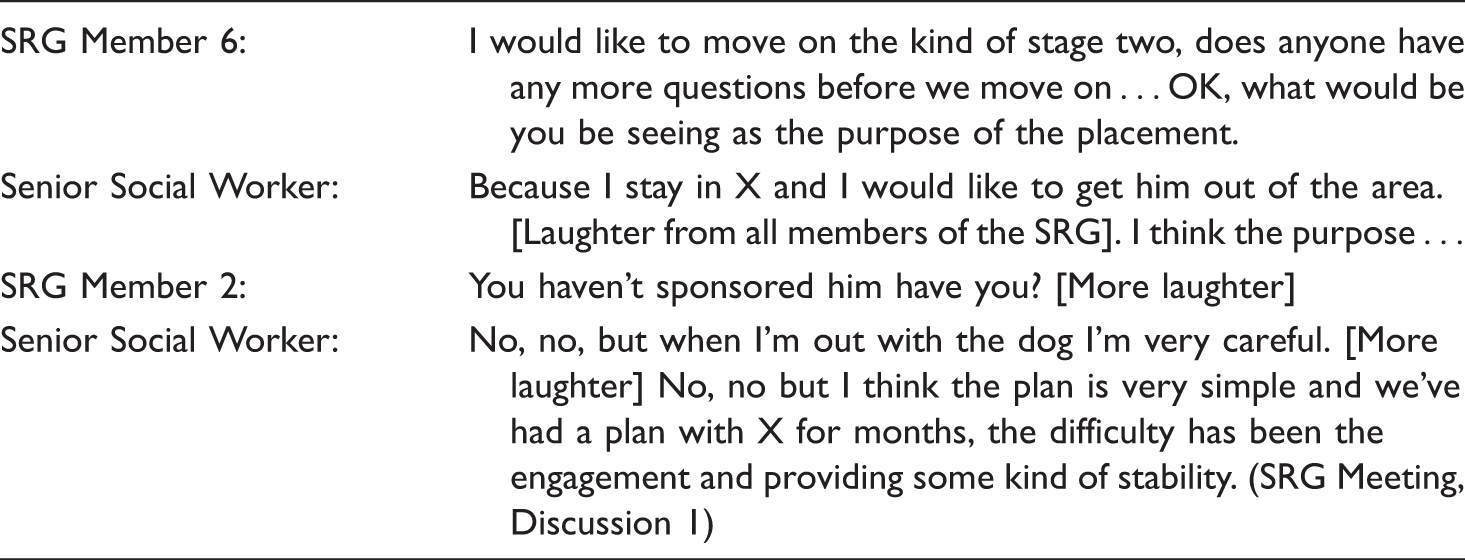
In this extract, SRG Member 2 jokingly asks the senior social worker if he fell for one of the scams this young person had been running to steal money from people in his local area. Jokes on both sides are greeted by laughter before the social worker returns to the business of discussing the case. This is a typical example of how humour was used, albeit briefly, at meetings where SRG members and social workers or senior social workers knew each other well and had a positive rapport. This rapport, as SRG Member 1 explained in the first quote in this section, is built up during previous formal and informal contact.
While acknowledging his close relationship with and respect for some social workers and practice team managers, another member of the referral group was keen to emphasise the importance of scrutinising all social worker referrals. ‘But if I were to lock up X [young person] because I respect Y’s judgement [practice team manager], and Y is probably right, that is not good enough’ (SRG Member 5, Interview).
All of the senior decision makers placed an emphasis on the need to be as objective as possible in their decision making. However, some still acknowledged the influence the level of trust in relationships with referring social workers could have on their view of a particular case.
Discussion
There is growing consensus about ‘the complicated interplay between rational, objective, formal and organisational processes and the subjective, informal and relational dimensions’ in social work decision making (O’Connor and Leonard, 2014: 1816). In the face of this complexity, more and more emphasis is being placed on the need for working cultures in which relationships with colleagues and supervisors support practitioners to critically reflect on their practice. As Featherstone et al. (2014: 84) have argued practitioners need ‘the time, space, argumentative flexibility, analytic ability and trusting relationships to debate and make sense of the information they have recorded’.
The findings of this study support a growing body of evidence about the significance of professional relationships in decision-making practice (Helm, 2016; Taylor and White, 2006; White and Featherstone, 2005). The first, and perhaps most well-recognised influence, is on information gathering. As Reder and Duncan (2003) have argued ‘communication is an interpersonal process’, making good relationships and mutual understanding crucial to the gathering of information to inform decision making. Investing time and energy in improving the quality of professional relationships may, therefore, be one way of improving the quality of information at our disposal as social workers. The findings of this study suggest that reciprocity and exchange are central to this (Gilligan, 2002); the social workers who seemed most successful in getting information from other professionals or families also seemed good at giving of their time and sharing information with others.
Acquiring the necessary information is, however, only the first step in any decision-making process. As the findings of this study also show, analysis or ‘thinking through’ the case and making sense of the information gathered is often done with other professionals. Without effective processes for analysis, it is difficult to form judgements and make decisions (Helm, 2010) and the professionals involved in this study were clear that they needed others to help them with this important work (White and Stancombe, 2003).
The findings of this study also suggest that professional relationships provide access to knowledge about decision-making systems, processes and thresholds. This helps decision makers to ‘think through’ how to time their referral and where to go for further advice. Although the study did not provide conclusive evidence that those who knew best how to ‘work’ the system were better at getting their referrals acted upon, there was a widespread belief that this was the case. To date, studies have not explored how social worker’s professional networks and knowledge of systems impact on the outcomes of their practice. However, a recent study of newly qualified teachers showed that supporting the development of individual professional capital, defined as the amount of reciprocity and trust in their professional relationships and networks, may improve resilience and retention (Fox and Wilson, 2015). As work environments become more inter-professional this is clearly an important area for future social work research. It is also important for supervisors and employers to consider how they can best support workers to develop their professional capital (Beddoe, 2013).
This study found, however, that ‘thinking through’ a case for secure referral was not just about sifting through facts and coming up with a strategy for making a referral; professionals also spoke about the emotional side of decision making. Members of the SRG felt that anxiety could be an undermining emotion in secure accommodation decision making and saw it as their role to help manage anxiety. The importance of containing anxiety is regularly discussing in the social work literature (Taylor et al., 2008). Douglas (2007: 33) explains that containment is about receiving and understanding ‘the emotional communication of another without being overwhelmed by it’ and then communicating ‘understanding and recognition back to the other person. This process can restore capacity to think in the other person’. Despite the intentions of the SRG, social workers and residential workers did not always experience the group decision-making process as particularly ‘containing’. Many residential workers and some of the social workers lacked trust in the SRG, and there was conjecture among some about the ‘true’ workings of the decision-making system. This suspicion and lack of trust towards the SRG became visible in two of the observed meetings, where the quality of discussion was more adversarial and less problem solving. These findings support the contention made elsewhere that it is the quality of professional relationships that determine their ability to provide containment; where there is less trust there is less chance of productive dialogue or containment of difficult emotions (Ruch, 2007).
Trust in professional relationships was also found to play a role in how practitioner’s assessments are evaluated by other, more senior, decision makers. Research into health care organisations has shown how trust can improve workplace relationships, encouraging collaboration between professionals and improve job satisfaction (Calnan and Rowe, 2006). However, the findings of this small-scale study suggest that trust is a complex factor in social work decision making. As the respondents in this study noted, if I trust your assessment because I trust you, I may not be properly scrutinising your assessment, which is part of the role of senior managers and gate keepers. To trust is to have ‘a state of favourable expectation regarding other people’s actions and intentions’, where information is partial and incomplete (Mollering, 2001: 403). Trust in the assessments of other professionals can be understood as a heuristic, or short cut, in decision making, and like all heuristics, may be valuable if used under the right conditions (Slovic et al., 2007). Trust always requires a bit of leap of faith, otherwise there would be no need for trust (Giddens, 1990). However, blind faith would be irresponsible and unethical, especially when issues of a child’s liberty and well-being are at stake (Banks, 2006). Decision-making processes still need to give due consideration to the evidence presented, no matter who is presenting it, and further research is needed to better understand the role of trust in professional relationships and social work decision making.
Conclusions
The findings of this small study, while not generalisable, support a growing body of evidence which suggests we never truly make decisions on our own; individual workers and managers need to take account of the impact relationships with colleagues and other professionals can have on decision-making practice (Forkby and Hojer, 2011; Helm, 2016; White and Stancombe, 2003). Organisations need to consider ways to foster trust between professionals and provide safe spaces for making sense of feelings, critical reflection and hypothesising (Ferguson, 2005; Hamama, 2012; Ingram, 2015; Lawler, 2015). In so doing, they will have the best chance of developing and sustaining professionals who will be better able to make sound judgements and grounded decisions.
Footnotes
Acknowledgements
The author would like to thank all the participants who took part in this study and her PhD supervisors Professor Kay Tisdall and Dr Joe Francis.
Declaration of Conflicting Interests
The author(s) declared no potential conflicts of interest with respect to the research, authorship, and/or publication of this article.
Funding
The author(s) received no financial support for the research, authorship, and/or publication of this article.