



Abstract
In the last decades, we have witnessed a growing interest for the use of photovoice, also referred to as participatory photography, as a visual research method, particularly in social sciences. In this systematic review of the literature, we seek to explore how the methodology has been applied in studies that focus on research with, on and about women. We critically evaluate the potential of photovoice to ‘give’ voice to and empower female participants. Nineteen relevant articles were identified and analyzed using a descriptive within- and cross-case analysis. Several authors claimed their study was inspired by feminist theory; however, few were convincing in the way this was implemented in practice. Empowerment claims were made by many, however, seldom evaluated at the end of the studies. We outline how female voices can manifest themselves in different phases of a research process and present types of empowerment that can potentially be reached through photovoice.
Introduction
Background
Overview photography as a research method.
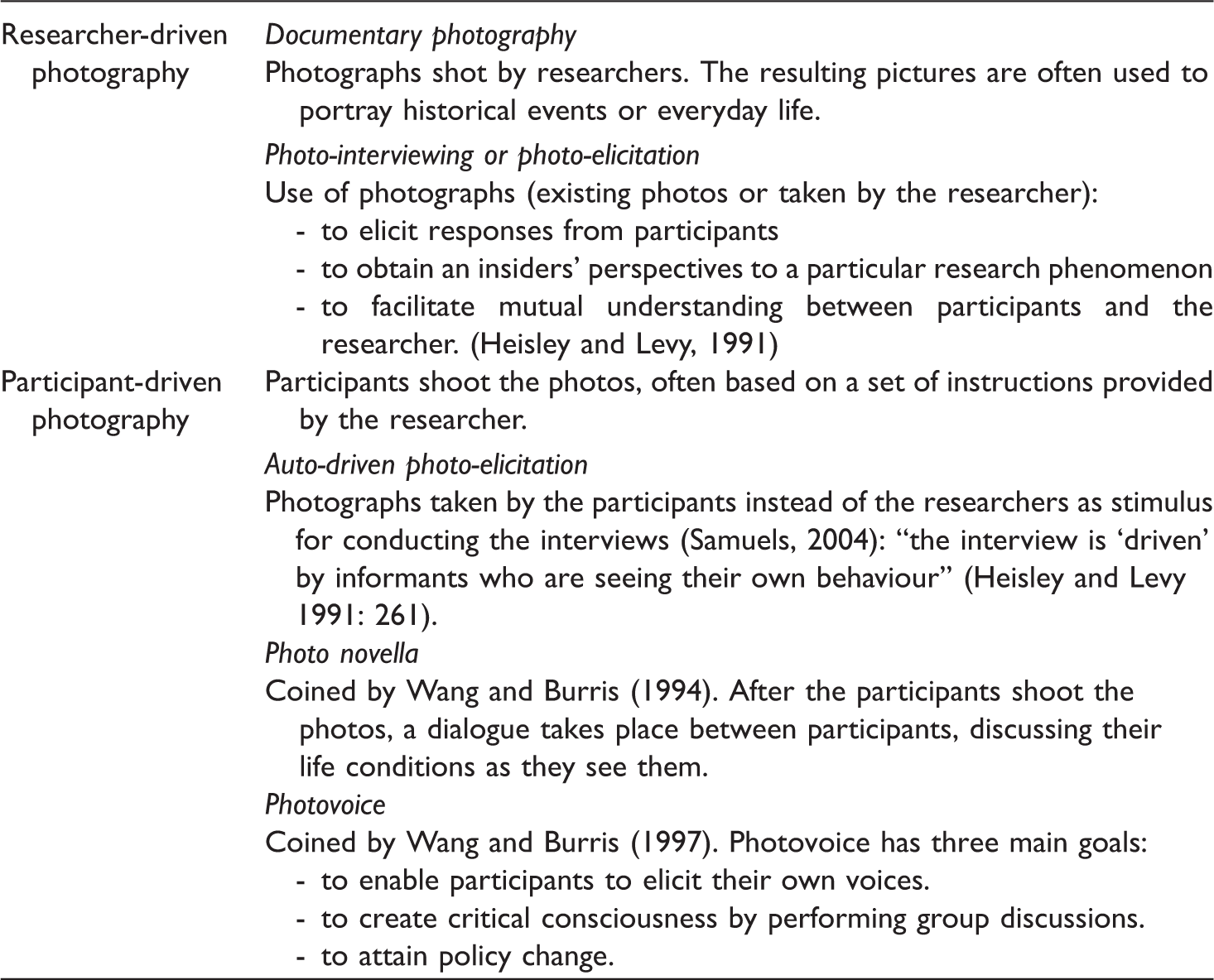
Although initially introduced as ‘photo novella’ by Wang and Burris (1994), the concept of photovoice was first coined in 1997, in the context of a research project that invited rural Chinese women to portray their everyday realities and influence the policies and programs affecting them (Wang and Burris, 1997). Since then, the use of photovoice has been promoted for exploring the needs of diverse vulnerable populations, including homeless people (e.g. Wang et al., 2000), people with disabilities (e.g. Jurkowski and Paul-Ward, 2007; Booth and Booth, 2003) and people with HIV/AIDS (e.g. Hergenrather et al., 2006; Teti et al., 2013). The method has substantially been applied in projects focusing on the lived experiences from vulnerable women (e.g. Teti et al., 2012; Walsh et al., 2010.
According to Wang and Burris, photovoice is founded on three overlapping core principles: Feminist theory, Paulo Freire’s critical educational approach and a participatory approach to documentary photography. First, feminist inquiry had an important influence on the conceptualization of photovoice. It promotes a strategy focusing on research ‘by and with women instead of on women’ and countering the imbalance between the voices of women and men (Weiler, 1988). It is emphasized as an inherently political- and action-oriented theory (Kuratani and Lai, 2011). Second, Paulo Freire was an important inspiration source for the development of the method. The Brazilian educator used dialogue to support a more egalitarian approach to education from literacy work (Freire, 1970). His theory on empowerment education is built on the belief that people themselves are the experts of their own lives. Through critical reflection people come to see how conditions in their lives are socially and politically constructed, which can potentially lead to social change (Peabody, 2013). This has been a source of inspiration for many social workers working with vulnerable populations. Freire’s theory is incorporated in the principles of photovoice by: developing critical consciousness during the photographic process, motivating people to take pictures of their concerns, sharing with others the meaning of these photos and eventually identifying community needs. Moreover, advocacy is promoted by encouraging participants to develop strategies to change policy. Third, the photovoice approach has been informed by documentary photography. The term itself refers to portraying significant historical as well as everyday life events through the language of pictures. Documentary photography has already proven its relevance for social research and policy change in the last century. It has for example been applied by social reformers at the turn of the 20th century to call attention to social issues such as child labor. It eventually led to policy reform and the foundation of social services (Huff, 1998, in Russell and Diaz, 2013). Wang and Burris modified this approach into participatory documentary photography and encouraged vulnerable populations to share their subjective experiences (Graziano, 2004).
Photovoice offers opportunities for social researchers and social welfare practitioners. It is an approach that not only focuses on the needs of a particular individual but also takes into account the broader context, the history and power processes people are exposed to. Photovoice is promising for the field of social work as it has a long history in empowerment practice. Some of the desired outcomes in the field of social research and professional practice are linked to reducing powerlessness and encouraging actions that affect people’s lives (Molloy, 2007). Social workers have a well-established tradition in facilitating group processes and engaging people in group work. The group work component of photovoice – it brings community members together and focuses on relationship building – turns it into an excellent research tool for those working in and studying socio-cultural practice. In addition, photovoice can humanize research findings and give more in-depth meaning to experiences, which makes it more applicable in practice and appealing for policy makers (Russell and Diaz, 2013). Although the values and practice of photovoice are in line with the principles underpinning social work practice, specific references to the field of social work in publications on photovoice are scarce (Peabody, 2013).
Objectives and research questions
A number of literature reviews have been written focusing on photovoice as a research approach (Catalani and Minkler, 2010; Hergenrather et al., 2009; Kuratani and Lai, 2011; Lal et al., 2012; Purcell, 2007). Our review differs from previously conducted reviews because of its explicit focus on how the methodology has been applied in research projects with female participants. We examine photovoice studies in the broad field of education, social sciences and social welfare topics, including prevention. We have a particular focus on areas relevant to social workers: community development, inclusion of people with disabilities in society, youth work, care for homeless people, international development, environmental topics and so on.
This review investigates how sensitive authors are to the tenants of feminist and empowerment theory that have originally inspired photovoice. We study how researchers have conceptualized these premises in their own studies and whether they are able to pull them through in their implementation phase. The following research questions were developed:
How did the authors position themselves within their study? How did they conceptualize women’s voice? How did they conceptualize women’s empowerment and was it reached at the end of the research process?
Researchers’ portrait
The study was conducted by four female researchers: two female students from the educational department and two female professors working, respectively, in the faculty of social sciences (social research methodology) and educational sciences (social pedagogy). Two members of this research team conducted an extensive literature review on arts-based methods with vulnerable participants. The interest for the research topic arose from the many discussions we had around whether or not women should be considered as a vulnerable population and the consequences for this target group in terms of stereotype thread or stigmatization from such categorization. A considerable amount of articles in this extensive review focused explicitly on doing research with female participants. Based on this observation, and considering the feminist and empowerment perspective from which the photovoice research approach was originally developed by Wang and Burris, we focused on the underlying premises of the methodology. What is at the core of our concern is trying to identify and label the techniques of women’s empowerment.
Methodology
This review is part of a broader scoping review that presents an overall picture of the use of arts-based methods in the field of community-based research. Communities were defined as groups of people sharing a particular identity, cultural heritage, language, belief, shared fate or interest. In the context of this scoping review, a comprehensive database of articles in the field of arts-based research was compiled, including visual studies, performative studies and narrative studies. The criteria that were used to decide whether articles should be in- or excluded from the review currently presented are outlined below. Details on the inclusion and exclusion criteria used in the scoping review have been published elsewhere (Coemans et al., 2015).
Searching and screening for relevance
We selected articles that involved some key features of photovoice: the women had to take photographs themselves and had to engage in a dialogue about their thoughts and problems displayed in these images. Articles that used photovoice in combination with other creative data collection techniques (e.g. the creation of poetry, drawings) were excluded. Only qualitative primary research articles were selected. Furthermore, articles had to be written in English, French, German or Dutch and had to be published between 1994 and 2013. The year 1994 marks the publication of the Wang and Burris paper.
The search strategy within the database compiled from the scoping review was based on a three-step screening strategy. The first screening was conducted by one reviewer and consisted of a quick title screening to decide whether an article was potentially relevant. The second screening focused on the content of the abstract and was performed independently by two reviewers. A screening instrument was developed based on the inclusion and exclusion criteria, which guided the reviewers during the screening phase. Articles were included if they met all the criteria. In the third screening phase, we sought the full text from articles with abstracts labeled as ‘unclear’ and from the articles that passed the first two screening phases. A final decision was made based on a consensus between members of the research team.
Data extraction and synthesis
First, a descriptive within-case analysis was conducted, looking at sub-units of every article (Baxter and Jack, 2008), including: year of publication, country of the study, author’s discipline, setting, participants, recruitment strategies, sample size, research design, methods for data collection, data-analysis and public dissemination. Second, a cross-case analysis was undertaken, looking for differences and similarities across all of the sub-units (Baxter and Jack, 2008). To answer the research questions, we conducted a thematic analysis that involved recovering patterns or themes within our data (Van Manen, 1990). A holistic approach was adopted to look beyond the isolated phrases and reflect on the elements of the whole text (Longacre and Hwang, 2012).
Results
Study retrieval
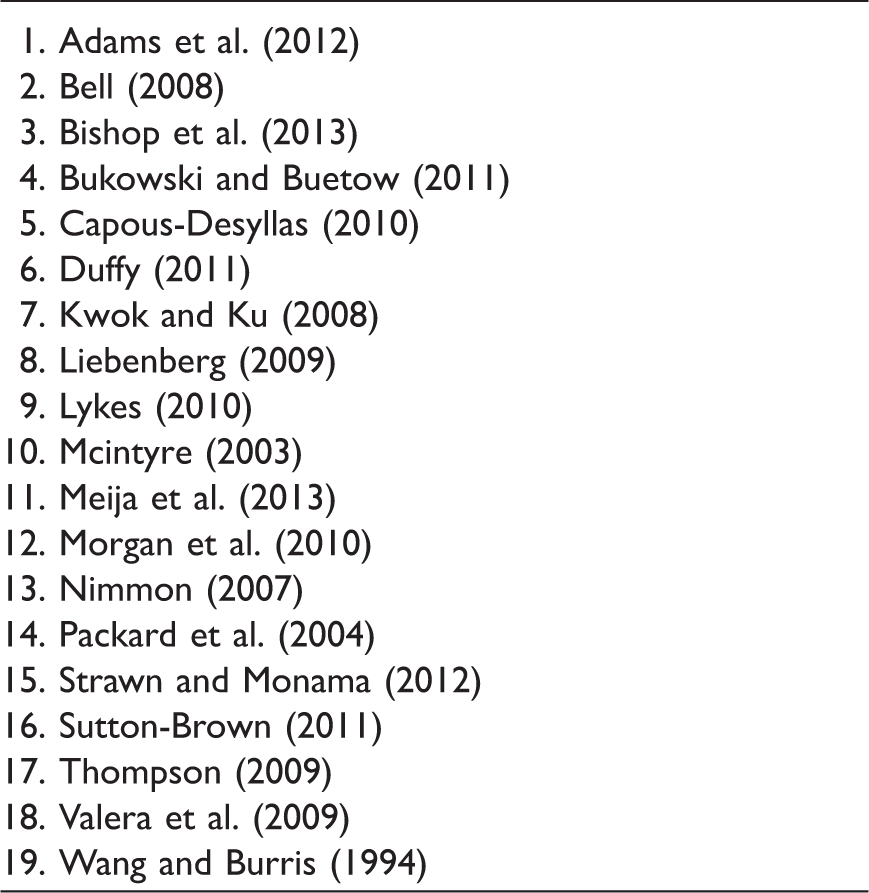
As can be seen in Figure 1, the comprehensive search strategy of our broader scoping review identified 6750 unique articles as potentially relevant. However, for the present review, we focused on the set of articles that described the use of the photovoice methodology. This narrowed the initial dataset of potentially relevant articles to 88. From this pool of studies, 31 articles were conducted with women. Twelve articles were eventually excluded in this phase for various reasons: articles could not be traced (N = 2), they didn’t match our definition of primary research articles (N = 4), they discussed therapeutic projects (N = 1), or they included other creative methods than only photovoice (N = 5). Finally, 19 articles met our inclusion criteria (listed in Box 1). An overview of the retrieval process is outlined below:
Search and retrieval process. Final set of included studies.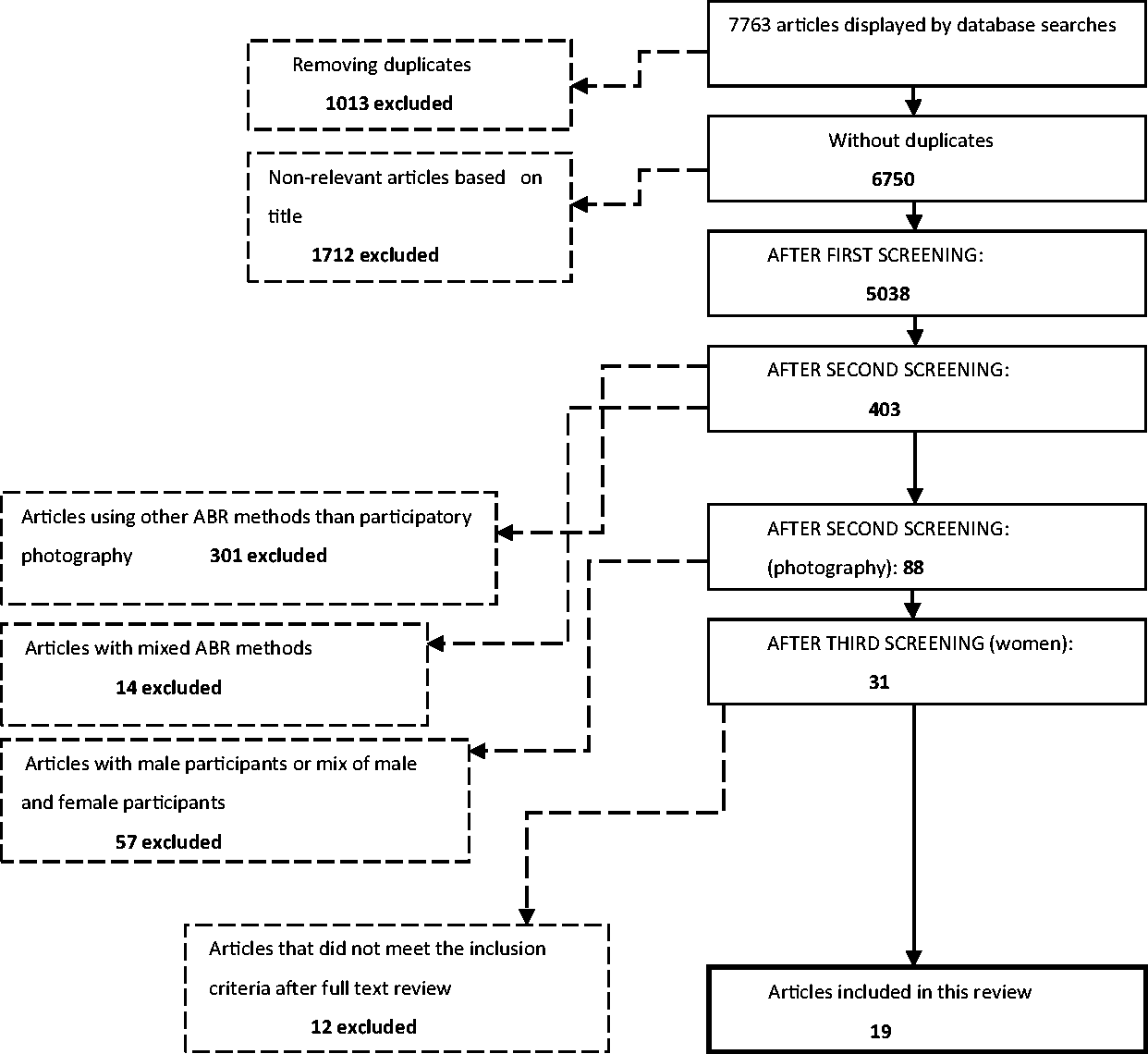
Descriptive findings
Main descriptive characteristics of the articles selected for data extraction and synthesis.

The numbers refer to the criteria listed in Box 1.
Methodological characteristics of the articles selected for data extraction and synthesis.

Main descriptive characteristics
The articles were all published in the past 10 years, except for two articles dating from 2003 to 1994. The latter was conducted by Wang and Burris. It was meant to draw attention to the method (Figure 2).
Year of publication of the included articles.
The studies were conducted in 12 different countries. Most of the articles (N = 10) originated in North America. Four projects were conducted in Africa. The authors’ disciplines varied among the studies and included the field of education (N = 8), social sciences (N = 6), and health prevention (N = 5). Sample size was reported in all of the articles and ranged from one to 62 women.
In the majority of the articles (N = 13), authors reported a relatively small sample size, ranging from one to 10 women. Several articles also mentioned other demographic characteristics such as marriage status, parenthood, education, work, race, immigrant status and living situation. All researchers described specific characteristics of their participant group, such as working class women, homeless women, mothers, immigrants, sex workers and a disabled woman.
A partnership with community organizations was mentioned in the majority of the articles (N = 16). These organizations were mostly local agencies, including community workers, teachers and volunteers. Three articles did not report their recruitment strategy. Those who did, described it as: snowball, purposive or peer sampling, a poster display, the use of flyers, mailing, online methods, media advertisement or the involvement of a community worker to assist in recruitment.
Methodological characteristics
Overall, the research design used in the studies was consistent and in line with the design proposed by Wang and Burris (1994): most articles framed their study as participatory research (N = 18). Twelve of these articles explicitly referred to participatory action research. Other designs included case studies, ethnographic research and arts-based research.
All articles in this review combined photography with other qualitative data (e.g. interview transcripts, field notes). Almost all women were in charge of making the photographs (except for a study featuring a woman with a disability that needed assistance for data collection).
More than half of the studies explicitly mentioned a form of technical, artistic or ethical training as part of the research process. Technical trainings included for example basic camera operations and functions, how to work with the camera and photographic rules. These trainings further informed the women about the photovoice method in general and engaged them in a discussing on ethical issues concerning photography. Although authors often mentioned that the women gave their informed consent to use the photographs in publications and during conferences, explicit guidelines about taking pictures of other people and asking informed consent when taking someone else’s photograph were seldom reported on.
Thematic and content analyses were the most frequently reported analytical techniques (N = 7). Other reported techniques were: individual and group analysis, interpretive inquiry, analysis based on the principles of grounded theory and case study analysis. A minority of articles (N = 2) applied a software program to support their analysis.
Public dissemination is organized for raising awareness and as a form of advocacy that would directly benefit the women. Half of the authors used a combination of dissemination activities. These activities consisted for the most part of organizing exhibitions for community members, stakeholders and policy makers at local venues or on a more national level such as conferences and festivals. Two articles didn’t report any dissemination activities.
Analytic findings
How did the authors position themselves in the study?
In more than half of the articles, we find no positioning of the researcher(s) (N = 10). The researchers who do incorporate a positional stance towards the method and topic of study included details on their race, gender, age, education and/or earlier research experiences. Some of the authors further clarified how their background relates to the background of the women in their study (e.g. Bukowski and Buetow, 2011; Capous-Desyllas, 2010; Liebenberg, 2009; Mcintyre, 2003).
Although the majority of the articles were written by women, only half of the researchers (N = 10) explicitly mentioned the use of a feminist framework. Three out of these 10 studies failed to explain its relevance for their study (Packard et al., 2004; Strawn and Monama, 2012; Valera et al., 2009). Subsequently, only a minority of the authors motivated their interest in feminist research and reported their beliefs and previous experiences in this theoretical area. Capous-Desyllas (2010) for example does explain how her interest in research with sex workers was based on her initial interest in feminist debates on the topic. She described her involvement as a volunteer in and a member of several organizations related to the topic and her belief in a rights-based approach. Mcintyre (2003) motivated her interest in gender and feminist participatory research by referring to her previous experiences as a feminist activist teacher and a union organizer.
Most authors, however, preferred ‘to speak from the position of a “woman,” which is not the same as speaking from the political perspective of a feminist’ (Grant, as cited in Lazar, 2007: 145). Conducting research as a ‘woman’ means to know from the perspective of the structure of gender, while taking a feminist standpoint as a researcher involves having a critical meaning about gender, women’s positions in society and towards the own identity as a female researcher.
Although the photovoice method shares some common characteristic with feminist methodologies, i.e. to overcome biases in research, bringing about social change, displaying human diversity and acknowledging the position of the researcher (Bird, n.d.), references to the various feminist movements (e.g. liberal feminism, Marxist feminism, cultural feminism, postmodern feminism, cyberfeminism, ecofeminism, postfeminism) are practically non-existent (Maerten, 2002). An example of a study included in the review that did make its framework explicitly is that of Sutton-Brown (2011), guided by Mohanty’s transnational feminist framework.
How did the authors conceptualize women’s voice?
Stimulating the voices of women within a society that is still dominated by other, more powerful voices is one of the underlying principles of photovoice. We believe it is important to explore how voice is exactly given to these women. Women’s voice was found as a particular focus in respectively the analysis of the data, the public dissemination and the reporting of the findings. We borrowed the conceptualization of voice from Evans-Agnew and Rosemberg (2016) to structure this paragraph.
Women’s voice in the analysis of data
More than half of the articles explicitly reported women’s involvement in the analysis of the data (Adams et al., 2012; Bell, 2008; Bishop et al., 2013; Duffy, 2011; Mcintyre, 2003; Meija et al., 2013; Morgan et al., 2010; Packard et al., 2004; Strawn and Monama, 2012; Sutton-Brown, 2011; Valera et al., 2009; Wang and Burris, 1994). This included women’s selection of the photographs and identification of themes that cut across the photographs. In the remaining articles, it was not clear whether the women actively contributed to the analysis of the data. Interpreting the findings and situating the data in a broader societal context was almost exclusively conducted by the researchers (N = 18). The most common analytical approach adopted was coding segments in the data and categorizing codes into themes. In five studies, women’s involvement in this phase of the process was mostly limited to their participation in member checks to validate the researchers’ analytical statements (Capous-Desyllas, 2010; Liebenberg, 2009; Nimmon, 2007; Sutton-Brown, 2011; Valera et al., 2009). An exception is the study of Bishop et al. (2013) where the woman who was involved in the project was assigned the role of a co-researcher in all the steps of the research project, including the production of the end report. Another interesting finding relates to the potential interpretation bias introduced by having male interpreters translate women’s contributions into research findings (Sutton-Brown, 2011; Morgan et al., 2010; Thompson, 2009). Whether or not this influenced the conclusion of the studies is subject to further research.
Women’s voice in the reporting of the findings
In only one project, participating women were given a central role in preparing for the journal publication. Bishop et al. (2013) assigned a role as co-author to the woman involved in their project. We assume that this particular woman had a choice over which photographs would be published. The majority of author teams (N = 15) incorporated photographs made by the women in the final article, including self-portraits of the women and representations of their everyday life. We assume that these were mainly used as supporting material for the identified themes and selected by the authors themselves. Citations or participant-selected captions from women were often used in conjunction with the photographs. The amount of photographs taken by women portrayed in the articles was relatively low: 9 out of 15 articles included less than five photographs in their publication. Some authors referred with a link to the full and original photostories (as assembled by the participating women) (Bell, 2008; Nimmon, 2007).
Women’s voice in the dissemination of the findings to a broader public
In almost half of the articles, it was unclear what the specific involvement of the women was in the public dissemination phase (Adams et al., 2012; Bukowski and Buetow, 2011; Liebenberg, 2009; Lykes, 2010; Thompson, 2009; Valera et al., 2009; Wang and Burris, 1994). Two studies explicitly reported that the researchers were in charge of the dissemination process. Sutton-Brown (2011) mentioned that she was the one who ultimately created a slideshow for dissemination. Although she shared the results with the women beforehand, minor changes were made by the women. Kwok and Ku (2008) reported that in their study, researchers and social workers were the ones in charge of disseminating the views of the women via several public exhibitions, press conferences, etc. In the other studies, researchers described how the women were actively involved in the dissemination phase. Their specific role varied from selecting photographs for an exhibit, creating accompanying narratives, planning the specific data, searching for possible locations, promoting the event, to presenting their work.
How did the authors conceptualize women’s empowerment and was it reached at the end of the research process?
Empowerment gives meaning to the multiplicity of the underlying process of “giving voice” and goes into meaningful conditions. It can be seen as the interactive process between individuals and their environment. Throughout this process, “the sense of the self as worthless changes into an acceptance of the self as an assertive citizen with socio-political ability” (Sadan, 1997: 75). Hence, empowerment can be seen as an active process, changing human activity from a passive to an active state (Sadan, 1997). We adopted the main categories of the typology of Zimmerman, reflecting empowerment’s multilevel nature (Zimmerman, 1990, in Speer et al., 2001) to structure this paragraph.
Individual empowerment
Several articles in the dataset focused on the intrapersonal component of individual empowerment, including self-perceptions concerning ‘domain-specific perceived control and self-efficacy, motivation to control, perceived competence, and mastery’ (Zimmerman, 1995: 588). Several authors exemplified how the participatory research projects led the women to self-acceptance and self-confidence. Nimmon (2007) for example described that the women indicated that they often felt minimized in the broader society. After participating in the project they expressed feelings of importance and increased confidence when seeing themselves depicted in the photonovel. In the article of Morgan et al. (2010), the women articulated that they took pride in the fact that this project was about them. These examples refer to empowerment as a process of internal change, which relates to the women’s beliefs in their abilities to make decisions and to solve their own problems.
As an interactional component, empowerment addresses the way individuals understand and relate to their social environment. It addresses their ability to develop a critical understanding of their own community (Zimmerman, 1995, in Kasmel, 2011). There are several articles that mentioned photovoice as a means to achieve critical awareness. Lykes (2010) articulated that the Mayan women created critical stories about living in a war zone. Capous-Desyllas (2010) stated that women could get a critical perspective on their own lives, by articulating and dissociating themselves from their own photos. Meija et al. (2013) described that the Latina mothers developed critical reflection strategies during the photovoice project and began to see shortcomings in their neighborhood.
As argued by Parsons (1988, in Sadan, 1997), empowerment is also a process of external change (i.e. the ability to act and implement knowledge, skills, information). As such, the behavioral component of empowerment refers to taking actions that can influence outcomes. This implies participating in policy discussions at a community level. Although 15 articles referred to the principle of policy change of Wang and Burris, only five articles reported that change actually occurred. In the study of Bell (2008) for example, the women indicated that they “moved from seeing themselves as victims of change to agents of change” (p. 41). In doing so, they became engaged with the political system: they contacted legislators to express their opinions and informed them about certain community issues. They also started fundraising actions for community improvement activities. The women in the project of Valera et al. (2009) came up with their own answers to overcome food insecurity and informed local policy makers about the findings. In a considerable amount of articles, it was not clear whether policy makers were actually involved in the project (N = 8). Some authors (for example Capous-Desyllas, 2010) reported explicitly that policy makers did not attend community exhibits. Moreover, if policy makers were involved, it was not always clear to what extent the women were actively involved in the policy discussions (Kwok and Ku, 2008).
Community empowerment
In this review, we included a broad view on community as ‘a partial, temporary and dynamic unit that originates in the human need for a sense of togetherness and identification of others’ (Sadan, 1997: 133). Several articles reported on achieved levels of community empowerment in specific geographical areas.An example is the study of Morgan et al. who empowered women of La Carpio (Costa Rica) through photovoice by photographing community life and critically reflecting on the images. Kasmel (2011), echoing, stresses that community empowerment is an interplay between individual and community change with a long time-frame, with regard to significant social and political change. A possible outcome of community empowerment is an increase in social capital (Zhou and Bankston, 1994, in Kasmel, 2011). Potential indicators suggested including social cohesion, social trust, reciprocity, social networks or support system at a group level and community involvement. Kwok and Ku (2008) mentioned that the project helped to establish informal support networks with other participants and community members. Nimmon (2007) noted that ESL-speaking immigrants didn’t have an extensive social support system. As a result of engaging in a photonovel project, they created a new relational network.
Discussion
We acknowledge that we can only make assumptions based on what the authors have reported in their articles. Many times, authors are restricted by page limitations of journals and other publication related constraints beyond their control. This does not necessarily imply that authors didn’t think about the important decision points we would like to see addressed in order to create a learning opportunity for those building on their work. It simply means that attention in reporting needs a shift from a focus on content to a focus on potential process related benefits and harms.
First, we suggest that authors provide clarity about their particular intentions to ‘give’ voice to women. Whose voice is exactly heard in these studies? We noticed that the voices of women in photovoice projects are often mediated and interpreted by other voices (including male translators, facilitators and researchers). There is little detail on how the involvement of women in choosing the format, in making decisions about the content, and in the dissemination itself was stimulated. Moreover, authors tend to be on the safe side in choosing the formats to report on their findings and emphasize the narratives instead. The visual content is often treated as an accessory, an illustration for the narratives. Since cameras were placed in the hand of the women as a powerful tool to give voice, we recommend to give enough weight to these pictures in the articles themselves. In addition, we noticed a lack of information on the positional stances of the authors that may have influenced the findings: ‘we ask for revelations from others, but we reveal little or nothing of ourselves; we make others vulnerable, but we ourselves remain invulnerable’ (Behar, 1993: 273, as cited in Ashby, 2011). It is generally known that the life experiences and values of the author underpin the research process (Kralik and Van Loon, 2008). A critical reflection on whose voice is actually represented is therefore important.
Second, more information about the theoretical lens that inspires researchers’ projects could be given. Adding a feminist stance and explaining the position one takes on gender is one way to incorporate the researcher’s interpretive context when one works with a female participant group. Incorporating a theoretical lens into a photovoice project allows researchers to connect issues related to gender inequality and other cultural or structural social oppressive factors in a way that allows us to obtain a more comprehensive view and in-depth perspective. When working with women, plugging in feminist theory can make the findings more powerful. It can be used as a guard against ‘the desire to create a coherent and interesting narrative that does little to challenge hegemonic discourses and (over)simplified knowledge claims’ (Mazzei and Jackson, 2012: 745). Without theory, the use of particular methods in photovoice projects is at risk of becoming a very instrumental practice that neglects many of the theoretical underpinnings that inspired the developers in the first place.
Third, the use of the concept empowerment is confusing. There are many definitions and measurable indicators proposed (Duffy, 2011). Authors need to unpack the often touted term empowerment or at least clarify what sort of empowerment is achieved in their study. Few articles in this database specified outcomes or evaluation procedures. Such evaluations should not be limited to an overall reflection of the researcher at the end of the process. Empowerment outcomes could be formulated by the women themselves (Rappaport, 1987). This implies asking women how the process of photovoice changed their thoughts or life situation and what sort of empowerment is achieved. Those building on photovoice methodology also need to be sensitive to potential negative outcomes of such procedures. Creating awareness about oppressive structures that have an impact on a life situation while simultaneously creating awareness about the fact that oppressive structures in society cannot be changed immediately, is therefore recommendable. If not, it can leave women feeling more underpowered than before (Purcell, 2007).
Conclusion
The purpose of this review was to examine the underlying theoretical and empowerment premises of the photovoice methodology. Nineteen photovoice studies targeting women were critically analyzed. The literature reviewed here suggests that researchers should: take into account the underlying theoretical premises of the methodology, provide sufficient evidence for the achievement of its core objective (empowerment), and illustrate what space for the authentic voice of women is created and how.
In order to improve the overall quality of photovoice studies we advise authors to reflect on at least the following aspects: (1) the nature of the research, (2) the nature of the researchers, (3) the nature of the research team, and (4) practical considerations. Figure 3 includes a few questions that are helpful to consider when designing a photovoice study.
Considerations when conceptualising a photovoice research project.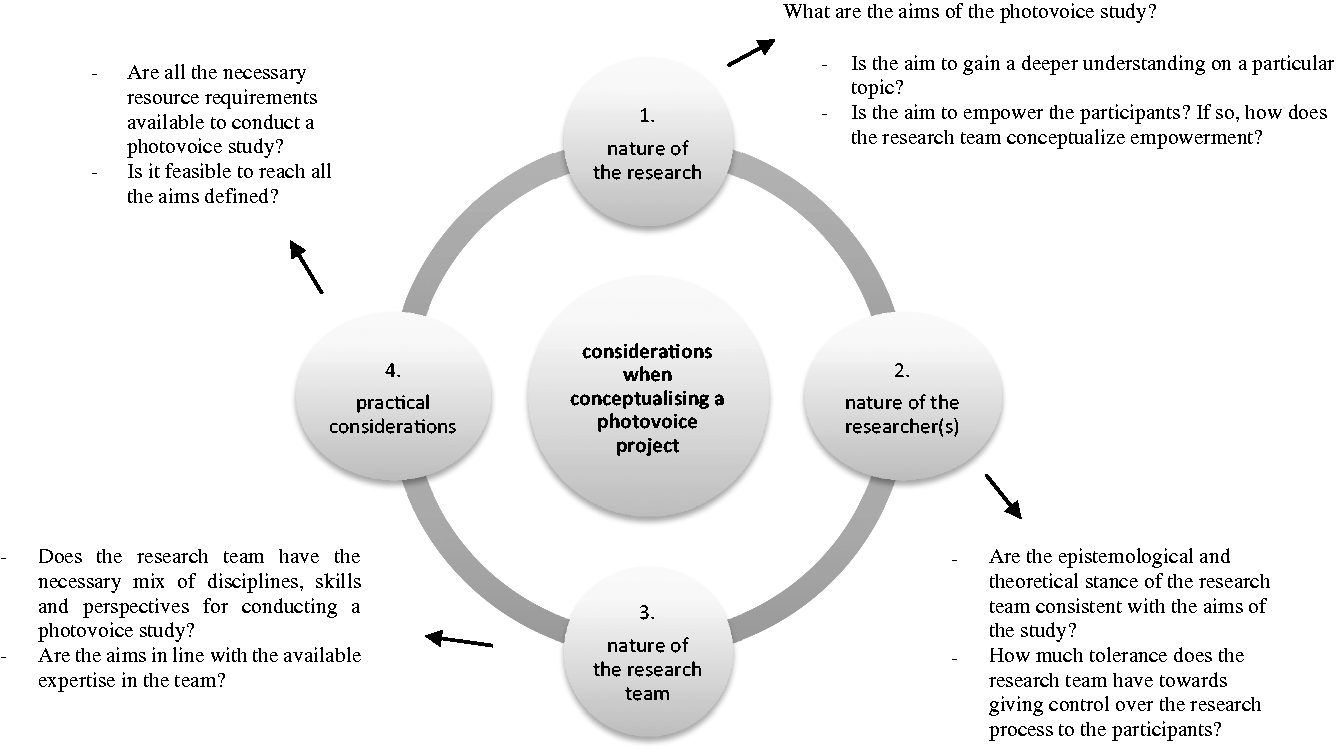
A first consideration is the nature of the research: is the empowerment component, embedded in the photovoice methodology, part of the purpose of the study? In many studies, we noticed a tension between the purpose of the researcher and the empowerment purpose of photovoice. Although many researchers consider empowerment as an important goal, their main aim is to gain a deeper understanding about a particular research topic. Empowerment is often presented as a rationale; the photovoice methodology is chosen because it gives participants ‘a voice’ and promotes change. However, we do not always see this empowerment component reflected in the research questions or objectives. We assume that this is the reason why so many studies fail to evaluate the photovoice process. When aiming to combine a research and empowerment goal, it is important to conceptualize the specific type of empowerment one aims to achieve, to provide sufficient evidence for the achievement of this empowerment aim, or to reflect why this couldn’t be accomplished.
Furthermore, one should take into consideration its own nature as researcher. This implies a critical reflection on the epistemological and theoretical stance of the researcher. The researcher’s role is not limited to identifying aspects that are important from the perspective of the participants. It is also important to assist participants in framing research findings into a broader context, while maintaining the study’s integrity. Feminism is one particular lens that could be applied and has successfully been used in previous photovoice projects with women. Framing a photovoice study as feminist inspired does not mean that certain methodological components that characterize the approach cannot creatively be adopted in other contexts or used differently when working with other target groups. It does not imply that feminism is the only theoretical framework that can be used in a photovoice study. Depending on whose voice is presented, researchers may select different frameworks. These decisions should be made explicit in the report. In addition, it is commonly known that researchers vary in the amount of tolerance they have toward ambiguity in the research process. In photovoice, participants control much of the procedure of data collection and analysis. It is the role of the researcher to assist participants in moving individual storylines into a more in-depth and theoretically informed narrative.
Another important consideration refers to the nature of the research team. Does the research team have the necessary mix of disciplines, skills, and perspectives for conducting a photovoice study? Apart from topical and methodological expertise, photovoice studies benefit from team members who have been trained to facilitate empowerment processes, who can focus on the group dynamics and who are successful in connecting with the participants, gatekeepers, language interpreters, and so on. Social workers are generally well trained to take up this challenge. Research teams should therefore consider if they want to form an alliance with practitioners and if they have the necessary connections with the field or have the expertise for creating these types of networks.
Finally, one should take into account some practical considerations. Being involved in a photovoice research project requires a serious amount of time and effort. The researchers have to prepare the project in collaboration with their team. They have to invest in camera and ethical training of participants. They have to devote a serious amount of time to build up a good relationship with the participants, to work on the group dynamics, to think about actions that promote change, to translate the findings to a broader audience and so on. Moreover, funding is often needed, for instance to purchase cameras, to make copies of the photographs, to invest in good translators or to set up an exposition.
In ideal circumstances, we gain more than an understanding of our research topic when conducting photovoice projects. These projects can stimulate women in raising their voice and reaching their empowerment goals. It is important to be attentive to these goals when conceptualizing photovoice studies within the broad area of social-cultural work practice and research.
Footnotes
Declaration of Conflicting Interest
The author(s) declared no potential conflicts of interest with respect to the research, authorship, and/or publication of this article.
Funding
The author(s) received no financial support for the research, authorship, and/or publication of this article.