




Abstract
Home and belonging are emerging areas of social work research. Very few studies in the social work discipline critically examine how home is broadly experienced or understood. Whilst the notion of home is contested, social work researchers can explore meanings of home in their quest to understand how social workers can contribute to developing a sense of community and belonging. This article presents the findings of an intersectional qualitative study that explored meanings of home in a capital city of Australia, drawing implications for social work. A thematic analysis of 13 semi-structured interviews found that home was experienced as both a material and emotional place. Home was associated with (1) the material security of housing, including homeownership and the safety of suburbs and neighbourhoods; (2) a connection to multiple homes and the making of home in migration, such as when re-settling in a new country; (3) belonging to a family, including emotional connections to lost family members or acknowledging a supportive family and (4) religious, ethnic and cultural self-expression. This paper argues that researching meanings of home is relevant to social work as a discipline that espouses human rights and social justice because a sense of home is central to the politics of belonging to a safe community and society.
Introduction
Previous literature on home in social work has positioned home as it relates to (1) institutional settings, (2) home visits, (3) a country and (4) to current living places. In social work, home is often understood in relation to various social institutions such as nursing, children, family, foster care and childhood ‘homes’. For example, social work scholar Lewinson (2015: 702) explored meanings of home from the perspective of older people living in an aged care facility, through photovoice and in focus groups, to co-construct a shared narrative of home and plan for changes to the care facility. As well, the word ‘home’ is often used in social work literature when referring to the ‘home visits’ of social workers in different practices settings (Winter and Cree, 2016). These studies include the idea that a ‘home visit’ is a mobile and embodied experience. For example, research in Israel presents an institutional ethnography of the bodily aspects of home visits (Muzicant and Peled, 2018), and in the UK, the embodied experiences, knowledge and practices of social workers conducting home visits in child protection were highlighted, positioning the home as a ‘resource for creative change’ (Ferguson, 2018: 79). The practice of home visits in social work has also been researched in a mixed-method study from the UK using Global Positioning System tracking, diaries and interviews to explore the emotional nuances of stillness/mobility in child protection work (Disney et al., 2019). Social work literature in child welfare has called for social workers to critically reassess how we use the term home, which includes challenging how social workers assume a moral position on the residential fixity of childhood homes, even when children may have multiple family homes and their connections to home can be fluid, complex and contested (Forsberg and Pösö, 2011). Thirdly, in social work, home is referred to as a country, as in research with western trained social workers ‘returning home’ to practice social work in their countries of origin (Wehbi et al, 2016), and in the lived experiences of refugees and ‘tragic' exiles from one’s home country (Kumsa, 2007). Lastly, when considering how to respond to formerly homeless drug users in a Housing First program, a recent Finnish study examined how workers constructed a sense of home in collaboration with their clients, arguing that supporting client’s attachments to their current living places can prevent future homelessness (Ranta and Juhila, 2019). The focus of this study broadens previous social work research and understandings of home. Drawing on an intersectional social work approach, this paper contributes to a critical analysis of home in social work, by highlighting meanings of home from the perspectives of a broad sample of community members in Australia, of diverse ages, genders, class, ethnic, religious backgrounds and migration experiences.
Home and belonging in social work
Research on belonging and home is an emerging area for social workers. Home and belonging are dynamic processes associated with identity politics, emotional attachments to collective group identifications and ethics and values related to how social attachments are valued and judged (Yuval-Davis, 2011: 10–18). The attachments, values and choices of individuals intersect with social privileges as well as social and systemic inequalities that people experience, which arguably affects one’s sense of belonging and home (Zufferey, 2017). Social work research on belonging particularly focuses on migration and working with migrants and refugees. Määtta (2017: 15) argues for broadening the social work frame on belonging by exploring the dreams and aspirations of new migrants, discussing choices that embrace social justice values, challenging racism, becoming ‘an advocate’, addressing grievances with the system, assisting to contribute to civil society and by collaborating on social change projects that enhance feelings of home and belonging. Civil society refers to the relationships and activities that are established within the grass-root levels of society in families, communities and voluntary organisations (Määtta, 2017). In this paper, we argue that if social workers can understand diverse perspectives on home and belonging, and how this is experienced for all members of the community, this can also strengthen our understanding of how to support civil society. A person’s subjective experiences of belonging and home are inextricably linked to their engagement with civil society, their environment, as well as their life biographies and lifestyle aspirations, including aspirations for homeownership.
Researching home
Home is a multifaceted concept that is contextual, subjective and ‘profoundly political’ (Mohanty, 2003: 126). The notion of home has been extensively researched across numerous disciplines but less so in social work. The differences between a home and a house were defined as early as Dovey (1985: 33) who stated that ‘a house is an object, part of the environment, home is best conceived of as a kind of relationship between people and their environment’. Home as place is a key idea in geography and anthropology that extends beyond one’s residence or house to multiple ‘places’, including to suburbs and neighbourhoods (Baker, 2013; Blunt and Dowling, 2006: 2), and in the making of home through domestic objects and homemaking routines (Cieraad,1999 [2006]). Home can be real or imaginary, a feeling of belonging to place(s), space(s), communities and families or a ‘state of being in the world’ (Mallett, 2004: 62). In sexuality research, it has been found that home is where lesbians expect to ‘feel safe, loved and validated’ (Egerton, 1990: 76); it is a ‘remembered’ ‘internal journey’ that occurs across time, in different places and spaces, and relates to one’s imaginings, feelings, practices and identities (Rowntree and Zufferey, 2017). The emotional sense of security, stability, privacy and safety of home was also found in accounts of homeownership (Gurney, 1999), when living in public housing (Mee, 2007) and in homelessness research (Kidd and Evans, 2011; Zufferey, 2017). Kidd and Evans (2011: 752) interviewed 208 young people in New York and Toronto who were defined as ‘homeless’ about what home meant to them and found that home was a ‘state of mind’ and a place, such as a physical dwelling. The material circumstances of that dwelling including housing tenure, rights and entitlements (Fozdar and Hartley, 2014), can also be associated with feelings of ontological security and a sense of home, which may not be experienced by people for example, without a physical dwelling.
Research with migrants and refugees has found that home can shift with migration; be ‘fluid’, mobile and hybrid; provide a temporal sense of belonging that is connected with ‘transnational identities’ and is associated with emotional connections to past and future ‘places’ and relationships (Ahmed et al., 2003; Chan, 2012; Fozdar and Hartley, 2014: 149). A sense of home in a new country for refugees and new migrants can be enhanced by accessing housing as well as ‘being settled in relationships and work’ (Hiscock et al., 2001: 62). Feeling at ‘home’ also derives from the right to be heard, the right to representation and includes spaces and places that allow for self-expression, unifying belonging, place and identity within the wider society (Crath, 2012). Whilst calls have been made for social work to broaden its focus on how identities connect with a sense of place, home and belonging, particularly for migrants and refugees (Maatta, 2017), this paper extends social work research on home to question the ‘imagined normality’ (Christensen and Jensen, 2012: 112) of for example, homeownership. In this article, we examine the meanings of home for ‘settled’ homeowners as well as new migrants and refugees ‘resettling’ in Australia, to explore how intersecting social inequalities and privileges can shape belonging and home.
Homeownership
Social workers can also have a broader remit in researching a sense of home and belonging that extends beyond examining social inequalities, to including the privileging processes of homeownership. The politics of homeownership is of central importance to social work, in the context of societies with high income and wealth inequality (ACOSS, 2018). Homeowners in countries such as the UK, USA and Australia are in privileged social locations. Attractive government subsidies and taxation policies for homeowners reinforce ‘entrenched inequalities of wealth and property, with negative consequences for social and economic equality’ (Gregory, 2016: 342). The ideological agendas of governments in advanced capitalist countries such as the USA, UK, Australia, Canada and New Zealand have ‘attempted to shift the burden of responsibility for citizens’ welfare away from the state and its institutions on to the home and nuclear family’ (Mallett, 2004: 66), continuing to support individualist and materialist housing aspirations. Thus, home is complicated by unequal power relations within ‘social, economic, political and physical environments’ (Easthope, 2004: 125) that privilege some groups of people over others. Those more likely to become homeowners are two-parent families, who are educated, employed, from high socioeconomic background and whose parents are also homeowners (Blaauboer, 2010; Helderman and Mulder, 2007; Kurtz, 2004; Mulder and Smits, 1999, 2013). If social workers are concerned with promoting social justice and making visible social inequalities, this would include acknowledging that one’s class privilege, occupation, earnings and inherited wealth are central to achieving homeownership (Kurtz and Blossfeld, 2004). Whilst it is acknowledged that meanings of home can be multiple, fluid and fluctuate between feelings of belonging (and not belonging), depending upon migration histories, family relationships, individual biographies and imagined futures, this paper contributes to social work scholarship by making visible identifications and diversities that shape understandings of home, which includes people’s classed engagement with homeownership.
Methodology
To understand the complexities that contribute to meanings of home and homeownership, and how this can vary among people of different ages, genders, classes, ethnicities, religions and migration backgrounds, this research was informed by an intersectional social work approach (Murphy et al, 2009; Zufferey, 2017). The central aims of intersectional research are: to focus on everyday lived experiences; to make visible intersecting identifications and diversities; to explore the complexities of oppressive and privileging processes; to examine social inequalities and injustices that manifest in interconnected domains of power relations and to promote social change (Christensen and Jensen, 2012; Hulko, 2015; Manuel, 2006; Murphy et al., 2009). The term ‘intersectionality’ was first coined by legal professor Kimberlie Crenshaw (1991) to highlight how gender and race functioned as intersecting systems of discrimination in American law for African American women. It has since been expanded to examine the positions of ‘any grouping of people, advantaged as well as disadvantaged’ (Yuval-Davis, 2006: 201). This involves ‘capturing the synergistic relation between inequalities’ and privileges grounded in lived experiences (MacKinnon, 2013: 1028), which in this paper relates to meanings and experiences of home.
Intersectional perspectives have pointed to the importance of researching majority groups (e.g. homeowners), including all members of society and questioning the ‘imagined normality’ of the majority (Christensen and Jensen, 2012: 112). Therefore, effort was made to obtain a sample that was inclusive of different genders, ethnicities, ages, religions, cultural backgrounds, classes, refugee and migration experiences. The theoretical sampling approach (Neuman, 2014: 276) employed in this exploratory study differs from the purposive sampling used in other studies that focus only on perceived marginalised groups (such as refugees) or privileged groups (such as homeowners). After ethics approval was granted by the University of South Australia’s Human Research Ethics Committee, participants were recruited from the urban population in Adelaide, South Australia, by circulating an invitation email, to email networks that comprised of human service organisations and around university campuses. Interested persons contacted the researchers directly either on telephone or email, any questions about the study were answered and then, a face-to-face interview, at a negotiated confidential venue, was arranged, where consent forms were signed. All interviews were audiotaped, transcribed verbatim and any personal or confidential details were removed. Pseudonyms were allocated to each interview.
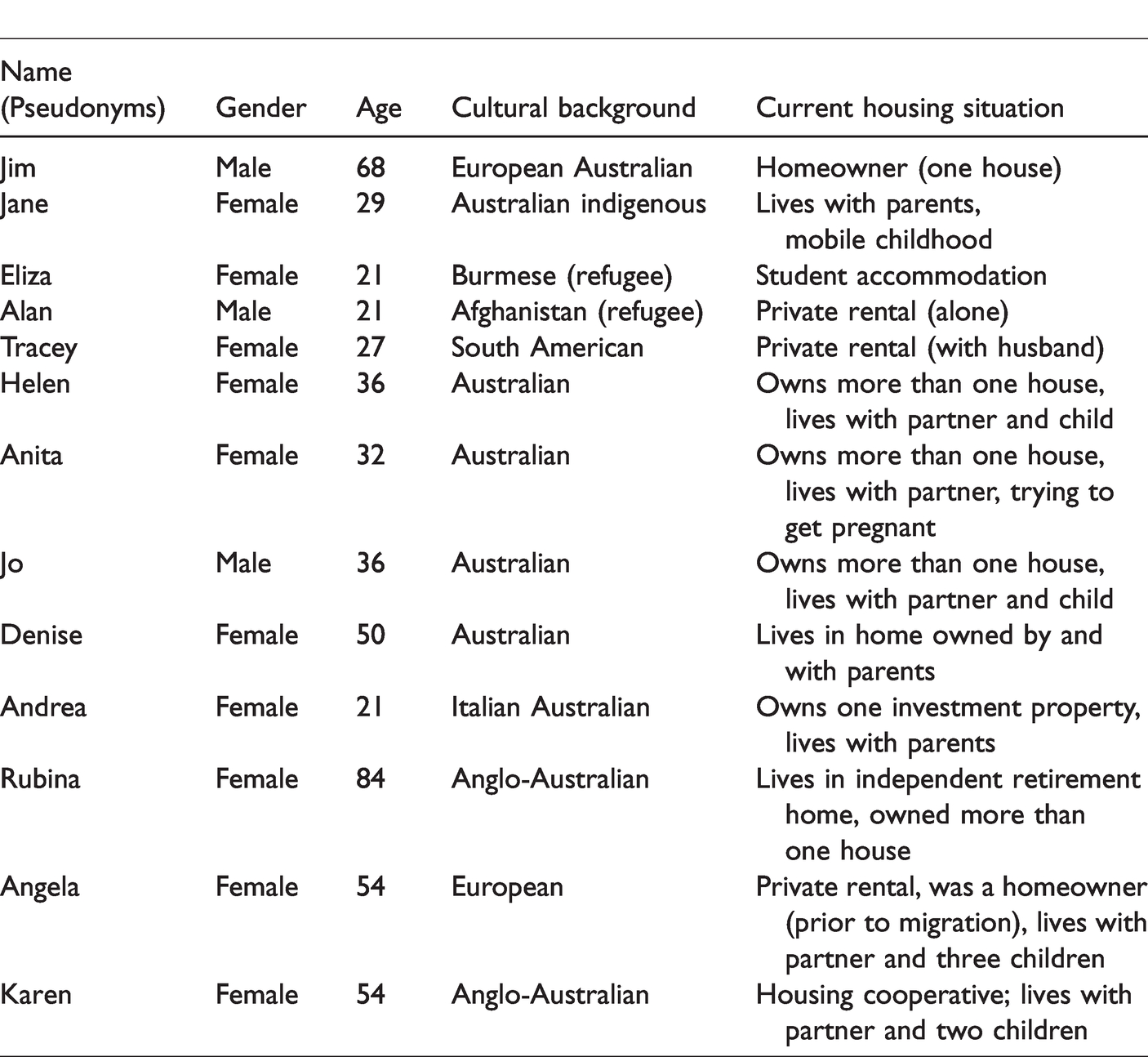
Semi-structured, in-depth, face-to-face interviews were completed with 13 people who responded and agreed to be interviewed, comprising of ten women and three men. Nine participants were recruited from the general population and four from multicultural agencies. The interviews were completed in various locations chosen by the interviewees, including on campus, in their home and in a human service organisation. The researchers asked them about their housing histories and what home and homelessness meant to them. The participants were aged between 21 and 84 years old and were from high to low income brackets and lived in various suburbs across Adelaide. Eight were born in Australia and five were born elsewhere. Two of these participants were born in Europe and migrated 7 and 50 years ago. The other three participants were born in South America, the Middle East and South-East Asia. These three had only recently arrived in Australia on temporary visas, two as refugees. Out of the sample of 13, seven were currently homeowners and one was a homeowner in her country of origin. All the samples were heterosexual. See Table 1 below for details about the demographics of the sample: gender, age, cultural background and housing situations.
Demographics of the sample group.
This intersectionality-informed qualitative research project framed the research questions around exploring what home means to a diverse community sample. A thematic analysis of the interviews was undertaken by dissecting the data into categories about housing and home and then collating these categories into themes (Braun and Clarke, 2006). The steps of the thematic analysis included familiarisation with the data, producing categories, identifying and reviewing themes, naming themes and then, documenting them (Braun and Clarke, 2006: 79). Two researchers completed and contrasted an inductive analysis by examining patterns of meaning or themes in the data (Hunting, 2014). Then, a multidimensional analysis was undertaken, consistent with intersectional studies, to examine the relationship between social structures (for example processes that support homeownership), identity constructions (individual resistances, identifications and differences) and symbolic representations (such as the status of home and homeownership) (Winker and Degele, 2011). Finally, notable intersecting social inequalities associated with for example, the classed privilege of homeownership, age, gender, religion, ethnicity, refugee and migration experiences were highlighted in the reporting of the findings.
Findings
The interview participants were asked directly ‘What does home mean to you?’ As the sample was diverse, meanings of home were also diverse, associated with one’s sense of belonging to a house, a country, a family, a class of people, a suburb, a place, a society and an ethnoreligious community. The findings pertaining to home were associated with (1) the material security of housing, including homeownership and the safety of suburbs and neighbourhoods; (2) a connection to multiple homes and the making of home in migration, such as when re-settling in a new country; (3) home as belonging to a family, including emotional connections to lost family members or acknowledging a supportive family and (4) a sense of home in religious and cultural self-expression.
The classed privilege of homeownership
The most dominant theme in the interviews across all age groups was related to participant’s engagement with (and resistance to) classed accounts of homeownership aspirations. Eight participants were (or had been) homeowners, including multiple homeowners. For participants with no family history of migration (Helen, Anita, Jo and Denise), home was associated with a physical dwelling (a house) and the symbolic status of achieving the security of home through homeownership in a ‘correct suburb’. Helen, Anita (female) and Jo (male) were all in their 30s, were married with children (or planning to have children) and multiple generation ‘Australians’, with no memory of migration. They were multiple homeowners, financially privileged and aspired to live in ‘good’ suburbs, with ‘good schools’ to improve their children’s future. They grew up in lower-to-upper middle-class suburbs in detached houses owned by their parents. They highlighted home as living in a good suburb, with local resources, such as access to quality facilities (including playgroups, schools, parks and playgrounds) and living near other people of similar socio-economic status and with similar middle-class values.
These narratives were consistent with literature on homeownership that discusses how middle-class neighbourhoods have symbolic value and are seen to provide residents with health and social status (Butler and Robson, 2003; Cattell, 2001; Pinkster, 2014; Savage et al., 2005); access to high-quality services and institutions, such as schools, day care centres, shops and cafes, allowing residents to balance work, family, leisure and social obligations (Boterman et al., 2010; Bridge, 2006) and safer environments for children (Aarts et al, 2010; Aminzadeh et al., 2013). These space/place-based understandings of home as a ‘good suburb’ and a ‘large house’ contribute to reinforcing the privilege and ‘comfort’ of middle-class homeowners, which contrasts with more mobile (Jane) and fluid meanings of homes or home as an ethnoreligious identity (Jim).
Three participants were 21 years of age. Eliza and Alan’s experiences as unaccompanied refugees meant that they lacked family support in Australia and could not currently afford to be homeowners, although they did aspire to buy their own homes one day. Andrea was also 21 and her family financially supported her to own her own home at an early age. Andrea is a second-generation Australian–Italian young woman who lived with her parents. With the financial assistance of her extended family, she owned her own house as an investment for the future. She recounted intergenerational experiences of multiple homeownership in Australia: ‘My Nona [Italian grandmother], they live frugally … but then they bought houses with their money … they helped out with all of that [my house], they helped with some of that money as well’ (Andrea, 21 years old). Andrea connected homeownership with a sense of security, and ‘home’ as being a secure ‘place where you feel safe and you belong’. This finding resonates with Pulvirenti’s (2000) study of 20 first-generation Italian Australians about their meanings of home and homeownership. Homeownership aspirations can be related to agrarian family histories, economic conditions and the ‘process of achieving sistemazione (settling down) – settlement, a place, a future’, which is commonly reflected in refugee and migrant experiences (Pulvirenti, 2000: 239). Andrea’s narratives also point to the relationship between family of origin and housing tenure, particularly homeownership, where parents can assist their children to purchase houses, through using the equity in their own house and their income or resources (Pickvance and Pickvance, 1995).
The oldest participant, Rubina (in her 80s), was also a migrant. Her housing situation and sense of home varied throughout her life course, coinciding with various life events: migration, raising a family and retiring. She transitioned from public housing to homeownership post migration to Australia. They moved to Australia for her husband’s career progression, which also alludes to the gendered aspects of migration and home (Madigan et al., 1990). She described the house they owned as being on a large block, with ‘three bedrooms, a big rumpus room and lounge and kitchen and what not’, which was in a ‘great’ location in which to live and raise children. Once retired, they downsized to a unit in a retirement village, where she currently lives and feels a sense of belonging: ‘I feel a connection here. I’ve got good neighbours and we are very friendly’ (Rubina, 84). Rubina highlights both the material and emotional aspects of home as being: ‘The centre of your universe and the people in it … it’s psychologically … where you’re at, isn’t it, and everything happens there … that’s the most important thing is your home and family’.
Whilst multiple homeownership can be associated with improving people’s housing circumstances, social status and financial security, these classed aspirations exist within an increasingly stratified society, in which the reproduction of inequalities takes place at political, economic, social and intersubjective levels (Yuval-Davis, 2015). When reflecting on class and homeownership, Angela and Karen, two women in their 50s with children, discussed resisting the middle-class housing norms of their families of origin. They came from class-privileged backgrounds and were first and second-generation migrants. As Karen’s quote shows, home can be associated with mobility and temporality: ‘home is where you make it … in a certain point of time’. Whilst research has shown that families with children tend to live in more valuable, owned housing than households with no children (Mulder and Lauster, 2010), this is not the case for Karen with two children and Angela, with three. Both women describe ‘sacrificing’ homeownership to benefit their children, prioritised private school education and the care of children over homeownership.
Multiple homes: Re-settlement in a new country
Despite aspirations for homeownership, another dominant theme was that emotional connections to home were multiple and not just to a ‘house’. All participants (not only migrants) alluded to multiple homes, including geographical locations outside and within Australia, such as other countries, suburbs or towns, as well as emotional and ‘psychological’ feelings of belonging to a culture, community and family. One exception was Denise (50s), who said home was ‘four walls and a roof’ as she had always lived in her parent’s family home and was expecting to inherit it. For recent refugees (Eliza and Alan) and new migrants (Tracy and Angela), Australia as a country was still ‘becoming home’, as they strived for a sense of belonging and security in their new home country, including materially aspiring to eventually own a home. When Tracy (in her late 20s) arrived as a student migrant in Australia with her husband, she said: ‘I felt homeless … I started crying because I felt that I didn’t have anything at all – nothing belongs to me’. However, when they moved into rented accommodation, coupled with getting a job and having an income, she felt more ‘at home’ in Australia. The new migrants often questioned what it means to ‘be at home’: ‘Am I or am I not a home in Australia?’; ‘Should I have left my home country to come here?’ and ‘where is home now? These narratives resonate with what Chan (2012) calls ‘hybridity’ for return migrants to Hong Kong, when ‘home, and belongingness, is here, there, everywhere—or nowhere’ (Chan, 2012: 31). Whilst it is acknowledged that the term homelessness is socially constructed, Tracy’s sense of expressed cultural ‘homelessness’, akin to a ‘state of mind’ (Kidd and Evans, 2011: 752), differs to the material experience of being without a house.
Whilst they had less choice about migration, for the two young refugees resettling in a new country (Eliza and Alan), home was intertwined with hopes of eventually reuniting with a supportive extended family. Both young refugees had lost their parents in war: ‘I lost my father, I lost my mother, I lost my life’ (Alan). They were alone in Australia and hoped to build a sense of cultural and familial belonging, with an imagined future of family togetherness and a safe house as ‘home’ in a new country, and the dream to eventually sponsor absent family members. This shows that ‘being mobile’ or feeling ‘unsettled’ does not necessarily mean that one is ‘detached’ and not emotionally connected (Ahmed et al., 2003: 1). In these narratives, emotional connections to family members lost in war were strongly intertwined with the making of a new home in Australia.
Family as home: A gendered account
All participants except Jim (whose extended family members were ‘exterminated’ in Nazi detention camps) alluded to family as home. ‘Home’ is often imagined as a place that ‘provides the locus around which emotions and relationships revolve’ (Fozdar and Hartley, 2104: 149). Symbolically and emotionally, home is referred to as the ‘arena of family life’, which is constructed in the literature as being gendered (Madigan et al., 1990: 639). As most of the participants were women, and the three men’s situation were so diverse, it was difficult to ascertain how gender intersected with meanings of home in the data. However, although not a migrant or refugee, Jane, who was of indigenous background, imagined a mobile home and family life with her partner (who must move regularly because he is in the Australian Army) and their future children. She emphasised that the actual material house and the location of home are not the most significant to her, as she is ‘not bothered’ if she must constantly move from house to house. Similar to Rubina’s experience of migration, the gendered ‘orchestration power’ of Jane’s partner and his work is evident in Jane’s interview, with her having to accept the housing decisions that she imagines will be made by her partner because of his work (Madigan et al., 1990: 639), contributing to her imaging of home as multiple and mobile.
Religious and cultural self-expression as home
The theme associated with religious and cultural self-expressions as home was particularly evident in migrant and refugee interviews. First and second-generation migrants (Tracy, Andrea, Rubina, Angela and Karen), and participants from refugee backgrounds (Jim, Eliza, Alan), discussed ‘home’ as being an emotional connection to an ethnic and cultural identity, which included to a family and/or to a country, as a place of security and safety. Jim focused on ethnic and religious self-expression most directly, when he connected home to his Jewish identity, ‘It’s a cultural ethnic religious connection’. However, as Jim stated, he continued to feel ‘a question mark over home’ in the country of Australia because ‘you feel at home when your ethnicity and your cultural background isn’t a question’ (see also Davis, 2017). Similarly, for Angela, home means ‘belonging to the place … the people … the society … and the community. I feel grounded to Europe, not in Australia’. ‘Home’ was emotionally connected to cultural places and ethnic and religious practices and routines that impart ‘a sense of regularity and familiarity’ (Possamai-Inesedy, 2002). However, for some migrants and refugees, this was only a partial sense of home and belonging, in a society with deep structural and systemic practices of cultural, ethnic and religious discrimination and power inequalities (Crenshaw, 1991).
Implications for social work
The central aim of this study was to explore how intersecting identifications and diversities shape understandings of home. The study found that a sense of home and belonging is associated with (1) material aspirations of homeownership in a ‘correct suburb’, (2) emotional connections to multiple homes, (3) as place to be with family and (4) cultural, ethnic and religious identifications. However, differences emerged for migrants and refugees who only felt a partial sense of home, ‘a question mark over home’ in Australia, with transnational connections marked by multiple identities and allegiances (Chan, 2012). This study found that migration, classed social boundaries, access to employment, income levels as well as age, gender and experiences of racism intersect to socially include and exclude people, influencing their capacity to achieve a sense of belonging in a country as well as homeownership, which ultimately shapes meanings of home.
The social work profession is an evolving one that operates within global and local contexts constituted by wide-ranging power dynamics within an ever-changing environment (Bent-Goodley, 2014). The ethical principles of social work are based on a commitment to human rights, social justice, dignity and worth of the person and the importance of human relationships (NASW, 2018). When considering the human rights and social justice mission of social work, social workers play an important role in advocating for addressing intersecting social inequalities that contribute to a sense of home and belonging that socially excludes the ‘other’ (Maatta, 2017).
The significance of the findings of this study for social work is that social workers can enhance a sense of home through supporting (1) the freedoms of religious and cultural expression; (2) the re-settlement process in a new country; (3) the building of connections to extended family; (4) access to secure housing in safe suburbs and neighbourhoods and (5) the affirming of diverse housing choices including resistances to homeownership. Social workers can become advocates for individuals within service systems to address social and political inequalities as they relate to home and belonging. They can explore the ‘dreams and aspirations’, values and choices of diverse community members (Maatta, 2017: 14); confront social inequalities such as sexism and racism, and become advocates within unequal housing systems. Drawing on this research, consistent with the social justice ethics of social work (AASW, 2010), social workers can highlight class privileges, social inequalities and social justice issues, as they pertain to housing, homeownership and home.
Conclusion
Meanings of home and homeownership are informed by the complex confluence of factors that include class, gender, religion, ethnicity, family-of-origin and cultural background, age, socio-economic status and citizenship status, having children and migration. As Määtta (2017: 14) argues, it is important for social workers to understand diverse modes of belonging when working with individuals, systems and to strengthen civil society, through the relationships and activities that social workers can establish with families, communities and in voluntary organisations. Social workers can draw on the meanings of home presented in this paper to work towards addressing unequal power relations, as associated with migration, racism, resettlement practices, supporting family connections and the planning of safe communities and suburbs, to contribute to building a stronger sense of belonging and home. To assist in their dialogue with the diverse population groups that they serve, social workers can benefit from understanding these complex perspectives about home and to examine broader privileging and disadvantaging social processes that can shape people’s sense of belonging and experiences of home (Zufferey, 2017). Intersectionality has been a useful lens to explore the complexities associated with intersecting influences on diverse meanings of home but not all social locations could be examined. These research findings highlight how class, age, gender, ethnicity and religion manifest in historically and culturally constructed accounts of home and homeownership. Future social work studies are needed to examine the complexities of people’s housing histories and feelings of belonging and home in more depth, as they intersect with citizenship, health, (dis)ability, gender and sexuality.
Footnotes
Declaration of conflicting interests
The author(s) declared no potential conflicts of interest with respect to the research, authorship, and/or publication of this article.
Funding
The author(s) received no financial support for the research, authorship, and/or publication of this article.