




Abstract
Incarceration of a parent has been shown to have significant negative impacts on children’s development, with poorer educational outcomes and engagement in anti-social behaviours. However, the experiences of children who do well, despite parental incarceration, have been largely ignored in scholarly research. This study therefore sought to bring a strengths-orientation to this area, investigating the protective processes described as important by non-offending, ‘resilient’, young adults with lived experience of parental incarceration. Data from individual semi-structured interviews conducted with five university students/graduates demonstrate the role of family support. Family-related protective processes, including positive caregiving characteristics, perceived closeness with non-incarcerated caregivers and multi-faceted family support, are the most important in helping the participants cope well and develop resilience. These findings provide important initial knowledge in this area and propose core areas for further investigation. These preliminary findings suggest that assisting families, through the provision of resources and parenting supports, would be helpful in facilitating the development of resilience for children with incarcerated parents.
Introduction
The number of children affected by parental imprisonment worldwide is unknown, but is thought to number in the millions. In the US alone, it has been recently estimated that more than five million children have experienced the imprisonment of a resident parent (Murphey and Cooper, 2015). In recent years, Australia, where this study was completed, has seen a rapidly increasing prison population. In 2018, the number of individuals incarcerated was 42,974, a 4% increase from 2017 (Australian Bureau of Statistics (ABS), 2018), which has flow-on effects to the number of children with incarcerated parents. Of Australian prisoners, almost one-half report having at least one dependent child (Australian Institute of Health and Welfare (AIHW), 2019). Although there are no official data on children of incarcerated parents, it is estimated that the population of children who experience parental incarceration is equivalent to the prisoner population (AIHW, 2015). However, the needs of this large and growing number of children are largely neglected due to the lack of guiding principles and policies in adult service systems with which families interact (e.g. Trotter et al., 2015). What is known is that these children experience various stressors including enforced separation from primary caregivers, social stigma and financial hardship (Dallaire et al., 2010; Luther, 2016; Trotter et al., 2017), which have significant negative effects on the children’s physical and psychological well-being.
It is necessary to identify the potential issues and risks for children experiencing parental incarceration to harness the attention of policymakers and service providers, including social workers; however, focusing solely on the ‘negatives’ may have the indirect effect of reinforcing stigma and reducing aspirations and expectations for these children. While the majority of studies report poor psychological and social outcomes for children with incarcerated parents, many overcome these adversities and do well in their lives (Kjellstrand and Eddy, 2011; Nesmith and Ruhland, 2008). Indeed, Eddy et al. (2013: 76) argue that such resilience is the rule rather than the exception, with Johnson et al. (2018: 1914) reporting that most children can be seen as ‘adjusted’ or ‘striving’.
Despite this, very few studies have sought to focus on those who are doing well. According to Haskins et al. (2018), it is critical to identify resilience pathways among children of incarcerated parents in order to properly address their unmet needs. Although resilience remains a contested concept, we adopted a more general term: the capacity to adapt successfully despite experiencing significant adversity, and which results from an interaction between people and their environment (Masten, 2016); and which can be fostered by protective conditions and experiences (Flynn et al., 2017). This study is therefore underpinned by a general strengths-orientation and sought to identify the protective processes described by university students/graduates who have experienced parental incarceration.
Existing knowledge
The current literature on protective factors for children with incarcerated parents is extremely limited, with most research focused on describing and seeking to understand intergenerational patterns of offending (Flynn et al., 2017). Given the paucity of research in this area, a critical literature review approach (Grant and Booth, 2009) was implemented. This involved an extensive search for recent (within the last decade) relevant literature by the first author, identification by both authors of the significant studies in this area and subsequent evaluation of their conceptual contribution to this emerging area. The discussion is presented as a narrative review.
Children in the context of their family: Protective processes
Much research about children affected by parental imprisonment has sought to describe the connection between this experience and outcomes for children. Most recently, this has included using large, linked data sets, noting the connection between parental offending and children’s conduct disorder (Tzoumakis et al., 2019) as well as parental conviction (particularly imprisonment) and children’s developmental vulnerabilities (Bell et al., 2018).
Findings from a US study (Kjellstrand and Eddy, 2011), examining the associations between a range of parental features (including imprisonment, health, social disadvantage, etc.) and children’s anti-social behaviours, however, found only an indirect relationship between parental incarceration and problem behaviours for children in Grades 5 and 8 (aged 10–14 years). Those authors report that the relationship is explained by parent health, social disadvantage and parenting quality; note this was less so, perhaps unexpectedly, by the time children were in Grade 10 (aged 15–16 years). Parenting quality (monitoring, involvement, praise, etc.) particularly was seen to have considerable influence; this is consistent with patterns established in previous community-based studies (e.g. Eisenberg et al., 2005; Steinberg et al., 1989). Some US researchers report a specific connection between a positive parent–child relationship and secure attachment. Attachment has been shown to assist either in the development of empathy, which then moderates the relationship between parental incarceration and children’s aggressive behaviours (Dallaire and Zeman, 2013) or to improve children’s ability to regulate their emotions (Zimmer-Gembeck et al., 2017).
Focusing specifically on parent–child relationships, Davis and Shlafer (2017) drew data from the Minnesota Student Survey to investigate the protective role of strong parent–child relationships in mental health problems for adolescents who have experienced parental incarceration. Their findings indicate that children’s subjective perceptions of how much parents care about them partially moderate the relationship between parental incarceration and children’s emotional and behavioural problems (including anxiety, intrusive thoughts and suicidal ideation). Similarly, drawing on the US National Longitudinal Survey of Adolescent Health, Nichols et al. (2016), in their study of educational resilience, found that parent–family closeness decreased delinquency in children with incarcerated parents.
However, findings from further research in this area have emphasised their interactive and embedded nature, notably the impact of other cumulative life circumstances and current problems. Nichols et al. (2016) found that the protective effects of strong parent–child relationships tend to be weaker for children who are currently experiencing parental imprisonment. This is likely because children who are experiencing parental incarceration may be exposed to additional, current, stressors and adversities. Similarly, Markson et al. (2016), with data from a study of 801 children of incarcerated fathers, found that a high level of mother–child closeness only plays a protective role for children in the context of low cumulative risk. That is, the protective role of positive parenting and a close relationship is more effective in a less adverse environment. It is well established that where a family member is imprisoned, families tend to be stressed, both financially and emotionally (e.g. Arditti et al., 2003; Beggs, 2002); this context in which families operate will influence how they can parent and care for their children. Johnson et al. (2018), in their study of 26 carers and children in the US, similarly found that children who were seen to be ‘thriving’ experienced fewer contextual stressors, such as instability in housing or finances. Those authors further found that a range of carer characteristics were protective for children: positive expressiveness, including closeness, optimism and empathy; agency – role modelling and social support. Overall, the evidence suggests that for effective and supportive parenting and parent–child closeness to be enacted, a wider supportive environment is needed.
Families as the provider and conduit of support
A limited number of small-scale, mostly US, studies have highlighted the positive role played in children’s lives when families are able to provide or link children to wider supports. Luther (2015), interviewing 32 US college students who had experienced parental incarceration when they were aged under 18 years, highlighted that emotional, informational and instrumental support from extended family could promote children’s resilience. These adults also provided access to social activities, supported the child’s vision for a better life and redirected the child from risky or illegal behaviour onto a prosocial path.
Similarly, Nesmith and Ruhland (2008) found that providing opportunities for children (N = 34) to participate in social activities, including sports, theatre and church, helped them to cope well. Such participation distracted them from the negative emotions caused by parental incarceration, but also enabled them to build confidence through focusing on strengths and interests and receiving social support. ‘Feeling normal’ was emphasised. The latter, and its links to positive self-identity, was also noted in Walsh’s (2016) small multiple case study in Victoria. It is important to note that these studies have typically used an exploratory research design to uncover coping strategies, and therefore cannot confirm the relationship between particular coping strategies and resilience. More importantly, the results are difficult to generalise to the wider population, because coping strategies might be dependent on different variables such as children’s personality, available family resources and support, the type of parental offences and the relationship with incarcerated parents.
Linking to the community: Connections to education
Building on research showing a link between experiencing parental imprisonment and poor educational outcomes, some studies have focused on schools specifically. Exploratory research in Victoria, based on the views of a small sample of teachers (McCrickard and Flynn, 2016), points to the unique role of schools in providing caring, supportive adults and safe spaces for children to help alleviate feelings of stigma and isolation; the potential for schools is also noted in research by Roberts and Loucks (2015). Drawing on a larger data set from children, Nichols et al.’s (2016) findings about academic resilience indicate that school connectedness plays a compensatory role for the children in achieving a higher level of academic results and education. Teachers are argued – by Thurman et al. (2018) – again based on an analysis of secondary data (Texas Alternative School Health Survey – 2015), to be important to children’s resilience. Their findings emphasised the importance of being recognised, encouraged and guided by teachers as well as the role of teachers in promoting prosocial life paths. While some school programs have been offered (e.g. Lopez and Bhat, 2007), there has been little evaluation of these re-effectiveness. Most articles are limited to describing programs and providing initial observations on program impacts.
Mainstream research in the area of parental incarceration typically focuses on the challenges faced by the children and the negative effects of parental incarceration, such as intergenerational offending and anti-social behaviour. Limited studies have investigated the protective processes that help the children of incarcerated parents to develop resilience. An examination of this literature shows that multi-layered processes including self-regulation, family support and connections, along with community connectedness are influential. However, the bulk of these studies rely on existing secondary data from the US. Although these studies confirm the protective role of particular factors or processes in parental incarceration, the chosen methods cannot provide any explanation about how these work in the complicated context of parental incarceration. There is also questionable wider application, given the very specific circumstances of mass incarceration evident in the US, which is not so in other western jurisdictions, including Australia, where the current study was conducted. In addition, the role of other less studied processes is also worthy of examination.
Methodology, methods and participants
Given the limited attention given to this topic, the aim of this study was to present an initial, strengths-oriented, investigation of the nature and function of the protective processes identified by university students/graduates who have experienced parental incarceration. This study falls within what Neuman (2014) calls an exploratory design, where the main aim is to explore a new topic or new aspects of an existing area of concern. As discussed by Flynn and McDermott (2016: 88) Research at this level aims to discovers knowledge about an issue, to gain initial insights or clarifications, and to test whether or not any propositions or hunches you may have, have any merit. Exploratory research simply seeks to identify factors or variables that are key to the research problem or phenomenon, not test or measure these.
The target participants of this study were non-offending university students or graduates who had experienced parental incarceration (of at least one night) during their childhood. Using a broad definition of parental imprisonment was a deliberate choice, befitting the study’s exploratory aims. Given the limited knowledge of protective factors or processes by which young people develop resilience, the researchers sought to ‘cast a wide net’, and to not exclude any potential sources of information. The study also incorporated an ‘extreme-case’ sampling approach – seeking what Patton (2015) calls exemplar cases – those whose experiences differ from the dominant pattern (Neuman, 2014). In this case, the existing research indicates that children who experience parental imprisonment typically have poor education experiences and outcomes (McCrickard and Flynn, 2016). Accessing higher education was therefore used as an indicator of resilience in this study, informed by the approach taken by Luther (2015). Although there are many representations of resilience, educational success is a considerable, as well as obvious, indicator. The limitations of this approach are acknowledged and discussed further later in the paper. Although a qualitative, exploratory study typically only requires a small number of participants (Hewitt-Taylor, 2011), there is no agreed standard about the appropriate sample size. A small sample size here (N = 5) allows for rich data to be gathered and detailed exploration of the issues discussed.
As the potential participant group is hidden in the general population, multiple recruitment strategies were applied to recruit participants and compensate for any lack of representativeness. Prior to the participant recruitment process, the proposed study was reviewed and approved by the University Human Research Ethics. Potential participants were recruited from both online channels and university campuses across Melbourne. Online channels included Postgraduate Association Newsletters, Facebook Fan pages and Twitter. The recruitment flyers were also posted on information boards around the main campuses of the researchers’ university. In addition, the recruitment flyer was also made available on the websites of two organisations who work with prisoners and their families. Interested parties made initial contact with the second author, who brings considerable social work practice and research experience in this field, who then sent explanatory statements to them, confirmed if they met the inclusion criteria and wanted to participate in the study. All potential participants who did not reply to the information sent by the second author were sent one follow-up email to clarify if information had been received and if they wanted to discuss the project further before deciding on participation. No further emails were sent, as non-response was seen to be a choice made. This ensured that the research was conducted ethically and was mindful of participants’ privacy.
Those expressing interest were then linked via email with the first author, who was collecting the data and coordinating the study. Participants chose their preferred interview time and location to ensure autonomy and a reduction in the inequality between the researcher and the participant (Flynn and McDermott, 2016).
Individual semi-structured interviews were conducted to collect qualitative data. This approach allowed for in-depth data on participant experiences, and comprehensive exploration of what these ‘children with incarcerated parents’ deemed to be protective. Semi-structured interviews were most suitable for the study purpose, as they allowed the researcher to categorise potential protective processes and generate more reliable and comparable findings by asking each participant similar questions on pre-determined topics (Cohen and Crabtree, 2006). The semi-structured interview questions were based on themes identified in previous research (e.g. Davis and Shlafer, 2017; Kjellstrand and Eddy, 2011; Luther, 2015; Nichols et al., 2016). The interview schedule was piloted via scoping interviews with two ‘resilient’ adult children, as expert consultants, who had experienced parental incarceration. This was done in order to verify the protective processes identified in previous research and identify anything further. Subsequently, additional protective processes identified from these scoping interviews, notably internal motivation and family expectations, were included in the interviews.
Data were analysed by thematic analysis, a systematic and flexible method suitable for exploring individual lived experiences (Braun et al., 2015). Interviews were transcribed by the first author and then coded; this was then independently reviewed by the second author. The analysis combined descriptive/interpretive and deductive/inductive coding (Braun and Clarke, 2012). In terms of deductive coding, the researcher interpreted the data by considering strength-based theory and the existing protective factors and processes identified in previous research. Meanwhile, the inductive strategy ensured that we were open to new ideas presented by the participants. After the data were fully coded, similar and overlapping codes which reflected a meaningful pattern were identified as a theme (Braun and Clarke, 2012).
Findings
Study participants
As noted above, participants were recruited via universities in Victoria, Australia, using a range of approaches. A total of five individuals participated; a further seven people (Female: 5; Male: 2) made initial contact with the researchers, but chose not to continue with the study. As discussed above, one follow-up email was sent to all who did not reply to the information sent. Around one-half of those who expressed initial interest, but did not continue to participation, engaged in a number of emails or phone calls with one or both researchers and expressed a desire to participate. We did not pursue these participants further and cannot comment on their reasons for not responding. The other half typically simply did not reply. Again, it is not possible to speculate on the reasons for this, although one person who had requested initial information did reply to explain that they had misunderstood what the study was about and that they did not fit the criteria, as they had not experienced parental imprisonment. See Table 1 for participant characteristics.
The study participants.
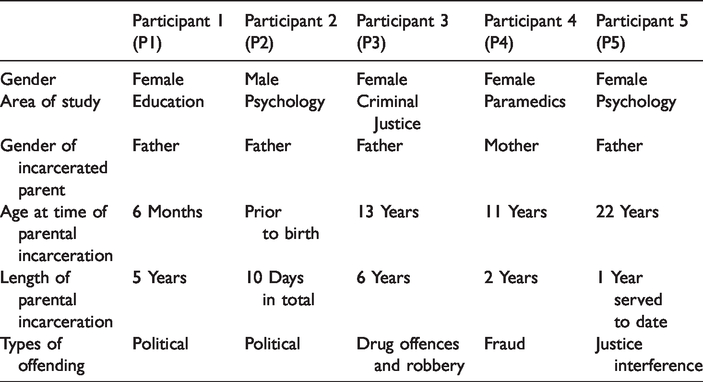
The participants were aged 19–32 years and included both local and international university students or graduates who had experienced parental incarceration. The diversity of their characteristics is evident, with regard to their age when their parent was imprisoned and the length of that imprisonment. As is also evident, most of the participants were young women (n = 4), with almost all reporting that it was their father who had been in prison (n = 4). It is also of some interest to note that the participants’ chosen areas of study are all helping professions in some ways. This has not been an issue noted in any previous research and was unanticipated. While not of primary interest to the current study, it is certainly worthy of further examination. As indicated earlier, the selection criteria were kept wide in order to allow examination of different experiences; this is important as the study is at the exploratory stage, and important information may be overlooked if there are too many parameters. For example, one unanticipated issue which arose during recruitment was the interest in participating expressed by two individuals whose parents had been imprisoned for political matters (outside of Australia). This is an issue which has had little to no attention in the scholarship related to children of prisoners. They were included in the study because they met the selection criteria, and their experiences added new and valuable insights to the area of parental incarceration, with some core similarities and differences. Key themes in the data are outlined below; raw data in the form of quotes are provided as supporting evidence. Participants are identified as P1–P5.
Family as the key to protective processes
Study data indicate that the family is the primary protective pathway to help participants build resilience. Further analysis shows that family functioning can be specifically divided into three aspects: positive caregiving characteristics, a close relationship with the primary caregivers and family support.
Caregiving characteristics: Respect and role modelling
All five participants report having had at least one consistent primary caregiver to support them during the period of parental imprisonment and beyond. The participants report that their primary caregivers – who include mother, father, grandparents and uncle – were consistently supportive and showed them unconditional love and care. ‘It’s like they (grandparents) support me like moneywise, they support me like their own daughter. They don’t push me to do anything, they are very … like whatever you feel is right, we will support you’ (P3). They (father and uncle) respect our choices, they treated us like you were the adults and you know every decision you make has an outcome and that outcome you have you deal with. That was they told us very early. (P4) She (my mother) worked a lot, she worked as a man, she was a breadwinner of my family, so she needed to work a lot. She works hard. I know how hard her life was. My mother is my role model … for me, if you work harder, if you try harder, you will overcome some obstacles … I never give up. (P1)
Relationship: Closeness with non-incarcerated caregivers
The results indicate that the participants’ relationships with the non-incarcerated primary caregivers are secure, close and positive. It’s always been perfect with mum. It’s always been great … like I could open up to her, my feeling with her is very secure. (P2) They (grandparents) are always like being my parents to me. I always want to go to their house as a little girl. (P3)
Multi-dimensional support: Emotional, informational and instrumental
Data analysis reveals that the support provided by caregivers is multi-dimensional and interactive, with participants describing receiving emotional, informational and instrumental support from their primary caregivers and extended family members. This multi-faceted support was described as important in helping them to cope with the challenges experienced.
Emotional support, including encouragement and positive expectations, and informational support, such as guidance and advice, are described by participants as being consistently provided by the family members to help them achieve the ‘best version’ (P4) of themselves. My father was in the prison, that’s why my grandfather loves me a lot … but at that time … my aunties bullied me … they said: ‘prison father’s daughter’. But when they said me like this, my grandma scolded them … my grandpa and my grandma stood by me … my grandparents protected me. (P1) It’s a lot of emotional, but the same time, they (grandparents) are very … um you know, they are very: come on, like you have to let this out, come on, you have to do this, or you know … don’t go down to this path. They kind of remind me like I am more than what my dad was … because before, everything was happening, I went to their house, I was very much like I’m gonna end up like him, but now I’m like … they like you know … you will be good, you will be fine. And they are very supportive, and they are very good at motivating you like going do what you wanna do. (P3) I think my mum does affect a bit … but my dad was a lot more … she does kind of pushing us do a little bit better … probably more my mum’s expectations to go to the Uni. (P5) I got most of my family here, my immediate family and my dad’s sisters and brothers, so they are all here. That’s really great, because I kind of … I got great support network to help me out, help me through things … , like when my dad died, after we found out, the whole extended family, 15 people came to support us. It was really great. (P2) My dad’s brother came and helped my dad, cos he couldn’t work full time and look after us … I think it’s especially with my uncle … he was devoted to bring us up. So I don’t know, I just tried to be the best possible kid I could be, cos I was appreciated I guess … (P4) All the money she earned, she invested in our education. (P1) They just try to keep our lives as normal as possible … when I was year 11, I went to India by myself and I was part of this like schools from all around the world like kids we built school in India. I did that. I did a lot like feed the homeless like I went to science camp staff like that. (P4) I used to play netball 3 times a week, train 3 times a week, so it was kind of very like … a very intensive, I think I enjoyed it because it was just … took my mind off everything … that’s good to let off steam and just let out … like … it was good, cos you mind wasn’t thinking anything, it’s just the game … It's a whole new group of people, like it was good to just see people that kind of didn’t see you in that bad mental way. But like, yeah, it was very good. It helps a lot. (P3)
Unanticipated findings: Parent, school and community factors
Although noted in the literature as important for children, relationships with incarcerated parents are reported here to be more complicated and unstable. It is most common for participants to describe this relationship to have been negatively affected by the incarceration. For example, when describing current relationships, they ‘don’t speak’ (P3, P4) and are ‘less open with each other’ (P5). The feelings expressed toward their incarcerated parents remain ‘unsolved’ (P4), and they feel ‘disappointed’ (P3, P4, P5), ‘disgusted’ (P3), ‘upset’ (P4) and ‘angry’ (P5).
Despite being indicated in some previous research, any protective role played by community supports, such as teachers and professional services, including social workers or counsellors, are not as clear in this study. Indeed, no participants reported accessing any targeted support services. P3 and P4 were the only two participants to nominate teachers key to their development; they both describe their teachers as supportive and understanding. Participant assessments of the value of school counselling and community psychological services are also inconsistent. Some psychological sessions provided a safe space for two participants to talk or deal with their emotional issues. However, sessions are described as ineffective and unhelpful by two participants (P2, P5), due to the perceived limited capacity of the counsellor.
Given the specific focus of this study on what assisted young people, these issues were not explored further.
Discussion: Intersecting family processes
Overall, study findings indicate that within families, protective processes including positive caregiving characteristics, close relationships with the primary caregivers and family support not only help the participants to cope with the adversities associated with the parental incarceration but also play a fundamental role in linking the participants with protective processes in the community, such as activities and services.
Relationships with carers: Positive caregiving characteristics alongside closeness and security
It is clear from the findings that the positive impact of the non-incarcerated primary caregivers is both in what they provide to the young person and in how they behave. The participants describe their caregivers as responsive and supportive. The caregivers respect the participants’ autonomy and have positive expectations of them – as responsible for their own life. More importantly, most of the participants describe their non-incarcerated caregivers as a role model, whose positive attitudes toward adversities are internalised by the participants. These findings echo those presented by Johnson et al. (2018) who emphasised closeness, optimism and empathy, alongside agency. These characteristics also reflect an authoritative parenting style, which has been shown to be related to fewer problematic behaviours, higher self-confidence and better academic performance in children (Eisenberg et al., 2005; Steinberg et al., 1989). The results broadly support the quantitative evidence from Kjellstrand and Eddy’s (2011) study that ‘effective parenting’, such as involvement and praise, has positive effects on aggressive behaviours of children who have experienced parental incarceration. Another explanation may be that the positive caregiving characteristics enhance the relationship between the participants and their non-incarcerated caregivers (Davis and Shlafer, 2017).
The narratives of the participants indicate that the perceived closeness with the non-incarcerated caregivers is vital in helping them do well. Participants report a secure and close relationship with their non-incarcerated caregivers; they recognise and acknowledge consistent and unconditional care from their caregivers. Data also indicate that the difficulties and challenges the participants and the non-incarcerated caregivers have been through together may also strengthen their relationship. The findings also accord with previous research, which showed the buffering impact of close relationships with carers (Davis and Shlafer, 2017; Nichols et al., 2016). Based on the findings, another protective factor, multi-faceted family support, may alleviate the participants’ emotional difficulties and potentially disruptive behaviours.
Multi-faceted family support: Emotional, informational and instrumental
The participants describe receiving wide-ranging support from both their immediate and extended family. The consistent support the participants received is reported as the most important protective factor to help them overcome adversities they faced. Although social support has been investigated and reported on in some previous research (e.g. see Johnson et al., 2018; Luther, 2015), the current study’s findings bring a more nuanced understanding of the types of support provided and how these may interact.
In terms of emotional support, participants describe family members’ expressing understanding and positive expectations, allowing them to feel both accepted and trusted. When informational support, such as guidance and advice, was provided in conjunction with these forms of emotional support, participants were resourced to achieve those expectations and develop their own positive identities, which are different from their incarcerated parents. These are consistent with previous research findings, about the role of families in bringing ‘optimism’ (Johnson et al., 2018) and enabling ‘successful’ young adults to envisage a better life (Luther, 2015). Having someone believe in them might be especially important to these participants, as the stigma of parental incarceration facilitates their self-doubt and may negatively affect the other people’s perceptions and expectations of them (Dallaire et al., 2010).
Family support not only comforts and motivates the participants but also plays an important role in linking the participants with external protective resources. Regardless of the financial status of the family, the non-incarcerated caregivers created opportunities for the participants to access education, social activities such as baseball, camps and volunteering, as well as psychological support. The current study underlines the interaction between multi-layered protective processes and stresses that family resources and functioning provide a strong base for children with parental incarceration to achieve resilience. In addition, the structural resources, reflected by the participants, helped them to feel ‘normal’, to distract themselves from the chaotic reality, to find release from their grief and disappointment and to gain a sense of control. Previous studies (Luther, 2015; Nesmith and Ruhland, 2008) emphasise the development of a sense of normality. These findings build on from Walsh’s (2016) initial suggestion that engaging in community activities such as sports and volunteering may help the participants to form a positive identity that is different from their incarcerated parents.
Unanticipated findings and limitations
Previous studies have shown some protective role played by the relationship with the incarcerated parents and recommend that the relationship is maintained during the parental incarceration (Luther, 2015). However, as detailed in the ‘Unanticipated findings: parent, school and community factors’ section, the dynamics between the participants and their incarcerated parents, typically fathers, were complex and inevitably worsened after the incarceration, which participants describe as negatively affecting their emotional well-being in the longer term. There are many possible factors contributing to these negative outcomes. For instance, recent evidence shows that there is limited parenting support or preparation for post-release parenting for incarcerated fathers in Victoria’s prisons (Bartlett and Trotter, 2019). More targeted and in-depth studies are needed to capture the complexity in the relationship between children and their incarcerated parents and managing the challenges both during and after imprisonment. In addition, this study has been unable to demonstrate any consistent protective role played by the school or community services, indicated in previous research (Lopez and Bhat, 2007; Luther, 2015; Thurman et al., 2018). There are potential factors that may lead to this inconsistency such as the small and self-selected sample, along with the lack of specific services for this participant group in Victoria.
Moreover, this study unexpectedly recruited two participants, whose parents were incarcerated for political matters in prisons outside of Australia. This group of children has not been the focus of any research or scholarship to date. Initial data indicate that the adverse circumstances experienced by these participants tend to be consistent with the wider group of participants and ‘children of prisoners’ more generally: the physical and emotional absence of a parent, poverty and stigma (Luther, 2016; Trotter et al., 2017). Although an outsider view may have anticipated these study participants expressing more mixed emotions, including some pride, they report similar common negative emotions about this experience, such as grief, anger, disappointment, sadness and anxiety. However, although not explicitly examined in this study, the inhumane treatment and torture experienced by their fathers as political prisoners appears to have long-term negative impacts on their social functioning after the incarceration. This is unsurprisingly described by these participants as having an impact on the whole family, both emotionally and financially. This area of study is absent in academia, but it is worth investigating further, specifically and separately, in order to gain a better understanding of the children of political prisoners and pay more attention to allocating and designing appropriate services for these parents who are released from prison.
This study also has limitations which need to be acknowledged. The targeted participants in this study are largely invisible in the community due to the overt stigma and shame caused by parental incarceration; this may have negatively affected people coming forward to volunteer for the study or going on to participate. The study may fail to account for more diverse voices because of the challenges in recruitment. Future studies should consider various data collection strategies to reduce potential concerns about being stigmatised and identified. For instance, the option of online questionnaires and phone interviews might be provided, which are less confronting and may ensure anonymity.
In addition, the indicators of resilience used in this study – no offending history and accessing higher education – are easy to identify and measure. However, this approach ignores important insights from those who cope well with parental incarceration and are resilient, but choose not to engage in higher education studies. Future studies may need to consider the term ‘resilience’ much more comprehensively. Last, the results of the small-scale qualitative study cannot confirm any relationships between the variables and be generalised to the broader population. Therefore, the explored protective processes and their potential mechanisms will benefit from being examined by larger scale studies.
Implications and conclusions
The findings highlight the critical role of family functioning in building the resilience for those young adults. Positive family functioning, which enables multi-faceted family support, not only helps the participants to build individual strength in dealing with the parental incarceration but also enables the participants to connect with protective supports and processes in the wider community. The majority of previous studies stress that children with incarcerated parents face various stressors such as financial hardship and those children tend to have poor psychological and social outcomes (Dawson et al., 2012; Murray et al., 2012). However, the current small-scale exploratory study provides initial understanding of children with incarcerated parents from a strength-based perspective. That is, children can do well despite parental incarceration if they have a stable and supportive caregiving figure to support them and link them to the wider community. Moreover, the protective roles of positive parenting and perceived closeness with the caregiver might be more effective in a less adverse family environment (Markson et al., 2016). The findings suggest the need to locate supports for children clearly in the family context.
This study is the first study systematically exploring the protective processes identified by ‘resilient’ young adults who have experienced parental incarceration in Australia. Interviewing participants who are often considered hard to reach provides initial insights into the development of resilience in children who have experienced parental incarceration and builds a foundation for future studies. The unexpected findings in terms of the experiences of political prisoners and their children should raise attention to this less studied group. In summary, this exploratory study is the first step to explore the issue of parental incarceration from a strengths-based perspective.
Footnotes
Declaration of conflicting interests
The author(s) declared no potential conflicts of interest with respect to the research, authorship, and/or publication of this article.
Funding
The author(s) received no financial support for the research, authorship, and/or publication of this article.