




Abstract
A burgeoning literature provides evidence that neighborhood matters, especially in relation to urban adolescent development. Exposure to crime and poverty has been shown to negatively impact key aspects of development, such as physical, mental, and emotional well-being. Traditional theoretical frameworks identifying the social mechanisms of place fail to critically examine how neighborhood effects are socially constructed at the individual level, and rather assume aggregate community narratives. Such blanket measures of neighborhood effects do not account for individual interpretations of space or the impacts of larger structural forces on decision making and developmental processes. A unique combination of qualitative GIS methodologies was utilized to explore how urban adolescents define, navigate, and engage their surrounding environment to better understand the mechanisms of neighborhood effects, and how these interactions shape development. Sedentary and walking interview data were paired with GPS data to develop a real-time understanding of the spaces across which youth were navigating. The findings from this work suggest that how youth perceive space is a complex process, stemming from the interaction of structural and social systems, and highlight the value of understanding varying resident experiences when considering definitions of neighborhood. This study begins to fill a gap in the neighborhood effects’ literature by developing an argument for the social construction of place as an alternative to traditional methodological and theoretical frameworks.
Background
Exposure to neighborhood disadvantage, typically indicated through census-bounded compositional characteristics (e.g., crime, poverty, and residential mobility rates), places youth at risk for poor outcomes across numerous domains of functioning (Bowen et al., 2002; Leventhal and Brooks-Gunn, 2000; Minh et al, 2017; Oakes et al., 2015; Sampson et al., 2002). Yet, there is growing concern that such macro-level indicators fail to capture key social processes that may be critical to understanding how and why neighborhoods shape youth development (Oberwittler and Wikström, 2009) and elucidate malleable targets for prevention and intervention.
There is an emerging consensus that social processes in neighborhoods may be better captured through micro-level measures of space, including perceived crime, resident movement, and service utilization choice as these focus on internal processes that are not easily observed (such as how one perceives something, decision making, and cognition) (Campbell et al., 2009; Hipp, 2007; Sampson, 2019; Schaefer-McDaniel, 2009). Prior research suggests potential methods for eliciting these processes (e.g., surveys, photovoice, community mapping exercises, and in-depth interviews) (Coulton et al., 2001; Hipp, 2007; Mmari et al., 2016); however, the majority of this work has focused on adults, failing to integrate youth experiences and perceptions into definitions of neighborhood (Murry et al., 2011).
The importance of space in adolescent development has also long been documented. Bronfenbrenner’s Ecological Model (1979, 1986) highlights the importance of place in human development. Identity formation, among other outcomes, is impacted and formed through interactions spanning a variety of relationships, settings, and contexts (French et al., 2006). Adolescents interact regularly across the social fabric of their neighborhood with family members, peers, and others not included in their intimate relationship networks. Tajfel and Turner (2004) suggest that identity development is shaped by aligning with a particular group while distancing oneself from others. The authors note that this is particularly true for ethnic minorities or other devalued groups. Equally important to social relationships is how youth construct the meaning of the spaces in which they spend time, including neighborhoods, and how these meanings relate to their development. Using a unique combination of spatial and qualitative methodologies, this study offers an understanding of how young people construct meaning of the spaces in which they spend time and, further, how these meanings influence development, while also offering a differing perspective on neighborhood effects theory.
Theoretical underpinnings of neighborhood effects
Neighborhood effects’ research has its roots in the early twentieth century, with the seminal work of Shaw and McKay (1942). By applying geospatial analyses to assess crime across an urban landscape, Shaw and McKay illustrated the importance of place for development. Years later, Jencks and Mayer (1990) published a critical review of the neighborhood effects’ field, resulting in five theoretical frameworks for assessing the link between neighborhood and youth outcomes that have provided a foundation for studies since (Leventhal and Brooks-Gunn, 2000). Specifically, the authors suggest that the availability of institutional resources, such as schools and community centers, as well as exposure to healthy adult mentors and supervision may positively impact development. Competition for scarce resources functions as a mediating factor in resident behavior, while the concept of contagion supposes that socially disruptive behavior is spread throughout peer and neighbor groups. Jencks and Mayer (1990) also posit a relative deprivation framework, suggesting that low-socioeconomic status individuals, who move into more affluent areas, are likely to experience feelings of defeat and an inability to perform at the same levels as their peers.
Most recently, the theory of collective efficacy suggests that developing trust between residents is a key component of developing social control within geographically defined spaces. In locations with high levels of collective efficacy, residents feel connected to one another, thereby making them more willing to challenge disruptive social behavior in the community (Oakes et al., 2015; Sampson et al., 2002). As trusting relationships are built and maintained between individuals living within the same neighborhood, these bonds serve as a form of social control, with neighbors being increasingly likely take an active role against socially maladaptive behavior, such as crime (Sampson, 2002). Conceptually, collective efficacy measures neighborhood processes as aggregate outcomes rather than assessing data at the individual level.
The social construction of place
Across the empirical landscape, neighborhood is almost always defined by U.S. Census Bureau data (i.e., census blocks, block groups, and tracts) as these geographical units of analysis allow for the application of large administrative and geocoded datasets (Coulton, 2012; Coulton et al., 2001; Hart and Waller, 2013; Hipp, 2007; Sampson et al., 2002; U.S. Census Bureau, 2019). However, utilizing a strictly bounded definition of neighborhood fails to adequately capture other spaces residents consider part of their neighborhood and may not measure actual resident experience or exposure to environmental conditions. Census tracts, block groups, and zip codes, though useful for categorizing, organizing, and grouping individual level data, fall short of capturing the micro-interactions between residents and the spaces around them that create meaning and uniquely defined neighborhood boundaries.
Conventional measures of neighborhood are statistically fixed spaces with geographical boundaries, while comparatively, “relational” measures of neighborhood include resident networks, malleable geographical boundaries, and layers of assets that shift across both time and space (Cummins et al., 2007). Coulton (2012) presents a socially constructed definition of neighborhood, whereby residents develop a unique pathway of activities throughout their daily travels, which may or may not fall cleanly within traditional census defined measures of neighborhood. Additionally, social interaction is an important aspect in defining evolving boundaries of place, ascribing different meanings to different people, depending on their lived experiences (Coulton, 2012).
In response to the need for a more finely tailored measurement of neighborhood, researchers have developed methods that more precisely capture residents’ perceptions of place. Mental mapping techniques focus on how residents perceive and define their neighborhoods by having residents draw the bounds of their neighborhood on GIS produced maps and merging these individual maps to find common overlap (Coulton, 2012; Engstrom et al., 2013). Activity path tracking, whereby individuals relate their day to researchers who geographically tie their activities to maps is another popular technique among place-based researchers (Wiebe et al., 2016). In both of the above methods, Census level and administrative geo-tracked data are used to provide context to the spaces in which individuals travel and reside (Engstrom et al., 2013; Wiebe et al., 2016). Aside from developing novel spatial and statistical analyses, other researchers have begun to implement surveys and in-depth interviews with local residents to develop a deeper understanding of how they interact with and perceive the surrounding environment (Engstrom et al., 2013; Hipp and Boessen, 2013; Sampson et al., 2002). However, relatively few studies have captured resident perspectives through deep qualitative investigation.
Identity formation within context
A long history of theorists have established that adolescence is a critical time for the formation of identity—the understanding and knowing of oneself and how that relates to having a specific place in the world (Erikson, 1968; Sokol, 2009; Velez and Spencer, 2018). Erikson (1968) developed a hallmark theory conceptualizing identity development across the lifespan. Specifically, he argues that adolescence is the period in which identity development is the most important and salient feature (Sokol, 2009; Velez and Spencer, 2018). During this period, when expectations of oneself or the surrounding environment are not met, role confusion can arise (Erikson, 1968; Sokol, 2009). In such circumstances, adolescents often work toward cognitive resolution, leading to further development during later phases in life. However, if such dissonances are not resolved as a result of social and environmental factors, the individual may develop a sense of loss and will fail to continue toward a healthy sense of identity (Sokol, 2009).
More recent theorists have begun to understand development as being impacted by a range of surrounding ecological systems, outlined most clearly by Bronfenbrenner (1977, 1979). The ethnic identity of an individual, for example, can be understood as interacting with immediate influences (such as family), less personal and familiar spheres (such as teachers and neighbors), and macro-level processes such as laws and policies (Bronfenbrenner, 1977, 1979; Velez and Spencer, 2018). However, typically only a single aspect of identity, such as ethnicity or gender, is studied through the Bronfenbrenner framework. Thus, increasingly complex models of adolescent identity development seek to capture the intersecting aspects of identity, and how they all are impacted through unique lived experiences and interactions within the surrounding environment (Hogg, Terry, and White, 1995). In doing so, understanding the cumulative impact of holding multiple identities of oppressed and stigmatized groups has been a defining feature (Velez and Spencer, 2018). Specifically, Velez and Spencer’s phenomenological variant of ecological systems theory (PVEST) describes identity formation as a result of risk and protective factors, based on unique societal position and individual lived experiences (Velez and Spencer, 2018). Within a neighborhood context for example, an adolescent may be exposed to violence, but protected by strong positive familial ties and support.
As noted by McBride Murry et al. (2011) and Swanson et al. (2003), investigation into the neighborhood effects on adolescent identity development remains understudied, especially, among ethnic and racially diverse youth (Swanson et al., 2003). In relation to the theories that explore the intersections of systems which adolescents navigate, the unique stressors that low-income youth of color are impacted by, may in turn, disrupt healthy processes of cognitive and psychological development. Specifically, structural factors such as indirect violence, racism, and social stigma associated with ethnicity and socioeconomic status all affect aspects of youth identity formation (Murry et al., 2011; Phillips and Pittman, 2003).
Methodologically, most neighborhood effects work to date has focused on spatially aggregated administrative data or tallied survey responses, which may mask micro-level processes otherwise captured through intensive field work and individual interviews. Additionally, nearly all attempts at measuring and observing social processes at the micro-level are focused on adult participants. Thus, there remains a gap in the current literature regarding how adolescents interact, define, and perceive their neighborhood, particularly with regard to identity development. This study builds upon this notion by qualitatively capturing the ways in which neighborhood boundaries and meanings evolve for young adults, and how neighborhoods are just one of many places that hold significance in shaping world-views.
Combining novel measures of neighborhood with qualitative methods
Though the body of neighborhood effects literature is extensive, a limited number of studies have begun to pair traditional qualitative methodologies with technology to better measure neighborhood and capture the lived experiences and perceptions of youth residents directly. This study takes a step in a new direction by implementing a multiple case design with ethnographic, physiological, and cartographic methods to develop a nuanced understanding of how young people, aged 16–21 years, experience their neighborhood and how the surrounding environment impacts their development. Asking participants to describe how they define their neighborhood while also collecting real-time activity pathways, allowed the researcher to develop a deeper understanding of how spatial boundaries of place may vary from person to person. Additionally, the collection of multiple types of data allows for an increasingly holistic understanding of the phenomenon under study, otherwise known as triangulation (Malterud, 2001).
Methods
A unique combination of qualitative and GIS methodologies was utilized to explore how urban adolescents experience, perceive, and interact with their surrounding environment. A holistic design was used to study 12 cases.
In-depth sedentary and walking interviews were conducted in the participants’ neighborhoods. Prior to the first interview, participants selected a pseudonym which were used to manage all the study data while maintaining confidentiality. The data collection process took place over an 18-month period and included seven to eight interviews conducted over a three-week period for each participant—a total of 85 interviews overall, as well as over 180 hours of observation in participants’ neighborhoods were completed during the course of the study. Four of each participant’s interviews were conducted in conjunction with a GPS device and a wrist-based heart rate monitor. During these interviews, participants would recount their previous day while looking at the map generated by the GPS device, focusing on moments where their heart rate increased. Other interviews included an initial baseline interview, a family history interview, a walking interview (conducted either in the participant’s neighborhood or another self-described place of importance), and, when possible, a member check interview. Of the 12 cases, only 2 did not complete the interview cycle, both completing all but the walking interview.
Field observations were conducted in each neighborhood, and detailed memos were constructed. The researcher conducted every interview, listened to the recording directly after each session to facilitate the development of field notes and memos, and in many cases transcribed the data. When interviews were transcribed by an external transcriptionist, the researcher listened to the recording and cleaned any errors in the transcript. Field notebooks were also developed in which initial thoughts and ideas about interviews were logged, as well as the development of the study as it progressed. GPS data were collected over a four-day period to develop a “real-time” understanding of the spaces across which youth are navigating, through the use of location trackers - devices that uploaded geospatial information every 10 minutes. Youth met with the researcher every day during the GPS information collection process to discuss in detail what their daily activities had been. Combining both accurate geospatial information with rich qualitative interviews provided a unique perspective into understanding how young adults move through their neighborhoods and how their identity develops in relation to their environment. At the end of the study period, youth accompanied the researchers on a walking interview in either a tour of their neighborhood or a self-identified important space.
Participants and recruiting method
A purposive sampling method was employed in this study. Participants were recruited out of youth-serving centers located in North and West Philadelphia, both of which drew young adults from a variety of different neighborhoods. Youth engaging in activities at the recruitment sites were informed of the study by center staff; those interested in participating would reach the researcher via a Google number. In total, 12 cases were recruited for the study. These cases were divided evenly by gender, nine self-identified as African American and three as Puerto Rican. Table 1 describes the participants, their self-selected pseudonyms and self-disclosed gender, race, and age, as well as the region of the city in which they resided at the time of the study.
Participant characteristics.

Analysis
Qualitative analysis
Data analysis was frequentive and began at the onset of the study through the creation of theoretical notes and memos. Codes were generated through an iterative process, initially relying heavily on analytic memos (Miles et al., 2013; Saldana, 2016). After the codes had been identified, they were then collated into a thematic bucket and were refined through the creation of thematic maps. Analysis was inductive, relying on the data to generate themes and theory (Glaser and Strauss, 1967). Thematic analysis was used to identify patterns and develop codes from the data set, which included interview transcripts, field notes, and memos. The six stages of thematic analysis, as outlined by Braun and Clarke (2006), were followed as detailed in Table 2.
Process of thematic analysis.

Spatial analysis
Spatial data were downloaded by 24-hour period from the GPS device’s secured website. Downloaded data were associated with the participants’ chosen pseudonym and date of the download. Spatial data were cleaned such that only the following information was included: degrees latitude, degrees longitude, and date. Data were uploaded to ArcGIS, along with a base map of Philadelphia acquired from the open-source website, Open Data Philly. Latitude and longitude data were appended to the base map of Philadelphia in order to analyze the participants’ activity paths. Activity routes were then blinded by rotating spatial markers (i.e., streets). This technique allowed for the integrity of the data to be maintained while still adhering to ethical standards of anonymity for the participants.
Findings
The findings below are organized by theme. Given the complex nature of the study, quotes from participants include a notation specifying the interview from which the data were extracted. Street names and locations have been anonymized.
Constructing boundaries: restrictions and adaptations in movement
Participants in this study frequently discussed boundaries, both in a concrete sense (e.g., North versus South), and in a more fluid sense (how various areas of the city felt different). Oftentimes these boundaries, whether concrete or fluid, dictated not only a youth's movement in the city but also how they moved. Often these boundaries were defined by or related to interactions, either positive or negative, with others in the neighborhood.
Kalia, a high school senior whose parents are divorced, primarily lived with her mother but often navigated both her neighborhood and her father’s neighborhood to maintain her relationship with him. Further, Kalia traveled across the city with the soccer program she attended. Here, Kalia describes how social interactions within her neighborhood limited her movements: I don’t walk down Thanes … coming from soccer, I take the train and get off at Thanes and could just walk straight to my house, but I don’t because it’s a really bad area. There’s certain areas I know are bad. Sometimes I still go through them if it’s like the daytime or whatever, but at night I’ll go around and take a different direction, just cuz I know what kind of stuff happens in that area and I don’t want to be in danger or by myself. In that area there’s just a lot of older guys hanging around and they just be sitting and bothering you and bothering you and bothering you until you go over there to just, you know. Or drive-bys be happening, a lot of drug related stuff. I mean, you could walk down the block and someone gets shot, that’s real, that happens a lot. People fighting, you could be minding your own business and somebody will pull you in the mix. Someone can come out of nowhere and just start arguing with you and then out of nowhere all these guys are jumping you. (Member Check Interview) [When I was on the north side] I felt like I didn’t want to be really around them because it’s not my hood, but, since I was waiting for the bus, I felt a little nervous … I mean, it’s like a war been going on between south side, north side. I live on south side. So they see any south side people, they just automatically thinking, ‘Oh, him go on south side. Let’s tip’. I ain’t for it. (Daily Overview 3) People know me though so sometimes I’m good walking around. Other than that you can’t just walk around without being alert. You can’t just walk in certain peoples neighborhoods because they gone look at you like are you from here? Then it goes from that situation. Then that person might be like, don’t matter if I’m from here. Then it goes from that. It escalates to a whole other situation. Then it be drama. That’s why I stay to myself. (Walking Interview)
“I would say it’s alive”: metaphorical representations of space
When asked to describe their neighborhoods, participants often relied on sensory descriptions that represented notions of “good” and “bad”, as well as racialized spaces. These metaphorical representations of space offered powerful descriptions of the neighborhoods in which these youth lived and spent time. For instance, Kalia’s description of her neighborhood, which has traditionally been home to one of the largest Puerto Rican populations in the city, reflects the heritage and culture of the neighborhood, and how she associated that with her own identity: I would say it’s alive because we’re, this whole area, it’s a big Hispanic population, and we’re very loud people. And, like here, in this park and that park right there, they have a lot of Hispanic festivals and all that kind of stuff. The Puerto Rican Day parade is like, you know, it’s a big thing around this area too. We’re just proud of who we are and we’re loud about it. And also, I feel like it’s really vibrant, there’s a lot of colors and whatnot. Especially the buildings around here, they’re not so much anymore, but there used to be a bunch of really loud buildings and even this park is really colorful. The other park around here is really colorful too. So it’s just like … that’s just how I would describe it. A little dirty, but you know, you get used to it. (Baseline Interview) I think it’s like kinda sad, cuz it’s like they [white people] come in and they’re like changing everything and making everything more expensive and they’re just trying to change how we are, like how we live kinda. Remember how I was saying that we’re loud, and we’re all like close to each other, we all just hangout and stuff? And they’re not like that. They’re quiet and they have all their money, you know? So I feel like they’re not only trying to change the neighborhood, they’re just trying to change the way people live. (Member Check Interview) It’s nice and friendly, if you go outside. When they [my friends] come over they be like, oh, you live in a white neighborhood. I’m like, I live in African neighborhood, technically … The difference between a black neighborhood and a white neighborhood to everybody is its calmer, it’s safer. You can walk outside and just say hi to your neighbors and wave or just walk and it’s nicer. So that’s what the difference is … Mostly in Philadelphia, when you see something in the bad parts, meaning where the broken houses at, they’re always African American and Puerto Rican. Now I see white people do, too, but it’s just the majority out there are African American. That’s what people make into a stereotype. (Baseline Interview)
“Neighborhood means family”: affective expectations for space
Participants often expressed feeling like their neighbors and neighborhood felt like family. For these youth, this carried a multitude of meanings, including having a safe space to express themselves. This was the case for Future, whose family had lived in their neighborhood and house in West Philadelphia for three generations. During the time of our interviews, Future was living in an apartment in the Southwest section of the city, but he considered his family’s neighborhood of his home. He often compared this space to the neighborhood in which he lived with his friend, always stating that where he lived was not a neighborhood to him. Here, Future describes what he loves about his family’s neighborhood, and why he did not want to leave: Everybody know my face so I can knock on the door and walk inside. Say if you live on my block, we neighbors, I knock on your door and I went to school with your son or something or your daughter. Knock on the door, I’ll go right inside the house, eat. They be able to do the same thing with me; knock on my door, eat, sleep there for a couple hours. Once my hood, we get a face and we know that we can trust you, you cool. Just don’t break our trust. Don’t steal from our house and don’t do no weird stuff. (Baseline Interview) Neighborhood? Neighborhood be all like family to me, like, if you all grew up together, we are family. That’s how I’m saying. My grandma incident (her death), they was all helping me get through it and all that. (Walking Interview) I guess how the groups are, but I mean like the groups treat each other as family. So they’re never like, unless something crazy happens, they’re never against each other. (Baseline Interview)
“The North Philly in me came out”: constructing identity in relation to space
Neighborhood plays a vital role in adolescent development, as young people spend a lot of time in these spaces. The youth in this study typically identified strongly with their neighborhoods. For example, Boston had lived in North Philadelphia until his family moved to Mount Airy when he was 10-years old. He described North Philadelphia as a loud, dynamic neighborhood where people took care of each other; whereas his descriptions of Mount Airy were negative—he found it to be a quiet place and felt that neighbors could not trust each other. Throughout our interviews, he often stated that he felt as though he was a quiet person strictly because the neighborhood he lived in was quiet and that had he continued living in North Philadelphia he would have been a loud, dynamic person. Here, Boston describes an incident where he felt the “North Philly” side of him came out: Some guy had come up to my friend and started something and there was another guy that came over and he said ‘what did you say to my friend?’ … And eventually he punched my friend in the face. And so me, you know, the North Philly in me. I ran over, I hit the guy or whatever and there was like three more people than what we had. They just jumped us. I wasn’t gonna let someone just come up and hit my friend. At least not in front of me. Cuz I know if I just sat there and let it happen he would have felt some type of way too. That never happens like that. Me and him, if somebody hits me, he’s going at them. (Baseline Interview) I mean things changed from the violence here. Pretty much I would have to say if I had to be born again I wish I was in Jersey … I mean then probably if I wouldn’t have to go through too much issues with school and stuff. If I had friends that was not trying to get into danger but away from danger. Most people I hung out with they always want to get into trouble. It’s tough. Pretty much if I was born in Jersey I probably would have different friends, a better neighborhood. (Walking Interview) No snitching. You can’t be out here in people business, you know. That’s how you get yourself hurt. So like, you mean, you usually gotta stick to yourself out here, it like, be a maze like, stay away from like situations that’s gone put you in crazy predicaments like … Well, first things first, don’t be something that you not. That’s first of all. Like everybody out here be trying to, try to sell weed, but they really not like that. ‘Cause at the end of the day if you get caught and you can’t do nothing about it, and you don’t wanna be in jail, the first thing you gone do is turn around and tell on your mans. So that’s gone get you killed. That’s why there be a lot of murders nowadays, because of that. So I want to prevent and just to stick to myself. Can’t hear, can’t see nothing. I have not even been around that place. Like, I won’t even know what you talking about. (Walking Interview)
Discussion
This study builds on the existing literature by illustrating the ways urban adolescents think about boundaries, both hard and soft, examining both the language they assign to the spaces they spend time in and their affective expectations for these spaces, and exploring the ways identity is related to neighborhood. Place plays a vital role in identity development as urban adolescents tend to spend much of their time in the surrounding neighborhood. However, as illustrated in this study, neighborhood is an ever-evolving term, changing with each youth by their personal geographies, or how they understood themselves and their neighborhoods in relation to the rest of the city. For example, while some youth would say that they were from “West Philadelphia,” as they talked more about their neighborhood throughout the study they would refine the nomenclature, shifting from “West Philadelphia,” to “Parkside,” to “48th Street,” as in the case of Conner. Their understandings of neighborhoods in the city, including their own and those that held significant meaning for them, added to their understandings of boundaries, both hard and soft, and thus influenced how they navigated space throughout the city. It is clear, that though individuals identified strongly with their immediate neighborhood (seen in the highlighted areas on figure 1.), they also spent time in other areas of the city.
Understanding boundaries in the city was also related to how the youth identified with their own neighborhoods. The importance of neighborhoods for development was made clear by the narratives youth shared during the baseline and walking interviews. Most felt strong affective attachments to their neighborhoods, and in fact, many identified their neighbors as family or discussed everyone “knowing” them during the baseline interview. These affective ties are imperative for development, as building strong relationships is an essential aspect of adolescence. It is through interactions across a variety of contexts that young people are able to develop a sense of themselves within complex yet interrelated systems (Tajfel and Turner, 2004).
Identity formation is significantly impacted by social interaction, with the adolescent self-developing as a result an individual’s distinct role and place in society, influenced by the types of relationships maintained and surrounding environment (Hogg et al., 2006). The importance of social groups in relation to how place impacts identity was elucidated by Isabel in describing her neighbors as a group that took care of each other, describing the relationship “like family.” Additionally, in many cases, these strong ties led youth to attribute aspects of their identity with neighborhoods. For example, though he had lived in his current neighborhood for five years at the time of the interview, Boston felt a strong attachment to North Philadelphia, as he grew up there and most of his good friends still lived there. While he felt his personality was different from his friends because he no longer lived in North Philadelphia, he also felt like that neighborhood had imprinted on him a desire to protect his friends when needed.
The relationship between neighborhood and identity can be further illustrated in Kalia’s experience. Kalia’s ties to her neighborhood were associated with memories of her family, as well as her Puerto Rican identity. As her neighborhood has begun to change through processes of gentrification, she felt a sense of loss—not just of the space she deeply cared about but also of aspects of her identity that she felt would be erased by whiteness. In other cases, identity development was impacted by place through the distancing of oneself from others in the neighborhood.
Further, Money Man describes that many people in his neighborhood sold drugs, and how he actively worked to stay away from engaging in such behaviors. During his interview, he also expressed a distrust of individuals to remain loyal to one another, particularly if caught in the criminal justice system. This stands in stark contrast to the theory of collective efficacy, which suggests that if strong social ties are developed, neighbors are likely to adhere to a similar moral code.
The findings from this study support increasingly complex theories of adolescent identity development. Specifically, those that assess and consider how multiple aspects of identity are impacted by interrelated aspects of place such as Spencer’s PVEST. The social, environmental and historical components of neighborhood, all impacted the participants of the study in different ways. Though individuals may have lived in the same neighborhood, their unique identities (such as being female versus male, Puerto Rican versus black, etc.) lead to each participant having different lived experiences. This study contributes significantly to the study of identity formation within the context of neighborhood, by illuminating how multiple aspects of place work in tandem during this critically important developmental phase of life.
Complicating neighborhood as an aspect of analysis
Research on neighborhoods is made difficult by defining neighborhoods as an aspect of analysis. Sampson (2012) explicates this issue: “Neighborhoods are both chosen and allocated; defined by outsiders and insiders alike, often in contradiction to each other; they are both symbolically and structurally determined; large and small; overlapping or blurred in perceptual boundaries; relational; and ever changing in composition.” (p. 5). As a unit of analysis, neighborhoods are defined, in a sense, in two competing ways. The first is through socially agreed upon ecological, or physical, boundaries. For example, in Philadelphia, there are 157 “official neighborhoods.” The map below displays the 157 neighborhoods recognized by the city, as well as the neighborhoods that the youth talked about highlighted, and the activity paths of the youth (Figure 1).
Though these neighborhoods are officially recognized by the city, they do not reflect the ways neighborhood definitions and boundaries are interpreted by residents, and thus, how they evolve. The highlighted areas on the above map represent neighborhoods mentioned by youth over the course of this study. Sampson (2012) proposes defining neighborhoods in more theoretical terms as areas maintaining socially unique characteristics within larger geographies, regions, or communities. This definition recognizes the spatial importance of neighborhoods, while still allowing for residents to define neighborhood for themselves. The qualitative design of this study allowed neighborhood definitions to evolve with each youth’s personal geography over time. The path diagram below illustrates how neighborhood as an aspect of analysis evolved throughout the study, when compared to the highlighted map above one can see how neighborhoods are evolving for these youth (Figure 2).
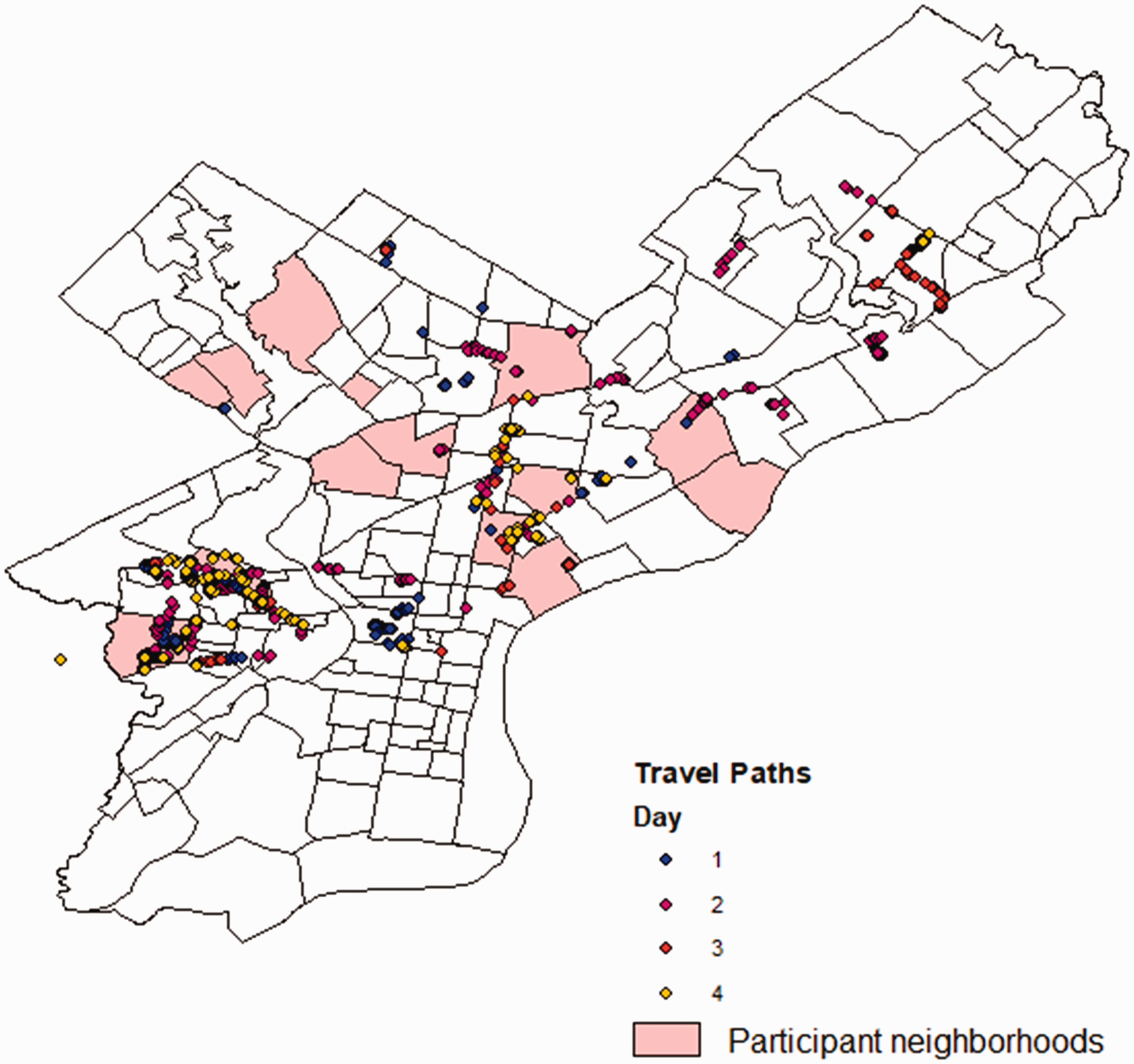
City neighborhoods and travel paths.
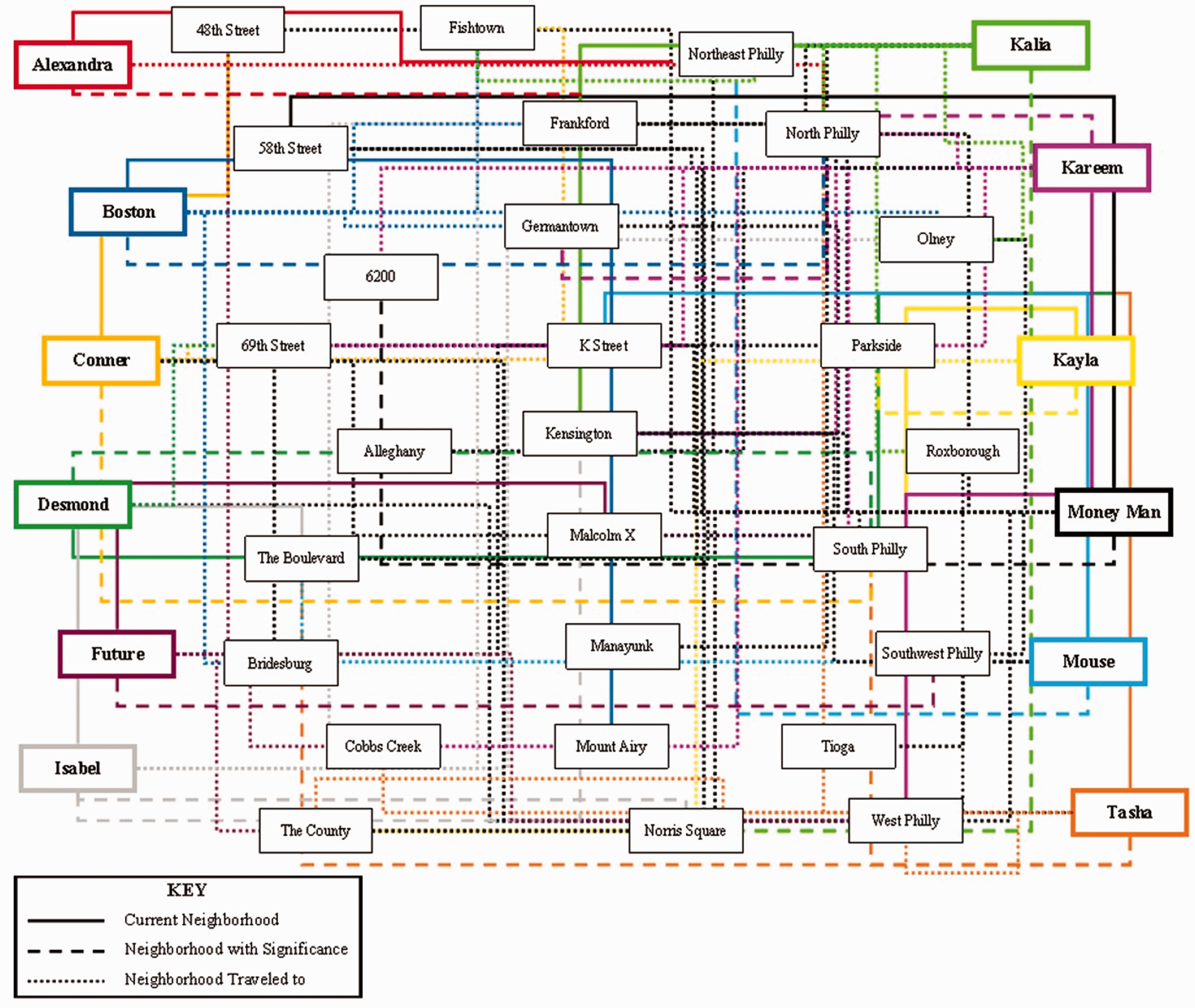
Participant path diagram.
Study limitations and contributions
Though this study aimed to grow and build the empirical landscape on neighborhood effects, it is not without limitations. The heavily qualitative nature of this work reduces our ability to make causal claims. Additionally, GPS data were only collected over a four-day period. Given that data collection spanned an 18-month period, the movements of participants may have varied from week-to-week and be dependent on other varying factors such as weather. For example, some of Kalia and Boston’s daily overview interviews took place during heavy snows and thus had to be rescheduled. Thus, future research should seek to increase the length of time GPS information is collected to develop an increasingly detailed understanding of how (and where) youth are navigating across the city. Regardless, the findings from this work have continued to expand our current understanding of neighborhood effects, particularly regarding the bi-directional interaction of urban youth with their environment.
This study presents a unique and novel approach to developing an understanding of how youth define their neighborhood and how their environment impacts development. Relying on multiple sources of data is a strength of this work as it begins to fill a gap in the neighborhood effects' literature regarding the measurement of micro-level social processes and moreover provides a novel approach to defining neighborhood effects. Additionally, this study will continue to develop increasingly malleable and nuanced measures of neighborhood, specifically those identified by residents. Our findings suggest that the complex process through which individuals create meaning out of place is not static across an identified population or geographical area. Rather, there are mutual exchanges between the resident and the surrounding systems. These findings challenge traditional geographically restricted measures of place, as well as systematized frameworks identifying the social mechanisms of neighborhood effects. Importantly, this work brings to light the voices and lived experiences of urban youth and provides an opportunity to more deeply understand how youth interact with their environment, and in turn, how the environment impacts their development.
Footnotes
Declaration of conflicting interests
The author(s) declared no potential conflicts of interest with respect to the research, authorship, and/or publication of this article.
Funding
The author(s) received no financial support for the research, authorship, and/or publication of this article.
