



Abstract
There is often a superficial veil that divides those willing to discuss the construct of race and those participating in racial ambivalence or color blindness. Talking about race, racism, and the traumatic effects of racism is a discussion that society is still learning how to navigate. This qualitative study, utilizing the narratives of 13 social workers, was the first to question how social workers, in the role of justice system advocates, engage with the construct of racism-based trauma experienced by the incarcerated person. Data analysis revealed that participants conceptualized racism-based trauma as an often unbeknownst and persistently stressful reaction to a covert or overt racially oppressive situation potentially accentuated by place or locale. Results highlight the importance of increasing knowledge in the construct of racism-based trauma to be beneficial in practice while confronting white privilege and allyship were identified challenges. Participants, varying in their education, indicated having received no training on racism-based trauma. An engagement with one’s racial identity before and during a critique of racialized systems was also posited as being beneficial. The aims of engaging with construct ultimately strengthen and diversify social work pedagogy, training, and policies regarding marginalized groups.
Engaging with and assessing one’s stressful experience of a racist event can be a daunting task for the social worker and the client (Pender-Greene and Blitz, 2012). Dr. Robert Carter, one of the contributors to the construct of racism-based trauma, posited that the necessity for this approach arose after recognizing that People of Color (PoC) experience high levels of racism-related stress and are injured by it (Carter, 2007). Dr. Carter’s findings also led to the realization that social science professionals providing direct services to clients, like educators, psychologists, and social workers, may be unfamiliar with how to recognize or engage with this specific type of stressor (Carter, 1995, 2007).
For racism-based trauma specifically, the ability to assess and treat the trauma is difficult when one is unable to acknowledge racist experiences or one’s own racial identity status (Carter, 2007). A reaction in which a multitude of signs, symptoms, and injuries follow one or more experiences of a racially oppressive situation, whether done overtly or covertly, serves as the definition and indicates how robust racism-based trauma can be (Carter, 2007). Recognition of certain factors has given rise to this construct and the desire to assess thoughtfully the stressors experienced after an encounter with racism. Some of those factors include: (a) race-based stressors have a deleterious effect on one’s well-being, and (b) the inability for both the client and practitioner to engage authentically with race hinders a healthy therapeutic interaction or practice setting (Carter, 2007; Carter and Forsyth, 2009; Carter et al., 2005).
The racism-based trauma construct is also delineated and understood through conceptual and empirical examinations of collective trauma and cultural trauma (Alexander, 2004; Hirschberger, 2018; Onwuachi-Willig, 2016). Collective trauma broadly refers to psychological reactions to a traumatic event that affects an entire society, community, or group (Hirschberger, 2018). Hirschberger (2018) also posits that collective trauma has a role in shaping group identity and promoting group affiliation. In a similar way, cultural trauma theorists posit that when a society, community, or group endures a horrendous event, the experience permanently changes the group’s collective consciousness and identity (Alexander, 2004; Onwuachi-Willig, 2016). Racism-based trauma can be experienced simultaneously at the individual level, as conceptualized and operationalized by Carter (2007) (e.g. through direct experiences of racial microaggressions and racial discrimination), and at the collective level through historical traumatic events like the 400-year enslavement of African American ancestors and indirect traumatic events like the lynching of African Americans during the period of Reconstruction and the Jim Crow Era and present-day police killings of African Americans (Sotero, 2006; Truong et al., 2016; Tynes et al., 2019). Thus, racism-based trauma occurs through both collective and individual level experiences situated in systemic, interpersonal, and cultural racism.
There are several areas of focus when considering where racism-based trauma occurs. One of those settings, often disregarded within the literature, is the justice system and social work setting. In addition to assessing for trauma, there appears to be difficulty in how trauma is disclosed and reported in the incarceration setting. For instance, scholars engaging with race from a practice standpoint have stated that the experiences of racism and viewing of racism, such as police shootings of unarmed African Americans, have prompted African Americans and other People of Color to form aversive perceptions of the helping professional and criminal justice officials (Gaston et al., 2016; Tolliver et al., 2016). However, it is still unclear whether the incarcerated person or justice system social worker considers the carceral experience to be a racially traumatic one (Breckenridge and James, 2010; Knight, 2015).
Recently, Kang and Burton (2014) suggested that social workers use a trauma-informed approach in a carceral setting to advance the argument that juvenile justice-involved, African American youth have been traumatized by racial discrimination. Hence, a consideration of racism-based trauma among social workers, their clients, and colleagues logically gives way to new explorations (Knight, 2015; Levenson, 2017) and the need to build more research evidence on effective therapeutic practice and interventions that consider victimization due to racism and its impact on the intervention relationship.
Establishing a clear and developed definition of a construct, such as racism-based trauma, aids in the construct’s legitimacy and furthers interdisciplinary approaches. Because the construct is rooted within psychology, sociology, and anthropology, it was important to consider how other disciplines, like social work, engaged with the construct. Social work as a discipline and profession has an explicit focus on social justice and equity and, thus, is expertly positioned to aid in how the construct is understood and how the definition can be expanded. Additionally, how helping professionals, like social workers, conceptualize racism-based trauma reveals how they view racism and racial identity and how they may assess for it an intervention setting. Thus, the role and experiences of social workers serving as advocates within a criminal justice system or carceral setting are the focus of the current study. Also examined in this study were social workers’ successes and challenges addressing their clients’ racism-based trauma stemming from racism experienced by incarcerated persons, with a consideration of the practitioner’s own racial identity development.
Theoretical underpinnings
The impact of racism on one’s wellness and psychosocial development persist throughout the entire lifespan. Racial development theory helps social workers lift the veil from race and racism and drives the rationale for this study. Engaging with the construct of racism-based trauma involves a significant amount of interpersonal and intrapersonal reflection. Moreover, the experience of the stress is an individualized one prompted by the overt and covert actions of others. The racial identity development theory, drawing from the Cross’ (1971) Theory of Psychological Nigrescence, includes a multiphasic approach that incorporates the fluidity involved in a person’s engagement with their racial identity. Cross et al. (1991) allude to the fact that to live in the United States is to engage with race, whether one wants to or not.
Considering how social workers view themselves in relation to race can factor into how they understand the race-related experiences of clients. Social workers’ engagements with their clients’ race-related experiences is also important because developmental milestones of People of Color can be marked by unique challenges not considered by the major psychosocial development theories social workers use (Csizmadia et al., 2012). How one views oneself can also uphold White privilege or other detrimental approaches to race between the client of color and the practitioner.
The current study
Racism-based trauma as an individual and collectively experienced phenomenon resulting from systemic, cultural, and/or interpersonal forms of racism is also determined by where an individual is in their racial identity development. The study researchers also posit that the subject processes and concludes an experience or exposure as a traumatic one rooted in or due to racism based on where he or she is in their racial identity development, where those in later stages are more likely to conclude an experience is due to racism or racial discrimination than those in earlier stages. We also argue that this may be true for helping professionals, specifically justice system social workers, who work with clients and communities at risk of manifested racism-based trauma (integrated with and in addition to other traumatic experiences). The justice system social worker is charged with the skill to recognize the signs and systems of racism-based trauma in order to assess, intervene, and treat effectively. Thus, the current study researchers explored what justice system social workers know about racism-based trauma as a concept and how they applied this concept in practice. The following research questions guided the study: How do justice system social workers define racism-based trauma? To what extent do justice system social work practitioners provide education to clients and assess for racism-based trauma in their practice? The study researchers sought to discover how justice system social workers define racism-based trauma in order to inform micro, mezzo, and macro social work practice approaches to identify, assess, and intervene with clients and communities with racism-based trauma.
Positionality
The researchers both identify as African American. One researcher serves as an Assistant Professor within a School of Social Work at a Predominately White Institution (PWI) in America’s Deep South. He also possesses roughly seven years of forensic social work experience where he has worked in both prosecution and defense-oriented settings. Most of his clients have been African American men, women, and children who have talked about American and localized justice systems disregarding their racial experiences. The other researcher is also an Assistant Professor in a School of Social Work at a different PWI in the south. She has over 20 years of experience studying racial identity development and the impact of racism as a form of interpersonal and structural violence in African Americans. The researchers’ background informed the formulation of the research aims, design, data collection, and analysis processes. Although we acknowledge that our background and beliefs informed the research, we used a constructivist grounded theory approach to understand how social workers construct conceptualizations of racism-based trauma (Charmaz, 2006). To that end, we bracketed our experiences and assumptions to prevent misrepresentation of participants’ views and experiences (Ashworth, 2010).
Methods
The current study was part of a larger study that used grounded theory and phenomenological approaches to explore social workers’ engagement with clients’ trauma associated with incarceration in the United States. The current study aimed to discover he ways in which justice system social workers understand, define, conceptualize, and treat racism-based trauma in order to inform construction of its conceptualization.
Sampling and eligibility criteria
The purposive sampling method was used for this study. To be considered an eligible participant, the interviewee must have met the following criteria: (a) be between the ages of 21 and 70; (b) hold a baccalaureate, master’s, or doctoral degree in social work; and (c) currently serve as an advocate for clients and practice social work within a justice system setting. Practice settings that met eligibility requirements and served as targets for recruitment were: (a) state and federal public defender offices; (b) prisons at the local, state, and federal level; (c) community reentry centers; (d) grassroots organizations; (e) advocacy centers; and (f) private practice settings.
The purposive sampling method was used for this study. This study was a part of a larger study focusing on justice system social workers working on behalf of people indicted, arrested, incarcerated, or reintegrating into a community. These practitioners engage in advocacy practices that involve defending the justice involved person, offering mitigating circumstances for lesser penalties, and engage in evidence-based interventions with the incarcerated person to alleviate the psychosocial stress prompted by the experience. These practitioners also have varying levels of educational and practice setting experience. This rationale was used to demonstrate the range of educational and practice settings where racism-based trauma was not considered, taught, or examined in any specific way. This is also relevant to the study as it is interested in understanding the conceptualizations of racism-based trauma amongst different social workers through the racial identity development theory.
Recruitment strategies
Study participants were recruited via email to gauge interest in the study and to schedule interviews. Regarding the dissemination of emails for recruitment, the researchers searched various agency websites for contact information of employees who were either titled or identified as a social worker. This involved searching websites of federal defense attorney agencies throughout the country and subsequent recruitment emails sent to 15 potential participants possessing the title of Social Worker and Investigator. Five potential participants working as social workers within various city public defender offices were also recruited via email. The city public defender offices were identified by searching for offices in major cities. A Google search of “forensic social workers” and “reentry center social workers” yielded the contact information of at least two social workers working within a reentry center and a social worker working at a center focusing on initiating criminal justice. One social worker was recruited via email and subsequently in person after discovering the social worker practiced locally. Of the 25 participants who were recruited, 12 responded and committed to participating in the study. Of those 12 participants, two identified as men, while the remaining 10 identified as women. Six participants identified as White, five identified as African American or Black, and one identified as biracial. Participants are identified using a pseudonym to maintain an ethical obligation to protecting their anonymity and confidence.
This study was approved by an Institutional Review Board. As such, participants were informed of the study’s goals, procedures, risks, benefits, and costs related to the study. Participants were informed that if they consented to participate in the study, they could withdraw from the study at any point. Participants were also told the interview would be video and audio recorded. Lastly, participants were told they would be assigned a pseudonym during the study in the event their narratives or quotes were used. This was done to protect their privacy and maintain confidentiality.
Participant profiles
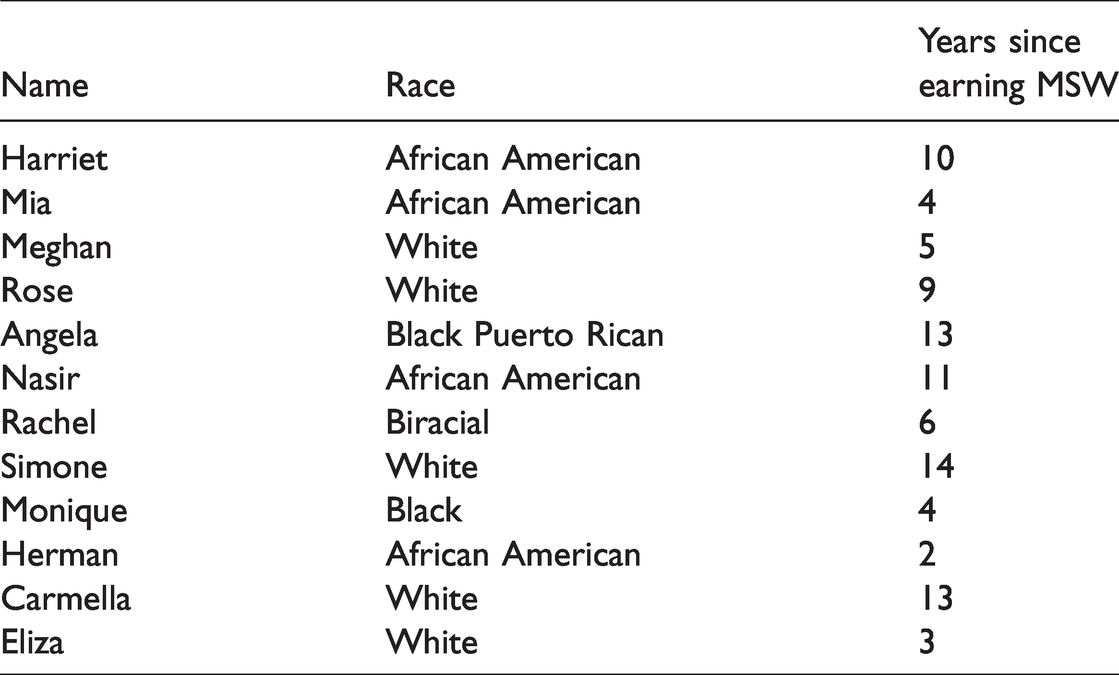
Participants are described in Table 1 to illustrate their demographic background, educational background, and employment settings. These profiles demonstrate the selection of the participants as “information-rich cases related to the phenomenon of interest” (Palinkas et al., 2015: 533).The profiles include the race and education of participants to further emphasize the importance of couching the study in identity development theories. The participant’s narratives are influenced by their experiences and are believed to be influenced by their personal racial experiences. Educational background of the participants has been included to highlight the wide range of degree attainment dates amongst the participants. Participants were given a pseudonym to maintain confidentiality.
Participant race and degree information.
Data gathering and analysis
The interviews were conducted by the first author and lasted between 45 min and 1 h. The interview guide included items grouped into one of the following categories: (a) Professional Experience, (b) The Incarceration Experience, (c) The Extent of Engagement, (d) The Benefits and Challenges of Engagement, and (e) Closing. While these were the categories in the interview guide, data from a subset of questions were used for the current study (see Supplementary Appendix for interview guide used for the current study).
Semi-structured interviews were conducted with 12 social workers to elicit social workers’ definitions and experiences with assessing for and intervening in racism-based trauma. Semi-structured interviews enabled the researchers to ask a set of standardized questions to all participants and follow-up questions based on participant specific responses and experiences. This approach arose from the work of qualitative methodology scholars and the notion that semi-structured interviews should be used to hear the story and understand human complexities (Creswell, 2003). The researchers developed a set f standardized questions prior to the study and asked follow-up questions to elicit further detail or clarity based on participant responses. Interviews continued as an iterative data gathering and comparative analysis process until saturation, where the first author saw strong repetition in the themes already observed and articulated and stopped data collection (Saunders et al., 2018).
The participant interviews were transcribed and text data were coded line by line using open coding to create initial coding categories followed by axial coding to formulate themes (Strauss and Corbin, 1994). All codes originated from this study’s interviews, and no a priori codes were used. Codes were synthesized into themes on perspectives, knowledge, and opinions on racism, racial identity, and trauma and their place in social work education and practice. The themes that emerged from the interviews focused on stress, trauma, and racist events experienced by clients prior to, during, and after the incarceration experience.
The synthetization or “triangulation” of the data helped align competing viewpoints that may be due to participants’ different practice settings (Konecki, 2008) and establish data validity. The study researchers use two triangulation methods were used to contribute to validate the data: investigator triangulation and theoretical triangulation. The researchers engaged another investigator knowledgeable of the constructs and the social work field to review the data and codes to establish coding validity. (D. T. Campbell and Fiske, 1959; Farmer et al., 2006). Theoretical triangulation enabled the researchers to validate codes and themes by comparing the participants’ accounts with the tenets of the racial identity theory (Denzin, 1978; Tracy, 2010).
Results
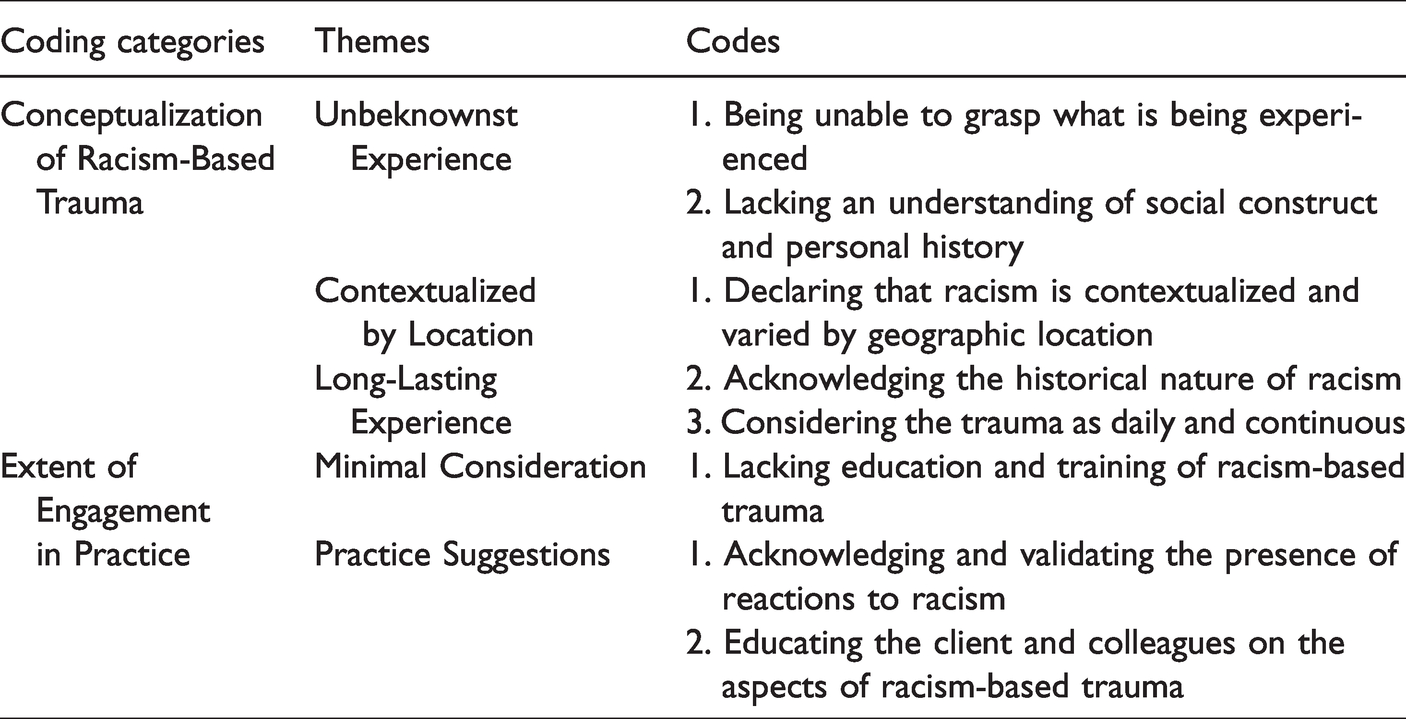
Findings are organized by the fundamental interview questions: How do social workers define racism-based trauma? To what extent do social work practitioners engage with racism-based trauma in their practice? In the first section of findings, the definitions and conceptualizations of racism-based trauma are listed as themes. These themes include describing racism-based trauma as an unknown experience, a long-lasting one, and one influenced by geographic location. In the second section, the extent of engagement with the concept in practice is covered. A subtheme in this section was the minimal consideration of racism-based trauma in practice. Additional themes emerged on effective engagement in practice as something that could occur through acknowledgement, validation, and education. Table 2 includes the section, themes, and subthemes.
. Coding categories and themes.
Section 1: How do criminal justice system social workers define racism-basedtrauma?
Participants were not confident about and unsure of how to define the construct. Meghan said, “I don’t know, that’s a really tough question,” while Eliza simply said, “I don’t know how I would do that.” However, the following themes emerged in the participants’ attempts to conceptualize and define racism-based trauma experienced by their clients: The trauma is unknown by the victim, the experience is influenced by place and locale, and the effects of the trauma are long lasting.
Unknowingly experiencing racism-based trauma
Participants communicated an awareness of and sensitivity to the fact that the client may be unable to recognize an experience as resulting from racism. Meghan stated she thought the clients in her practice “didn’t even realize that what they were experiencing was racism.” Eliza went on to conceptualize that, at the root of experiencing racism-based trauma, there was a sense of feeling the stress without knowing how to identify it. Eliza said, “I think racist trauma, at its core, is about the fact that you don’t know if something is being done because of who you are as a person or because of what you’re doing.”
Participants’ responses around this theme also reflected that clients are interested in understanding their history and their place within society. The lack of truly being able to understand, interpret, and alleviate racism-based stress leads to normalization and acceptance, which can be unhealthy. This point became clearer after Harriet and Angela stated that explaining involves some sort of realization and awakening: Harriet: I think the thing with the clients is making them realize that some of the things that they suffered, some of the treatments that they've received are not normal. We have a tendency to normalize so many bad things that happen in our lives. And it's not normal. This has been all they've ever known, and all they've ever seen from relatives, and, you know, brothers, uncles, fathers, or whatever, this trauma, they don't see it as a trauma, they see it, it's just, that's their life. Angela: Saying to my clients, “Hey, did you know that statistically speaking, it was more likely as a man of color blah, blah, blah.” Like, not like that. But, when a guy is like, “You know, I just feel like they're always targeting me, man, like, everywhere I go in my neighborhood.” Being able to be like, “Do you know what, actually your area is targeted statistically more than anywhere else in the city. That's a fact.” For them to be able to hear words like, “No, that actually happens. Like, that's not just you, amplifying [expletive]. It's real.” I think race-based trauma, the feeling of it is that sense of worry, that sense of uneasiness. It's like a perceptive uneasiness when you walk through the world. Well, I have not experienced it. I know a lot of people that have, and I know I watched the news and I understand the things that are going on in America today. I say I haven't had the same experiences, but I know that there are a lot of people around me who have had those experiences. As a Black woman, I know what it feels like to think or to believe that someone doesn't like Black people.
Racism-based trauma accentuated by location
For Meghan, the fact that her clients experienced “racism in the deep South” meant one had to be particularly aware of practices and policies particular to the Southern region of the country. Carmella focused on the experience of racism in the South, as well: “Well, because I feel like in certainly this country, but definitely in Alabama, where I work, most of the clients that I work for, if not all of them, have issues that are related to systemic racism.”
The theme of region or locale influencing racism was strengthened by Eliza, Simone, and Nasir. It may be easy for those engaging with race and racism at a superficial level to think it is more prominent in the South. Eliza, Simone, and Nasir challenge this assumption as follows: Eliza: You know, Philly's a very Black city. It's, you know, it's like, 40% Black, 38% White. And, you know, so a lot of a lot of the correctional officers are Black as well. So, there's that complicated component of, yeah, of, like, you know, Black people within kind of acting as actors in this racialized system, right? Simone: But I think, yeah, I think getting to leave Montana—like, I grew up in Oregon, and Montana made Oregon look diverse, which is not great. Because Oregon is also like, not very diverse racially. So, I think coming to the South and being in a space where we have to talk about race and racism because it's happening. Like, I could point out so many things that my coworkers in Montana were doing that were racist, but there was not a space that that was like a conversation. One year at the Halloween party, the Executive Director, who is a social worker, came dressed as a Mexican. Like, what do you do with that? Nasir: Again, when you look at the South from the East from the West from the North but then you also have to look at it within the South and being in the South. I’ll tell you like this, this might make sense to you. You can't try a case the same way in Jackson that you can in Tupelo. You can't try a case in Tupelo the same way you would do in Leakesville, Mississippi, because there are cultures within cultures even within those different aspects of counties throughout Mississippi.
Experiencing long-lasting racism-based trauma
In their conceptualizations of racism-based trauma, the participants mentioned that racism-based trauma lasts throughout the lifespan. Eliza declared that when thinking about racism-based trauma, one had to consider the “hundreds of years of racialized trauma that have come before that.” Participants placed racism-based trauma within the specific historical and contemporary context of racism and racial oppression in the United States. The long-lasting nature of experiencing racism-based trauma also points to a sense of hopelessness in that the effects of the trauma is inescapable, as Simone mentioned: “Um, yeah, so, there are so many ways to describe it. It’s really longitudinal, right? It's not something that can be escaped or avoided or controlled by the individual who's experiencing it.” Rose also stated, “I would imagine it as generational and extremely traumatic.” Similarly, Monique commented, “I guess it would, the first thing I would say is just like trauma, ongoing trauma on the daily.” This “not being able to move past or let go of [trauma] because it is recurring,” as Mia described, is important for the practitioner to consider. Likewise, Herman mentioned that to experience racism-based trauma was to be “affected by it to the point where you can’t get over it” and that it “comes back.”
Section 2: How have criminal justice system social workers addressed racism-based trauma?
Themes emerged around how criminal justice system social workers have addressed racism-based trauma in practice despite having limited exposure to a definition of the construct. Those themes included: (a) minimal engagement with racism-based trauma in social work training or professional development, (b) assessing and responding to the client with consideration, and (c) educating the client.
Minimally engaging with the construct
The extent to which participants learned about racism-based trauma in their social work training or professional development was minimal and infrequent. Participants reported a belief to having been exposed to some semblance of education on racism and racism-based trauma in professional development trainings, but consideration of racism-based trauma in these trainings was superficial. Nevertheless, participants talked about how they would engage with racism-based trauma in practice. Participant responses covered inquiry, practice experience, and practice improvement. This was the case despite participants reporting difficulty conceptualizing and defining the construct.
Participants were asked in what ways they had been trained or read scholarship on racism-based trauma. Harriet replied, “Not at all,” Mia stated, “I haven’t but I wish that I had,” and Rachel reported, “None.” This lack of training was the consensus among participants. Lack of training prompted the feeling of not knowing how to examine race and racism, let alone assess and intervene with racism-based trauma. Eliza summarized this point and the theme as follows: The majority of our students were young, White women, you know, who were you know, 22 to 26 and you know, we had a lot of great students, you know? But it was often a real challenge. Like we did role plays and stuff but there was no, “How do you talk about racism with clients?” Like what does that look like, you know? Just talking about race is not doing anything other than like perpetuating this nonsense about like color blindness in my program.
Assessing and responding to the client
Participants were asked to describe how they would assess and respond to a client they believed was experiencing racism-based trauma. In assessing and responding to a client presenting with racism-based trauma, participants indicated the best approach to take was to acknowledge and validate. Harriet said, “I think validation is so key because you feel like no one understands what's happened to you, and everyone is downplaying what may have happened to you.” Empowering the client is vital, and Monique spoke to this in the following narrative: I think it's hard to respond, it's felt hard to respond, especially when they're disclosing to me racial stress, such as the feeling of the being targeted by the police, but they're in a jail setting. And I feel kind of powerless. I think my way of responding, like I said, is just acknowledging and validating that like, “yes, things are very unfair,” and just like doing work, to explore the strengths that they do have, and like, what exists outside of that. So, my usual approach is about giving them permission, getting rapport with me, and being able to talk about it. I don’t want to minimize it. I want to start to gather the information for them. And that can be tough because, you know, they can come out and talk with me and maybe show some emotions.
Educating the client
When considering participants’ definition of racism-based trauma and the fact that trauma is often unknown to the client, it became important for practitioners to educate the clients on the construct. As said by Nasir, “It's a whole lot easier if they understand their culture. So being culturally sound or culturally competent is always the best way to approach it.” Harriet makes this point clear when she emphasized how having validating and honest conversations with her clients may aid in their defense: You know, I do know that there's discrimination out there. But one thing that I try to get our clients to see is that—“Okay, if you are robbing a bank, it doesn't matter what racial, ethnic group you are. You know, it didn't matter what racial background you come from—robbing a bank is robbing a bank. If you were followed from your house to the bank, and you were just going to withdraw some money then I can see that. I think the other thing is that like, it can be empowering because you can help support your client as they develop the language and awareness around their own possibility, and how they can navigate these spaces. I think those of us who are socially conscious and aware make different choices and can be strategic. We can calculate, we can advocate, we can do certain things.
Discussion
Conceptualizing racism-based trauma
Participants considered the experience of racism-based trauma to be unknown and unidentifiable to the victim, one impacted by place and locale and one that is long lasting. It is with these themes in mind that the researchers propose an alternative definition of racism-based trauma: an often unknown yet persistently stressful reaction to a covert or overt racially oppressive situation potentially accentuated by place or geographic location. With a particular emphasis on place and location, this definition expands the conceptualizations within the racism-based trauma literature (Carter, 2007). The emerging definition also complements present thinking on how geographic location accentuates perceptions of racism: environmental racism within the South; racial violence prompted by law enforcement interactions in the Northeast, Midwest, and West; and negative birth outcomes prompted by racism throughout the entire country (J. Campbell, 2010; Chae et al., 2010; Williams, 2018). The focus on a particular place accentuating racism-based trauma suggests that one should consider the location and particular history of race and racism where one lives when engaging with clients.
Effective engagement with racism-based trauma is an intrapersonal task as much as it is an interpersonal one, The individual’s ability to recognize an experience as racially traumatic and cope with the experience on those terms involves both a reflection on race and an assessment of one’s racial identity (Carter, 1995; Cross, 1971). Therefore, the unbeknownst experience of racism-based trauma is not strictly reserved for the client. Study participants were unable to provide a definition or clear conceptualization of racism-based trauma. At the same time, participants also stated they had not experienced racism-based trauma themselves. It is possible that the participants did not identify having experienced racism-based trauma because they were unfamiliar with the construct. It is also possible that the participants did not disclose any experiences with racism-based trauma because they were also actively thinking about their experiences. One participant did mention guilt and assumed that they had been perpetrators of racism-based trauma. Participants’ difficulty in defining racism-based trauma may suggest limited engagement with race and oppression and their own racial identity. Thus, study participants may also have restricted capability at identifying their own experiences with racially traumatic situations, much like the clients they serve. Thus, the praxis of justice system social workers should dually involve a reflective process of identifying their own racial identity while also learning what racism-based trauma is and how to assess and intervene on the sequela of this particular type of trauma.
Participants’ conceptualization and emerging definition suggests the construct can be explained as heavily influenced by external factors. This is consistent with Carter’s (2007) thoughts identifying the impact of racist actions, regardless of intent. Often as covert as they are overt, racist practices have been used in the erasure and creation of traditions that reinforce systemic, structural, and cultural racism in the United States (Behm-Cross, 2017; Buck, 2012). Racism is supported by romanticism, reminiscent of the “good ole’ days,” and a desire to maintain superiority, dominance, and control (Defilippis et al., 2006; Dottolo and Kaschak, 2015; O’Connell, 2016; Winberry, 1983). The conceptualization of racism-based trauma that emerged from the current study directly challenges those practices and identifies perpetrating actions at the micro, mezzo, and macro level. This is assumed to be a critical aspect of legitimizing the construct and the feelings of the client.
Engaging with racism-based trauma
While engagement with the concept of racism-based trauma was found to be minimal among study participants, a willingness to lift the veil to examine race, racism, and racial identity was expressed by the participants. The desire to acknowledge and validate subconscious and conscious reactions to racism hinted at how important it is to empower the client’s understanding of the experience and the veracity of it being a traumatic one. This approach is also one practitioners were willing to use over a long period of time. Participants expressed that discussing experiences of racism in a validating way prepared the client to be introduced to the ways it showed up in their daily lives.
Shifting from validating the event as a means to empower the client to educating the client on the construct is also important in lifting the veil. Many traditional developmental theories and practice approaches social workers use leave out a consideration of specific challenges, particularly those due to racism and oppression, that influence and impact the experiences and outcomes of people of color (Csizmadia et al., 2012; Swanson et al., 2003). To address this gap, participants expressed awareness of historical approaches to clients of color, while also promoting educating the client on racialized systems. From a practice standpoint, clients’ encounters with racism have led people of color to form aversive perceptions of social workers and other social science practitioners (Gaston et al., 2016; Tolliver et al., 2016). Clients’ fear of the helping professional is more than likely compounded by racial dialogue that is often disparaging and, in extreme cases, threatening (Flaherty et al., 2013). Therefore, educating the client appears to be a way not only to empower the client but also a tool used to combat and navigate racist systems.
Limitations
The current study’s findings revealed a developing conceptualization of racism-based trauma based on the education and practice experiences of justice system social workers. Nevertheless, the study is not without limitations. One limitation was the inclusion of only social workers who work in justice and corrections. Thus, future research on conceptualizations of racism-based trauma should include social workers and other mental health professionals in other settings (e.g. education, health care, social/human services, etc.) may deepen the definition and applicability of the concept. Another limitation was that there was no direct measurement of racism-based trauma in those whom use the social work services. Future directions in studying the construct should involve engaging with service users to explore their conceptualization of racism-based trauma.
Implications for social work practice
While lifting the veil to uncover racism-based trauma allows conversations on the traumatic effects of racism to occur, the implications from this study aid in removing the veil altogether. The implications from this study are intended to prompt the social work practitioner to give greater consideration to the racialized experience of the client. Social workers are also encouraged to engage in a constant reflection of themselves and the privileged lens enabled by their own race. This approach suggests the importance of developing one’s own racial identity. Participants indicated a lack of training with the construct and a sense of discomfort or “survivors’ guilt.” Awareness of one’s identity and acquiring deeper training in racism and racism-based trauma, assessing for racism-based trauma in clients may be less elusive. Such a reflection will prompt the social worker to take greater time to ask thoughtful questions about one’s own racialized experience. It is also anticipated that social workers, particularly in a justice system setting, will educate clients on the construct to the best of their ability. This will aid in clients’ wellness, self-advocacy, and a deeper understanding of their own racialized experience.
Implications for social work education and professional development
Exploring the teaching and learning experiences of social work students has been a focal point for scholars and indicates that one of the first settings in which social workers uphold social justice is within the classroom (Gair, 2018; Satterly, 2017). This is assuming one of the first settings during which budding practitioners may experience stressful situations prompted by racial salience or insensitivity. Scholars have examined the ways in which benevolent racial attitudes, racial microaggressions, and privilege are discovered and given consideration in social work education and training (Davis and Gentlewarrior, 2015; Huber and Solórzano, 2018). Thus, social work education programs should prepare social workers to assess and treat racism-based trauma effectively (Trolander, 1997). In the least, engagement with race and racism in educational settings instills the importance of considering and reflecting on dynamics of race.
This study’s findings also have potential implications for agency policies and practices in staff professional development and continuing education requirements. Some agencies require their social workers complete training or continuing education in diversity and cultural competency. However, these trainings are not required at many agencies or organizations that employ social work practitioners. Moreover, the trainings may not explicitly cover racism-based trauma as a construct to consider in practice. The intent of making trainings such as this mandatory is to inform and encourage more thoughtful and equitable practice. Therefore, agencies’ longstanding commitment to training its leadership and workers on identifying, assessing, and intervening on racism-based trauma at the individual and community levels as well as advocacy to address systemic racism is critically important to eradicating such inequities at multiple institutional levels.
Implications for social work research
In addition to practice and education, the current study’s findings have implications for future social work research. The following questions should be considered for future work on racism-based trauma: Is the definition of racism-based trauma emerging from the current study valid and reliable? In what ways have social workers been subjected to or be perpetrators racism-based trauma. In what ways do social workers engage with racism-based trauma in social work curricula? How do social work practitioners conceptualize assessments and treatments of racism-based trauma? With all of these considerations in mind, it is posited that the construct of racism-based trauma is an important one to which the field of social work may contribute.
By viewing psychosocial stressors such as racism-based trauma through a social work lens, one is expected to approach those stressors with a level of competence, advocacy, and ethical responsibilities that are nurturing to the client, the practice setting, the colleague, and the broader society. This lens, offered without the consideration of racism-based trauma and influenced heavily by the Code of Ethics, has shaped social work practitioners for decades and has influenced a plethora of social work practices, considerations, and policies. While the constructs of race and racism-based trauma are complicated, this study suggests that social work practitioners can lift the veil to serve clients better.
Supplemental Material
sj-pdf-1-qsw-10.1177_1473325021997542 - Supplemental material for Lifting the veil: Considering the conceptualizations of racism-based trauma among social workers
Supplemental material, sj-pdf-1-qsw-10.1177_1473325021997542 for Lifting the veil: Considering the conceptualizations of racism-based trauma among social workers by Samantha Francois and Curtis Davis in Qualitative Social Work
Footnotes
Declaration of conflicting interests
The author(s) declared no potential conflicts of interest with respect to the research, authorship, and/or publication of this article.
Funding
The author(s) received no financial support for the research, authorship, and/or publication of this article.

Supplemental material
Supplemental material for this article is available online.
References
Supplementary Material
Please find the following supplemental material available below.
For Open Access articles published under a Creative Commons License, all supplemental material carries the same license as the article it is associated with.
For non-Open Access articles published, all supplemental material carries a non-exclusive license, and permission requests for re-use of supplemental material or any part of supplemental material shall be sent directly to the copyright owner as specified in the copyright notice associated with the article.
