




Abstract
We use a collaborative autoethnography (CAE) methodology to explore how our research team conducted community-based participatory action research (CBPAR) with lesbian, gay, bisexual, transgender, queer, questioning, intersex, asexual, and other sexually and gender diverse youth (LGBTQIA+) youth during the COVID-19 pandemic, which required us to modify our original research approach. This paper describes the authors’ processes and provides critical reflections on continuing to use CBPAR during the pandemic with LGBTQIA+ youth to develop and evaluate a mental health intervention (i.e., Tuned In!) that aims to address their mental health needs. Our CAE revealed three main themes: 1) Enhancing Accessibility; 2) Centering the Voices of LGBTQIA+ Youth; 3) Prioritizing Relationships and Community Building, and an over-arching theme of Trust that facilitated our efforts. Taken together, our findings illuminate practical approaches to engage LGBTQIA+ youth through research despite myriad obstacles brought on by the pandemic.
Keywords
Introduction
With increased isolation and challenges associated with the COVID-19 pandemic, conducting research, particularly community-based participatory action research (CBPAR), has been particularly challenging (Rodrigues et al., 2020). CBPAR is an approach to research that aims to critically engage and include community members within each stage of the research process (Burns et al., 2011) and seeks to address community needs and problems through practical actions and strategy that come directly from the community. The meaningful involvement and engagement of community members directly affected at all stages of research (e.g., establishing the research question, and developing data collection methods), and the sharing of power with the community, is what differentiates this methodology from others. The authors are currently utilizing CBPAR for the development, implementation, and evaluation of an eight-week virtual LGBTQIA+ youth (e.g., lesbian, gay, bisexual, transgender, queer, questioning, intersex, asexual, and other sexually and gender diverse youth) affirmative mindfulness-based program called Tuned In!, which was implemented in conjunction with LGBTQIA+ youth in Connecticut. Given the unique barriers posed by the pandemic, the literature documenting CBPAR during this time remains scant. As a result, this paper introduces the use of a collaborative autoethnography (CAE) to document processes, challenges, successes, and strategies for implementing CBPAR with LGBTQIA+ youth during the enduring COVID-19 pandemic.
Background
LGBTQIA+ youth & COVID-19
LGBTQIA+ youth experience disproportionate health and mental health disparities (Russell and Fish, 2016; The Trevor Project, 2021). For example, given their mistreatment and stigmatization within society, LGBTQIA+ youth are found to be at a significantly increased risk for both attempting and completing suicide, developing mental health conditions, and experiencing barriers to accessing comprehensive treatment (The Trevor Project, 2021). These disparities have been significantly impacted by the pandemic, with 35% of LGBTQIA+ youth reporting increased feelings of loneliness compared to 22% of cisgender/straight youth, as many LGBTQIA+ youth believe their home environment is not a safe place, and reporting that they have felt unsafe in their home since the start of COVID-19 (The Trevor Project, 2021). This is illuminated by a recent study conducted from January to June 2021 by the Center for Disease Control and Prevention (2022) in which 74% of lesbian, gay, and bisexual youth experienced emotional abuse by a parent or caregiver during COVID-19, compared to 50% of heterosexual youth. It comes as no surprise that rates of depression and anxiety have also increased among LGBTQIA+ youth throughout the pandemic given the isolation compounded by rampant systemic discrimination (Iacono et al., 2021). In fact, 2021 was named the “Worst Year for LGBTQ State Legislative Attacks'' by the Human Rights Campaign (Ronan, 2021). There were over 250 legislative bills proposed in 2021, with nearly 240 anti-LGBTQIA+ bills filed in state legislatures during 2022 (Flannery, 2022). Legislative bills proposed include, but are not limited to, anti-trans sports bans, anti-trans medical care bills, religious refusal bills, prohibition of discussing LGBTQIA+ issues within education, and restricting access to school and public bathrooms (Ronan, 2021). LGBTQIA+ youth are faced with a myriad of stressors that contribute to mental health issues.
While youth have been isolated at home, unable to attend school in-person for much of the pandemic, and faced with increased stigmatization within the public, the pandemic has left LGBTQIA+ youth with restricted access to social supports and other protective factors. Connectedness to social support from peers and access to safe, supportive networks through school, helping professionals, and extra-curricular activities are among the strongest indicators for protection against risk factors (Ceatha et al., 2021). Without accessibility to these safe spaces during the pandemic, the construction of “support” has increasingly shifted to a more online presence for LGBTQIA+ youth, especially with potentially hostile living environments with families. While not a physical space as typically defined, virtual supports and programming offer a “third space” for LGBTQIA+ youth by providing a safer community to exchange ideas, build relationships, and find belonging and comfort (Markiewicz, 2019). A third space offers accessibility to a socially constructed reality, which offers greater refuge from stigma, discrimination, and violence that cause disproportionate rates of psychological distress among LGBTQIA+ youth (Austin et al., 2020). As a result, creating accessible and safer “third spaces” becomes more important than ever given the increased disconnection and heightened political tensions as it relates to COVID-19.
LGBTQIA+ youth mental health intervention research & COVID-19
The demands COVID-19 placed on mental health practitioners and researchers required a swift response to the changing needs of the most vulnerable. To make mental health services more accessible to LGBTQIA+ youth (16–29 years old), mental health intervention studies like AFFIRM (Craig et al., 2021), an eight-week study that uses manualized affirmative Cognitive Behavioral Therapy (CBT), has been adapted to a virtual platform. Craig et al. (2021) found that virtual intervention adaptations were effective in affirming youth, providing connection, and helped develop adaptive coping skills. In making the transition from in-person to virtual mental health intervention services and research, especially among vulnerable youth populations, critical reflexivity is a tool that has been especially important in supporting this process. Iacono et al. (2021) posit that critical reflexivity assists providers and researchers in working through feelings of helplessness, identifying, and working collaboratively among diverse positionalities and social locations, and feeling effective in working with vulnerable populations.
Mental health intervention research is particularly important to enhance supports for vulnerable populations like LGBTQIA+ youth, especially given the unique stressors and challenges they face. LGBTQIA+ youth have been underserved in both mental health and health research (Dysart-Gale, 2010; Craig et al., 2021) and remain relatively invisible within medicine and healthcare. Baker and Beagen (2014) interviewed 24 physicians and 34 LGBTQIA+ identified women to explore how cultural competence should look in healthcare settings—the outcomes of their study indicate the importance of “learning with” LGBTQIA+ patients and joining with them. An emphasis on power dynamics was also illuminated, which suggests the need for potential power-sharing in both practice and research.
Community-based participatory action research (CBPAR)
An increasing number of researchers are adopting participatory research methods with youth, which generally centers partnership between adult researchers and youth, and power-sharing between adult and youth as co-researchers. While there are a myriad of participatory approaches (Lagae, 2012), they tend to seek to understand identified issues within a community with hopes of co-creating knowledge through concurrent reflection from those participating (Brogan et al., 2021; Wagaman and Sanchez, 2017). These approaches also typically involve community members identifying specific needs and concerns and working alongside academic investigators in applying scientific parameters to collect data and address community-informed research questions (Muhammad et al., 2015). As a comprehensive participatory method, community-based participatory action research (CBPAR) provides the opportunity for the highest level of community participation and engagement throughout the entirety of the research process.
In looking closer at power-sharing within the participatory research process, CBPAR offers a collaborative approach that involves all collaborators throughout the research process, including developing research questions, data collection and analysis, and dissemination of results (Burns et al., 2011). CBPAR is also closely aligned with social work values and rooted in social justice, as it seeks to shift power imbalances (e.g., from power over to power with), enhance reciprocity (Maiter et al., 2008), and engagement with community members (Burns et al., 2011; Vivona and Wolfgram, 2021). Ultimately, the CBPAR framework aims to create sustainable changes grounded in practical concerns raised by people in the community. CBPAR researchers are required to understand and adequately address issues of power, privilege, and ethics (Vivona and Wolfgram, 2021), which brings to light the importance of critical reflection and reflexivity as a key component within CBPAR.
Collaborative autoethnography (CAE)
Despite CBPAR being a transformative research methodology, there have been limited accounts of CBPAR illuminating specific processes and the level of depth required by scholars in this work. This limitation most certainly is evident when exploring CBPAR within the challenging COVID-19 pandemic context. Given this, engaging in CAE can be an intuitive and helpful approach to understand and document the nuances in conducting CBPAR in a pandemic. A CAE is an iterative and dialogical process in which research team members critically reflect, share, and interpret their findings (Acosta et al., 2015; Chang, 2013). Chang (2013) emphasizes the importance of self-interrogation within the context of collective and collaborative sharing among team members. A CAE invites a team of researchers to be both the participant and the researcher by reflecting on and sharing personal experiences, collaboratively engaging in data analysis, and co-constructing knowledge (Bright et al., 2012; Gant et al., 2019; Lapadat, 2017; Yang et al., 2022). As a process that necessitates critical reflection and reflexivity, CAE overlaps with many central tenets of the social work profession (NASW, 2021) and social justice values associated with CBPAR (Acosta et al., 2015).
Given the challenges posed by the COVID-19 pandemic, a CAE seemed to be an ideal process for this research team considering the sociopolitical context of the pandemic and how it has impacted CBPAR with LGBTQIA+ youth (Lac and Fine, 2018; Vang et al., 2023). The obstacles encountered by researchers have challenged the field to use new, creative strategies to collect qualitative data, including technological mediation (Roy and Uekusa, 2020). As a result, a CAE offers a salient solution to capture this unique moment in time, calling for deeper exploration, critical self-reflection, and the lifting of marginalized voices. This paper aims to provide a CAE on shifting and continued engagement in CBPAR mental health intervention development and evaluation with LGBTQIA+ youth during COVID-19. Additionally, this paper aims to provide social work researchers broad level and practical approaches to engage vulnerable communities, such as LGBTQIA+ youth, through research despite the myriad of obstacles and limitations resulting from the ongoing, multi-phased pandemic and beyond.
Methods
A CAE approach was utilized to investigate how the unprecedented circumstances surrounding the COVID-19 pandemic impacted social work research, particularly CBPAR as it relates to LGBTQIA+ youth mental health intervention development, implementation, and evaluation (i.e., the Tuned In! project). Tuned In! has been collaboratively developed with LGBTQIA+ youth and community partners. Youth participants engaged in eight virtual group sessions that focused on processing intersectional minority stressors (Meyer, 2003), developing important coping skills and social support. Given the emphasis on CBPAR, an LGBTQIA+ youth research advisory board was developed. Eight youth were recruited through community partners, email, and online platforms (e.g., Facebook, Twitter, and Instagram), which targeted both providers and youth directly. The youth research advisory board provides an opportunity for active collaboration between adult and youth co-researchers throughout all phases of the project, including outreach and recruitment, data analysis and interpretation, and knowledge translation and dissemination for LGBTQIA+ community health programming integration.
A CAE seemed ideal given the nature of CBPAR, with a focus on power-sharing and critical reflection (Chang, 2013). We utilized a systematic method to bring together our varied experiences in working in CBPAR and LGBTQIA+ youth mental health intervention research to understand what stood out to us from our varying positionalities. Both analytic and evocative styles were encouraged in responding to critical reflection questions since this may provide more nuanced results (Acosta et al., 2015; Chang et al., 2016; Gant et al., 2019). An evocative CAE approach is most common, which seeks to create connections between the researcher and reader through the invocation of emotions (Anderson, 2006; Oswald et al., 2022), and leans more toward being an art (Ngunjiri et al., 2010). We sought to achieve this through prompting personal narratives and collaborating to highlight the multiplicity among us within a shared context. We also pursued an analytical CAE approach by systematically collecting, reviewing, and analyzing data from multiple sources and implementing various strategies to ensure research rigor (Ngunjiri et al., 2010; Rogers-Shaw, 2021). While the differences in styles can often be polarizing, we believe that there is value in viewing these styles as a continuum and as not being mutually exclusive categories (Ngunjiri et al., 2010).
Positionalities
Social work faculty (non-tenured and tenured), doctoral research students, members of the LGBTQIA+ youth research advisory board, and clinical group facilitation team participated as part of the research team in shaping this CAE. Our research team was composed of eight co-researchers with a variety of intersecting identities from diverse backgrounds, including identification with the LGBTQIA+ community as gay, queer, lesbian, bisexual, non-binary, and cisgender and straight allies. Additionally, all members of the research team have experience in higher education at varying levels, including representation of Bachelor’s, Master’s, Doctoral, and Post-Doctoral degrees. Reflexivity was utilized within our reflections to identify areas of both power and privilege with regards to our race, ethnicity, ability, socioeconomic status, and age. As a research team, we critically reflected and responded to the following questions: (1) What has your experience been like working on the Tuned In! project (e.g., consulting/providing feedback, intervention facilitation, study coordination)? (2) How do you think the pandemic has impacted your work on the project (e.g., strengths, challenges, and limitations)? (3) What do you think are helpful strategies/approaches for engaging LGBTQIA+ youth in CBPAR amid the pandemic? (4) What do you think are helpful strategies/approaches for implementing an online mental health intervention project (i.e., Tuned In!) in the midst of a pandemic?
Initially, all co-researchers reviewed principles of collaborative autoethnographic research (Chang, 2013) and created a mutual agreement focused on maintaining values of equity, justice, and openness. All co-researchers were trained by the lead author who holds expertise and several years of experience in qualitative research. Less experienced co-researchers were provided mentorship around coding, developing emergent concepts and ultimately themes. We then each individually wrote a reflexive narrative in response to the aforementioned research questions, which resulted in over 20 pages of raw data and was then peer-reviewed and filtered based upon feedback from one another. We engaged in collective virtual meetings (approximately 1.5 to 2 hours in length) to increase accessibility in reviewing data, collaboratively defining themes, and supporting in writing the manuscript. All eight co-authors participated in group sharing, meaning-making, coding, data review, and group writing. While our data collection and analysis focused on the actual team transcripts, each team member was encouraged to use available individual and team memos and notes (compiled in a shared Google folder) and digital recordings of meetings as data to support ongoing analysis and theme development, which enriched our collaborative data collection and analysis process.
Data analysis
Each reflection was anonymized to safeguard against and buffer power differentials or bias, and research members were randomly assigned two critical reflection narrative transcripts to review and code. In addition to research team members creating and analyzing their own narrative (Chang, 2013), each team member analyzed the narratives of others by using a “Sort and Sift, Think and Shift” strategy (Maietta et al., 2021). This analysis strategy parallels with and strengthens the dynamic process of CAE as it is an iterative process of “diving in” to understand the content and dimensions of the data and then “stepping back” to critically reflect on what has been learned while simultaneously determining next steps and understanding the researchers’ relationship to the data (Maietta et al., 2021). This dynamic and collaborative process reflects both analytic and evocative analysis strategies within CAE (Ngunjiri et al., 2010; Rogers-Shaw, 2021) by first systematically collecting, reviewing, and analyzing data from multiple sources and then analyzing the connection between the researcher and narrative (Anderson, 2006; Oswald et al., 2022).
Furthermore, each research team member was then prompted to select their top ten quotes that “struck them” as it related to our research questions and was asked to memo for each quote to identify why it struck them (Maietta et al., 2021). Before our initial team meeting, each member read the two randomly assigned transcripts and then coded and memoed each multiple times before coming together to review emergent ideas and to identify converging and diverging themes. The initial meeting focused on exploring quotes, ideas, and concepts that emerged in relation to our own critical reflections. Disagreements, or points of divergence, were brought to light at each meeting and then discussed and mapped out on the virtual “whiteboard.” For members who were unable to attend the meeting, they were asked to send along a copy of the quotes they selected and their respective memos and notes so they could still be included in the group discussion. A shared document, which featured all the main concepts and emerging themes identified from the initial meeting, was co-created by all authors from meeting notes and recordings. This collaborative document was then distributed to the research team for review and feedback as a Google Doc to prepare for our second data analysis meeting.
Before our second meeting, the research team reviewed the Google Doc from our previous meeting and provided further feedback within the document on emerging concepts and themes, in addition to highlighting practical suggestions discussed in our transcripts and previous meetings. The second research meeting consisted of revisiting initial emerging concepts and themes and finalizing top themes from the collaborative document, in addition to providing supporting evidence with quotes from narrative transcripts. Through this iterative process, a final version of the collaborative work was sent to the research team for further insight, associated quotes, and feedback. Throughout the research meetings, data was analyzed utilizing an intersectional approach which led to an iterative process of interrogating which experiences were at the center of our discussions (Chang, 2013). A final data analysis meeting was held to finalize and organize themes and subthemes among co-authors. Lastly, following the rough draft of the manuscript, all participants were given the opportunity to contribute, edit and provide feedback.
Findings
The research team identified three main themes: 1) Enhancing Accessibility; 2) Centering the Voices of LGBTQIA+ Youth; and 3) Prioritizing Relationships and Community Building. While not an isolated theme, the team found that Trust was a central tenet of the development of accessibility, centering of voices, and prioritizing relationships and community building. The development of trust is often an iterative process, and our research reinforced this process as each theme contributed to establishing and deepening trust.
Theme 1: Enhancing accessibility
The theme of enhancing accessibility was evident throughout this CAE. While the pandemic posed many challenges related to accessibility, we saw that it also broadened the reach of forming connections and relationships. For instance, group intervention recruitment and retention efforts were expanded in accessing harder-to-reach participants through the ease of registering and participating online (i.e., WebEx). One research team member highlighted the accessibility by stating that it is “easier to show up to a virtual session vs. an in-person session,” which exemplifies how virtual programming makes it physically, emotionally, and mentally more accessible. This is particularly important in a time of severe isolation and disconnection from the community. Creating accessibility through a virtual platform allowed for participants to build a pathway to broadening the “connection to the LGBTQIA+ community.” The ease of connection to the LGBTQIA+ community was further reinforced through establishing trust and “...safety, especially in providing feedback,” by the consistent interactions that occurred with participants through email, text, and phone. The consistency within interactions allows for greater accessibility to group facilitators and the research team.
Given safety concerns while living at home, LGBTQIA+ youth had a choice in deciding where they participated in the intervention, which “gives flexibility and open access to a vulnerable population.” Several physical spaces were offered (e.g., LGBTQIA+ community centers/spaces) for youth to use in the event that they could not safely participate at home. We also found that further benefits of being virtual led participants to believe that it contributed to the “ease of coordination…and gets folks from all over CT involved, regardless of physical location,” which contributes to enhanced accessibility and connectedness to the larger community. Accessibility through an online platform was not only a tool in engaging LGBTQIA+ youth but also in holding regular youth advisory board and research team meetings. One co-author, who was part of the youth advisory board, noted that they sustained an injury and “...was still able to participate in consultation Zoom meetings,” while another member of the research team shared, “I am probably less connected than I would have been due to the pandemic…The virtual piece is great as it helps me to feel super connected to the team in Connecticut, so I am grateful for that.” The ability to still contribute to the study while injured and the ease of connecting to the entire research team contributed to accessibility and illuminated other accessibility suggestions such as working toward disability justice, including offering disability accommodations, subtitles, or even providing recordings of the group for participants who were unable to attend in the future.
Accessibility through trauma-informed care
With the limited nature of programs available to the LGBTQIA+ community, the importance of providing trauma-informed care (TIC) became even more prominent as a way to enhance accessibility. TIC is an integrative framework that offers a holistic understanding of the client’s problems, strengths, and needs by offering a sanctuary through the creation of “physical, interpersonal, and moral safety within a social environment to ensure trust, collaboration, choice and empowerment” (Levenson et al., 2021: p. 2). TIC was necessary from the beginning of the research process in setting the expectations for the rest of the study. Referring to outreach in the pandemic, one member of the research team highlighted the importance of asking for permission to outreach participants in the initial recruitment survey. We also explored exercising intentionality in trauma-informed research by highlighting how facilitators provided participants with the study material ahead of time so they were aware of what to expect for the next group session. Another co-author and member of the youth advisory board shared: “I also felt that I could take my time to think and reflect on the study materials and share my thoughts and opinions freely during the meetings.” This co-author’s reflection illuminates the “sanctuary” that was intentionally created within the processes of CBPAR intervention development. Additionally, from a TIC perspective, the level of engagement was left to the choice of the participant, which honored their own experience and contributed to the development of trust and safety. In demonstrating participant choice in the research process, one co-author shares: “I also felt that my participation level was continuously up to me, and I had the freedom to engage as much or as little as I wished.” Participants understood their autonomy and self-determination with regards to their participation in the study during the uncertain times posed by the COVID-19 pandemic. This highlights the importance of maintaining the TIC principles of predictability and consistency, as youth research participants valued the ability to choose their level of participation for each session. With the groups occurring consistently at the same time and day over an 8-week period, one group facilitator shared that participants “...noted the importance of the intervention groups in offering a space of affirmation, respite, and intentional care as a touchstone in their lives.” Participants consistently relied on groups to offer safety and security while expecting reliable support, which are all foundational tenets within TIC. In addition to focusing on the TIC principles of predictability and consistency in creating a “sanctuary,” the CAE revealed the importance of flexibility in enhancing accessibility. For example, while it was a manualized intervention being evaluated, participants also noted opportunities to address and process recent systemic sources of oppression, like discussing the implications of Roe v. Wade being overturned. One of the group facilitators illustrates the impact and importance of TIC and flexibility in leading online groups with vulnerable populations, like LGBTQIA+ youth: Thirty minutes before the first group of our second pilot group, my co-facilitator suddenly contracted COVID-19 symptoms and was unable to facilitate…An emergency consultation with our ever-collaborative PI resulted in a third option: an informal “Meet and Greet” for participants. This allowed us to maintain connection with the group participants while preserving the intervention’s fidelity.
The ability to adapt and remain flexible within the study created room for intentionality in building connection among participants. The intentionality around centering accessibility for LGBTQIA+ youth, being trauma-informed, and building both emotional and physical safety created the foundation of trust with the participants and group facilitators.
Theme 2: Centering the Voices of LGBTQIA+ Youth
The importance of centering the voices of LGBTQIA+ youth when conducting CBPAR in the pandemic emerged as another salient theme. We found that centering youth voices was facilitated by intentional power-sharing between adult and youth co-researchers, which we regarded as potentially empowering. Trust was also central to power-sharing and facilitating empowerment.
Power-sharing
While the team recognized that the principles of CBPAR seek to prioritize and center the voices of community partners, it became evident that the pandemic posed significant barriers to power-sharing and centering LGBTQIA+ youth co-researchers’ voices. We reflected on how power-sharing between adult and youth is already an inherent problem in CBPAR given adultism—a form of marginalization whereby society identifies youth as inferior to adults (Bell, 2010). Pandemic-related stressors inadvertently further reinforced this form of marginalization. Speaking to the prevailing lack of centering LGBTQIA+ youth voices in CBPAR, one youth co-researcher stated: In the past, my struggles with engaging with LGBTQIA+ youth-directed research is that I never felt that I “counted” as LGBTQIA+ enough. Society tells LGBTQIA+ youth that they are too young to understand their identity, so it can be discouraging and even a form of self-gaslighting to constantly question if you’re LGBTQIA+ enough to participate in LGBTQIA+ research.
With participants feeling like they mattered within the CBPAR, there was a sense of belonging and empowerment that was naturally created in knowing there was a safe space for them to show up authentically, while the physical space may pose threats to their identities at the margins. While a foundation of belonging is necessary to power-sharing, another member of the research team noted that “…centering issues of power helps engage youth better, especially during a time when disengagement due to pandemic-related challenges (e.g., Zoom fatigue, extreme stress and overwhelm, mental health challenges, etc.) is so prevalent.” By naming and addressing power dynamics with youth, there was more room for power-sharing to occur.
Facilitating empowerment
Relatedly, our research team also noted that centering the voices of LGBTQIA+ youth co-researchers while conducting CBPAR in the pandemic meant facilitating a sense of empowerment among youth co-researchers. We explored how intentional partnering with youth was affirming and supported finding “one’s voice.” One youth co-author put it this way: “I felt that my input was valuable. The video calls themselves involved a small group of LGBTQIA+ young adults and all of our feedback and critique, no matter how small or nitpicky it may have been, was held with equal weight and importance.” Their ability to express feedback directly based on their lived experience facilitated an empowering sense of “voice.” Another youth spoke of the ways in which affirmatively facilitating empowerment supported centering LGBTQIA+ youth voices in our CBPAR work: “…emphasizing that all experiences are equally valuable and important is vital. Acknowledging that there is not a singular way to be LGBTQIA+ makes way for a more inclusive and constructive dialogue.” By creating an intimate, safer space for all LGBTQIA+ youth, there was a sense of openness and empowerment to both develop and use one’s voice in sharing insight, providing feedback, and offering moments of vulnerability.
Finally, as a throughline in this study, trust was found to be fundamental to support centering LGBTQIA+ youth voices. Trust provided the fertile ground to allow for a steady flow of power-sharing between adult and youth co-researchers, which supported empowerment among LGBTQIA+ youth co-researchers: “I think what is needed is to align with and trust local wisdom from community members (i.e., LGBTQIA+ youth) that can provide direction to ensure a successful project. Community members are the experts in a CBPAR context.” With LGBTQIA+ voices often being silenced within community spaces, there is a need to recognize “local wisdom” among community members as valuable and necessary, while elevating their expertise throughout the process to center the voices that matter. Ultimately, centering the voices of LGBTQIA+ youth, by intentionally cultivating power-sharing between adult and youth co-researchers and facilitating empowerment, contributed to the foundation of trust needed to successfully implement CBPAR with LGBTQIA+ youth.
Theme 3: Prioritizing Relationships & Community Building
In addition to 1) enhancing accessibility and 2) centering LGBTQIA+ youth voices in CBPAR during COVID-19, the third theme that emerged was prioritizing relationships and community building between youth and adults. This prioritization was seen in a myriad of ways.
CBPAR focused on increasing overall wellness of LGBTQIA+ youth
For instance, the CAE illuminated how adult researchers’ use of CBPAR in the pandemic involved prolonged deep engagement with youth and a focus on increasing overall wellness for LGBTQIA+ youth. This focus was particularly evident through the intentional variety of programs and interventions that the team has been developing specifically tailored for LGBTQIA+ youth. Speaking to this approach, one co-author noted their experiences in helping shape Tuned In!: I…appreciated how the coordinators would mention changes that were being made or were taken into consideration based on input from the previous meeting. Not only did it show us as a group that our input was being implemented, but it showed that the facilitators of this project cared. They showed accountability and genuine curiosity.
With the centering of LGBTQIA+ youth, their feedback and input were both recognized and implemented in order to remain aligned with the unique needs of youth that would enhance their well-being. Prioritizing relationships and community building meant continuing to press on, despite many challenges and setbacks the research team experienced. One co-author aptly commented on the need for LGBTQIA+ specific programming to improve overall wellness: My experience working on the Tuned In! project has not only been rewarding but refreshing to see the care that has been taken to ensure LGBTQ+ youth have the programming and support that they need in their emerging and early adulthood. This is called for in a time where laws are being made to further marginalize this vulnerable population of LGBTQ+ individuals and the pandemic rages on.
Given the current political climate and needs of emerging and early adults, there is a need for creating programming and supports that provide spaces for LGBTQIA+ youth to develop relationships, build community, and have a sense of belonging. Developing interventions that focus on overall wellness for LGBTQIA+ youth, particularly in a pandemic, adult researchers demonstrated the importance of relationships and community building, which can deepen trust with youth co-researchers.
Taking care: Youth, facilitators, and research team
Our CAE revealed that another way to prioritize relationships and community building was through “common humanity.” As a result of the CAE, the research team found that “common humanity” was defined by fostering a sense of mutual care and belonging. Common humanity was facilitated by taking care of each other—group facilitators taking care of LGBTQIA+ youth, the research team taking care of group facilitators (e.g., checking in and supervision), and LGBTQIA+ youth being mindful and respectful of facilitators and the research team. One co-author, who is also a group facilitator, stated, “engaging with youth in my role as facilitator offered experiences of deep relational connection; clarity about the importance of queer community; linkages between mindfulness and social justice work; and renewed awareness of the power of intentional communities of practice.” This facilitator intentionally prioritized relationship and community building in their work with LGBTQIA+ youth, which ultimately deepened trust and allowed relationships to flourish. This appeared to pay off, as a participant researcher indicated, “…my aforementioned struggles with perceived bi-exclusion coupled with academic imposter syndrome presented somewhat of a barrier for me at first. However, I felt that a nonjudgmental space was provided which made me feel that I could represent all of my identities safely.”
The intentional space created by facilitators offered participants a nonjudgmental space to show up authentically while feeling cared for, regardless of barriers experienced in other settings. We found that this sense of care and common humanity was present throughout the intervention and was a bedrock of CBPAR intervention development and evaluation in the pandemic. Additionally, by engaging in tailored, LGBTQIA+ specific mental health interventions and learning tangible strategies to self-advocate, participants were able to authentically share experiences and build community. A researcher reflected: …a participant arrived thrilled to report that they had engaged in self-advocacy at work using skills from the group. They shared that their fierce self-compassion resulted in access to an entirely new, more stable living and working arrangement. I remember watching the genuine excitement, joy, and care spread across each participant’s face on the screen.
This shared sense of community and connectedness was made possible by the prioritization of relationships that was emphasized weekly throughout the CBPAR intervention. As group members witnessed each other’s successes, they were also able to connect how tangible tools learned from intervention activities can provide LGBTQIA+ youth a sense of self-power to navigate a cis-heteronormative world. As one research team member noted: “This connection is so important in a time where there has been so much upheaval, confusion, harm, and general feelings of loneliness that has been present since the start of the pandemic.” CBPAR in a pandemic ultimately brought a sense of personal community between youth and adults. In this way, our CAE showed that CBPAR intervention participants generated a sense of both personal and community awareness and care, which was particularly important given the pandemic and the political attacks being thrown at LGBTQIA+ youth at the time of intervention implementation.
Discussion
A CAE was employed with the intention of highlighting the process of conducting CBPAR and intervention research with LGBTQIA+ youth during the pandemic. Social work faculty and doctoral students, LGBTQIA+ youth, and community partners participated in the CAE. Three main themes emerged: 1) Enhancing Accessibility; 2) Centering the Voices of LGBTQIA+ Youth; and 3) Prioritizing Relationships and Community Building. Trust was an overarching theme that was central to the origination and development of our three main themes. Our findings and processes align with others, particularly social work researchers (e.g., Oswald et al., 2022; Wagaman and Sanchez, 2017) who argue for greater transparency and critical reflexivity in the research process, as well as the use of methodologies that are deeply participatory. Our CAE process allowed for building greater solidarity across different social identities and positionalities on our research team, in an effort to enhance power-sharing among team members (Acosta et al., 2015; Oswald et al., 2022). Our findings contribute to the social work literature by highlighting important considerations for LGBTQIA+ youth CBPAR, as well as by identifying broad level and practical strategies to support CBPAR intervention research with LGBTQIA+ youth in the pandemic and beyond.
Key issues encountered and recommendations for CBPAR intervention research with LGBTQIA+ youth.
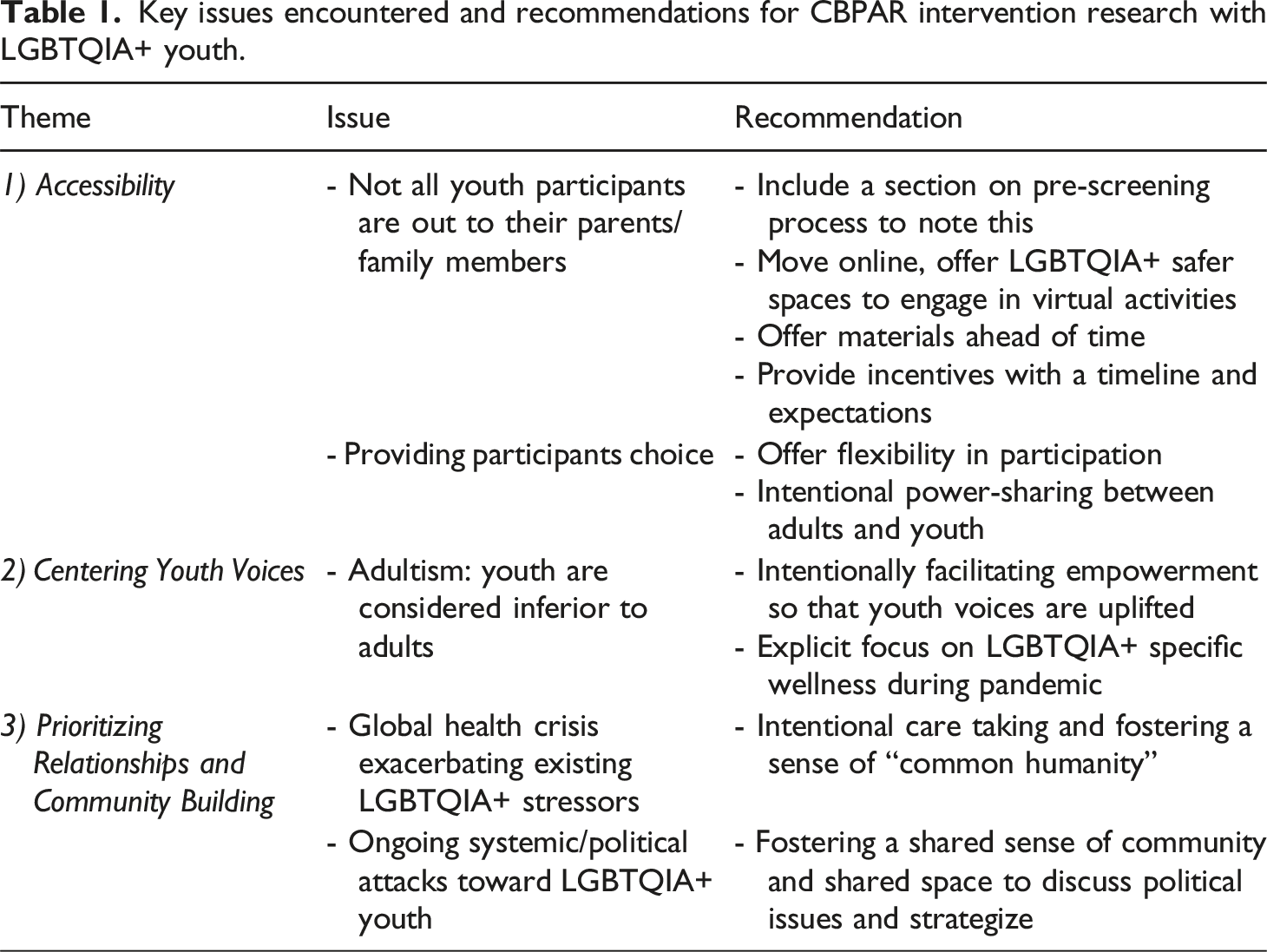
Utilizing an expanded LGBTQIA+ affirming framework of TIC (Levenson et al., 2021) was found to be critical for enhancing accessibility and trust building in the CBPAR process. Tuned In!, the mental health intervention being implemented and evaluated is explicitly affirming of diverse intersecting identities as part of its application of TIC, and our team maintained this framework while engaging in the CBPAR process to deepen trust and safety. The theme of “increasing accessibility” offers some movement toward research and practice informed by disability justice frameworks, which explore the role of intersectionality, wholeness, cross-disability, cross-movement solidarity, and collective liberation (Berne and Sins Invalid, 2015). If we are to understand experiences of systemic oppression within the context of trauma, our frameworks for TIC must expand to include the lineages of liberatory praxis (Freire, 2000), Black feminisms (Hooks, 2000; Collins, 2002), body liberation (Da’Shaun, 2021), and disability justice work (Berne and Sins Invalid, 2015). In this way, research and practice can offer experiences of deep healing and movement toward social transformation for participants, other researchers, and practitioners, which Tuned In! offers concrete suggestions.
Finally, prioritizing relationships and community building is critical to building trust in CBPAR work during the pandemic. In alignment with social work values and practice, establishing trust in group work can help transcend micro group work practice and reflect greater community building for social change (Knight and Gitterman, 2018; Iacono et al., In Press). This study also highlights the importance of extending participatory research to diverse youth-serving community organizations to increase future LGBTQIA+ youth participation, community building, and support. With the ongoing systematic and political attacks toward LGBTQIA+ youth, engaging in CBPAR through community networks and holding a shared space to discuss issues are of critical importance for LGBTQIA+ youth.
Limitations and conclusion
While CAE provides a form of shared accountability and qualitative rigor as a collaborative endeavor, this methodology has been critiqued for lacking generalizability and non-representativeness (Gates et al., 2020). Another notable limitation is the inherent power differentials between adult and youth co-researchers, differential power and status within the academy (e.g., tenured professor, assistant professor, and doctoral students), and the inherent tensions and power division in CBPAR between the community and academy. While the narratives were anonymized, there were still potential identifiers written within the narratives that could be connected to research team members, which is an inherent limitation of the study and may impact data analysis due to social desirability (Turner et al., 2022). While we acknowledge these limitations pose challenges to the CAE process, we contend that CAE is one crucial and justice-oriented approach to providing insight and nuanced perspectives on CBPAR processes during an unprecedented period such as the COVID-19 pandemic, where many CBPAR researchers have been faced with the challenge of navigating how to ethically continue their programs of research. As adult and youth co-researchers, we acknowledge the intersubjective nature of this work and our ethical responsibility in the CAE process. In response to these limitations, we incorporated several strategies to establish greater trustworthiness and enhance research rigor.
Guided by the principles of CAE (Chang, 2013), which center on equity, justice, and openness, the strategies we utilized include the anonymization of narratives, random assignment of two narratives to each member, acknowledgment and ongoing discussion of the aforementioned power differentials and a commitment to disrupt them as they occur through reflexivity, building interpersonal trust among members, transparent and open communication (via email, text, virtual platforms, and in person), engaging in multiple readings of critical reflection transcripts by multiple coders, and the generation of individual and group memos/field notes to enhance transparency. Further, we built on established relationships as all members on the research team previously participated in the CBPAR intervention—as Lapadat (2017) highlights, established trust among team members provides a deeper listening or witnessing, vulnerability, and collegial feedback, which contributes to respectful engagement, and accountability, particularly around power differentials. Additionally, throughout our research process, we encouraged a spirit of respectful scrutiny related to our coding, memoing, interpreting data, and generating final themes. We also enhanced credibility through ongoing member checking and interrogating which interpretations were valued and centered in our discussions; this meant maintaining a focus on intersectional meaning-making and documenting how we differently experienced CBPAR in the pandemic based on our positionalities and intersecting social identities. Finally, we digitally recorded all data analysis sessions and maintained a shared record of memos/field notes, which allowed us to consistently review and share our critical reflections, insights, and factors that impacted our collaborative data collection and analysis process (Gibbs, 2007).
As adults and youth engaged in qualitative research, our CAE on CBPAR with LGBTQIA+ youth in the pandemic highlighted the importance of producing knowledge that supports us in maintaining ethical research standards and practices. As a diverse research team, we aimed to describe our research process as we shifted and continued to engage in CBPAR mental health intervention development and evaluation during the ongoing pandemic. We also aspired to produce knowledge that would provide other social work researchers ethical and pragmatic approaches to engaging in CBPAR, and research more generally, with underserved communities such as LGBTQIA+ youth. In the spirit of qualitative inquiry, we hope this writing encourages further collaborative autoethnographical accounts to learn from our collective narratives and be better prepared to face the social work research challenges that lie ahead in the evolving COVID-19 pandemic and beyond.
Footnotes
Declaration of conflicting interests
The author(s) declared no potential conflicts of interest with respect to the research, authorship, and/or publication of this article.
Funding
The author(s) received no financial support for the research, authorship, and/or publication of this article.
