



Abstract
This article highlights promising macro and micro interventions for women who participated in +SHIFT, a cost-free antiviolence groupwork and case management program piloted in Victoria, Australia, due to their system-identified use of force. +SHIFT recognizes the harm endured by women as well as the harm caused by them. Through a thematic analysis of 21 interview transcripts, the authors identified four themes that captured women’s experiences: (1) program philosophy and curriculum components, (2) co-facilitated group structure, process and interactions (3) shared peer experiences and peer support, and (4) connecting curriculum content, life experience and personal accountability. The program approach was conceptualized by one woman as “planting seeds” for participants’ healing and awareness of alternative perspectives and behaviors that promote non-violent relationships.
The Positive Support and Healing creates Innovative Forward Thinking (+SHIFT) groupwork and case management program was designed and implemented in 2018 in Victoria, Australia. It was one of the first programs in Australia to offer a response to cisgender women who were systems-identified as using violence within their intimate relationships. Decades of feminist contextual research has established that, when compared with men’s abusive actions, women who resort to using force tend to use minor or moderate physical, verbal and emotional forms of harm (Warren et al., 2020a). This is a widely diverse group in terms of age, education, socio-economic status, life experience and other intersectional identities. It is well established that a large proportion of women who use force have domestic and sexual violence survivorship histories either in their adult intimate relationships or through childhood family of origin experiences (Larance, 2024b; Warren et al., 2020a). Women’s use of force must therefore be examined and understood in the context of male violence and patterns of gendered coercive control (Anderson, 2009; Larance and Miller 2017; Swan and Snow, 2002; Sweet, 2019; Warren et al., 2020a). This perspective allows us to see the complex ways in which women have both been harmed and have harmed others.
Typologies of cisgender women’s violence in their heterosexual relationships detail a range of motivations for using force. They may use force to gain short-term control of chaotic or abusive relationship dynamics, to protect themselves and their children, and/or as a response to prior trauma (Bair-Merritt et al., 2010; Larance, 2024b; Larance and Miller, 2017; Miller, 2005). Physical self-defense, both in response to an attack by their intimate male partner or in anticipation of it, is the most common form of force reported in the literature, and by resorting to force women may become involved in the criminal justice system (Warren et al., 2020a). However, a wider range of forceful actions beyond self-defense have been identified in recent scholarship. While a small proportion of women use violence to exert control in their intimate relationships, women generally use force, including non-defensive forceful actions, in an attempt to assert their own dignity, (re)gain or (re)establish some personal autonomy from a controlling partner, rather than as an expression of power they already have (Larance, 2024b; Larance and Miller 2017). Interventions addressing women’s use of force must take all of these motivations into account.
This article describes the philosophical approach of +SHIFT and presents the perspectives of 21 diverse women who had program contact between 2018 and 2022, including their experiences of the program and what they gained from their participation.
The development of antiviolence programs for women in Victoria, Australia
Shelters for domestic violence (DV) victim/survivors have existed in Australia since the 1970s, and the DV sector has traditionally been reluctant to allocate resources away from traditional victim services to address the behavior of DV offenders. DV advocates have also been wary about moves to describe women as anything other than victim/survivors, due to the long history of gender-equivalence debates in Australia (for example, see Taft et al., 2001). Furthermore, an incident-based violence-focused approach used by police at the time of their first response has led to many women being mis-identified as offenders when in fact they were DV victims (Larance et al., 2022; Larance, 2024a).
In recent years, a range of service providers across Australia have responded to the need for gender-responsive antiviolence programming for women, often developing their own small-scale, local response. Formal antiviolence interventions for women who have harmed their intimate partners emerged in the United States and elsewhere in the early 2000s (for example: Larance et al., 2009; Larance et al., 2019b; Pence et al., 2011; Covington, 2013; Walker, 2013), with the recognition that antiviolence interventions designed for men who had abused their intimate female partners were inappropriate for women (Miller, 2005). However, few of these have been adapted for the Australian context (Warren et al., 2020a). 1
However, a recent national survey has found that many professionals, working in a range of community services across Australia, regularly encounter women who have used force in their intimate relationships, particularly in specialist DV services and in substance use programs. Survey respondents reported that these women rarely sought services specifically to address their use of force, but were identified through referral or intake information, or through self-disclosure. Individual work with women was the predominant response reported, as specialist responses for women’s use of force were not available and referrals to perpetrator services 2 such as men’s behavior change programs were seen as inappropriate (Warren et al., 2020b).
In the Australian state of Victoria, most DV services are government-funded and therefore free of charge to participants. Funding streams are divided into offender programs and services for victim/survivors, with the latter including a wide range of DV services for women and children. Service responses for DV offenders consisted primarily of men’s behavior change programs, until 2015, when the Victorian Royal Commission into Family Violence recommended a review of the spectrum of responses to “all perpetrators across varying forms and risk levels of family violence”, resulting in a funding stream for a range of groups falling into this category (Neave et al., 2016: 69).
In response to these trends, and an identified need within their own programs for a service targeting women who use force, in 2018 two non-government agencies - Baptcare and Berry Street - established the +SHIFT program in two metropolitan community locations and in a major regional center in Victoria, Australia. With the program funded under the new extended perpetrator stream of government funding, program developers emphasized that the program be advertised as voluntary (a common approach for Victorian non-government services), both to differentiate it from men’s behaviour change programs, and based on evidence that readiness to change is a key factor in successful groupwork participation (Maldonado and Murphy, 2021). Courts or child protection services could recommend or order that women enroll in the program, but program co-facilitators accepted women only if they themselves agreed to participate. In addition to the cost-free intervention, initial funding also provided childcare and transportation vouchers in recognition of potential barriers to women attending the program. From 2018 to 2022, funding for the program included research evaluation. This article draws on data collected as part of this evaluation.
The + SHIFT program
Adapted from the U.S.-based Vista Program (Larance et al., 2009, 2019a, 2023), +SHIFT is grounded in a “healing place philosophy” (Larance, 2006) that emphasizes family safety, and promotes alternatives to use of non-self-defensive, non-fatal force. The program is informed by evidence that women who resort to physically harming their partners and/or their children often have histories of being harmed in their intimate relationships (Dasgupta, 2002; Dobash et al., 1992; Larance et al., 2019a; Miller, 2005).
As set out in the Australian Practice Framework (Kertesz et al., 2021), theoretical foundations for the program include the Ecological Nested Model (ENM) (Bronfenbrenner, 1977) and intersectionality theory (Crenshaw, 1991). As detailed in the ENM’s inter-related components, +SHIFT recognizes the relationship between women’s experiences in a range of contexts: individual (e.g., childhood, family of origin dynamics), micro- (e.g., family, friends, colleagues), exo- (e.g., occupation, social networks), meso- (connections between micro- and exosystems), and macro-systems (e.g., societal norms, culture). Grounded in ENM, empowerment theory encourages people to understand the connections between their personal experience and the context in which they have made choices, enabling them to expand the range of choices available to them (Arnold and Ake, 2013).
In addition, the complexity of each woman’s life is deeply influenced by her interlocking and overlapping intersectional identities (Crenshaw, 1991). Intersectionality theory offers an analytical framework for understanding how marginalized women’s experiences of relationship and institutional power, and the choices available to them, are shaped by a range of personal identities including, by not limited to, their age, race, ethnicity, sexual identity, gender identity, citizenship status, and national origin (Collins, 2015; Crenshaw, 1991). +SHIFT’s supportive intervention approach attends to women’s individual, intersectional experiences across the inter-related components of their complex lives and provides women opportunities to heal from the harm they have experienced while simultaneously raising their awareness and use of non-forceful behaviors across their relationships.
The + SHIFT draft curriculum 3 is a tool for group co-facilitators trained in the program’s philosophy and approach, to guide group member healing and increase their awareness of viable alternatives to force. The sixteen-session framework focuses on group participant safety and support, healthy relationship boundaries, feelings of shame, exploring how socio-cultural messages shape perceived relationship options, an increased awareness of self-talk and escalation cues, and promoting equitable relationships free from violence and coercive control. Group co-facilitators are tasked with tailoring session content to the unique needs of the women in their groups.
The program’s definition of “accountability” is a cornerstone of service delivery. Rather than women being accountable to others or to institutions, +SHIFT views accountability as the “actions, thoughts, or behaviors toward or involving others that reflect the integrity of the person you want to be” (Larance et al., 2019a). This approach has the demonstrated potential to catalyze individual healing and change through a process of recognizing how personal shame and guilt often mask feelings of grief, loss, and betrayal (Larance and Rousson, 2016). The process can enable deeper self-awareness, freedom from immobilizing shame, and awareness of previously unrecognized relationship options.
Co-facilitators implement a non-judgmental trauma-informed approach inside and outside the group (Baird and Alaggia, 2021; Elliott et al., 2005; Substance Abuse and Mental Health Services Administration [SAMHSA], 2014). In groups of no more than 12 participants who self-identify as women, sessions include a member-led ritual opening, a co-facilitator-guided accountability check-in, and a member-led ritual closing where group members’ feelings of safety are cultivated. Outside the formal group, co-facilitators offer women support and resources by checking in with those who have missed a session or who have not yet started the program.
Methodology
The + SHIFT evaluation adopted a convergent mixed methods approach (Creswell and Plano Clark, 2017) to describe the women attending the program and their histories; measure differences in participant attitudes, behaviour and well-being (Kertesz et al., 2019); and understand in depth the program components that facilitated healing and repair for women system-identified as using force. Ethics approval was granted by the first author’s university human research ethics committee.
From late 2018 to 2022, program data including referrals, participation and completion rates were collected. Program participants were asked to complete a questionnaire prior to starting + SHIFT. At group completion, during the sixteenth and final session, participants were asked for consent to have their data included in the program evaluation. Questionnaire data consisted of demographic information, as well as several pre-and post-program measures to assess the women’s change process. Demographic data reported in this paper were taken from the pre-program questionnaire responses. Research team members supervised by the first author interviewed a sub-sample of women about their experience of the program, shortly after they completed the group sessions. While the research team planned to interview women again 3 months after the program finished, attempts to contact interview participants at this later date were unsuccessful. In this paper we primarily draw on a thematic analysis (Braun and Clarke, 2019) of the interview data to engage with the research question: What, if any, impact does + SHIFT program contact have on women who have used force in their intimate relationships?
Confidentiality was emphasized when informed consent was obtained prior to each interview, and pseudonyms have been used throughout this article. Women were invited to reflect on their experience of +SHIFT and what, if anything, they had gained from participation. In a semi-structured interview style, questions were open-ended to encourage interviewees to share what they considered significant, including issues they deemed important for the agency to hear. In addition to questions about the number of sessions attended, interviewers asked about “some of the things that were discussed within the program” and for examples of any impact the program had had on the interviewee. Other questions about changes in stress levels and in interpersonal relationships were phrased as “did you notice…” (see Appendix for interview schedule). While the interviewers explicitly stated that there was no expectation for the women to talk about personal or distressing experiences, many interviewees chose to talk more broadly about their lives. For the few interviewees who showed distress, the interviewer offered to pause or stop the interview, and discussed what support the interviewee could access.
Interviews were recorded, transcribed and then thematically analyzed. Following preliminary manual coding using NVivo 14 software (Braun and Clarke, 2019) by the first author, the first two authors independently and manually identified themes in the interview material. The authors then collaboratively developed a thematic structure, agreed to by both, with four themes relevant to the research question, that also reflected and honoured features, perspectives, and individual worldviews of the interviewees. Rather than endeavouring to quote from all 21 women in this article, quotations that most articulately represented the perspective of all interviewees have been selected to illustrate each theme. As a result, the voices of several women appear to be prominent, due to their expressive ability.
As the findings reported were obtained through an evaluation of +SHIFT, the sample was limited to program participants who volunteered to be interviewed. The program was open to all who identified as women, bur primarily received referrals for cisgender women, as another local service offered group and individual work for women, trans, and gender diverse people who had used force and/or violence in family and intimate partner relationships. By chance, participants volunteering for interviews were all heterosexual. These findings, therefore, are drawn from a small group of cisgender, heterosexual women, and care should be taken in generalising the findings to other groups.
Findings
Program participants
The program primarily received referrals from police (25%) through triage of reports where police had identified a woman as the primary offender in an incident they had attended; child protection (23%) following child protection investigation of family dynamics; and specialist DV services (21%) where professional assessment and intake information revealed women’s actions or women may have self-disclosed. In contrast to the national workforce survey referred to earlier, the program did not receive referrals from substance use services. A number of women heard about the program by word of mouth and self-referred (9%). However, during the 4-year evaluation, it was clear that women identified by by non-government services (e.g., specialist services rather than court or child protection) as “victims” as well as “perpetrators” were referred to + SHIFT. Evaluation data indicate that more than three-quarters of program participants reported experiences of violence or abuse in current or recent partner relationships or in their family of origin. Over 70% reported experiences of violence or abuse in past adult relationships. More than half the participants described using force due to losing their temper (56%), or to defending themselves or their children (54%). Issues of control were mentioned by a small number of women, in terms of an inability to contain their own emotions or their attempts to regain control in a relationship.
Interview participants
Characteristics of +SHIFT Interviewees.
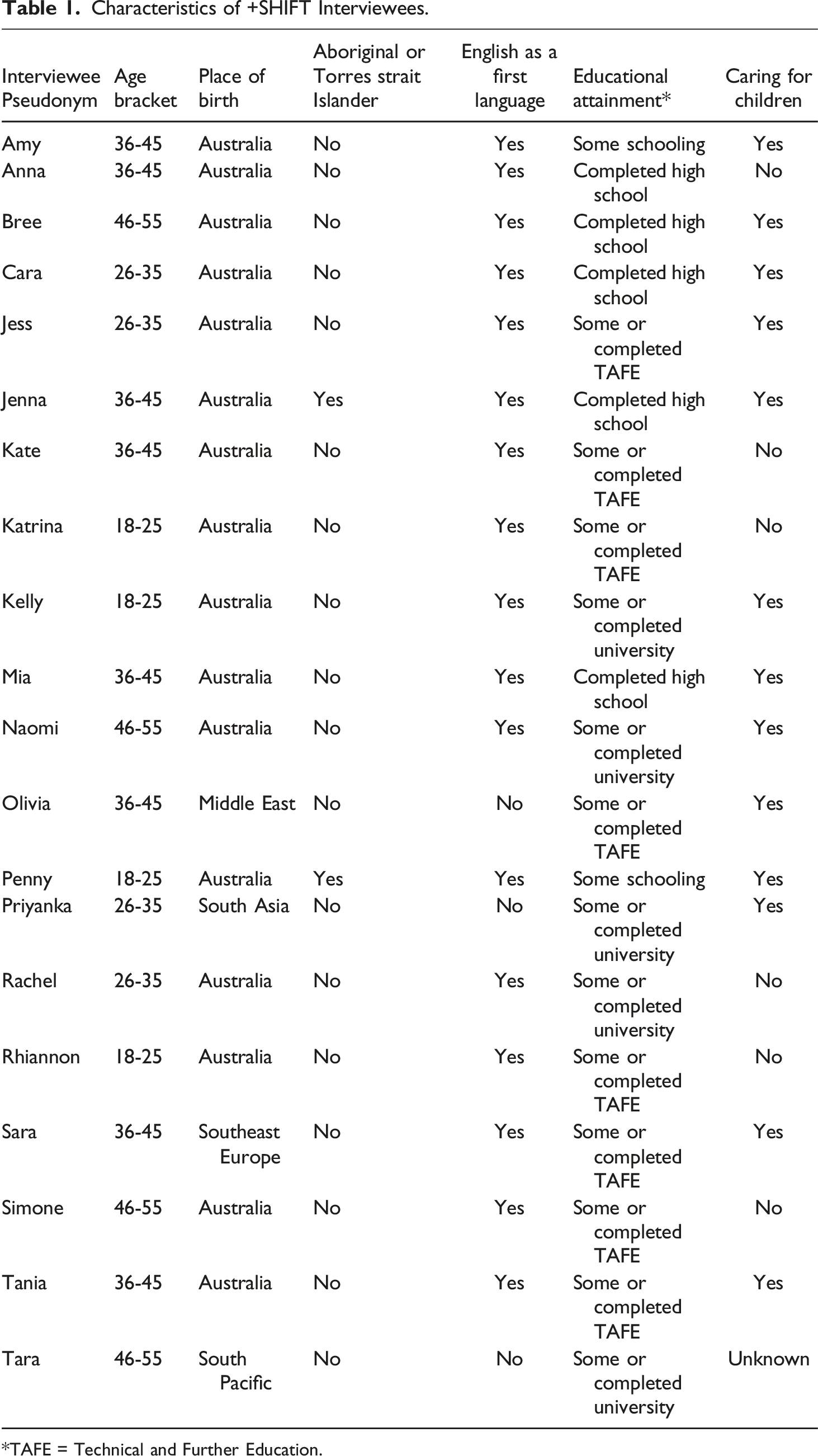
*TAFE = Technical and Further Education.
Thus, the women interviewed were broadly representative of the larger sample of 180 women who completed the program over 4 years, a retention rate of 56% from program inception. Facilitators reported that many women who disengaged did so because of competing demands on their time and energy due to court or child protection requirements and referrals, or because of issues with substance use, or the chance to enter a detox program. A very small number of women were reported to have left due to group dynamics, pointing to the importance of initial assessment and skilled facilitation.
In the interviews, women identified four areas which made + SHIFT an impactful and, at times, transformative experience for them. These were: program philosophy and curriculum components; co-facilitated group structure, process and interactions; shared peer experiences and peer support; and the insights they gained by connecting curriculum content, life experiences and personal accountability.
Program philosophy and curriculum components
Interviewees described different aspects of what they had gained from the curriculum content. Most participants spoke of learning about domestic violence, and how being harmed by their partners had influenced their lives. For example, connecting thoughts and feelings from early childhood and young adulthood to their adult experiences. Discussion about these experiences, and the expectations placed on them throughout their lives, validated the actions and choices women made in these contexts. For example, Jenna explained: I’ve always been the kind of person that’s like, it happened, get over it, move on with your life. I didn’t really think about I guess the impact of some of these things and how it had changed me as a person and I guess the course, the program, allows you to explore some of those things. if someone hits you, ‘you make sure you lay the last punch, love.’ That was the education that I got… With + SHIFT…when we sort of peeled it back, I realized that culturally I'd been taught a lot of things that weren't necessarily true or right, that were my family's reality. I was able to see that this relationship, it was toxic on a lot of levels, and it wasn’t just me, where I’d always thought it was my fault… Understanding not just my behaviour but other people’s behaviour… helped me see situations for what they were.
Understanding emotions and particularly their own emotions was an important area of growth and specifically discussed by half the participants. Learning not to judge herself for the anger and other emotions she felt because of her experiences, Jenna realized that “it wasn’t about getting the emotions under control. It was more about understanding the emotions and where they come from”. Jenna explained how this tied in with her expectations of herself. I just wasn’t very forgiving of myself. [Now] I think it’s okay to be sad and it’s okay to be angry. They’re all normal emotions, you have to feel them. There’s no avoiding it but just mainly making sure that you feel them in a safe way.
A third of participants also commented on learning to communicate more respectfully and assertively about how they were feeling, in situations ranging from minor domestic irritations to major relational issues. Directly reflecting one curriculum area, Katrina noted that “using ‘I feel’ a lot helped”. Kelly put it a different way. Talking and telling someone how you’re feeling instead of screaming at them is different, it’s much better to just talk about it rather than scream or go off your head and cry. I’ve probably become a bit firmer in the fact that I deserve my needs being met. If you’re not meeting my needs and if you’re disrespecting me or making me feel [bad] – I can choose [whether] to have you in my life. I don’t have to have you in my life because we’re family and put up with you doing and saying these things. So it’s just given me a bit more strength around that.
Aspects of the curriculum explore communication patterns - for example, passive, passive aggressive, aggressive, and assertive - as well as perceptions of relationship interactions as “strong” or “weak”. As a woman who valued always standing up for herself, but who had also experienced two abusive relationships, Simone made connections between sessions that seemed to encourage her to reflect upon how she related to others. She noted: [the sessions] sort of shone a spotlight on how, if you’re using force, … there’s a fine line between assertiveness and aggressiveness. I suppose I probably crossed that line a little in the past. I saw it as a strength whereas it’s actually a weakness. [Since then] I’ve probably focused more on being assertive in a far less aggressive way… seeing things more from other people’s points of view.
+SHIFT sessions provided the women with opportunities to recognise when their emotions were likely to intensify and offered strategies for interrupting the escalation, de-escalating, and avoiding verbal and/or physical abuse toward others. More than half the participants spoke in some way of having learned to take a pause to reflect, “stepping back and looking at things at a different perspective” (Cara), rather than responding in kind to abusive communication from others. Some women noted the importance of recognising escalation cues, such as comments that reminded them of previous harms. Kate joined the group due to her concerns about the violence in her family, including her own treatment of her teenagers and the defensive force she had used against violent partners. She then found that group discussions helped her think about the abuse in her family of origin. These reflections allowed her to recognize a pattern of interactions with her mother, the shame it elicited, and to then interrupt that cycle. The cycle for me went, just put up with [my mother’s verbal abuse]. And my self-talk was, ‘don't bite, don't bite, don't bite…don't say anything. You're just going to intensify things’. Because once I would bite, even softly, I lost control by giving her my power. And then she would say something that would trigger one of my wounds. And then of course I would become highly abusive and…there would be some big fight…Then I would feel very guilty…ashamed of the way that I reacted. (Kate)
All the women said that + SHIFT contact facilitated a greater acceptance of themselves and the importance of meeting their own needs. For some women, de-escalation involved focused self-care activities such as rediscovering hobbies, having coffee with friends. Olivia described “just making time just for myself and also when some situations get to the point that I’m not in control, take some time out from that circumstances or situation”.
Co-facilitated group structure, process and interactions
Almost all the women reflected upon how their + SHIFT participation was characterized by feeling safe in the group environment. Critical to feeling safe was the co-facilitators’ trauma-informed and nonjudgemental approach. Simone noticed that one of her group co-facilitators had: “experience and compassion but at the same time she’s very professional, … she’s very well-trained. Yeah, but there’s a big heart. She was a really good support”. Naomi stated that she “really trusted and appreciated the women running it, you know, they’re just so non-judgmental and supportive. Yeah, I just felt safe there”. Zia pointed out that co-facilitators promoted feelings of safety before the group sessions began. [The facilitator] continuously checked up on me, made sure that I was okay... By the time it came to actually doing the group, I’d already established a good enough relationship … that I wasn’t anxious about her anymore.
The few criticisms of the program made by interviewees focused on personal preferences regarding session timing and frequency and program length, and on some difficult dynamics between group members, illustrating the importance of careful intake and assessment processes for a group to reach its potential.
Two key elements of the +SHIFT model (Kertesz et al., 2021) were noted by the women. Ground rules were reported to support safety, respect, listening and exploration. In addition, a check-in early at each session, was very supportive and being able to sort of just talk about the week that went down and get support from people that have got a lot of background and experience in those kind of situations, especially [the facilitator]. (Simone) It wasn’t a therapy session. They didn’t sit down and say tell me about your childhood. We would go through the material and reflecting, it came up organically… I’ve spoken about things in here that I haven’t spoken about in 20 years but after speaking about it, being so scared to talk about it, you can’t imagine, the weight that that takes off you.
Shared peer experiences and peer support
Over half the women reported commencing the group with hesitation, nervous, defensive or worried that they would have to associate with “troubled” or “criminal” people. However, as noted by Simone, “the other participants were all, you know, just normal ladies”. Within the safe environment cultivated by skilled co-facilitators, the exchange of stories and positive peer support by group members enabled women similarly situated by current life circumstances to break the isolation often experienced as part of DV and reduce the stigma they felt. “I could hear my story from every mouth that was in the room”, noted Tara, reflecting along with a third of the women on the power of finding that they were not alone in their experiences. Naomi explained: The stories were all horrific, but I found it very comforting, just very female positive… I always came away from there happy, feeling good… that I’m not nuts, that what happened to me was awful, and that… I do have life skills, I’ve got my shit together, you know. I realized that it's not just one culture, it can happen to anyone at all ages… and all different violent types of relationships whether it be emotional or physical violence. I think just sharing your stories with strangers… It's really personal information, so you kind of get to know everyone's inner secrets, you can't help but bond with someone.
A third of the women talked about support and advice they received from other women in their group. “We can be open; we could be honest… I didn’t feel alone. There was support that all the girls were reaching out to each other,” explained Cara. Similarly, Zia noted: It helped hearing everyone else’s events that have happened as well, because everyone would pitch in their idea. Like, whenever someone was getting upset about something, like we’d all try and support each other and give each other all of the different strategies to deal with it. And it was really beneficial. I was like you do realize that you’re still partly in that cycle of abuse and control and power. She was like I know but I just don’t see a way out yet. I turned around and I said to her, I’m like, only you will see an out when you’re ready.
Connecting curriculum content, life experience, and personal accountability
The topics covered in the group curriculum were received by the women in varying ways, with half of the group identifying a particular moment of insight. Through their interviews, it was evident that women were at different points on their journeys towards healthier relationships with themselves and others. Jenna expressed a key curriculum message about accountability, connecting the information she had learned in the group with her own actions. I don’t have to hold myself accountable to anyone... That’s what my opinion was when I very first started here, but after I did [the group], …I realized I actually do hold myself accountable to someone…I need to hold myself accountable to the person that I want to be. I would walk away or not speak to [my mum] for six months. And then, I would feel very… ashamed of the way that I reacted… I realized with +SHIFT that it's my cycle, not my mum's cycle that I needed to concern myself with. +SHIFT just helped me with my eating problems. It's been a lifelong battle for me and, it was just the way as a little kid, I guess, I was able to really control things. …With + SHIFT I realize that, well, I only overeat when my self-talk isn’t good. …It's coming from deeper. It's coming from the same… sort of damage and the same sort of wound.
Several women reported that bringing together past experiences and present challenges with curriculum content, grounded by the support of peers and co-facilitators, enabled them to leave group sessions feeling calmer and better about themselves. Cara also reported a significant change in her thinking and actions. I’ve noticed a big change and shift because I’ve got more understanding of what I’m going through… I’m doing a lot of things that are more assertive and … I’m not looking at the problem so close-up. I’m actually stepping back and looking at things at a different perspective.
Kate reflected upon the role of +SHIFT in her realization that while she had endured harm from multiple people in her life, she could now acknowledge that she also had a choice in how she responded to others. +SHIFT helped me to tie it all together and realize that the process that’s happening is so very predictable. With predictability you can keep yourself really really safe…+SHIFT is the only thing that I’ve done that’s helped me forgive my mum …you really start to realize the patterns and understand it at a deeper level.
Connecting her mother’s abuse to her own behavior — while situating those actions within a new understanding of her family’s culture — enabled Kate to change her behavior toward her mother and her children, and get closer to the person she wanted to be by utilizing non-abusive behaviors. Kate said: “the [children] are saying that I’m not as angry… I’m a lot less...controlling… I get up in the morning and I want to have relationships where I walk away with my head held high.” As she reflected: “I do feel that if I'd done + SHIFT earlier... I feel like it probably would have shortened my healing time. Because…I don't think I've ever experienced anything that's put together so well... You have these light bulb moments... I just feel like the seeds of it are... the seeds of everything that you need to heal.”
Discussion
Through interviews with women who had taken part in the +SHIFT antiviolence groupwork program, this paper identifies four aspects of the intervention approach which have contributed to participants’ awareness of alternative perspectives and behaviors promoting healthier relationships, and ultimately, their healing. The seeds of healing (as described by Kate) were the program philosophy and curriculum components; co-facilitated group structure, process and interactions; shared peer experiences and peer support; and the integration of these components with each woman’s own life experience. The authors have chosen to focus on aspects that were successful for participants – the seeds that germinated – whilst acknowledging that the women who dropped out of the group early (and were not contactable for interview) may have had other responses. Responses from interviewed women about how the group could be improved were very individual, with no particular theme emerging. Several comments advocated longer sessions to allow better coverage of topics, and other individual comments related to goal setting, facilitators managing group dynamics or a wish for individual time with the facilitator and opportunities to ‘make up’ missed sessions.
Key aspects of the
Rather than expecting measurable behaviour change during the intervention period, +SHIFT promotes an internal accountability of developing actions, thoughts or behaviors that reflect the integrity of the person you want to be (Larance et al., 2019a). Within the safety of the group, Kate and many other group participants spoke of the families they had grown up in, their adult relationships and their relationships with their children, and the impact of these experiences on themselves and their behavior. A focus on the impact of culture – an intersectional concept incorporating family, social and ethnic attitudes – also encouraged women to reflect on how these experiences had shaped their habitual responses.
Women’s reflections on the impact of these experiences varied widely. Although many or most of the women’s stories demonstrated a history of victimization, and women could describe the problems in their relationships, some women described themselves as fighters and did not like to be labelled as victims (Larance et al., 2022). While Kate described herself as an abuser and spoke of having to “unlearn” attitudes and behaviors taught her in childhood, other women’s reflections suggested that they had come to the program at an earlier stage in their journey, but nevertheless had found the program valuable. Several interviewees had participated in the program twice and reflected on its cumulative value.
Conclusion
This paper focused on the impacts of +SHIFT program contact for women who used force in their intimate relationships, specifically in terms of the women’s experience of the program design and delivery. Many questions are left unanswered, however. Despite the difficulties of maintaining post-program engagement with women, combined efforts by program and research teams to conduct follow-up interviews could yield important information about how the women translated their insights from the program into their lives and relationships. In addition, exploring in detail the prevalence amongst program participants of mental health challenges, and issues with substance use is vitally important, to contribute to the growing understanding of how these issues may be caused or weaponized against women who have experienced DV.
The stories told by the women who participated in +SHIFT are powerful reminders that they were designated ‘offenders’ by a socio-legal system which creates a dichotomy between victims and offenders, thus inadvertently perpetuating their abuse by legal and intervention frameworks, rather than seeing them as harmed women who may harm others because of a dearth of choices.
The art of delivering successful antiviolence interventions, in this case for women identified as having used force, involves integrating theoretical foundations, an evidence-based curriculum, trauma-informed approaches to process, strong facilitator skills and a focus on the power of relationships, both with co-facilitators, and with peers. In the case of +SHIFT, these elements created a “healing space” for women who endured as well as caused harm, honoring their life experience rather than condemning their actions, and respecting them as experts in their own lives. These “seeds of healing” enabled women who participated in +SHIFT to become more at peace with themselves and assess what behavioral and relational choices were viable in the context of their own lives, to promote non-violence across their relationships.
Footnotes
Acknowledgements:
Special thanks to Georgia Ovenden, who conducted some early interviews and also conducted an early analysis of the interview material, published in the original report (see  ). Thanks also to Sophie Franklin, who assisted the research team in developing a coding structure from the interview material. Above all, thank you to the women participants of +SHIFT who consented to share their experience and expertise, and to the professionals who engaged so compassionately with these women.
Authors’ contributions
MK and LYL collaborated on the evaluation design. MK and JI conducted interviews and contributed to the initial analysis of the full interview dataset. MK and LYL conducted separate analyses of the interview data based on the initial analysis and then collaboratively developed the thematic structure. The first draft of the manuscript was drafted by MK and LYL, with the second major draft written by MK. All authors commented on and contributed to subsequent versions of the manuscript. All authors read and approved the final manuscript.
Funding
The authors disclosed receipt of the following financial support for the research, authorship, and/or publication of this article: The research was funded by the Department of Social Services, Commonwealth of Australia, and by Baptcare.
Declaration of conflicting interests
The authors declared no potential conflicts of interest with respect to the research, authorship, and/or publication of this article.
Ethics approval
This research received ethics approval from the University of Melbourne Human Research Ethics Committee (Ethics ID: 12219).
Informed consent
Participants included in this study gave their written informed consent to participate, with the knowledge that de-identified data (e.g., demographics, quotations and examples) may be included in publication of research reports and articles.
Data Availability Statement
The data that support the findings of this study are available on request from the corresponding author. The data are not publicly available for privacy reasons.