



Abstract
While coercive control is widely recognised as a patterned system of relational and institutional entrapment, the Spiderweb metaphor—used as a practice tool in family and domestic violence direct practice spaces in Australia—remains underdeveloped in academic literature. This article expands the Spiderweb metaphor as a practice-informed conceptual lens for understanding how coercive control operates over time and across domains, while situating the metaphor alongside established practice frameworks. This discussion outlines six interlinked dimensions of the metaphor, including the structure and stickiness of the web, the adaptive strategies of the person using coercive control, processes of resistance and strand-cutting, and the gendered and complex, non-linear dynamics of leaving, returning, and staying as survivors navigate coercive control. Drawing briefly on the concept of the “arrest web,” the article highlights how coercive control often becomes visible only when illuminated from particular angles. By integrating theory with practice-based reflection, the Spiderweb metaphor is presented as an intervention tool to support pattern recognition, risk assessment and survivor-centred safety planning across diverse practice contexts.
Introduction
As part of my Master of Social Work studies, my first fieldwork placement involved a research-based collaboration with a community legal service specialising in family and domestic violence (FDV). Terminology varies across Australian jurisdictions; I use FDV consistently in this paper for clarity, reflecting the Western Australian practice context that informed this reflection, while recognising that “domestic and family violence” (DFV) and “family violence” are also commonly used in other contexts. During this placement, I attended a 2-day training on the Common Risk Assessment and Risk Management Framework (CRARMF) (Department for Child Protection and Family Support [DCPFS], 2015), facilitated by an experienced social worker and FDV specialist. Her use of the Spiderweb metaphor to explain coercive control prompted me to develop the metaphor further as a way of integrating insights from research, training and practice, and of tracing how coercive control operates across time and settings.
Building on Biderman’s (1957) articulation of coercive methods and Stark’s (2007) theorisation of coercive control as a patterned system of entrapment, the Spiderweb metaphor offers a practice-based extension that remains underdeveloped in academic literature. While survivor accounts and practice discourse frequently draw on imagery of entrapment, including metaphors of webs and constraint, such imagery is seldom elaborated as an analytic framework within academic literature. Larance’s (2025) concept of the “arrest web” advances this imagery by showing how coercively controlling partners may mobilise legal processes so that institutions themselves become part of the web. In this account, webs are often only visible when illuminated from particular angles—understood here as cross-system recognition of patterned harm rather than disclosure alone—which helps explain why coercive control is frequently misunderstood or misrecognised within institutional responses.
The Spiderweb metaphor is positioned in relation to established practice frameworks, including Walker’s Cycle of Abuse (1979) and the Duluth Domestic Abuse Intervention Program (DAIP) Power and Control Wheel (Domestic Abuse Intervention Program [DAIP], nd; Pence & Paymar, 1993; see Figure 1), both of which have helped practitioners and anti-violence intervention participants recognise patterned domestic abuse. However, the Spiderweb does not rely on a predictable, stage-based “cycle” (Walker, 1979) as an explanatory model. Instead, it builds on the practical insights of the Power and Control Wheel (DAIP, nd) by depicting coercive control as ongoing, non-linear, cumulative, and structurally entrapping, including how control can shift and reconfigure in response to resistance or intervention. It aligns with the Wheel’s focus on power and control tactics, while extending it by illustrating how tactics operate as interconnected strands, how institutional processes can become part of the entrapment, and how pressure redistributes when one strand is disrupted, enabling control to be re-woven across relational and institutional domains without treating either framework as a universal explanatory template. Domestic Abuse Intervention Program (DAIP) Power and Control Wheel, used with permission by Domestic Abuse Intervention Programs (DAIP, nd).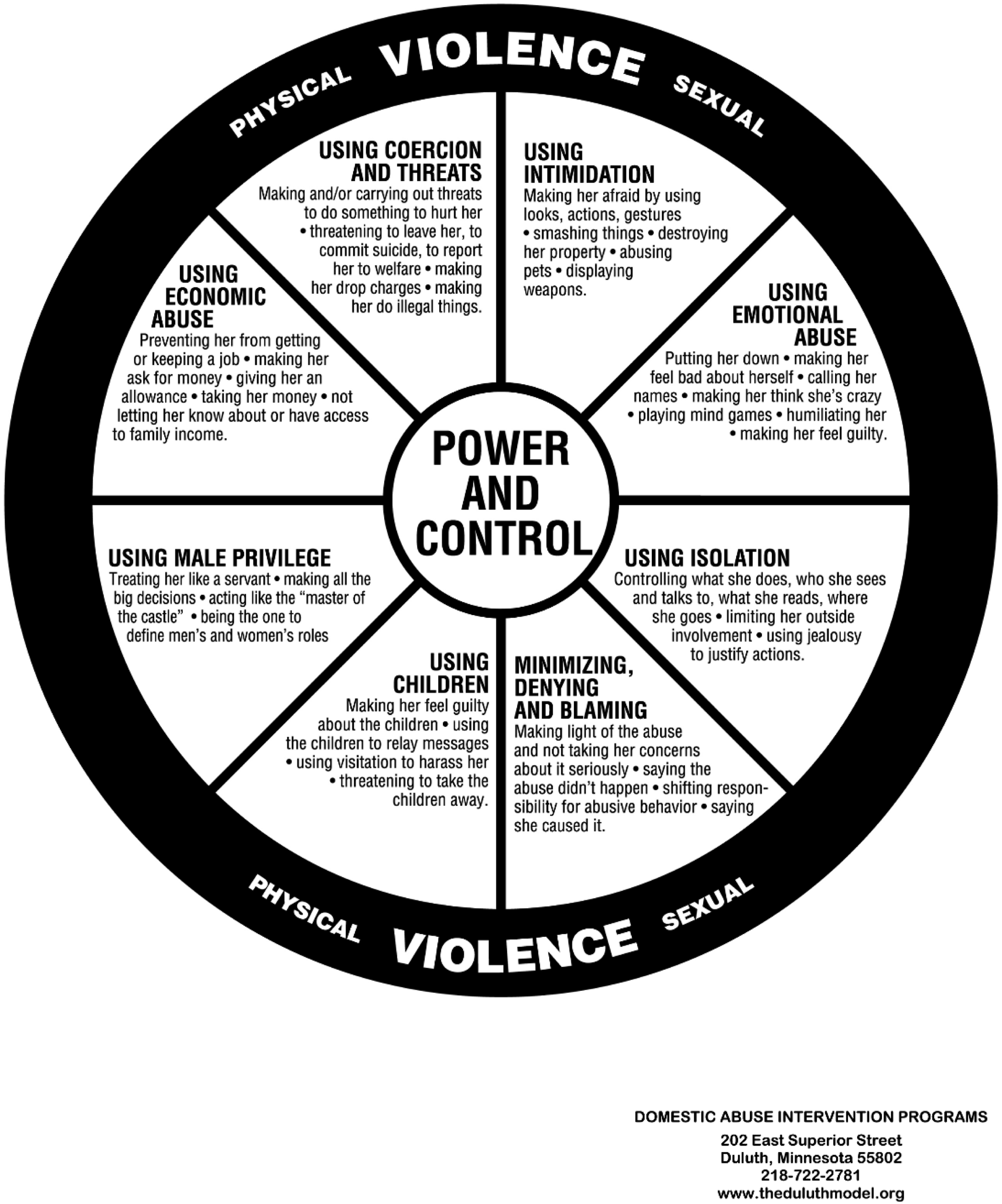
Coercive control is widely recognised as a profoundly gendered phenomenon, most commonly involving men’s use of controlling behaviours against women. At the same time, scholarship has highlighted the limits of rigid victim–offender binaries for capturing coercive control across diverse contexts and identities (Larance et al., 2022). Accordingly, this article adopts behaviour-focused language (for example, “person using coercive control” and “person subjected to coercive control”) to foreground patterns of action and power rather than fixed identities, while retaining explicitly gendered analysis where analytically important. This supports application in practice across settings, including LGBTQ + relationships, where coercive control has also been documented (Stark and Hester, 2019).
The article examines six interlinked dimensions of the Spiderweb metaphor: the cross-domain structure of the web; the “stickiness” that sustains entrapment over time; the adaptive strategies of the person using coercive control as the “spider”; processes of resistance and strand-cutting; the deformation of the web under intervention; and the complex, dynamic patterns of leaving, returning, and staying under coercive control. Drawing on practice-based reflection alongside established theory, this discussion shows how the Spiderweb metaphor can support survivor-centred assessment, practice-based intervention and safety planning, as well as coordinated responses to patterned harm.
Structure of the web: Cross-domain, patterned control
The Spiderweb metaphor reframes coercive control from a series of isolated incidents to a patterned system of domination operating across multiple domains of everyday life. Drawing on Stark’s (2007) conceptualisation of coercive control as an ongoing liberty crime, the metaphor highlights how seemingly discrete tactics interlock to constrain autonomy, exhaust resistance, and narrow pathways for safety. These strands are constructed and adjusted over time in response to resistance, intervention, and changing circumstances.
Biderman’s (1957) early framework identified core techniques of coercion such as isolation, degradation, threats, and induced exhaustion. While these insights remain historically important, contemporary research demonstrates that coercive control now extends far beyond these original domains, embedding itself within legal, technological, social, and institutional systems. The Spiderweb metaphor helps map these strands together, making visible how control is sustained through their interaction rather than through any single tactic.
Relational and social isolation
One central strand of the web involves the progressive erosion of social connection. This may include restricting contact with friends and family, undermining credibility within social networks, or positioning the person subjected to coercive control as unreliable or unstable (Anderson, 2009; Stark, 2007). Over time, these dynamics are reinforced through reputational management, whereby the person using coercive control presents as reasonable or caring in public while discrediting their partner in private (Tolmie et al., 2024). Such relational strands reduce access to informal support and increase dependence.
Cognitive, emotional, and informational control
Cognitive and emotional strands work to destabilise a person’s sense of reality and self-trust. Gaslighting, narrative manipulation, selective withholding of information, and constant monitoring of reactions can leave the person subjected to coercive control doubting their perceptions and judgement (Fontes, 2015; Sweet, 2019). Humiliation, belittlement, and unpredictable rule setting further reinforce compliance by creating confusion and fear, limiting both help-seeking and credibility when disclosure occurs (Darke et al., 2025; Lohmann et al., 2024).
Sexual and bodily control
Sexual and bodily control forms a distinct and often under-recognised strand of the web. This may include sexual coercion, reproductive control, pressure or punishment related to sexual availability, and threats involving intimate images (Henry and Powell, 2016). Such tactics generate profound shame and exhaustion, while constraining a person’s capacity to leave or disclose abuse safely (Henry et al., 2023; Tarzia and McKenzie, 2024). These bodily strands intersect with emotional and reputational control, deepening entrapment across domains.
Economic and material control
Economic strands restrict access to financial resources and material stability. This may involve controlling income, sabotaging employment, accumulating coerced debt, or preventing independent financial decision-making (Adams et al., 2008; Stark, 2007). Economic control limits practical options for leaving and amplifies vulnerability across housing, parenting, and legal processes (Byrt and Cook, 2025; Johnson et al., 2022).
Legal, institutional, and bureaucratic control
Coercive control frequently extends into legal and institutional systems. Tactics may include misuse of family court processes, repeated litigation, manipulation of protection orders, or strategic engagement with police and professionals to portray the person subjected to control as unstable or aggressive (Douglas, 2018; Miller and Smolter, 2011). Where children are involved, threats or actions related to custody and contact can create prolonged entanglement long after separation (Jeffries, 2016; Reeves et al., 2025). In these ways, formal systems may become part of the web, even when individual actors do not intend harm.
Technological surveillance and digital abuse
Technological strands involve the use of digital tools to monitor, harass, or control, including tracking devices, password control, constant messaging, or surveillance through shared technologies. Technology-facilitated abuse allows coercive control to persist across physical distance and separation, extending the web into digital spaces (Harris and Woodlock, 2019). Recent human–computer interaction (HCI) 1 scholarship documents how digital tactics are rationalised, normalised, and adapted in response to boundaries and intervention (Bellini, 2024; Woodlock et al., 2020).
Animal abuse and non-human hostages
Abuse or threats directed toward pets and companion animals represent another strand of coercive control. Harm to animals can function as powerful leverage, particularly during separation and family law proceedings. Recent Australian research has documented the use of violence against pets and companion animals as a mechanism of coercive control, particularly in the context of separation and help-seeking (Butler and MacDonald, 2024). In parallel, family law reforms and professional guidance have increasingly addressed the role of pets and family animals in relationship breakdown and post-separation arrangements, highlighting their significance within legal decision-making processes (Attorney-General’s Department, 2025; Cleary et al., 2021). Together, these developments underscore how animals may function as non-human hostages within the web.
These strands do not operate independently. They overlap, reinforce one another, and shift over time, producing a web that adapts to resistance and intervention. In some cases, people beyond the intimate relationship, such as family members, legal representatives, or professionals, may occupy particular points within the web. Their actions can function like wind caught in the strands, sending vibrations that alert the person using coercive control or amplify existing pressures.
By mapping coercive control as a web rather than a sequence of incidents, practitioners are better positioned to identify patterned risk across domains. This structural view supports more coordinated safety planning focused on how the web as a whole constrains choice and shapes risk.
Stickiness of the web: Relational, bodily, cultural and structural adhesives
The Spiderweb metaphor not only captures the multiple strands of coercive control but also helps explain why these strands hold over time. The “stickiness” of the web refers to the forces that bind strands together and make separation, resistance or escape extraordinarily difficult. Rather than being reducible to a single psychological explanation, this stickiness is produced through overlapping relational, bodily, cultural and structural processes operating simultaneously.
Relational and romantic adhesives
One source of stickiness lies in relational and romantic dynamics. Love, hope and idealised relationship scripts can function as powerful adhesives within the web. Many people subjected to coercive control remain attached through expectations that the partner will change, that the abuse is temporary, or that maintaining the relationship is necessary to preserve family stability. Intermittent reinforcement can intensify attachment, particularly when harm is periodically followed by affection or remorse (Herman, 1992; Stark, 2007). These dynamics reflect the complex emotional terrain in which coercive control is embedded, rather than an absence of resistance.
Children, post-separation entrapment and family court dynamics
Children form one of the most enduring sources of stickiness, particularly after separation. Research shows that children are not merely witnesses to domestic abuse but are actively harmed by, and entangled within, regimes of coercive control (Callaghan et al., 2017; Katz, 2015). Parenting responsibilities, fears about child safety and ongoing contact through family law systems can tighten the web long after an intimate relationship has ended. Court-mandated contact and shared parenting arrangements often require continued interaction with the person using coercive control, extending the web across legal and bureaucratic settings (Hester, 2011). In this sense, children may be caught within the web while also functioning as points through which ongoing exposure is maintained.
Sexual and bodily adhesives
Sexual and bodily forms of coercion represent a deeply adhesive layer of the web. Sexual coercion, reproductive control and threats involving intimate images operate through shame, humiliation and fear, undermining bodily autonomy and restricting options for disclosure or departure. Image-based abuse can bind people to silence and compliance long after physical separation (Henry and Powell, 2016). Sexual violence also carries significant health and psychological consequences, contributing to exhaustion, dissociation and reduced capacity to mobilise resources (Dartnall and Jewkes, 2013). These violations function not as isolated acts but as strands that embed control within the person’s relationship to their own body.
Cultural, religious and migration-related adhesives
Cultural, religious and migration-related pressures can further reinforce entrapment by shaping the social and institutional costs of leaving. For example, scholarship on immigrant South Asian women in the United States documents how community denial of intimate partner violence, honour and shame norms, and reliance on extended family networks can constrain help-seeking and make separation socially risky (Das Dasgupta, 2000; Das Dasgupta and Warrier, 1996). In settlement contexts, migrant women may also face visa dependency, language barriers and fears of deportation, which can be exploited as part of coercive control and become entangled with legal and service responses (Vaughan et al., 2020). Together, these constraints can strengthen and complicate the web across social contexts, amplifying both relational and institutional constraints.
Fear, obligation and guilt (FOG) as internalised strands
Fear, obligation and guilt remain important elements of stickiness, but function best when understood as one layer among many rather than the primary explanation. Fear of retaliation, obligation shaped by gendered caregiving expectations and guilt rooted in self-blame are continually reinforced by relational, cultural and institutional dynamics. Over time, coercive control becomes internalised, with individuals self-monitoring speech, movement and emotion as if surveillance were constant, even in the absence of the controlling partner (Stark, 2007). This internalised control represents one of the most insidious strands of the web.
Importantly, the stickiness of the web does not imply passivity. Remaining, returning, or appearing compliant can reflect strategic, prioritised forms of resistance shaped by constraint—an issue taken up more fully in the discussion of strand-cutting below.
The spider: Adaptation and accountability in coercive control
Risk in coercive control must be understood not only as patterned, but also as adaptive. Within the Spiderweb metaphor, the spider represents the person using coercive control as an active agent who maintains, repairs, and reconfigures the web in response to resistance, intervention, and changing circumstances (Kelly and Johnson, 2008; Stark, 2007). This framing shifts attention away from isolated incidents towards the ongoing work involved in sustaining control.
Multiple strands operating simultaneously
The spider does not rely on a single strand. Coercive control is sustained through the simultaneous use of multiple strands across relational, financial, legal, technological, and parenting domains. This helps explain why interventions that focus narrowly on physical violence may appear effective in the short term, while control continues through economic sabotage, legal harassment, surveillance, or manipulation of parenting arrangements (Myhill, 2015; Stark, 2007). From a practice perspective, this underscores the need for holistic risk assessment, rather than assuming that the reduction of one form of abuse signals safety.
Adaptation when strands are disrupted
A defining feature of coercive control is the capacity to adapt when particular strands are weakened or cut. When one pathway is disrupted—through a Family Violence Restraining Order, relocation to safe housing, or access to independent income—control may be redirected through other means. Physical violence may reduce while legal abuse, reputational attacks, or financial manipulation intensify (Douglas, 2018; Miller and Smolter, 2011). This adaptive pattern highlights why coercive control cannot be understood as a linear cycle, but as a dynamic system responding to constraint.
Strategic presentation and system navigation
Like a spider sensing vibrations in the web, people using coercive control often test boundaries and adjust behaviour in response to professional scrutiny. This may include presenting as cooperative or reasonable to professionals, emphasising involvement as a caring parent, or displaying selective compliance while intensifying coercion in private—forms of strategic presentation that have been documented in research on arrest, legal systems abuse, procedural manipulation, and perpetrators’ management of accountability (Douglas, 2018; Larance, 2025; LeCouteur and Oxlad, 2011; Miller and Smolter, 2011). Such strategic presentation can obscure ongoing risk and contribute to misinterpretation when assessments privilege surface behaviour over patterns of control.
Accountability and the need for ongoing monitoring
Recognising the agency of the person using coercive control is central to effective intervention. A pattern-based approach requires sustained attention to how control is maintained and reshaped over time, rather than treating interventions as isolated events. Research on perpetrator accountability highlights the importance of monitoring behaviour across domains, including parenting, legal engagement, and public narratives, rather than relying solely on programme attendance or formal compliance (Fitz-Gibbon et al., 2018; LeCouteur and Oxlad, 2011).
Viewing the person using coercive control as an adaptive agent reinforces a survivor-centred focus. Rather than asking why the person subjected to control does not escape the web, practitioners are better positioned to map how the web is maintained, anticipate reconfiguration, and strengthen coordinated responses that constrain the most dangerous adaptations first (Walklate et al., 2018).
“Cutting the strands”: Resistance, illumination, and turning points
Within the Spiderweb metaphor, moments of increased safety or agency are best understood not as sudden escape, but as points where particular strands of control are loosened, re-routed, or partially cut. These turning points are rarely singular events. Rather, they emerge through cumulative acts of resistance, access to resources, and shifts in visibility across systems. In this article, “strand-cutting” refers primarily to a gradual, strategic process of loosening, disrupting, or partially severing specific strands, rather than a single act that permanently removes entrapment.
Resistance as ongoing and often hidden
Response-based practice emphasises that people subjected to coercive control are always resisting, even when that resistance is subtle or constrained (Coates and Wade, 2007). Such resistance may include information management, emotional withdrawal, strategic compliance, delayed disclosure, or quiet resource gathering. Larance and colleagues describe these as “strategically stealthy” (Larance et al., 2018) practices: everyday actions aimed at preserving safety and autonomy within a web that punishes overt opposition. From this perspective, remaining, returning, or appearing compliant are adaptive responses to risk rather than indicators of passivity.
Illumination as a precondition for safe intervention
Cutting strands safely depends on cross-system visibility: shared recognition of patterned harm across legal, welfare, and service contexts, rather than reliance on disclosure or recognition within any single incident, professional encounter, or institutional silo. When coercive control is only partially recognised, interventions may be isolated or misinterpreted, enabling further adaptation by the person using control. In practice, patterned coercive control may become legible only in particular institutional settings, such as legal proceedings, child protection involvement, or crisis intervention, where information is aggregated and behaviours are interpreted as a course of conduct rather than a discrete event (Larance, 2025). This helps explain why coercive control is so often misunderstood or misrecognised within fragmented institutional responses. Without shared recognition, cutting one strand can send vibrations through the web that alert the person using coercive control and prompt rapid reconfiguration.
Illumination is also an intervention in itself when undertaken with victim-survivors. By mapping the web together, practitioners can support autonomy and self-determination by enabling survivors to identify priorities, safety-plan, and coordinate supports in ways that make sense for them. Coercive control can be enacted so thoroughly that the multiple connections of the web are difficult to see from within; making the web visible can therefore redistribute power by shifting the analytic frame away from “individual choices” and toward patterned constraint across domains.
Cutting strands and the risk of re-tightening
Access to resources and supports can weaken specific strands but rarely severs them entirely. Legal protections, safety planning strategies, economic and housing supports, and technological safety measures may reduce immediate risk while leaving other strands intact (Adams et al., 2008; Davies and Lyon, 2014; Harris and Woodlock, 2019; Vaughan et al., 2020). The metaphor also highlights that strand-cutting may temporarily increase risk, as weakened strands can prompt control to shift into less visible or more institutionally mediated domains (Stark, 2007). In some contexts, practitioners may therefore support workarounds or strategic non-disclosure as safer short-term responses where disclosure is likely to trigger escalation and safety planning is ongoing. Strand-cutting is therefore not a moral imperative to act quickly, but a calibrated process requiring prioritisation, timing, and ongoing reassessment.
Institutional dynamics and misidentification
Institutional responses play a critical role in shaping whether strand-cutting reduces or amplifies risk. When disclosures are minimised or mishandled, organisations may unintentionally become part of the web, a phenomenon conceptualised as institutional betrayal (Smith and Freyd, 2014). In such contexts, survivors’ resistance strategies may be misread as non-compliance or instability. Scholarship further highlights the danger of misidentification, whereby people subjected to long-term coercive control—most often women in documented criminal and family law contexts—are reframed as primary aggressors or offenders (Douglas, 2018; Larance et al., 2022). Behaviours that function as survival or resistance may be interpreted as violence, alienation, or mental instability, prompting responses that effectively re-spin the web at the point of help-seeking. While a detailed analysis lies beyond the scope of this article, recognising these dynamics underscores how institutional responses can actively reshape the web.
Turning points as relational and systemic achievements
Seen through the Spiderweb metaphor, turning points are not moments of simple exit. They are points where resistance becomes more visible, strands are weakened with support, and systems begin to recognise patterned harm rather than isolated incidents. Each cut redistributes power, but only when accompanied by coordinated monitoring of adaptation across domains. For practitioners, the task is not to ask why someone has not escaped, but to recognise and document resistance within constraint, support and document illumination across systems, and avoid interventions that inadvertently tighten the web.
Why the web distorts rather than collapses
Intervention in situations of coercive control rarely leads to a simple or immediate collapse of the web. Instead, the Spiderweb metaphor highlights how the structure often distorts, stretches, or reconfigures in response to disruption. When one strand is weakened or cut, pressure is redistributed across the remaining strands, allowing control to be maintained through alternative pathways (Myhill, 2015; Stark, 2007).
This distortion reflects the elastic and adaptive nature of coercive control. For example, when safe housing reduces physical proximity, financial sabotage, reputational attacks, or legal harassment may intensify. When legal protections interrupt overt threats, control may shift into parenting arrangements, community narratives, or institutional processes (Douglas, 2018; Vaughan et al., 2020). The web does not disappear; it changes shape.
Three implications follow.
First, power redistribution rather than resolution
Intervention can disrupt a person using coercive control’s sense of omnipotence, particularly when survivors gain access to legal, social, or community supports. However, this disruption often provokes adaptation rather than disengagement, with control reasserted through less visible or more socially sanctioned strands where those who are coercively controlling and system actors fail to recognise the broader pattern (Stark, 2007; Walklate et al., 2018).
Second, the potential for temporary escalation of risk
Periods of separation or transition are consistently identified as high risk. As the web is damaged, surveillance, threats, or legal manoeuvres may intensify in an effort to restore dominance (Campbell, 2001; Douglas, 2018). Within the Spiderweb metaphor, illumination across systems is therefore a precondition for safe intervention, as isolated cuts may be misinterpreted or countered by rapid reweaving.
Third, the conditional possibility of longer-term change
In some cases, sustained disruption of multiple strands, combined with consistent accountability responses, may constrain a person using coercive control’s capacity to adapt. Behaviour change programmes, parenting accountability measures, and supervised contact may contribute to longer-term risk reduction and accountability when embedded within coherent systems of monitoring and consequences (Day et al., 2009; Fitz-Gibbon et al., 2018). Such change, however, is neither linear nor guaranteed.
Importantly, the Spiderweb metaphor cautions against equating intervention with resolution. Distortion rather than collapse is often the expected outcome, particularly in the short to medium term. Recognising this allows practitioners to anticipate risk, avoid premature assumptions of safety, and maintain a focus on pattern, adaptation, and system-level visibility.
Extending the spiderweb: Gender, dynamics of leaving, returning and staying, and implications for FDV assessment and systemic change
While the Spiderweb metaphor already illustrates the structure, stickiness, and adaptability of coercive control, this section extends the metaphor in three practice-critical directions: gendered drivers, the complex, dynamic patterns of leaving, returning, and staying, and implications for risk assessment and longer-term system responses.
Gendered drivers as background tension
Coercive control does not operate in a social vacuum. Gendered power relations, cultural norms that normalise male dominance, and peer cultures that reward entitlement function as a constant background tension that keeps the web taut (Connell, 1987; Our Watch, 2021; Stark, 2007). These conditions help explain why coercive control is often reframed as “mutual conflict” and why responsibility for safety is frequently displaced onto women rather than remaining with the person using coercive control. Naming these gendered drivers does not negate the use of behaviour-focused language elsewhere in this article; instead, it situates individual patterns of coercive control within the broader social conditions that sustain them.
Dynamics of leaving, returning, and staying as entrapment
The familiar pattern of a person subjected to coercive control leaving the relationship, returning to the relationship, and staying in the relationship can be reinterpreted through the Spiderweb metaphor as dynamic entrapment rather than individual indecision. Through a practice lens, leaving the relationship is often the most dangerous moment for a person subjected to coercive control, as the person using coercive control may escalate tactics and violence in response to attempts to break free, sending vibrations through the web (Campbell, 2001; Mahoney, 1991). Returning reflects the web’s stickiness, shaped by fear, obligation, guilt, and structural constraints such as housing insecurity, parenting arrangements, migration status, and financial dependence (Forward and Frazier, 1997; Vaughan et al., 2020). Staying may involve locating a relatively safer position within the web, where apparent compliance coexists with ongoing planning and “strategically stealthy” forms of resistance (Coates and Wade, 2007; Kelly and Johnson, 2008; Larance et al., 2018).
Implications for FDV assessment tools and system responses
Reframing gender and the dynamics of leaving, returning, and staying through the Spiderweb metaphor has important implications for family and domestic violence risk assessment and system design. Each time the spiderweb is illuminated—through disclosure, system contact, or cross-agency information—practitioners may be seeing only part of a longer pattern of heightened risk that cannot be captured through one-off incident reporting alone. In practice, the web should be assumed to remain in place unless there is sustained evidence over time that multiple strands have been fully severed and coercive control has ceased. Returns to a relationship should not be interpreted as disengagement or poor judgement, but as indicators of unresolved structural and institutional strands that continue to bind the web. Risk assessment frameworks therefore require dynamic monitoring, coordinated responses, and long-term accompaniment rather than episodic intervention. These insights align with contemporary approaches that prioritise pattern recognition, cross-agency information sharing, and survivor-centred accountability, including the CRARMF in Western Australia (DCPFS, 2015) and broader evidence from Australian risk framework reviews (McCulloch et al., 2016).
A further practice-facing critique is that family and domestic violence systems can become oriented toward managing victims’ safety without commensurate attention to resourcing perpetrators’ opportunities to change. Cooke’s (2015) discussion, framed explicitly as a call to “shift our gaze from victims to perpetrators,” is consistent with this concern and underscores the importance of strengthening system capacity to support accountability and change alongside survivor safety.
Recent scholarship underscores the importance of survivor-centred systems responsiveness, while also highlighting the limits of reform where accountability mechanisms remain fragmented or disconnected from survivor safety, often weakening individual strands without disrupting the broader web (Larance et al., 2025; Westmarland and Kelly, 2013). Taken together, this points to the need for accountability approaches that can hold complexity without relying on rigid categories. The Spiderweb metaphor can also accommodate cases that do not fit neatly within victim–offender binaries, including situations where a person who has experienced coercive control later uses force and becomes positioned by systems as an “offender” in institutional narratives. Practice frameworks developed for women who use force offer one way of holding this complexity, supporting accountability without erasing coercive control victimisation (Kertesz et al., 2021).
Finally, efforts to illuminate and cut strands at a system level must be grounded in safe, trauma-informed consultation with survivors themselves. International guidance cautions that poorly designed reforms can inadvertently tighten other strands of the web if survivors’ voices are not central to decision-making (UN Women, 2022). While a fuller exploration of survivor-centred system redesign lies beyond the scope of this New Voices article, the Spiderweb metaphor provides a foundation for future work bridging practice insight, policy development, and survivor-led change. This article does not seek to evaluate specific policy reforms or prescribe system redesign, but rather offers the Spiderweb metaphor as an analytic and communicative framework to support reflection, coordination, and future survivor-led inquiry.
Conclusion
The Spiderweb metaphor reframes coercive control as a patterned, cross-domain system rather than a sequence of isolated incidents. By tracing how relational, economic, technological, legal, and parenting strands interlock over time, the metaphor makes visible the cumulative and adaptive nature of entrapment, while emphasising that survivors are not passive but continually resist through strategic, prioritised actions under constraint.
At the same time, the metaphor underscores why intervention must remain dynamic. As particular strands are disrupted, people using coercive control may adapt by tightening or reconfiguring others, reinforcing the need for coordinated monitoring and accountability across systems. In this sense, the Spiderweb functions as both a conceptual and practical bridge, supporting practitioners to move beyond incident-based assessments, align with risk frameworks such as the CRARMF, and anticipate shifting risks while centring survivor safety across settings.
Footnotes
Acknowledgements
I would like to thank Tori Cooke, whose facilitation of a 2-day Common Risk Assessment and Risk Management Framework (CRARMF) training during my placement helped spark the ideas that developed into this article. I am especially grateful to Kirsty Oehlers for recognising the potential of this work, encouraging me to develop it for publication, and providing generous guidance throughout the revision process. I also thank Rebecca Jury for her early encouragement and thoughtful engagement with the developing idea.

Funding
The author received no financial support for the research, authorship, and/or publication of this article.
Declaration of conflicting interests
The author declared no potential conflicts of interest with respect to the research, authorship, and/or publication of this article.
Use of AI-assisted writing tools
As a non-native English speaker, I used ChatGPT to assist with language refinement and clarity of expression in parts of this manuscript. The conceptual development, theoretical framing, literature selection, argumentation, and substantive content are my own. All interpretations, citations, and final wording were reviewed and verified by me, and I take full responsibility for the accuracy and integrity of the manuscript.