



Abstract
Formal ceramics art education is becoming a fundamental requirement for professional practice in ceramics in Nigeria. Considering the ample resources available for ceramic practices in the country with a teeming population of over 140 million people, there is a promising future for the art, in spite of the effects of globalization and inter-cultural infiltrations. Despite the existing raw material potential, ceramic resources are still underutilized, while the ceramic art programme still cannot produce individuals who can function productively in a highly competitive ceramics market economy. An appraisal of the professional engagement of art and design graduates does not find the objectives of the programme in Nigerian tertiary institutions to be met. This article examines the current status of ceramic art education by identifying existent problems and inherent potentialities, as well as suggesting a way forward through repositioning art education in Nigeria.
Introduction
The arts and crafts have been an integral aspect of African traditional culture since prehistoric times, as shown in previous documents on Africa’s arts history (Blier, 2001; Eyo and Willet, 1982; Fatunsin, 1992; UNESCO, 1967; Willett, 2003). Their introduction into the formal educational system therefore resonates with an age-old practice. The artistry expressed in the use of ceramic materials, dated back to early periods, could now serve as a surviving reference mark of human development across a wide spectrum of culture-based civilizations from time immemorial. One of the earliest found terracotta sculptures of sub-Saharan Africa, associated with the Nok arts of northern Nigeria, mirrors the people’s creative ability and excellence in ceramic craftsmanship as early as 500 BCE. It is supposed that the knowledge of this craft across generations must have been learnt or taught in informal settings such as the apprenticeship system.
Over the years, Nigerian art tradition has continued to grow from its traditional orientations, metamorphosing into modern creative expressions significantly influenced by contact with Western Europe. Wangboje (1969, quoted in Kashim et al., 2010) noted that the first attempt to introduce fine arts into the Nigerian educational curriculum was in 1897 at the Hope Waddel Training Institute, Calabar. Also of important note is the pioneering work of Aina Onabolu (1882–1963), a man who set the stage for modern art training in the early twentieth century. In the development of Nigerian ceramics around the mid-twentieth century, the establishment of the Abuja (Ladi Kwali) Pottery Training Centre anchored by the British potter, Michael Cardew, was a remarkable precursor to the introduction of ceramic courses into Nigerian tertiary education. The ‘Anglo-Nigeria studio pottery movement’ of the 1960s, as discussed in Akinbogun (2009), characterized a period of interface between and synthesis of European pottery techniques and the traditional method of pottery practice in Nigeria (Figure 1). Prior to this time, ceramic art practices followed essentially the traditional model and were limited to the use of hand and simple tools. However, this new development exposed Nigerians to professionalism and growing possibilities in the field of ceramic practice, and this in turn prompted the Nigerian government to officially establish ceramics learning in Nigerian tertiary institutions in the early 1960s: first at the Zaria Art School (now Ahmadu Bello University, Zaria) then at the University of Nigeria, Nsukka (Ali, 2002).
An iconic illustration of Abuja pottery making as featured on the back of a Nigerian currency note. Inset is Ladi Kwali, a famous proponent of the Anglo-Nigerian pottery. © Central Bank of Nigeria.
Concept of Nigerian arts education
Ceramics is a skill-based practice and can be studied as art, vocation or technical education. A unifying factor is the fact that all forms of its study engage clay minerals, the principal and most abundant ceramic material in Nigeria, which can be creatively and productively utilized for socio-economic gains. Ceramic art education now strives to gain prominence in the foreground of Nigerian education. Arts education is a psycho-cognitive and developmental process which enhances individuals’ ability to create and communicate: sharpening the sense of perception and judgement through thoughtful reasoning and sensorial experience. The National Art Education Association (1994) promoted its far-reaching impact in the National Visual Arts Standards: Arts education benefits both student and society. It benefits the student because it cultivates the whole child, gradually building many kinds of literacy while developing intuition, reasoning, imagination, and dexterity into unique forms of expression and communication. This process requires not merely an active mind but a trained one … it also helps students by initiating them into a variety of ways of perceiving and thinking.
The education in arts in Nigerian schools is all-encompassing, covering learning experiences in such areas as music, dance, theatre, drawing, photography, painting, sculpture, textiles, ceramics, design, printing, and interior and exterior decoration. It includes not only the visual and other sensory aspects of all forms of art, but also elements such as folklore, tales, myths and legends, as noted by Fatuyi (1996). From the late 1960s, shortly after the colonial era, the Nigerian educational structure undertook major policy reforms in order to refocus its purpose towards building a culturally sensitive learning experience by detaching it from the British model (Kashim and Adelabu, 2010). However, these policy implementations have been the bane of educational development in Nigeria.
According to Mamza (2007), the National Policy on Education (NPE: Federal Republic of Nigeria, 2004) has provisions for the teaching of art at all levels of education, and recognizes the role of art education as one of the powerful instruments for a self-sustaining economy. It is one of the disciplines in the educational programme that provides trainees the opportunity to acquire appropriate skills, ability and mental competences which permit the individual to live self-reliantly and contribute to the development of society. The National Policy on Education (Federal Republic of Nigeria, 2004) and the objectives of art education (fine and applied) at post-secondary level, stated by colleges of education, polytechnics and universities, stress two important areas in the Nigerian educational system:
the production of self-reliant, resourceful, creative people, people with initiative and understanding for the need to create, that is, people with a positive identity in the community; the development of aesthetic awareness among the public with regard to the products of industry and the environment.
The seemingly paramount attention given to science and technology above the arts in Nigeria requires a comment. An education lacking in the development of self-creativity and individual expressiveness may not be altogether desirable, especially in an economy struggling to control a rising unemployment rate. Ceramics is a self-developmental vocation in the field of art and design whose potential is yet to be fully tapped by arts education in Nigeria, even though formal ceramics education took root in 1953, when it was first introduced in Ahmadu Bello University, Zaria, one of Nigeria’s foremost tertiary institutions. Akinbogun (2006) and the United Tertiary Matriculation Examination Brochure (JAMB, 2010) have recorded at least 15 universities, 10 polytechnics and 6 colleges of education involved in teaching ceramics as an academic programme.
Pedagogical approach in the teaching of ceramics
In most of the higher institutions offering ceramic art education in Nigeria, a cognitive and competency-based learning system is usually projected, coupled with an objective approach to student assessment. A model for the teaching of ceramics in Nigerian universities of technology is further exemplified. At the introductory stage, a foundation of knowledge is laid to develop students’ manipulative skill and visual perception; to promote their understanding of art and design principles, tools and methods; and also to acquaint students with the concepts and vocabulary of visual art and design. The intermediary stage captures subjects in creative drawing, art and design history, two- and three-dimensional design, reproductive methods in art and design, study of African crafts techniques and the use of computers in design. Towards the advanced level of graduation, students are guided in using their creative skills in areas of production such as industrial ceramics, hand-building and throwing. Reproductive methods are also taught in slip casting, jiggering and jolleying. The subject of kiln building and firing also forms a pivotal area of learning which is practically oriented. There is currently an emphasis on the need to develop the students’ entrepreneurial skills and proficiency in the use of computers in order to raise graduates’ employment potential.
The art and design curriculum revolves around basic subjects with an underlying theme that focuses on culture and on the creation of indigenous design concepts (Figure 2). With this, students are prepared to understand the society they live in and they are besides oriented to self-reliance by learning to tap into locally available resources for sustainable development. Essentially, the teaching provides students with appropriate training and intellectual orientation in the acquisition of skills and proficiency required for creative designs that enhance and add breadth to the quality of living.
A student hand-building a clay work with a strong reflection of social-cultural value reminiscent of traditional African art.
Contemporary issues concerning ceramics art education
Ceramics art education in Nigeria faces various challenges. These hamper the rate of students’ enrolment and slow the development of ceramic education, as remarked by Na’Allah (2001). Most higher institutions offering art and design programmes still have to contend with problems of ill-equipped studios and inappropriate teaching materials, which results in the improvisation of tools. The paucity of teaching materials and ill-equipped ceramic studios pose serious challenges for quality education delivery (Figure 3).
Throwing practice by undergraduate students using a manually operated potter’s wheel.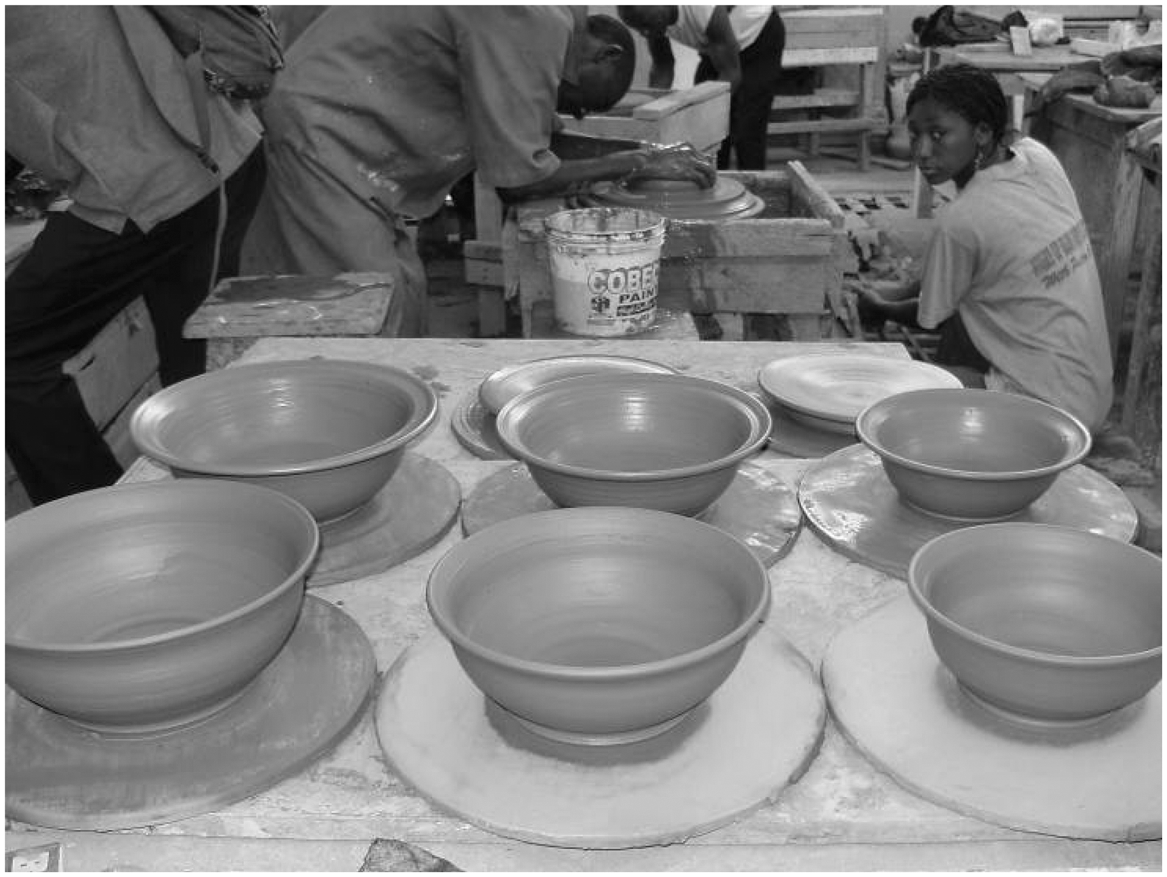
Processed ceramic raw materials are hard to come by either through local processing or through importation. Local processing is difficult because of the lack of access to appropriate equipment, while importation consumes too much money through foreign exchange. It is an established fact that tertiary institutions in Nigeria are poorly funded, far below the 26% of the country’s annual budget recommended by UNESCO. This makes it difficult to accomplish the basic objective of education as outlined by the Millennium Development Goals (MDGs) and United Nations Educational Scientific and Cultural Organization (UNESCO).
The emphasis that is being placed on science and technology based subjects in the curriculum seems to relegate the art-related disciplines to the background (Kashim and Adelabu, 2010). Ogunduyile (1999) and Mbahi (1999) report that most Nigerian parents are biased against fine and applied art as a subject because it is assumed that success could only be made in life if children are encouraged to study engineering and medical sciences, even when they do not have the mental capacity to cope with them.
The potentialities of ceramic arts
In spite of the various constraints clouding the prospects for ceramics education in Nigeria, ample opportunities and possibilities are waiting to be unveiled. The following can be identified as factors in the rich potential of ceramic art education relevant to the prospect of careers. Nigeria is home to a diverse culture and rich art tradition that have been long established, with artistic excellence reminiscent of Roman classical art (see Figure 4). Its strong artistic and cultural heritage serves as a source of inspiration for prospective art and design students. The pioneering efforts of educators past and present such as Aina Onabolu, Kenneth C. Murray and Babs Fafunwa have, since the early part of the twentieth century, laid a good foundation for arts education and practice. And, finally, contemporary ceramics scholars such as Ahuwan Abashiya, Moses Fowowe, Oyeoku Akpan, Akinbogun Tolulope Lawrence, John Agberia, James Ewule, Demas Nwoko, Ozioma Onuzulike and a host of others have pushed the frontiers by exploring new trends in ceramic art and design with new languages of expression. These rich legacies and constant changes occurring in ceramic art practice are good indications of the continuity and sustainability of this age-old practice (Kashim and Adelabu, 2010; Ozioma, 2009).
Terracotta head called ‘Lajuwa’, Ife Palace, 12th-15th century CE. Fundación Marcelino Botín/Museum for African Art. © National Commission for Museums and Monuments, Nigeria. Photo Karin L. Willis.
Apart from Nigeria’s vast cultural creative crafts potential, the country is endowed with abundant ceramic resources that could serve the purpose of education and research capable of transforming the nation economically and technologically (Adelabu and Kashim, 2010; Kashim, 2003; Na’Allah, 2001; Sullayman, 2000). Besides the abundant availability of solid raw minerals, Nigeria is also endowed with a high reserve of petroleum products, the by-products of which can readily be converted to usable fuels for energy generation in ceramic firing processes. A good number of ceramic cottage industries have been established in the post-colonial era based on this availability of ceramic raw materials. In spite of the unfavourable economic conditions, the surviving small and medium enterprises in Nigeria are still able to sustain their production for local consumption. Hence engagement in creative and productive ceramic practices can serve as gainful ventures, and, with functional policies in place, there is good potential for job creation. With a population of over 140 million, Nigeria has a vibrant market for ceramic products suitable for various aspects of household and industrial utility (Kashim and Adelabu, 2009). An increase in housing construction coupled with an increase in the acceptance of ceramic tiles, bricks, tableware and sanitary ware are producing a growth in demand.
Another important factor is the existence of professional bodies. Contemporary ceramics within 50 years of existence in Nigeria has formed two professional associations, namely the Ceramics Association of Nigeria (CerAN) in 1986 and the Craft Potters Association of Nigeria (CPAN) in 1995. The establishment of these related associations is significant for the sustenance and growth of professional ceramics practices in Nigeria. The objectives of the associations have been fostered through annual exhibitions and forums where deliberations are made on issues that affect ceramic education, practice, research and development with a view to proffering pragmatic solutions of existing problems and promoting professional advancement (Ozioma, 2004).
Addressing the limitations
Mamza (2007) maintained that any nation that seeks relevance and competitiveness in the age of globalization must make every effort to give its citizens the best education possible. The extent to which ceramic arts education could be a viable instrument by which the nation can promote self-reliance in the twenty-first century cannot be overemphasized. But for that to be possible the following agenda needs to be addressed:
the need for holistic appraisal of the art education programmes within the current education system; the need for a deliberate and purposeful training of art teachers to be able to meet the challenges in the nation’s school system (Mamza, 2007); implementation of the educational policies, including research funding support to the higher institutions; the need for participation of the private sector in the development of art education, with a view to promoting ingenuity of standard domestic production and aesthetic expression suitable for modern taste; a constant review of the design process; raw materials development through the mining and research institutions; appraisal of the existing teaching models to ensure effective teaching and learning.
Constant reviews and evaluation of art curricula, theories and methodologies will make for improvement and the development of better approaches to broaden information and gain a deeper understanding in art education (Chanda, 1993). Cultural and social values should be an inseparable element of the education process, as has been pointed out by Nakpodia (2010).
With the growth of applications in the use of ceramic raw materials, ceramics as a course of study in Nigeria has a promising future considering the vast potential that can be tapped and maximized from it locally and internationally. Self-reliance should not only be seen as an end in itself but as a means to wider ends. Art, science and technology should be properly synergized, seen as a means of securing sustainable ceramic practices, and adopted as a key tool for advancing Nigeria’s national development in the twenty-first century.