




Abstract
The paper proposes the activity of drawing as a methodological strategy within a university research context. It is illustrated with examples from one of the authors’ (Roberts) practice-based PhD research. The paper argues that drawing as a research method can be validated in a manner akin to the more established research methods associated with the range of research paradigms outlined in Denzin and Lincoln’s Handbook of Qualitative Research. It is proposed that visual research methods are unique in their ability to produce experiential knowledge that can be shared through visual media but not easily articulated through language. The paper then argues that drawing’s contribution as a visual research strategy has a more holistic and far-reaching potential within the university than other qualitative and quantitative research methods. In addition, visual research outputs operate as components of findings and conclusive evidence in the form of experiential knowledge that can enrich and extend language-based cognitive knowledge.
This paper draws on insights positioning drawing as a methodological research strategy arising from Roberts’ practice-based PhD work in the context of discussions generated at the Practice Makes Perfect symposium. Methodological and research categorisation and frameworks reference Norman Denzin and Lincoln’s (2005) Handbook of Qualitative Research.
As a female artist engaged in the figurative representation of the female nude, Roberts’ practice, viewed within the context of an identified Negative Feminist Critique of Figurative Representation (NFC), conflicts with her identification and sympathy for feminist ideologies. The NFC is a correlated body of feminist theory from the 1970s that identifies figurative representations of women, and specifically the female nude, as representing a masculine perspective. Roberts’ research explores the perceived incompatibility between the NFC and figurative representations of the female nude. Her research is practice based, utilising a hermeneutical, dialectical method of analysis to collate evidence for the existence of the NFC.
The ‘Negative Feminist Critique’
The NFC emerged as a component of the 1970s second wave feminist movement, that was concerned especially with economic and social discrimination, with an emphasis on unity and sisterhood. The central assumption was that women were present as subject matter, but not practitioners within the history of Western art. The NFC concluded that figurative representations of women in Western European art are necessarily presented from a male perspective and demonstrated that women, represented unclothed, reflected male generated sexual ideals for a presumed male audience. Feminist artists responded to the exploitation of the figurative representation of the female body by employing a progressive number of strategies intended to disrupt the voyeuristic male-gaze conventions of the female nude. The theoretical historical analysis of the NFC identified a number of these strategies, one of which, the positing of figurative representation and specifically one-point perspective as representing a masculine viewpoint, provided a focal exploration theme for practice-based research.
Practice-based research and experiential knowledge
Michael Biggs (2004: 6–21) defines practice-based research as research that prioritizes some aspects of experience arising through practice over cognitive content. Whereas cognitive, historical research is adequate to formulate the philosophy and implications of the NFC, visual enquiry complements and develops cognitive linguistic enquiry, allowing a testing out and reconsideration of assumptions arising from the NFC. A participatory approach facilitates a more informed investigation of discrepancies between the artist’s experience and intentions, with perceived experience and intentions tangible in critical reflection of works produced.
Biggs distinguishes visual research as unique in its communication of experiential knowledge that can be understood but not easily articulated, unlike the familiar cognitive knowledge derived from more orthodox methods of research. He identifies three distinct subdivisions of experiential knowledge, each of which needs to be considered in relation to the research enquiry: explicit content, that can be expressed linguistically; tactic knowledge that can partly be explained linguistically, but also contains understandings that cannot be verbalised; and ineffable content, that cannot be explained linguistically.
In order to understand the role played by experiential learning and its relation to Roberts' research enquiry, it is useful to consider both within the wider philosophical context of alternative inquiry paradigms charted in Figure 1 (Denzin and Lincoln, 2005).
Practice-based research and methodological paradigms
According to Denzin and Lincoln, the positivist paradigm of research assumes the generation of objective universal factual findings using quantitative methods to test an identified hypothesis. A positivist research paradigm suits scientific investigation that focuses on a specific question within narrow research fields. As such it is fundamentally unsuited to an examination of the relationship between the negative feminist critique and figurative representation of the female nude, where the hypothesis presupposes a multiplicity of interpretative possibilities and universal assumptions of gendered perspective or understanding create an undesirable and indefensible essentialist understanding. Ambiguity in meanings generated through drawing is unavoidable and often advantageous to the research process. Similarly, the paradigm labelled postpositivism by Denzin and Lincoln is based on the assumption of an underlying absolute reality or truth with objective and definite outcomes. Constructivist and participatory paradigms, grounded in relative and participative realities, allow for subjective practical knowing and co-created findings. The participatory paradigm in particular is suited to a practical methodological framework facilitating the development of experiential knowledge. This will be discussed in more depth with reference to the practical and theoretical development of the doctoral study.
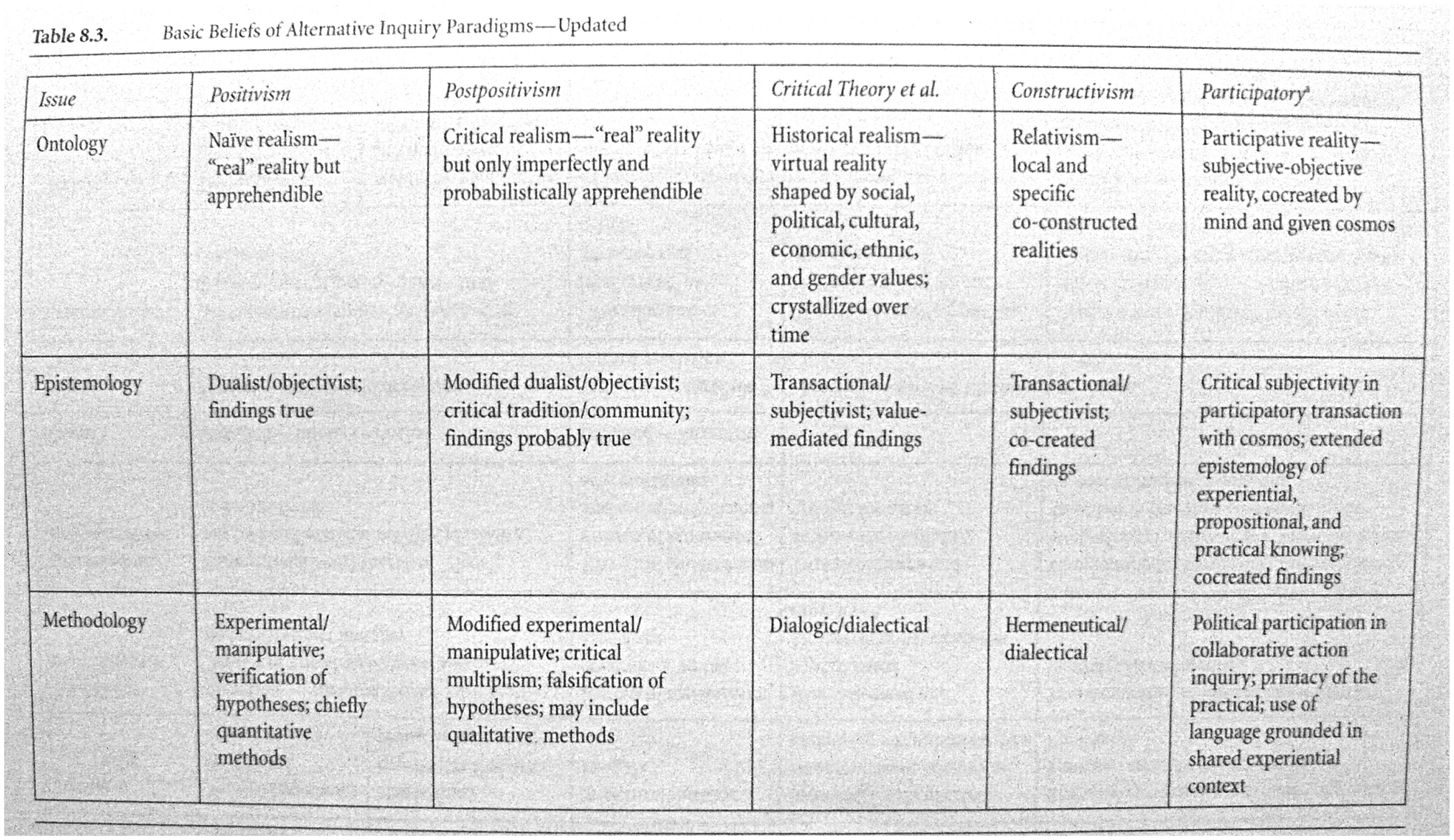
Philosophical frameworks and drawing analysis
The following section of the paper demonstrates the contribution of experiential knowledge within constructivist and participatory frameworks through an examination of selected practical research. To facilitate this correlation it is useful to map the alternative philosophical bases and their defining parameters, specifically for the analysis of drawing. Figure 2 (Riley, 2008: 155) summarises the philosophical bases and illustrates the relationships between philosophical bases, their ontological and epistemological parameters, and the main methodological approaches to the analysis: negotiation of meanings – and the production of drawings.

There need be no divergence between drawing as method and established ontological and epistemological parameters. Traditional life drawing correlates with the rationalist/empiricist philosophical base identified in Figure 2. The artist is objective in the assessment and representation of the figure that is unmoving and fixed. The model is ‘reality as absolute’ and measurable. Within the life drawing class, proportions or measurements can be judged as being accurate or not.
Anastasia Drawing (Figure 3) was produced using the sight size method of drawing, where the scale of the represented figure is the same scale as the model appears to the artist from a fixed viewing position. Such rigid dependence on both the model’s position and the artist’s viewing position remaining fixed and static is tangible in the resultant drawing that suggests the application of an objective and analytical perspective. The model’s averted gaze does not challenge or confront potential voyeuristic objectifying interpretations of the woman represented. This drawing and the use of the sight sized perspective technique within the context of the NFC represents a fundamentally masculine approach to drawing and is antagonistically positioned to the communication of what might constitute a female perspective. This differed from the subjective experience of the artist producing the drawing. When the scale of a sight-sized drawing extends beyond life-sized, the working process is altered. In order to produce the drawing, the paper was pinned on a wall behind the model, who was elevated. Starting from a fixed position the artist walked forward to draw on a sheet of paper pinned to the wall behind the model, returning to the marked position to check marks and measurements. Anastasia, who modelled for the session, directed the artist in the sight-sized method, of which she is an experienced practitioner. This considerably disrupts the conventions and expectations of both one point perspective practice, and also the conventional etiquette of the life drawing room. During the production of this drawing, the power relationship between the model and artist became ambiguous, the model was elevated, naked and static, looking down to instruct the artist. The artist followed the model’s directions, but remained clothed, and in control of the represented image. In this instance the experiential involvement in the process of practical research offers insights into a mis-match between the gendered experience of drawing and the resultant drawing. This demonstrates how an extension of the NFC’s philosophical basis can be applied to gender the research process. The common terms identified in Figure 2 – objective relating to rational and empirical paradigms and subjective relating to the pragmatist paradigm – are positioned by the NFC as masculine and feminine, respectively. Both practical exploration and historical research relate the conventions of the NFC to life drawing practice. This initial exploratory practical investigation into geometric perspective and gendered perception revealed that the ‘rules’ and expectations of both the traditions of the female nude and the NFC were more complicated, numerous and prescriptive than originally perceived. Mapping the beliefs of the NFC and the traditional canon of the female nude (as outlined by Kenneth Clark, 1960) into a comparative chart reveals that feminist theory provided an alternative canon of the female nude – equally as prescriptive and restrictive as the traditional canon it was devised to oppose.
Anastasia Drawing. Charcoal on paper. 2010.
In order to escape from the prescriptive rigidity of binary opposition, subsequent practical research focuses on the ambiguity or tensions between the two canons of the female nude as a strategy to negotiate the rigid prescriptivity of the canonical frameworks. Although the research investigates a number of oppositional positions identified in the Nudes Convention Chart, this paper will focus on the development of gendered geometric perspective in the light of these insights.
Initial exploration of one point perspective and sight sized drawing developed into a unique multiple perspective method, demonstrated in the Extended Drawings series. Extended Drawings developed as a means of retaining observational figurative representation and the contained form of the figure, without the rigidity of one point perspective. Extended Drawings begin with a selected focal area from which the drawing expands. In Tonya: Elevated Perspective (Figure 5) the model lay on a mattress on the floor, and a sheet of paper was placed on the floor next to her.
Nudes conventions chart. Tonya: Elevated Perspective. Charcoal on paper. 2011.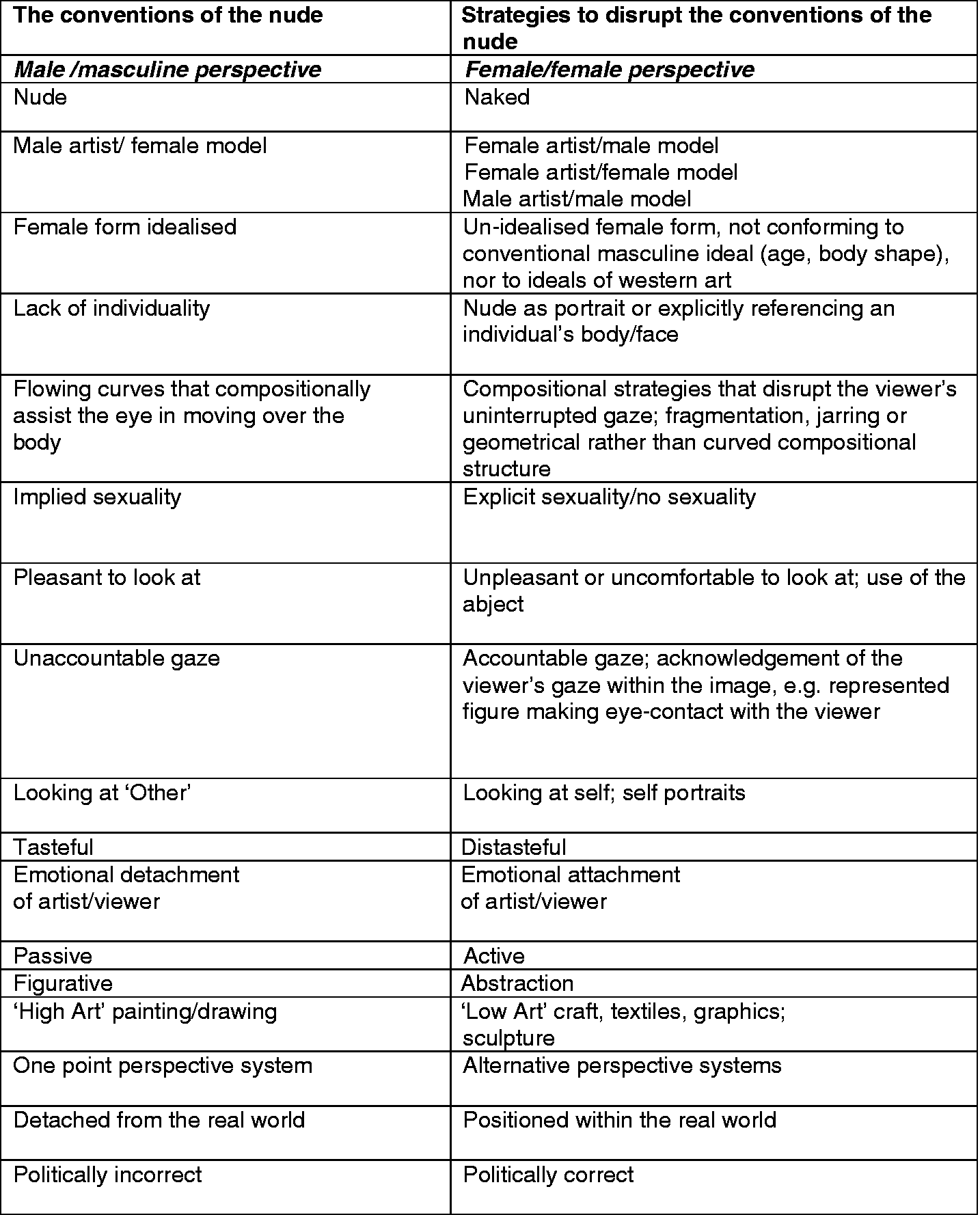
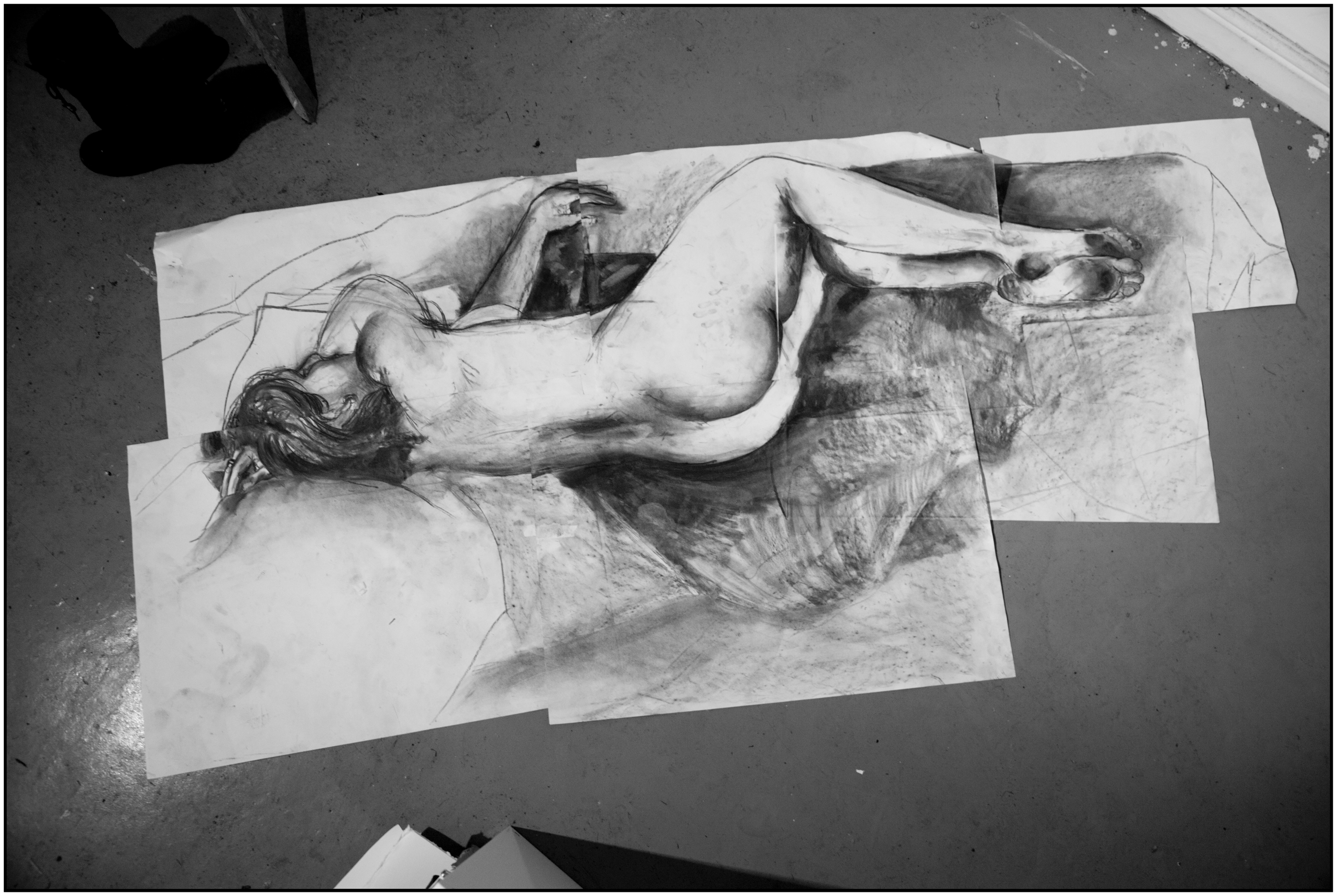
The drawing initially focused on the averted profile of the model’s face, her arm and her shoulder. Additional sheets of paper were added to extend the drawing as it developed, the scale of the work necessitating the artist shifting viewpoints as the drawing enlarged. Viewpoints vary and the distance between artist and model alters. Tonya’s profile was drawn sitting on the floor, her torso represented from above. Each part of the figure is drawn as seen from a unique viewing position. Although Extended Drawing is essentially a multiple perspective system, strategies such as the use of plumb lines and internal proportional measurements, together with a recording of negative shapes (those shapes in the field of view that constitute background, rather than parts of the figure) and convergent lines (lines that incline towards each other, or towards a common point of meeting) are integral to maintaining the sense of ‘accuracy’ associated with observational drawing. Keeping the drawing open-ended and flexible allows elements to be adjusted to match the compositional whole, rather than to comply with mathematically accurate measurement. The sequential reconstruction (Figure 6) maps the process of producing an extended drawing.
Extended drawings reconstruction sequence. Tonya: Elevated Perspective. 2011.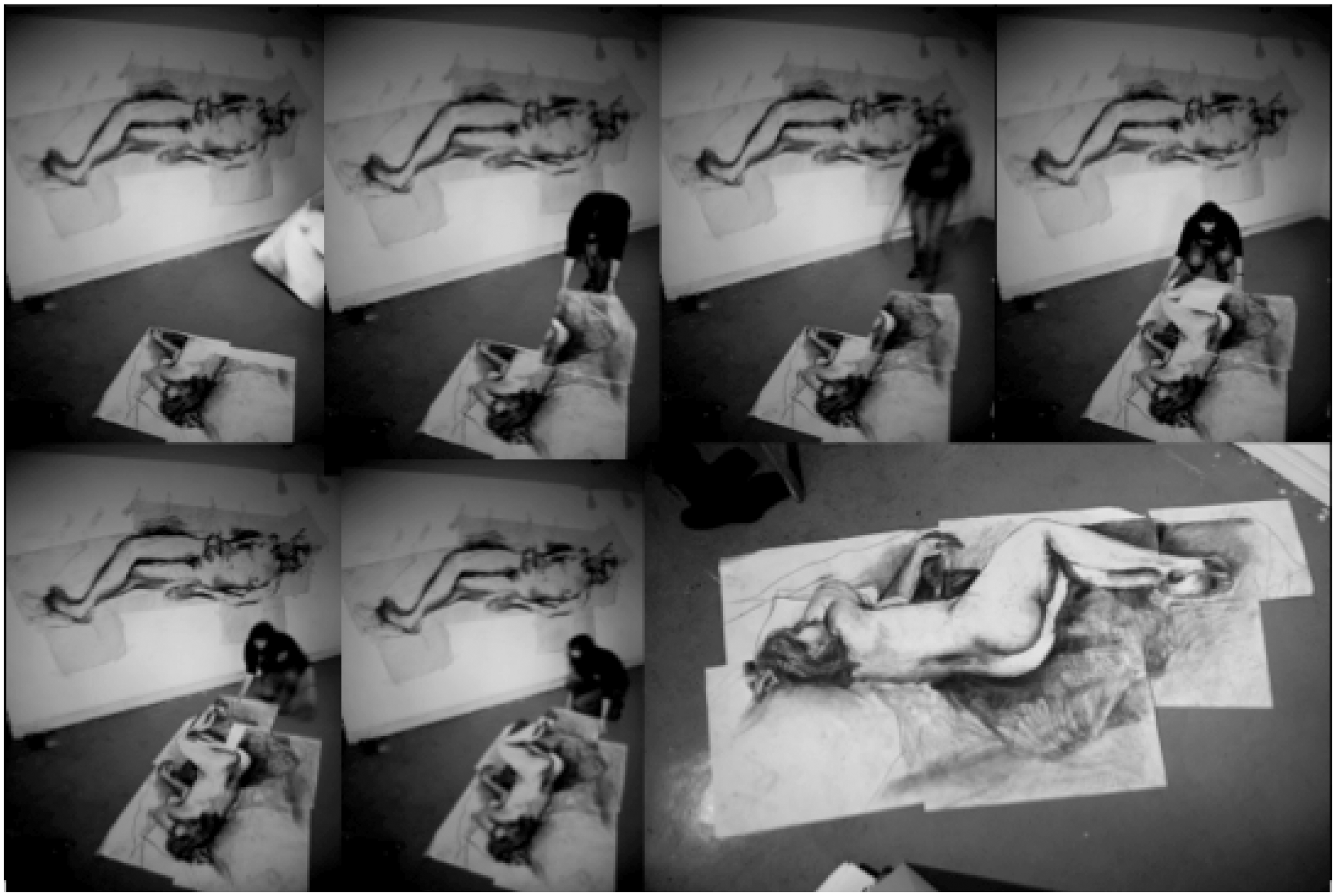
An essential component of any research project is that it produces findings that are communicable. Participatory and experiential research is a useful tool for exploration and for defining questions pertinent to the hypothesis, but as artworks lend themselves to multiple interpretations dependent on the individual and shifting perspective of the viewer, it is necessary for the researcher to linguistically identify and evidence findings that are generated. A logical extension of the Nudes Convention Chart (Figure 4) allows research paradigms to be encompassed within its binary oppositional structure. If rational and empirical research can be positioned as masculine, then the pragmaticist paradigm, with its emphasis on subjectivity and emotional response, is correspondingly feminine. However, the choice of a constructivist paradigmatic framework, using a semiotic approach to the analysis of works produced and the articulation of meaning/findings, is suitably ambiguous in its gendered affiliation, allowing for a consideration of structural, compositional and material elements of the work, as well as providing a framework through which emotional and seemingly intuitive responses to the work can be subjected to scrutiny. The adoption of a constructivist paradigm is compatible with early feminist research by virtue of its ontological stance, which recognises the researcher as an idiosyncratic individual capable of constructing multiple realities. That the production and analysis of drawings consist of choices necessarily linked to gender, class, race and social attributes within a specific historical and cultural context is imperative to the study, and negates the possibility of findings that are absolute or universal in nature. The Nudes Convention Chart (Figure 4) can itself be understood on a constructivist philosophical basis. Both Clark’s canon and the feminist canon are applied retrospectively and are socially and culturally generated. The shift from Clark’s canon to the feminist canon reflects changes in cultural and social expectations. In analytical terms, Tonya: Elevated Perspective (Figure 5) is a representation of a woman lying naked on the floor. The drawing is also displayed on the floor, resulting in an elevation of the viewer’s position. The viewer is positioned as an active participant, invited to adjust his or her viewing position, in contrast to the vulnerability of the model’s passive, static pose. The permutations of potential meanings to do with gender/power relations, both between artist and model and between the drawing and its viewers, may well stimulate those viewers to reconsider their individual preconceptions about, and stances towards, the possible permutations of those relations. Cognitive, historical research formulates the philosophy and implications of the NFC, visual enquiry complements and develops cognitive linguistic enquiry, allowing a testing out and reconsideration of assumptions arising from the NFC. Participatory methodologies allow informed investigation into discrepancies between the artist’s experience and intentions, and the perceived experience and intentions tangible in critical reflection of works produced. This symbiotic approach benefits cross-disciplinary collaborative research projects. Understandings generated through historical ontologies can be enriched and enhanced through partnership with practice-based researchers. Similarly practice-based research can generate new and unexpected insights that can be developed through theoretical or philosophical analysis.
Conclusion
The extended drawings began as an exploration of geometric projection systems in relation to gendered perspective, but resultant images developed into an in-depth deconstruction of a number of the oppositions outlined in the Nudes Conventions Chart, most noticeably the oppositions of containment/fragmentation and passive/active, as they relate to both representation and viewer positioning; together with objectivity/subjectivity and the intimate/the monumental, as well as questioning what constitutes female perspective and how, or if this can ever be effectively communicated to the viewer. Complex, multi layered artworks that create tensions of expectations are likely to offer complex and multi layered findings, appropriate to this particular doctoral inquiry.
Within practice-based research an unattractive or clumsy drawing can be successful if it offers insights or findings relevant to the research (Roberts in Reisz, 2013: 40). Aesthetically interesting or engaging artworks, however, often offer more than a face value aesthetic appeal. Kreitler and Kreitler (1972) claimed that the source of the pleasure we experience when looking at drawings relates to the resolution of the tensions – visual, emotional, psychological – implicit in all good art. In this respect, the practice-based inquiry evolves and develops, not exclusively though an articulated explicit understanding, but also through tacit aesthetic understanding. Tacit understanding of an artwork’s relevance to the research question can not only presuppose, but also support and offer clarity to verbalisation. In this respect, artworks generated can be positioned as more than just a method of research, while needing to be presented and assessed as a component of method, of findings and conclusions relating to the research hypothesis.