



Abstract
Integration of music in an academic university teaching setting is an example of how artistic practice and competences have potentials to resonate beyond the immediate discipline. The article explores music activities as contributing to learning environments for university students, creating shared experiences in groups of diverse learners with different needs. The music activities are discussed in light of challenges in today's university concerning student diversity. Two empirical examples of experiments with music in university teaching at a Danish university are presented. Empirical data were collected by means of qualitative research methods (teaching logs and qualitative surveys) and analysed in a socio-cultural learning perspective. The first empirical example presents music as supporting students relate to each other in the classroom. The second example describes how music may support students' sensory awareness when practising qualitative research like fieldwork. Both examples imply interdisciplinary potentials of putting music into play in university pedagogy.
Keywords
The challenge: Mass university and student diversity in classrooms
In the very first lines of her introduction to the special issue of Arts and Humanities in Higher Education on ‘Reflective Conservatoire’, Gaunt (2016) states: We are experiencing a paradigm shift in specialist education in the performing arts: in what it takes to prepare students for professional life, and in the potential for this work to resonate beyond the immediate disciplines. (269)
In spite of the challenges and to show how music may ‘resonate beyond the immediate discipline’ and contribute to innovation in university pedagogy, the article reports two examples of the integration of music and musical activities into university learning environments. Based on this, I will argue that music can play an important role in meeting some of the challenges arising in university classrooms concurrently with universities changing from elitist to mass education institutions. The challenges relate to classes of students with highly diverse preconditions for academic work and for decoding the academic environment (Boyce-Tillman, 2014; Jensen, 2016).
My own context is no exception. I teach at a masters' degree programme on learning and pedagogy within the humanities at a Danish university. The intake of students has been growing steadily since 2009, with student numbers increasing from 25 to 95 per class. The diversity of the students refers to family and social background as well as to educational background. Approximately half of the students hold the so-called professional bachelor's degrees as teachers, pre-school teachers, social education workers and different types of health bachelor degrees, while others hold bachelor degrees from the university in sociology, communication, culture studies, sports studies, health studies and many others. Student ages vary from early 20s to late 40s, and approximately half of the students bring a large amount of work experience from pedagogical/facilitating work in schools, kindergartens, hospital wards, elder care, etc. into the university environment. Consequently, the students represent a comprehensive variety of skills, knowledge, competences and different sorts of professional and educational backgrounds and experiences. Adding to this, not only do the students' educational backgrounds vary, their social backgrounds are diverse, too. We see a growing number of non-traditional students with few or no previous skills in research or academic thinking and methods. An increasing number of them express insecurity, inferiority or even vulnerability due to unfamiliarity with the university environment, which in turn may impede their opportunities for participation and learning. In contrast, we also experience a concern on the part of the academic university bachelors that the theoretical and scholarly levels of the programme will be lowered because of the student diversity.
Our situation is not unique, nor is the tendency new. The increase in student diversity started in the 70s with the liberating and democracy-based new pedagogies, courses and study programmes (Stafseng, 2009) and continues into the present time in the wake of the financial and economic crisis from 2008 and forward. In the ‘00s, the intake of students explodes, as the educational level of the population is seen as a factor for economic growth (Arvanitakis, 2014: 737; Caspersen and Hovdhaugen, 2014). This seems to be an effect of the idea of globalisation, according to which life-long learning and competition between nations for long have been the political arguments to encourage youth to enrol in higher education programmes.
Music, learning and pedagogy
But why relate music and student diversity? The answer to this question can be found in research at both pre-school and elementary school levels. Here, music and other artistic disciplines have already shown potentials beyond their immediate fields in respect of creating learning environments that embrace diversity (e.g. Bamford, 2009). In these areas of public education, arts subjects are gaining increasing interest in research due to a growing understanding of other ways of knowing and learning than the cognitive. In such research, sports, activity-based teaching and arts are underscored. For instance, research on the inclusive potentials of artful teaching, arts integration and other similar arts involving pedagogies has grown in recent years in the USA, e.g. Project Zero at Harvard University and ArtsBridgeAmerica (Bamford, 2009; Krechevsky, 2012).
As already mentioned, the strengthened focus on education is also visible at university level in the increase of new types of students whose paths into the university environment are many, and whose backgrounds vary greatly. Therefore, we need to extend the focus on diverse learning styles and social and cultural integration to higher education, leaning on experience, research and knowledge on the potentials of interdisciplinary arts activities in teaching developed at lower levels of education. In other words, if arts activities seem to have potentialities for learning and learning environments at elementary school level, why not also at university level (Boyce-Tillman, 2014)? However different the university may be in its educational goals, it may be reasonable to assume that the benefits would be similar: when teachers include artistic activities, students are provided with a variety of opportunities for participating, and their differences in learning styles and learning paths are accommodated. In this case, music can contribute to create learning environments that embrace students' differences (Burnard et al., 2008). It seems that music can have a positive effect on social inclusion in groups of students, as music allows a wide range of achievement and participation, which is independent of social background, gender, race, religion or other cultural differences in students (Burnard et al., 2008). The anthropologist way to understand this is to consider music as both means and end of social, human activity (Dillon, 2006). The music sociological explanation is that musical activity allows culturally diverse and informal life-world musical expressions to meet more formal forms of music in the classroom (Boyce-Tillman, 2014; DeNora, 2000, 2003). A psychological way to understand it is that music creates direct and empathic relations because of the imitative and shared elements (Fukui and Toyoshima, 2014).
Based on these assumptions, the article will contribute with two analyses of practical examples of pedagogical experiments on engaging students in academic work, in which I use my musical expertise cross-disciplinarily in university teaching. The examples highlight the interplay between arts and academe in university pedagogy and imply the potential of performing arts to ‘resonate beyond immediate discipline’ (Duffy, 2016; Gaunt, 2016).
Professional development and research methodology
Before moving on to the examples, I will give a brief outline of the methodological framework that provides data for the empirical examples. Data derive from three sources:
My teaching portfolio, compiled when attending the course in university pedagogy for assistant professors at the Aalborg University. A qualitative student survey collecting experiential statements on a music activity in the introduction period. A qualitative survey with student testimonials on experiences of a music exercise related to a student course in qualitative research methods.
The empirical material from my teaching portfolio consists of logs addressing my own professional development process, where I tried to overcome certain student challenges by integrating music in my teaching. Also my interpretations and analyses of the students’ experiences of this process are part of the logs, and these analyses underlie the formulation of questions in the two survey inquiries.
Matrix for data analysis.

Based on Schön (1987).
The left column contains ‘raw data’, i.e. the unedited teaching logs. The middle column is for interpretation of data and condensation of meaning expressed in the log. The right column suggests theoretical perspectives and concepts in light of which data and meaning from the two first columns can be transformed into academic terms (Giorgi, 1975; Whiting, 2008). Within this system, observations and descriptions from my own practice were combined with a broader theoretical framework, creating knowledge of more general interest. This was expected to capture the possible effects of music in teaching in a university setting (see also Jensen, 2016). The matrix can be viewed as an interplay between the descriptions of life-world experiences (column 1) and the interpretations based on experience-based reflection (column 2) and theoretical understandings (column 3) (Brinkmann, 2012; Dysthe and Engelsen, 2011), working with a phenomenological (column 1) and hermeneutical (columns 2 and 3) perspective of knowledge creation.
The use of my own descriptions, pedagogical considerations and actions makes the methodological approach auto-ethnographic to a certain degree (Denshire, 2014). However, rather than emphasising the introspective or literary aspects of my experiences (Collins, 2010), I have endeavoured to describe in as much detail and as visually as possible the steps and actions of my teaching, and to some extent the observed reactions of the students (Jensen, 2016). In order to qualify my own accounts of the students' responses to the teaching activities, I created two qualitative surveys, one for each type of musical activity. The content of the surveys is described below in connection with each example.
Despite the fact that research in the humanities does not involve a risk of physical harm, the researcher should consider how to minimise the risk of other types of inconvenience for informants to enact ethical principles and code of conduct within research (American Psychological Association, 2010: 3–4). In my case, I asked of the students to answer a survey designed by me, one of their educators, who has the formal power of assessing and grading them throughout their educational course. This may pose an integrity risk for the students: they may feel pressured to respond or pressured to relate emotionally to teaching activities they might prefer to forget. In addition to the ethical issues, it may also constitute a validity risk of biased statements and answers in the survey, as students may try to guess what responses I want from them.
I have addressed these risks by ensuring anonymity and voluntariness. Anonymity was secured because the survey was web-based (SurveyXact) and designed in a way that prevented tracking of students' identities. Voluntariness was secured, because students were required to actively access the survey in order to respond.
To meet the principles of integrity, dignity and no-harm, all descriptions and quotes have been modified, so that precise locations or respondents are unidentifiable to the extent possible, considering that I as a data provider am not anonymous. However, the anonymity of the students is preserved by the means described above, which furthermore guarantees that I cannot possibly use any names or gender-specific terms.
First example: Students relating within the learning environment
As mentioned, our programme concerns ‘learning, pedagogy and innovative change’. During the last two years, I have been responsible for the introduction course. Being one of the first educators that the students meet, I have a unique opportunity to assist the students in overcoming some of their initial insecurity and vulnerability as newcomers to the programme. To support this effort, I have developed a musical tool using ‘body-percussion’ (described below), whose purpose is to help the students accommodate to the university setting by working with the student–student relations. This can be seen as a parallel to Moffat and McKim's (2016) work with drama a means of threshold crossing. Their idea of understanding the troublesome, critical points where students’ learning engagement may be impeded as threshold concepts resonates very well in our study programme. When starting in the programme, one troublesome point for our students is in fact the student diversity, which causes them to be insecure of their own positions and a little suspicious towards each other. This poses a ‘threshold’ for engaging in the university learning environment, and my idea was that music might assist the students in ‘crossing it’ (cf. Moffat and McKim, 2016).
As mentioned, the following description of the activity as well as the students' statements are based on my teaching portfolio logs and on a qualitative survey, asking the students about the musical activity's impact on their first impressions of the programme and the institution (for further detail, see Jensen, 2016: 14).
Music as a cultural sign system
In this example, based on observations from my log, I used my musical skills acquired from leading a youth string orchestra during my years as a performing and teaching violinist and transformed them to lead the process of supporting the students to do a rhythm together. I asked the students to get up from their seats. This already broke monotony in the room. This small action was meant to turn the students' attention to the fact that their bodies are part of the academic setting in the teaching situation, though an often uheeded part. We then ‘woke up the body’ in three steps:
Stepping from side to side, finding a common four-beat pulse. Continuing the pulse with our feet, but now adding different rhythms by clapping hands. Here, I improvised call-responses with simple rhythms that the students imitated. Continuing the pulse, now adding more rhythms, clapping hands-on-upper legs, also in the call-response-style.
Now it was time to create ‘the human drum set’. While the pulse continued, I divided the students into three groups without speaking, but just using body language and small sounds, showing with my hands which students belonged in which group. Each group was assigned a role: ‘bass rum’, ‘snare drum’ and ‘hi-hats’. I started leading the ‘bass drum’ group in a bass drum figure on 1, 2 and 4, stomping with my feet (Figure 1).
Rhythm 1: (“bass drum”) – Stamping with feet. r = right foot, l = left foot.
It was necessary that I counted 1, 2, 3, 4 in order to keep track of the pulse. Next was the ‘snare drum’ group, who were shown to clap their hands on 3 (Figure 2).
Rhythm 2: (“snare drum”) – Clapping hands.
And finally, the ‘hi-hats’-group clapped this rhythm on the upper part of their legs (Figure 3).
Rhythm 3: (“hi-hat”) – Clapping hands on upper legs.
What I observed when starting this process was that the students' attention was very intensely directed towards me, when the rhythmical task was demonstrated. They concentrated on imitating the rhythm, watching me very closely. As we progressed, their attention moved visibly from me to their peers. Their concern changed from imitating me into keeping the rhythm together with their group.
As regards this observation, the students’ formulations from the survey on this activity are interesting: ‘I was occupied following the lead, but I also tried to listen to the whole rhythm’, or ‘it was fun to see how everybody was working with the rhythm, and at the same time I tried to get my own part right’. In light of Bruner's (1997) socio-cultural learning and education theory, the students’ occupation with following the rhythm entails that they are provided with new possibilities of creating meaning in the situation. They are shown a certain cultural system of signs (p. 19), in this case cultural signs of music. In this sense, I use the cultural system of signs of music to show the students possible ways of acting that creates meaning in the musical situation (Bruner, 1997). Since the musical situation takes place in a university teaching context, the rhythm functions as a new way of creating meaning, a way that includes other cultural signs than words and spoken language. Furthermore, when the students imitate what they are shown, they are provided with new ways of framing the teaching situation. Finally, when the students’ attention shifts from me to their peers, this can be seen as scaffolding (Bruner, 1997: 21), a concept that Bruner developed based on Vygotsky's (1978: 86) thoughts on the so-called Zone of Proximal Development. In this case, the students help and support each other keeping the rhythm, interacting and externalising their individual and shared meaning of the situation. Especially when I indicate that they should keep the rhythm while I turn to the next group, the students’ attention shifts from watching me (imitation mode) to watching each other (scaffolding mode).
These reframing, imitating and scaffolding aspects of putting cultural signs from a performing arts discipline into use in an academic teaching context correspond with the relational aim of the musical activity. When the students are allowed to participate by using their everyday, life-world skills (stomping and clapping) in creating musical expression, they are provided with possibilities to relate to their peers in culturally shaped, shared time-space (the pulse and shown rhythmical figures) (DeNora, 2000).
Furthermore, the relational potential of the music activity is connected to the increasing complexity when putting all three rhythms together. This demands a collaborative effort of the whole class, as is visible in Figure 4.
Rhythm 4 – The assembled rhythm ‘human drum set’.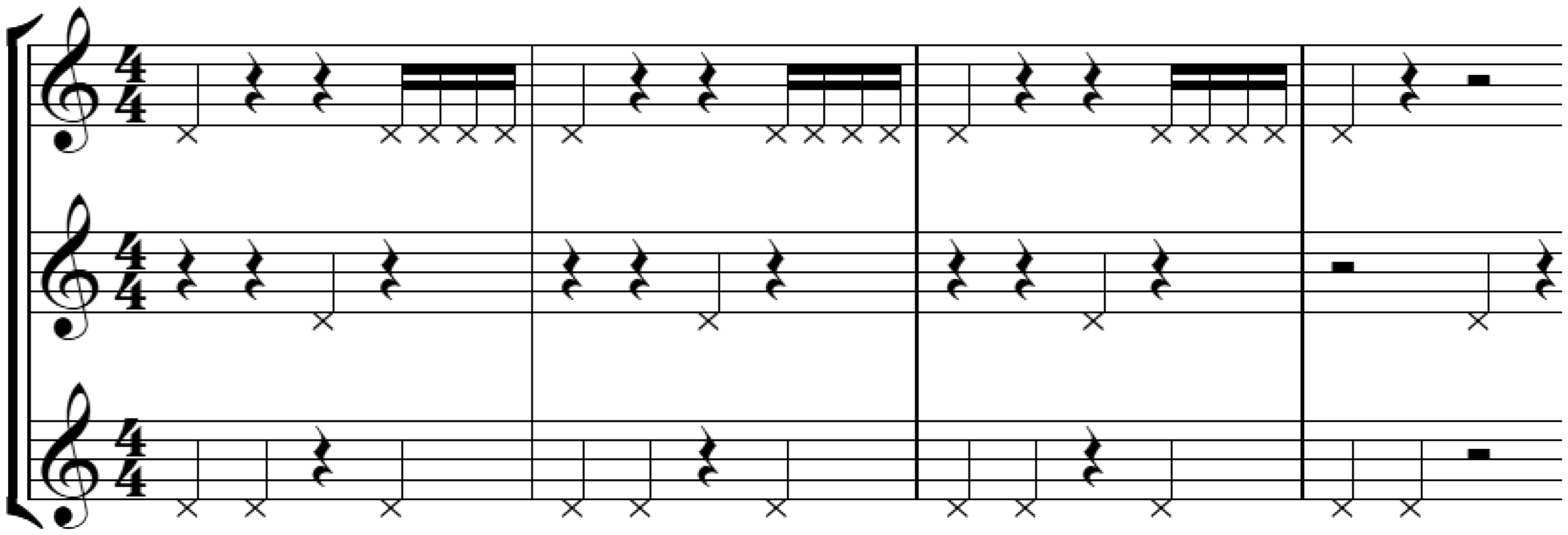
This collaboration encompasses at least three different opportunities for the students to participate: (1) solving their own task (stomping or clapping hands or upper legs in the right rhythm), (2) listening to and adjusting their own effort to that of their ‘own’ group and finally (3) listening and contributing to the rhythm as a whole – and enjoying the sound. This collaborative effort seems to be accompanied by the students observing their peers, their bodies and their movements, in new ways that decreases anxiety and suspicion towards each other. This in turn contributes to interacting and getting to know each other at a different frequency than by talking. Again, I see the collaborative effort of creating a rhythm in a shared space and time, as a living example of what I with Bruner (1997) in mind would call ‘the work’ or ‘the oeuvre’: The oeuvre can be seen as a cultural product that conveys a shared meaning in a group of individuals (p. 22). According to Bruner, the oeuvre includes both individual contributions to and offers students an experience of a shared whole. This in turn may lead to the building of individual as well as shared identities and a sense of belonging in the group, in this case the sense that ‘we are the class that makes rhythms together in the classroom’ (Bruner, 1997). Seen in this light, the musical ‘oeuvre’ of pulse and rhythm can be a powerful means of initiating a sense of belonging in a diverse group of students, showing them that learning activities can be both fun, serious and identity developing at the same time. They also experience diverse ways to participate. As Bruner states, the cultural product, in this case a rhythm, builds identity, because the ‘work and works-in-progress create shared and negotiable ways of thinking in a group’ (Bruner, 1997: 23). However, one aspect is my ideas in my teaching log; another is the student experience of this interdisciplinary pedagogical innovation, which will be presented in the following.
Students’ experiences: ‘Real team-experience’ or ‘too silly’?
The following quotes derive from the qualitative survey when asked about their immediate experience of the activity: It was very unexpected, but it made us laugh, and this was very good, because we got something to be together about, as a real team. Good shared experience! I also thought: is this the university? Great! I understand that the activity was meant to create a good atmosphere among a group of strangers, but it made no difference for me. Too pedagogical and silly for the university. On the one hand, it was refreshing, but on the other it was a little transgressive and unpleasant in the beginning. But it ended out being a fun experience, where your head got freshened up. I also thought: Is this really the university? Great! Transgressive, but fun!
Implications: How music resonates in the learning environment
The implications of the above statements are significant in light of my initial reference to the Reflective Conservatoire. Considering Gaunt's (2016) suggestion that performing arts have potentials to resonate beyond the immediate disciplines, this experiment may be an example of the potential of making the social and relational dynamics of a performing arts discipline (music) work in the teaching context of an academic discipline (pedagogy) in order to work with the student–student relations in the learning environment. However, as the experiment also implies, there may be challenges to such an attempt to include an interdisciplinary activity. As shown, a number of student statements express resistance to the musical activities, which might reflect a feeling of lacking efficacy, either in relation to musical activity specifically or to unexpected activities in the university pedagogical practice generally (Bandura, 1997). This implies that such interdisciplinary pedagogical work in higher education may challenge students’ (and presumably colleagues’) expectations for the situation and create resistance, and the individual university educator as well as the collective of educators must be prepared for this. Having said this, the majority of the student statements and my own observations still imply sufficient potential in musical activities in respect of contributing to student–student relations in the learning environments to legitimise further development of the idea, especially in classes with significant student diversity. Other researchers using arts in teaching in higher education support this conviction, since they report similar obstacles, but still consider the benefits convincing enough to continue experimenting with arts and music in higher education pedagogy (Simons and Hicks, 2006: 84). I have, therefore, repeated the rhythm exercise later in the programme, using it more offensively as an ‘oeuvre’ that the students should actively reflect on in terms of learning concepts, which they worked with in their projects. In this way, the rhythm functioned as an active content, to which the students could relate at a conceptual level. This occasioned, as far as I interpreted it, a higher degree of understanding of my idea on the side of the students.
Second example: Music and fieldwork
Not only the learning environment can benefit from the potentials of music but also the content areas may use music as a bridge between academic concepts and the students’ personal learning processes. In this respect, I draw on my competences as performing musician, as music analysis is necessary as a tool to express your own interpretations of a piece of music. The following example draws on portfolio and survey material from the second year of the master's programme. At the second year, the students know each other well, and now most of them are confident students who have completed several projects and exams. At this point of the programme, the students prepare for empirical, scholarly fieldwork in an organisation in real life. To the students, fieldwork seemingly appears like a mystery – as Moffat and McKim (2016) would phrase it: a threshold concept. In this case, the learning obstacle is that much literature states that doing fieldwork is a craft (Brinkmann, 2012), that experience is required (Hammersley, 2004), and that it requires that, in a phenomenological sense, the researcher is required to ‘put aside pre-understanding’ when observing social interaction (Brinkmann, 2012). The students, however, struggle with a lacking clarity concerning exactly how the craft is learned, or how researchers ‘put their pre-understandings aside’ in practice.
In my experience as an artist, however, the phrases above relate to the ability to direct attention to bodily impressions, to what is seen and heard in the field, to the extent possible without interpreting or ascribing meaning (Babbie, 2003). This separation of sensing (seeing and hearing) and interpreting (how that which is seen and heard is understood) was described by Danish philosopher Løgstrup (1983) as the artist's tool for creating art. According to Løgstrup, this is extremely difficult, because it contradicts our immediate approach to acting, which is to avoid the hassle of paying too much attention to the sensations of everyday life in order to act effectively (Løgstrup, 1983, 1997; Polanyi, 1962). However, letting the world make an impression and suspending interpretation is not only of value for artists but also for other fields, since it is a powerful way to learn and explore, which is needed in fieldwork and is reflected in phrases such as ‘putting aside pre-understandings’. Therefore, the experiment was designed to ‘train’ the students’ awareness of sensing and suspending interpretation by means of ‘observing’ a piece of music.
The study theme for the teaching session was ‘how to observe and study pedagogy and specific user groups’ learning in practice?’ The session started with a powerpoint lecture outlining different ethnographic approaches to field work in practical contexts, followed by reflections on how to approach the observation studies of specific learners and the applied pedagogy in empirical contexts.
Student exercise.

As Table 2 indicates, the students were asked to listen at different levels of attention: the sensory, the interpretative, and the imaginative/empathic level. At the sensory level, they were asked to identify sound-related aspects such as: what instruments could they hear, tempo, shaping, dynamics and instrument intensity. At the interpretative level, they were asked to elaborate on their experience while listening to the music: did they see inner pictures, colours, sequences, actions, or did they feel a certain atmosphere, spirit or ambience while listening to the piece? Finally, at the imaginative/empathic level, the students were asked to indicate what they imagined was the composer's intention with the piece, or if the piece made them reflect on broader issues of their social lives. This division into the three levels of attention was intentional, both relating to Løgstrup's theory and following several analytical approaches to art (Jensen, 2011; Thomsett, 2012).
As expected, the students in my experiment had great difficulties in separating the basic impression of the sounds from their interpretation of the sounds as music. However, the exercise with prolonged sensing in music had a direct transfer value for the students, as the discussion in class on their difficulties concerning music observations was followed up by reflective questions relating to their academic fieldwork. The students were asked questions like ‘did the music exercise change your perception of your research field’ or ‘did you get new ideas about fieldwork?’
At the end of the lesson, the students were asked about their experience of the exercise, and immediately after the lesson, I wrote down significant student statements in my teaching log. These statements were used in a qualitative survey, in which the same students had the opportunity to reflect on their own statements once more in open SurveyXact comment fields. At the time the survey was sent out, the students had completed the programme, now working as professionals. Therefore, the survey would capture their retrospect valuation of the music exercise and also whether this had had a lasting effect on their practice of fieldwork.
The design of the exercise
In the student testimonials, several new observations emerged, starting with the design of the exercise. Some of the students indicated that the exercise took them by surprise. Others thought that it was ‘odd’ and a ‘little crazy’ and several of them described this experience in the following or similar ways: It was as if the music was a completely foreign language – I know that music has its own terminology, but I don't know it, so it was very hard to describe, what I heard in the music. (Former student) When you can't even identify the instruments or distinguish them from one another, it is impossible to describe the musical impression. (Former student) I quickly realised that there was no right or wrong, it simply was a matter of describing what you heard and felt, the sounds, the dynamics etc. (Former student)
Field work as sensitive practice
Apart from the design, the content of the exercise seemed to lead to a deepened understanding of field work for other students, as reflected in this description: After the exercise, I realised that what we had done was that we saw, heard, sensed and experienced deeply what is meant by empirical rigour. In field observations, it is not enough that you hear, what you expect to hear or ‘believe that you hear’, because the tone of voice and body language can tell you even more. You have to really listen. (Former student) … I actually experienced the fact that people perceive reality in so many ways – I realised the importance of being aware of my own pre-understandings and the way I perceive reality, and to be open and try to understand the reality of the informant in order to cover all nuances of a field. (Former student)
Implications: Music as an interdisciplinary potential for pedagogical innovation in higher education
To discuss the further implications of the pedagogical experiments with music, I will refer to my initial interest sparked by Gaunt above, stating that performing arts have potential to resonate beyond the immediate discipline. With the empirical examples, I have outlined two ways in which as a former performing artist, I have crossed disciplinary borders and experimented with pedagogical innovation in the field of university teaching by means of my musical skills and competences. One implication of the findings above is that if performing arts should create interdisciplinary value, it is crucial to be able to analyse the specific aspects of the art form that have the potentials to resonate in other disciplines and fields. In the first example of innovation, the potential of music was related to the social dynamics of musical activity. This specific aspect was used to work with student diversity and insecurity by using music to build student–student relations in the learning environment. In the second example, the sensory evoking effects of music was the specific aspect that was used to work with student challenges concerning fieldwork, practising the suspension of pre-understanding. These two formulations can be seen as attempts to externalise tacit, embodied knowledge of music practice with the purpose to learn how it can contribute in other disciplines. Following this line, Budge's (2016) research imply the need for arts teachers to externalise embodied knowledge when teaching and practising within the university environment to develop knowledge and become better teachers. My research implies that this externalisation is also important in order to develop the potentials of the arts to in interdisciplinary work, as the findings above imply that this work requires quite an amount of further experimentation and refinement.
To discuss the further implications of the two experiments, I will continue to refer to the work of Simons and Hicks (2006), whose research on arts and music integration in teaching in higher education suggests that artistic modalities serve as ‘a bridge between the students’ worlds and the worlds of higher education’. The two examples of music activities presented above imply a similar bridging function of music between the academic environment and the students’ everyday experience.
A last, but important, implication of the interdisciplinary work with music in a university context has to do with music's bodily roots. The findings indicate that music has occasioned the students to realise how their bodies and senses contribute to scholarly work, particularly in example 2, when doing fieldwork or other qualitative research methods. This raises a number of questions regarding academic work and university pedagogy. Firstly, that fieldwork as an academic discipline taps on artistic and performing aspects of action. As shown above, this is often overlooked in literature, and the implications of my experiments with music observation is that music (as well as other artistic fields) may contribute with insights and skills that can be transferred almost directly to the craft of qualitative research because artistic work emphasises the bodily and sensory aspects of action. This leads to fundamental questions of teaching and learning in higher education as such, since the general main focus of universities is on the students demonstrating and documenting theoretical work (Arvanitakis, 2014). However, my experiments raise the question if the students may experience deeper learning when involving the body, in this case, in relational work in the classroom or in the work with understanding fieldwork. I might even go so far as to raise the question: can we solely rely on language and written, theoretical forms of knowledge to build our students’ academic competences? A weighty argument to think otherwise came from ecologist phenomenologist David Abram (1997) already two decades ago. Related to this context, his thoughts on the primacy of immediate experience rather than the unexperienced entities of theoretical concepts and literature seem to correspond with the findings in my experiments. His emphasis on the intersubjectivity and embodiedness of human consciousness and the reciprocity rather than passiveness of perception (Abram, 1997) is empirically reflected in the student quotes above. The powerful example is that many of them, still after one year, express in profound detail what they learned from the music exercise in fieldwork. Based on this, a potential of performing arts to resonate beyond immediate disciplines may be to contribute to university pedagogy, innovating it to embrace the students’ and educators’ bodies as part of learning academic knowledge, skills and competences.
Footnotes
Declaration of conflicting interests
The author declared no potential conflicts of interest with respect to the research, authorship, and/or publication of this article.
Funding
The author received no financial support for the research, authorship, and/or publication of this article.