




Abstract
It is widely accepted that the academic job market is very limited and unlikely to expand any time soon, yet enrolments in PhDs continue to rise. If the PhD is no longer preparation for academia, where do these graduates go on completing their degrees? This study of Australian PhD graduates in Humanities, Arts and Social Sciences (HASS) explores motivations to undertake a research degree, their experiences of academia, and their current employment. These personalised narratives reveal the impact and value of doctoral education on the employment trajectories of HASS PhD graduates in non-academic careers. These stories uncover both the ‘cruel optimism’ and positive employment outcomes experienced by HASS doctorate holders. It is argued that commencing PhD candidates should be encouraged from the outset to seriously consider their doctorate as preparation for careers beyond academia; rather than being ‘failed academics,’ these graduates succeed as high-level knowledge workers.
Keywords
Background
It is widely accepted that the academic job market in developed countries has been very limited for some years now and is unlikely to expand significantly any time soon (Auriol et al., 2013; Cyranoski et al., 2011; Golde and Dore, 2001). Speculation about the future and viability of universities in the face of soaring costs, digital disruption (such as Massive Open Online Courses (MOOCs) available, at least in theory, to anyone with an internet connection) and the Maker Movement 1 (Halverson and Sheridan, 2014) is rife; these discussions occur both within academia (Izak et al., 2017) and in the wider media and public discussions of Higher Education (Hall, 2018; Ward, 2014). Within this context, we know that very few PhD graduates go on to become full professors and only a low percentage get full-time academic jobs (Acker and Haque, 2017; Barsky et al., 2013 Loxley and Kearns,2018). Yet we keep on producing more and more PhDs – in Australia, for example, we graduate enough PhDs to replace the academic workforce every three years (McGagh et al., 2016). Why are people continuing to do PhDs, and what happens to those who don’t go onto academic jobs? Pedersen (2014) explores the question of employment destinations in relation to STEM doctoral holders; in parallel, I ask: ‘Where are Humanities, Arts and Social Sciences (HASS) doctoral graduates employed?’
Clearly, a major decision such as starting a PhD will be associated with multiple motivations and aspirations, given the significant time and financial commitments entailed. Research into the motivations driving PhD candidates in general to embark on research degrees reveals a range of reasons behind the decision. Guerin et al. (2014), surveying PhD candidates from all disciplines across a research-intensive university, demonstrated the key factors influencing this decision are: family and friends; intrinsic motivation (i.e. genuine interest in the research topic, personal identity); lecturer influence; previous research experience; and career progression. This last factor, though not exclusively directed towards university positions, includes those who do hope to obtain a permanent academic appointment. The limited published research specifically focused on motivations for undertaking doctorates in HASS disciplines includes Brailsford’s (2010) research on history doctorates. Brailsford (2010) lists motivations that echo those found by Guerin et al. (2014): personal development and intrinsic interest in the discipline; encouragement from third parties (friends, colleagues, family, and academics); and improving career prospects. Much of the other relevant research into doctoral motivations relates to professional doctorates in Education and/or Business (see, e.g. Clark, 2007; Jablonski, 2001; Leonard et al., 2005; Wellington and Sikes, 2006). Not surprisingly, given that professional doctorates are usually closely linked to the candidate’s profession and workplace, these studies also identify career progression amongst the motivations to embark on doctoral studies. For those studying in HASS disciplines, an academic life still appears to be one of the main career expectations (Gemme and Gingras, 2012; Mason et al., 2009; Morrison et al., 2011), though I readily acknowledge that not all candidates want to work in a university. Further, the broad age range of those doing a PhD in HASS includes some who see this as their ‘retirement plan,’ having waited for many years to be in a position to follow their intellectual pursuits at doctoral level. Until now, however, the usual expectation is that a PhD is the required preparation and entry-level qualification for a HASS university lectureship: the culture inside universities implicitly communicates that a PhD provides the normal pathway into an academic career.
Within universities there has been little guidance, at least until recently, for PhD candidates in HASS about how the knowledge and capacities gained during doctoral studies might be used outside academia. The growing interest in generic or transferable skills at doctoral level (Gilbert et al., 2004) is evidence of the changing attitudes to likely employment futures beyond academia for the majority of PhD graduates (Neumann and Tan, 2011). Increasingly, universities in Australia and the UK that had previously required only research in doctoral degrees are including coursework designed to expand the skillset acquired during candidature (Denicolo, 2016). Substantial resources have been put into developing the Vitae Framework for researcher development and informative career profiles for researchers made available online (see vitae.ac.uk). The Australian higher education system has yet to provide comparable resources for PhD graduates, though the need for such detailed material is clearly evident.
One strand of the research into doctoral education focuses on the identity formation during doctoral studies, and how these identities interact with career trajectories (see, e.g. Hancock and Walsh, 2016; McAlpine and Turner, 2012; McAlpine and Amundsen, 2016). As individuals transition through thinking of themselves as students into regarding themselves as researchers, many begin to consider who they will become as professionals in their field. McAlpine and Amundsen (2016) remind us of the importance of individual agency in understanding the career choices of doctoral graduates, whilst acknowledging the constraints of external forces that inevitably influence the available choices. Identity trajectories are intertwined with career trajectories, so that ‘understanding imagined futures involves understanding past intentions’ (McAlpine and Turner, 2012: 539); relinquishing the imagined future of an academic life includes setting aside some of the original motivations for undertaking a PhD. For some this is deeply unsettling, experienced as disappointing failure.
Some PhD graduates struggle to surrender an imagined future and identity as a full-time, tenured academic. An emerging strand of research into academic work and identities mobilises the concept of ‘cruel optimism’ (Berlant, 2006) in an attempt to understand this phenomenon (Burford, 2018; Thouaille, 2018). Berlant (2006: 21) defines ‘cruel optimism’ as ‘a relation of attachment to compromised conditions of possibility.’ This damaging attachment to a problematic object of desire can be observed in PhD graduates who cling to the belief that they can be one of the few to succeed in academia despite the repeated setbacks experienced in their own work lives. It is possible to see how such a fantasy of ‘the good life’ can operate as an obstacle to an individual’s success and flourishing (Berlant, 2011). That fantasised ‘script of the ideal faculty life’ (Bieber and Worley, 2006: 1022) can be extraordinarily difficult to dislodge. Using a different framework, Acker and Haque (2017) invoke Bourdieu’s concept of ‘hysteresis’ to explain the dissonance PhD graduates experience when they turn out to be excluded from the fortunate few to obtain full-time, tenured academic positions. By understanding something of these psychological conditions and the stories behind them, universities and those involved in doctoral education can help graduates manage their responses to their future work choices.
Not all graduates are caught in this unhappy limbo, of course, and there is an increasingly robust discourse lauding the value of a PhD in ‘alternate academic’ (‘alt-ac’) careers and also beyond the academy entirely (sometimes referred to as ‘post-ac’ careers). Recognising the limited opportunities offered by academia at present, many PhD graduates actively choose to work in higher education administration, government, non-government organisations (NGOs), not-for-profit organisations and private industry. Much of the research into employment outside the academy concerns PhD graduates in STEM areas (Science, Technology, Engineering and Mathematics) (Hancock and Walsh, 2016; Pedersen, 2014; Thiry et al., 2015), but there is also some investigation into post-PhD careers for HASS doctorates (Higgins and Daniels, 2015; McAlpine et al., 2013; Wood and Townsend, 2013) that focuses on the skills and capacities developed during HASS doctorates.
Perhaps not surprisingly, we see much of the discussion about non-academic careers occurring outside the academy, on social media and online news services. For example, the UK-based Times Higher Education published a blog entitled, ‘What happens when academics quit? Good things, it turns out’ (Perel, 2018); the US-based Chronicle of Higher Education forum has a discussion board dedicated to ‘Leaving Academe’ (accessed at https://www.chronicle.com/forums/index.php/board,28.0.html); and a Nature Editorial (2016) outlined the findings of the Vitae report What do research staff do next?. The latter explained that PhD graduates choose to leave the academy because ‘they wanted better long-term prospects, they wanted more job security and they were no longer prepared to be employed on short-term and fixed contracts’ (Nature, 2016: 585). The tenor of these discussions is much more positive than the preceding reports that universities are turning out far too many PhDs (see, e.g. Cyranoski et al., 2011; Croucher, 2016; Kolata, 2016). Instead, we now see radio broadcasts such as the Canadian CBC Sunday Edition documenting successful transitions out of academia (CBC/Radio-Canada 2018). Blogs such as ‘Jobs on Toast’ (http://jobsontoast.com/) and ‘The Versatile PhD’ (https://versatilephd.com/) offer advice on making these transitions, and online communities such as ‘Beyond the Professoriate’ (https://community.beyondprof.com/) have emerged to provide professional development and career coaching for those working through their employment options post-PhD.
I wanted to find out more about the lived experiences of HASS PhD graduates working in non-academic jobs in order to provide positive models for current postgraduate students. The project also investigated the impact of doctorates on career trajectories and the skills/capacities graduates gained from doing the PhD. While the stories here are situated in the Australian context, they resonate with the international context described above. The voices of those with first-hand experience of negotiating academia and transitioning out bring to life the bland statistics and government reports on graduate outcomes and career paths.
Methods
Originally pictured as straight forward semi-structured interviews, the project became a version of narrative enquiry (Connelly and Clandinin, 1990; Clandinin, 2007), revealing the sometimes intense emotional challenges in the stories of moving out of the academy. Participants needed very little prompting to tell their stories beyond the general questions: What were your original motivations for doing a PhD? Did your career intentions change during or after your doctoral studies? How did your career path develop? Do you have any regrets about leaving the academy? The stories spilled out readily, perhaps influenced by two main factors. Firstly, I was inviting them to tell stories of their own success and victory – after all, they had all succeeded in obtaining their doctoral qualification and were now employed. But there were also painful and unhappy memories attached to this story for several of the participants, which soon became apparent when describing their decisions to look for work outside the academy. This leads to the second factor: I often noticed a strong sense that participants ‘needed’ to tell the story, to explain themselves, perhaps to say out loud the reasoning that they had rehearsed in their own heads so often in the past. At times there was a sense that telling the story was almost cathartic, or allowed for some healing process to occur. Narrative enquiry opens the possibilities for participants to make sense of their emotions and experience through recounting a comprehensible, coherent story (McAlpine and Amundsen, 2018); these interviews opened a space for such stories to be told. The transcripts expose strong emotions in their long, tumbling sentences, halting starts and stops and uncertain repetitions.
Participants were recruited via a ‘passive snowball’ technique (the ethics committee required that I advertise the project and ask others to tell suitable recruits about it, and thus for the participants to approach me themselves). Interviews were on average approximately one hour long; audio recordings were transcribed and returned to participants for checking. Themes were developed through manual coding following repeated reading of the transcripts (Braun and Clarke, 2006). Pseudonyms have been used to ensure anonymity in reporting the results, as well as removal of any other identifying factors. Twelve PhD graduates (five women, seven men) who had studied and worked across three Australian universities were interviewed. Their PhDs were in a range of HASS disciplines: Politics (4), History (1), Creative writing (3), English literature (1), Gender studies (2) and Labour studies (1). All 12 had completed their degrees between 2000 and 2017. It is important to note that all participants were domestic students; unlike many of their international student counterparts, they did not have the option (or obligation) of returning to existing lecturing positions in their home universities overseas. Participants were of different ages and had a range of work experience – some had come straight through from undergraduate and Honours degrees into doctoral studies, while others had been in the workforce for several years prior to embarking on their PhD. As a qualitative study, this project cannot make claims to being comprehensive, nor generalisable; rather, it seeks to uncover a range of experiences and to present various possibilities.
Where did they imagine their PhD leading?
When asked about their original motivations for doing the PhD and what they hoped to do after it, most participants responded that they had planned to be an academic; those enrolled in creative writing doctorates hoped to continue as creative writers; but several admitted they had not really thought beyond the thesis. Their stories reveal a range of pathways into and out of academia.
A recurring theme that emerged from the stories was a dawning recognition that participants’ imagined vision of an academic life was very idealistic, somewhat removed from contemporary realities. Their original perception of academic work was focused on scholarship and teaching: I just had this moment [as a third-year undergraduate student] of – I’m reading things that people wrote about this! This must be like a job that people can do! And I just had this moment of – I could do this for a living – I could – research and teach about the kind of literature that I love. (Alison) I had this image in my head of what academia was and I very much wanted to do that, which was basically spending all my time in a library and researching and writing and teaching… (Brian)
However, during the process of undertaking the degree and spending more time at close quarters with academics, students do often move ‘from a rather naïve understanding of academic work (with their imagined futures representing a sort of wish fulfillment) to a grounded embodied experience of academic work’ (McAlpine and Turner, 2012: 545). Participants reflected: I certainly didn’t have a realistic conception of what academia is or had become. And I don’t think I – in some ways it’s hard to understand something before you’re in it, but I didn’t understand it, I think, as a system. (Michael) I guess the job just wasn't what I actually thought the job was, when I actually got there. (Brian)
Some participants realised early on that they weren’t suited to an academic career, despite enjoying researching and teaching. One participant recalled: It was probably about two years in to my PhD, when I started thinking about ‘Is this what I actually want to do?’, because I enjoyed the teaching, I enjoyed the research. But for the research side, I enjoyed research [for] myself. I enjoyed reading and writing about things and thinking about things, but I didn’t really enjoy too much the – sharing it with other people side of things. I didn’t really get into publishing – I presented at a few local conferences, but I didn’t really – I didn’t really like talking about my research with other people, all that much, or debating it, or trying to argue my point. (Alison) Their life is their career. I don’t want that. I enjoy the university environment, but I want a job that I can leave at the office. […] I don’t think that I am enough like them. […] This is something that I do that I enjoy, but it’s not the way I am. And I think that’s – I think if you’re going to do this job, I think you have to have that real drive to make it the biggest priority in your life. (Alison) I think I began – towards the end, sort of, maybe the last six months of my tenure before I submitted, I think I had a deepening sense that it wasn’t going to work as I had anticipated. Both in terms of what I now understood the kind of – the game to be. The formula for success which I hadn’t really cracked, I think. I think just in terms of doing what I was doing. I mean, it was – I had really ended up in a very small field that was of no real interest to universities hiring. The few that were hiring. And so I think I realised at that point that I was sort of heading towards a probable dead end, professionally speaking. (Michael)
Two participants did obtain full-time contracts as researchers and lecturers, but decided to leave the university system. One explained: ‘I wanted more than just a full-time, busy job. I wanted to explore the world a little bit, so I took leave without pay and went travelling for a year, which turned into two years, which turned into seven’ (Anna). The other felt limited by the research jobs she was employed to undertake: there was just something at the back of my mind where I was just then questioning, well, I’ve now acquired all of this knowledge, but it was more about the skills that I’d acquired […] I realised that I actually had all these skills, I shouldn’t be pigeon-holing myself in academia. There’s other opportunities out there. (Julie)
Over time, then, these PhD candidates developed a more realistic understanding of academic lives in today’s universities. For those who had originally been motivated by a desire to pursue an academic career, this close-up observation started to shift their career plans.
What experiences pushed them out of academia?
When asked about the events leading up to their decision to move out of the academy, participants usually described experiences of being pushed out by disappointment and inability to remain employed in the sector, rather than being pulled out to better work or lifestyle opportunities. These experiences highlight the cruel optimism at play in academia, but also the tipping points at which individuals break free of damaging attachment to an academic career. The list of factors that pushed participants out of academia will come as no surprise to those who have attended to the debates about the nature and purpose of doctoral education in recent years. Key amongst the push factors are the limited job opportunities for newly graduated PhD holders, the realities of teaching in the contemporary university, and the prevailing academic cultures they encountered.
Fierce competition for very few positions
Even those who had amassed the academic capital required to be considered for academic positions found that intense competition meant they had little chance of succeeding in obtaining one of the few jobs on offer. The painful recognition that capturing one of these prized positions was in fact out of reach was expressed by several participants: I guess the challenges that there are for getting any kind of paid academic work in the long term. I think it’s sort – you have a misguided assumption that perhaps there’s an opportunity once you’ve finished to get ongoing academic work somewhere but it’s – the competition for it is very significant and the opportunities just aren’t really there most of the time. (Jarrod) I applied for a few [academic positions] and I applied for anything, but it’s not like there’s a great gush of academic jobs and that. Anyway, that was still long enough ago that one can dream of a tenured job in academia. I think that dream’s probably gone now, but that was still what was allegedly on offer at the time.[…] The department was, I think, five or six old blokes and it was literally waiting for them to retire. (Geoff) my supervisor would on a yearly basis for about five years say to me, ‘[Daniel] hang on. The baby boomers are about to retire. Just hold on. There are going to be so many jobs here. You’re going to slot straight in. We really like you. We want you here.’ And I’d go, ‘Yep, yep, yep.’ […] And then he came up to me and said, ‘Get the f**k out.’ He said, ‘Nothing’s changing here. It’s getting worse.’ (Daniel)
Realities of teaching in the contemporary university
For those who did engage in some casual university teaching, the realities of this employment turned out to be very different from what they had imagined. Casual teaching, although a sizeable proportion of today’s undergraduate course delivery (Frances, 2016), was felt to be systematically exploitative and reliant on ad hoc organisation; at its worst, part-time tutors were thrown into the job with minimal preparation to work with undergraduate students who were ill-prepared for the demands of a university education. While the participants had taught in only one Australian city, their stories echo concerns voiced around the nation (Andrews, et al., 2016; Crimmins, 2016) and overseas (Acker and Haque, 2017; Archer, 2008; Bérubé and Ruth, 2016; Waaijer et al., 2017).
The precarious nature of part-time teaching and short-term contracts was a major cause of concern: the insecurity of teaching. You don’t really find out until the last minute whether you’ve got a contract or not and then it’s very insecure in terms of you don’t know how many tutes you’re going to get, that sort of thing. It is quite sporadic as well I suppose. But as a long-term prospect it’s not something that really appealed even at – I just know how tight it is getting contracts and all those sorts of things. I had other friends who have finished and had been hanging around the uni for the last five to six years going from contract to contract trying to get a more permanent teaching arrangement but just that stability is not there at all. (Jarrod) I wouldn't know if I'd have a job until – one class I actually picked up in week two and they said, ‘We need someone to teach this’, and I'm like, ‘Yep I'll do it.’ And that was in week two of that course. (Brian)
For some participants, financial issues proved to be a strong push factor to make the decision to leave academia: During the period when I was doing my PhD, it seemed like the job market was getting more and more brutal and that the financial uncertainty associated with that was increasing, and because I was older – because I was 34 when I finished. And so, I was like, I am too old, the probabilities are too low. I didn’t like the teaching. Like I said, a lot of the way the system was run I didn’t think was that great. (Nathan) I was teaching casually. I was a research assistant. I was at the time, all told, working ten jobs to be able to pay my rent. So I was working in a pub a couple of nights a week. I was working in retail. I was teaching at two institutions. […] and I just didn't think I could keep that up. […] It was horrific. It was really horrific. It was horrible for my health. It was horrible for my mental health. And really what it came down to was, in order to pursue my career in academia, I had to make a lot of hard choices and sacrifice a lot, and do a lot of things in order to remain teaching. That became untenable, in the long run. (Brian)
A recurring theme in the interviews was disillusionment with the university system itself. This was directed at the exploitative employment conditions offered to casual staff and the lack of training to actually do the teaching they were contracted to provide. One participant explained the deeply discouraging experience of being employed as a casual university teacher: I thought it was like prostitution. You would get approached at the start of the year when there was a crisis. And I know that it’s the structure that forces this, because you don’t know the student load until pretty late, and then you have to bed down the tutors. So I knew that it wasn’t necessarily because of the people in charge at the school level. I knew it was our economic model was forcing that sort of behaviour. But you would get approached. In that really weird space and time, you’d get approached, and you’d be told, ‘You’re beautiful. You’re a natural born tutor. Your [student evaluations] are great. You’re this. You’re that.’ And then at the end of the month, you just get like a fistful of money thrown at you and, you know, ‘You’re ugly. Finish your thesis.’ (Daniel) I wasn’t really equipped to deal with a lot of that stuff. Again, what we’re talking about, a lot of the kind of remedial work that they needed […] grammar and basic construction of paragraphs, and stuff like that, which I am not an English teacher, at the end of the day. (Nathan) I would have liked to have had more training rather than being thrown in the deep end, and not really given much support in how to actually teach, but I muddled through. I did enjoy it. (Alison) They were like, ‘All right you've done a year of your PhD, you can now teach’. And I'm like, ‘Really?’ Because I don’t know that I can. And they just kind of put you in a classroom and it's the most terrifying thing ever, like, they hand you a coursebook and go, ‘there are some students, go teach them’. And you're like, ‘I don’t know if I know all the stuff in this course book!’. (Mary)
The culture of academia
Participants also recounted their experiences of becoming disenchanted with the university culture at a more general level when seen up close. Unlike those in Bieber and Worley’s (2006) study in the United States, some of these graduates were repelled by what they observed, adding to their resolve to give up their aspirations to work as academics: just seeing how frustrated some of the academics were getting in terms of wanting to do things and having so much red tape and not being able to, and just the power dynamics that were going on. (Mary) Unfortunately we had a couple of changes of heads of school, and the workplace environment became quite toxic, and many people went on sick leave and there was a lot of stress. (Anna) [In relation to providing higher education for the nation]: never have I done something that is viewed as being so important. The gap between perceived importance and the realisation of the day-to-day activities and the complete lack of self-worth. (Daniel) I guess that’s the other key thing too, it’s when you are doing that thesis you’ve always got that nagging thing in the back of your mind that you know you should be working on that. And then you see how that translates over into, like – look at my supervisor and the other academics around and, as I said, other colleagues who are trying to get an academic position and they’re in the same sort of boat where they’re always thinking about the next publication and how they’re going to juggle that with all their work. Always the nagging guilt that you’re not doing what you should be doing or you should be doing more, you should be writing more, you should be doing more publications, you should be doing more of that. Yeah just seeing how that grinds people down. It doesn’t grind everyone down. Some people are thriving in that environment but I certainly didn’t. (Jarrod) you really did feel like the degree mill kind of thing where we’re just like, ‘We will sign up whoever. We’ll take the money.’ […] So, yes, that was pretty bad, to be honest. (Nathan)
Where did they go and what did they do?
This group of HASS doctoral graduates were employed both inside and outside the academy, in ‘alt-ac’ and ‘post-ac’ careers in roles and sectors consistent with those recommended by groups such as Vitae and Beyond the Professoriate. Some took up non-academic roles inside universities, working in university administration at various levels, providing student and staff support and development, and developing resources. Others were recruited into government positions via graduate programs or to work on specific projects, employed in state and federal departments. Non-government organisations (NGOs) and not-for-profit organisations also provided satisfying, full-time, paid employment. Some participants worked in private industry, and a few were self-employed as freelancers. That is, they dispersed throughout the workforce.
Skills and occupation titles.
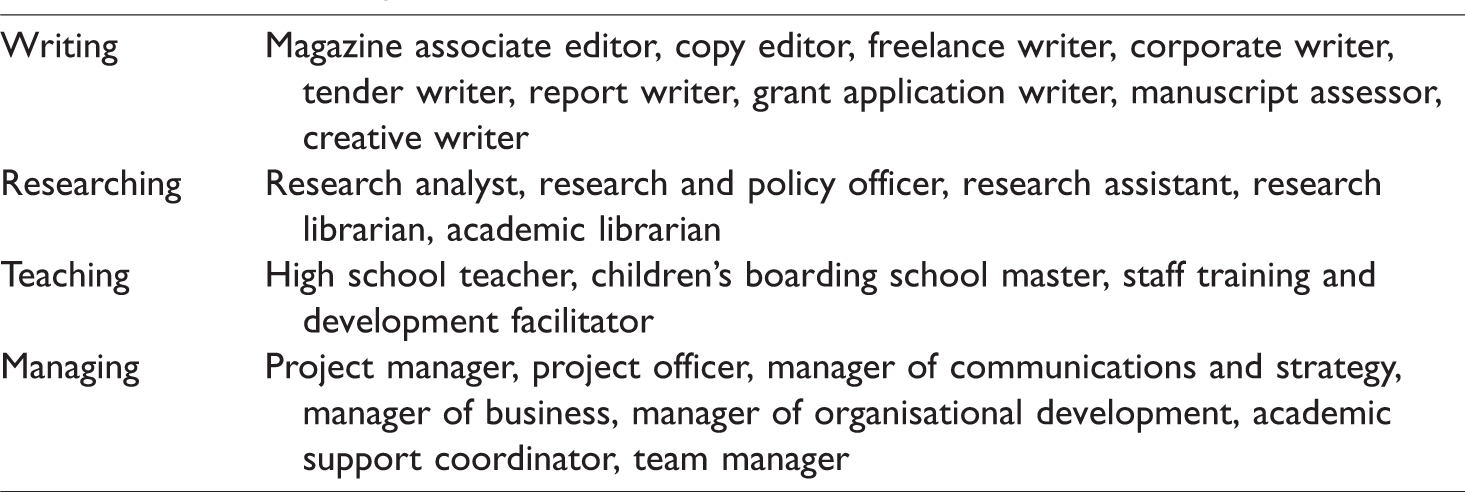
Some members of this group went into graduate positions in government where they used a whole range of their writing, researching and managing skills in running projects, gathering materials for parliamentary submissions and preparing reports. Interestingly, one mentioned that his experience of university tutoring had taught him how to facilitate small groups effectively, an invaluable capacity when faced with organising government committees: I think tutorial management and those sorts of things is useful when in any kind of team work, team-based work environment, which all government work is, but getting everyone engaged and involved and talking and those sorts of things, taking the lead in discussions and being – being in a leadership position as you are in a tute, you’re leading the whole process. (Jarrod) Yeah, it’s that sort of looking at what are the issues, what are the experts in those areas recommending, and then how does that fit as a package of policies. It’s literally talking to the government. We produce research reports, we would essentially hold events, giving a platform to other experts in the field, we’d be talking to the organisations in our sector, both to engage their interest and expertise and knowledge, as they deal with the people with the problems, and then we directly lobby to parliamentary committees, whatever. (Geoff) Even this morning I’m about to analyse 10 years of statistics to look at some trends. I’ve just done strategic planning with the board, and a lot of that again was looking at statistics, looking at trends, doing some analysis, doing some forecasting, and putting it all together into this story, into this argument. (Julie) I was able to give them [students] that support, while I was doing the [government] reporting. So, it wasn't a typical compliance role, where you're in a back office doing spreadsheets and whatnot. So thankfully it was very student facing. (Brian) [I] still get to look after students, and I get to, where possible, hold back the admin walls from academics. And I get to educate them [admin staff] on how hard it is to be an academic. (Daniel)
Of those who participated in this project, only a few were developing the portfolio careers that might be expected in today’s gig economy. Among these individuals were those who had embarked on freelancing, sometimes to allow time to undertake other intellectual and creative work, and sometimes because being self-employed entrepreneurs suited their domestic circumstances. As Bridgstock (2012) reminds us, entrepreneurship should not be regarded as ‘a dirty word’ in the Arts – indeed, many creative practitioners need to manage their own careers independently. But most of the participants in this study were full-time employees, undertaking only one job at a time, though they did report a certain amount of change in terms of rotating through government departments or areas of university administration; others were employed on specific, short-term projects or limited contracts, rather than the permanent job-for-life previous generations aspired to. While it is not possible from this data to say that the value of the PhD lies in being more likely to have secure employment, these doctoral holders do appear to be well placed for regular, reliable employment in the knowledge economy.
All the study participants found themselves working in very different roles from what they had originally imagined for themselves when they embarked on their doctoral degrees. While two still held out some limited hope to continue teaching in their discipline areas, they had all moved away from the notion of themselves as full-time, tenured academics. On the whole, they found themselves in positions that offered sufficient outlet for their skills and capacities; as one participant explained: ‘I think I’ve probably found a good balance with this job, whereby I get to do enough research that the research part of me is satisfied ’ (Anna). Surprisingly, though, none of the participants felt it was their content knowledge that was being used by their current jobs.
When asked about any career advice they would pass on to commencing PhD students, participants urged careful consideration of not only what candidates want to get out of the experience, but also what they plan to do afterwards. They also advised that it was a good strategy to undertake some paid work outside academia before embarking on postgraduate study, rather than going straight from school into undergraduate study and then into a doctoral program; this was mostly to ensure that candidates have a better sense of what and why they want to continue studying. Volunteering for community groups and NGOs was also highly recommended: I remember when I finished, one of my academic mentors said, ‘just keep applying for jobs, but just remember you’re just as likely to get a job from your community work as you are from your academic work’. And she was right [laughs]. (Geoff)
Conclusion
The narratives reported above clearly demonstrate the challenges and disappointments associated with academic work in the contemporary university setting; they also point to how HASS PhD graduates find fulfilling, stimulating work outside the academy that draws on their doctoral education. The stories of post-PhD employment narrated in this study teach us some important lessons for current PhD candidates, their supervisors and doctoral educators.
Current HDRs, and those contemplating embarking on a doctoral degree, need to know about these stories early in the process of their decision-making about their own futures. It is quite possible that better information about likely career trajectories following a HASS PhD will lower attrition rates: if PhD candidates enter their studies with their eyes open, they are less likely to feel disappointed further down the path. As one participant explained, the decision to ‘leave the monastery’ (Michael) is particularly difficult if the alternatives are murky and obscured.
It is also important for supervisors to know where their doctoral students go on graduation, so that they can inform candidates about viable, satisfying employment opportunities for HASS doctoral graduates. Even more important, it is vital that supervisors ensure that alt-ac or post-ac careers are not perceived as a second choice: the damaging concept of a ‘failed academic’ is inconsistent with the realities of 21st century academia. The ways in which PhD candidates are used as casual teachers urgently needs to change, too. The stories recounted above provide graphic detail into the lived experience of casualised teaching. Supervisors can play a role in implementing less exploitative work practices in their own departments that keep alive the ‘cruel optimism’ that traps PhD candidates in a vicious cycle of hope.
There are advantages to universities when they employ PhD graduates in administrative positions, as demonstrated by participants here who refer to their own negotiations between these worlds (this is emphasised in the way they strategically use their title of ‘Dr,’ as I report in a forthcoming article). In many institutions, there appears to be a degree of antagonism between management and academic staff; PhD holders who have experience of academic work are well placed to understand the sticking points and hence develop mutually beneficial systems and procedures acceptable to both academics and management. As Berman and Pitman (2010) argue, universities could benefit substantially from the graduates they produce by employing research-trained professional staff.
When doctoral graduates take their knowledge and skills out of the ivory tower and into the broader workforce, they are at the forefront of breaking down boundaries between universities and wider society. They can facilitate engagement between universities and industry, establishing collaborative research projects and offering internships for students. Their understanding of both university and industry needs places them in an ideal position to broker these exchanges.
Outside universities, particularly in Australia, employers need to be educated about what a HASS PhD brings to their workplace and organisation. In some countries is it common for PhD graduates to enter business, industry and government, but others (including Australia) still have a long way to go. These workers have a rich skill set that can be mobilised in multiple ways in a knowledge economy. The World Economic Forum predicts: Overall, social skills – such as persuasion, emotional intelligence and teaching others – will be in higher demand across industries than narrow technical skills, such as programming or equipment operation and control. In essence, technical skills will need to be supplemented with strong social and collaboration skills. (WEF, 2016)
The study has limitations in that participants had all completed their PhDs and were employed at the time of the interview. They were, in effect, invited to tell a story of their own success; no doubt there are other less triumphal narratives circulating amongst doctoral graduates. The stories in this study are located in the Australian context, but do resonate with the experiences reported elsewhere.
The next step in understanding the lived experience of HASS PhD graduates working in non-academic careers is to establish what skills and capacities they learned during their doctoral studies and how they are using them in their current employment. This will be useful in establishing what aspects of doctoral education are most important for post-PhD careers, and hence influence the design of doctoral programs in Arts, Humanities and Social Sciences. In the meantime, the current study uncovers, through the voices of those who have completed their PhDs and moved into alt-ac and post-ac employment, what it is like to transition out of the academy; this knowledge can be used to break the cycle of cruel optimism that is experienced by too many of our talented and capable HASS PhD graduates.
Footnotes
Acknowledgements
I’d like to acknowledge the generosity and candidness of the interview participants in sharing their stories with me. Thank you also to the Faculty of Arts, University of Adelaide, for help in transcribing these interviews.
Declaration of conflicting interests
The author declared no potential conflicts of interest with respect to the research, authorship, and/or publication of this article.
Funding
The author disclosed receipt of the following financial support for the research, authorship, and/or publication of this article: The author received a small grant from the Faculty of Arts, University of Adelaide to support the research.