




Abstract
A study of the work of the writer Tim Robinson, this paper also presents a series of wider arguments regarding concepts of landscape, dwelling and writing. English-born, but resident in the far west of Ireland for nearly 40 years, Tim Robinson is the author of a series of increasingly féted books about the Aran Islands and Connemara. Erudite and dense, these texts present the Aran and Connemara landscape to the reader via a heady mix of cultural and natural history, and personal reflection and speculation. Two recurrent questions arguably frame these texts: what does it mean to dwell in a landscape? and What does it mean to write about landscape? In this paper, after contextualizing the writer, Aran and Connemara, I develop a contrast between Robinson’s work and some influential current understandings of landscape and dwelling, in particular the mobile and dynamic notions of dwelling developed by the anthropologist Tim Ingold. The paper then hinges on an examination of a recurrent motif in Robinson’s work – ‘the good step’. In the image of ‘the good step’, I argue, we witness neither a nostalgic romanticism, nor a dynamic identification with landscape, nor more widely a fusion of land and life, but rather a displacement of land and life from each other – a displacement that is originary. The good step, the step that cannot be taken, is thus less the ideal goal, and more the aporetic possibility of writing through landscape per se – a conclusion offered here for both cultural geographers and landscape scholars and writers more generally.
Introduction
I looked for these books – Tim Robinson’s books – for a long time. I had come across intriguing references to them, a couple of colleagues had mentioned them to me, and from what I was able to glean, I developed a rather fanciful sense of them as islands not-quite-visible from the shoreline I was squinting from. More concretely they were a nagging absence on my bookshelves, and in my own writing and thinking. It’s not that they were wholly unobtainable to someone determined; rather that, in the early 2000s, they were out of my intermittent reach – largely out of circulation, and out of my price range too, whenever I thought to check online: for a time copies fetched over £150, with a waiting time of up to six months.
But now everything has changed. Two more books by Robinson have suddenly appeared, to widespread mainstream critical acclaim, and in their wake the earlier two I had initially looked for have also re-surfaced, reissued in stylish bindings and beatified, as it were, by prefaces and introductions from doyens of landscape and literature such as Seamus Heaney and Robert Macfarlane. Now I have copies of all four books – the two volumes of a projected trilogy, Connemara: Listening to the Wind, and Connemara: The Last Pool of Darkness, along with the two previously unreachable Aran Island texts, Stones of Aran: Pilgrimage and Stones of Aran: Labyrinth. 1 Stacked together on top of each other, these tomes echo the monumental quality of their titles, and the equally monumental scale of Robinson’s own freely-admitted ambition: the total description of landscape. For me though, despite their substance, they have yet to settle and solidify onto the bookshelf. Along with my other thoughts, I haul them from house to office and back again, and sometimes farther afield. I find myself clearing them from the table at dinnertime; they’re here beside me now as I type.
Geographers and others interested in questions of dwelling and selfhood, landscape and life, walking and writing, have potentially much to learn from Tim Robinson’s work. That is the general argument of this paper. With the exception of prescient early work by Catherine Nash, these texts have not as yet been subject to extensive academic discussion, certainly not within geography. 2 But over the roughly 25 year period in which cultural geographers in particular have engaged in sustained critical investigation of topics such as landscape, identity, representation and culture-nature relations, Robinson has, in a for me remarkable parallel, been exploring very similar themes, and quite often via a similar, or at least sympathetic, sensibility. Moreover, like the work of a very different but equally peripatetic writer, W.G. Sebald, Robinson’s texts offer not just textual material to be critically contextualized or interpreted. Beyond this, their narrative form and reach, along with their scholarly lineaments and breadth of reference, position them, I would contend, as active contributions to contemporary geographical thinking, practice and theorization.
To further specify this, I will argue in this paper that Robinson’s work provides a conduit through which we can explore, and even just possibly answer, some perennial questions about landscape in particular. Two issues stand out for me in this context. First, the question of landscape as a concept that has come to be nested within and understood through evolving notions of dwelling. Landscape, that is, conceived most broadly – and I will argue, with Robinson, most questionably – as a communion of land and life, nature and culture, and therefore as a reservoir of existential value, identity and authenticity, albeit one either under imminent threat, or already long evaporated. Framed variously as a lost world, or as an ongoing ensemble of life-practices and life-journeys, or as a concordance of land- and life-forms, it can be argued that ideas of dwelling have been used to both define landscape as such, and to understand the histories of the landscape concept. This is evident, I would argue, in both specialist academic literatures and more widely. For example it is difficult to deny that genres of environmental writing and nature writing, certainly in the UK and the US, inherit a complex romantic legacy in which notions of land and life existing in reciprocal harmony play a significant, if contested part. This will be further explored later in the paper, not least because Tim Robinson’s work also inherits and negotiates a similar legacy. Here, though, the wager is that the question of what it might mean to ‘dwell’ in landscape merits further examination, especially perhaps in the light of Tim Ingold’s ongoing work on the topic, and that Robinson’s writing supplies a particular means of doing so.
I have argued elsewhere that absence and distance are constitutive elements of landscape, which a full-bodied phenomenological approach, as it were, or an approach to dwelling that stresses presence and the proximate, can find difficulty in accommodating. 3 In this paper, though, via Robinson’s work, the focus will fall upon the relationship between dwelling and moving, or dwelling and displacement to be more exact. 4 If numerous recent studies have suggested an internal consonance between forms of mobility and forms of dwelling, and if it has been further claimed that movement per se adds dynamism, vitality and perhaps even veracity to concepts of landscape and dwelling, then here the aim is rather to displace dwelling from within – if by this term ‘dwelling’ we simply signal, and retain, a sense of land and life in some ways sutured together. 5 This is not to exhume any blanket opposition between the ‘mobile’ and the ‘sedentary’, or to valorise the relatively mobile over the relatively fixed. Instead of seeking to synergize moving and dwelling, perhaps we can argue that displacement and dislocation are, insidiously, right at the very heart of any sense of dwelling?
This first ‘question of landscape’ is fairly conceptual. A second, subsequent and related question, is perhaps more aesthetic and even ethical in orientation, and concerns landscape writing, or the voicing of landscape. I should note though that whereas issues around dwelling are foregrounded in this paper, questions of writing will remain implicit and in the background, before being addressed more directly in conclusion. That said, if anything can at first sight be called ‘landscape writing’ it is surely Robinson’s Aran and Connemara texts, with their weave of land, history, memory – a weave spun between, on the one hand, moments of epiphany, and on the other an insistent sense of poignancy and loss. But what does it mean, to write through landscape? How can contemporary writers – geographers included – work to usefully inhabit or haunt a concept and a sentiment arguably predicated upon senses of loss, and of potential re-connection, as evidenced by landscape’s generic literary legacy of yearning and returning; nostalgia, elegy and lament? 6 Is it possible to walk a fine line between an inescapably romantic lament for dwelling’s loss, and the sidelong insight that displacement, not rootedness, is originary, and in so doing vitiate landscape as a mode of critical and creative writing?
In what follows, I will begin by situating Robinson and the landscapes of Aran and Connemara, before moving on to discuss his work in the context of ideas of dwelling, focusing especially on the work of Tim Ingold. The paper then advances in more detail its central claim regarding the displacing of dwelling in Robinson’s work, via a discussion of one of his guiding images: ‘the good step’. A longer-than-usual conclusion follows – first, offering some reflections on other aspects of Robinson’s work which are, at first sight, seemingly out of step with the arguments of this paper, and then second, as indicated, finishing with a discussion of landscape and writing.
Background
Texts
I have already claimed Robinson’s texts for ‘landscape writing’ here, but they are in some ways genuinely sui generis. And likewise Robinson himself. The word that reviewers routinely reach for in describing him is ‘polymath’. This does usefully condense his eclectic biography, from Cambridge-educated mathematician, to cosmopolitan conceptual artist, to cartographer and writer firmly ensconced for nearly 40 years in the far Irish west of Aran and Connemara. 7 It would seem apt also with reference to his writing, which presents the Aran and Connemara landscape to the reader via a dense, heady mixture of literary, historical and naturalistic themes. As Catherine Nash notes, Robinson’s writing centres upon ‘tracing the intersection of bodily experience, botany, geology, mythology, history and folklore, in his attempts to evoke the deep resonances and multiple dimensions of a place’. 8
But I think that in the word ‘polymath’ there is an unfortunate suggestion of something magpie, restless and scattershot. In contrast, it seems to me that Robinson’s landscape-texts are characterized, despite their topical variety, by a certain striving for unity, and univocity, in form, theme and purpose. Or perhaps it would be more accurate to say that these texts are haunted by images of unity. Because, as I hope to show, the fact that any such sought-after unification – of self and land, word and world – is never ultimately achieved, and is moreover recognized as unachievable, is in large measure the insistent message of Robinson’s writing.
The distinctive milieux for these speculative claims are the Aran islands and Connemara in the west of Ireland (see Figure 1). Robinson, along with his partner M., settled in Arainn, the largest of the Aran islands, in 1972; subsequently they moved to Roundstone, one of Connemara’s larger villages, in 1984, and have remained there since. As he relates in Stones of Aran: Pilgrimage, his first response to the landscape was cartographic. A local shopkeeper suggested that his mathematical and graphic skills might dovetail with his interest in Aran history, language and folklore in the form of a new map of the islands, and, he writes, ‘the idea appealed to me so deeply that I began work that same day’. 9 Since then, Robinson has published detailed maps and accompanying gazetteers of the Aran Islands, Connemara and the nearby Burren landscape, in County Clare; maps that focus upon the preservation and illumination of Irish place-names and otherwise under-recorded and obscure sites: prehistoric forts, cashels, tombs; early churches. 10
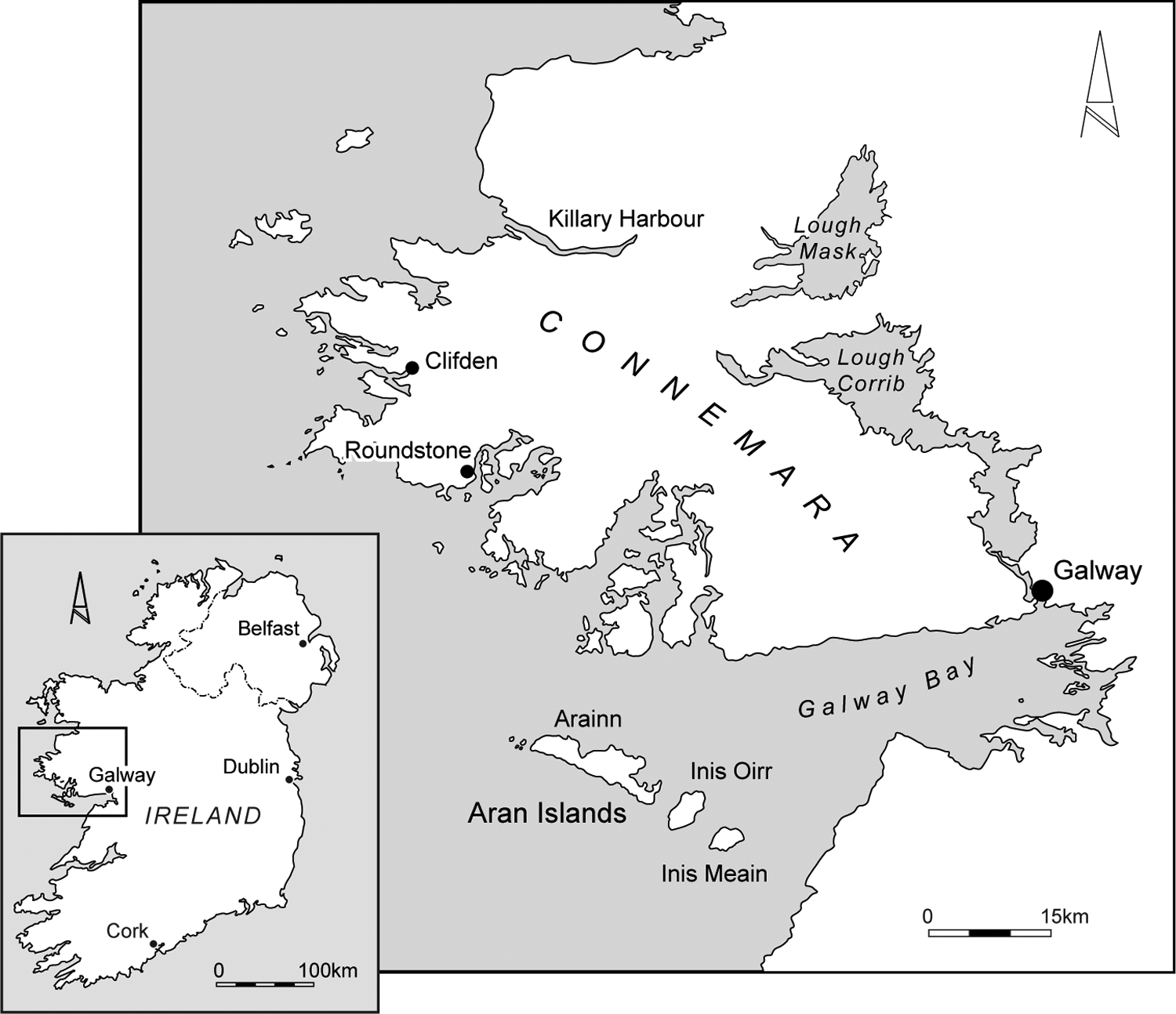
The Aran Islands and Connemara
These maps, and the attendant link between map-making and writing, both grounded in extensive perambulatory and archival research, will clearly be of interest here. But Robinson himself tends to downplay what I sense must be an intricate association, making only fairly scattered references to the map-work in his texts, and indeed at one early point describing it as ‘preliminary storings and sortings of material for another art, the word-hungry art of words’. 11 Similarly, this paper will not seek to comment further on Robinson’s maps, or the relation between map and text, partly for reasons of space and coherence (not to mention a general lack of expertise as regards cartographic practice and interpretation), and partly because I want to focus more specifically here upon questions of landscape and life, writing and worlds. The maps would constitute another paper altogether. The four texts in question, though, do exhibit some map- or atlas-like qualities, insofar as each sets out to describe a specific area by means of a digressive yet also quite strictly adhered-to itinerary. Stones of Aran: Pilgrimage – as the title implies – is written up in the form of a walk around the coastal perimeter of Arainn, the largest Aran island. Its companion volume, Stones of Aran: Labyrinth, meanders through the island interior. Connemara: Listening to the Wind, takes Robinson’s domicile, the coastal village of Roundstone, as its focus, and extends from there to describe both the surrounding coast, and, proceeding inland, the bogs and mountains of Connemara’s heartland. Lastly, Connemara: The Last Pool of Darkness is structured as a circuitous voyage along Connemara’s northern and westernmost peninsulas, again with diversions inland.
Landscapes
Already in sketching Robinson’s biography and oeuvre Aran and Connemara start to shimmer into view. Any scene-setting description of them here is pre-emptory and possibly dubious – because this is Robinson’s entire, encyclopaedic topic – but necessary nonetheless I think, given that these are not widely known or familiar regions. The Aran Islands (three of them, in Irish, Arainn, Inis Oirr and Inis Meain) stand in the Atlantic some miles from Ireland’s west coast. Geologically they are a continuation of the limestone plateaus of the Burren in County Clare to the east – and this is not an inconsequential matter, because the most immediately apparent and extraordinary feature of these islands is that, as first presented to the eye, they consist largely of a plain of naked stone, in slabs, terraces and pavements, rising westward to terminate abruptly in a long, high, jagged, ocean-facing cliff, and falling eastward to a series of indented coves and strands. This nearly treeless limestone plain, exposed to the harsh elements, is further mazed and subdivided by innumerable stone walls – the ‘labyrinth’ of Robinson’s second Aran volume – walls reflecting long and torturous histories of inhabitation and attempts at marginal subsistence. Connemara, the name given to the mainland a few miles to the north of Aran, is a much larger, more diffuse and varied terrain; in general terms comprising a series of narrow, rugged peninsulas, with beaches and inlets backing onto rough moor and bog, and then rising upland and inland to the classically mountainous shapes of the Twelve Ben and Mamturk ranges.
Together, Aran and Connemara occupy a particular, ‘special’ place in Irish histories and imaginations, especially so as such histories have been narrated and constructed anew by various nationalisms, firstly romantic and latterly civic-statist, over the past 150 years. 12 This place is at once on the margins and right at the heart. As in-part Irish-speaking areas they continue to function today as cultural hearths – that is, as repositories of a nominated and nearly officially sanctioned sense of authenticity and purity. As landscape they are equally apprehended, especially by visitors from both Ireland and abroad, in terms of an auratic sense of celtic-ness, of almost-otherworldly westerness, sometimes folksy and rustic, sometimes wild and mystic. 13 Aran, in particular, is complexly entrained in such visions, given its seclusion and isolation, and given also the cultural and archaeological significance of its prehistoric stone forts, its legendary ecclesiastical history as a site of very early Christian monastic settlement (‘Aran of the Saints’), and its subsequent 19th-and early-20th-century ‘discovery’ by antiquarians, anthropologists, film-makers, mythographers and writers. 14
But lest the above paragraphs paint too romantic a picture of Aran and Connemara, it must be also noted at the start that their histories are shaped by long-lasting poverty and injustice. These are marginal landscapes, both geographically and economically. Connemara especially continues to be haunted by the legacies of the Great Famine of the 1840s, which decimated the local population, and to an extent its story, alongside that of Aran, is shaped by the iniquities and oppressions of British colonial rule in particular; a story of dispossession, absentee landlordism, eviction, racist and sectarian discourses, and ongoing emigration and depopulation. 15 And such themes are also part of the terrain that Robinson walks.
Walking and dwelling – walking as dwelling
Robinson does walk the Aran and Connemara landscape – this is his primary ‘method’, so to speak. 16 In addition, as noted above, his texts, in particular the Aran volumes, are themselves structured and narrated as extended walks, or as a series of excursions, most often on foot. Walking here firstly denotes a particular empirical mode of investigation and encounter, at times almost Sauerian, or perhaps antiquarian, in its devotion to the intricacies of local material cultures, and to storehousings of lore, custom and tradition. Unsystematic, but omnivorous nonetheless, this peripatetic fieldwork is the wellspring and conduit of Robinson’s texts. Through walking, he encounters locals, incomers, visitors, stone walls, cottages, churches, flora and fauna – walking thus affords opportunities for conversing, listening and observing; in other words it supplies in the most straightforward sense much of the ‘source material’ that Robinson seeks to elucidate in his texts. In another echo of Carl Sauer, walking is also at times closely allied here with more attentive and expert forms of watching, that is, with the trained eye of the naturalist, geologist and archaeologist. Oftentimes Robinson walks in partnership with such experts, and in a substantive sense these books are as much natural history as cultural history. With pages of detailed commentary on marine life, on bog plants and on geological processes, they have at times what could almost be called an instructional quality.
But above and beyond this, Robinson’s mode of walking, and thence of writing, draws most of all on refurbished romantic registers and legacies. 17 As Joseph Antony Amato argues, from the early-19th century onwards, ‘romanticism offered a new definition of walking, as it directed walkers towards solitude, on the one hand, and communion with the countryside and nature on the other’. 18 Setting foot on this particular cultural path, walking for Robinson does often involve the call of the wild; literally a passage from homely surroundings to locales such as mountain passes, deserted shorelines, vertiginous cliff-edges. As Nash notes, walking thus enables, and itself emerges as, ‘an exchange of energies between the land and body surface’. 19 And travelling along this well-grooved narrative trail entails reflection, sometimes affirmative, sometimes scathing, upon what have become almost commonplace cultural suppositions – that walking enables a therapeutic, restorative and even spiritual encounter with ‘wild’ and remote landscapes; with the strange, the lonely and the elemental – with nature. Robinson thus consciously presents himself as a seeker after ‘privileged moments of spatial awareness, able to bear the heavy vestments of symbolism’. 20 As I will further discuss later in this paper, he inhabits this romanticism quite knowingly and reflexively, without straightforwardly rejecting it. Like much contemporary writing on nature and landscape, therefore, this work is acutely aware of its inheritance of a set of idioms and tropes, through which the landscape is framed and apprehended. 21
But what is the relationship between walking and dwelling, if by the latter term we at first simply and unthematically imply some correspondence, some concordance, between land and life? In some ways, this question follows directly from the points on romantic walking above, insofar as the concept of ‘dwelling’ also bears traces of a romantic inheritance. In The Song of the Earth, for example, Jonathon Bate nests the phenomenological concept of dwelling, as articulated by Martin Heidegger, firmly within the attitudes to nature and culture inaugurated by romantic poetry. Notions of dwelling are understood in terms of a wider, ramifying discourse, one culminating (for Bate) in strands of contemporary ecological and environmental thinking. 22 Walking and dwelling are so presented as kindred spirits within a wider schema of beliefs and practices regarding culture-nature relations within romantic traditions. 23 To parse this a little further, walking, especially solitary walking, is seen as proper to dwelling within these traditions; it prompts reverie, closer attunement between self and landscape, and thus the in situ elaboration of a wider ethos, one in which life is best lived through close synergy with local life forms and rhythms. And most simply of all, walking cultivates dwelling – for Tim Robinson, for example, as for many others, writers or not, walking is a privileged route to deeper knowledge of landscape, it marks a passageway through which the visitor or incomer can begin to sense the perspective of the longer-term inhabitant, and perhaps (given time – dwelling’s other key cultivator), even become that inhabitant.
Beyond these as it were historical and pragmatic associations, however, the recent work of the anthropologist Tim Ingold proposes a perhaps more formal account of the walking-dwelling relation, and in order to pinpoint here what I believe to be the originality of Robinson’s landscape vision, I want to spend some time developing a contrast with Ingold’s work. So, while still grounding walking and dwelling as above all practical activities, Ingold sets out to claim a more fundamental, even ontological connection between the two. In Lines: A Brief History, he argues that walking is dwelling; or more exactly, to adopt his own terms, that dwelling is best conceived as ‘wayfaring’.
24
The lynchpin of this argument is a vision of life – all life, of which human life is part – in terms of continual, open-ended movement, flow and process. In this vision, to be human, to be alive, is to be on the move; a human being is a creature ‘instantiated in the world as a line of travel’, and thus engaged a priori in ‘the never-ending journey that is life itself’.
25
For Ingold, therefore, movement, or ‘wayfaring’, is the very quintessence of being-in-the-world, conceived here as immersion within and emergence from an imminent flow of life and perception:
Wayfaring, I believe, is the most fundamental mode by which living beings, both human and non-human, inhabit the earth. By habitation I do not mean taking one’s place in a world that has been prepared in advance for the populations that arrive to reside there. The inhabitant is rather one who participates from within in the very process of the world’s continual coming into being, and who, in laying a trail of life, contributes to its weave and texture.
26
With these claims, Ingold signals a clear departure from any general thought of dwelling in terms of sedentary inhabitation of a bounded region, and a departure also from the hierarchical and anthropocentric tonalities of Heidegger’s thinking, in which human being is marked as distinct from the being of animals, plants and stones, for example. 27 Dwelling blossoms, so to speak, into a more mobile, holistic and processual vision, in which to live is to inhabit is to move. But at the same time several key elements of a phenomenological understanding of human being are re-articulated: an emphasis upon involved practice, rather than distanced contemplation, as the basis of intelligibility and sense-making, a stress upon the engaged, ‘worldly’ nature of existence per se, and above all a sense that the truth of this ‘fundamental mode of being’ has been obscured, for us, by scientific and modernist epistemologies that presume a separation of culture and nature, self and world. Walking, for instance, is therefore most commonly conceived today, Ingold argues, as mere mechanical, means-to-end passage across a pre-given, indifferent, external landscape, and not as a first-order process, a set of rhythms and trajectories without origins or ends, on the basis of which ‘landscapes’ and ‘selves’ are articulated as such. This becomes explicit when Ingold, following Kenneth Olwig, draws a contrast between the martial steps of soldiers pacing across the u-topic, non-place of the parade ground, and the topian, that-is, place-making, ventures of the wayfarer, who, in founding a pathway, produces a meaningful, experiential landscape. 28 For Ingold, then, modern, western forms of locomotion and transportation subordinate lines to points, and conceive the world as inert terrain on top of which one travels, atom-like, only in order to reach a destination. The wayfaring perspective, by contrast, embeds life within lived-through landscapes. Above all then, wayfaring is a form of living and dwelling in the world in which there is no separation between self and landscape. Both are lifelines, continuous and cosanguineous within the earth’s body: no distances interrupt their flow, their ongoing-ness.
If walking is dwelling-in-the-world – and it is difficult not to sense that walking is being privileged here as a prototypical form of wayfaring – then it is, crucially, already also an intelligible movement of inscription. It is not, in other words, simply practical ‘way-finding’, it is always already a meaningful act through which worlds are narrated into existence. For Ingold, to go for a walk is to tell a story, and equally, vice versa, the telling of a story takes both speaker and listener for a walk. This is not merely metaphorical, a walk is not just ‘like’ a story, Ingold argues; rather, both walking and storytelling are related forms of wayfaring – two life forms in principle continuous and open-ended. In this way, to speak or write about a walk through a landscape is not to produce a second-hand facsimile or representation of a first-order, ‘lived’ experience – walking and writing instead become commensurable forms of a general, univocal world-composing:
telling a story is not like weaving a tapestry to cover up the world . . . Far from dressing up a plain reality with layers of metaphor, or representing it, map-like, in the imagination, songs, stories and designs serve to conduct the attention of performers into the world.
29
What we sense here, therefore, is a certain continuum of world, body and text – of landscape, walking and writing. We move through these planes without discontinuity, dislocation or fragmentation. To put this another way, Ingold’s entire thesis is framed in terms of lines – moving, weaving lines – but in another sense it is concerned with erasing one, particular line: the dualist line dividing the cultural from the natural, writing from worlds, selves from landscapes.
Displacing dwelling: ‘the good step’
I have spent some time discussing the relations between walking and dwelling, land and life, tracing a line from a broad romantic ethos in which these are entwined to a perhaps more precise account of walking as dwelling, as a concordance of life and land. And now we come to the crux of this paper. In many ways, Tim Robinson’s descriptions of the Aran and Connemara landscape would appear to both exemplify and endorse the arguments made by Ingold, as summarized above. Or to put this another way, Ingold and Robinson seem to share much in their conceptions of land and life. On one level, for example, Robinson’s books are one long hymn to the conjunction of life and land to be found in Aran and Connemara. The urgent necessity of bearing witness to this conjunction is what ultimately impels writing. This weave of land and life, moreover, is so dense and intricate, and also so careworn, that it demands in turn a new form of writing, a topographic response as singular as the topography itself, in which the encyclopaedic and the lyrical themselves coincide: a marriage of the facts of nature and the fancies of culture. For example, on the very first page of Connemara: Listening to the Wind, Robinson evokes the image of the last breath of a fisherman, dying by the riverbank:
Whatever the burden of the gillie’s last breath, it was dispersed into the air to be degraded by the hiss of rain or eroded molecule by molecule in the Brownian fidget of drifting pollen grains, and captured, a little of it, by the tilting, spilling cups and saucers of the water surface, dissolved, hurried under the old bridge at Tuaim Beola and added to the sea. So one can imagine it infinitesimally present in, and persuasively interpreting, the sough (which we should not delude ourselves is a sighing) of the Ballynahinch woods, the clatter (not a chattering) of the mountain streamlets, the roar (not a raging) of the waves against the shore.
The clear intention here, it seems to me, is to suggest that land and life are not so much laminated or superimposed onto each other, but are rather interwoven as strands within a single yet infinitely complex fabric. They are thus concordant life forms percolating through each other, interchangeably contributing to an ongoing intermeshing, a weaving to which all elements equally contribute. Robinson signals this weaving of land and life as both an inimitable and intrinsic quality of the landscape – thus defining landscape as such – and as the ineluctable topic that his work will seek to address. This process, moreover, is both local and global, both particular and general. It is a particular nexus of ways of life, climates and topographies that produces landscapes as lived localities or arealities, each time singular, but at the same time this process also has a universal or even metaphysical aspect. If we attend to this nexus closely enough, we may discover larger truths about humanity’s relation to itself and to nature. In this respect, Robert Macfarlane captures an essential facet of Robinson’s work when he says that ‘like all great landscape works it is at once both territorially specific, and utterly mythic’. 30
And yet, there are obvious hesitancies even here. Clearly, Robinson fights shy of any wishful or self-aggrandizing anthropomorphism – the sough of the wind is not a sighing – and thus any suggestion that poetic or metaphorical licence is sufficient on its own to scope out the landscape’s essential attributes. However, here and elsewhere in his writing I would argue, Robinson consistently advances a much stronger and more central claim regarding the non-coincidence of culture and land. Even if he bears witness to moments of epiphany – elemental or arcadian – in which a harmony or even fusion of culture and land, or past and present, or at the individual level, writing and experience, is seemingly apparent, such moments are invariably shaded with ambiguities; qualified, disrupted and disputed.
This persistent suspicion of what Robinson himself terms ‘the indiscriminate welter of “being at one with Nature”’,
31
is manifest most clearly, and most significantly, in the image of ‘the good step’, which threads through Stones of Aran: Labyrinth. If walking could be synonymous with, or at least a handmaiden to, dwelling, then, via ‘the good step’, Robinson goes right to the heart of this thesis, and precisely in order to dispute the concordance of land and life that romantic dwelling claims. He begins with a vision:
I was on a summer’s beach one blinding day watching the waves unmaking each other, when I became aware of a wave, or a recurrent sequence of waves, with a denser identity and more purposeful momentum than the rest. This appearance . . . resolved itself under my stare into the fins and backs of two dolphins (or were there three?) . . . It was difficult to see the smoothly arching succession of dark presences as a definite number of individuals. Yet their unity with their background was no jellyfish-like dalliance with dissolution; their mode of being was an intensification of their medium into alert, reactive self-awareness; they were wave made flesh, with minds solely to ensure the moment-by-moment reintegration of body and world.
32
This, as it were, definitive image of unity – unity of life form and milieu, form and content – leads Robinson onto the image of the ‘good step’, the central problematic of his text. With reference to the totalizing ambitions of his Aran walking and writing, he writes: ‘let the problem be symbolized by that of taking a single step as adequate to the ground it clears as is the dolphin’s arc to its wave. Is it possible to think towards a human conception of this “good step”’. 33 Such a step, an adequate step, would be ‘good’, first, insofar as it would tread upon the ground with a certain respect – a respect not only or exactly ecological, but manifest more generally in a maximum fidelity to the manifold human and natural histories of the land traversed. To take, both textually and corporeally, this ‘good step’ would not be, however, to exhaust the landscape, to have the final word on it. Rather it would be to inhabit the landscape, to dwell therein, in a manner so holistic and faithful that, as noted above pace Ingold’s work, a continuum of land, body and text would be established and communicated. The good step would be the landscape.
Can such a step be taken? Can self and world coincide in this fashion? And can there be a writing of sufficient acuity, detail, texture, piety even, so as to perform textually the work of the ‘good step’, the step that is adequate to the ground it clears? For Tim Ingold, as I understand it, these types of questions are in a sense redundant, or are based on false premises; because they assume, even as they are posed, a distinction between self and landscape, writing and worlds; a difference, a distance and a separation that does not in truth exist. The answer for Ingold is yes, therefore, the good step can be taken, and what’s more it is being taken all the time, even if we do not recognize it as such. All steps are necessarily ‘good’, if by good we mean a step in time and in tune with the ground – for this is what life, wayfaring, actually and inescapably is. For Tim Robinson, however, the answer is no, the good step cannot be taken.
First, and most simply, this is because the good step is an impossible ideal – it is, in part, predicated upon a fantasy of omniscience, of total knowledge. As Robinson notes in Pilgrimage, it calls to mind ‘a god’s all-comprehending step’. 34 The humility and sense of disinvestment supposedly underwriting the good step would thus itself be underwritten by a latent possessiveness – an identification with landscape would therefore slip into an appropriation of landscape. 35 And, in addition, if the good step could really only be taken by a god, it would therefore necessarily be a ‘take-off point for transcendence’ that would sublimate the ground from whence it sprang. In other words, within the image of the good step there lurk idealist and transcendental tendencies, in the most literal sense – tendencies to rise above and become forgetful of the thickets of human and earthly circumstance that are, in the final analysis, Robinson’s entire concern. The good step could not therefore be the step of a human – an earthling, a creature circumscribed by grounds and locations.
Thus, despite giving his book the title of ‘pilgrimage’, Robinson fights shy of religious or spiritual connotations, through which his walk might be viewed as a quest for some state of grace. The search for the good step, the step that would seamlessly unite land and life, culture and ground, does retain nonetheless something of the flavour of a grail quest. Like a grail quest, for instance, what matters is less the unattainable goal and more the insights that may be gained en route. This is how Robinson appears to view his work, in some respects. While the good step involves ‘conceiving of what I knew to be inconceivable’, through it we can still conceive of a worldly multitude of different, concrete steps, ‘rash or wary, ritualistic or whimsical, processional or jiggish, trespassory or proprietorial . . . the hollow footfall of the museum attendant . . . the breathy creeping of the Peeping Tom’. 36
But above all, and most pertinently of all, from my perspective in this paper, Robinson also wishes to strongly eschew any suggestion that ‘the good step’ might connote a union or fusion of self and landscape. In fact, the opposite is true: what Robinson’s Aran pilgrimage reveals is precisely the impossibility of such a fusion. Just as the dying breath of the fisherman by the riverbank partakes of and enters into the wider world without being a ‘good breath’ – an exalted lungful to maximum capacity – then so no step achieves unity with its grounding, or even the air through which it passes. In an extended reflection, through the concluding pages of Pilgrimage, Robinson is quite unequivocal regarding this. Here, he writes that ‘the notion of a momentary congruence between the culture one bears and the ground that bears one has shattered against reality into uncountable fragments’. 37
In this way, in both a critical and technical sense perhaps, the good step is aporetic. An aporia, in the sense most recently used by Derrida, is a figure of doubt, contradiction and dislocation that haunts from within any ontological claim – here, for example, a claim concerning a congruence of culture and ground, life and land. 38 Or, the aporia denotes – fairly literally in this case – an impasse, a blocked pathway, a step that cannot be taken. As aporia, therefore, the good step presents an image of unity and unification that is impossible, and that unravels from within the communion of life and land it purportedly expresses. The good step, supposedly an articulation of the quintessence of dwelling, in actuality displaces dwelling.
And this, in fact, is the ‘goodness’ of the step – in displacing a thought of dwelling, it opens rather than encloses landscape, un-earths it, as it were, while remaining committed to grounds yet-to-come. To deploy some more technical terminology, it is thus possible to see in Robinson’s guiding image a refutation, in principle, of what Derrida calls ‘ontopology’. By this term – which couples together being (ontology) and location (topology) – Derrida refers to ‘an axiomatics linking indissociably the ontological value of present-being . . . to its situation, to the stable and presentable determination of a locality, the topos of territory, native soil, city, body in general’.
39
Derrida is mostly speaking here in terms of a critique of nationalism, in particular ethnic nationalism (and this is also the main context in which ‘ontopology’ has been taken up by geographers
40
). In this context Catherine Nash identifies and focuses upon the avowedly ‘stateless’ dimension of Robinson’s ‘good step’, in which she detects a rejection of any nationalist model of landscape belonging.
41
But there is a clear echo here too, for example, of Heidegger’s philosophy of dwelling, in which being and location are also yoked together in various ways.
42
And thus more widely, ontopology might be taken to denote the congruence of culture and ground, the coincidence of land and life, which Robinson’s good step in its very taking displaces and dislocates. This is not, however, to suggest that there is, in the first place, or indeed as a ‘first place’, such congruence or coincidence; a first-of-all unity of land and life that is only subsequently displaced. The good step instead displaces such notions precisely before they are placed as such – its displacement of land and life from each other is originary. Derrida himself quickly and characteristically seeks to displace the ontopic from within, through writing that dislocation is:
just as ‘archaic’ as the archaism [the ontopic linking of land and life] that it has always dislodged. This process is, moreover, the positive condition of the stabilization that it constantly relaunches. All stability in a place being but a stabilization or a sedentarization, it will have to have been necessary that the local difference, the spacing of a displacement, gives the movement its start.
43
A ‘spacing of a displacement’ is the incessant force and life of landscape – something spatial, something temporal, something never quite itself. Tim Robinson’s good step, I would argue, is exactly ‘the spacing of a displacement’ in this fashion: an inaugural but always-incomplete ghosting in which land and life are untied rather than united. And perhaps it is precisely this dislocation that makes his accounts of the Aran and Connemara landscape compelling – that makes them landscape writing.
But all of this does not mean that an aporetic approach to landscape is necessarily left bereft of either critical purchase on history, memory, subjectivity, or descriptive possibility when it comes to evocations of land and life. For Robinson himself, for instance, such possibility appears to lie specifically in the future-oriented, always open and ongoing aspect of walking. In this vein, late on in Stones of Aran: Labyrinth – the successor volume to Pilgrimage – the step suddenly makes another notable appearance. Walking with eyes closed on Aran’s stone plateau, Na Craga, quite near the cliff-edge, ‘clarifies the nature of the step’:
as the foot descends through space, a surface exactly the size and shape of the foot-sole receives it; this support is the top of a column of inconceivable height that goes down and down, narrower and narrower, until it rests upon a point, a nothing, at the centre of the earth, and from that point opens up again in the opposite direction like the cone of futurity opening out of a moment, into the unsoundable.
44
The imagery here is characteristically cosmic, upscaling quickly from the individual body, balanced upon the landscape, to encompass the entire world, and then lifting off even from there, out into the numinous. The step, however, remains incomplete, suspended in the ‘cone of futurity’ rather than firmly anchored to the stone, a spacing at once ineffable and provisional. 45
At this point, to conclude this section, and with this image in mind, I want to return to my starting point, in terms of questions of dwelling, mobility and displacement. I have claimed a distinction here between Tim Ingold’s conception of ‘wayfaring’ and Tim Robinson’s motif of the ‘good step’. For Ingold, wayfaring enrols land and life together as moving, consanguineous lifelines. Robinson, by contrast, presents an aporetic, more hesitant vision, edging away from any notion of land and life as quintessentially conjoined. Here, therefore, to anticipate my conclusion, we appear to have a form of thinking, writing and performing that vitiates landscape without endorsing any essential congruence of land and life, or indeed throwing any lifeline to such an idea. Yet despite these differences, and as I also began by noting, the two writers also share much. The work of both is rhetorically characterized, for example, by an openness, an ongoingness – a refusal of easy points of origin or ending, and a commitment to movement and motion as key motifs of the world’s unfolding. Both are critics of ‘modernity’ (as I will discuss further below with reference to Robinson), and of the epistemologies (Ingold) and developments (Robinson) associated with that term. Both are also naturalists, fascinated by, and drawing lessons from, the worlds of plants, insects, birds, land and marine life. Were Ingold and Robinson to meet, and talk, I am confident that they would find much common ground, not least in Robinson’s assertion of ‘the step . . . as a metaphor of a certain way of living on this earth’.
46
I will repeat my claim nevertheless: the movement of ‘the good step’ is very much a critical dis-placement of what are seen by Robinson as problematic notions of rootedness and embeddedness in landscape – notions that haunt any thought of dwelling, howsoever mobile or dynamic it might be. This is his own summation, given at the end of Stones of Aran: Pilgrimage:
In all this, the step is to be distinguished, maximally, from those metaphorical appendages of humanity, the need for which is much cried up by so many well-wishers of the species: roots.
47
Conclusion: ‘deep places’ and landscape writing
Offering interpretations of literary works, especially those of a still-living writer, can be a sensitive matter. A sense of unease is perhaps accentuated when texts are being used to advance arguments in different registers, as has been the case here. I have marshalled Tim Robinson’s work in the service of an argument against a thought of landscape as dynamic dwelling-in-the-world, arguing instead that a displacement of land and life from each other, a displacement of dwelling, is in actuality the incessant precondition of landscape – that is, of a creative tension of land and life.
My initial worry is that a wider readership would find this argument not only abstract but also, perhaps, unnecessarily purist and unforgiving. Shortly after completing a first draft of this paper, I received an invitation to participate in a seminar on Robinson’s work at the University of Cambridge. 48 Robinson himself was in attendance, along with his partner M. 49 I was the only geographer in a room otherwise dominated by creative writers and literary scholars. To my relief, the discussion I presented – a very abbreviated version of this paper – was politely received, rather than being greeted with puzzlement or even hostility, as I’d feared. Despite that, however, I still felt rather at the margins. For many of the participants, Robinson’s achievement lay chiefly in bearing witness to the unique qualities of a particular set of landscapes, and of a particular way of life. Ideas concerning the special value of places such as Aran and Connemara were prominent, along with a stress on the importance of preserving deep affinities with and attachments to specific places. In this vein, for the author and critic Robert Macfarlane, for instance, Robinson’s work is above all ‘an exceptional investigation of the difficulties and rewards of dwelling’. 50 Such an interpretation presumes these landscape-texts are about the possibilities of dwelling, and so to claim, as I have done here, that they contain a refutation-in-principle of this possibility, might seem perverse. Robinson, it could be argued, instead describes and inhabits a compromise position, one that acknowledges the transience of cultures and the intransigence of stones, but which places final ethical and aesthetic value nonetheless on the achievement and sustenance of a pragmatic sort of dwelling, a best-fit, in precarious circumstances, of land and life, eked out and cobbled together, and perpetually under threat.
This line of thinking can be extended into broader considerations of the value of landscape, and the purposes of landscape writing. In this vein, for example, Robinson does indeed at times present himself as a defender of locality, custom, tradition. Above all else, as noted earlier in this paper, an ethos of devotion and fidelity to Aran and Connemara underpins his writing, and this in turn is compelled by a sense of the special and unique qualities of these landscapes. In several notable instances Robinson thus appears to articulate a localist position, one that is distinctively negative as regards the encroachment of ‘modernity’ and ‘progress’ upon Aran and Connemara, and that thus defines the local in terms of such threats. This surfaces in opposition to wind farms, to proposed airports, to the profusion of holiday homes and caravan parks, and also to the overly sanitizing and neutering effects of state-led heritage preservation schemes at various sites in the area. There are strong criticisms in Robinson too of both unchecked capitalist developments, ‘built to profit from that which they degrade’,
51
and of attempts to impose official order and uniformity upon a local landscape therefore positively defined in contrast by its vitality, unruliness and heterogeneity. And there are also appeals to deeper, nearly metaphysical levels: thus very near the end of his most recent published work, Connemara: The Last Pool of Darkness, Robinson nominates Connemara as a ‘deep place’:
places that demand fidelity to their truth . . . a deep place is a historical and ongoing process, a slow event, in which, at every stage of its development or degradation, its current name is the touchstone of eligibility for the proposed new element. Thus a place ripens or rots; thus, in this instance, if Connemara is to conserve its truth to its name it must decisively reject certain so-called ‘developments’.
52
On the face of it, Robinson succumbs here, finally, to a romance of place. Connemara is defined as unique and deep, an island of authentic dwelling, a precarious, processual fusion of land, atmosphere, history and identity. Spoken aloud, the very word ‘Connemara’ has a mellifluous, alluring quality; the lilt of it hanging in the air, beckoning. The temptation to understand both this place and Robinson’s books as exemplary instances of the existential and romantic power of ideas of place, genius loci, dwelling and so on, is nearly irresistible.
But, just as the ‘good step’ was revealed to be less the ideal goal, and more the impossible possibility of landscape writing, so a ‘deep place’ is, in Robinson’s hands, also constitutively haunted by paradox. The phrase ‘the last pool of darkness’ is a memorable description of Connemara offered by Ludwig Wittgenstein while staying, rather improbably, in the region in the late 1940s. Robinson uses the story of Wittgenstein’s Connemara sojourn to introduce and develop a central motif, or conceit, of his text – Russell’s Paradox of the classes. This celebrated problem highlights a ruinous flaw in late 19th-century attempts to provide logical foundations for arithmetic by grouping together sets, or classes, of numbers (e.g. the class of even numbers, odd numbers and so on). 53 This might seem straightforward. We can note, however, that the class of numbers called ‘even numbers’ is not itself an even number; it is not a member of itself. And if we upscale from here to consider the class of ‘all classes that are not members of themselves’, we arrive at an impasse, a contradiction (if not quite an aporia); because this class appears to a member of itself if, and only if, it is not a member of itself. 54
An irresolvable paradox of belong/not-belonging thus arises. And for all that he hopes Connemara might coincide with itself, might simply be itself – that is, for all his searchings for ‘some hoped-for conclusive identification of the quintessence of Connemara’, 55 Robinson recognizes, in his final pages on the topic thus far, the equally paradoxical and destabilizing aspect of this quest. Can Connemara include itself? Can the name of the landscape be part of the landscape? How can some elements be in Connemara but not of it? For Robinson, like arithmetic, a landscape cannot be grounded, cannot be given firm and final foundations. Between the name and the land, between past, present and future, between word and world, a gap interposes itself, necessarily, fragmenting senses of belonging and identification.
To conclude this paper, I want to return to the second ‘question of landscape’ with which I began – concerning the impulses and purposes of landscape writing. In the UK at least, over the past few years, there has been something of a renaissance of this genre, with the publication of a suite of books including for example Robert Macfarlane’s The Wild Places, Roger Deakin’s Waterlog, Richard Mabey’s Nature Cure, and, at something of a remove, Kathleen Jamie’s Findings. 56 Others could be added to the list – including, perhaps, Robinson’s Aran and Connemara texts; there are clear structural and topical commonalities. All are concerned by landscape, and specifically by a search for identification with landscape. All thus inherit, in different ways, the romantic, peripatetic and naturalist traditions of walking, thinking and writing discussed earlier in this paper. But in an acerbic critique of Macfarlane’s work in particular, Kathleen Jamie highlights how, even when reflexive acknowledgement of the problems occasioned by this inheritance is made, other issues remain. 57 A particular narrative arc persists, one of loss, yearning and reconnection. We have a sense firstly that we have lost something – something to do with landscape and ‘nature’, some connection to both the past and the non-human. We mourn this loss, and set off in search of redemption. And eventually some reconnection does occur; through physical and intellectual application, some charismatic contact is re-established between self and landscape.
But I believe that Tim Robinson insistently, precisely and decisively punctures this romantic narrative, and that in doing so supplies a lesson and maybe even a model for contemporary landscape writing. He is not immune to yearning of course – for example Stones of Aran: Pilgrimage takes Arainn as a fragment of a lost whole, ‘broken, blessed Pangaea’. 58 Each text, though, concludes by querying itself, by questioning the distance between writing and experience, and refusing over and again to imagine that this distance can be crossed, or crossed out. The paradox haunting Robinson’s writing is that the more he says, the more the words accumulate, thousands of pages of them, the more Aran and Connemara withdraw from view. This is why he finds that ‘the notion of a momentary congruence between the culture one bears and the ground that bears one has shattered against reality into uncountable fragments’. A clearer disavowal of dwelling, of a correspondence of land and life, is hard to imagine. The lesson we can draw for thinking and writing about landscape can be expressed as another question – the impossible but imperative question with which Tim Robinson concludes Stones of Aran: Labyrinth: ‘how to match one’s step to the pitch and roll of this cracked stone boat of a cosmos’? 59 It can’t be done – but precisely because it can’t, we have something to say.
Footnotes
Acknowledgements
Thanks to Jos Smith, Nick Groom and Andrew McNeillie of the Atlantic Archipelagoes project for the invitation to speak about, and to meet, Tim Robinson. And further to Catherine Nash, for generously sharing her doctoral research on Robinson. Thanks also to Keri Jenner, Deborah Knight, James Riding and Liz Roberts for helpful comments on an earlier draft, and to Robert Macfarlane, John Brannigan and Norman Ackroyd for stimulating discussion of Robinson’s work, Ireland and ‘nature writing’ more widely. Lastly thanks to three referees and to the editor Tim Cresswell for their prompt and in-depth engagements with this paper. All interpretations remain my own.
Funding
This research received no specific grant from any funding agency in the public, commercial or not-for-profit sectors.