



Abstract
This paper endeavours to track some of the numerous absences conjured up by the building stone of Manchester. As a vital, ever-changing materiality entangled within a host of relations, stone can evoke the now absent human and non-human agencies of the city. Absence is revealed through an affective, sensual and imaginative engagement with stony materiality, so that the absences of other places, networks and connections, distant lives and events, human remains, cultural practices and tastes, environmental conditions and its material effects, historical recognition and matter itself are made present and acknowledged. In honouring the numerous humans and non-humans that have been integral to the ongoing production of the city, I show that stone is one element in dynamic, ongoing urban re-composition and emergence, constituting part of the city’s ever-changing temporal collage.
Introduction
In his fascinating tales about the endless renovations, destructions and amendments that have continually transformed renowned buildings, Edward Hollis 1 reveals how the architect’s desire to produce the ineluctable and permanent is an impossible dream, invariably thwarted as buildings are subject to endless recontextualization and adaptation, dependent upon prevailing aesthetics, political ideologies and religious imperatives, technologies and interpretations of history. As they shapeshift ‘from century to century’ under processes of ‘perpetual and simultaneous construction and decay’, buildings appear and disappear, are ‘built on top of each other, out of one other or inside one another’. 2 Outliving ‘the purposes for which they were built, the technologies by which they were constructed, and the aesthetics that determined their form’, buildings ‘suffer numberless subtractions, additions, divisions and multiplications’. 3
These stories of material fluidity underscore Ingold’s contention that: a building is a condensation of skilled activity that undergoes continual formation even as it is inhabited, that it incorporates materials that have life histories of their own and may have served time in previous structures, living and non-living, that it is simultaneously enclosed and open to the world, that it may be only semi-permanently fixed in place.
4
In the modern urban built environment, changing social, economic and political processes continuously cause the demolition, replacement, renovation and reconstruction of buildings and other fixtures, producing the palimpsests and temporal collages evident in the city’s materiality. Accordingly, this modern urban dynamism ensures that as formerly solid things turn to air, multiple absences emerge, especially in periods of rapid change. Crucially, this discloses how humans are not distinct from materiality but are actively and passively imbricated in its continuous emergence as part of the ‘multitude of interlocking systems and forces’ that contribute to its vitality, and render matter ‘active, self-creative, productive, unpredictable’.
5
The impact of these human practices is also accompanied by a host of non-human agencies, for: (a building) is constantly buffeted by the elements, the forces of wear and tear, and the visitations of birds, rodents, arachnids and fungi, all calling for the equally improvisatory interventions of workmen of diverse trades – plumbers, joiners, window cleaners, roofing specialists and a host of others – merely to shore it up against the tide of destruction.
6
Material change in cities as elsewhere, is wrought by the complex ‘material enfoldings of complex topologies of living and non-living entities’, 7 a changing cavalcade of agencies, and investigations into the materialities of buildings can reveal their entangled histories. 8 In attempting to further ‘open up and multiply the pathways along which the complex materialities of the urban might be apprehended’, 9 I consider this productive dynamism alongside recent considerations of vitalism as part of the ‘new materialism’, to explore the ways in which one kind of urban matter, the stone used in a variety of buildings in central Manchester, bears numerous and varied traces of absence.
Though this dynamic urban fluidity is profoundly evident, it is also imperative to avoid hyperbolic claims that flatten urban process and experience. Crucially, endless urban transformation continuously produces residual traces of that which was there before, proliferating clues of multiple material absence that pervade the mundane and spectacular spaces of the city. These traces reveal the ongoing necessity to continually restore the city, to stabilize it in the face of entropy, but they can also interrupt the flow of the present, interjecting with inferences, affects, sensations and fantasies. Such absences do not necessarily provoke an intense awareness of the loss of a familiar person, thing or place but rather promote an empathetic conjecture, an imaginative response to often obscure and vague signs that something is missing from where it used to be, though these absences may also be evidenced in archives and old photographs.
In performing the habits and routines of everyday urban existence we are apt to overlook these multiple resonances from the past. Yet, by adopting a perspective that seeks them out, we may enrich the everyday apprehension of the city, avoiding narratives that would reify place-identity and, more importantly, honour the host of human and non-human agents that continuously make, remake, interact and engage with urban materiality. 10 By drawing upon a range of resources, including historical texts and archives, geological accounts, web-based information, and an affective, 11 more-than-visual sensual encounter with materiality, 12 the perspective I adopt here in the interests of confining the discussion identifies several of the numerous stony traces that litter the surfaces, corners and fixtures of central Manchester as part of a distributed geography of multiple absences. Rather than identifying specific buildings or ‘big things’, 13 I have focused on a particular material component that extends across the space of a city centre. The accompanying photographs are intended to more vividly present the absences in supplementing the text, offered as conjectural, imaginative and sensual, and not intended to constitute a fixed alternative account but provide a sense of the seething diversity of such absences by undertaking a somewhat Latourian, 14 non-hierarchical identification of some of the innumerable agents and processes that combine to produce absences and have been replaced by other materials, are in absentia.
Stony materiality and absence
Before and after its incorporation into a structure, stone undergoes numerous transformations: during its geological and geomorphological formation and recomposition, through its removal from a place by quarrying, by its conversion into a utilitarian entity by stonemasons and subsequent incorporation as constituent in a built assemblage, as it is eroded by human, organic, chemical and climatic agencies, and when this leads to its replacement, restoration or insertion into a different building.
The capacities of stone – its capacities to affect and be affected by other entities – are conditioned by and condition its properties, those qualities intrinsic to its composition. As Coole and Frost 15 point out, these vital properties are even evident at the sub-atomic level where atoms display no stability but continual emergence, a lack of fidelity to any relationalities and a volatile behaviour that nevertheless may provide the illusion of momentary steadiness through dominant tendencies to cohere with others. Like the metallic vitality of iron discussed by Jane Bennett, 16 stone is always aquiver with an activity that is usually imperceptible to humans.
This insistence on material mutability draws upon the notion that while a building assemblage provides a structural quality to a collection of diverse materials, including stone, it is also always becoming – an emergence – and surrounded by so many relationalities and potentialities that ‘collide with each other, overlap, and interfere, and form therefore, a multiplicity which has to be managed’. 17 This relationality means that a thing is never a discrete, bounded entity, but ‘a knot whose constituent threads, far from being contained within it, trail beyond’, connecting with external flows of varying scales. 18 The elements within an assemblage are, or were conjoined to networks and flows that are apt to disappear, re-emerge or be replaced. Thus, a stone in a building is forever in formation, shedding its previous incarnations as it becomes repositioned and resituated within a host of changing co-constituents and agencies. These material properties and capacities, changing connections, and the effects of multiple agencies can be tracked to reveal historical depth, so that ‘scale and time are multiply enacted and assembled at concrete local sites’. 19 In this sense, the temporalities by which all materialities emerge are hugely variable, subject to ‘different relations and durations of movement, speed and slowness’. 20 For instance, the properties of certain kinds of stone may make it suitable for installation in particular environments in which it endures over centuries whereas at other sites, the particular cocktail of chemical agencies may erode it rapidly. Hurcombe avers that stone is often ‘the most durable element of the archaeological record’ 21 yet though it’s ‘brute “thereness” seems so self-evident and unassailable’, 22 even the most ‘obdurate materialities become more or less precarious achievements’. 23
When one element disappears or moves away from an assemblage, the integrity of the other elements, along with the larger assemblage of which it is part, is threatened. As processual entities, things are always caught amidst a swirl of agencies and relationalities that ensures that they are always liable to ‘decay and disappear, reform and regenerate, shift back and forth between different states, and always teeter on the edge of intelligibility’. 24 Latham and McCormack 25 call this condition ‘turbulence’, a continual, lively order(ing) and disorder(ing). Accordingly, as Anderson and Wylie insist, in order to grasp a fuller understanding of materiality, we must develop ‘an attunement to how heterogeneous materialities actuate or emerge from within the assembling of multiple, differential, relations and how the properties and/or capacities of materialities thereafter become effects of that assembling’. 26 With built structures, we can identify that though their original components may change or become scattered, they persist through becoming progressively constituted out of ‘different collections of “stuff” which may alter through time allowing us to identify different temporal parts’. 27 A consideration of the processual materiality of building assemblages provides one approach by which we may recognize the ‘multiple temporalities inscribed in the surfaces of the city’. 28
Some built entities disappear after a short period while others linger, and building assemblages are repeatedly remade by abstracting and adding different materialities. The multiple temporalities of the city and individual buildings 29 are embedded in horizontal and hidden vertical layers but also inscribed onto surfaces, often traces from different eras that coincide in an asynchronous melange, a play of temporal juxtapositions that incites an improvisational and fragmented account rather than a sequential narrative. As a fluid, fractured and composite space of temporal collage, the material composition of the city allows ‘distant presences, events, people and things to become rather more intimate’ than we might expect, 30 if we become attuned to the multiple traces of other time-spaces.
Such an attunement requires historical research and knowledge but is also provoked by an affective and sensual encounter with materiality that promotes empathy with other times, people, events and non-human agents. This underscores the necessity to critique understandings of materiality as brute reality, supporting Latham and McCormack’s argument that ‘paying increased attention to the material actually demands that we begin to take seriously the real force of the immaterial’. 31 Coole and Frost similarly maintain that a plenitude of immaterial resonances are inextricably entangled with materiality, including ‘imagination, emotions, values, meanings’. 32 As Louise Crewe asserts, ‘things are dismantled, cast aside, destroyed, and disposed of but remain in countless material and immaterial forms, traces, remnants, fragments, and memories’, 33 in the city as elsewhere, providing the resources out of which to apprehend myriad absences. This awareness of absence, can, according to Joe Moran, produce an ‘inarticulable feeling of pathos experienced in commonplace environments’. 34
With their endless processes of material ordering and disordering, places are sites of spatial-historical compression in which material entities ‘evoke tensions, ruptures, and absences’. 35 In this paper, I show how the stone in several Manchester buildings acts as portals through which to speculatively enter a past invoked by a variety of absences. Material absence may be signified in numerous ways: 36 a gap clearly identifies that which is not there; a replacement heralds the absence of an original, especially where it stands out from its older co-constituents; a residue or trace reveals the absence of that which caused it or to which it belonged; a thing may have altered over time to become a shadow of its former self; a repaired and renovated thing may contrast with its former appearance and constituency; the disused tracks of an obsolete network that formerly connected people, things and places testify to vanished material relationalities; knowledge and belief about a durable thing and its style and purpose may evaporate; and the associations present only in memory about the meaning of a thing may be superseded, whether as part of embodied memory or reverie.
Absences loom large for long periods in some places, generating and sustaining imaginaries. For instance, Gaston Gordillo 37 shows how in the remote Gran Chaco of Argentina, now absent remnants of late 19th century ships intended to initiate the development of the region but subsequently marooned in the silted up Bermejo river, continue to resonate with thwarted dreams of progress and prosperity. Though now intangible through decay and being buried by earth and water, these absent things linger, powerfully embedded in social memory and identity in a setting which has seen only economic stagnation for over a century. Conditions here have ripened so that absences retain their power to inform a sense of place, whereas elsewhere, perhaps under conditions of rapid change, absences become erased from memory. However, we can never be sure whether the trace of an absence remains, whether physically evident, present in an archive or retained in memory. Things insufficiently disposed of, 38 invisibly concealed underground or immured behind walls 39 may return as evidence or suggestion.
The following depictions of the absences provoked by the building stone in Manchester emphasize that engagements with and understandings of materiality cannot be confined by assumptions about its concrete reality. Absence is revealed through an intimate engagement with matter, drawing on archives and histories but also by developing an affective, sensual and imaginative sensibility towards materiality so that the absences of other places, networks and connections, distant lives and events, human remains, matter, cultural practices and tastes, environmental conditions and its material effects, historical recognition and matter itself are made present and acknowledged.
Addressing material absence: the multiple hauntings of Manchester’s building stone
Distributing material absence and presence
The production of all urban materiality involves the removal of that material from one place to supplement the fabric of another place. The material absences produced through the redistribution of stone is evident across a British countryside dotted with quarries, holes in the landscape from which stony matter has been or is being extracted. There are innumerable small hollows that testify to the local basis of most pre-industrial stone quarrying; yet, since then, there has been a progressive diminution in the number of quarries and the consequent creation of ever-larger sites of stone extraction, and this has produced an increasing numbers of abandoned sites of material absence, which may result in the quarry being left, reutilized or filled in.
All of the stone in Manchester’s buildings conjures up this material absence in other places and, in addition, the current absence or presence of that extractive industry and the technologies, workers and owners that were involved in quarrying there. Most of Manchester’s important early modern buildings – the Cathedral, Chetham’s College and St Ann’s Church – were constructed using Binney sandstone from Collyhurst, an area one mile from the city centre where the remains of a large quarry, closed for 200 years, can still be discerned, with small rock faces marked by the labour of quarrymen. With the development of canal and then rail links, better quality stone was accessible from surrounding counties. St Ann’s for instance, imported sandstones from Runcorn, Darley Dale in Derbyshire and Hollington in Staffordshire. Only the latter remains a working quarry. The massive Runcorn Quarry supplied stone for numerous buildings in Manchester, north-west England and beyond, but has been inactive for a century, and is now part of a large country park, with the well worked cliffs, channels and rock ledges part of its scenic qualities. Darley Dale quarry remains a vast hollow but lies dormant, while Parbold Quarry has filled with water and serves as an unofficial ‘nature reserve’ (see Figure 1). The Bridgewater Hall, opened in 1996, features a façade covered with veneer of rich red sandstone from Corsehill, Annan in Dumfriesshire. Formerly a huge quarry supplying stone for Glasgow’s tenements, the whole site was effaced by landfill, with little sign of its former use, until the stone was in demand again and a small area was opened up in the 1980s and quarried once more.
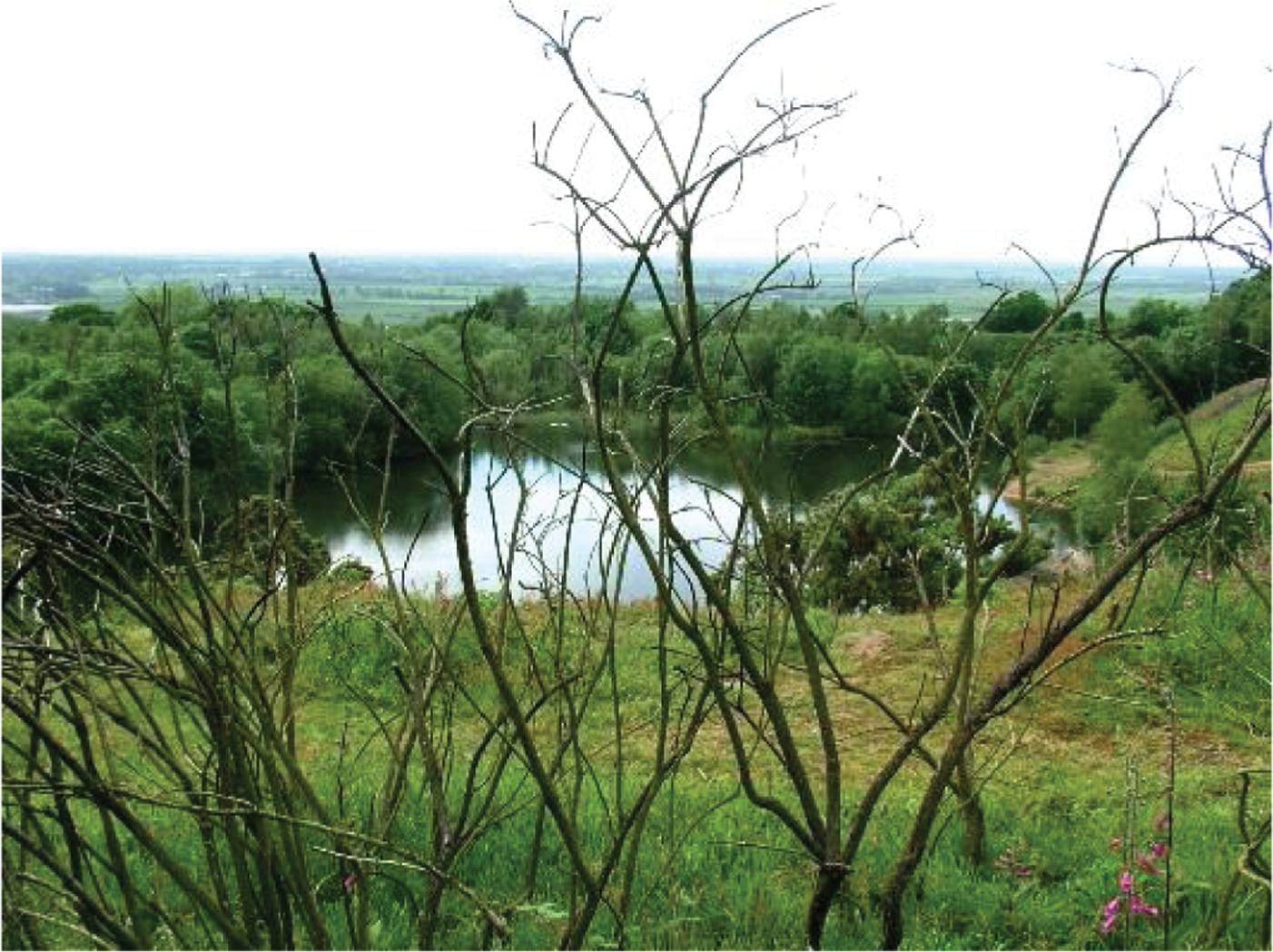
Parbold Quarry, now flooded.
Absent networks and connections
Besides their reference to the absences in the landscape or its attempted infilling, and the absent people and technologies that formerly circulated in and around a quarry, stones from elsewhere also draw attention to the absence of the relationship between building and supply site that would likely have been part of a larger network. This underscores how cities are endlessly materially reconstituted out of their connections with other places through the formation, augmentation and dissolution of networks of various scales. And it also further emphasizes ‘a relational and distributed view of materiality that provides a way to unpack apparent permanencies and stabilities, and show how the competencies and capacities of things are not intrinsic but derive from association’. 40
Stone supply chains are provoked into being by what Bruce Braun calls ‘imbroglios that mix together politics, machines, organisms, law, standards and grades, taste and aesthetics’, 41 generated by often fleeting architectural fashions, building techniques, cost, technologies of transport and quarrying and stone masonry, and local politics in the sites of supply and destination. Supply networks may be ‘tightly coupled with complex, enduring, and predictable connections between peoples, objects, and technologies across multiple and distant spaces and times’ 42 while at other times they may be intermittent, volatile and variable. Manchester’s stone supply initially depended upon the quarry at Collyhurst, but as canal and rail links were established with places further afield, this relationship was terminated in favour of better quality sandstone from the Peak District, other Pennine areas, the Lake District and Cheshire, and subsequently Portland limestone from Dorset, and various Scottish granites and sandstones, as can be discerned in the stony fabric of the city centre. 43 Today, stone is sourced primarily as cladding to clothe iron frameworks, and is often sourced globally. For instance, the Arndale Shopping Centre extension, completed in 2006, features stone from Italy, Portugal, France, Germany, Brazil and South Africa, highlighting the increasingly complex global circulations of disparate materialities. 44
The construction of Manchester Town Hall, completed in 1877, necessitated the provision of an enormous amount of material, including 14 million bricks, 17,000 feet of granite shafting, and 68,000 feet of polished oak, in addition to the importation of 500,000 feet of Spinkwell sandstone from Bradford 45 to clad the supporting brickwork. The quarry, close to Bradford’s city centre, now largely filled in and incorporated into Boar’s Well Urban Nature Reserve, was a huge operation that provided local stone and was exported throughout the north of England (see Figure 2).
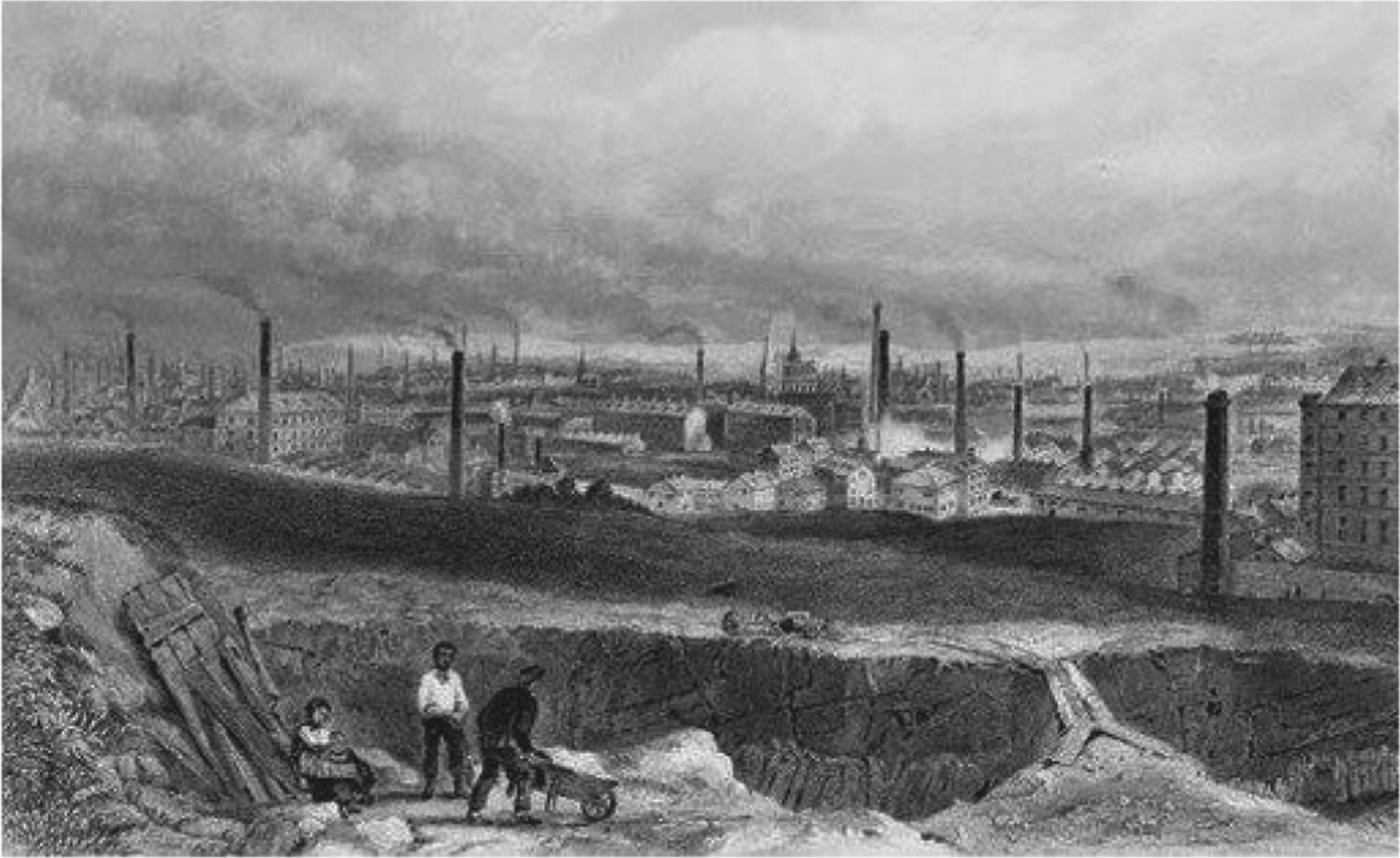
Spinkwell Quarry, Bradford, circa 1870. (Source: Bradford Industrial Museum).
Some networks through which stone was supplied to Manchester are partially intact, with certain routes disappearing while others remain as vestiges of their now absent function. For instance, at the formerly vast Runcorn quarry, traces of the old tramways that transported the stone remain (see Figure 3), the cobbled quarry road at Collyhurst survives (see Figure 4), and the quarry and sections of the six mile Peak Forest Tramway that connected the Peak Forest Canal to the Dove Holes Quarry in the Peak District have been restored as a heritage attraction. The canal, also used to bring gritstone from Crist and Barren Clough into Manchester, has been revived with the rise of leisure cruises, incorporated once more into the larger British waterway network. These networks of stone quarrying, transport and construction have been volatile over the past 300 years, and in most cases, the materials they supplied that clothe many of central Manchester’s buildings have outlasted them.
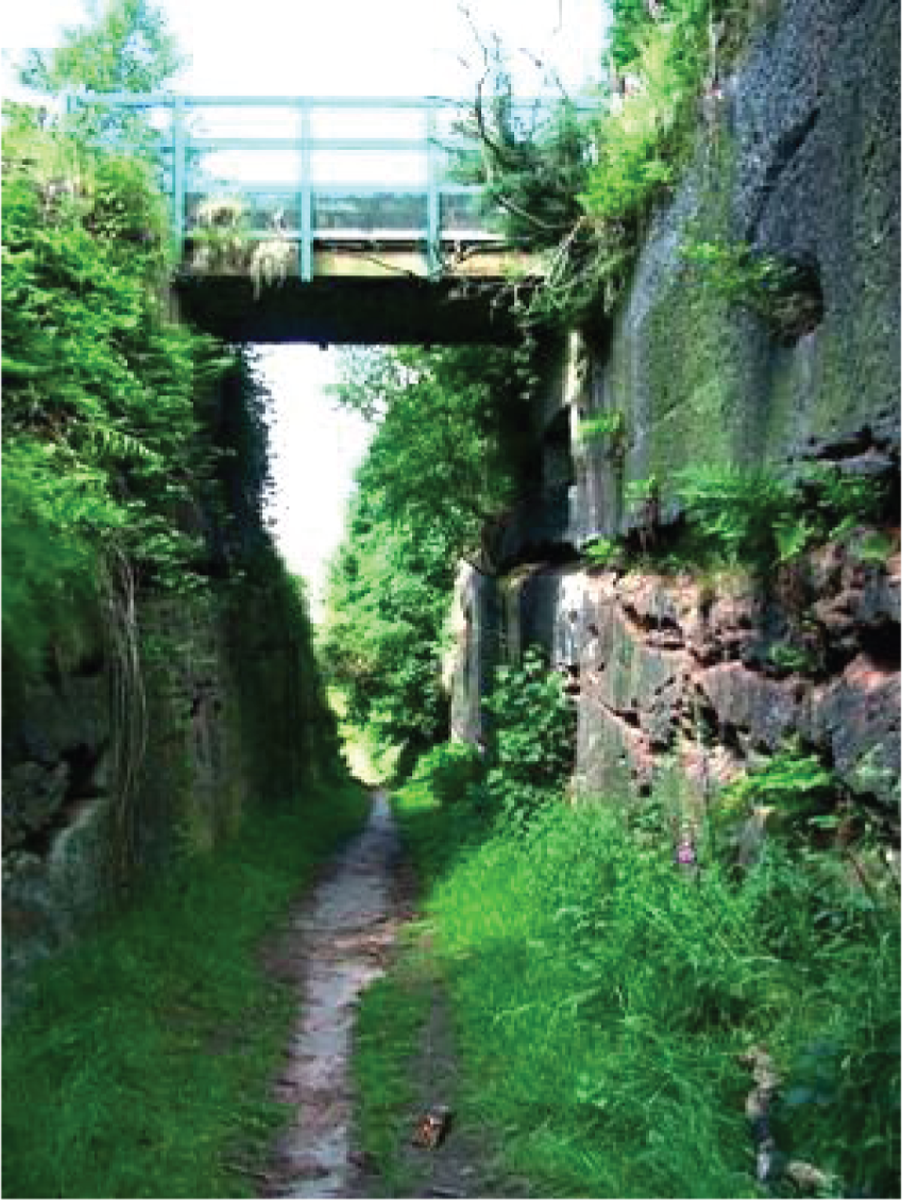
Runcorn Quarry, old tram-line.
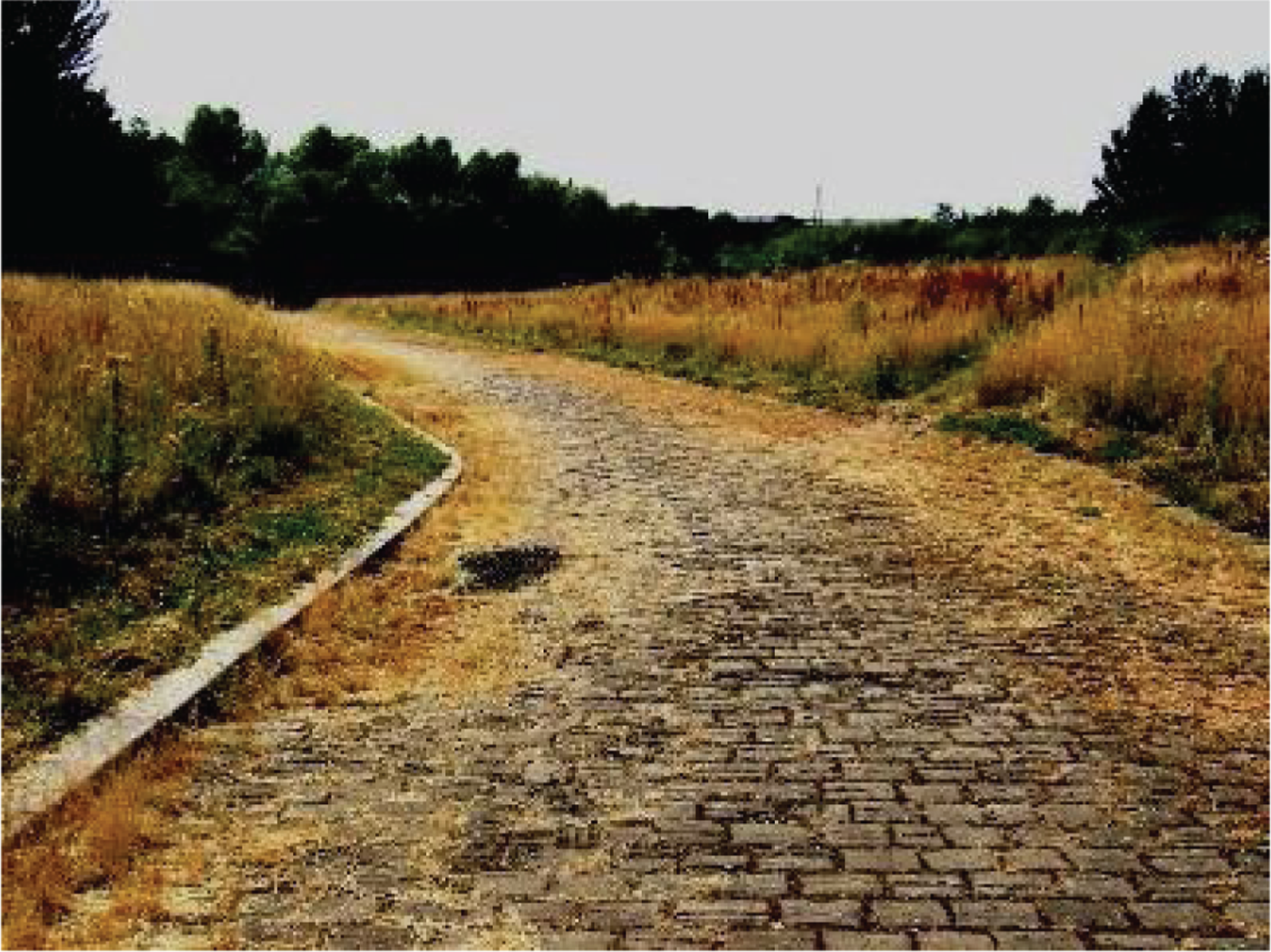
Cobbles, Collyhurst Quarry.
Absent life, distant events
Building stone always contains evidence of its geological formation. In Manchester, the Central Library, along with several other prestigious buildings, is clad in Portland Stone, an upper Jurassic white limestone formed about 135 million years ago on the bed of shallow, warm, sub-tropical seas. The rock contains fossils of shell fragments, fish spines, sea urchins, gastropods, algae and ammonites, embodying former life, organic remains of a long distant environment. A speculative geological gaze can imaginatively reconstruct these long absent life-forms and the environment in which they were created as well as conjuring other unimaginably distant times and places. For instance, the fine grained, early Triassic pink/red sandstone from the Corsehill quarry was formed under hot and arid desert conditions that were occasionally subject to flooding, as can be seen in the horizontal bedding, where a denser water-saturated sediment has sunk into the lower layers (see Figure 5). The traces of these ancient violent events are evident on the surface of some of the stone blocks built into the Bridgewater Hall complex.
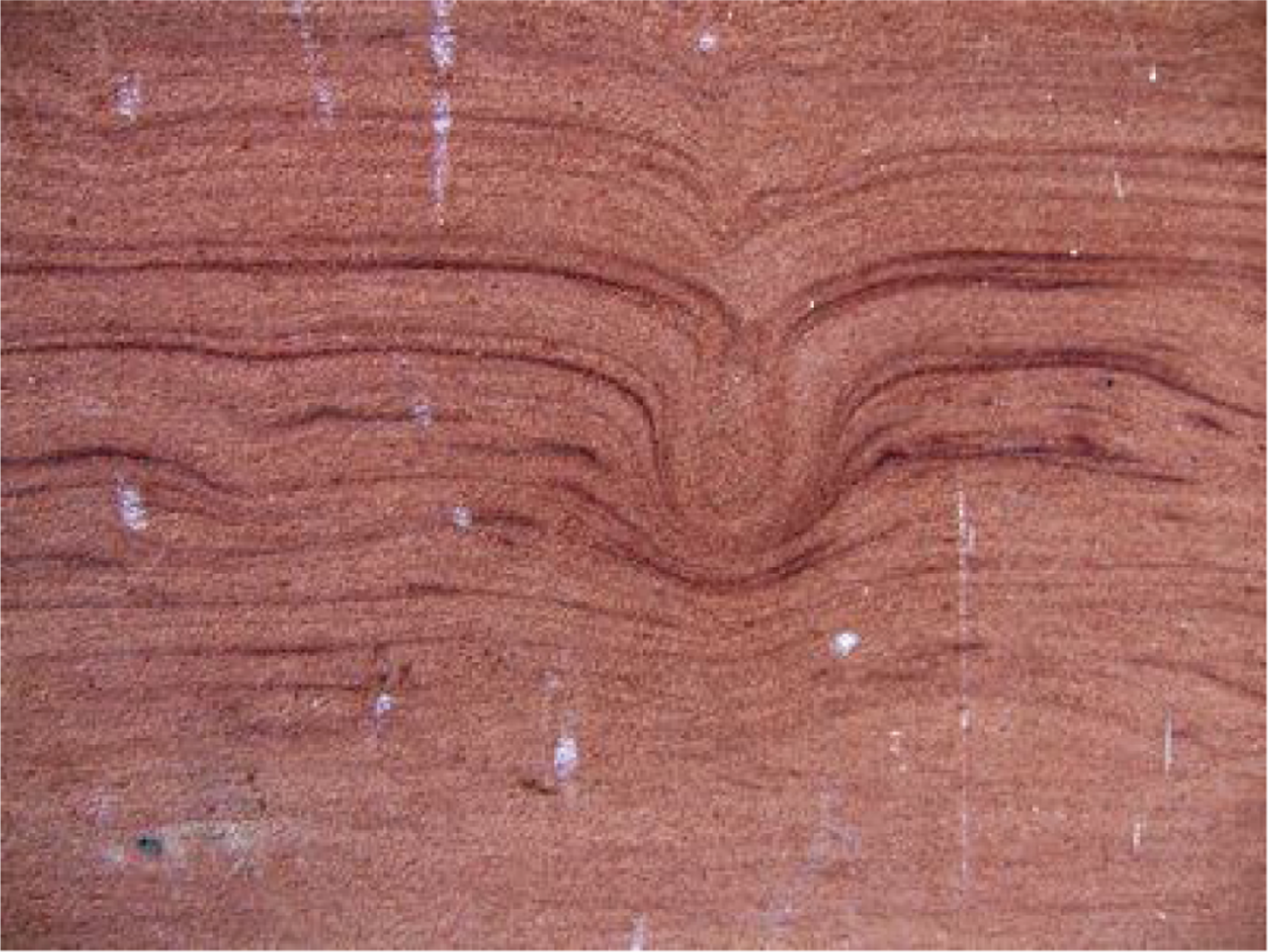
Desert Flooding, Corsehill sandstone, Bridgwater Hall.
The early Permian Binney sandstone from Collyhurst was created from desert sands blown into dune formations during this period when the land now constituting the British Isles was located within the low latitude desert belts to the north of the equator. This stone summons up an absent, alternative Manchester, a place that contrasts with that of the present-day city, renowned for its rain and cloud, provoking us to imagine place at a different temporal scale, and as a process, emphasizing Doreen Massey’s claim that there is no ‘intrinsic indigeneity’ for ‘both allegorically and materially . . . local place identity does not grow out of the soil’ 46 but emerges gradually at a millennial scale out of a multiplicity of conditions and agencies that contribute to its material concoction.
Absent remains
At the east end of St Ann’s Church, a selection of headstones lie neatly embedded in the ground and against the wall, replete with sentiments expressing hopes for eternal and heavenly peace (see Figure 6). However, plans of the church in the late 19th century show that it was surrounded by graves on all sides, typical of urban burial sites. In the intervening years, the paving surrounding the church has been raised around one and half feet and most gravestones have been buried beneath later developments, reducing the spread of sacred space out from the church walls. Their presence is a matter of conjecture: they may be there but presently form part of the substrate of the Square.
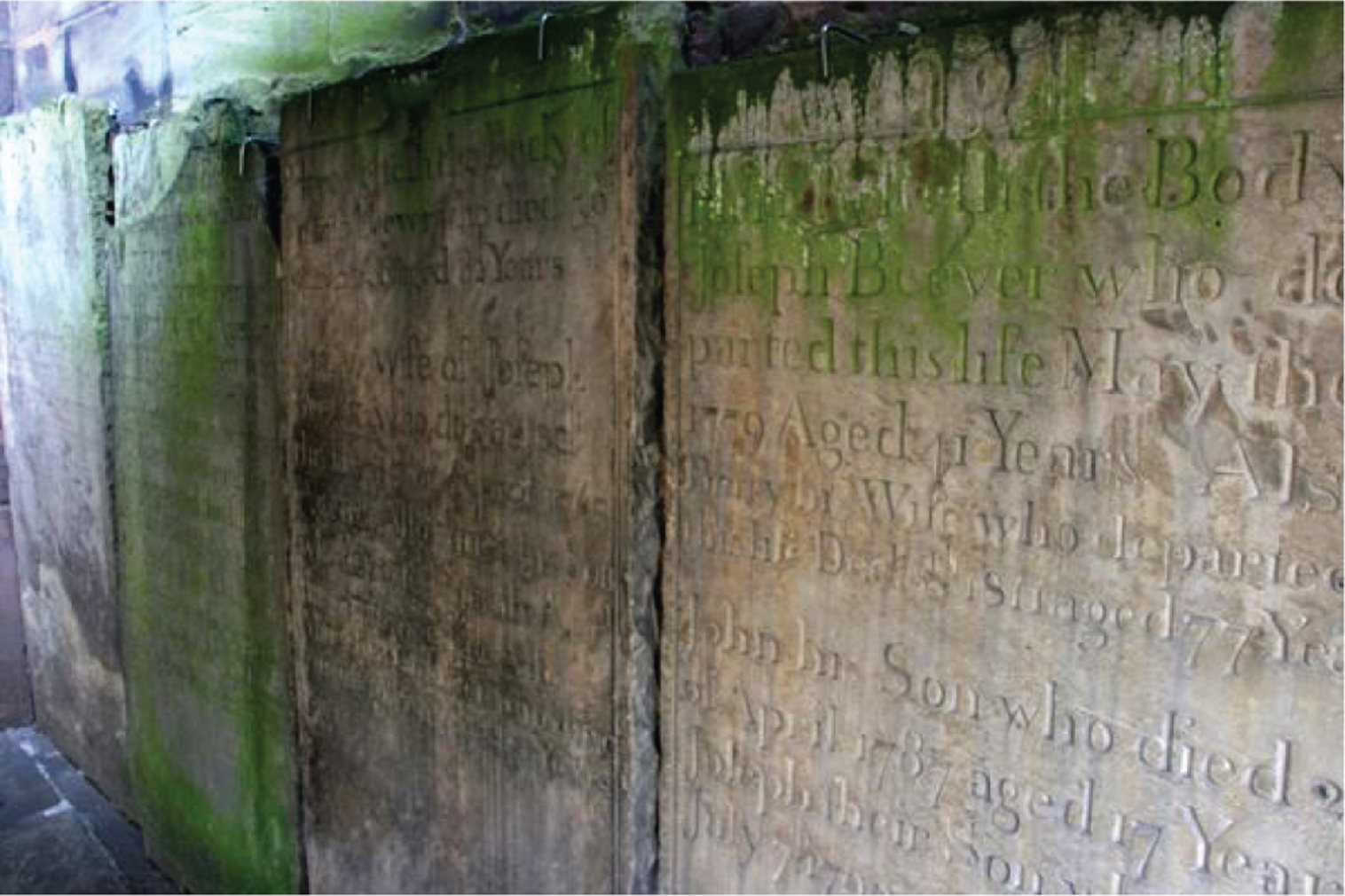
Gravestones, St Ann’s Church.
Also absent are the human remains that lay in the earth below. The graves remain stone signifiers that have been disconnected to the decaying human remnants that are supposedly entombed beneath them. The shortage of burial places meant that at St Ann’s graveyard, as in other growing cities, the ordinary cycle of rotation was superseded by the cramming into plots of increasing numbers of dead, with obvious health risks and environmental degradation and this led to local residents petitioning the authorities to cease burials. Before new burials, they wrote, it was usual for ‘graves to be probed with an iron rod to ascertain whether they are capable of receiving an additional corpse’ and when they were carried out, such burials caused ‘emanations’ to ‘arise from the graves which are injurious to health and offensive in their odour’ (petition from residents of St Ann’s Square 1874). Subsequently, the legions of bodies were excavated and removed and the site was redesignated as a public place and bestowed to the council following the Open Spaces Act of 1887. The remaining gravestones testify to the tradition of city centre cemeteries and their replacement by the more regimented, gridded, garden designs that obviated the need to walk over graves and offer a space for quiet reflection and mourning away from urban bustle. 47
The tomb is exemplary of a material artefact that conjures up the immaterial. Indeed, Mitch Rose critiques dominant analyses in material and cultural studies that privilege the present and invoke relentlessly productivist economic and relational associations between people and things, citing the tomb as a thing that causes us to step aside from this interactive relationality: ‘To engage with a tomb means reckoning with an absence; an event of absence where someone once present is now absent; an event we are called upon to recognize and reckon with’. 48 The radical alterity of the now absent, ‘beyond all knowability, management, manoeuvrability and control’, 49 foregrounds the inability of things to secure meaning. Rose goes further in considering the tomb emblematic of materiality, suggesting that the ‘the ongoing production of objects, buildings and landscapes’ can be conceived as a response to address what is ultimately ‘an arcane, elusive and wholly unpredictable life’ 50 that extends into an unknowable future. He argues that the solidity a material infrastructure promises is illusory, and keeps at bay the unknowable and the inevitability of absence by providing ‘a concrete form we can hold onto in the face of an alterity more radical than any identifiable or knowable difference’. 51
Agencies of absence
The vitality of matter emerges out of its entanglement with innumerable non-human agencies that work over various temporal scales. Some endure while others cease after some time, perhaps because of human intervention. As periods of interaction with matter cease, traces of many of the myriad agencies that have been complicit in a building’s material emergence are embodied in its composition. Moisture, ice, wind, acid rain, rusting iron structures, rising ground salt, biofilms and moss are some of the agencies that contribute to the erasure of stone, part of the uncanny, often imperceptible forces of nature that always circulate around urban materialities. 52 In present day Manchester, a more obvious agential absence is that of soot, a substance that covered and eroded the city’s buildings for two centuries of intense industrialization. Mortar crumbled, elaborately carved stonework perished due to the corrosive action of soot and the toxic air pollution, and the statue of the Prince Consort in Albert Square, according to one contemporary commentator, resembled ‘a representative of one of the dark races’. 53
In the late 1960s, the Town Hall was cleaned of the dense accretion of soot that coated its stone exterior. Today, the rather dull colour and condition of the stone remains remarkably intact. At the time of its construction, contemporary critics protested about the cost of the building since ‘most of its architectural effect would be lost because ruined by soot and made nearly invisible by smoke’. Alfred Waterhouse considered that the prevailing trend to construct polychromatic buildings that combined stone types and colours was outmoded for this very reason, and he chose Spinkwell stone because of its durability rather than its aesthetic qualities, in contradistinction to other sandstones more susceptible to chemical erosion. In due course, the ‘outside walls quickly blackened and its ostentatious ornamentation soon became mere traps for soot and grime’. 54
Similarly, much of the local Binney sandstone used in the construction of St Ann’s Church proved susceptible to the chemical cocktail of pollutants and had to be replaced. Because the church was quickly coated in the all-pervasive soot, there was no imperative to match the colour of the original masonry with the better quality stone imported from elsewhere (see Figure 7). Accordingly, following the Clean Air Acts in the 1950s after which it was thoroughly cleaned, the church was revealed as a complex mosaic of differently coloured sandstones (see Figure 8). This multicoloured stony surface and the Town Hall’s rather dull Spinkwell sandstone testify to an era in which practical strategies for building design and repair had to take into account the inevitability of discoloration on all stone surfaces. Indeed, central Manchester’s buildings now assume a polychromatic appearance that contradicts mythic notions of the grim grey and black hues of Northern materiality. Multiple stone colours and textures are complemented by the greens of verdigris, slate greys and reds, a variety of brickwork, concrete, glass and plastic. This colourful material medley calls forth that which it has replaced, a condition remembered in the design and composition of some of its buildings. Though Manchester’s air quality remains poor, it is now largely devoid of the thick, choking atmosphere of industrial times that besides blanketing buildings in soot also contributed to toxic acid rain and clogged the lungs of its citizens. Where there are now thriving parks, suburban avenues and lawns, once there were blackened stumps, murk and filth, and the highest death rate from bronchitis in the UK. The wealthy moved to leafier residences in the new Cheshire suburbs, leaving behind the environmental ravages and unhealthy inhabitants of the inner city.
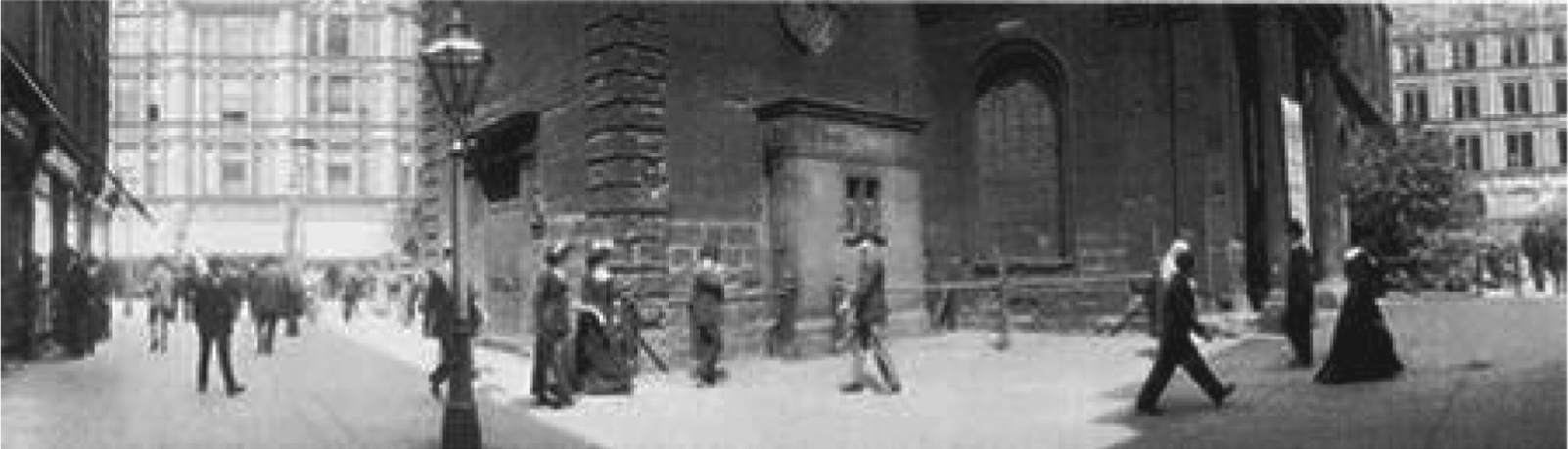
Soot-covered St Ann’s Church, 1870s. (Source: St Ann’s Archive).
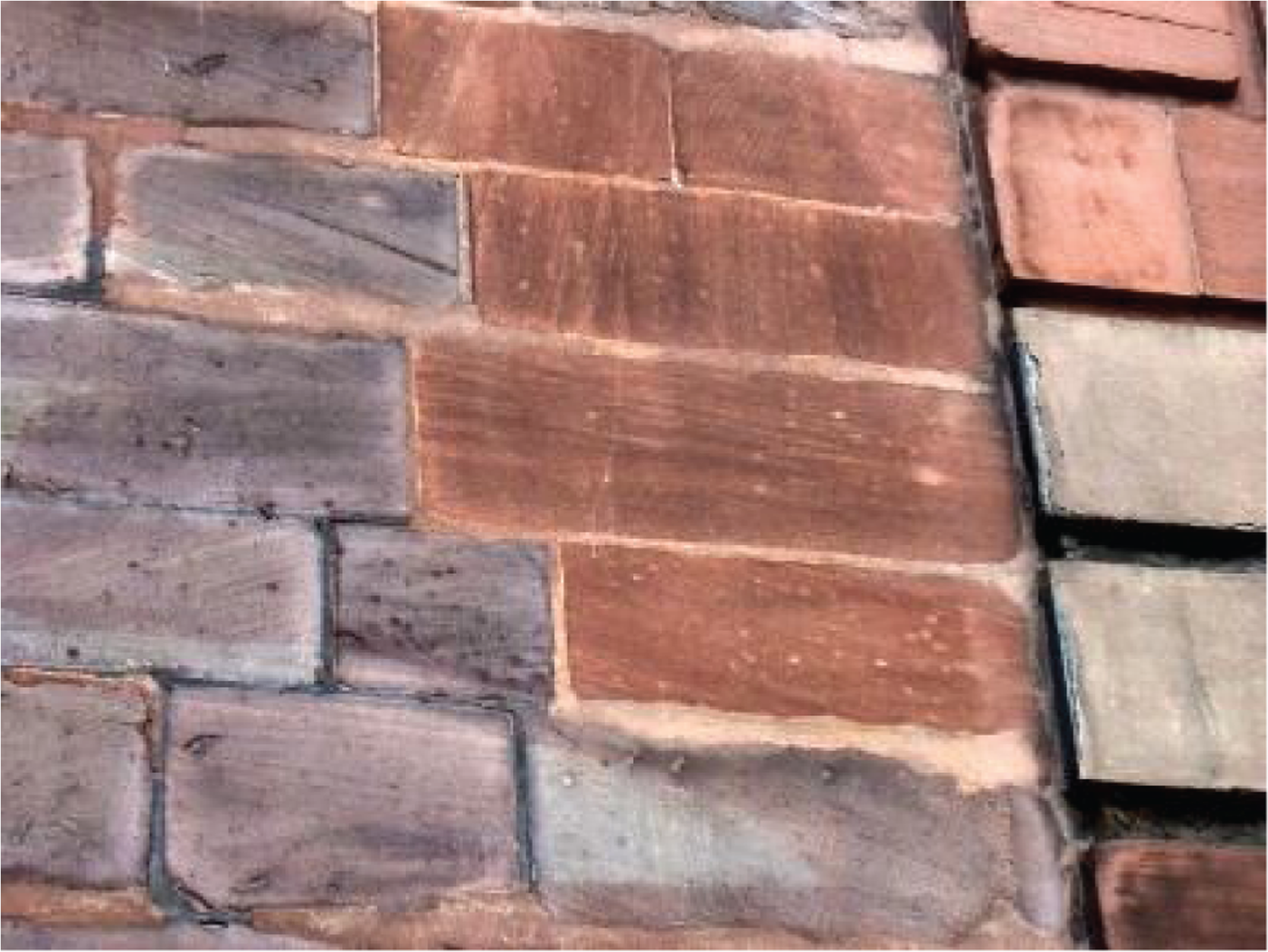
St Ann’s Church: original purple Collyhurst stone, and replacement red Runcorn and Derbyshire sandstone; Repairs to mortar.
Replacing absence
A building ‘calls for unremitting effort to shore it up in the face of the comings and goings of its human inhabitants and non-human inhabitants’ 55 for ‘left to themselves . . . materials can run amok’. 56 However, when we try to defer entropy through erasure and restoration, as Crewe remarks, ‘[o]ur attempts to manage, control, and dispose of things are constantly challenged by the enduring fragments, vestiges, traces, and remnants of things that linger and haunt’. 57 Repair and maintenance continually strive to keep absence at bay and fill the gaps that signify absence. In the stone buildings of Manchester, the processes of decay and erosion are evident in the gaps they create and in the remedial action taken to replace them. These repairs testify to the absences that have been filled with different matter.
This restoration of presence summons up the numerous human and non-human agencies that produced absence and the people who replaced that absence with presence, by filling in and repairing stone. So it is that the vitalism of the material world, the properties and capacities of matter and the innumerable non-human agencies that transform things, provokes the never-ending human attempts to secure the material fabric and meaning of place. Repair, first then, makes absent that which was acting upon stone to harm and ultimately dissolve it. I have already mentioned the massive efforts that have been made to cleanse Manchester’s surfaces of soot, a substance that was previously a co-constituent in many stone buildings. In addition, stone cleaning has banished biofilms from the surfaces of stone, and maintenance has prevented pigeons from frequenting ledges and damaging the stone with their acidic droppings. Second, damage has prompted the replacement of stone in buildings such as St Ann’s Church, where differently coloured stone from various sources reveals the absence of much of the original Binney sandstone (see Figure 8), although much of this original stone remains unlike at the Cathedral where the whole of the exterior stonework was replaced between 1850 and 1870. Third, the spectral, numberless artisans and technicians, masons and builders who have made good the emergent absences of stone building are usually entirely absent from the historical record although their work is materially inscribed.
Such amendments have been improvisational and contingent, some slapdash and some careful, and some may have been subject to erasure themselves. Most older buildings such as St Ann’s Church, Manchester Cathedral and Chetham’s Music School are material compendiums of this unheralded work, palimpsests of repair work that has been repeatedly superseded by newer restoration methods, all enacted with the aim of resisting the tide of material destruction and entropy. This absence is visual and tactile, for the different materials utilized in repair and restoration look and feel different to their surrounding co-constituents, and this perhaps conveys a glimmer of the sensual experience of building, repairing and restoring work. In discussing the Neolithic artisans who constructed the Rollright megaliths in Oxfordshire, Nicholas Chare imagines their intimate feel for the oolitic limestone out of which the stones were wrought, their attunement to its thermal potential and its tactile qualities. Yet, while he imagines this deep engagement with matter, he laments that ‘a fleeting fingering, like a passing glance, is too detached, inadequate for grasping the shifting nature of stone that was recognized and exploited in prehistory’. 58
These agents are usually absent in historical accounts of buildings and places, and stories of their endeavours needs to be inserted in the construction of alternative histories that decentre key figures and events, as I now discuss further.
The spectral horde and the anonymous few
In Albert Square, the large public space adjacent to the Town Hall, the cobbled surface of the ground is punctuated by several statues from Victorian times. This era of public statuary, characterized by imposing stone likenesses of monarchs, philanthropists, military heroes and statesmen, is long over, its language of realism and gravitas bereft of irony or humour seems illegible to modern tastes. The raising of large sums of money through public subscription to honour these individual men seems equally remote.
As Nuala Johnson declares, such monumental statues serve as ‘points of physical and ideological orientation’ often around which ‘circuits of memory’ are organized. 59 But they are rarely remembered. Some people may be mesmerized by the gothic monument bestowed with imperial symbols that houses the statue of Queen Victoria’s consort, Albert, and many will recognize the name of William Gladstone, but few now remember 19th century radical John Bright, banker and local philanthropist William Heywood (see Figure 9) or Manchester’s reforming bishop, James Fraser. They belong to a public realm and a hierarchical world that has largely disappeared.
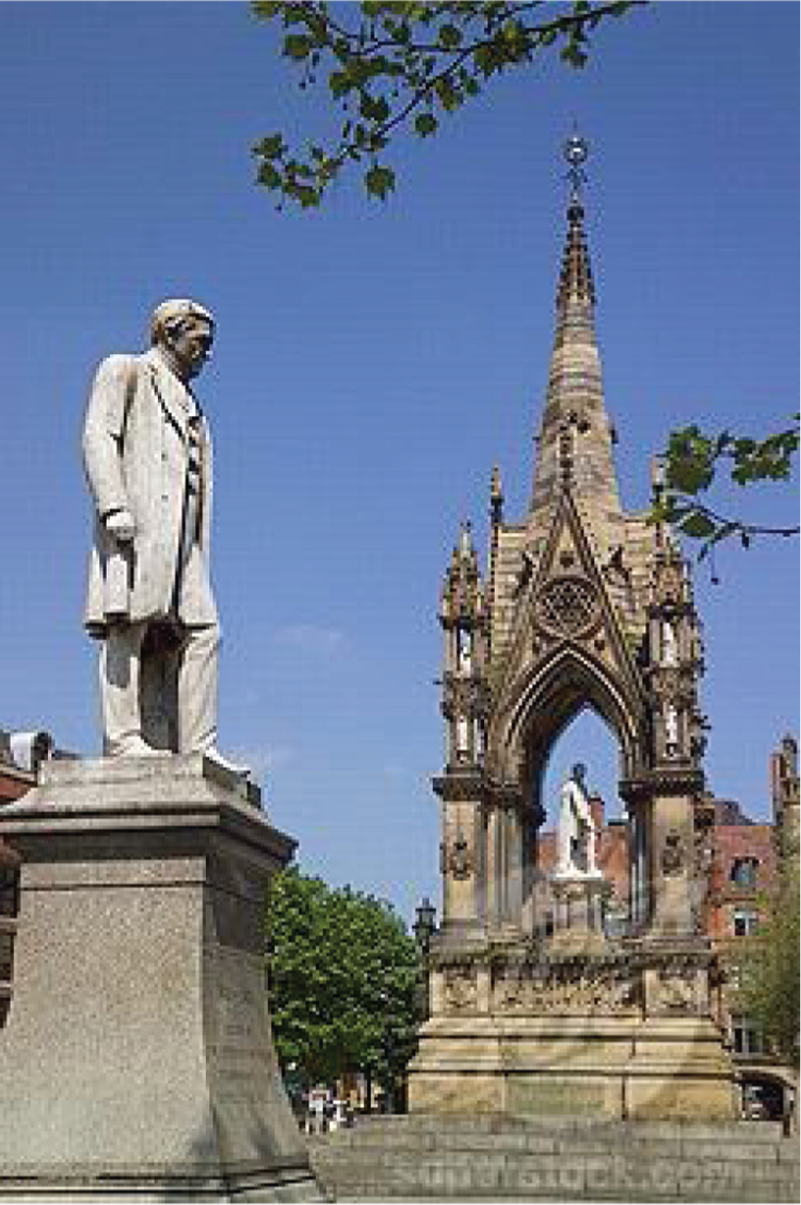
Oliver Heywood and Prince Albert, Albert Square, Manchester.
Marina Warner 60 shows how a post-revolutionary elite wanted to materialize particular ideals in the statuary along the Champs Elysees in Paris to provide an enduring testament to revolutionary values. Yet, the classical allusions upon which such monoliths depend for their meaning are no longer familiar to contemporary onlookers, revealing that despite the desires of the powerful to imprint meaning upon cityscapes, such aims are often thwarted by the changing basis of knowledge and aesthetic convention. A contemporary example is the ensemble of the huge, heroic, totalitarian state architecture, sites of collective consumption and heroic statuary of post-socialist Bucharest that remain despite the absence of the political and social conditions under which they were erected and which gave them legitimacy. In the absence of this regime their meaning has shifted and many have been adapted for other purposes. 61
Allison Bain 62 shows how contemporary artists in Toronto strive to attain everlasting presence through numerous strategies, some succeeding while others remain in obscurity. We can see the ways in which the material, here of stone, testifies to this ongoing quest throughout urban history: for sculptors and those they sculpt to mark presence on space. The fame of some is fleeting, others are nameless but remain present, and some endure over a longer spell. Despite the obsolescence of this form of individual commemoration, the stone figures maintain a presence in the Albert Square, atop their plinths, their stony faces gazing soberly into the middle distance, as if deep in spiritual or intellectual thought.
This vague presence contrasts with the absence of those who laboured in the construction of the Town Hall. Surrounding the already built Albert Memorial in the square were a host of masons and artisans whose numbers expanded to around 700 as the building neared completion, along with an assortment of steam engines, cranes, polishing tables and saws. 63 Unlike Waterhouse, the still celebrated architect of the Town Hall, this legion have not been recorded as having made a significant contribution to the building. Paid off after finishing their work, they are part of a historically anonymous transaction that evaporates, though it may occasionally be rescued in some archive. Of course, this absence testifies to how certain subjects have been historically valued less than others and yet they are somehow difficult to banish from the mind once they have been imagined in the square, part of a scene of hard work, knotted muscles, stone dust clogging the nostrils, the sweat and the shouts and jokes and banter. And if the stone of the Town Hall is inspected, traces of saw and chisel marks are evident, and like the mason’s marks (see Figure 10), graffiti and fingerprints that can be found in stony facades, traces of their presence remain, of their intimate engagements with the vital, ‘incipient tendencies and propensities of stone’ and the ‘other forces, affects or bodies’ with which it comes into contact. 64
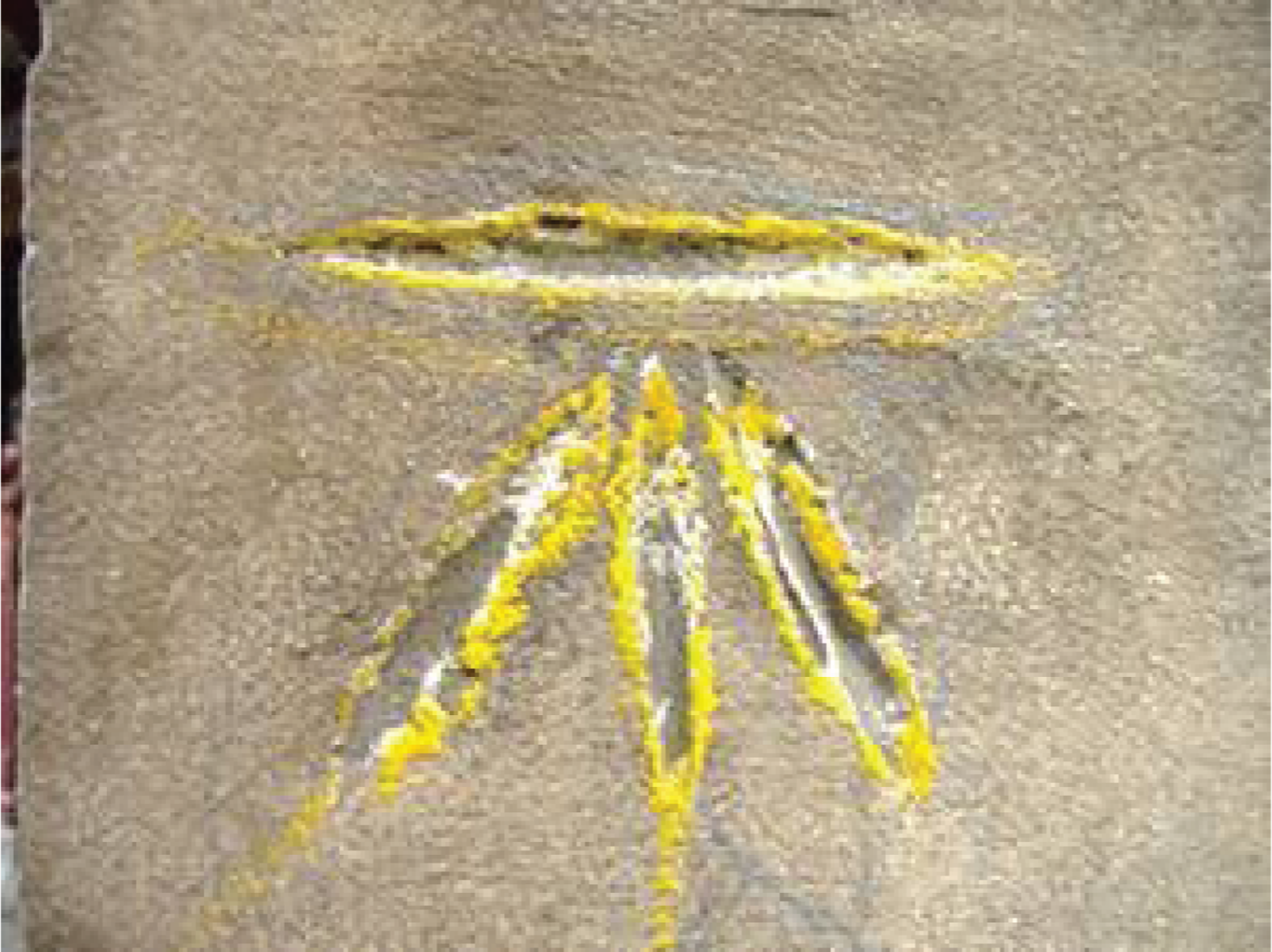
Mason’s mark, St Ann’s Church.
Conclusion
The forging of promotional and historical narratives may testify to desires to fix meaning in place. However, as I have shown above, these visions are continually liable to be disrupted by material absences, here revealed in the stony fabric of the city. It could scarcely be otherwise when we consider the dynamism of the city, with its vagaries of fashion and taste, the creative destruction wrought upon its fabric by capitalism in its various incarnations, by the impulsive decisions of planners and bureaucrats. And there are the vital qualities of materiality itself, ceaselessly in formation, always emergent. In a world of seething, entangled energies and agencies, places and things are inevitably different to how they used to be and how they will become. In the material fabric of place, certain absences leap out and announce themselves, others can be traced with some effort while others fade from the world. Caitlin DeSilvey 65 argues that the materiality of the city haunts the future as well as the present, foretelling of future gaps, forgettings and absences and this can promote ‘an anticipatory history that foresees absence as part of the flux of material change’. Since absences are everywhere, distributed in various materialities across space, it is imperative to acknowledge them and allow them to provoke and proliferate the ways in which the city can be narrated, for behind each absence lies a story, whether historically apparent, fantastic or somewhere in-between. In this paper, I have tried to show that a more sensual, imaginative and conjectural approach to place narrative can be facilitated by an engagement with stone and the multiple absences it contains and suggests 66 when we move beyond an apprehension of things as mere brute materiality, acknowledge the immaterialities that circulate around them and honour the multiple human and non-human agencies that contribute to the emergence of the city.
Footnotes
Acknowledgements
I would like to thanks the organizers of the special session on absence at the IBG-RGS annual conference of 2010 and of this special issue, especially Lars Frers and Lars Meier, for their support. I also thank Ian Drew, the late Fred Broadhurst, Tim Cresswell and two anonymous reviewers.
Funding
This research received no specific grant from any funding agency in the public, commercial or not-for-profit sectors.