



Abstract
Recent work by cultural geographers on visual art has emphasized performative and participatory aspects focusing upon the embodied and multi-sensory experience of encountering and being part of a work of art. Research on non-figurative art has much to offer in elucidating the relationships and distinctions between representation, non-representation and abstraction. Non figurative artists were representing or enacting a new kind of materiality, one that was putative, in process and ever changing. That materiality was based upon the adoption of a mid-20th-century cosmology and inspired by recent advances in the understanding of matter and the universe. Kinetic art, which is characterized by a set of abstract aesthetics that represent or reproduce real or illusory movement, was, especially in the post-war period, inspired by this new cosmology. Mid-century kinetic artists created non-figurative abstract models of the latest understandings to bring their associated energies, forces and motions to the senses of the viewer-participant. The models that kinetic artists produced in a variety of media were designed to be experienced in an embodied manner rather than simply viewed. These and other models of a mid-century cosmology signify a period in which the practices of representation were shifting significantly and consequently demand our attention.
Introduction
This paper explores the representational practices of kinetic artists in the light of wider challenges to the significance of representations and, in particular, their connection to materiality. In response to conceptual developments emerging from theories of performance and non-representation, cultural geographers working on a range of textual forms have arguably begun to make more explicit than before the role and function of representations. This work is uncovering the ways in which representations function not as mimesis, nor simply as historically and contextually bound snapshots, but also as mobile, processual and active. 1 This paper builds on that development and focuses not on an individual artist or piece, but on a movement in 20th-century visual art, kinetic art, and, in particular, the ways in which kinetic artists reflected a mid-20th-century sense of materiality that in turn reflected an interpretation of a cosmological shift.
In the mid-20th century there was a subtle change in cosmological understanding that arose from the dissemination of ideas from new physics developed in the first half of the century. Artists who wished to represent the newly understood nature suggested by these ideas had to find new ways of doing so and, among visual artists, abstracted forms of representation were one outcome. By attending to developments in abstract art through the mid-20th-century geographers can track significant changes in the practices of representation among artists and others who were responding to the emergence of a new understanding of nature and the universe. Those new understandings were driven by theoretical and practical advances that had profound effects on the way in which matter was understood. Artists working with abstracted aesthetic forms like kinetic artists were then representing or enacting a new kind of materiality, a materiality that was putative, in process and ever changing. The daily practices of 20th-century visual artists revolved around explorations of materiality and representation and studying their work can help elucidate something about a new sense of the material that informed their work.
To develop this proposition I begin with some coverage of the ways geographers working on visual art have used a notion of representation that employs a take on materiality that is closely related to a reading of renaissance cosmology on the one hand and historical materialism on the other. Work by geographers on non-figurative art is then reviewed to demonstrate how a focus on representational practices suggests an alternative relationship between representation and materiality. The succeeding empirical sections map out kinetic art as an aesthetic practice, in particular, with respect to the ways in which kinetic artists attempted to develop representational strategies that would reflect a new sense of materiality emergent in mid-century cosmology. The conclusion reviews the importance of representation and how we might attend to the ways in which the practices of representation changed significantly as a result of a desire to reflect and model new understandings of nature and the cosmos. In this, the work of kinetic artists pre-echoed geography’s current concerns with representation as active and contingent and co-emergent with matter and materiality, and talk too to the discipline’s foundational concerns with cosmography.
Geography and visual art
Figurative art 2 has often been the empirical focus of geography’s engagement with the visual arts, with landscape and nature representation the primary subject of attention. 3 The development of critical approaches to artistic representations with the ‘new’ cultural geography of the early 1980s is often characterized as a return to landscape within the discipline. However, the focus on landscape art that emerged at that moment was less about continuing long-standing traditions of engagement with a genre of figurative art and more about its centrality to the conceptual developments led by Denis Cosgrove and others. Cosgrove’s still influential project was to trace the material connections between modes of representation broadly conceived and modes of seeing during the renaissance, and specifically in making material connections between these visualizations and social and morphological changes in his region of study, the Venetian republic and the Veneto. He traced a revolution in ways of seeing sparked by renaissance cosmology, which itself was bound up with innovations in visualizing and representational practices, such as developments in perspectival representation and navigational, terrestrial and astronomical mapping techniques. Specifically, it was in the mapping and accurate measurement of resources, especially land, that the material connections lay. 4
The concepts of landscape as they were adopted by geographers from the mid-1980s then were not a result of a call for us to study landscape art and other forms of landscaping per se, but rather a response to a plea to recognize the material basis of representations. So, it was not that landscapes and their representation were more appropriately ‘geographical’ than other forms of visual art, nor indeed that there was a longer tradition of looking at landscape art among professional geographers. Rather, the theoretical developments shaped by Cosgrove, Stephen Daniels and others demanded that the representation of land as scenery in the modern period was essential to material changes in society. Accordingly, the method of choice was iconographic, hermeneutic and deconstructive and based primarily on exposing texts to their real contextual histories of production and – although perhaps less often – consumption. While new cultural geographers working on visual arts soon downplayed historical materialism, representations of landscape remained central.
Perhaps as the latest stage in that move away from more fundamental renderings of historical materialism, there are recent shifts discernible in the study of visual art by geographers that, while not rejecting the representational, epistemologies of deconstruction or iconography, emphasize art as a performative and participatory encounter. These new approaches are also responding to challenges to the cultural turn in geography that ask us to look beyond representation and to turn our attention to the fluid and processual nature of the world. 5 These challenges are developing innovative renderings of embodiment and subjectivity that models human subjects as enmeshed in and inseparable from a vital network of biological and non-biological, technological and non-technological, material and non-material things. There are some quite fundamental challenges to the foundations of cultural geography, not least in the way in which established conceptions of material and materiality are being questioned. In response, recent work by cultural geographers interested in the visual arts has broadened somewhat and focuses not only on visual aspects of a piece or oeuvre, but the embodied and multi-sensory experience of encountering and being part of a work of art. Harriet Hawkins’ work on installation art, for instance, is an attempt to capture the experience of taking part in a work of art, of moving through an installation, of viewing it through various technologies and from various perspectives, of experiencing in it not only the sights, but its sounds, smells and what it feels like to touch. 6 This multi-sensory, embodied and participatory focus while at once redressing an imbalance and attending to the consumption of visual art, can be read as a response to these recent challenges to the longer established ways of engaging with art in geography. In addition, it is a response to the kind of art objects under scrutiny in this work. Throughout the post-war period artists have been experimenting with form to create decentred and deconstructive aesthetics, where the meaning of a work of art emerges not on the plane of the canvas or on the surface of a sculpture, but in the space between the ‘viewer’ and the work itself.
Art, abstraction, representation and geography
Although work on non-figurative and abstract art by geographers is not extensive, that which has been produced has something to offer in elucidating the relationships and distinctions between representation, non-representation and abstraction. This work reminds us that representation in the visual arts is not a simple process of depiction. Non-figurative art can, in other words, also be representational: it can, for instance, as Crouch and Toogood demonstrate in their work on Peter Lanyon, relate knowledge of the world to the viewer and in doing so exercise and activate senses other than sight, and so portray an emotional and abstracted attachment to place and landscape. 7 Non-figurative forms of representation thereby engage and immerse the viewer into the artwork as an event or moment and undermine the objectifying, distanced view of landscape and nature as portrayed in post-renaissance representations. The viewer of non-figurative work becomes the figure in the landscape because ‘the spectator is pulled into an active participation with the painting’, and ‘an extension of the pictorial space’. 8
Abstract art has also been used to elucidate current concerns in the discipline around the limits and possibilities of representation. Dewsbury and Thrift have used Paul Klee’s work to think through the ways in which non-figurative representation is not driven by a search for a point of origin or fixity, but motion and movement, of portraying a world and universe in flux – a multi-faceted aesthetic of ‘genesis eternal’. 9 The de-centred, non-objectifying forms of non-figurative abstractions have potential to offer something to our own debates around material and materiality. And the networked materiality of nature is a recurrent theme identified by geographers studying abstract visual art. 10 Matthew Gandy’s work on the art of Joseph Beuys and Gerhard Richter suggests that contemporary apprehensions of nature are more appropriately portrayed in non-figurative forms, partly because of the objectifying process of figurative, naturalistic representation. 11 Abstraction produces immersive, embodied models of nature that portray nature as a vital network of material and immaterial interactions that are also now of concern to geographers. 12 Because this nature is relativistic, decentred and processual, non-figurative abstractions would appear to be the most appropriate aesthetic form with which to attempt to model it.
The nature that exercises some abstract forms of visual art has also been related to wider cosmological speculation during the 20th century in which the artist worked with new conceptions of energy and matter. Bridget Riley’s optical art (op art) aesthetics, for instance, adopt a formal and rigorous abstraction that, when experienced by an immersed viewer-participant, can be interpreted as conveying a contemporary cosmic nature of mass and energy in flux. 13 Here, I want to develop this further by outlining the ways in which new ideas about matter, energy and the universe were affecting mid-20th-century artistic practices of, in this case, kinetic art. What was being reflected in this art was a new cosmology to which a vital, processual and at once material and immaterial understanding of nature was central. While not fully replacing the modern renaissance cosmology that has been the focus of much work on landscape and nature representation in geography, a new cosmology augmented and sometimes undermined those modern ways of seeing with a more subtle definition of matter and thereby ultimately, nature too. Developments in physics and cosmology from the mid-1920s drove these new understandings and while it is never clear just how much of this complex theoretical material artistic producers fully ingested, it is present in the statements they made about their work and also often discernible in the forms of the work. 14
Kinetic art: defining the aesthetic
The artist and experimental film maker Hans Richter provides perhaps the most succinct definition of kinetic art, describing it as the ‘Movement Movement’. 15 Put simply, kinetic art is a visual art that represents or reproduces real or illusory movement. While some critics and practitioners have taken a more narrow view of what is and is not kinetic art, I use a broad view including works that are two-, three- and (if you include time introduced through actual motion) four-dimensional: from the illusory, flickering and pulsing surfaces of abstract op art; through variously powered mechanical objects and sculptures; to pieces consisting of lightshows and lighting effects. While in some works there are representative elements and forms, for the most part, kinetic art is non-figurative, abstract and characterized fundamentally by the transmission of movement to the viewer. For surrealist and critic Aldo Pellegrini, kinetic art did this in five ways: first in immobile structures where in work such as op art the movement comes about through the ‘energy of perception’ when one views or experiences a painting; second, mobile pictures or ‘transformables’ that use some form of motor; third, un-mechanized mobiles that are operated by the movement of air or by the physical interaction of the viewer; fourth, sculptural forms that use magnetism to create movement; and fifth, ‘Lumitechnical apparatuses’, or installations that use moving lights. 16
Pioneer of the form, Alexander Calder was driven to portray movement in his kinetic sculptures. His Crinkly avec disc rouge (1973) (Figure 1) sculpture that today sits in the Schlossplatz in Stuttgart is one of a large number of ‘mobiles’ that he produced throughout his lifetime. Calder’s mobiles were constructed in various sizes, some occupying gallery space and others, like Crinkly, in open air sites. To Jean-Paul Sartre, a regular visitor to Calder’s studios, Calder’s mobiles were ‘little private’ celebrations having no existence other than its movement that was perpetual and always becoming: ‘A “mobile” is in this way like the sea, and is equally enchanting: forever re-beginning, forever new’. 17 Crinkly embodies movement in various ways: its ‘legs’ are bent at the joint as if in mid-stride; that motion is emphasized further by the blocks of contrasting colours – red, yellow, black, white – with which the elements of the limbs are painted; the kinetically mobile component that sits at the top consists, like all of Calder’s mobiles, of organic geometric shapes that rarely had square edges because he felt forms such as squares and rectangles disrupted the flow of movement. The mobile in the Schlossplatz is driven by wind currents and eddies that circulate through the surrounding buildings. Calder was not inspired by the ever increasing mechanical movement that characterized the 20th-century world, but movement in nature. While he exploited the natural movement of the air to animate his sculptures, it was in fact the kinetic nature of the movement of bodies in the cosmos that he wished to portray: ‘You see nature and then you try to emulate it …The basis of everything for me is the universe. The simplest forms in the universe are the sphere and the circle. I represent them by disks and then I vary them . . . Even my triangles are spheres, but they are spheres of a different shape’. 18 In Crinkly this is reflected in the mobile element of the piece with circles and organic geometric shapes representing cosmic bodies in motion.
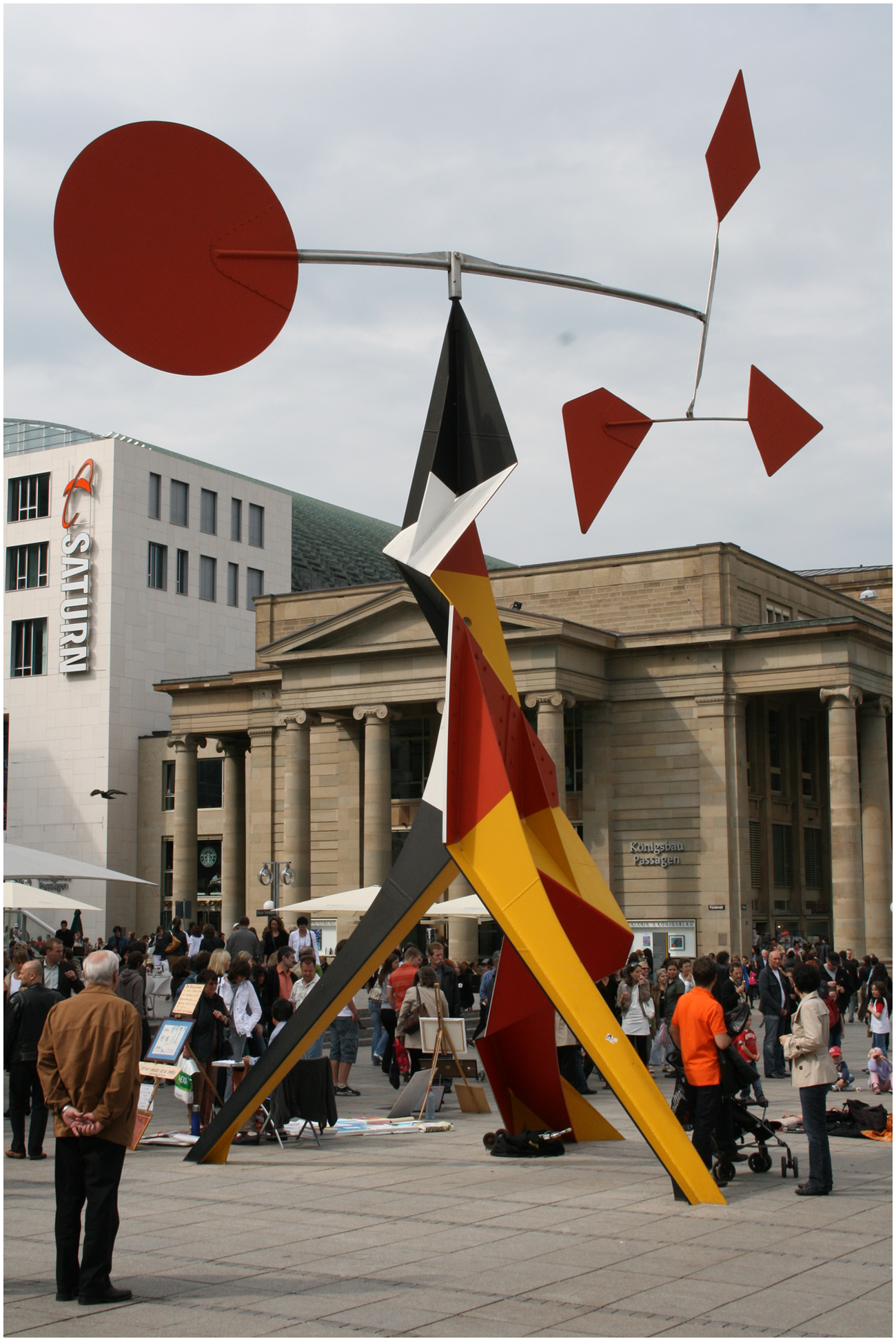
Alexander Calder, Crinkly avec disc rouge, 1973, steel, Schlossplatz Öffentlicher Platz, Stuttgart. Photographed by François Philipp in 2008. Copyright 2.0 Generic (CC BY 2.0).
Kinetic art appeared from the early 20th century onwards emerging in the ideas and work of the Futurists in the 1910s and 1920s. Arguably, however, it was in the 1930s that Kinetic Art first came properly to prominence through the work of its first stars, Alexander Calder and László Moholy Nagy. While an American, Calder found greater inspiration and more outlets for his work in continental Europe, especially Paris. 19 After the Second World War, however, and associated with the migration of a number of other key figures, the United States and the Americas generally became a territory from which kinetic art of various forms were produced. The most prolific period for kinetic art was post-1945 and running to around the mid-1970s, with the late 1950s and 1960s as a period of most activity, probably because aspects of the aesthetic were so well suited to the various performative practices adopted by the counterculture, especially those associated with lumitechnics. 20 During that time, while the forms diversified, kinetic art found coherence as a movement and ‘self-sufficient genre’, and featured in a number of exhibitions globally. 21 Kinetic sculptor George Rickey’s assessment is that prior to the 1960s and despite the efforts of pioneers like Calder, the movement had no ‘patriarch of Form’, that is to say that the genre was still in its infancy and only with time would a ‘distinguishable Form’ emerge. It was, he said, ‘only in the last fifteen years and quite outside Calder’s work, that the indications of the Form of kinetic art’ began to appear. 22
Artists who used a variety of techniques, and many critics in that especially prolific post-war period, declared kinetic art as the most significant development in artistic and aesthetic practice, because it better reflected the contemporary ‘epoch of movement and speed’. For Pellegrini, renaissance questions of space and perspective were replaced by the kinetic trend in art because the ‘notion of movement reveals itself to be most modern by being tied in with scientific relativity and time, on the one hand, and on the other, with vital dynamics’. 23 This, then, was a genre in tune not only with a general cultural trend towards the veneration of movement and speed but also one most definitely in thrall to contemporary ideas about space-time, matter and energy. During the 1960s there was a spate of exhibitions and displays of the kinetic form. 24 As practising artist Paul Henry noted in 1969, once the concern of a few artists, kinetic art ‘has proliferated, so that it is being created by ever increasing numbers of fine artists, while at the same time kinetics have become one of the major attractions at discotheques and pop-music concerts’. 25 Many displays of the genre did not take place in the spaces of the art museum or gallery, partly because of the size and complexity of some installations, partly because the ‘materials’, such as light, required a particular kind of space, and partly because many of the developments in the aesthetic were happening in the multimedia lightshows favoured by the counterculture.
Perhaps because it did not easily occupy the spaces of established art display and was connected with a notorious if not infamous social movement, kinetic art is rarely found in galleries today. 26 One is more likely to encounter it in the departure lounge of an airport or similarly large and anonymous interior spaces. Guy Brett, one of very few chroniclers and appreciators of kinetic art, wrote in the catalogue of the Hayward Gallery’s 2000 retrospective on the kinetic, Force Fields, that the genre has been treated as a ‘kind of side-show or entertainment in 20th-century art, not to be treated with the same high seriousness as, say, Minimal Art, Conceptual Art, or for that matter Pop Art’. 27 Kinetic art, then, is a maligned and under-appreciated artistic practice but it has something to say to our contemporary concerns for representational practices.
Techniques of kinetic art
When one explores the development of kinetic art through the words of artists in what became their house journal Leonardo, more than other contemporary genres, there was a tendency to focus on technique and the technical. Critics would frequently write of kinetic artists as completely au fait and in tune with new technology and how they reflected that comfortable familiarity in their practice. 28 In three-/four-dimensional art the artist was required to have some sense of practical engineering and, depending on how a sculpture or installation was to move, knowledge of mechanics, magnetics, electrodynamics, aerodynamics and so on was also required. In two-dimensional optical art the emphasis was most often on different ways of exploiting the moiré effect, whereby when ‘two or more families of curves (actually of finite line-width) are superposed, a new pattern appears: the moiré’. 29 For op artists working on canvas, like Bridget Riley and Victor Vasarely, and concerned with re-presenting the buzz and momentum in the world, moiré was an ideal technique because the painting or drawing ‘appears to be oscillating . . . Moiré is a demonstration of lines energized’. 30
Vasarely’s Supernovae (1959–61) (Figure 2) moves, but unlike Calder’s work, the movement is illusory. The structure of the painting gives the impression of rhythmic pulsation as one’s eye is drawn from left to right and back again. The shimmering effect, in which one can also perceive colours, is perhaps appropriate to the spectacular moment of mass into energy after which the piece is named. The moiré effect in Supernovae, although quite understated, works at the moment of perception and causes apparent movement on the plane of the painting. Vasarely uses the effect to convey the palpable energies between the perceiving eye and the picture and perceiving the energies in this painting is a thoroughly embodied and immersive experience. Vasarely was at pains to make his art a social one – ‘[a]rt is the plastic aspect of community’ 31 – and one that was sensed rather than thought-through or intellectualized: sensed to such a degree that it ‘creates a virtually physical effect on the viewer’. 32 In Supernovae, energy and invisible colour is conveyed to the immersed viewer-participant who can not only see but feel the energies. The moiré effect, then, gives the illusion of energized motion in the embodied mind of the perceiving viewer and was a kinetic technique that was both the significant innovation of op art but also attracted the greatest criticism for the sense of nausea and dizziness that often accompanied lengthy viewing.
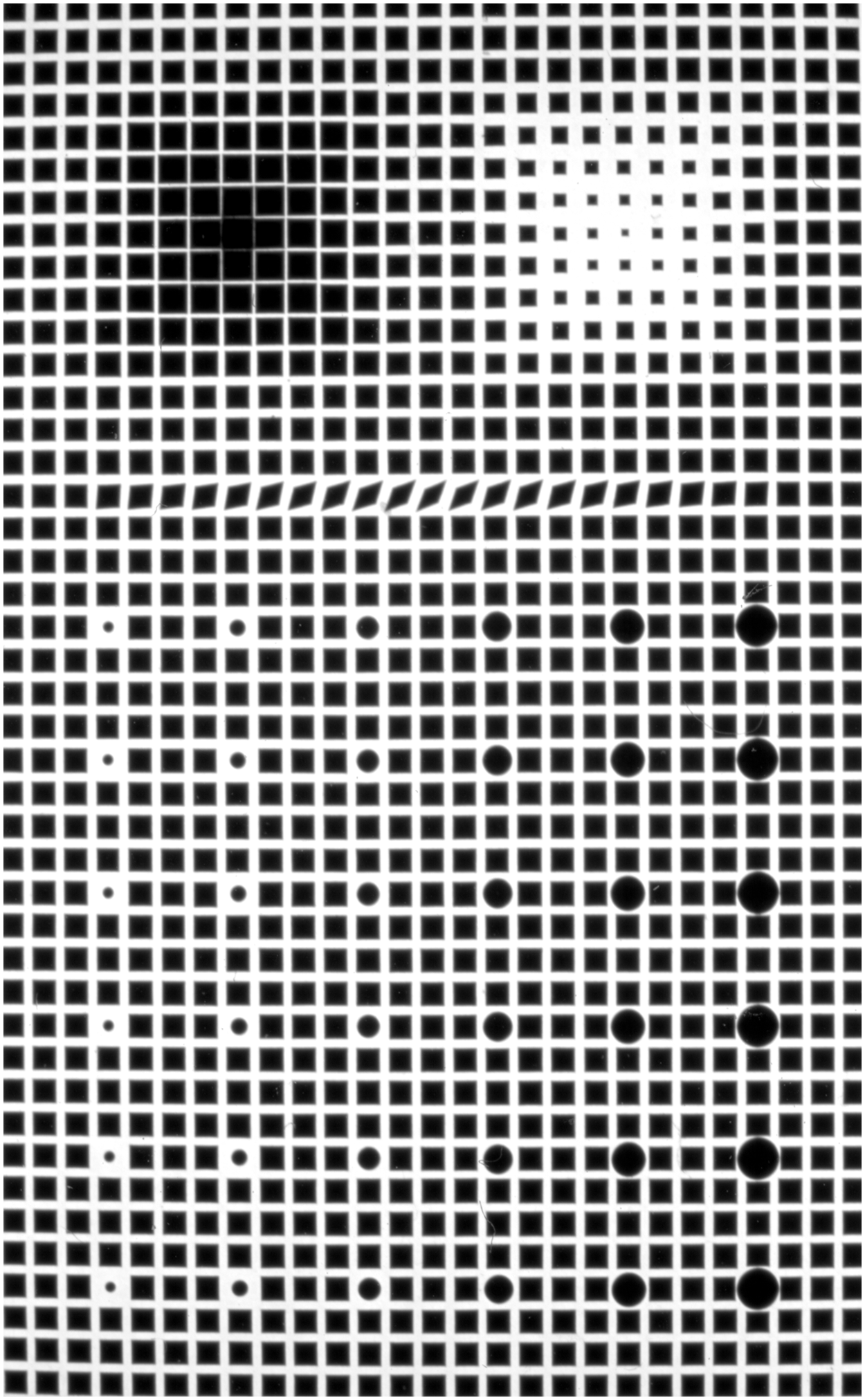
Victor Vasarely, Supernovae, 1959-61, oil on canvas, 2419mm x 1524mm. Tate collection. © ADAGP, Paris and DACS, London 2012.
Much coverage of these kinds technical and practical aspects of Kinetics in the post-war period was shaped by the writing of Frank Malina who was a practicing artist and the founding editor of Leonardo. Malina’s background as a former rocket engineer certainly coloured the way in which he approached his artistic work. According to Frank Popper, his ‘visual memory retains the images of graphs, probability curves, microphotographs, wind tunnels, aerodynamic streams, models of nuclear structure, etc.’ and this found figurative and non-figurative expression in his art. 33 The most significant application of Malina’s technical background was, I think, in the way that he recorded the field of kinetic art though his writing in and editing of Leonardo. There is a sense that Malina was more concerned with recording the aesthetic as de-personalized, and while this is a common observation of kinetic and some other forms of abstract art, in the case of kinetic art what Malina also absented was any kind of philosophical and metaphysical coverage. So, while many artists enjoyed discussing, for instance, the metaphysical implications of contemporary time-space theories, Malina had no patience for them. He ‘hated buzz words and use of loose language’ and banned from use in his publication a number of words and phrases including ‘all, always, avant-garde, create, eternal, everyone, evolve (for develop), forever, great, intuition, modern, never, no one, obvious, of course, pure, space (for area or for surface), theory (when hypothesis is correct) and universal’. 34 Malina then appropriated the term ‘Kinetic Art’ via Leonardo and associated it more with technique than aesthetics to the point that while informative in terms of practice and the practicalities of creating a kinetic artwork, reading his work it becomes very difficult to discern motive and meaning. Pieces written by practicing artists and published in Leonardo during the 1960s and early 1970s were more often than not technical expositions describing how to construct a rotating painting, or circuits to produce flashing lights, different forms of movement and so on. 35 Nevertheless, these technical accounts hide a deeper motive that connects directly with newly envisioned relations between technology, humanity and art. The goal of much kinetic art then was to bring about a new harmony between the three for the ‘development of mankind’s intellectual and spiritual resources’, which required artists to ‘extend their creative capabilities’ by using the ‘tools of modern technology’. 36
Representation in kinetic art
While most post-war kinetic art was non-figurative, it would be a mistake to assume it was not representational. Kinetic art aesthetics reflect not so much a turn away from the world as a development of conceptualism and constructivism whereby ideas and relationships figure more prominently than schematic representations of nature and landscape. Specifically, kinetic artists were driven to relate something for which there seemed to be no graphic language in conventional art and something that characterized the world that was developing around them – movement. For Frank Popper, abandoning the figurative elements of painting and sculpture was vital to this process. The work of abstract pioneers such as František Kupka, Robert Delaunay, Francis Picabia, Marcel Duchamp, Vladimir Tatlin, Wassily Kandinsky and Alexander Archipenko was identified by Popper as foundational because they ‘helped to liberate the element of movement by eliminating the representative content of the work of art’ 37 but movement was nevertheless the major subject of their work.
Movement was viewed as both eternal and universal in the sense that it is a fundamental characteristic of nature, but it was not until the 19th century ‘when the dynamo for the generation of electricity was invented that practical means became available to the painter to enter into this domain of visual experience’.
38
By the mid-20th-century there were additionally newly conceived and recently conceptualized movements in nature that could not be perceived in a traditional sense, such as the motion of electrons in atoms or the movements of distant stars, movements that became a preoccupation for kinetic artists. Wider existential and popular culture in the post-war period seemed also to be characterized by movement in a variety of forms: Cinema and television have accustomed modern man to the unlimited possibilities of movement and change in pictures. Three-dimensional photography is on the threshold. Microscopes and telescopes reveal the micro- and macrocosmos. Flying, the eternal dream of mankind, is a daily routine. Press a button, and music surrounds you, another button catches nature for you in moving or still pictures. Man overcomes gravity and goes out to conquer space . . . While all this has been happening, art has not changed much in the last 30,000 years.
39
It would, however, be wrong to adopt David Bowman’s 1972 line that kinetic art ‘merely apes our kinetic culture’ and can only ever offer a sanitized version of it, because the artists themselves, while undoubtedly in thrall to the kinetic vitality of modern urban life, were captivated by more eternal and fundamental kinds of movement too. Frank Malina, for instance, with his depersonalized, almost technocratic view of art, was exercised not by representing the momentous buzz of contemporary culture so much as ‘communicating new visions of the universe as found through scientific research to the community at large’. 40 The means by which that communication was achieved in kinetic art was not through conventional representational practices but instead often relied upon a particular sense of how the art was to be consumed by the viewer.
The experience and consumption of kinetic art, more so than most other contemporary movements, were integral to the process of (non)representation that it characterized. Some likened the experience of a three-dimensional kinetic piece, for instance, as akin to listening to a musical composition that evolves and takes place over time and in conjunction with the body of the listener. 41 The meanings of a piece emerged then in the space-time between and in conjunction with the embodied viewer-participant and were at once a psychic, physical and haptic experience. Optical art, for instance, ‘makes us aware that man is an organism’ 42 and received a great deal of criticism from the art establishment as reports of fainting and disorientation peppered reviews of exhibitions. 43 Perhaps contradictorily, pictures and objects that were wilfully impersonal elicited feeling and emotion; they came alive despite being non-figurative and difficult to connect with objects one had encountered beyond the artwork. Frank Malina, for instance, worked hard to develop his Lumidyne light projecting mechanism to ensure that his coloured glass work would not illicit an emotional response that associated it with stained glass windows and wanted to connect directly to the viewer without sensationalism. 44
The Lumidyne system, which rhythmically projected coloured lights, Malina found, was most successful when it was in tune with the bodily and environmental rhythms of the viewer: ‘Malina has found that the most satisfactory means of direct visual communication has been to incorporate rhythms that belong to a familiar understanding of our own biological condition and environment’. 45 His moving Lumidyne pieces, while sharing the basic technologies of construction and projection, are a markedly varied form. Some, like Paths in Space (1963), consist of defined and entangled lines of light. Others, like The Cosmos (1965), are reminiscent of op art painted with light and composed of geometric and repeated shapes, points and patterns. And some, like the six pieces in the Nebula series (produced between 1961 and 1974), feature drifting clouds of light punctuated by more sharply defined points and lines. Despite his technophilic outlook, Malina was determined to model movements that were crucial to us but hidden from view, or requiring of special technologies to do so. His Lumidyne piece Brain Waves (1964) modelled the electrical activity of the brain as imaged through encephalographs, and his ‘Galaxy’ series presented the motion of planets. 46 This modelling of invisible but palpable rhythms and movements in his constructions, notwithstanding his unwillingness to discuss the metaphysics of his work, implies that to discuss their consumption in terms of the sight alone would be misleading because they also required embodied participation.
Even the most technologically-driven and impersonal kinetic art was designed to affect the spectator both physically and emotionally by removing the signs of artist and by minimizing the importance of the work itself, a characteristic often interpreted as a response to the crisis of representation: Kinetic art seems . . . to be directly related to this crisis of representation. It notably avoids presenting the sign of the artist’s involvement with his [sic] material. Instead it reinstates the plane surface whether a semi-opaque screen, an area covered with repeated elements, or a transparent screen of Perspex or muslin.
47
In revealing the ‘subtleties of speed and time in an experience generated between the work and the spectator’ 48 kinetic art would provoke and awake the spectator. 49
To make an art focused on movement that would impact on ‘us – men of the space age’ 50 new materials and new media were required. Light became a medium of choice for many artists; whether optical artists experimenting with un-projected light, though in a representative sense by using stark contrasts of light and dark on the canvas, or real light projected on objects or screens, or the projection of moving images, or in the use of sunlight. Light had been used since the early- 20th century in precursors to kinetic art, to, for instance, create ‘new space’ in neoplasticism, supermatism and constructivism. 51 The journal Leonardo from the 1960s and 1970s carried many articles describing how to construct mechanisms designed to project and manipulate natural and artificial light and, again, it is easy to dismiss this work as rather technophile and masculine. However, the reason that light was used in post-war kinetic art relates directly to new understandings of the material and to dematerialization.
Making (im)material models
The increasing precision of man’s understanding of motion in the physical world has led to a recognition of motion as a pervasive aspect of nature. In our new conceptual models of nature, the stable, solid world of substance which in the past was considered permanent and preordained, is understood as widely dispersed fields of dynamic energies. Matter – the tangible, visible, stable substance in the old image of the physical world – is recast today as an invisible web of nuclear events with orbiting electrons jumping from orbit to orbit.
52
Post-war non-figurative artists worked with competing, sometime contradictory notions of the material. For curator Lucy Lippard, contemporary art concerned dematerialization and was broadly at once a negation of two related definitions of the material. First, there was a matter of fact materialism related to the physicality of a work that, especially with the advent of conceptual art, became subsumed to the idea and thereby dematerialized. Second, there was the Marxist inspired sense of the material whereby modern art might avoid commodity status and appropriation. Much contemporary art was, for Lippard, about a ‘deemphasis on material aspects (uniqueness, permanence, decorative attractiveness)’. 53 In terms of artistic technique, dematerialization involved a range of strategies for kinetic artists. Artists working on plastic objects would use the actual movement of their pieces to create the effect of dematerialization, ‘like the vanished spokes of a wheel in motion; or where movement of the object or observer can bring about a profound change in its appearance’. 54 Op artists used techniques such as moiré on their canvas and artists working in three dimensions also simulated moiré by placing moving objects in front of striped backgrounds. 55 Experiencing these optical illusions had the effect of breaking down solid planes and more generally highlighting doubts about the ‘solidity of the real’. 56 One can experience something of this dematerialization effect when simply viewing a moiré effect op piece.
Victor Vasarely’s 1969 mural on the Juridicum (faculty of law) at the University of Bonn (Figure 3) for instance, has the effect of destabilizing the plane of the brutalist modern structure that it adorns, causing both a sense of motion and lack of fixity in the dimensions of the building itself. The instability radiates from the offset geometric shapes that consist of varying lengths of dark and light stripes that seem to stand proud on the surface giving the illusion of vibration or, in Moholy-Nagy’s words, a ‘lightening up or dissolution of material’. 57
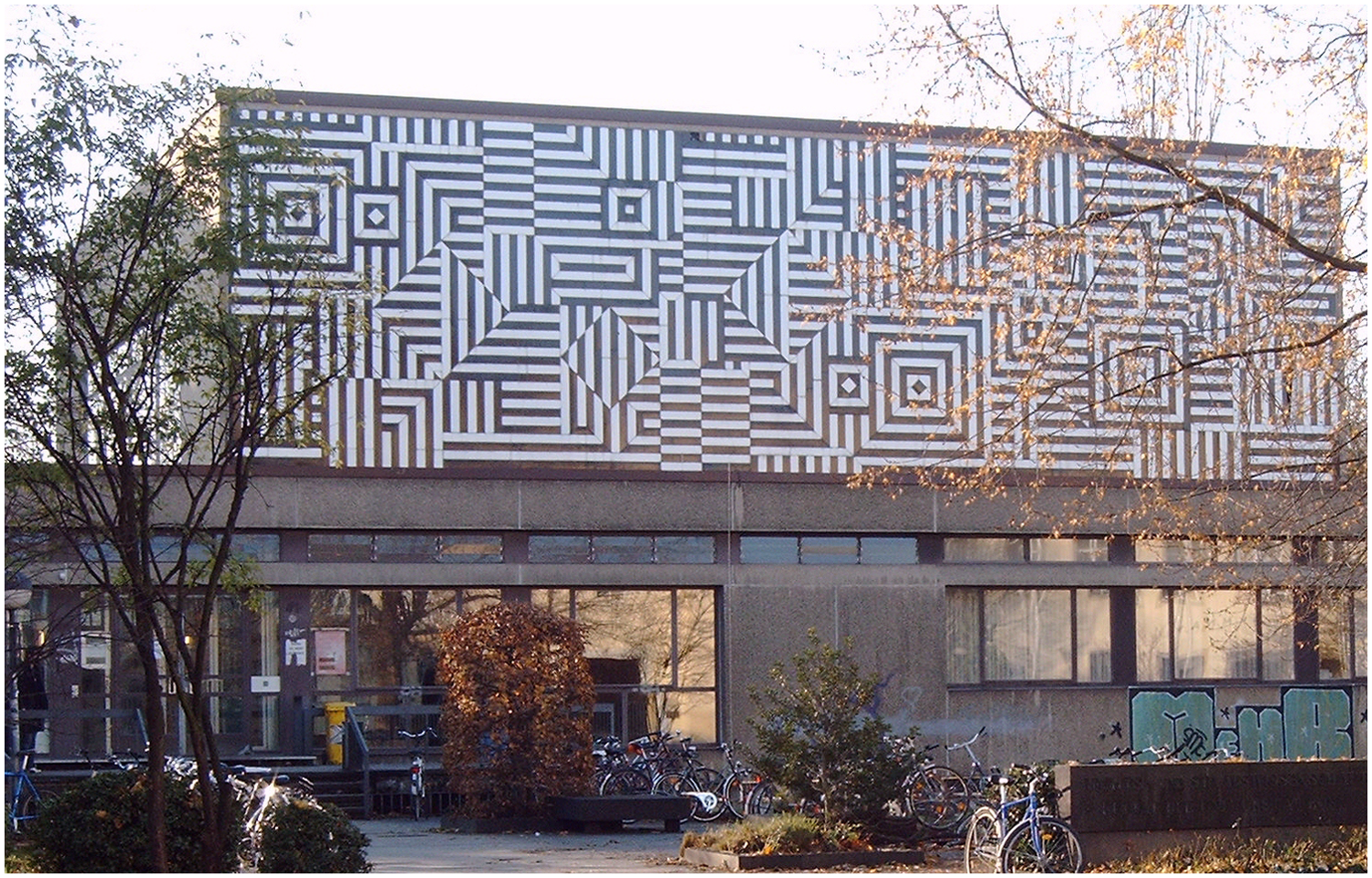
Victor Vasarely, Facade of the Juridicum, University of Bonn, 1969. Photograph by Hans Weingartz, 2005. Copyright ShareAlike 2.0 Germany (CC BY-SA 2.0).
The use of light and the deployment of increasingly sophisticated projection technologies were part of the same dematerializing movement for kinetic artists. Kinetic art was from its inception always associated with the use of light as a medium of expression and one that directly addressed issues of materialism and perception by creating new spaces. 58 The artist was charged with moulding light ‘by optical means, almost as a sculptor models clay. He [sic] must add colour, and finally motion to his creation. Motion, the time dimension, demands that he must be a choreographer in space’. 59 Kinetic art pioneer László Moholy-Nagy was among the first to realize its potential, constructing his Light-Space-Modulator (Figure 4) in the late 1920s (also used in the 1930 film Lichtspiel Schwarz-Weiß-Grau) and instead of ‘painting with brushes and colors one could now paint with light’. 60 For Moholy-Nagy, as for subsequent kinetic artists, the use of light was something that connected that sense of dematerialization with a sense of motion, of a world in flux, because it momentarily subverted the solidity of objects or shapes: light reveals in kinetic works ‘another type of energy field, one in which volume has been broken down into particles’. 61
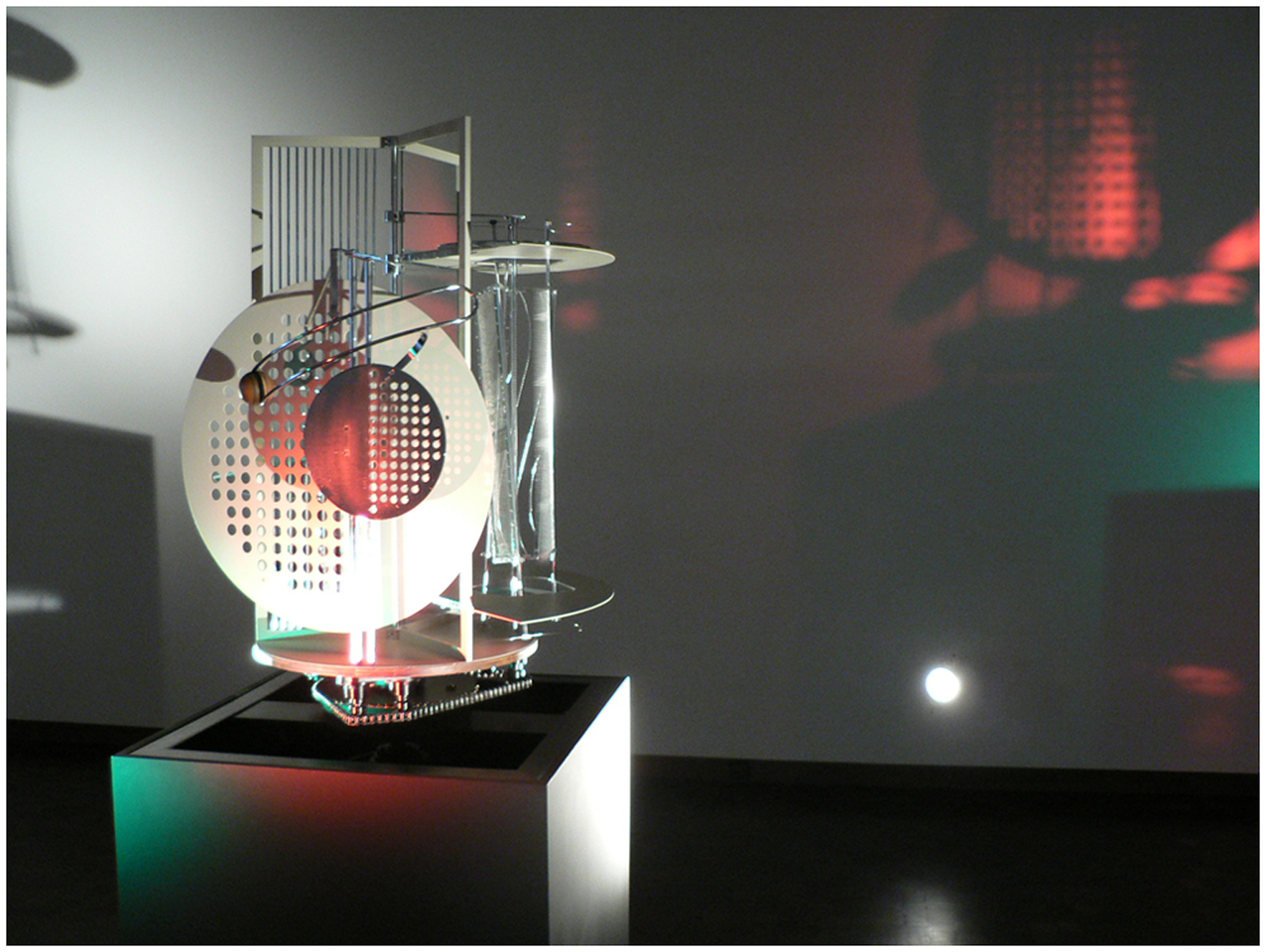
László Moholy-Nagy, Light-Space-Modulator, 1922-1930, 120cm x 120cm (this reproduction c1970), Van Abbe museum, Eindhoven. Photographed by by H.C Gilje in 2006. Copyright ShareAlike 2.0 Generic (CC BY-NC-SA 2.0).
Energy, matter and motion were then fundamental concerns for kinetic artists. While most art criticism of the genre has, like Lippard, pondered its characteristic of dematerialization in terms of commodity status and the physicality of the art object, it is in fact the third, mid-century cosmological understating of materiality that to me seems more important. One finds this new cosmology, where artists discuss the dissolution of matter into energy, or refer to the invisible forces that underpin their structures and, indeed, in their obsession with motion. Motion and mobility were not just characteristics of the modern speeded-up age to be rendered meaningful by kinetic artists, because the incorporation of real or illusory motion into an artwork also dematerialized the art object by lessening its importance, rendering ‘a durable object as an ephemeral act’, moving literally from ‘mass to motion’ 62 and ‘emphasizing relation, instead of mass’. 63 Magnetism was used in constructions to refer to the absent presence of matter, to make ‘matter present by its absence, it shows that matter is energy’. 64
There were, then, subtle shifts in nature that mid-century kinetic artists wanted to relate in their work. This was a nature defined and characterized by movement, a perception that replaced nature as an assemblage of objects to be represented by artists, to nature as process to be captured. In the words of George Rickey from 1963: The artist finds waiting for him, as subject, not the trees, not the flowers, not the landscape, but the waving of branches and the trembling of stems, the piling up or scudding of clouds, the rising and setting and waxing and waning of heavenly bodies; the creeping of spilled water on the floor; the repertory of the sea – from ripple and wavelet to tide and torrent; the antics of people, schools of fish, companies of soldiers, heads of wheat, traffic jams, bees and ants – the ‘very many’ in motion; the quivering of the aspen or the cowering of the panicked mouse, or, also part of ‘nature’ in that it is part of his environment, the rotations and reciprocations in his car and his appliances, the swinging of cranes and bridges, the thrust, lift, and drop of planes, the random bouncing and rolling of a ball whether on grass, clay, or a roulette wheel, and those movements of sub-atomic particles never to be seen, but mapped and inferred from the tracks in the bubble-chamber and vague and awesome accounts in the press.
65
Kinetic artists were charged with making models of this processual nature and to bring it to the senses of viewers and participants, to show them ‘how to see it better’. 66 The new kinetic dimension was that the movements that artists attempted to portray were no longer disposed to the organic rhythms of nature ‘years, months, days, the beating of a pulse, breathing, menstrual periods’ . . . because in the ‘technological era . . . speed is basic to our lives . . . we have become dominated by this new dimension; often we can succeed in conceiving of life and its “products” only as evolving in a continuous and persistent becoming’. 67 Some simulated the movements of nature in their work by using mechanics while others modelled nature and used it as ‘a constructional model for appliances’. 68 Op artists, too, worked with these natural processes and created a ‘plastic analogy of their intrinsic dynamism through realizations rich in multiple perspective’. 69 An important driver with this vision of nature was the emergence of a mid-20th-century cosmology to which kinetic artists, in particular, seemed in tune.
Einsteinien notions of space-time, a key component of the new cosmology, were the subject for the modelled abstraction of a number of kinetic artists. Paul Konrad Hoenich, for instance, turned his back on figurative painting because he wanted to ‘realize the dimension of time and the realm of thought in my pictures’. 70 There is, however, a distinction to be made between early kinetic artists who wanted to model the everyday experience of space-time in a speeded up modernized world and those, generally after the Second World War, who were inspired by Einsteinien and quantum understandings of matter and the universe. As Linda Dalymple-Henderson has described in a number of publications on the subject of the fourth dimension in art, the proof of concept only occurred in 1919 with a solar eclipse that established empirical proof that light curves around masses as predicted by Einstein and so proving his concepts of relativity and space-time. 71 Only then ‘would the multivalent spatial fourth dimension be superseded during the 1920s and 1930s by the temporal fourth dimension of the space-time continuum’. 72 The earlier incorporation of space-time into kinetic art tended to focus on their centrality to speeded-up modern life. As The Realist Manifesto (1927) of Gabo and Pevsner stated: ‘Space and time are the two exclusive forms for the fulfilment of life, and therefore art must be guided by these two basic forms, if it is to encompass true life’. 73 Quotidian time and space and not relative time-space were the focus of this early work with the ‘kinetic rhythms . . . the basic forms of our perception of real time’ being an innovative element of the artwork. 74 Moving into the post-war period, the focus on kinetics was reinforced and reinvigorated by the adoption of relativistic versions of space-time, a reality that was by then more appropriately expressed processually. As a 1960 Group T statement noted, ‘we have noticed a tendency in the arts to express reality in terms of becoming’. 75 The interdependences of space and time in new relativistic physics took a while to infiltrate kinetic art, which also expressed ‘an interlocking of time and space’, 76 even though one of its first champions, László Moholy-Nagy, was writing about it as early as the mid-1920s in his 1928 book Von Material zu Architektur (produced in English as The New Vision).
Op artist Victor Vasarely who was one of the most vociferous in proclaiming this new cosmology or cosmic nature, noted that the nature that inspired the traditional figural painters ‘was that of Lamarck and Linnaeus; ours is that of Einstein, Planck and Heisenberg’. 77 And there is a more general sense among artists and critics from the period that the new generation were responding to revelations in quantum mechanics, relativity theory and astronomy. This ‘cosmic speculation’, as Guy Brett has labelled it, involved explorations of time-space, wave-particle dualities, energy and matter and, like scientists, artists made ‘models of the universe’ but intuitively. 78 The cosmic speculation of kinetic artists took many different directions because it tended to follow a particular aspect of the emergent cosmic nature that attracted them. What is clear, however, is that the mode of representation shifted in response to it and kinetic artists became creators of interactive models of the universe rather than figurative representers of it. The renaissance cosmology of the artist as detached observer was superseded by the kinetic artist as orchestrators of mass and energy and convenors of events in time and space that would be experienced by viewer-participants.
Abstract painter Bettina Brendel was, by the late 1960s, captured by uncertainty theory and the dual wave-particle understandings of light. To this end she read, met and corresponded with Werner Heisenberg and would cite his Physics and Philosophy (1962) when discussing her work, as in her Leonardo article on the influence of atomic physics on her paintings. This fascination with atomic (and later cellular and molecular) structures, patterns and forces persisted throughout her career. In her graphic interpretations of Heisenberg’s principles and wave-particle light she attempted to develop a style that captured the ‘motion of electrons and light particles, photons, and the fact that they are not points in space . . . [she] conceive[d] of moving electrons as little streaks or short lines of a length equal to the diameter of an atom’.
79
Brendel was at pains to point out that this was not, however, a visualization of what was actually happening but imperceptible to the human eye or imaging technologies. She was not, in other words, producing ‘a working model for instructional purposes’, but was rather driven to produce abstracted icons that would stand as symbols for the particles and their processes: I would like to have these short lines become a symbol for the structure of light and energy and to see them projected on the runways of jet planes, as a cloud of holograms hanging over cities or as an ever present symbol that appears unannounced on television screens in the home or even in space capsules.
80
Similarly, Victor Vasarely stressed that artists dealing with quantum themes or this new cosmic nature more generally were not engaged in scientific modes of representation – ‘neither Euclidean geometry nor that of Einstein’ – but worked ‘without exact knowledge’ to render it meaningful to those who encountered their work. 81 The motivation to produce abstractions to appreciate a new cosmic nature was clearly widely held and a more general characteristic of other practices in the post-war period. For artist and aesthetic theorist Gyorgy Kepes abstraction was crucial to understating the ‘palpable facts of immediate reality’ because it allowed the truth to be visualized: ‘The process of deallegorization and mathematization of our mental models of motion has led to the discovery and control of nuclear energies . . . it has led to a living interdependence between the abstract and the concrete’. 82
On a macroscopic scale and some years before Bettina Brendel’s quantum speculations, Alexander Calder had come to a similar resolution to Brendel’s in developing his kinetic models of the universe: ‘I felt there was no better model for me to choose than the universe . . . spheres of different sizes, densities, colours and volumes, floating in space, traversing clouds, sprays of water, currents of air, viscosities and odours’. 83 But to account for this diversity required abstraction that modelled ‘forces acting in space and time’ 84 rather than figurative representations of concrete reality.
Frank Malina, perhaps partly because of his rocket and jet propulsion engineering background and partly too because he was working at a time of fast development in space exploration, was also inspired to capture outer space. His Lumidyne works Away From the Earth I and II (1965 and 1966) (Figure 5), for instance, are not representations of what the earth might actually look like from space or how orbiting objects might appear and the trajectories rockets might take to break orbit. The pieces, which consist of coloured lights orbiting and moving away from a milky white clouded sphere, illustrate that the space race was something that animated kinetic artists, but like other imagings of cosmic nature that inspired them, were designed to give a kinetic sense of the momentum rather than the actuality. 85 Because so much of what the kinetic artist wanted to give a sense of in their work was invisible, for Malina too, it made sense to use abstraction to give an appreciation of, for instance, ‘motions that we cannot perceive directly, such as the motion of bodies at a great distance from the earth and at the interior of the atom’. 86 The desire of kinetic artists to bring these forces and motions to the senses of the viewer-participant manifested in a form of non-figurative abstraction that modelled motions and created often multi-sensory environments or events to be experienced. Above all then, post-war kinetic artists were working on models of a mid-century cosmology that have been attended to only implicitly by cultural geographers.
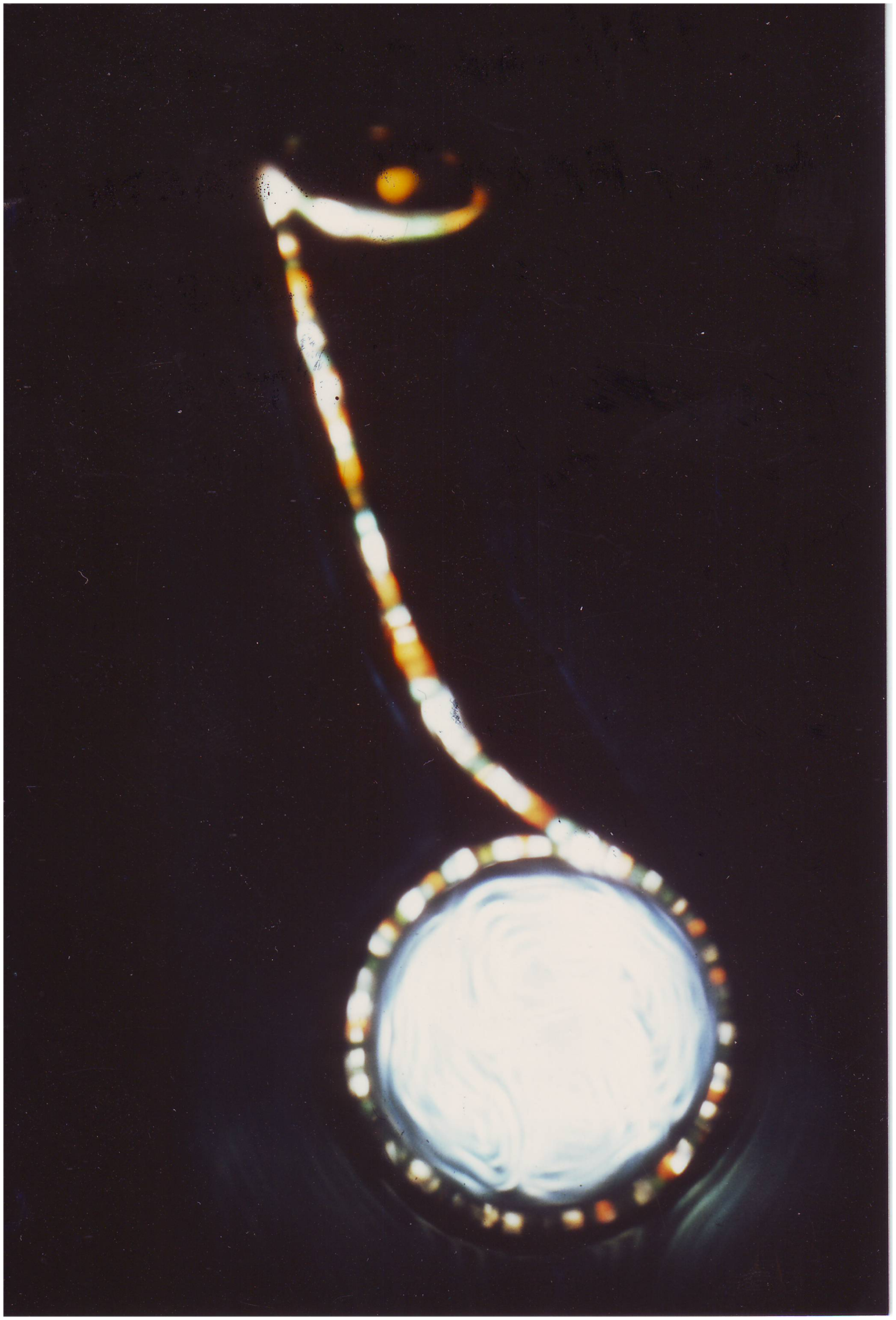
Frank J Malina, Still from Away from the Earth II, 1966, Lumidyne system, 100cm x 200cm. Malina family collection. Copyright Malina family.
Conclusion: mid-century representation
This paper has traced some of the ways in which kinetic artists worked with revolutionary conceptions of the material, its relationship to immaterial energies and the appropriate representational technique with which to render their subject. For the most part, kinetic artists found figurative tropes inadequate to help them capture and build their immersive models of a new cosmology that was characterized by revised notions of matter, energy, space-time and light. They developed a range of abstracted techniques to convey this relativistic, always becoming mid-century cosmic nature to the viewer-participant. The microcosmic models produced by kinetic artists established representational techniques that were characterized by two key and related features: movement and dematerialization.
Movement was either illusory, actual or a combination of both in kinetic art and portrayed both a sense of speeded-up human and social worlds and a rendering of newly theorized movements in nature at the micro- and macro- cosmic scales. The modelling of a mid-century nature of energy, matter and cosmos in motion involved abstract aesthetic strategies that conveyed a sense of matter and mass in flux. To convey this idea of dematerialization kinetic artists used a variety of tactics including moiré effects, mobiles, lighting systems that painted or projected, and multimedia environments. These techniques arose because kinetic artists had in common a conviction that to depict this mid-century enlightenment required abstraction that would appeal to many senses at once in the viewer-participant. In this respect kinaesthetics were also synaesthetics: the immersive environments established by kinetic aesthetics, which demanded an embodied consumption of the artwork, drew upon a popular mid-20th century movement that regarded synaesthesia almost as an ideal cultural state. 87 But kinaesthetics were also indicative of substantial changes to the practices of representation to which revised ideas of material were central.
Geographers have yet to fully explore the ways in which the practises of representation shifted in the mid-20th century, although those who have worked on aspects of non-figurative visual and installation art have made inroads into addressing questions of materiality and the depiction of kinetic nature. Representation, its limits and its fluid relationship with the ‘material’ have been the object of kinetic art suggesting that it has something to offer our current concerns about representation, materiality and embodied encounter. 88 For some time now geographers concerned with representation have taken an approach that considers representation not as a presence in its own right, but as an interplay of relations, as both contingent in a socio-cultural-historical sense and active in the sense of effectivity. In terms of visuality we recognize now that it is so bound with desire, emotion, sensory resonance and affect and that it is not possible to consider a visual representation independently from its effect because it is in what representations do and how they function that their significance lies. Twentieth century kinetic artists, in their practice and technique and in their desire to shift the ground of representation and to model a processual nature pre-echo this perspective.
Art from the mid-20th-century was an art of encounter in which the active space of the artwork was that between the piece and viewer-participant. Like many mid-20th-century cultural producers, the representations of kinetic artists were not ‘representations’ so much as meta-representations of an exciting and new mid-century cosmology to which relative and processual understanding of matter and nature were central. Representations then retain an importance that demands our attention, in particular, because they have something to say about matter and materiality. In technoscience studies Karen Barad makes a similar observation in her conceptual reworking of the relations between materiality and representation. She suggests that it is representationalism and not representation that is problematic. Representationalism implies a separation between representation and the entities to be represented, a perspective entrenched in western culture, but representation differently conceived elucidates a different perspective on materiality. Using quantum physics Barad reworks ideas of the co-relation between the representation and the object of representation by suggesting that matter emerges through representation and vice-versa and that both have agency. For example, the practices of representation have an effect on the object of investigation so that, dependent upon the apparatus used, matter and light can exhibit the qualities of a wave or a particle. There is, then, a co-emergence of meaning and matter suggesting that representation is better understood performatively as an intra-action of agencies: the ‘universe is agential intra-activity in its becoming’. 89 This agential realism suggests that ‘matter is not a fixed essence; rather, matter is substance in its intra-active becoming – not a thing but a doing, a congealing of agency’. 90 In their microcosmic modelling Kinetic artists inspired by the same new physics as Barad reflect a similar perspective on the co-relation of materiality and representation where both co-emerge in intra-action with the viewer-participant. That shift in the practices of representation in response to a revised cosmological understanding is something that ought to receive the attention of geographers: as we debate and explore material/immaterial, representation/non-representation, we might consider the benefits of returning to some foundational concerns around cosmography. The project to represent the material universe as cosmos is something that not only underpins geography, but also drove kinetic artists and other cultural producers in the mid-20th-century. Significantly, their attempts to model mid-century cosmology required a shift in the practices of representation and also a refigured sense of the material connections of representation. It is in these characteristics that one can identify a relatively underexplored aspect of both the geographies of visual art and the practices of (non-)representation.
Footnotes
Acknowledgements
Sincere thanks to the two anonymous referees and Tim Cresswell for invaluable suggestions for improvement. Thanks also as ever to my supportive colleagues in geography at Sussex.
Funding
This research received no specific grant from any funding agency in the public, commercial or not-for-profit sectors.
Notes
Biographical note
Simon Rycroft is Senior Lecturer in human geography at the University of Sussex where he researches and teaches on the cultural geographies of post-war Britain and the United States. He has recently published Swinging City: A Cultural Geography of London, 1950-1974 (Farnham: Ashgate, 2011).