



Abstract
This paper is broadly concerned with community engagement as a facet of museum practice. The paper offers a reading of a community exhibition entitled Curious, held at St Mungo’s Museum of Religious Life and Art in the city of Glasgow. I take the reader on a tour of the exhibition, offering insights into its form and function. I show how community exhibitions can pose challenges to traditional museum practice by disrupting taken-for-granted assumptions about curatorial authority, and I emphasize both the range of meanings that can be attached to museum objects and the radical potential of including non-expert knowledge in the creation of displays and exhibitions. I also argue, however, that community exhibitions may be understood as poor relations to traditionally curated exhibits, and that curatorial authority is still key to the production of museum displays.
I arrive at St Mungo’s Museum of Religious Life and Art on a particularly wet and wintry December day, even by Glasgow’s standards. As I struggle through the door, I’m greeted by the museum welcome staff, who take my umbrella, hang up my coat and fret about the state of my wet feet. I say I’m here to see the Curious exhibition, and they’re thrilled: apparently it has not been well-attended in the weeks following its launch. I’m directed upstairs to a warm, airy and colourful gallery space, where I take off my shoes – I’ve got the place to myself, after all.
St Mungo’s is a museum devoted to religious life and art. It is not a religious museum, but a museum devoted to the phenomenon of religion and its material expression. Opened in 1993, it occupies a prime spot in the very oldest part of Glasgow, nestled between the medieval cathedral and the Necropolis, a 37-acre graveyard that houses 50,000 erstwhile residents of the city. The 13th century gothic cathedral is the final resting place of St Mungo, the city’s founder. Glasgow’s cathedral was one of the few Catholic churches to survive the Reformation intact, and has, since then, housed the High Kirk of Glasgow. An 18 metre-high statue of John Knox - the father of Presbyterianism himself - occupies the highest point of the adjacent Necropolis.
As part of my doctoral research, I volunteered with Glasgow Museums – the municipal authority that runs St Mungo’s – on the Curious project. A major strand of Curious is a community engagement (hereafter, CE) project that addresses the cultural diversity of Glasgow, and forms part of the Cultural Olympiad. In conjunction with Glasgow Museums staff, the Curious participants have curated an exhibition from Glasgow Museums’ reserve collections. The objects selected by participants include a typewriter, a Clarice Cliff tea-set, a Warri board game from Sierra Leone, a butter churn from Shetland, and a sculpture by Austrian artist Sibylle von Halem, entitled ‘Veil’.
In what follows, I present a reading of the Curious exhibition, although I focus on what is arguably the exhibition’s centrepoint, ‘Veil’. 1 From my position as a researcher-come-museum-volunteer, I use the Curious exhibition as a means to outline some of the tensions inherent in the practice of CE. CE is often mooted as a way for museums to ameliorate iniquities in representation by including voices typically excluded from museum exhibitions; in recent years, however, it has come under criticism due to its tendency to conceptualize communities as homogenous, fixed and static. 2 There are also questions to be asked about the extent to which traditional curatorial practice is disrupted by the involvement of communities, and to what extent community exhibitions represent a ‘different’ experience for museum visitors.
A tour of Curious
So with notebook in hand, I begin my tour of Curious by approaching the butter churn from Shetland. The churn is interpreted through the oral testimony of CE participants, and participants’ thoughts are displayed on interpretative labels, or in video and audio clips; this mode of interpretation is reproduced throughout the exhibition. In an accompanying video, one of the CE participants recalls making butter in a goatskin as a child in Kurdistan. There’s an accompanying audio clip of a group of children singing in Gaelic – a rhythmic song, not unlike the waulking 3 songs I learned at primary school on the Isle of Skye. I’m not sure I’ve ever seen a butter churn before, yet instantly the Gaelic word for butter – im – springs to mind. A second later, the word for churn, or milk-pail – cuinneag – follows. I scribble furiously in my notebook, knowing somehow that this is important, and that I want to remember this strange mix of surprise and nostalgia.
I move on to a case housing a Clarice Cliff tea-set, and a necklace crafted in the Punjab. The interpretative panels explain why Curious participants felt an affinity with these objects. I scrutinize them, trying to identify with them, to see the links between them (they are in the same case, after all), but I draw a blank. I finally settle on the theme of inheritance – these are two things that would be passed from mother to daughter, and kept in the family. The objects are beautiful and the theme of inheritance strikes a chord, but the gulf in meaning between these two objects is overwhelming to me, and so I move on.
Next is a case housing a Sudanese kissar, a twig broom from Myanmar, and an Indian wedding chest – all of these are from the 19th century, but that’s the only link I immediately make between them. The kissar looks a bit like my dad’s prized banjo; the twig broom reminds me of a trip I made to Korce, in Albania, where I watched women in the marketplace making brooms, quickly and skillfully binding together bundles of twigs with twine. Again, I feel at sea – what do these objects mean in the context of this exhibition? Their mundane nature is touching, however – who, or what, did they remind the Curious participants of?
I move on to a case housing a radiogram, a board game and some unusual figurines. The figurines are Santeria figures from Cuba, and represent the amalgamation of the traditional Orisha religion practiced by the Yoruba of West Africa with Catholicism – the religion that many slaves were forced into upon landfall in the Caribbean. Around the corner are two Hindu avatars, and I am fascinated by their similarity to, and difference from, the Cuban figures. I think about the statue of the Virgin that sits on my mantelpiece at home, a half-ironic gesture on the part of my Irish Catholic boyfriend. Not for the first time, I marvel at how quickly my mind races to compare and contrast, to draw links between these objects and objects I have seen elsewhere.
In the corner, far from the rest of the cases, is a video display. The video collates participants’ interpretations of an artwork entitled ‘Veil’, by Sibylle von Halem. Von Halem’s piece is a veil made of small brass plates, held together with metal links. ‘But where is it?’, I wonder. ‘Why is it not with the rest of the objects?’. The individuals on-screen talk through their interpretations of ‘Veil’. One woman suggests it looks feminine; another, that it looks masculine. One woman suggests it looks like it might be worn for protection; another, like it would incarcerate the wearer. One woman states that it does not, for her, represent the veil in Islam. A common theme throughout the statements onscreen is that ‘Veil’ is extremely beautiful: one teenage girl is awestruck, ‘There’s nae word to describe it’.
In front of me is a ledge, and to the side, a set of steps leading to the lower gallery. I lean on the ledge to take notes, and catch sight of ‘Veil’ downstairs. I remove the headphones and make my way towards ‘Veil’. Up close, the piece is uncanny. To me, it looks more like a shroud than anything, and it seems to absorb religiosity from its surroundings – an icon of Mary, a series of statues, the museum’s collection of stained glass. The label makes me laugh aloud, and the reverential atmosphere is shattered; it attributes the piece to von Halem, but it also gives a quote from one of the CE participants, who says: ‘It looks like something Cheryl Cole would wear on her wedding day’.
The variety embodied in the participants’ interpretations of ‘Veil’ is staggering. Perhaps more than any other object in the exhibition, ‘Veil’ seems to bring to light the genuinely radical potential of CE. Even as a critical geographer wise to the perils of cultural reductionism, I expected ‘Veil’ to be used as a springboard into debates about cultural and religious difference because of its loaded title, and its resemblance to a shroud or a burkha, and yet I was proved wrong. The interpretations offered by participants were wildly diverse, and made reference to both the aesthetic quality of the object, and its symbolic potential.
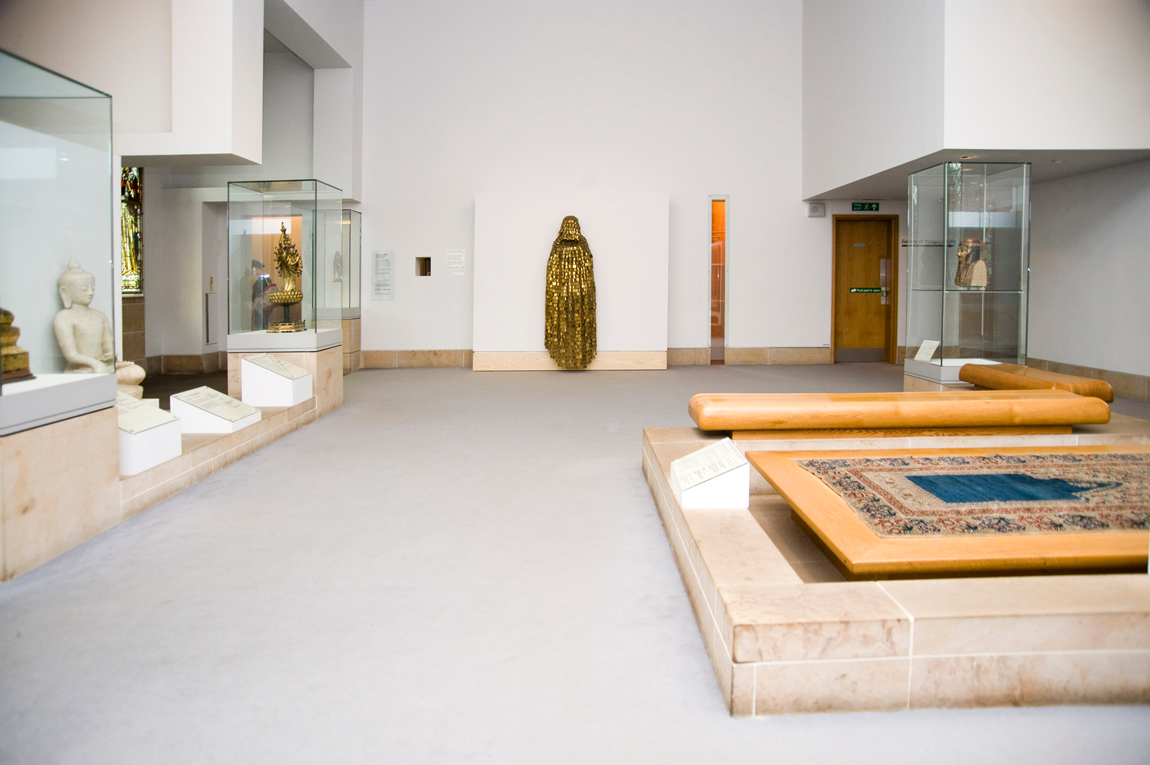
Sybille von Halem’s ‘Veil’, from the lower gallery. © Glasgow Museums.
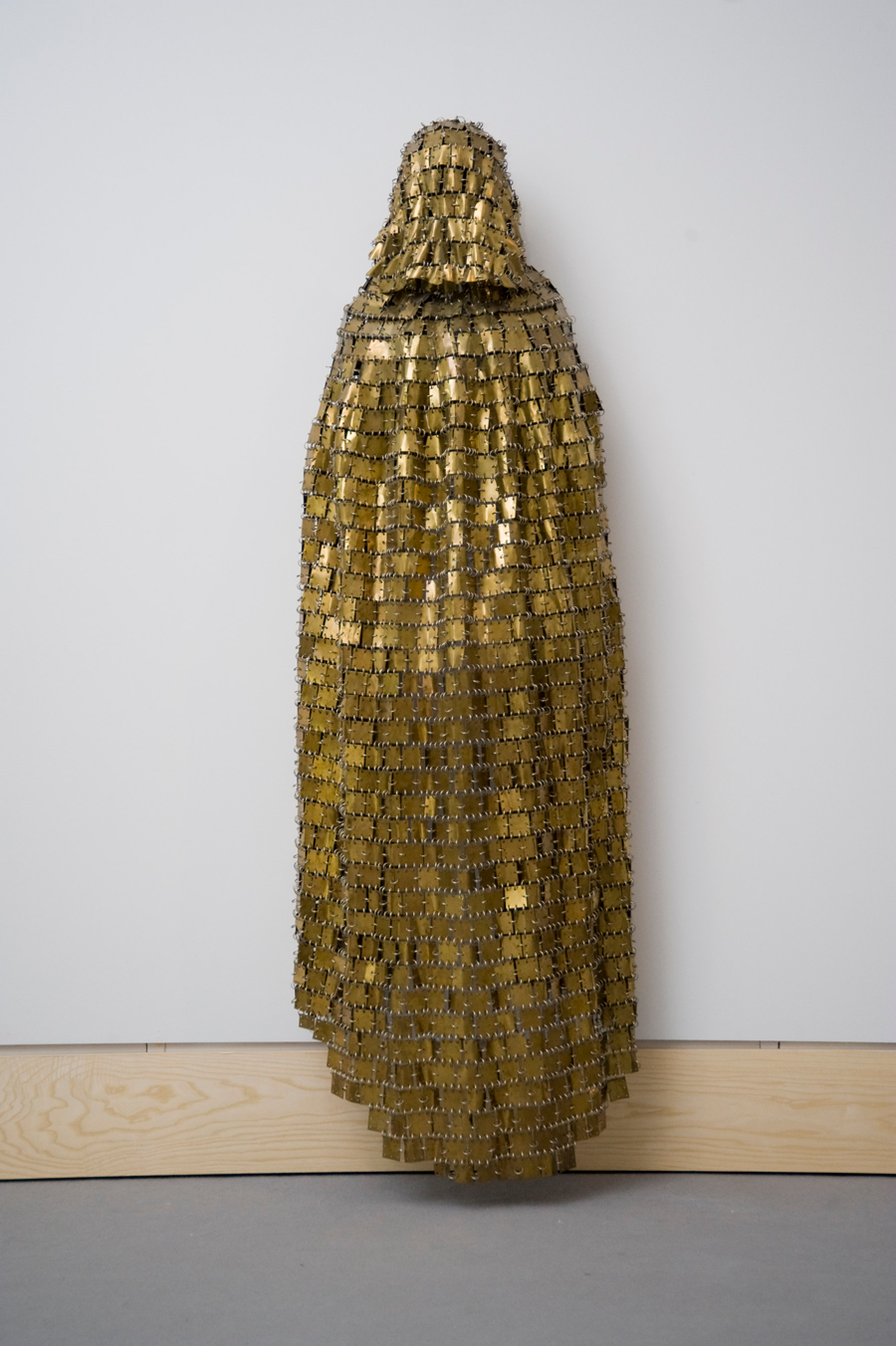
Sybille von Halem’s ‘Veil’. © Glasgow Museums.
Representing community
What comes across strongly is the lack of consensus on what ‘Veil’ represents, and this is one of the key points I want to make here. CE often attracts criticism for portraying communities as homogenous, coherent, and bound together by a shared cultural identity; often, communities are expected to behave like communities. 4 Curious avoids this lazy pigeonholing; rather, it presents a series of objects, chosen and interpreted by an extremely diverse cross-section of the city’s population, including ethnic minorities, religious groups, native Glaswegians, students, and so on. Curious dispels some of the myths associated with the term community insofar as it is commonly used within museums by emphasizing that communities do not always have a coherent cultural identity: they are collections of individuals with similarities, and differences. They overlap with other communities, and come into conflict with them too. Curious does not function solely to bring alternative voices into the museum, thereby correcting some kind of imbalance in representation; rather, it forces the visitor to identify those themes that cut across putative cultural differences. 5
Supplementing or reconfiguring museum practice?
Curious offers an unsettling and highly personal experience for the visitor, and I have tried to give a sense here of what it is like to walk around the exhibition. I suggested that the butter churn was the ‘first’ object in the exhibition, due to its placement directly opposite the entrance. Yet after that, there is no prescribed way of moving around the exhibition space. In the absence of taxonomy, or an overarching narrative to ‘see through’ to the end, movement around the exhibition is entirely at the visitor’s discretion. 6 This encourages the visitor to do as I did – to search for similarities and differences between the objects, and to make comparisons with things that are known. 7 It also encourages visitors to be attentive to the stories told by CE participants; I found myself being drawn by their descriptions, and recounting similar events and experiences. 8
It is worth noting, however, that the arrangement of objects in the Curious exhibition was at the discretion of the curatorial team. 9 In this case, the community groups selected the objects, and it was left to the curatorial team to arrange the objects thematically, and emplace them within the exhibition space. In this way, CE appears more about supplementing traditional museum practice than radically reconfiguring it. The segregation of ‘Veil’ from the rest of the exhibition is telling in this respect: why is it not ‘in’ the exhibition? One gallery assistant told me when I visited: ‘It’s special. More people will see it in the main gallery’. I remember thinking: ‘But that’s not the point – is it?’ The spatial segregation of Curious from the rest of the museum implies in many ways that community exhibitions may be as regarded poor relations to traditionally curated displays.
Despite my admiration for Curious, perhaps these inconsistencies in approach point to a more general problem often associated with CE – arguably, museums tend towards doing things for communities, or putting on exhibitions about them, rather than creating things with them. 10 Museum professionals are often guilty of speaking for communities, reserving the right to interpret them and their material culture. 11 Within museums, this means that the status quo frequently remains unchanged – it is still the job of museums and museum professionals to collect, display and interpret material culture. In this way, community exhibitions might work to correct iniquities in representation, but often within the confines of a form of museum practice that is simply unsuited to representing communities in all their dynamism and complexity. 12
Footnotes
Acknowledgements
The author extends thanks to Janice Lane and the staff of St Mungo’s Museum, and to Hayden Lorimer for his useful comments on an earlier draft of this article.
Funding
This research was supported by the Economic and Social Research Council (grant number: (ES/F023227/1).