




Abstract
Critically reflecting upon a performance piece enacted by the author, this paper explores the value of artistic practice as a means for undertaking research. The performance was a piece of GPS drawing, using the movement of a body in space to write the word ‘RIDE’ across the city, subsequently represented in the form of a map. Scholars working in mobilities have increasingly been opening up the spaces of transport to critical enquiry, revealing the practices and powers enmeshed in the everyday activity of moving from A-to-B. This paper argues that in using a bicycle ride to create an art work – even one of little aesthetic merit – the author was able to create a new understanding of cycling practices that would not be captured through conventional social science techniques.
Saturday. I’m in work, applying for another job (gotta keep your hand in). Pick up the GPS and head home, intending to have lunch and then go out on the bike. But I get distracted by the F1 qualifying. Suddenly it’s quarter past three. It’ll be getting dark in an hour and a half. Need to hustle. (Diary notes, 1 November 2009)
Climbing onto a bike is a part of my everyday mundane routine. This makes me fairly unusual in the UK because although most people can ride bikes, few do on a regular basis. 1 Cyclists are a diverse group; race cycling, leisure cycling and commuter cycling are distinct practices, underpinned by different motivations and performed in quite different ways. 2 Many UK cities are too congested to allow riding primarily for sport or pleasure meaning that urban cycling tends to have a large instrumental component, with bikes used as a means of getting from A to B. 3 Because it is a low carbon mode of transport, the bicycle has become tangled up on discourses around sustainability, with cycling often constructed uncritically as a good thing for the environment. 4
As any mobilities scholar will tell you, there is far more going on than simply instrumental movement in even the most ordinary of journeys. I wanted to find a means of rethinking the urban ride as a mode of transport and experimented with an arts-based approach. There is nothing unusual in geographers collaborating with artists, but many of us are still uncomfortable in ‘doing’ art ourselves as a research practice. Artistic approaches break us out of our social science comfort zones, forcing us to think in different ways. 5 I would argue – and some practitioners may take issue with me at this point – that the practice is much more important than whether the outputs of these activities have any aesthetic merit. 6 Indeed, worrying about aesthetic inadequacies can stop social scientists from exploring what is a potentially fruitful avenue of methodological innovation.
Journeys made by bike are usually ephemeral, nonetheless videos shot from a rider’s-eye view can give interesting insights into everyday mobilities. 7 Analysis of video material has become fairly mainstream within the social sciences; for instance, Laurier and Philo’s minute analysis of the daily tasks undertaken by travelling salespeople. 8 The use of GPS to record the body’s movement in space has also become unremarkable. Nonetheless, GPS remains a problematic technology, notwithstanding its ubiquity within modern smartphones, giving a gods’-eye view of the world, falsely objective, cold and detached. Drawing on Haraway, we can argue this perspective removes the situated agency of the body, reducing the individual journey to points on a map, that ultimate symbol of geographers disciplining landscape. 9
The very nature of GPS as a technology of control does, however, make it a prime target for subversion through artistic application. In this journal, for example, Parks has indicated the possibilities offered for using GPS as a spatial notebook, ‘plotting the personal’, to stimulate later recall of places and events. 10 Turning to look at Figure 1, on one level this is simply an example of ‘GPS drawing’, using a GPS track to draw patterns on landscape that only become visible after the event. 11 More than this, however, Figure 1 was explicitly generated to recall an embodied performance. As such it has some commonalities with the famous photograph of Richard Long’s A line made by walking (1967) – it is the record of the work, not the work itself. What follows is a description of the performance underlying the GPS track illustrated in this map.
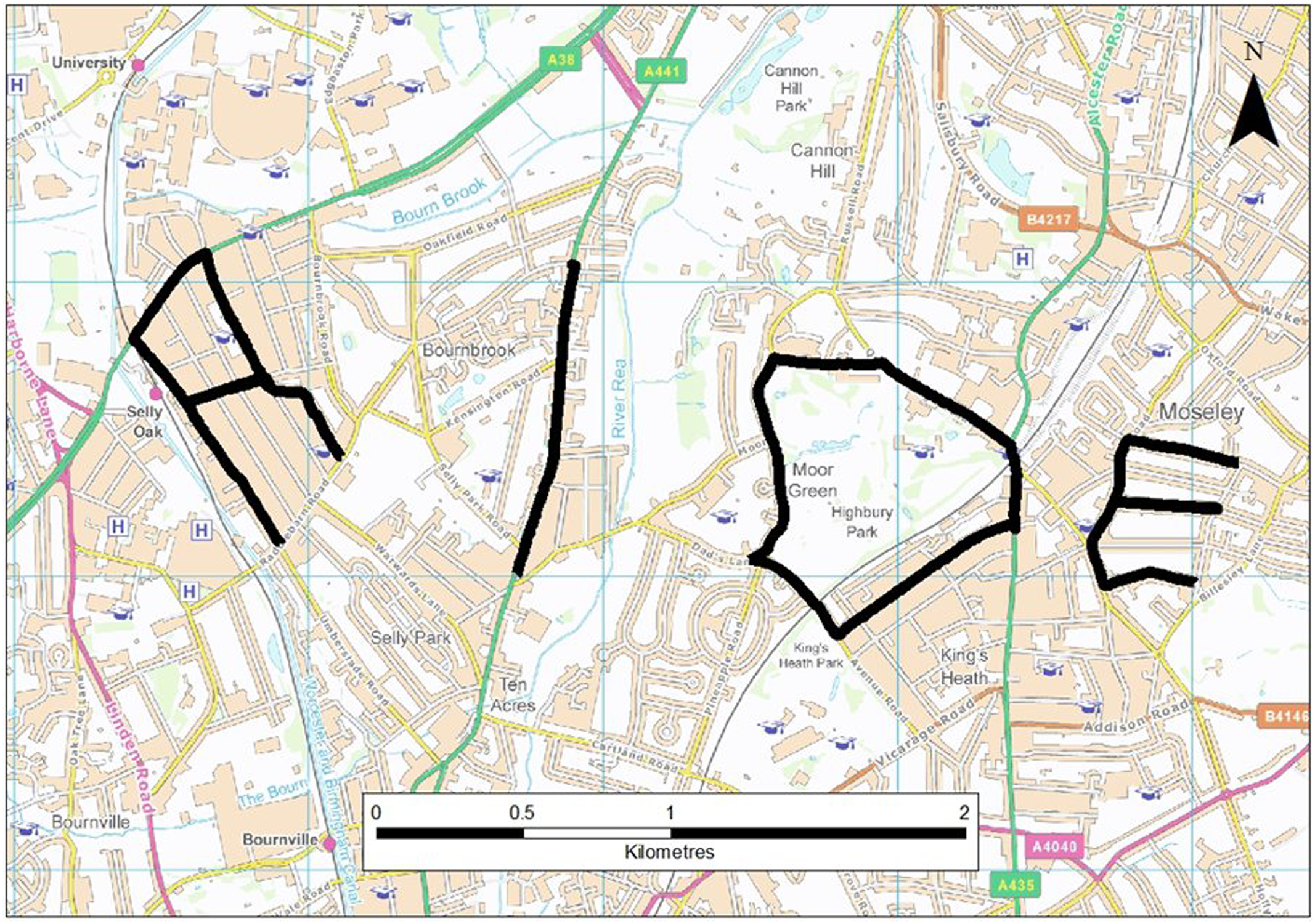
GPS data overlaid on Open Street Map base showing part of southern Birmingham, UK.
On Saturday 31 October 2009 at 32 minutes and 41 seconds past 3 p.m. GMT I started a GPS recorder at the top of Heeley Road, a location about 10 minutes from my home by bike. The route was planned out in advance, drawn as a series of sketches on a piece of paper that would later disintegrate in my pocket from sweat and repeated handling. I had picked a location conveniently close to home with a road network of sufficient density and variation that I could make the letters emerge from it, like a face in a cloud.
Facts about the letters:
Total distance: 8.8 km
Average speed: 5.6 metres/second (~20 kph)
Highest point above sea level: 170 m
These cold facts, like the GPS trail itself, tell a very partial story. Critically, they do not indicate how afraid I was during the performance.
I’m usually a confident cyclist, but I had made a bad decision. When setting off, even though I knew it wasn’t long until the autumn sun would start to set, I’d not taken my lights with me. It rapidly became clear that I’d badly underestimated how long it was going to take me to perform the act of writing across the city. So, not a race cyclist and straddling a not particularly lightweight bike, I found myself having to push quite hard, chasing the last of the daylight to make the journey safely. And I cursed the fact that I happened to be dressed entirely in black 12 making me even less visible to motorists. The fear was a straightforward one, that I would be injured while making this artwork, knocked down by a fast moving vehicle whose driver had not seen me in the fading light. For some artists the possibility of injury forms part of the performance, most notably for Bas Jan Ader the Dutch artist who died at sea enacting his final work. 13 Risking injury was not my intention, but neither did I want to risk having to get off the bike and push it home. I have a guilt-ridden anxiety about my tendency toward laziness and being easily distracted (e.g. by motor racing) and so I was also worried that having had the idea for this performance, I would fail to see it through. As a result, fear and paranoia were my constant companions on this journey.
The paranoia grew as I started drawing the letter ‘R’ on the long straight terraces around Heeley and Raddlebarn Roads. This is classic studentification territory, Victorian by-law houses that sit on the edge of the university campus. I started to worry that members of the student population were going to stare at me, wondering what I was doing. My usual hyperanxiousness – constantly worrying what other people think of me – was magnified by the time pressure and the sense that this was an utterly ridiculous thing to be doing.
Being nervous while riding was an unusual sensation for me, giving a window into the emotional and affective responses held by those who perceive urban riding to be dangerous. While the straight run along the bottom of the Rea Valley to complete the ‘I’ was relatively easy, a steep hill separated me from Highbury Park, around which I planned to make the ‘D’. Push, push, push up the hill, heart pounding. An idiot driver held his hand on the horn as he went past – no obvious reason, but many UK drivers apparently harbour resentment toward cyclists. I may be familiar with such passive-aggressive behaviours from my everyday cycling, but it was an unwelcome extra pressure on an already anxious ride. The GPS track, coarsely limited to a few metres in accuracy, does not show the slight wobble where I flinched.
I used to live around where I drew out the ‘E’. I’d forgotten that these roads are smeared across quite a steep hill, invisible in the 2D map around which the route was planned. Puffing and panting, up and down, up and down drawing out the cross pieces:
. . . there’s two pissed middle-aged blokes with purple flowers drawn on their faces. ‘Nice bike’ they shout as I go past. I make a matey response . . . They’d never do that to a passer-by, but you’re on a bike so it’s legitimate to be shouted at. Fuckers. (Diary notes, 1 November 2009)
My heightened emotional state made the landscape feel hostile, harmless drunks made threatening. As I got back to the High Street to start the return leg of the journey I noticed that around half the cars had their sidelights on. At this point I was nearly 8 km from home. Going back down the hill toward the River Rea, I estimated it was 20 minutes before the fading light moved from marginal to dangerous. No way I wanted to give up, dismount and walk home in the dark. Cold air, heavy sweat, lungs screaming from the effort, lettering finished, I made my way up the other side of the valley, the final push toward home, making it just as the last of the light drained out of the city.
The performance described here plays with the mismatch between instrumental transport, aspirations to sustainability and the affective pressures on the cycling body. In an interview, long after an evening trespassing on the unfinished New Jersey Turnpike, conceptual artist Tony Smith discussed how the experience refigured his understanding of what art could do. 14 As with Smith, the event described above took place some years ago 15 and for several years this performance existed only as a memory and a printout from Google Earth stuck to my office door. By offering this description of the work to a professional audience as the basis for a peer-reviewed article I risk devaluing its artistic currency by making it an instrumentally-driven career ‘output’.
The counter to this, however, is that the intention was never to create great art. Neither the GPS drawing nor the word art elements were particularly original. But, following Marion Milner’s On Not Being Able to Paint 16 I had the confidence to try expressing ideas through an artistic mode, allowing me to experiment with a different way of conceptualizing the practice of riding. Where my everyday bicycle commuting is forgettable, ordinary, banal, the RIDE performance is seared in my memory. Like Smith’s adventures on the New Jersey Turnpike, my RIDE has helped me think differently about both art and cycling. Viewed from above, de Certeau’s Wandersmänner were enacting unconscious tactics of resistance, 17 but this performance was consciously enacted. Instead of the gaze from atop the World Trade Centre, the gods’-eye view of the GPS deploys a cold, scientific, disembodied technology to let me make a statement about cycling as sweaty, visceral, emotionally intense and highly embodied practice.
Footnotes
Funding
This research received no specific grant from any funding agency in the public, commercial or not-for-profit sectors.