




Abstract
Sarah Whatmore has argued that ‘[t]here is an urgent need to supplement the familiar repertoire of humanist methods that rely on generating talk and text with experimental practices that amplify other sensory, bodily and affective registers and extend the company and modality of what constitutes a research subject’. But how does one do this? What kinds of research practices are useful? And more specifically, what kinds of methods can help to conjure and enact a vitalist materialism in the field? This essay offers a brief and critical account of how the author attempted to perform a vitalist materialism through fieldwork practices undertaken in 2007. Research into Caribbean agronomic responses to the EU Sugar Reform involved ‘muddy boots’, diary writing, and video documentation methods. Participating in the thick of agronomic experiments facilitated a greater sensitivity to and awareness of the interactions and miscommunications involved between different vital agencies and video provided an evocative way of communicating more-than-human materialities. In sum, these methods were successful with regard to Whatmore’s call, but proved to be more useful as memory-prompting tools. This author found that practising vitalist fieldwork did not mean that one had to enrol fantastical new methods to reveal or get at ‘the vital’. Rather, the cultivation of a vitalist geographical imagination that was receptive and open to the liveliness of materialities and the significance of relational becomings was much more important.
Anderson and Wylie 1 remind us that our ways of grappling with matter and materiality should be properly considered as distinctive ‘material imaginations’: ‘ to think of matter is invariably to perform a material imagination’. 2 This essay offers a brief account of how the author attempted to perform or inculcate a vitalist material imagination through fieldwork practices undertaken in 2007. 3 With theoretical inclinations of a more-than-human sort, 4 the research mobilized this approach to explore the response of the Barbadian sugar sector to the European Union sugar reform, particularly in relation to their agronomic cane breeding program. 5 The EU reform phased out trade preferences that had supported former colonial sugar industries, including Barbados, for decades. 6
This essay seeks to offer a short and critical account of how I went about performing, or at least trying to perform, a vitalist materialism. This conceptual approach imagines nonhuman materialities as animated by dynamic and lively capacities to affect change and to participate in political life. 7 This paper outlines the ‘muddy boots’, diary writing, and video documentation methods that constituted fieldwork efforts to mobilize this concept, commenting critically on the possibilities of animating vital materialism in practice. Crucially, I suggest that fostering a particular material imagination 8 is imperative to such a task, as opposed to adopting new methods.
Although it is not only during the fieldwork stage of research that one ‘performs’ theoretical imperatives, (the formulating of research questions, analysing of results and writing up are just as important
9
), I want to dwell a little on this because of the commonly heard calls for methodological sensitivity and innovation in relation to more-than-human geographies.
10
For example, in this journal, Sarah Whatmore argued that
[t]here is an urgent need to supplement the familiar repertoire of humanist methods that rely on generating talk and text with experimental practices that amplify other sensory, bodily and affective registers and extend the company and modality of what constitutes a research subject.
11
But how does one do this? What kinds of research practices are useful? And more specifically, what kinds of methods can help to conjure and enact a vitalist materialism in the field? Below, vital materialism as a concept is briefly outlined, before summing up efforts to think through and perform fieldwork with these ‘how’ issues in mind.
Vitalist materialism
Vitalist materialism is an approach that draws on a notion of ‘vitality’ or life force as animating material life. Greenhough 12 has outlined that early ‘vitalism argues that there is some exceptional quality, soul, spirit or élan vital 13 that is possessed only by living beings’. Fraser et al. 14 discuss a ‘new vitalism’ that is less concerned with the difference between living and non-living, and more with how ‘objects, subjects, concepts are composed of nothing more or less than relations, reciprocal enfoldings gathered together in temporary and contingent unities’. 15
This research engaged with the vitalist materialism demonstrated by Jane Bennett’s ‘political ecologies’. 16 Bennett argues that nonhuman materialities can be lively and forceful participants, but does not claim that all actants have the same participative capacities, characteristics or degrees of power. 17 Recognizing the vital and interactive agencies of different materialities is important as it reminds us to pay attention to the roles that nonhuman participants play, which effect entire collectives and which are regularly downplayed or overlooked by policy-makers and economists. 18
Materialities here are understood to be animated by their own dynamism and spatio-temporalities, which are processually configured through relations with other materialities. 19 If we acknowledge a dynamic yet unknowable flux of life, we therefore cannot claim to know or fix any such inherent quality. 20 This conceptual territory demands that we practice a form of empiricism that sees the world we research as lively, and ‘excessive’, 21 and somehow always moving away from our attempts to grasp and describe it. The following paragraphs summarize how an attempt was made to engage with these ideas in the cane-breeding and selection fields at the Agronomic Research and Variety Testing Unit (ARVTU) in Barbados.
In the field: ‘doing’ vitalism
Supported by agronomic research papers and several interviews, three specific methodological strategies were deployed in an attempt to engage with the (more-than-human) vital materialities at play at the ARVTU: participant observation (an internship), diary-keeping and video documentation. These involved different ‘affective registers’ 22 and forms of representation. A month was spent ‘interning’ at the ARVTU, which involved hands-on practical work and very muddy boots. This task was approached by following the senior agronomist through the cane plots for the first couple of hours of each day with a video camera, filming where possible. The rest of the time was spent as a general field volunteer with the team. In itself, there was nothing especially ‘posthumanist’ about these methods.
However, during fieldwork, I adopted an attitude to the task that, (it was hoped), attended to the vital material relations that quite literally surrounded me. There was an attempt to become more consciously and affectively aware of non-human agencies. 23 I touched the cane, sniffed around, worked hard, listened . . . [Video 1: https://vimeo.com/45194275]. Conscious of Anderson, Cook and Madderns’ discussion of ‘learning to be surprised at the capacities, and properties, of different materialities’ 24 and also of Jane Bennett’s ‘enchanted materialism’, an active wonderment towards the more-than-human agencies encountered at the ARVTU was encouraged.
Keeping a diary provided some textual expression of how the internship activities were experienced and worked to prompt memories of specific events later on. Video was deployed as ‘a means of witnessing various forms of knowledge, skill and embodied practice that can escape text- and talk-based approaches’. 25 It was hoped that by using video and diary in this way, it would encourage a reflexive attentiveness to the cane plant (and other) bodies. Deciding where to point the camera at any particular moment was part of the process of learning in the field, becoming a tool for thinking, seeing and re-presenting materialities.
However, I have been troubled by the thought that perhaps one might simply have asked the agronomists more questions about their embodied practices and interactions with nonhumans. That is, in order to learn about the vital materialities of cane-breeding – and to write about it – was there any need to spend a month literally in the field, stomping through three-metre-high grasses with a video camera in one hand and a refractometer in the other? What did becoming affected by the cane and agronomic practices in this physical way bring to the PhD thesis?
Reflecting on this, there were a few substantive things learnt/encountered during fieldwork that, I suspect, would otherwise have escaped attention: (1) recognizing different (but similar) cane varieties is a difficult skill that even specialist agronomists struggle with [Video 2: https://vimeo.com/45194274]; (2) rats are in the fields and they like to eat the sweetest sugar cane, damaging the plants and interfering with agronomists’ experiments [Video 3: http://vimeo.com/43167583]; (3) tags to mark different varieties in the field go missing: wind and rats carry them away [Video 4: https://vimeo.com/45195589].
These points, which were not mentioned during previous interviews with agronomists, complexified and extended the author’s understanding of the more-than-human relations and vital materialities at play, but they did not transform it. So was there anything else learnt from the experience? There are three points to make here: (1) a deeper respect for the challenges faced by agronomists was gained; (2) a deeper sense of sympathy with agronomists and workers developed, and (3) a heightened awareness of cane plants’ physical form and the dynamic properties of a cane field in agronomic experiments emerged. So in this sense, the methods led to a more sensitized and intensified awareness of the ‘field’ of study. But these points could probably have been developed without video documentation or diary-keeping. So was there any gain in deploying these methods?
Using video, it was hoped, would provide evocative ways of communicating, more-than-human materialities. 26 The video clips are arguably evocative of the many interconnections and intercorporeal registers/relations that constitute the ARVTU assemblage (if viewed with these ideas in mind). Further, in terms of implying the relation between the fieldworker and ‘the field’, the video clips show the hesitant movements of the camera and searching for objects of focus. For the author, this served as a reminder of the haphazard process of learning about the sugarcane environment. Watching the video clips a year after undertaking the fieldwork helped to recall how, at certain moments, the (phytogenetic) ‘stuff’ of canes became individuated ‘things’ as one learnt to sense differences between varieties. On reflection then, the video documentation as a method was useful for recalling personal embodied fieldwork experiences. Critically, it was perhaps more useful and interesting in relation to this reflexive re-membering of the learning process, than in terms of communicating vitalist materialities. One could say the same about the results of the diary writing practice.
The diary writing was adopted to record and express personal experiences during fieldwork. At the end of each day, a descriptive journal account was written, documenting particular thoughts or observations that stood out. In the PhD thesis, excerpts from the diary entries were quoted verbatim (see Figure 1) to provide a more vivid and personal account. But again, the method provided more scope for reflexive attention to creative knowledge co-creation experiences, than it did for theorizing more-than-human vitalities.
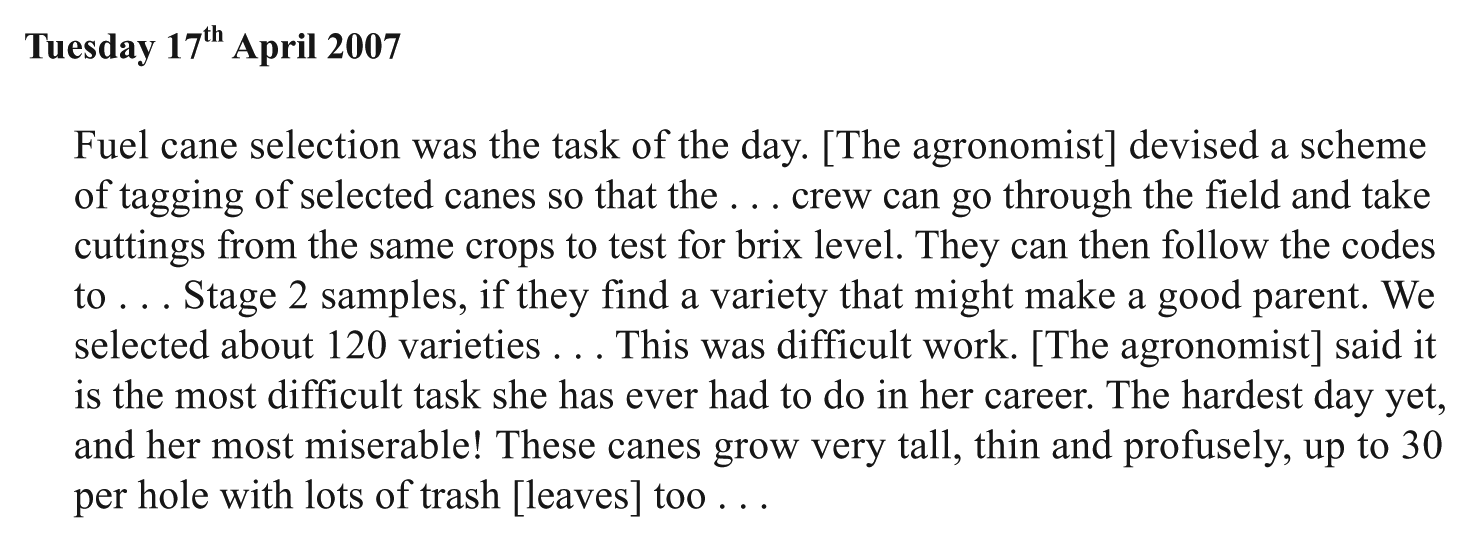
Diary extract from the field.
Efforts with diary-writing, videoing and participant observation attempted to adhere to the ‘radical empiricist modality’ that would be sensitive to the vitalist dynamism 27 and more-than-human becomings 28 discussed above. But, as has been pointed out elsewhere, such a stance requires that research questions must be deliberately and inescapably at risk of being redefined by the phenomena mobilized in the research process. 29 Reflecting back, in this instance it seems that the experience of ‘doing’ the fieldwork informed analysis, but was not critical to the way the ‘the field’ was conceptualized. Although the author learnt more about how more-than-human agencies and vital materialities affected the agronomists’ experiments, the economists’ policy outcomes and the industry profits, 30 the research agenda was not re-shaped by encountering these relations in this particular cane field.
Conclusion
In retrospect, things would have been done differently. The time spent in the field learning about sugar cane agronomy and getting muddy boots was insightful, but with hindsight, I would not have walked around with a video camera in hand. Looking back at the footage now, it does seem rather embarrassing. A more useful and less embarrassing intervention might have been to offer to make a (perhaps participatory) video for the ARVTU about their experiments.
In regard to Whatmore’s call to deploy ‘experimental practices that amplify other sensory, bodily and affective registers and extend the company and modality of what constitutes a research subject’, 31 the fieldwork practices discussed here were successful. Ultimately however, the diary and videos proved to be useful primarily as memory-prompting tools and ways of cultivating a particular geographical imagination. The same core argument and research conclusions could probably have been written up without them. This can be read as a failure on the researcher’s part to innovate and experiment . . . to allow the ‘data’ to reformulate the concepts. 32 This contrasts with different experiences of using video at other stages of the research process; for example, participatory video making with sugar workers did intervene with the author’s agenda and research questions in quite radical ways. 33 [Video 5: participatory video links: http://www.vimeo.com/16089820; http://www.vimeo.com/6812707]
Importantly, participating in the thick of agronomic experiments did facilitate a greater sensitivity to and awareness of the interactions and miscommunications involved between different vital agencies. This awareness, I suspect, was of a different quality than could have been gleaned from interviews with human participants alone, and so proved to be a useful research practice for engaging with more-than-human subjects. Referring back to a question posed at the opening of this paper; what kinds of methods can help to conjure and enact a vitalist materialism in the field? Despite efforts to be innovative and experimental, I found that practising vitalist fieldwork did not mean that one had to enrol fantastical new methods to reveal or get at ‘the vital’. Rather, the cultivation of a vitalist geographical imagination, or ‘attitude’ 34 that was receptive and open to the liveliness of materialities and the significance of relational becomings was arguably much more important. It did matter what was done in the field, but much more important was how the field was imagined to be and therefore, to what and how attention was directed.
Footnotes
Acknowledgements
For support in Barbados, the author would like to thank the BAMC, the field agronomists and workers at the ARVTU, and John and Janice Hunte. Thanks also to Hayden Lorimer for initial feedback on this paper.
Funding
The author gratefully acknowledges doctoral funding received from the Economic and Social Research Council, postgraduate studentship TTA-030-2005-00333 and supplementary funding provided by Jesus College, Oxford. Postdoctoral funding to pursue further research and publication is kindly provided the University of KwaZulu-Natal.