



Abstract
Located at the interface between contemporary archaeology, cultural and historical geography, this essay explores the ‘more-than-representational’ nature of memory as embodied and haunted by the spectral. Focusing on the post-industrial landscape of the Royal Forest of Dean, I narrate a walk undertaken in November 2008 with local resident, Ron Beard, as we sought to re-trace an old miners’ path. Histories of the landscape unfolded as we walked. Yet they also revealed a haunting sense of loss, a fragmented remembering and forgetting that was unsettled by ghosts from the past. For memory is born of strange and uncanny associations, inexplicable connections between times and places that erupt into the present without warning. As such, memory demands new ways of writing; narratives that better cope with our fragile and contingent recollections, disclosing the haunting presence-absence of the spectral in all its shapes, apparitions and phantasms. I begin by pursuing the idea that memory is more-than-representational. I go on to explore the recurrent manifestation of the spectral, which disturbs, displaces and conditions our understanding of space and time, absence and presence. Developing the argument that alternative styles of writing are needed to reveal the true nature of memory and our haunting engagements with the past − while at the same time accepting Wylie’s assertion that spectral geographies should themselves be spectral − I consider the work of Walter Benjamin and W.G. Sebald, which, through devices such as literary montage, biography and phantasmagoria, successfully unsettles, disrupts and enlivens. Taking stylistic inspiration from these great writers, the ‘Long Path’ is narrated in a non-conventional academic style that seeks itself to displace settled orders of space and time, to reveal the revenant trace of the spectre.
Introduction
It was an afternoon spent with members of the Forest of Dean Local History Society that led me to the ‘Long Path’. I had allowed my interests in walking and landscape to permeate the conversation: paths that were rendered impassable during the spring and summer of 2001, when the British countryside was effectively closed off due to the outbreak of foot-and-mouth disease; and the creation of the first official walking routes by the Forestry Commission, developed in collaboration with the Rambler’s Association during the 1960s. Out of this came the Long Path, a tantalizing opportunity to follow a disused miners’ trail − from the village of Ruspidge to Lightmoor Colliery. It set in train a journey into the region’s industrial past, an unsettling of space and time, absence and presence that revealed the haunting trace of the spectre, ‘the ceaseless becoming-past of the present in all its inescapable revenance’. 1
Despite some notable exceptions, 2 the implications of non-representational theory have largely been thought out spatially, with little attention given to the dimensions of time.3,4 As both cultural geographer and contemporary archaeologist, I am particularly interested in the manner in which the past influences and interrupts the present − those barely perceptible echoes from the past that have the power to move us in unexpected ways. In other words, I want to examine not just the legacy of the past, but its capacity to generate affective registers, to evoke and to unsettle. As such, I seek to develop distinctly archaeological approaches to considerations of materiality and time, placing an emphasis on memory and haunting, absence and presence. These themes are explored throughout this essay, as I reflect on a morning’s walk with local resident Ron Beard and our attempts to locate the Long Path, the more-than-representational 5 nature of memory and the recurrent manifestation of the spectral.
The ‘more-than-representational’ nature of memory
Of late, there has been a growing interest in memory among those writing on landscape. Indeed, Ingold argues that ‘to perceive landscape is . . . to carry out an act of remembrance’, that such acts of remembering are not ‘a matter of calling upon an internal image, stored in the mind’, but arise through our ‘engaging perceptually with an environment that is itself pregnant with the past’.
6
While several accounts offer personal recollections,
7
or focus the memories of others,
8
a number of scholars have also sought to explore the more material aspects of landscape and memory,
9
a relationship that has attracted great interest as a topic within archaeology.
10
Yet what is often the object of archaeological work on memory is not the act of remembering, but a representation of memory, the ‘inscription of memory on space’
11
− an artefact, a gravestone, a monument. As Jones suggests, this stems in part from the distinction drawn between ‘memory’ and ‘remembering’:
Memory . . . is often conceptualised as a representation . . . When we speak of material culture as a surrogate or carrier of memory then we treat objects as a form of representation . . . Remembering, however, is the process of recall, which is produced less at a contemplative distance and more in the current of quotidian activities.
12
The concept of memory has long been understood to hold active and passive elements; the act of remembering, that requiring conscious effort, can be contrasted with memories that are passively experienced, or impressed upon us. For Plato, processes of recollection, and the associated transmission of cultural traditions, were focused upon oral, conversational practice rather than writing or inscription. By contrast, Aristotle emphasized the role of the senses, and the manner in which the materiality of the world is perceived and remembered. Unlike Plato, he suggested that recollection works ‘by laws of association’, which can be strengthened by repetition, or habit, and everyday experience. Indeed, central to the modern concept of memory is the distinction between so-called practices of ‘incorporation’ (embodied action) and practices of ‘inscription’ (physical entities that store or carry information). 13
For Bergson, 14 there were two distinct forms of memory: ‘habit memory’, stored within the body and developed through repetitive action; and ‘pure memory’, the survival of personal memories in the subconscious. Habit memory is an automatic functioning of the body, based on past experience. Conversely, pure memory is a spontaneous, faithful preservation of the past, which is less associated with everyday, practical aspects of life, and thus more contemplative. Central to this argument is Bergson’s assertion that we prioritize the perception and retention of experiences and information that will be useful for future conduct. As such, it is often contended that Bergson’s work has much in common with Proust’s concepts of ‘voluntary’ and ‘involuntary’ memory. 15 For Proust, voluntary memory is partial, and is therefore accorded the secondary status of Bergson’s habit memory. By contrast, involuntary memory reveals every aspect of the past, including sensations and emotions; it shares the impulsivity of pure memory, in the manner by which it surfaces without conscious thought. However, where Proust’s account differs from Bergson is in the importance attributed to the body in processes of memory recall. Unlike Bergson, Proust stresses the role of physical sensations as fundamental to processes of involuntary memory; In Search of Lost Time is loaded with references to physical sensations as the source of involuntary memories, the most famous of which is the taste of the madeleine dipped in lime blossom tea.
Accepting that our memories are brought forth through bodily engagements with the world, we might assume that the landscape itself will play an important role in evoking the past. As the archaeologist, Andy Jones, suggests, the materiality of the landscape embodies retentions from the past that speak to future actions and events − partly through its physical endurance, which offers a means of experiencing, and thereby presencing, past events. 16 Jones argues that people and things ‘resonate’ temporally and in relation to each other in two ways: first, ‘because material culture endures while people change, objects have the power to affect us as a kind of material “echo” from the past’; and second, because objects change through time they offer a means of evoking remembrance ‘from the of view of the constancy of the person’. 17 Further, he stresses that ‘memory is experienced precisely because of the temporal disjuncture between people and things’. 18 However, it has recently been argued that we should expand our accounts of landscape and memory to look beyond the presence of objects and materials, places and people − to focus upon absence, loss and ‘haunting’. 19
A growing interest in ‘spectrality’ has emerged within cultural and historical geography, as scholars begin to rethink the manner in which spaces, events and practices disrupt our ideas of presence and absence. 20 The concept of the spectral has value because it suggests that our experience of the world is haunted by a space-time in which past and future co-exist, and interact, in uncertain and unpredictable ways. Understood in these terms, the spectral is not a ghostly spirit hovering over a concrete world of real objects and living bodies, but is integral to our experience of the world, as the enduring and unsettling capacity of place to haunt. 21 Writing on spectrality can be seen as part of wider efforts to engage with a broader conception of materiality. A growing number of scholars argue that to oppose the real, tangible and concrete world of material objects and things with that of an intangible, immaterial world of representations, affects, and emotions is wholly inadequate. 22 Understood as the impossibility of the fullness of presence, spectrality challenges our understanding of the material as the taken-for-granted, obdurate and concrete elements of our world.
Importantly, the spectral unsettles any linear understanding of time, disturbing our sense of place and self through the arrival of haunting memories. According to Derrida, as long as we perceive time as ‘a historical temporality made up of the successive linking of presents identical to themselves and contemporary with themselves’, we are unable to grasp the true nature of history and memory. 23 Spectrality leads us ‘to doubt [the] reassuring order of presents and, especially, the border between the present . . . and everything that can be opposed to it: absence, non-presence, non-effectivity, inactuality, virtuality’. 24 ‘Before knowing whether one can differentiate between the spectre of the past and the spectre of the future, the past present and the future present’, writes Derrida, ‘one must ask oneself whether the spectrality effect does not consist in undoing this opposition.’ 25 It is interesting to note that Derrida’s spectrality has a strong ethical dimension − a point that is often overlooked in the literature. ‘If I am getting ready to speak at length about ghosts, inheritance, and generations, generations of ghosts, which is to say about certain others who are not present, nor presently living, either to us, in us, or outside us’, writes Derrida, ‘it is in the name of justice.’ 26 Derrida’s concept of justice is intergenerational; it is a justice for those no longer, or not yet, ‘present’. ‘No justice . . . seems possible or thinkable without the principle of some responsibility’ he writes, a sense of responsibility that extends ‘beyond all living present . . . before the ghosts of those who are not yet born or who are already dead.’ 27 In other words, Derrida urges us to be more ‘just’, to look ‘beyond the living present in general − and beyond its simple negative reversal’. 28 We must search for a ‘spectral moment’, a moment that no longer belongs to time, a moment that corresponds to ‘past present, actual present: “now”, [or] future present’. 29
Re-presenting the past
Much recent work on memory, matter, haunting and identity draws attention to the role that margins, memories, ghosts, phantasms and disorderings play in the affectivity of place, the politics of memory and the performance of historical identities. 30 However, it seems to me that the challenge in all of this work is to construct a narrative of the past that attends to the discursive and embodied conditions of its existence in the present, to highlight the matter that brings forth memories, and to make visible the invisibility of the spectral − ‘beyond the phenomenon or beyond being’. 31 Indeed, Wylie asserts that ‘as well as exploring forms and fabrics of spectrality, spectral geographies should themselves be spectral’. 32 This paper lends weight to Wylie’s argument, exploring both the spectral moment as it is experienced in our everyday encounters with the world, and literary styles that might enable us to convey such moments of spectrality. However, while I draw here upon Wylie, I wish to take this opportunity to position my work as distinct in approach and presentation, and in doing so to make one small criticism. Experiments and commentaries on writing about landscape have recently become popular, particularly within cultural geography. 33 In responding to calls for a non-representational style − one in which human beings are engaged participants rather than detached observers − many writers have focused upon the lived experience of landscape, accessed through phenomenological approaches, 34 in which human being is defined as embodied ‘being-in-the-world’, which both precedes, and ultimately levels, the distinction between ‘internal’ self and ‘external’ landscape. And there is little doubt that such experiments have been incredibly successful, demonstrating great potential to think and write landscape anew, in a way that exceeds the vision-oriented qualities of landscape and the always-already scripted nature of representationalism. John Wylie has been at the forefront of such innovation. However, while I admire and respect Wylie’s work, I also detect a tendency to write others out of his accounts, to mention companions in passing without further reference, or to relegate them to footnotes. 35 Although I understand the nod towards ‘absence’ in Wylie 2009, I remain sceptical of a writing style that focuses almost exclusively on the author’s thoughts, feelings and memories. Instead, this paper aspires to create a narrative style that allows other voices to be heard, a style that remains ‘sensitive to the ways in which individuals . . . experience memory as multi-sensual, spatial ways of understanding their worlds’, 36 as embodied acts of remembering. It seeks to develop literary techniques that enable us not just to reveal the haunting spectre of the past in the present, but to do so from the vantage point of the ‘other’. As Holtorf and Williams suggest, ‘this kind of “looking back” is not . . . about accurately recalling past events as truthfully as possible: it is rather about making meaningful statements about the past in [the] context of [the] present’. 37 It is also about revealing something of the manner in which the past erupts into the present, and the future-present can be found in the past.
Examples of such temporal disjuncture can be found in the work of some of our greatest literary figures. While Proust’s search for lost time is an escape into the past from a world filled with danger and the spectre of death, Walter Benjamin seeks to understand the future-present in traces of the past. Benjamin’s Berlin Childhood Around 1900 38 comprises a series of vignettes, marking a step towards the dialectical method of ‘montage’, seen most emphatically in the fragments that make up the Arcades Project. 39 Benjamin was strongly opposed to writing history in a way that suggested development, unfolding, or progress. Indeed, the meaning Benjamin sought to disclose in his materials was to be found in many sudden ‘illuminations’ triggered by his juxtapositions and ‘dialectical images’. Benjamin placed great value on discontinuity in his method, both to destabilize the particular features in view and to prevent their being reinserted into conventional, uncritical pictures of the world. The Arcades Project is a history of Paris in the 19th century, with a complex temporal layering of brief accounts of the past and more recent observations. Temporal sequence is not the organizing principle; instead, Benjamin develops a kind of dialectic between past and present, in which the present can recognize itself in a segment of the past, and the past yields up its meaning as it is read from the vantage point of the present. 40
W.G. Sebald was heavily influenced by Benjamin. In his ‘travel writing’, the act of wandering though landscape is crucial to the evocation of memory. There is a redemptive quality to Sebald’s work, the imaginings of landscape invoked − assembling and chronicling, piece-by-piece, places, experiences, life, all that will eventually pass beyond human memory. In The Rings of Saturn, 41 for instance, Sebald narrates a deteriorating landscape, surrendered to the forces of nature and the legacies of the past. But what is so revealing about this landscape and its mysterious narrator is not so much the melancholic, borrowed-timeliness of landscape and life; rather, it is the hopelessly impossible and yet wonderfully chaotic manner in which fragments of past, experience and land intertwine, it is how the stories are traced and told. The initial impression is perhaps that it is composed of a series of unlikely incidents and recollections. And yet, as improbable as these associations might seem, the somatic nature of memory suggests that they might powerfully, and in some senses accurately, demonstrate the manner of our engagements with the temporal and material dimensions of our world. The walk along the Suffolk coast might at first appear linear and topographically sensible, traceable, but this is not the case. Our protagonist instead traverses improvised paths, scales fences, and finds himself lost in an intricate tangle of mind and world. The labyrinthine character of the mind is echoed in the landscape and reverberates in memories and stories of the past. The apparent ruptures and discontinuities evident in Sebald’s writing reveal the fragile and contingent nature of our recollections.
As Wylie notes, Sebald’s literary form − which combines existential memoir, autobiography, travel writing and phantasmagoria − also presents us with a world that is haunted by the past. 42 Narrated in what might at first appear to be a factual style, there is much ambiguity as to whether the narrator is Sebald himself, and whether the events he describes are factual or fictitious. Visual evidence in the form of photographs and documents lends an aura of authenticity, yet interruptions of surreal and phantasmagorical digression, along with changes in mood, topic and tempo, combine to disrupt and unsettle. The emphasis upon travel and exile within Sebald’s writing also conveys a sense of the un-homely, unheimlich or uncanny. Yet the power of Sebald’s work is that it ‘allows itself to be haunted’. 43 And this is what my account of walking the Long Path strives to achieve.
The Long Path
On 21 November 2008, we met to retrace the Long Path. We stood in the car park on that cold November morning, poring over maps pulled from the boot of Ron Beard’s car. Referring at once to both cartography and landscape, we discussed the location of railway lines and tramroads, collieries and iron mines. Up on the top was Buckshaft Iron Mine, with a tramway leading down over the far side of St John’s Church, Ruspidge. Another tramway brought ore from Shakemantle Iron Mine and coal from Lightmoor. There was a railway line stretching towards the nearby town of Cinderford, with branches and sidings off to Crumpmeadow and Foxes Bridge collieries. And another branch wound its way to Lightmoor, joining up with Severn and Wye Railway, or the ‘mineral loop’, as it was known locally. To our north was Bilson, one of the first big collieries in the area, then Trafalgar, Crumpmeadow, Foxes Bridge and Lightmoor. You can’t quite see the tip now the trees have grown, said Ron. It was while we were standing there at Ruspidge Halt, that I experienced what could only be described as some kind of palpitation, like an echo from the past. For a moment I was sure that I could smell coal dust drifting through the valley, while the faint clattering sound of wagons winding their way out of the collieries seemed to hang in the air. I thought I saw a puff of steam discernible on the horizon, later realizing that it must have been smoke rising from a chimney on the hillside, carried upwards on the breeze.
I was eager to get going, to catch a first glimpse of Lightmoor colliery and to see what could be traced of the Long Path. Instead, we lingered a while longer, speculating about the names of the mines. ‘Trafalgar’ conjured such a sense of triumph and grandeur. The Trafalgar gale was granted in August 1842. Decades earlier, on 21 October 1805, the British Royal Navy had been victorious in a battle against the combined fleets of the French and Spanish at Cape Trafalgar. The battle was the most decisive of the Napoleonic Wars; the Franco-Spanish fleet lost 22 ships, without a single British vessel being lost. Timber from the Royal Forests had helped to secure the victory, and Admiral Lord Nelson himself had visited the Forest of Dean in 1803 in an effort to safeguard supplies for his fleet. In October 2005, on the 200th Anniversary of the Battle of Trafalgar, 200 oak trees were planted to form a commemorative avenue in the Forest. Planters were each offered a bottle of ‘Trafalgar Ale’ donated by the local Freeminer Brewery, and named after the Trafalgar Colliery.
Eventually, we set off down the B4226, towards Cinderford Bridge. All of this is so much more overgrown than when I was a boy, said Ron, gesturing at an area of waste ground. Ron told me how he used to play rounders on the grassy area in front of us, and cricket in the area beyond, now covered with undergrowth. The ‘church tumps’ they were called, the hillocky, hummocky ground around the church up there. There were lots of quarries, some old surface coal mines, you know, levels and so on, he said. Leaving the B4226, we took a right down ‘Railway Road’, stepping onto what was once the old tramway. We knew it as the ‘Dram Road’, said Ron, because of the trucks that were drawn by horses called ‘drams’. In the late 18th and early 19th centuries, a series of horse-drawn tramroads were developed in the Forest, transporting coal and ironstone to local ironworks, and later to docks on the Severn at Bullo Pill and Lydney, shipping coal and other products to markets further afield. With the introduction of railways in the mid-19th century, the tramroads were gradually superseded by the new transport system. 44 Traces of the old tramroads remain as stone sleeper blocks, earthworks, bridges and other structures, and sometimes as footpaths following a track bed. I can remember when they still had the tramway blocks along here before they made it into a road, said Ron.

Railway Road, November 2008.
We continued down Railway Road, eventually reaching the original start of the Long Path. It was the decline of mineral traffic as a result of the closure of the larger collieries from the later 1920s that led to the abandonment of branch lines and tramroads, and, after the Second World War, to the virtual disappearance of the railways. Former stretches of railway lying outside the Forest boundary were sold off to private individuals and companies, and the area of land lying between Ruspidge and the Forest was no exception. Now part of a mobile home park, access is no longer permitted and is physically denied by impenetrable wooden fences and padlocked gates. Despite appeals to the Council, the route remained closed; having crossed the railway it was ruled to have been an illegal footpath, and the right of access could not be upheld. The whole of Ruspidge was cut off from the Forest, and the Long Path was virtually lost. My father used to use it, said Ron, and he knew the owners, so he asked them about it, and they said ‘Oh, I don’t mean to stop you Mr Beard’, but of course, they did. We stood there a while in front of the gates, gathering our thoughts.
I asked Ron about his father’s work. Dad was a miner, well, surface worker, he said. He worked underground for a short time, but my mother was a very nervous type, and so she persuaded him to change to surface work. So, most of his life he spent tipping dirt, you know, spoil from the mines. He spent about 19 years at Lightmoor and then he transferred to Eastern, and that ridge up there is the Eastern united tip, so up on that tip was where my father worked for about 25 years, said Ron. Closing in January 1959, Eastern United was one of the last large mines operating in the area, employing some 900 men. As Ron Beard talked, I found that my eyes were drawn to the Eastern United spoil heap. I tried to imagine what it would be like to spend 25 years creating such a landscape-defining feature. The mass of material displaced from underground sits proudly on display, a monument to the toil of men like Ron’s father who now lie still and silent. We continued on. There used to be a row of houses here, which was called the ‘Long Row’, said Ron, and that was where my father’s father was born, so that’s going back to the 1870-1860s. Ron had known it as ‘Evans’ Row’, whether they had owned it or not he was unsure, but they had certainly lived there. There were only six or seven houses, which became derelict just after the war. The Evans’ had Damson trees in their garden, so once it became derelict, we used to go scrumping, said Ron. Crossing a wooden footbridge, we set off on the Long Path. We rustled through the fallen leaves of autumn and scrambled up a steep bank. Disturbing the damp leaves brought forth the heady scent of autumn.
I always remember dad saying that the most wonderful thing was at night they would see the lights of the carbide lamps of the miners coming down through the trees, so you could just see the miners’ bobbing lights as they walked back from work, said Ron. This evocative description reminded me of the artist Laura Daly’s work for Reveal, a series of temporary installations created from light and sound, and exhibited in a selected area of the Forest of Dean Sculpture Trail in April 2006. Reveal aimed to evoke a new interpretation of the Forest, based on artworks utilizing a range of technologies: smoke machines, kinetic sculptures, film projections and audio works. Laura’s work was inspired by the experiences of miners working at Trafalgar, using miners’ lights, with original metal battery canisters, and audio recreations of footsteps, along gravelly paths and through streams. I visited Reveal on Saturday 8th April. I remember the stark cold and blackness of the night between the artworks, and the constant chatter of people moving around me. I shuffled from one installation to another, unsure of my footing in the darkness, taking care to avoid bumping into others. I found the whole experience unsettling, the darkness felt suffocating and the unexpected proximity of others put me on edge. I thought back to December 2005, when I’d accompanied Laura and the curator of the Sculpture Trail on a walk around the site as Laura’s ideas for Reveal were still emerging. There were uncertainties about where the artwork would be located, how long the batteries might last for the miner’s lamps, and how the sound recordings could be played on a loop. It had all seemed so unreal then. The idea of recreating something of the mining experience had captured my imagination, but I found it impossible to visualize the intended effect.
After much ‘scrambling’, we finally reached the summit and level ground − only to find that the path had disappeared. Despite our attempts to trace it, nothing could be discerned under the brambles and heavy fall of leaves. Retracing our steps, Ron suggested that we might have walked in the wrong direction, that the memories of his youth were betraying him. Half an hour passed in peripatetic disorientation. We followed one path and then another, each time finding ourselves at a dead end or heading off in the wrong direction. I don’t know which one of us was more disappointed. Finally, forced to abandon our search for that section of the Long Path, we continued on towards Lightmoor, along one of the Forestry Commission’s forest roads.

Laura Daly’s work for Reveal, April 2006.
As we walked, Ron spoke about his father. Born in 1897, he had started work at 13, but by 1915 he and his mates had all volunteered and gone off to war. Many coal mining areas raised battalions of ‘Pioneers’, skilled labourers to relieve the infantry of their non-combatant duties, such as digging trenches. The Forest of Dean Battalion of Pioneers was later taken over by the Gloucestershire Regiment. As the war went on, Ron’s father was taken ill with suspected Typhoid Fever. The tests proved negative, but he was split from his friends and put into one of the infantry battalions, the ‘First Eighth Worcesters’. All except one of the pals survived, said Ron. It was his father’s best friend, ‘Buller Turley’, who was killed. Ron explained that although his father had been christened Edwin, he had always been known as ‘Jim’, after the prize fighter ‘Jim Tolley’, while Jim’s best friend, Fred Turley was nicknamed ‘Buller’ after the Boer War General Buller. And it was Buller, unfortunately, who was killed, said Ron.
According to the Commonwealth War Graves Commission, Private Turley was killed on 30 March 1917, and is buried in Ste. Emille Valley Cemetery, Villers-Faucon, Somme.
The search for Turley’s medal card brought back memories of my own, of tracking information about my grandfather’s grave. Killed in action in the Netherlands on 19 January 1945, he was a rifleman with the 6th Battalion Cameronians (Scottish Rifles). Edward Arthur Hill, son of Arthur and Lily, husband of Doris, and father of Brian − my father. I shall always remember as a child staring at the small, moth-eaten black cat, symbol of good luck that had been placed on their wedding cake, which sat in a display cabinet in my grandmother’s home, along with a photograph of him in uniform and the telegram informing her of his untimely death at the age of 32. His last pencilled letter home describes his excitement at forthcoming leave, during which he would get to see how his baby son had grown. I am still the only member of my family to have visited his grave in the immaculately tended cemetery in Sittard, where I left a bouquet of white roses. A small tragedy, like those that beset almost every family, and yet his death has haunted us for two generations, having had a profound effect on the upbringing of my father, and in turn my own.
We approached Lightmoor Colliery along the line of an old tramway, with the profile of the spoil heap visible against the pale grey sky. Lightmoor Colliery was one of the largest and most sophisticated pits in the Forest. Writing in 1858, Nicholls describes the ‘coal-works’ of the Forest of Dean as worthy of comparison with ‘some of the finest collieries in the kingdom’. 45 ‘As an instance of their present excellence’ he writes, ‘Messrs. Crawshay’s colliery at Light Moor may be mentioned, for its great extent, completeness, powerful machinery, and size of pits.’ 46 Operated by Henry Crawshay and Co. 1823−1940, the site is now used by a timber firm. It still has a Cornish engine house, which was listed by English Heritage in 1982. However, in 2002 it was placed on the Forest of Dean District Council’s Buildings at Risk Register, after a survey undertaken in 2000 revealed that tree growth inside the structure had resulted in a partial roof collapse. 47 The former pump and engine house is now empty. The hipped roof, originally of slate, comprises a few bare timbers, while the roof trusses are more or less intact, with king posts. The east and west sides have two small window openings on each floor, but the windows themselves are missing.
We crossed an area of felled trees before taking the well-defined ‘Lime Tree Ride’. ‘It must have been rather grand mustn’t it, riding along here, with the lime trees and so on’, said Ron. Created during the mid-19th century by Head Forester, Edward Machen, the lime tree-lined track stretches from Parkend to Cinderford Bridge. Some of the lime trees still exist, standing tall, as if on ceremony, waiting for the Machen family to ride past on their way to church. During a Select Committee inquiry into the expenditure and management of the woods, forests and land revenues of the Crown in 1849, Machen was keen to report ‘an improvement in the order and conduct of the inhabitants of the Forest, the fruit . . . of the many years of pious labour which the clergy and Christian teachers of the neighbourhood had bestowed upon [them]’. 48
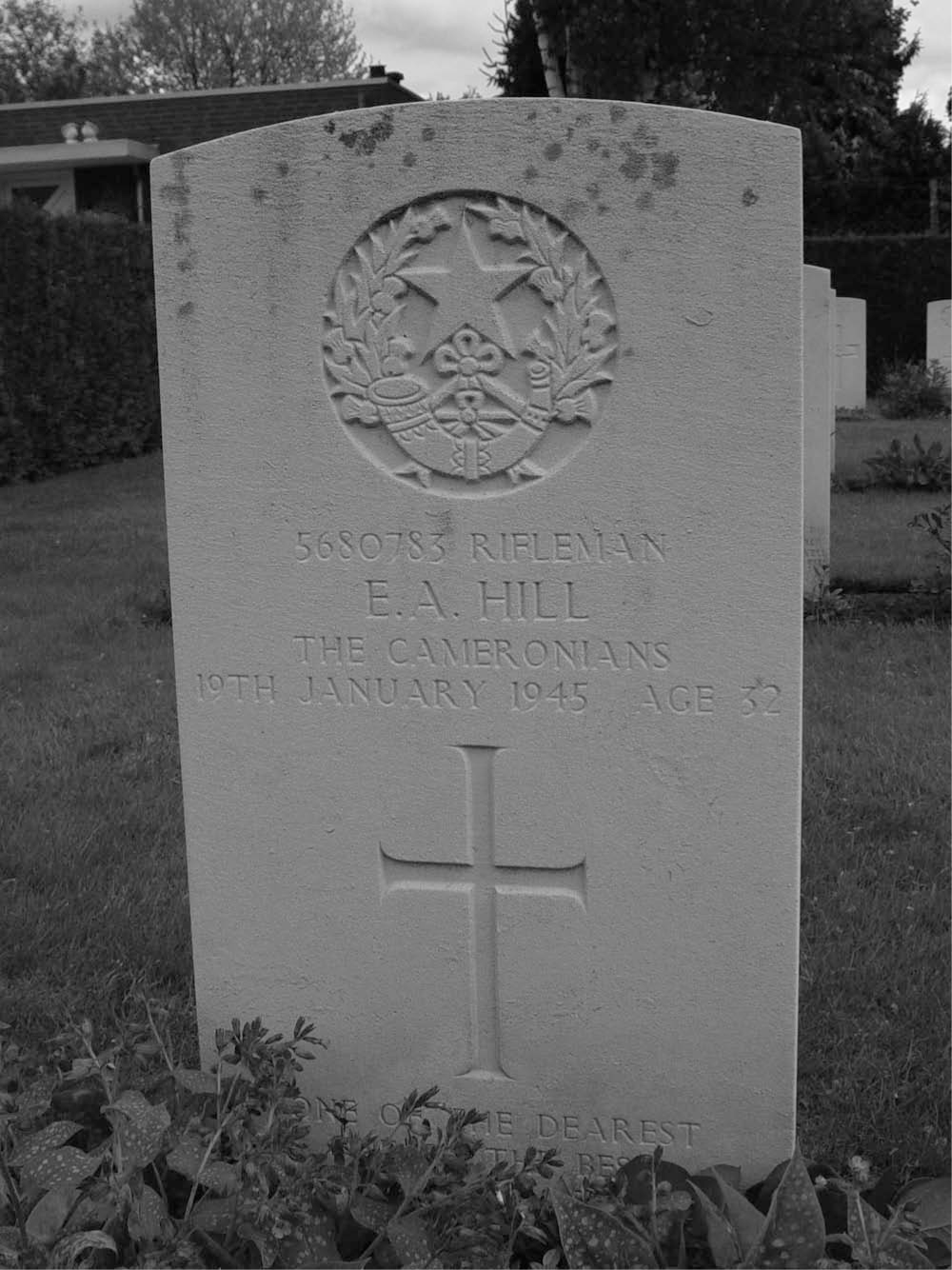
My grandfather’s grave, Sittard, May 2004.

Lightmoor Colliery spoil heap, November 2008.
As we continued on, Ron recounted his experiences of playing in the woods as a child. It was running through here, he said, that he had discovered lots of hollows. Exploring the dark woods with a friend, he had entered the undergrowth without following a path. Emerging some time later, the two friends had found themselves lost, unable to get their bearings. I looked that way, and thought Cinderford was the other way, said Ron, and I thought where on Earth is that town, there’s no town in that direction. It was only then that they realized what had happened. Instead of walking straight through, the unwitting pair had gradually turned, walking around in a circle. It was very unnerving, said Ron, it was unreal. The forest certainly has the power to confuse, rendering the familiar unfamiliar, or ‘uncanny’. The power of the uncanny is arrived at not by an encounter with anything strikingly odd or unknown; rather, it is held within something that has a familiarity about it. As such, the uncanny arises from instances of repetition, including incidents wherein one becomes lost and accidentally retraces one’s steps.
I realized then that we were walking across a coal seam. The ‘hollows’ that Ron had stumbled upon as a child were, of course, bell pits. Pointing towards the undergrowth, Ron explained that many of the bell pits were dug by striking miners. Strikes over pay and conditions were common during the 18th, 19th and early 20th centuries. Venturing off the path, we ducked under a series of low hanging branches and leapt over a ditch. As we approached one of the hollows, I was hit by the stench of stagnant water. Here was pool after pool of black, eutrophic water, each no larger than a couple of metres in diameter, an indication of the rich mineral resources lying just beneath our feet. I later learned that a number of bell pits were ‘discovered’ as a result of a recent Light Detection And Ranging (LiDAR) survey of the Forest. 49 The name ‘bell pit’ is derived from the shape of the excavation; a narrow, vertical shaft was sunk into the coal or iron ore seam, which was then opened out into a small chamber. The practice typically did not use much timber for props, so once the roof became unsafe the pit was abandoned and another shaft dug nearby.
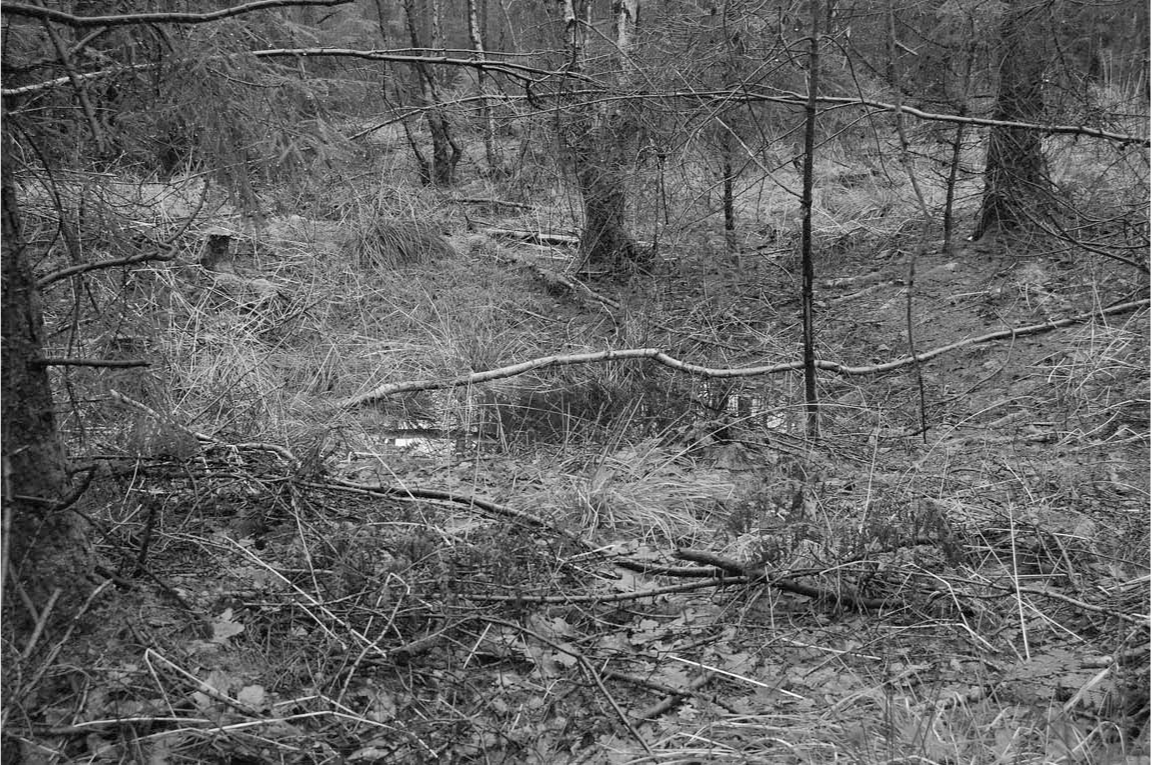
Bell pit, November 2008.
Nearing the B4226, and the end of our walk, we paused to reflect by an old boundary stone, which stood like a gravestone commemorating the death of the Long Path and the final stages of our journey. It’s difficult to read now, said Ron. It was dated 1843 and read ‘Lightmoor Enclosure, Lightmoor ENC, Morpeth, 65 acres, two roods and no poles’. Lord Morpeth was one of the Commissioners of Woods, responsible with the other Commissioners for many of the controversial forest enclosures. A number of the original Royal Forest boundary stones survive, but many of the stones erected to delineate the gales have, like those who worked them, long since disappeared. The Statutory Forest Boundary is also traditionally known as the ‘perambulation’, referring to the fact that it was regularly walked as part of the boundary marking process.
Ron went on to describe how the miners formed a strong community, everyone in the lane where Ron lived having a father, son or brother who worked at Eastern United. There were numerous social opportunities for mining communities, with some colliery owners and ironmasters providing schools and churches, and later welfare societies and recreation grounds. For example, an iron hall was built in 1897, in Commercial Street, Cinderford; used for public meetings and entertainment, it later became the Empire Theatre, which closed after a fire in 1919. 50 And a Miners’ Welfare Hall opened in 1930 in Wesley Road, providing the town’s main public meeting place in the later 20th century. 51 The Welfare Hall continues to be used as a social meeting place in the Town, with such events in May 2010 as Bingo, Amateur Boxing, a ‘Shoo Bop’, and other live entertainment. The sad exterior, crumbling rendered façade and boarded-up door, give it an air of dereliction.
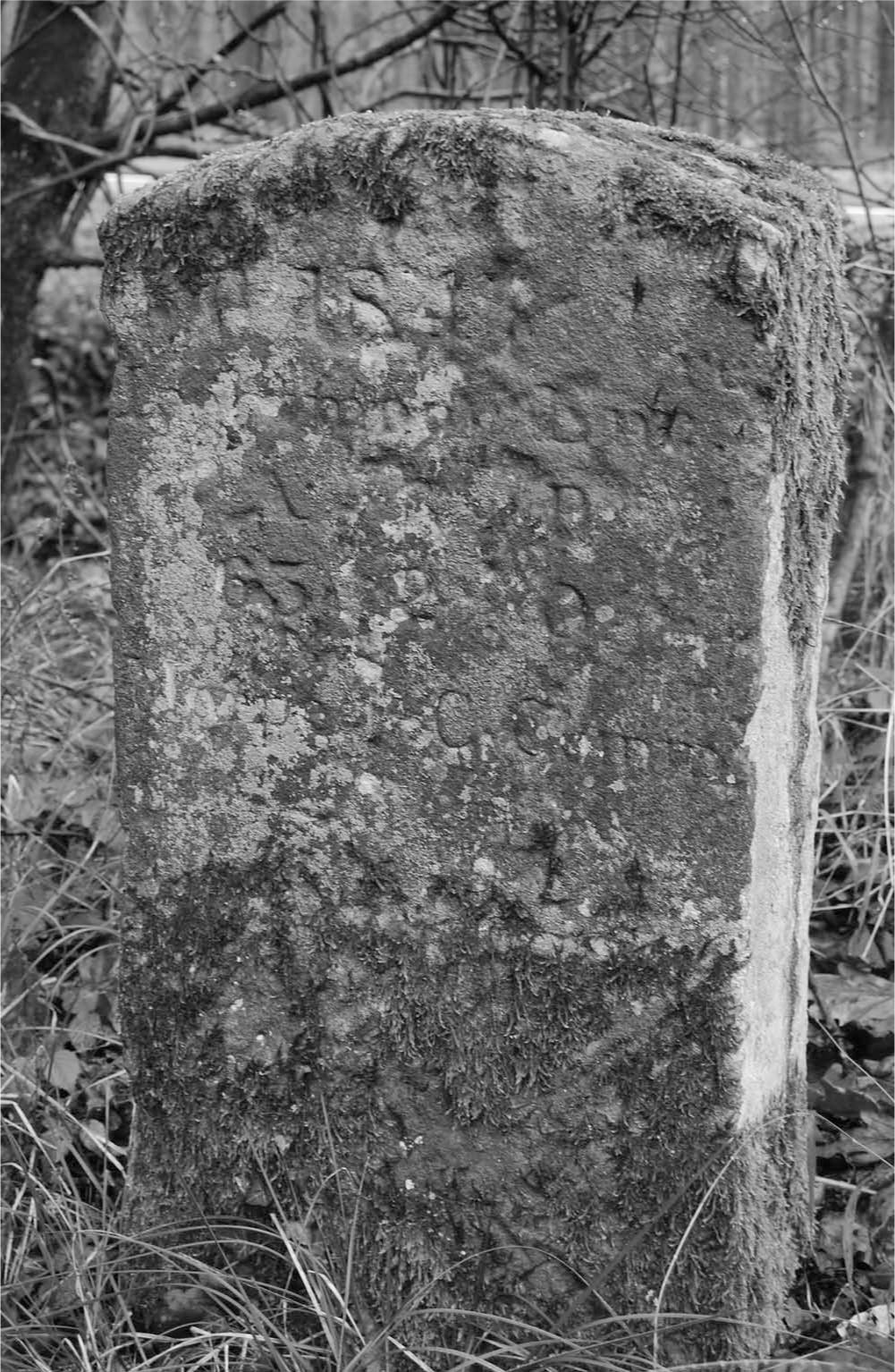
Boundary Stone, Lightmoor Enclosure, November 2008.

Cinderford Miners’ Welfare Hall, May 2010.
We arrived back at Ruspidge Halt just after midday. We were tired after what had been a long morning, but neither of us was quite ready to leave. You can imagine it was wonderful playing around here, he said. Ron described a game called ‘Hooperella’, in which groups of boys would run off up onto the ‘tump’ and the rest would try to follow them, shouting ‘if you won’t holler, we won’t foller’, while the boys on the tump would shout ‘Hooperella!’ It seems that the aim of the game was to find the first group of boys and then to race back down to the bridge. Such games might seem strange to the adult world, but children have an endless capacity for innovation in their play, often incorporating or co-opting landmarks and other elements of their surroundings, as markers, targets, or secret places. A game can be played for weeks and months at a time, intricate rules passed on from one child to another, through play with others, via siblings, and by imitation. As Ron spoke, I could almost hear the voices of those long grown up, now in the twilight of their lives: Hooperella! Hooperalla! Hooperella!
Conclusion
In my introductory comments, I suggested that working with memory could provide a more-than-representational perspective on the past. The act of walking creates powerful recollections because it provokes a distinct and familiar tactility with the world. In the case of walking the Long Path, these associations led to a childhood landscape of games and exploration. But this landscape was also heavily influenced by Ron’s father and the legacy he passed on through oral tradition. Personal memories of getting lost in the trees, scrumping for Damsons, and games on the ‘church tumps’, were interspersed with an older, intergenerational history of daily life in the Forest, of work and of war. As Connerton suggests, ‘we come to know each other by asking for accounts, by giving accounts, by believing or disbelieving stories about each other’s pasts and identities’. 52 Repetition is crucial to the reproduction and evocation of memory; the repetition of stories told, objects used, and paths walked. However, repetition is not solely about presence, it has a strong bearing on absence too, ushering in the haunting apparition of the spectre.
Derrida suggests that the ghostly, or the spectral, is always revenant, creating an endless process of returning that displaces space and time, absence and presence. 53 The freight of ghostly memories disorients place and self, it confounds, bewilders and startles. Haunting memories of the dead drag us into other places and times, into Buller Turley’s trenches of the Somme, into the battlefields in Holland in which my grandfather fought and was cut down. It is as if the dead are returning from their exile, like an afterglow that fills the dusk. They beckon to us from the past, their carbide lamps bobbing down through the trees, puffs of steam from their coal-laden trains drifting on the breeze, their boyhood cries of ‘Hooperella!’ These spectres haunt us, they move and disturb us. But it is often our own spectrality that is the most disorienting, the most unsettling and unnerving. Consider, for example, Ron’s experiences of getting lost as a child, entering the dark forest with his companion to go ‘exploring’ only to find himself back, sometime later, in almost the exact same spot from which he had set off; the familiarity of the Forest rendered unfamiliar, uncanny. Getting lost on 21 November 2008, in our attempts to trace the earlier sections of the Long Path, created for Ron a sense that there was someone or something playing tricks on him, that the memories of his childhood were betraying him. Vague recollections of the route were complicated by the loss of youth, the haunting spectre of the small, agile child from the past, who could scramble up banks, play ‘Hooperella’, go scrumping for Damsons, and run to Lightmoor Colliery along the Long Path. The inescapable revenance of the past acts not as a consoling or revelatory disclosure; it is, rather, a fragmentation and a fracturing, a dislocation. This is the ghostly reproduction of the self, ‘in oneself, in the others, in the others in oneself: they are always there, spectres, even if they do not exist, even if they are no longer, even if they are not yet’. 54
As Wylie argues, spectrality, the haunting of the self, the disturbance of past and present, and the unsettling of place, demands a new way of writing. 55 Constructing a narrative in such a way that it disrupts any sense of linear time is arguably a necessary first step. Taking inspiration from writers such as Walter Benjamin and W.G. Sebald, my account of walking the Long Path aims to convey the complex interdependencies between past and present, future-present and past, the incessant becoming-past of the present. Following Benjamin, it seeks to reveal traces of the future-present in the past, antecedents, such as a short-cut over the railway line that becomes incorporated into the Long Path and later renders it an illegal footpath, the section of the railway lying outside the Forest boundary that does not revert to the Forest upon closure but is instead sold into private hands. Similarly, the legacy of industry, of an upbringing centred upon coal-mining, and a tale from the trenches that spurred Ron on to develop an interest in the history of the locality and encouraged him to join the Local History Society, which precipitated our meeting.
Standing in opposition to any form of history that suggests progress or linear development, this narrative employs a subtle form of literary montage that operates by a process of juxtaposition and discontinuity − in the placing of text and image, and in changes in topic and style. Further, following Sebald, it endeavours to unsettle, to introduce the aura of the spectre. Although my account of walking the Long Path is based upon ‘authentic’ testimony and evidence, it opens up a space for elements of the fictive. By incorporating small diversions that border on the surreal, such as a palpitation or an echo from the past that comprises the smell of coal dust drifting through the valley, the faint clattering sound of wagons winding their way out of the collieries, and a puff of steam discernible on the horizon, I am striving to generate a reverberation from the past, to further disrupt the temporal order and to usher in the spectral. This is an attempt at a non-conventional form of scholarly writing that allows for objectivity and distance, draws upon oral testimony and documentary evidence, but also combines subjectivity and invention. It is an account that seeks itself to be haunted. This is also a style that aims to invoke multiple meanings and representations; connections between different sections of text, image and place are deliberately left unstated, so that it is possible for the reader to detect alternative potentialities and narrative trajectories, times and places, presences and absences. Yet it remains faithful to the walk, to the landscape and to our conversations. Although it is not a ‘true’ account in the strictest sense, it captures some semblance of the Long Path, and, more importantly, my hope is that it captures some semblance of the past. By adopting such an approach I also mean to raise a series of questions about the limitations of academic work, the impossibility of adequately representing and re-presenting the past in the present, and the impracticality of the task of representing others. As I suggested above, this kind of looking back upon the past from the present is not about seeking absolute truths, but instead proffers a means by which we might grasp the importance of the past today and the manner by which it influences and haunts our daily lives.
Footnotes
Acknowledgements
I would like to thank Ron Beard for taking the time to show me the Long Path, and for talking so eloquently about his childhood memories. I would also like to thank Tim Cresswell and the anonymous referees for their comments on an earlier draft of this article.
Funding
This research received no specific grant from any funding agency in the public, commercial, or not-for-profit sectors.