



Abstract
In this paper I build on my previous case-study focused research on memorialization to develop a thesis for absence-presence evidenced in vernacular memorial artefacts, spaces and performances at a variety of scales and locations across the British Isles. I make three key arguments: i) for bringing the universally significant experience of absence through bereavement to the fore in cultural geographies of absence; ii) for moving beyond representational and phenomenological analysis of memorial artefacts and spaces to focus critical attention on the contextualized interface between the representational and more-than-representational, embodied and affective practices that surround them, for a more nuanced understanding of the relationship between the living and the absent deceased; and iii) that this interface of form and practice at a variety of vernacular memorials and locations evidences dynamic negotiations of absence-presence. I explore the ways in which the emotions, memory and materiality of absence through death is expressed and negotiated in different memorial forms and landscape settings in the British Isles. Analysis is based on a range of empirical examples drawn from contemporary practices of memorialization and remembrance, and explores how living with absence as a result of bereavement is mediated through different material forms and practices including expressions of ‘continuing bonds’. The discussion is contextualized in relation to wider dialogue on absent presence, but argues that expressions of continuing bonds with the deceased evidence a relational and dynamic absence-presence. Practices associated with absence-presence intersect with growing trends to mark private grief and remembrance of individuals in public space, through the creation of a range of informal memorials that frame a ‘Third Emotional Space’ for the bereaved. The material memorialscape is indicative of the interwoven narrative journeys in and through particular place-temporalities for the living, for whom bereavement is a confluence of emotional-spiritual-practical way-finding.
‘[As geographers we experience] difficulties in communicating affective elements at play beneath the topographies of everyday life’.
1
Waiting for a train at the railway station in York (England) I saw a newly liveried memorial train. This underscores the mobility of ‘travelling memorials’, such as tattoos, t-shirts and bumper stickers, which carry their message of remembrance through both landscape and society. Detailed discussion of these mobilities is beyond the scope of this paper, but even static memorials can represent the mobilities of the deceased. While waiting on the platform at York, I sat on an unusual bench (see Figure 1). It was crafted from oak by Robert ‘Mouseman’ Thompson, with his signature mouse carved underneath one armrest, and was dedicated in memory of a woman who died at 38 years of age. In addition to the craftsmanship of the woodwork and the poignancy of a (by western standards) fore-shortened life, I was struck by the inscription: ‘Still Travelling’. From the perspective of the bereaved she was still ‘alive’, her absence due to being on a journey ‘elsewhere’. No doubt the form, location and text of the memorial tell us something of the deceased’s identity, but it also speaks of her vitality in the present, and her absence-presence in the lives of the bereaved.
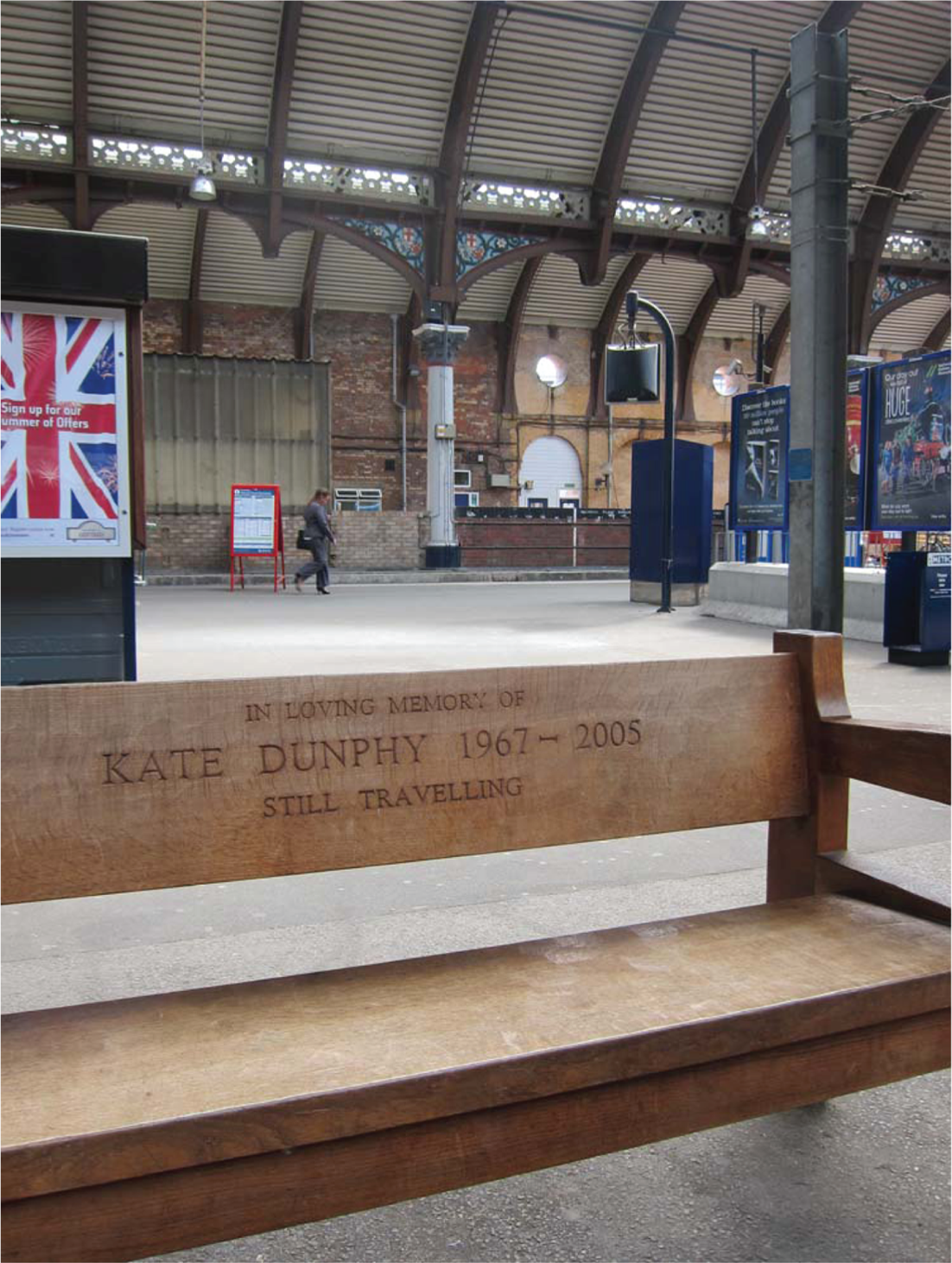
‘Still Travelling’ Memorial bench York railway station.
In this paper I explore absence through the everyday − but hugely impactful − phenomena of bereavement and mourning, engaging the concepts of ‘absence-presence’ and ‘continuing bonds’, with a focus on evolving practices of mourning and remembrance for individuals in the British Isles. Building on my previous analyses of specific case studies, I analyse a range of memorials that represent a variety of socio-cultural spaces and associated practices focusing primarily on vernacular memorials in public spaces. Through its reflections on the cultural geographies of absence-presence associated with everyday death, mourning and remembrance, this essay contributes to the now burgeoning body of geographical work addressing the absence of the everyday emotional-affective highlighted by Bondi et al. above. It offers a spatially informed perspective on the paradox of absence-presence experienced through bereavement and an analysis of the vernacular representational and more-than-representational in spaces and practices of mourning and remembrance expressed in the landscape. The concept of absent presence and theory of continuing bonds are discussed before turning to the analysis of specific places of memorialization and remembrance, which are indicative of expressions of what I term absence-presence.
Death is an everyday reality. It comes to each of us in due course and we experience the deaths of those around us with varying degrees of impact, depending upon our relation to them. For most people bereavement will have a major impact on wellbeing and self-identity at one or more times in their lives. The ubiquitous nature of death and bereavement means that we all experience the absence of the deceased and negotiate living with that absence in different ways, in and through a variety of place-temporalities. While this absence through death has attracted the scholarly attention of psychologists, artists, sociologists and others working in the inter-disciplinary field of death studies, there is considerable scope for cultural geographers to offer more insight to this universal and often life-shifting manifestation of absence.
Cultural geographers have given attention to absence in a variety of settings including former industrial landscapes, ghost towns, borders and coastal paths. Tim Edensor illustrates ways in which industrial ruins evoke presence as much as absence, including those objects that ‘are no longer there but announce their presence by the hole or shape or silhouette they leave behind’. 2 Similarly, in the case of ghost towns, Dydia DeLyser illustrates how a heightened sense of past landscape and society can be powerfully evoked, reconstructed imaginatively, and valued, precisely because its present state is a calcified relic from the past. 3 It is the absence of certainty that characterizes many migrants’ experience of state borders, as shown by Louise Amoore and Alexandra Hall, who further demonstrate that absence is productive of both effect and affect, which is of particular relevance to the following discussion. 4 The tensions between the absence and presence of the deceased whose lives have been marked by memorial benches at a Cornish bay have been discussed by John Wylie, whose phenomenological reading of landscape records a simultaneous affective conviviality with, while distancing of, the deceased. He observed: ‘the entire experience of the memorial benches at Mullion Cove seemed to me to be sensed more in terms of a slipping-away, a letting go, a failing to grasp or even touch’. 5 Interesting as Wylie’s experiential observations are, his analysis is inevitably circumscribed by his methodology, which has limited engagement with the material forms of the memorials, their scripted narratives or other people’s interaction with them. Extending the argument that Tony Walter has made about particular deaths to particular memorials, each person brings a different perspective or frame to the experience, depending upon their relation to it. 6 As Elizabeth Hallam and Jennifer Hockey note, ‘layered or multiple readings are encoded in memory spaces’; and furthermore, as Catherine Collins and Alexandra Opie articulate, their polysemic nature results in meanings varying with both observer and context. 7 Drawing on Foucault, the former underscore the hetreotopic qualities of memorials, while the latter highlight their heterorchronia; both are illuminating of the liminal qualities of memorials and post-death relationship represented by and mediated through them, but these need to be recognized as moored in the embodied past life, present memorial and ongoing emotional journey of the bereaved, as well as any ‘life of its own’ that a memorial artefact might engender with those who encounter it. My own contemporaneous study of memorial benches in a coastal setting highlighted the ‘discursive location of a loved one in an ideal setting’, but one that was rooted in a sense of home and belonging, where the memorial benches offered a ‘Third Emotional Space’ for embodied-emotional and performative remembrance, mediating between absence and presence and other related dichotomies. 8 Thus, there is no single static reading of memorials, but practice needs to be considered in conjunction with location and form. 9 I argue that in triangulating context, text, material form and embodied-emotional practices around such memorials, it is possible to gain insight to the dynamic negotiation of absence and presence in relation to the dead.
Absence, absent presence and absence-presence
In Being and Nothingness Jean-Paul Sartre, the existentialist philosopher, famously gives the example of walking into a café expecting to find his friend, Pierre, who is in fact not there, and the experience that results from his absence. This ‘nothingness’ he argues is really experienced; everything that he sees, as he searches the people and objects about him, is ‘not Pierre’. He talks of Pierre’s absence as ‘haunting’ the café: It is certain that the café by itself with its patrons, its tables, its booths, its mirrors, its light, its smoky atmosphere, and the sounds of voices, rattling saucers, and footsteps which fill it − the café is a fullness of being. And all the intuitions of detail which I can have are filled by these odours, these sounds, these colours, all phenomena which have a transphenomenal being. Similarly Pierre’s actual presence in a place which I do not know is also a plenitude of being . . . When I enter this café to search for Pierre, there is formed a synthetic organization of all the objects in the café, on the ground of which Pierre is given as about to appear . . . But now Pierre is not here. This does not mean that I discover his absence in some precise spot in the establishment. In fact Pierre is absent from the whole café; his absence fixes the café in its evanescence; the café remains ground; it persists in offering itself as an undifferentiated totality to my only marginal attention; it slips into the background; it pursues its nihilation. Only it makes itself ground for a determined figure; it carries the figure everywhere in front of it, presents the figure everywhere to me. This figure which slips constantly between my look and the solid, real objects of the café is precisely a perpetual disappearance; it is Pierre raising himself as nothingness on the ground of the nihilation of the café . . . It serves as a foundation for the judgement ‘Pierre is not here.’ It is in fact the intuitive apprehension of a double nihilation . . . to be exact, I myself expected to see Pierre, and my expectation has caused the absence of Pierre to happen as a real event concerning this café. It is an objective fact at present that I have discovered this absence, and it presents itself as a synthetic relation between Pierre and the setting in which I am looking for him. Pierre absent haunts this café and is the condition of its self-nihilating organization as ground.
10
I have quoted this extract at length because it captures both the effect/affect of absence and that ‘nowhere, but everywhere’ that the bereaved can experience in everyday spaces associated with the deceased; but before turning to that core concern here, a few comments on absence, presence and their potential relationality.
The very present sense of absence that frames and inflects Sartre’s experience of Pierre’s absence in the cafe, as described above, hints at the idea of absent presence when Sartre concludes that Pierre’s absence has presence in the space where he expects to find him. An absent presence reflects the apparently contradictory binding together of things absent with the present; whatever or whomever is absent is so strongly missed, their very absence is tangible (i.e. it becomes a presence). In everyday social life this sense of the absent presence might be experienced in a range of scenarios, such as by parents when a child leaves home or by a broken-hearted lover after a relationship has ended.
The apparent oxymoron of absent presence has intrigued artists and writers, each using their own medium to try to capture the essence of this phenomenon in tension, whether through photography, text, painting or dance. In Remarkable Creatures, Tracy Chevalier’s fictional account of the life and work of early 19th century fossil collector Mary Anning, Chevalier describes fossils as an ‘absent presence’, their absence made solid, material, by the process of fossilization. 11 Similarly, Morgan Meyer and Kate Woodthorpe creatively explore the similarities in the ways in which both museums and cemeteries make the ‘absent’ ‘present’ and act as spaces that transcend absence. 12 It is significant to the discussion here that Nadine Helstroffer’s Absence-Presence dance, set within the context of remembrance and performed in conjunction with the exhibition Eternal Presence. Handprints and Footprints in Buddhist Art, chooses to focus on the active and interactive qualities of ‘absence-presence’. 13 In the following discussion of relationship − living with − the deceased, I likewise use the term ‘absence-presence’ in order to emphasize the dynamic relationality of the two intersecting, but apparently oppositional, terms. Hallam and Hockey argue of the dead that the sense of their absence can become a presence (i.e. that absence can be productive of presence); similarly Silverman and Nickman refer to the dead as the ‘absent other’. 14 However, here I want to stress the stronger relational qualities of absence and presence that can be experienced as a result of a death of a significant other. Rather than being the consciousness of what is absent, it is the now absent deceased having continuity of presence, being given presence through the experiential and relational tension between the physical absence (not being there) and emotional presence (a sense of still being there), i.e. absence-presence is greater than the sum of the parts. Absence is not merely a ‘presence’ in and of itself, but rather the absent is evoked, made present, in and through enfolded blendings of the visual, material, haptic, aural, olfactory, emotional-affective and spiritual planes, prompting memories and invoking a literal sense of continued ‘presence’, despite bodily and cognitive absence.
Within interdisciplinary death studies, discussions of absence and presence of the dead are closely associated with what has been coined as the ‘continuing bonds’ model, and it is to this that I now want to turn.
Death and continuing bonds, religious and secular
Death is the ultimate ‘absence’, but one that the bereaved can rarely fully comprehend in all its ramifications, in the immediate term. Indeed, many bereaved people continue to experience a strong sense of the presence of the absent deceased in their lives, and work to give, mark, and insist on, the presence of the deceased in ongoing wider social relations, the material topography of the home and the wider environment. 15
We might ask, how is a relationship maintained with someone who is dead? For some this is through religious belief and practice (see for example the work of Douglas Davies, Kathleen Garces-Foley, Robert Goss and Dennis Klass). 16 Religions such as Hinduism, Islam and Christianity each offer the possibility of an afterlife and continued existence for the deceased, although different faiths and denominations have different eschatologies as well as ‘departure’ and remembrance rituals for the dead, with varying emphasis on the absence-presence of the deceased in this world. Non-Abrahamic religious and cultural practices commonly acknowledge the presence of the dead in ongoing ritual and remembrance: for example, in Hinduism ‘the dead and the living continue to influence each other’; Chinese cemeteries in Hong Kong are identified not only as the sites where the deceased are laid to rest, but where they continue to exert their agency, creating a liminal place, where ancestors’ spirits need care and annual propitiation; in Japan, home altars function as a hotline to ancestors in both Buddhist and Shinto households. 17 However, death rituals and models of grief in late-modern western society have tended to marginalize the dead spatially and socially, reflecting Judaeo-Christian theology of an afterlife elsewhere in heaven, and/or Enlightenment-based rationalization of the dead as ‘finished’ and ‘gone’. While there are cultural nuances within this broad-brush picture, such as spiritualists who feel a strong sense of connection with the spirits of those now inhabiting the afterlife, or the ongoing calendric rhythm of ritual intercession for the dead in Roman Catholic or Greek Orthodox practice, in much of contemporary ‘western’ society, the dead have tended to be sequestered in time and space. Indeed, it was argued in the 1990s that death itself was largely absent from everyday social life. 18 This was particularly the case in countries (such as the UK) where the intersection of the theological legacy of the Reformation, 19th-century public-health reform, the creation of municipal cemeteries on urban peripheries, and a rise of secular-scientific world views, combined to separate the living from the dead. 19
Anna Petersson argues that the spatial sequestration of the dead typically occurs within the bounds of the cemetery or crematorium; 20 and the cultural expectation in the 20th century west, that the bereaved ‘return to normal’ after a limited period of mourning might also be seen as a temporal sequestration for grieving. Numerous scholars, including Glennys Howarth and Christine Valentine, show that this dominant model of grief work was reflected in western normative ideas of what constituted ‘normal grief’, its processes and progress, whereby bereavement counselling was used to help the bereaved break ties with the deceased, making way for new attachments. 21 Based on often over-simplified interpretations of Sigmund Freud’s analysis of grief, this approach categorized chronic or complicated grief as abnormal, morbid, etc. As a consequence, any ongoing sense of the presence of the deceased was typically seen as futile and pathological, symptomatic of an early ‘immature’ stage of grief or as the product of fantasy, hallucination or hysteria. 22
In contrast to this, Paul Rosenblatt characterizes ‘grief that does not end’, arguing that ‘strong feelings of grief for major losses will recur over a lifetime’. 23 Within western psychology and bereavement counselling the Continuing Bonds model has evolved since the early 1990s. In this approach, the persistence of emotional and affective responses to bereavement is acknowledged, as is the sense of continuing bonds between the living and the deceased that may accompany those feelings. In contrast to the notion of closure, Dennis Klass, Phyllis Silverman and Steven Nickman sought to ‘offer an alternative model based on the mourner’s continuous bonds with the deceased’, arguing further that ‘we cannot look at a bereavement as a psychological state that ends and from which one recovers . . . [because] meaning-making as a continuous process requires that we develop a more advanced language for talking about and to the deceased’. 24 As Klass elucidates, in the continuing-bonds model, ‘death ends life; it does not end a relationship . . . the successful resolution of grief requires the mourners to construct a durable life story that enables them to integrate memory and continuing interaction with the deceased in their ongoing lives’. 25 This conceptual shift in bereavement studies has generated innovative research that recognizes that many of the bereaved conduct an ongoing ‘relationship’ with the dead, and this shift has helped to give the bereaved ‘permission’ to continue that relationship without fear of being labelled as abnormal. As Tony Walter has argued: ‘The bereaved should be reassured that they may retain the deceased.’ 26 Indeed, it has been argued that rather than being pathological, it is the norm to experience some sense of continuing bonds with the deceased. 27 As Goss and Klass articulate: ‘When we try to understand how bonds continue, and the meaning of those bonds that continue, we are in touch with something fundamental in the way individual humans make sense of their world and in the way individual humans narrate their own lives.’ 28 Walter describes this process as ‘finding a place’ for the deceased in ongoing lives, through the creation of an ‘enduring biography’ for the deceased and a re-negotiated sense of self-identity for those who remain. 29 Studies evaluating bereavement experience in the UK and USA suggest that, while not universal, nor always welcome, between one-third and three-quarters of the bereaved experience a sense of continuing bonds, and the majority of these experiences were positive. Some perceived a sense of dramatic ‘intervention’ in the form of protection from harm, while others reported a more subtle sense of presence or reassurance from the deceased, including seeing, hearing or being touched by them; others talked about or to the deceased, including actively seeking their counsel. 30
In their important book Death, Memory and Material Culture, Hallam and Hockey stress the importance of material foci for facilitating relations between the living and the dead: ‘past presence and present absence are condensed into a spatially located object’. 31 Memorials are clearly an important sub-class of these objects. Experiences and practices of continuing bonds might be indicative of the memorial functioning as transitional space, whereby the memorial acts both as a ‘memory object’, ‘linking object’ or as what is identified as a ‘passage landscape’. However, as Klass stresses, while the idea of transitional spaces or objects may shed light on the grieving process, the concept ‘does not convey the lively, personal relationship between the living and the dead’. 32 Joanna Wojtkowiak and Eric Venbrux’s study of practices and meaning-making around domestic memorials suggests that these represent, in van Gennep’s terms, the integration of the dead into everyday life, rather than separation or even transition rites. 33 Thus, integration and transition do not have to be set up in opposition to each other, but can be seen working in tandem with the relationship between the two varying over time – although not necessarily in a linear trajectory. As Hallam and Hockey note, cultures of death and memorialization are frequently characterized by the tension between transition, transformation and continuity. 34
Thus, detailed empirical studies show continuing bonds to be neither new nor limited to particular phases of grief. 35 Indeed, Walter has further suggested that an appreciation of the significance of continuing bonds is new only to the masculine-rational model of grief that has dominated western therapeutic practice, rather than being a novel approach for the bereaved. 36 Nonetheless, Roberta Conant noted of the group of widows she studied, that their individual and collective sense of the presence of the deceased was ‘surprising by the standards of rational culture’. 37 Another study by Gillian Bennett and Kate Bennett illustrated the association of continuing bonds with fantasy or hysteria and how the bereaved themselves often oscillate between ‘rationalist scepticism and a more supernaturalist validation of such experiences’. 38 This association of modes of grief with hysteria hints at the way in which bereavement models and representations of mourning can be profoundly gendered. 39 However, while both Conant’s and Bennett and Bennett’s studies focused on women’s experiences, in others’ studies, such as Klass’ on parents’ bereavement, men equally testified to the presence of the deceased. One father described how he talked to and sensed the presence of his deceased daughter beside him when he ran: ‘Frequently, I sensed she was nearby, cruising at my elbow listening.’ 40 Thus, it is not a gender-specific experience, although more work needs to be done to understand any gendered nuance in the experience of continuing bonds. As Glennys Howarth stresses, there is a need to be sensitive to the impact of gender, ethnicity, sexuality, etc. on differentiated bereavement experience. 41
In analysing the mechanisms and meanings of absence-presence, it is important to stress the distinction between haunting and continuing bonds. Davies makes the distinction between impersonal ghosts and the bereaved person’s sense of ‘the familiar dead’, which may or may not share attributes of ‘haunting’. While spiritualism and faiths incorporating ancestor veneration are practised in Europe, the majority of the bereaved in western society who experience a sense of continuing bonds would recognize the deceased as dead, but that nonetheless they are a part of the ongoing day-to-day life of the living. 42 Absence-presence acknowledges death, but also the continued ‘presence’ of the relationship. Klass and colleagues illustrate this with reference to accounts by the following leading American figures. Playwright Robert Anderson reflecting on his wife’s death articulated: ‘Death ends a life, but it does not end a relationship, which struggles on in the survivor’s mind toward some resolution which it never finds.’ 43 Similarly, Nobel physicist and atheist Richard Feynman wrote to his late wife years after her death: ‘I find it hard to understand in my mind what it means to love you after you are dead – but I still want to comfort and take care of you – and I want you to love and take care of me . . . I love my wife. My wife is dead.’ 44 More recently in the British press, author Sally Vickers, wrote of her ongoing relationship with her difficult late mother: ‘for all her manipulative and insouciant trickiness, I miss her. But of course she has never really gone. She wouldn’t. Few days pass when she is not there, somewhere over my shoulder, somewhere in my mind’. 45 It is the sense of ongoing relationship and its practices, informed by culturally determined attendant notions of caring, which is central to the idea and performance of continuing bonds. Usman Javed, a recently bereaved husband, also recounted: ‘I relax when I speak to my wife . . . Every Friday [Muslim day of prayer] I go to her grave and I just sit and talk to her; I tell her all about my day . . . But she never replies.’ 46 Based on in-depth study of cemetery practices in the UK, Doris Francis et al. describe these expressions and practices of continuing bonds as ‘keeping kin and kinship alive’. 47
The work of Riches and Dawson on infant mortality has been pivotal to studies of these ‘continuing bonds’. 48 They demonstrated how parents often experience a strong sense of continuing bonds with their deceased children, and express – practice – their parenthood, and witness their child’s existence through shrines, gifts, rituals and alternative forms of care-giving. The latter can include campaigning and fund-raising, a useful outlet for those who opt for an instrumental response to bereavement, i.e. those who want to ‘do something’ in the face of bereavement, a response often associated with the gendered norms of masculinity in western society. 49
Several of the attributes of continuing bonds are exemplified by UK television presenter Gloria Hunniford in her book Always with You. Facing Life After Loss, written after the death of her 41-year-old daughter. The very title embodies Hunniford’s sense of continuing bonds as well as her ongoing negotiation of life without Caron. The book was written in part in response to the thousands of letters Hunniford received from other bereaved parents (both mother and daughter being television personalities), but also in Caron’s memory ‘so that I can keep her spirit alive’. 50 On continuing bonds, Hunniford writes: ‘the memories are always with me, and her spirit whether real or imagined (I no longer think it matters), is always with me’. 51 For Hunniford, her relationship with her daughter was maintained through letters she placed in Caron’s coffin and ongoing conversations: ‘When worries threaten to consume me, when I doubt what it is I’ve been doing since Caron died, I return to her for advice, as I always did, and often still do.’ 52 Articulating her desire to care for her daughter, Hunniford wrote: ‘As parents, we have a need to care for our children . . . Caring for someone who is no longer there is a huge part of the grieving process.’ 53 For Hunniford, this is less about visiting and tending the grave, and in part focuses on fund-raising for the Caron Keating foundation, which keeps her daughter’s name ‘alive’, as well as her interests and values.
Thus, a sense of relationship or continuing bonds with the deceased is experienced by men and women, kith and kin, adults and children, people of different faiths and none. It can be performative, expressed through ritual and other embodied acts (e.g. religious observance or visiting the deceased’s favourite place), but numerous studies show it is also often manifested and sustained through material objects: graves, flowers and plants, memorials, domestic shrines, photographs, etc. 54 Gifting is a common practice for those expressing continuing bonds with the deceased; the placing of material objects at the grave or other places of memorialization is an expression of the continued social existence of the deceased; indeed, Miles Richardson argues that gifted objects left at shrines, graves or memorials signify ‘presence in the face of absence’. 55 Artefacts placed on or around memorials can signify the identity of the deceased, hopes and aspirations for them, and their absence-presence through ongoing relationship. These material objects represent an attempt to materialize the identity of the deceased (e.g. photographs and sports logos) and are a means of embodying and enacting ongoing hope, care and communication on the part of the bereaved. Furthermore, as Meyer and Woodthorpe articulate, ‘absence can be spatially located . . . absence can have some kind of materiality; . . . absence can have agency (it “acts” or “does” things)’. 56 The following discussion now turns to analysing the agency of both the deceased and the bereaved through this relational absence-presence, and how this is expressed through the representational and more-than-representational qualities of material memorials found in informal spaces of memorializaton. It is attentive not only to the agency of things, and what Collins and Opie term ‘the agency of place’, 57 but also to traces of emotional agency expressed through embodied performance.
Making the absent present: caring for and being cared for by the deceased
During the late 20th and early 21st centuries there has been an observable turn to memorialize everyday folk in public spaces, in the form of affordable vernacular memorials such as benches, roadside shrines, domestic-scale statuary and plaques. The multiple sites and functions of memorials have been well documented and the impulse to memorialize the dead can be read alternatively as a stage in marking a death of someone significant as an element of ‘closure’, or as a manifestation of a need to keep the name of the deceased alive and situating a tangible focus for the expression of continuing bonds. In the west, memorials can act as a ‘spatial fix’, a concrete place where the dead can be ‘located’, 58 and loss ‘tabulated’, 59 but also where the dead can be remembered, their lives narrated, and continuing care expressed. 60 In the Netherlands domestic shrines to the dead have become common practice among practitioners of various faiths and non-believers, with half of the respondents of a large-scale survey of both men and women reporting a sense of presence of the deceased at the shrine, as well as experiencing a freedom to converse with the deceased within the private space of the home. 61 These observations on the role of both the ritual and the material are supported by Francis et al.’s study of social relations between the living and the deceased (notably the relationships between parents and children, and partner to partner) in the formal memorialscape of the cemetery. 62 Recent studies of online memorials also highlight expressions of absence-presence and practices of continuing bonds, as well as other therapeutic mourning practices in these virtual (semi)public spaces: ‘ongoing interaction by the living with deceased persons’ profiles is increasingly commonplace’. 63 However, my focus here is on the material landscape. In the UK and elsewhere, the growing number of woodland cemeteries are frequently represented discursively as ‘living memorials’, and, as Andy Clayden and Katie Dixon note, specific trees in these or other locations are often chosen as memorials because they link in some way with an anniversary related to the deceased or their personal characteristics (e.g. a species in leaf or flower on the deceased’s birthday, or echoing the stature of the deceased). 64 However, they can go beyond this sense of ‘living memorial’ to represent continued presence through their very life, growth, longevity and permanence, with their characteristics embodying ‘aspects of personal and cultural memory, thereby facilitating and sustaining relationships beyond the grave’. 65 Thus, it is argued that ‘trees are being used not merely as memento mori but . . . they offer bereaved people a dynamic and enduring physical manifestation of the deceased’. 66 In their vitality, trees embody the absent life and represent an echo of its continuity in the lives of those who remember.
Memorials, whether living trees or inert structures, can reflect personality as well as identity markers of gender, faith and social affiliations; they can also act as a locus for representational, textual and performative expressions of continuing bonds. The following examples of everyday memorials that inscribe the landscape range in scale from hand-sized pebbles to mile-long crash barriers. They are indicative of individual, local, formal and informal, religious and secular modes of remembrance, with those expressing continuing bonds embodying and evoking an active sense of the absence-presence of the deceased in the lives of the bereaved. Their range is indicative of the cultural diversity and increasing individualization of memorialization practices in the UK. This reflects Linda Machin’s point that ‘[w]here society has become fractured into diverse belief systems the journey of grief is more isolated, and the struggle for meaning has to be undertaken individually’. 67 The evolution of those responses has resulted in informal memorials being, in Peter Jan Margry and Cristina Sanchez-Carretero’s words, ‘emphatically present’ in contemporary landscapes; 68 it is this phenomenon and its relation to absence-presence that is discussed below.
I have now been presenting and writing on the geographies of mourning and remembrance for several years; and reflecting on the same for more than a decade as a consequence of personal experience of bereavement and five years voluntary work with a bereavement support group. This confluence of experience and interests has sensitized me to, among other things, the scope and range of spaces, forms and practices of mourning and remembrance. I see memorials everywhere and am sure others do too. Contemporary landscapes, rural and urban, are dotted with memorials: the official memorials of ‘the great and the good’, war memorials, memorial halls and hospitals, ‘ghost bikes’ in memory of cyclist accident victims, benches and trees in the park, apples left outside Apple stores, flowers on the roadside. 69 Our landscapes are overlaid with many other ‘scapes’ including deathscapes, of which memorialscapes are part, and these inflect our experience and understanding of those landscapes. In turn, memorials and the practices that they prompt help us to understand and appreciate something of the experience and meaning-making of the bereaved, including that of absence-presence.
Building on the rich bodies of academic work in both landscape and death studies cited above, my own case-study-based analysis of memorial spaces has to date illustrated the strong contemporary impulse for everyday folk to memorialize their kith and kin in a variety of vernacular forms and public spaces across the British Isles. 70 Innovative spaces and practices have emerged in the face of weakened common rites of memorialization and grieving. Inevitably, where this is materialized through increased incursion into public space, other users of that same space may resent and contest its appropriation and inscription as site of material and performative remembrance. Landscape is widely accepted as being as much dynamic process as fixed surface, hence, as Wylie argues, landscape is always constituted as an assemblage of tensions. 71 These tensions are indeed frequently palpable in the case of memorialized landscapes and associated expressions of emotion and belief, as I have shown in the case of mountainside memorials. 72 Furthermore, while the growing practice of expressing private grief in vernacular memorials has included greater representation of women, children and ethnic minorities in public memorial culture, 73 this democratization has inevitably resulted in a proliferation of these informal memorials, which has fuelled these tensions. As I have argued elsewhere, one person’s sacred memorial can be another’s litter or vandalism visited upon the landscape, and furthermore, some members of the public object to being confronted by reminders of death considered ‘out of place’ (e.g. on a hill walk or in a civic park). 74
This is indicative of another aspect of the social reach of absence through the presence of markers of that absence and associated rituals of absence-presence, i.e. indicative of the social agency of memorials, and their potential for evoking emotional and affective responses in others as well as a sense of continuing bonds for the bereaved. While the location and form of any memorial provides its context and discursive frame, which may speak volumes about the deceased’s association with place, it is the use of visual images, symbols and text that often convey the message of any memorial most directly. Inscriptions are used to narrate the lives of the dead, storying a distilled essence of biography and identity (which as Tony Walter points out, tell us about the storymaker as well as the deceased). 75 Each memorial, as text, is in dialogue with its audience, asserting the right of the deceased to be remembered, but in some cases inscriptions claim much more: a right to be part of that particular place-temporality, a rhetorical claim to the attention of the viewer; a platform for worldview; occasionally even a contract for remembrance and reflection. 76
My research to date across these modes and spaces has shown a complex intermeshing of representational and more-than-representational forms and practices, and a wide range of expressions of relation to the dead. These reflect a confluence of increased informalization and individualization of social identity and practices, as well as a dynamic meshing of simultaneously increased religious diversity, self-spirituality and secularization. High rates of cremation and freedom to remove and dispose of ashes at will in the UK also facilitates flexible and individualist approaches to spaces and practices of bodily disposal. Within these trends, three continua have been particularly apparent. First, a continuum of belief, reflecting shades of belief-unbelief in the afterlife, with these beliefs representing a range of institutionalized religious discourses and looser folk spirituality. Second, although varying by cultural context and by individual, as well as over time, many of the bereaved draw on multiple sites and practices for expressing remembrance and continuing bonds with the deceased, ranging between those centring on body, home, virtual space, formal memorial and vernacular memorials in public places, whereby the latter often perform a mediating function between domestic and formal-institutionalized spaces and practices. Third, a continuum of relationship between the bereaved and the deceased, ranging between remembrance, a sense of continuing bonds, and spiritualist beliefs. Furthermore, I have argued that informal memorials in public spaces can be seen as constituting a kind of liminal ‘Third Emotional Space’ that affords a public mapping of private emotion, where ongoing negotiation of absence-presence can take place in the medium term. These memorials can mediate between private and public, domestic and institutionalized spaces of memorialization; different notions of the sacred; sad and happy memories; and between absence and presence. 77
Various places, marked as sacred in different ways by different groups, have been adopted as places for informal memorialization. Examples include Bronze Age stone circles such as Great Rollright in Oxfordshire, known to be used for cremated-ash scattering, and where memorial wreaths and roses were left in addition to winter-solstice offerings (see Figure 2). Christian sites, such as the Witness Cairn at the Isle of Whithorn (Galloway, Scotland) have also been adopted as spaces for informal memorialization (see Figure 4). In turn, previously secular spaces have been sanctified by other faith groups; for example, the River Soar (Leicestershire) was consecrated in order to accommodate Hindu ash-scattering rites; and other secular spaces have been made ‘sacred’ through their association with the dead, principally as sites of death or memorialization. Opportunity for active expression has proved significant in these contexts, whether through an imperative to ‘do something’, an outlet for emotional expression or to show ongoing relation. 78 However, as noted above, both vernacular material memorials and performative memorial acts in public can offend others’ sense of landscape aesthetics, religious or secular entitlement, and even ontological security, which causes debate and often prompts intervention and management by landowners, local authorities and planning agencies. 79
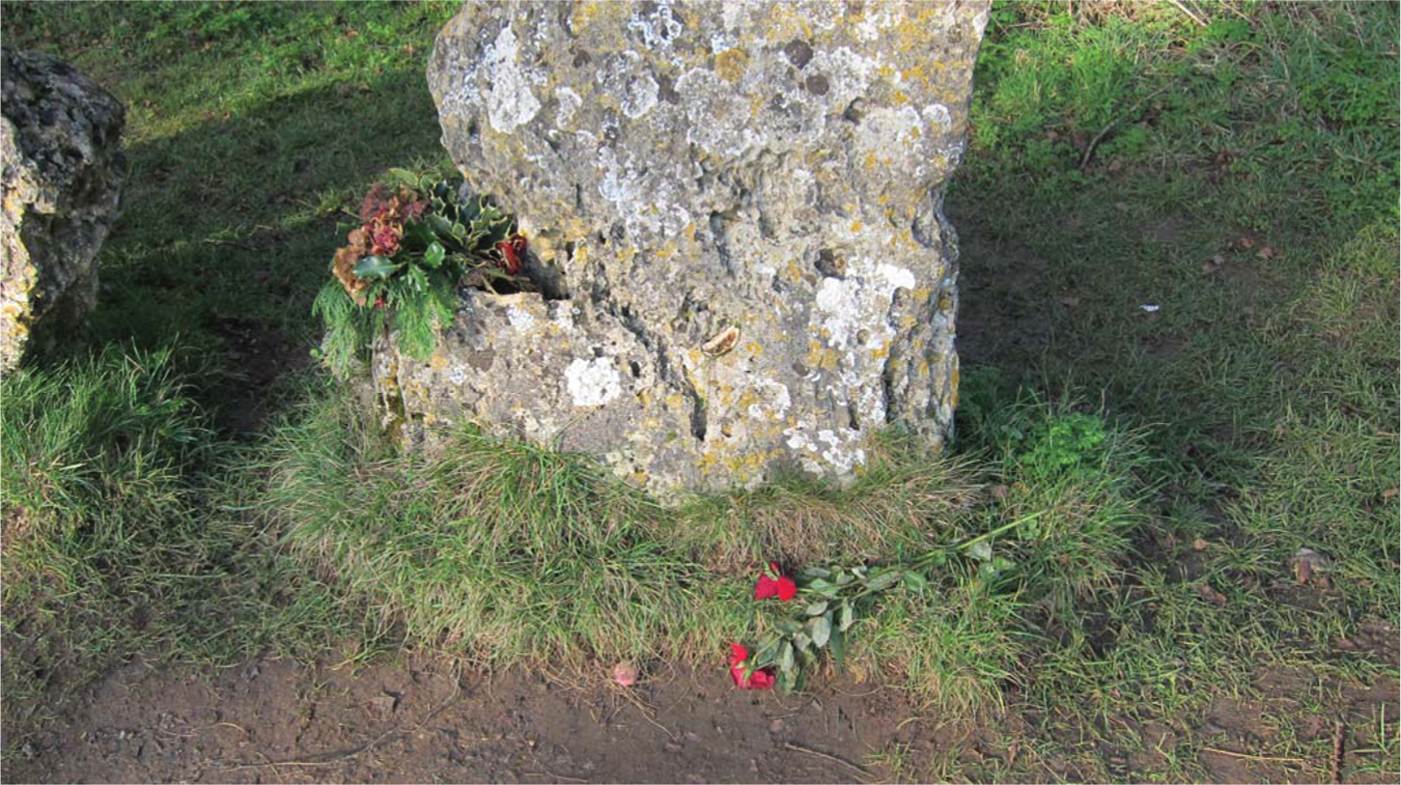
Christmas wreath, mince pie and roses at Rollright Stone Circle, Oxfordshire.
Expressions of absence-presence in informal spaces of memorialization
While some memorials situate the deceased and relationship to them in the past (e.g. ‘In memory of . . .’), others clearly represent a sense of ongoing relationship, exemplified by the plaque in the floral tribute in Figure 3: ‘Our love is forever/ and though we are apart/ it only grows stronger/ deep within my heart’. Analysed in more detail elsewhere, I have shown how the micro-memorial pebbles found at the pilgrims’ Witness Cairn, Isle of Whithorn (Scotland) include numerous examples of performative continuing bonds. These inscribed pebbles commonly address the dead directly; one states continued love in simple script: ‘To Laura, Nell and Suzie, still loved and missed’ (see Figure 4), while another captures the agency of the deceased in the social lives of the bereaved: ‘a beacon of hope left our lives, but not our hearts’. In the case of the latter, the presence of that beacon is symbolized pictorially by a lighthouse, which like cairns themselves, are important markers and means of safe passage for a coastal community, a guiding presence. 80 If, rather than a finite event, grieving is recognized as an ongoing process in the life-journey of the bereaved, that process can be identified as an individual and dynamic blend of leave-taking and way-finding. As Ingold notes of wayfaring, knowledge is ‘ambulatory . . . we know as we go, not before we go’. 81 Thus, practices of remembrance and mourning around particular memorials or other significant spaces can be identified as examples of what Wylie has described as the situated practices of wayfaring. 82
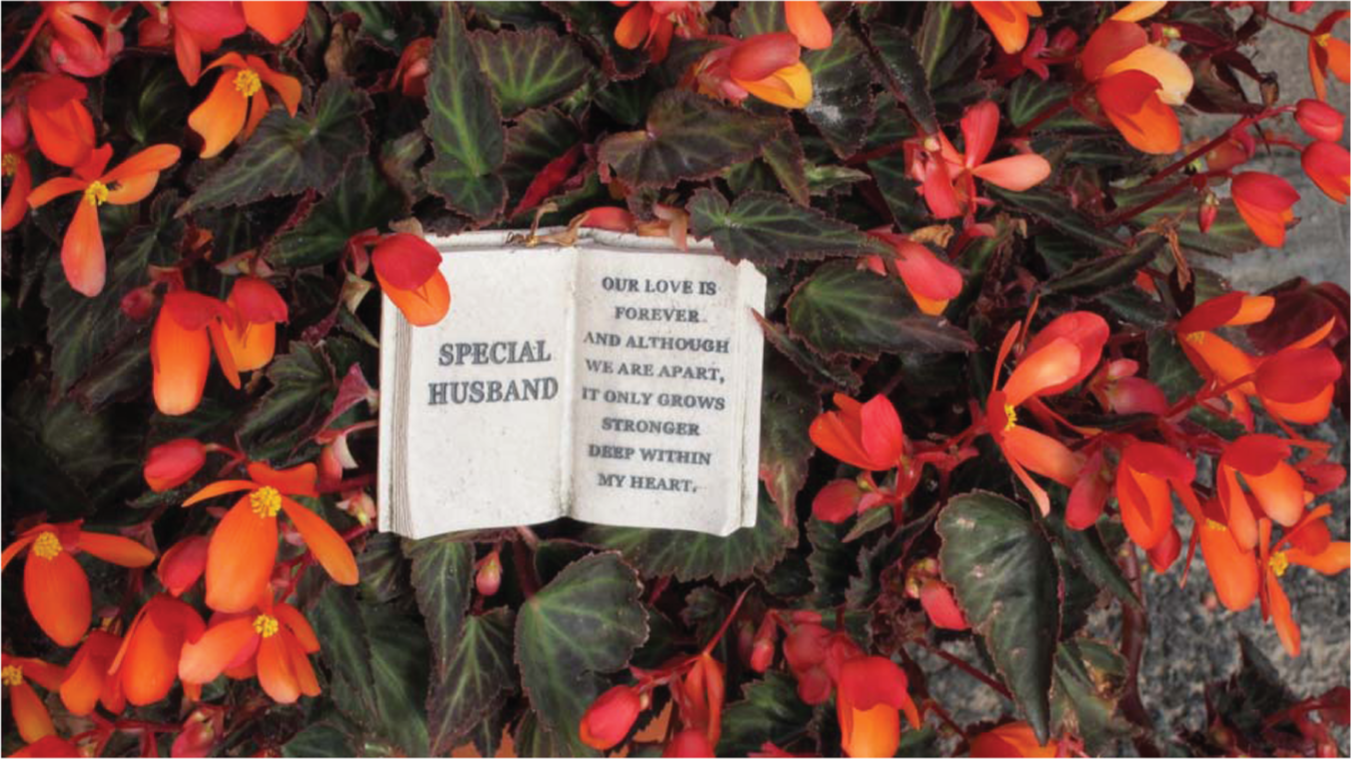
Memorial bench floral tribute two years after death: ‘Our love is forever . . .’.
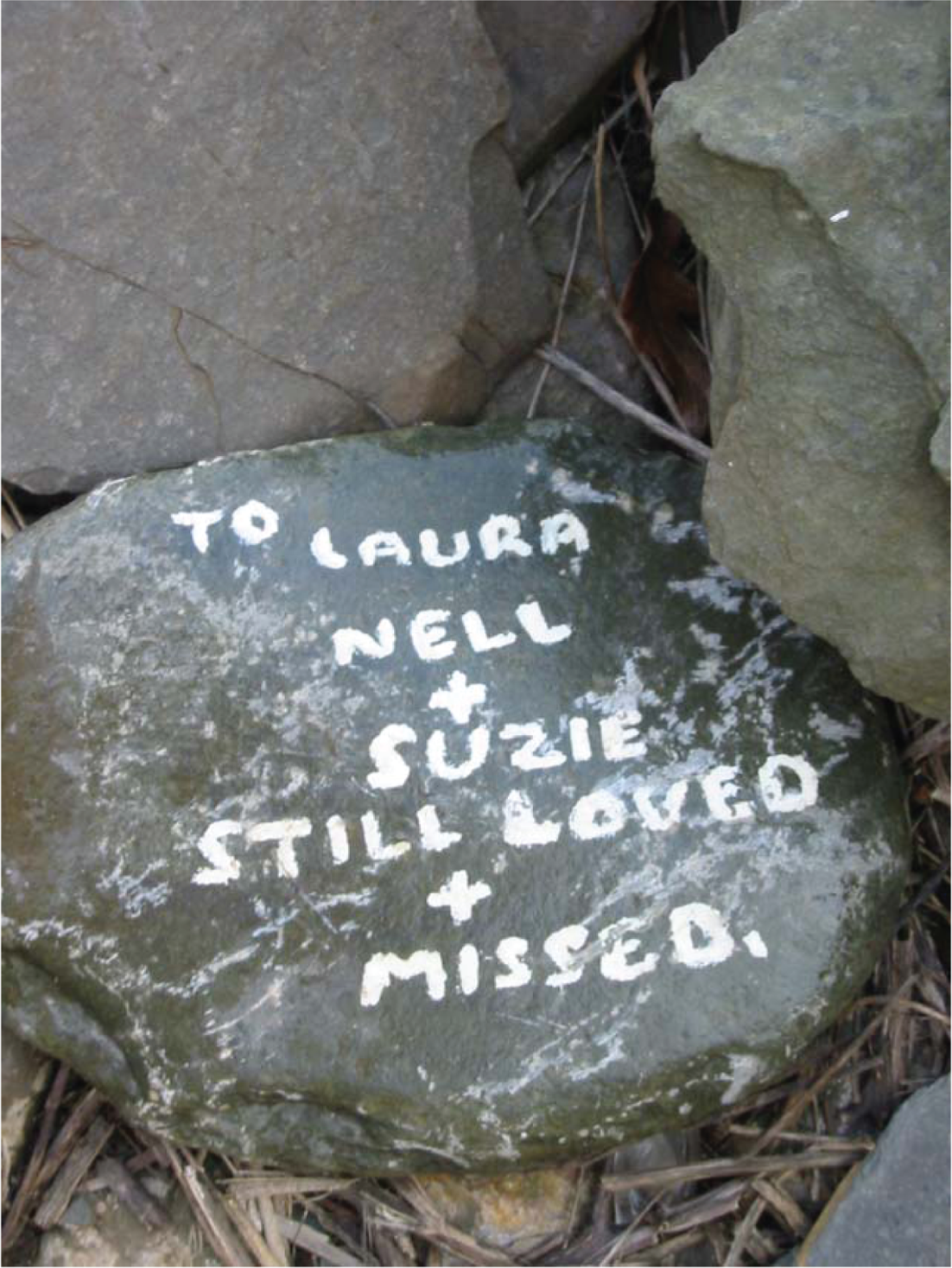
Witness Cairn memorial pebble, ‘still loved and missed’.
This wayfaring through an emotional-affective landscape of loss is practised and marked in various ways in different socio-cultural landscapes. Within the British Isles, memorial benches have become a common feature of civic parks and popular leisure spots, and as Wylie notes, in some cases these benches can be read as a means of saying goodbye to the deceased, locating them at a distance from everyday places and practices. 83 However, others testify to regular everyday engagement, through maintenance tasks such as painting or varnishing, but also through the attachment of flowers, potted plants, seasonal tributes, messages and material markers of identity such as football scarves or toys. As with other memorials, the location, inscriptions and practices around benches represent a range of relationships and beliefs, including those that signify and materialize the continuing attachment of the bereaved to the deceased. Continuing bonds can commonly be seen in the use of the present tense in inscriptions, and the ways in which people use a particular bench. The inscribed text and practices surrounding these benches often go beyond that of passive remembrance typified by ‘In loving memory of . . . Never will be forgotten . . .’ (Deal, England), to invoke active engagement and relationship (e.g. ‘Alive in our hearts forever’ [Edinburgh, Scotland]; ‘. . . We will always be together’ [Llandudno, Wales]). In some cases the deceased speak directly through the memorial, interpellating the passer by: ‘rest awhile with me’ (Port Erin, Isle of Man, my emphasis). This use of the first person places particular emphasis on the presence and liveliness of the deceased, exemplified by a plaque on a bench dedicated to a woman named Betty in Llandudno: ‘sit and enjoy God’s view as John and I did for over 50 years’. In these cases the deceased is given voice, in the case of the latter, articulating her kinship and world view; but more commonly, the bereaved use memorials as a focal point to iterate their remembrance or to address the deceased.
Direct address to the dead and strong expressions of continuing bonds were exemplified by the practices and artefacts centred on one particular memorial bench at St Margaret’s at Cliffe (Kent, England) placed in memory of a young father who had died the previous year (2008). Observed in February 2009, fresh flowers and a laminated letter from friends were attached to the bench, located near the beach. The letter updated the deceased on family events and asked him to support his wife when she started a new job: ‘give her the strength and courage to get through the first few days . . .’. This combination of practices might be described as an expression of folk spirituality or vernacular religion, 84 and testifies to the continuing significance of the deceased in the ongoing social lives of family and friends, as well as attributing something akin to ancestor spirit status to the deceased, whereby the dead can help the living through their own agency or proximity to God. 85 The practice of writing letters to the deceased recurs across several examples discussed here, which is indicative of the letter as materialized affective space and the act of writing as a significant means of communication with the deceased, with others who encounter the memorial and with self as a form of ordering and sense-making in the face of loss.
Figure 5 illustrates one of 12 benches along a stretch of popular coastal path in Port Erin, Isle of Man. Textually it speaks of continuing bonds: ‘This wonderful view we share, from this very special chair’, but perhaps it is its material evidence of praxis that speaks more eloquently of that ongoing relationship. It is not only the material and textual – representational − markers, but also the performances and practices around these marked spaces that signify and express continuing bonds, and that give a sense of ongoing relationship with the deceased; the repeated patterns of practice, evidencing flows of emotion and affect that can be recognized as indicative of dwelling with the deceased. Almost 15 years after the death of the man memorialized, it is the most actively ‘dressed’ bench of the group, continuously displaying pots of summer and winter bedding plants, with additional seasonal gifts, such as the Christmas wreath shown in the photograph, markers not only of remembrance but also of ongoing relationship. While the bench itself represents a fixed point in the landscape, with its fixed inscription, it is also a locus for a seasonal calendar of remembrance practices, what Santino has described as a ‘performative commemorative’, 86 which can be read as a reiteration of relationship as well as remembrance. Whilst interactive and dynamic narratives of continuing bonds can be mapped over time in electronic online memorials, 87 other vernacular practices leave little or no material trace. It was only through interview that I learned of a surviving partner who regularly visits the memorial bench dedicated to their late partner to share a drink with the deceased and talk about the day, blending Buddhist and secular western practices of absence-presence at the bench. These intersections of material and performative memorial, exemplify vernacular memorials as both focus and threshold space for continuing bonds, an example of what Meyer and Woodthorpe describe as ‘spaces which transcend absence’. 88 They also underscore the methodological benefits of longitudinal and in-depth study of interactions with such memorials, also evident in the studies of roadside memorials by Hartig and Dunn, Petersson, and Collins and Opie. 89
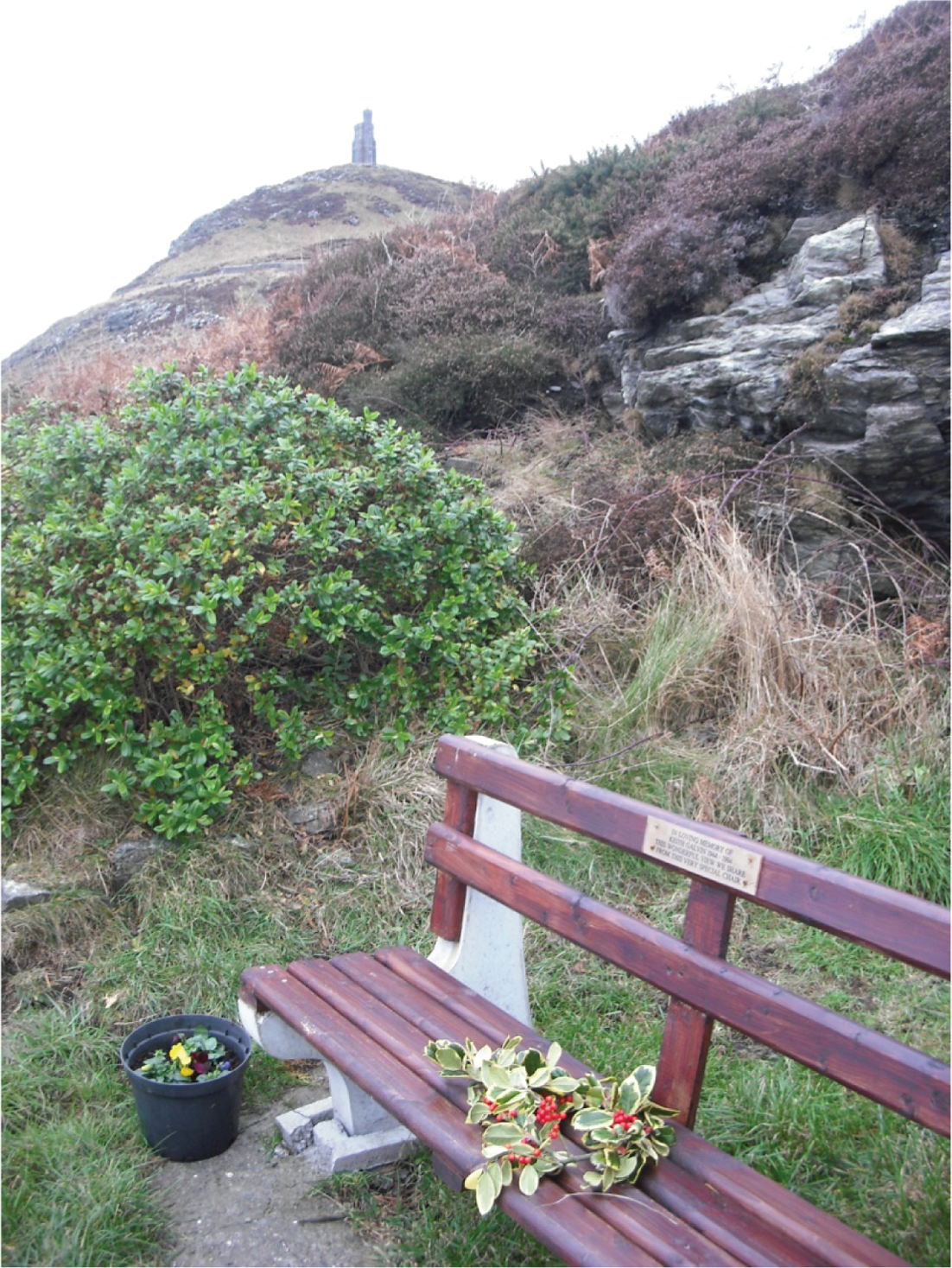
‘. . . This wonderful view we share, from this very special chair’ (Port Erin, Isle of Man; note the potted plants and seasonal wreath).
In addition to communication, caring for each other is an inherent characteristic of positive relationships, and care and continuity of care is another important performative dimension to continuing bonds with the deceased. After-death care of graves, shrines, etc. is a common form of continuing bonds expressed in the context of cemeteries (e.g. tending plants and lighting candles). This care is often performed according to socialized roles representing a continuation of gendered family care-giving and domestic labour (e.g. men painting or varnishing, women cleaning and decorating memorials, although a surviving spouse or adult child might take on all of these roles). 90
Care can be expressed in a variety of ways. As noted in the preceding discussion, campaigning is not an unusual response to bereavement, particularly for parents (but also for partners, colleagues, friends, etc.) who express their care for the deceased through raising funds or awareness of the medical condition, social problem or infrastructure failing that cost a dear one’s life. They thereby express affection for the deceased through care for others in the wider community, as well as giving presence to the deceased through a charity founded in their name or supporting an existing wider charity. Figure 6 illustrates two vernacular memorials for the victims of a traffic accident in Oxford, UK in 2005, when an out-of-control car crossed the unfenced divide between opposing traffic lanes, resulting in the death of four young people aged between 12 and 21. Klaassens et al. note that roadside memorials frequently embody a threefold need to mark the site of a sudden death, communicate to others about that death, and to attempt to give meaning to otherwise senseless loss, 91 each of which can be seen in this tragic case. The two permanent plaques at the site inscribe factual and emotional narrative: ‘tragically killed’ and ‘tragically taken away from us’. This photograph, taken six years after the accident, evidences both the impulse to memorialize the deceased at the site of traumatic death and the sense of continuing bonds symbolized by fresh flowers, anniversary letters and cards addressed directly to the dead. One victim from a different car is memorialized separately from the three children; in addition to a permanent plaque, his memorial includes a miniature fenced semi-permanent garden, flowers, candles and laminated letters and photographs. Photographs evoke the deceased in life, relationship to them and happy memories. The letters address the deceased directly and the fact that they are laminated prolongs the in situ presence of the sentiment expressed and, in common with the narrative of the text on the plaques, suggests a desire to communicate with others who might visit the site. 92 The large flag of St George is symbolic of the centrality of football and the England team in the life of one of the other accident victims. The absence-presence of this boy was further materialized in a memorial garden at his football club, through virtual space in an online memorial page organized by his family and YouTube film made by his team mates. 93 The latter, which also addressed him directly, included images of the team all wearing football shirts with his name and team number on the back, and the four-metre flag bearing his name being displayed on the terraces at their football matches, each an act of bearing witness and giving presence to him in the ongoing lives and activities of family, friends and team. The presence of the crash barrier between the directional traffic lanes is also testimony to the resulting community safety campaign for improvement of the road’s infrastructure. For family, friends and other locals who know of this tragic case, not only is the site of death significant but the mile-long crash barrier itself evokes the absence-presence of the deceased, and is itself a lasting memorial, the permanent transformation of the material landscape hinting at the radically transformed emotional landscape of the lives of the bereaved.
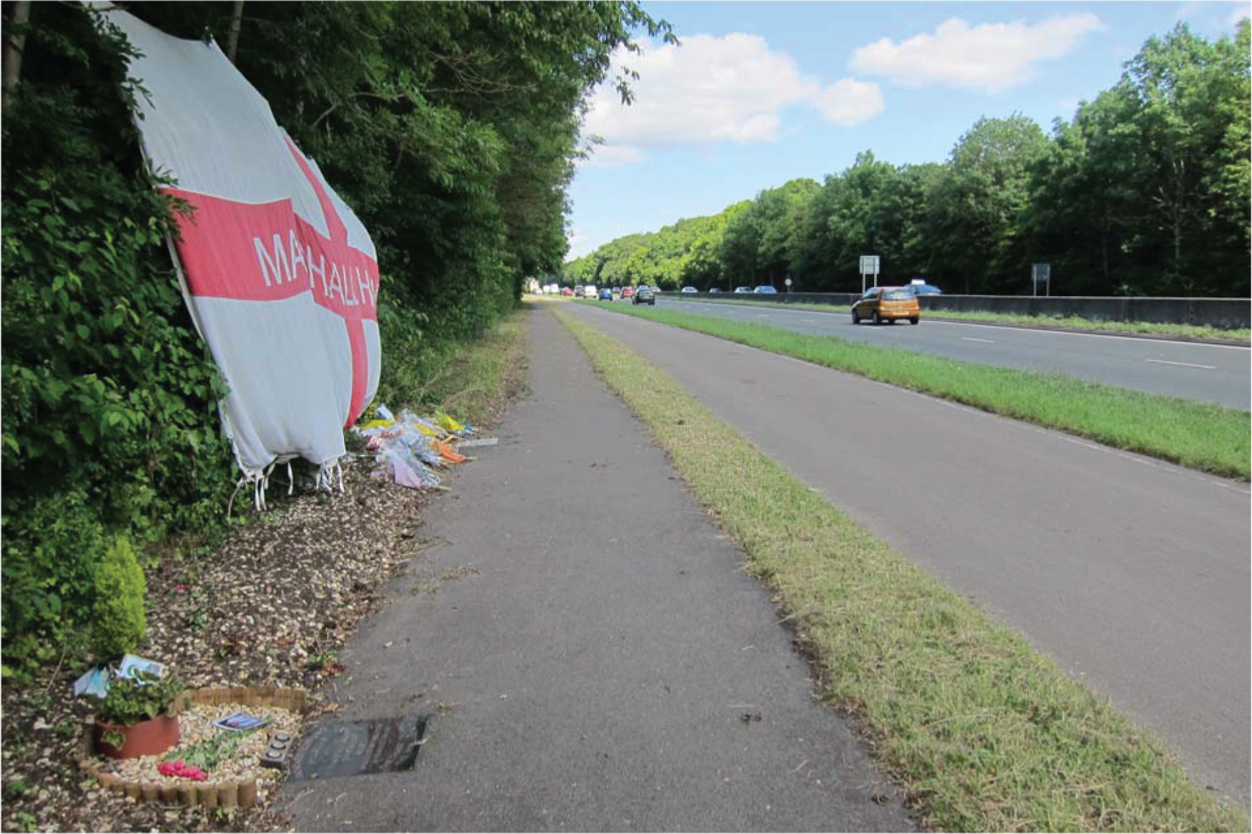
Roadside memorials on the A34 Oxford, with new crash barrier between directional traffic flows, May 2012.
Conclusion
For many individuals, knowledge and experience of someone’s death can go hand in hand with a sense of their ongoing presence of the deceased, often expressed as continuing bonds. This paradoxical absence-presence is mediated through religious or secular spaces and practices, or through a mixture of both. For all, the experience and expression of absence-presence through continuing bonds is a dynamic process, which may fade, flux or persist over time. Absence-presence is just one of many more-than-representational experiences of lifecycle that thread through the weft of complex place-temporalities, contributing to what Edensor describes as the ‘dynamic and processual qualities of place’. 94
This absence-presence is expressed through a combination of representational spaces and material forms as well as embodied practices and emotional performances. Memorials symbolize and evoke the dead as an absent presence as well as situating absence-presence and acting as a conduit for the practice of continuing relationship. For those situating and performing their continuing bonds at least in part through such public memorials, they are mobilizing public space for private memorialization, evoking the absence-presence of the deceased outside the boundaries of designated spaces for memorialization. Increased freedom to acknowledge and express the absence-presence of the deceased, in conjunction with wider socio-economic and cultural changes, has resulted in increased expression of continuing bonds in public spaces. This physical and discursive dispersal is part of the emerging vernacular idiom for talking about and to the dead. Hence, roadsides, railway platforms, parks and paths have been inscribed with informal memorials, which change the symbolic meaning and emotional-affective experience of those places for the bereaved and for those who encounter and engage with those symbols and practices of absence and absence-presence. Thus, the desire to acknowledge the absent dead and the paradoxical relationship of absence-presence in public spaces has generated multiple, sometimes colliding and competing, meanings and values in the landscape. These meanings and expressions evidenced in the landscape act as a witness. They testify not only to the presence of absence, but the agency and impact of absence-presence, as a manifestation of dynamic relation between the living and the dead as the bereaved journey through the landscape of loss, finding a way to live with-without the deceased.
While expressions of the absence-presence of the deceased can be read in material vernacular memorials through place-context, material form, visual iconography and inscribed text, these are largely static, reflecting emotions and agenda at the time when the memorial was established. It is often only in the ephemeral tracings of performance and temporary markers or gifts, indicative of emotional bond in the moment, which provide a sense of dynamic engagement and relationship that evidences the transformation of the absent deceased into expressions of absence-presence. In-depth and/or longitudinal research is needed to access the dynamic shifting dialectic of absence-presence, but cultural geographers can both learn from and contribute to much more nuanced understandings of absence through relational study of the deceased, the bereaved and the spaces of emotional-embodied practices and material markers of death and remembrance.
Footnotes
Acknowledgements
My thanks to Dydia DeLyser, Lars Meir and Erika Sigvardsdotter for their editorial guidance and patience; to the anonymous referees for their constructive feedback on an earlier version of this paper; and to Ruth Little, Jo Bushell and Sarah Evans for editorial assistance. As ever, my thanks go to Bill Mander for his input and encouragement.
Funding
This research received no specific grant from any funding agency in the public, commercial, or not-for-profit sectors.