



Abstract
The fantasy of a human being who is, or becomes, human to the extent they move away from animal nature is stubbornly persistent in western cultural formations. This article (see Acknowledgements) works with, and against, recent materialist moves within Cultural Geography to critically engage the idea that the human is in some sense irreducible to nature. It considers how comparative anatomists of the early 19th century – in explicitly departing from the 18th-century Cartesian dualism that had identified the human with an immaterial notion of soul or mind – looked to the human body, and above all the head, in order to establish that people were categorically different from all other animals. More specifically, the paper considers how it was to ‘race’ that scientists turned, in order to provide an anatomical foundation for a specifically modern strand of humanism. The discourse of humanism is thus considered, not – as many would have it – as an otherworldly or flawed myth, irremediably upheld by blind human faith and vanity. It is not the bearer of an idealism set up in (often shrill) negation to the task of ‘re-materializing’ Cultural Geography. Instead it is, itself, a worldly mix of ideas, practices and technologies. Eliciting humanism’s instability via this (overlooked) historical episode is to render it more vulnerable to precisely the scrutiny demanded by the earth’s current state of ecological fragility. It also enables a more rigorous interrogation of the notion of mind – humanist but also colonialist – that has been disowned in recent efforts to decentre the human in Human Geography. For, as this article demonstrates, re-imagining humanity’s place in nature extends to its co-habitation with all manner of others: human as well as nonhuman.
Keywords
Introduction: figuring the human
As the philosopher Simon Glendinning puts it in his critique of humanism (in the same universalist terminology he criticizes): ‘Man is only man insofar as he is essentially more than a human animal. Unlike animals, whose lives are defined solely by their existence, human beings are, or become, human as they transcend some animal-like condition’. 1 It is this formidably tenacious – and in the early decades of the 21st century, patently dangerous – idea in western-derived cultures, that humans are in some sense irreducible to nature, which this article takes up. It does so against the background of a now widespread concern within the social sciences and humanities, and perhaps especially in Geography, to challenge the longstanding assumption that some realm of human culture can be conceived as separate from another, nonhuman, domain called nature.
Challenging the idea that humans occupy a separate and privileged place among other beings has been the central goal of a now familiar post-humanist agenda in Geography: an agenda inspired above all, perhaps, by Bruno Latour and others, notably Donna Haraway, in Science and Technology Studies and in Actor Network Theory. 2 It is an agenda that has been particularly influential for a discipline long divided by an always-uncomfortable distinction between the human and the physical.
In Geography, Noel Castree and Catherine Nash note that the term posthumanism has been used both to describe a historical condition and to signal a theoretical perspective. 3 Descriptively, then, posthumanism has come to name the sense in which recent developments in biotechnology, our increased dependence on machines, the multiplication of hybrid objects, and so on, have meant that our lives are now so thoroughly entangled with all kinds of nonhumans that it has become difficult, if not impossible, to delimit a distinctively human form of being. Conceptually, posthumanism has centred more on the challenge these sociological developments have posed to the stability and integrity of the category of the human. More specifically, as Castree and Nash put it, it has challenged the very idea of the ‘human subject as separate and liberated from nature and fully in command of self and nonhuman others’. 4
The central goal of this critical posthumanism, as it is taken up and developed further in this article, is to challenge that deeply entrenched discourse of humanism that separates and elevates humans from the natural world. It is a challenge designed to effect, in the words of Australian cultural studies scholars, Gay Hawkins and Emily Potter, ‘a decentring of the thinking human subject’: 5 a decentring that increasingly in Human Geography, as elsewhere, has been pursued via what Sarah Whatmore referred to back in 2006 as a ‘recuperation of materiality’. 6
This recuperation is evident in a range of distinct but related developments. Acknowledging the proliferation of work in the ongoing task of ‘re-materializing’ Cultural Geography, it is possible to discern a few groupings as follows. 7 First, around material-culture studies of, for example, the intersections of matter, memory and place. Second, the move to reclaim ‘the social’ in an intensified focus on material inequalities in power-differentiated societies. Third, the non-representational turn to bodily practices and the affective economies of touch, taste, smell and sound; also of sense and sensibility in recent post-humanist phenomenologies. Finally, there is a naturecultures cluster, sharing various vitalist philosophies with non-representational geography in order to elicit the entangled materialities of nature, science and technology.
These engagements with materiality, now so disparate and disputed as to be the subject themselves of major reviews, 8 have decisively transformed the ground of a Cultural Geography once characterized as all-too-human. It is the ‘naturecultures’ cluster within the broader agenda called ‘more-than-human’ Geography that has arguably done most to challenge a Cultural Geography whose ontological gates once enclosed a taken for granted domain of culture and the human. To cite just a few focal points, this field has included studies of soya beans, dust mites, flu viruses, companion species, the cow (as another instance of animal domestication), wheat, the bio-political capacities of water, the elemental rather than ineffable properties of air, the countless nonhuman entities and organisms that compose urban life, the microbes that make up our own more-than-human bodies, the inventiveness of bacteria, nematodes too, and so on. 9 In uncovering the ‘affordances’ of nonhumans and not-quite human things, such work refutes the anthropocentric exclusivity of a humanist conception of agency as a rational consciousness directing all else. In describing what is an enlarged and relational conception of Life itself, these broadly materialist moves have also elicited culture beyond the ‘strictly humanistic’ as, in the words of Tim Cresswell’s review, a world of ‘humans/with/plus’. 10 Culture, as Castree and Nash put it, is always ‘in excess’ of the human. 11
This analytical and ethical ambition – to break out of a narrow and humanist conception of culture – is one that this article shares: as it too aims to problematize the idea that humans constitute a somehow distinct category of beings. In this regard, attention given to the formerly neglected lives of nonhumans in the field of ‘Animal Geographies’ since its reanimation in the 1990s has been a guiding ethical compass for this article. Especially relevant is the critical intervention that has disturbed the stability of the human-animal boundary and the interiorized binary that sets humanity (as reason) apart from animality (as instinct). 12
That noted, to help position the different strategy of decentring the human pursued here – and to frame the historical considerations that form the substantial part of this article – I take a departure point from recent materialist efforts to ‘bracket off’ that meaning-making subject to whom mind, creativity and power had once been solely attributed. It is a bracketing off, I will suggest, that has foreclosed an adequate critical engagement with the idea, or in Bruce Braun’s neat description, the humanist ‘figuration’, 13 of the human as something more than a human animal.
New materialism(s): displacing the thinking human subject
The phrase to ‘bracket off’ is taken from Jane Bennett’s influential 2010 manifesto Vibrant Matter. There, what is bracketed off, is ‘what is commonly taken as distinctive or even unique about humans’. 14
In the introduction to their collection New Materialisms, Diana Coole and Samantha Frost write that it was Descartes who identified the ‘thinking [human] subject . . . as ontologically other than matter’; such that modern philosophy has variously portrayed humans as ‘uniquely rational, self-aware, free and self-moving agents’. 15 For Bennett, this conception of the human as ontologically-other-than-matter is bound to ‘fantasies of human uniqueness in the eyes of God’. 16 And it is in its ‘bracketing off’, she argues, that human and nonhuman actants can be regarded as co-existing on the same level. So, as the editors of another recent volume in this area observe, it is precisely in the rejection of a Christian or Cartesian metaphysics that this so-called new materialism is ‘not dualist’ but ‘monist’, in its assertion that humans and nonhumans exist on a single material plane. 17
Succinctly, then, it is the idea of humanity’s ontological distinctiveness that the proposition of human-nonhuman coexistence on a single material plane, is set against.
This indisputable proposition, of co-existence, offers a valuable corrective to Cartesian and theological dualism, and with it the idea that humans are unique possessors of some immaterial soul or mind. But an issue to raise here concerns the acceptance, if sometimes only tacitly or by default in various new materialist geographies, of humanism itself as an im-materialism: of, to be clear, humanism itself as a more or less Christian or Cartesian doctrine. From this identification of humanism with the meta-physical, human exceptionalism – as the positing of a separation between active human subjects and passive nonhuman objects – is traced to the uncritical premise that humans are ontologically distinct.
The implications of this critique of ontological dualism have been quite far-reaching for current rethinkings of ‘the human’ in Human Geography. Fundamentally, they are evident in the tendency to turn away from those aspects of culture conventionally regarded as distinctly human, of, for example, intersubjective meaning, symbolizing, cognition and knowing. These tend now to be annexed from a geographic concern with humanity’s material existence, as if they somehow fall outside the domain of culture reconceived as a single plane of human/nonhuman entanglement. For how else, if not according to an ontological critique of meta-physical conceptions of the human, to apprehend the logic of the recent turn in Cultural Geography in which a supposedly unique ‘order of reason, mind, or consciousness’ in Val Plumwood’s words, 18 has been opposed – more or less term for term – by an affirmation of the ‘sensory, bodily and affective’ character of human existence? 19
The strain signalled in this manoeuvre should not be taken here as a criticism, as such, of the affective and bodily turns in Cultural Geography (including feminist engagements with the ‘lived body’ 20 ). Far from it. In the field of materialist engagements with race, for a (too) quick example, there is now rich evidence of just how much the idea of race as knowledge – as classification, meaning system, grid of signification – omits in terms of how race is lived, sensed, felt, performed and indeed emerges in materialities of encounter. 21 How much, too, the conventional research methods that have been used to critique racial representation fail to ‘tune into’ 22 and even ‘deaden’ 23 the bodily surfaces and intensities that produce race in interaction.
But to return to the focus here on the more-than-human tactic that sets aside humanism as ‘fantasy’, ideology, or as otherwise ‘immaterialist’, and then proceeds logically and politically to recuperate matter, some more immediate questions arise. First, can humanism be so readily excluded from the material? I return to that below. Second, does the materialist opposition to what is an essentially theological idea of humanism offer the best hope of challenging contemporary assumptions of human exception from nature? For, just in historical terms, is it really the case that the still lingering idea of human exception from nature draws only, or even largely, on Christian or Cartesian notions of the human? That is: is it really the case, as Bruno Latour himself has maintained, that people in western-derived cultures ‘haven’t moved an inch since Descartes’ – such that 500 or so years later as Latour goes on to lament, ‘the mind is still in its vat, excised from the rest, disconnected and contemplating . . . the world’? 24 As if some doctrine of human exception from nature had just persisted ‘despite Darwin’ (to quote Lynn White’s influential ‘Historical Roots of our Ecological Crisis’); 25 and as if human exceptionalism had just endured throughout – or somehow outside of – history, as some archaic meta-physical belief.
In responding to these questions, the approach taken in the next sections of this piece turns out to be modestly empirical, as it attempts to interject into a current post-humanist agenda consideration of the history of the idea of human exception from nature. The episode of this history considered, moreover, addresses how, at the very beginning of the 19th century, the idea of an immaterial soul or mind was actively rejected. Indeed, it was supplanted, via a set of scientific practices that offered a new account of precisely the physical – rather than meta-physical – distinctiveness of human beings. The next sections, then, take up the demise of Descartes’ account of the human and of what was (more generally) considered to be its exalted place in the so-called Great Chain of Being. As we shall see, the demise of this account impelled a fresh attempt to establish the human’s exceptional status. And it was this specifically modern formulation of humanism that, it is indicated in the final section of the paper, was to become influential, and arguably more influential today, than its Christian or Cartesian predecessors.
To anticipate this account: comparative anatomists of the early 19th century physically distinguished human beings by asserting the uniquely upright nature of the human body and, with it, the verticality of the human head. The significance of this upright characteristic was not, however, self-evidently given. The practices of craniometry and, centrally, the practices of racial craniometry, were developed as key ‘scientists’ attempted to establish an anatomical account of humans as creatures that were categorically different from all other animals, especially the great apes.
Of course, the emergence of comparative anatomy at the beginning of the 19th century, as well as evolutionary theory later on, attracted a good deal of hostility from those (especially Christian) commentators who continued to insist that humans were ontologically distinct from nonhumans. But again, to assume that human exceptionalism ‘just persisted’ despite these developments, out of some inexorable vanity or naïve Christian faith, is to gloss the history of what was an anxious effort to establish the exceptional status of the human without recourse to Cartesian metaphysics. It is this struggle and its legacy into the present that will be considered below. And whilst the struggle might perhaps be read as yet another instance in the systematic elaboration of a meta-physical notion of soul or mind, there are good reasons as already indicated, to avoid an assumption of humanism’s seamless continuity. For to assume this continuity is to risk construing the very idea of human exception from nature as something outside of history: as a belief that could somehow persist behind its various formulations; as a kind of underlying, motivating ideology that could exist apart from or prior to its various and of course always material manifestations.
The important point here, then, is that it is only by insisting upon humanism’s own materiality, by pursuing a critique based upon its worldliness rather than its otherworldliness – that is, as something which is assembled in the concrete sense that Latour, for example, has opposed to the linguistic idea of social constructivism 26 – that human exceptionalism can itself be rendered vulnerable. Only, then, by recognizing humanism’s very materiality can it become susceptible to precisely the intensity of scrutiny currently demanded by the earth’s state of ecological fragility. Setting-aside the notion of human exception from nature as abstraction or fantasy is not, then, arguably enough to decentre it in the interests of a planet under pressure.
As Joanna Bourke has observed, ‘[t]o understand the instability of definitions of the human, we need history’. 27 Not in any simple locational sense, a geographical imagination is needed too. 28 So it is in an attempt – from a southern positioning in one avowed post-colony – to elicit the instability of human exceptionalism, itself, that the next sections of the article consider its uneasy formulation via a notion of ‘intelligence’ that constituted a new, anatomical, account of mind. This notion remains unproblematized in the new materialist tactic of bracketing as fantasy the figure of the ‘thinking subject’. Indeed, the dismissal of humanist ideas about mind risks fixing the very historicity of that figure precisely as it is excluded from the domain of material existence. For the premise of humanity’s unique capacity for intelligence was no ethereal myth handed down by classical, Christian and Cartesian narratives of reason and soul. It was a technical and discursive achievement, precariously forged and situated in the modern colonial practices of craniometry and an emergent discourse of, to use the term identified below, anatomical humanism.
Human exceptionalism after the ‘Great Chain of Being’
‘Surely’, Linneaus wrote in the margins of his Systema naturae (1735), ‘Descartes never saw an ape’; 29 by which Linneaus was alluding to the discovery of the great apes from around the middle of the 17th century that turned into a problem the massive gulf Descartes had previously asserted between humans and animals. Linnaeus’ infamous assertion that he could find no physical way to categorically distinguish between humans and the great apes was premised upon his assumption that ‘orang-utangs’ (a general term at the time) walked upright. By the beginning of the 19th century, however, this claim was being called into question.
For the comparative anatomists of this period it was uprightness, or bipedalism, that came to be understood as a distinctively human trait. And although it was the head that constituted their primary focus, it was by relating cranial development to human uprightness that they sought to produce an account of human exception without invoking, as had Linnaeus and other 18th century naturalists, a Cartesian separation of mind from body.
Importantly, then, the concern of scientists like Georges Cuvier (in France) and William Lawrence (in England) to found an anatomical account of human exception did not amount to conceiving the human body – and specifically the human head – as just the ‘vat’ for an essentially immaterial conception of mind (after Descartes) or soul (dating further back to Judeo-Christian theology). Indeed it was precisely in the attempt to demonstrate that human mentality was a product of bodily structure, that arose that great 19th century obsession with the head, and, most notoriously, the collection and measurement of human skulls.
Limiting attention here to that aspect of human mentality considered as distinguishing humans from (other) animals, it was head size and shape which – taken as a reflection of the size of the brain – became a measure of the quality of this mentality. For the most part this quality came to be referred to as ‘intelligence’, a term that, as Elizabeth Williams has demonstrated, came to be understood over the course of the 19th century as an innate but variable faculty of ‘civilizability’ or ‘perfectibility’. 30
In his consideration of how ‘intelligence and its synonyms’ were created, John Carson’s The Measure of Merit, notes that from the mid-18th century, intelligence was made to stand for ‘whatever general intellectual power . . . made white male Europeans obviously more civilized and advanced than Ethiopians or Hottentots, not to mention other animal species’ (emphasis added). 31 Intelligence, then, for Carson, became discursively and politically defined as that intellectual power according to which Europeans were considered superior to other races. Additionally it was this same power that also distinguished – though unproblematically so for Carson – humans from other animals.
Carson’s argument echoes a now familiar ‘identity politics’ critique of the pernicious role of craniometry in turning the idea of racial difference and hierarchy into an innate condition. 32 In trying to relate variations in head size and shape to some intellectual capacity (or incapacity), Carson argues that the comparative anatomists of the early 19th century drew on ‘the vision of a hierarchy of species associated with the great chain of being, and with it the chain’s key criterion for distinguishing species – an organism’s overall level of intelligence’. 33 Conventionally, therefore, racial craniometry is critiqued as appropriating a pre-given concept of intelligence: one that had already provided the basis upon which the human had been distinguished from other animals and granted an exalted position at the top of the Great Chain of Being. 34 Here, however, an alternative, or at least a further, line of critique of craniometry can be suggested.
As Michel Foucault has argued, it was with the transition from the classical to the modern age that ‘the possibility of deploying a great natural order which would extend continuously from the simplest and most inert of things to the most living and the most complex, disappears’. 35 Cuvier himself maintained as much in the early 1800s when he stated that the ‘pretended chain of beings as applied to the whole of creation is erroneous’. 36 It is, then, far from clear that comparative anatomists like Cuvier simply drew on and extended the hierarchical principle of a divinely bestowed order of life expressed by the great chain. Indeed, the claim here, as recently supported in other assessments of the fate of great chain thought, 37 is that it was precisely with the demise of this belief system that human distinctiveness came to be understood in new, and specifically modern, terms.
As Carson has pointed out, ‘which [racial] groups were superior . . . and which inferior’ was already ‘known’ at the beginning of the 19th century. 38 Michael Adas, too, in The Measure of Man, notes that differences in the material culture of the world’s people, and their perceived levels of technological sophistication had, by that time period, come to entrench an invidious hierarchy of human societies. 39 What can be taken from these and many similar critiques of colonialism is that it was precisely because such differences in material culture were taken to form a self-evident intellectual hierarchy, that race came to constitute an essential resource – not only in the violent regimes of colonialism towards which a great deal of criticism has already been directed in anti- and postcolonial Geography and elsewhere. Race was also enrolled, and this has been largely neglected, 40 in the attempt to establish a modern successor to the paradigm of the Great Chain of Being.
Succinctly, the existence of a correlation between variations in the anatomical, and above all the cranial, structure of different groups of people and their ‘known’ level of intellectual inferiority, offered the possibility of a new biological basis for determining a hierarchy among living beings. The point of racial craniometry, then, was to establish this correlation: precisely by forging an anatomical concept of intelligence, and so to provide a new account of what Cuvier for example called that ‘vast . . . difference’ which separated humans from (other) animals. 41
Comparative anatomy: human uprightness and the brain
Something of this account of racial craniometry is discernible in that infamous early 19th century practice of head-measuring dealing with character traits considered to be linked to specific sites in the human brain, and known as ‘phrenology’. Johann Gasper Spurzheim, for example, maintained that ‘[t]he heads of different nations offer a study of great importance’ precisely insofar as they are able to verify the general assertion of phrenology that the brain is the organ of the mind. 42 Similarly, and comparing (what was said to be) the conspicuous difference in the forehead of the skull of the painter Raphael with that of a native of New Holland, the Scottish phrenologist George Combe contrasted the genius of the former with accounts of the ignorance of the latter in order to conclude: ‘We have now arrived, by a fair and legitimate induction, at strong presumptive proof in favor of the grand principle of Phrenology: that the brain is the organ of the mind’. 43
Here, however, the main argument focuses not on phrenology but on comparative anatomy, and more specifically, on the work of the French zoologist, Georges Cuvier, from the turn of the 19th century. His work was formative in the more familiar, open, and invidiously racist uses to which craniometry came to be put across many theatres of empire, notably in Samuel Morton’s infamous ‘Crania Americana’ in the late 1830s. 44 But, in what can only be a brief overview, the suggestion in what follows is that Cuvier’s recourse to race was informed not just by a racist, but by a humanist, rationale.
Comparative anatomists such as Cuvier, and also Lawrence, are often understood as having considered the human as ‘merely another animal’. 45 But despite seeing the human as a purely physical being, Cuvier wrote in his 1802 Lectures that ‘the distinction between brute and human mind . . . is absolute’. 46 He went on to ask: ‘With so much resemblance in the structure of the nervous system . . . why is there so vast a difference as to the total result, between man and the most perfect animal?’ 47 It was exactly in order to answer this question, it is suggested here, that Cuvier looked to and developed racial craniometry in his attempt to formulate – not a claim for racial hierarchy as such, but – an idea of intelligence that was qualitatively different in beings that walked upright.
‘Man’, in Cuvier’s words, is ‘the only animal truly bimanous and biped’. 48 The mere fact of uprightness cannot however account for that vast difference which, for Cuvier, set the human species apart from all others. To that end he turned as mentioned to racial craniometry – granted, as an aside here, that early 19th-century craniometry extended to a wide array of enquiries into idiocy, genius and later on to criminality. 49 Note too, via Elizabeth Fee, that craniometry involved almost exclusively the study of male skulls – an intriguing bias in itself, though one not possible to take up further here. 50 For it was racial craniometry most diagnostically, and more specifically for Cuvier, Petrus Camper’s infamous measure of the facial profile in the 1770s, that offered the most promising method for formulating an account of the significance of human uprightness.
Briefly, Cuvier took Camper’s facial angle – measured at the intersection of a line drawn horizontally from the nostril to the ear, and another drawn from the upper jawbone to the most prominent part of the forehead – as a measure of uprightness. Cuvier, however, went on to propose that the more upright a being, and so the more vertical its facial profile, the larger its brain was in proportion to its sensory organs (the nose and mouth). So, with anatomical uprightness, the brain, as, in Cuvier’s words, ‘the common centre of all the nerves . . . the instrument by which the mind reflects and thinks’, comes to predominate over those ‘two senses of smell and taste, which act with the greatest force on animals’. 51
For Cuvier, then, the facial angle constituted in Claude Blanckaert words ‘a physiological measure of intelligence’, 52 where intelligence was defined as the extent to which a more basic and animal-like existence had been superseded. And, as just mentioned, it was in proposing this understanding of intelligence that Cuvier turned to and developed Camper’s racial craniometry. He wrote – though quoted here is Cuvier’s earlier formulation of this understanding of the facial angle (co-authored with Geoffroy Saint-Hilaire): ‘In the various races of man one observes the same series of relationships as in the various species of animals, between the projection of the skull and . . . intelligence’, adding immediately that ‘none of the peoples with a depressed forehead and prominent jaws have ever furnished subjects generally equal to Europeans in the faculties of the soul’. 53
Cuvier was not, however, just claiming that those groups of people with ‘a depressed forehead and prominent jaws’ are inferior. In the disparaging terms of colonial stereotypes they were already ‘known’ to be inferior. It is, rather, the supposed fact of this inferiority that Cuvier is mobilizing in order to try to demonstrate a general anatomical link between head shape and intelligence – one that, taken from race, could be generalized across human and ape (see Figure 1).
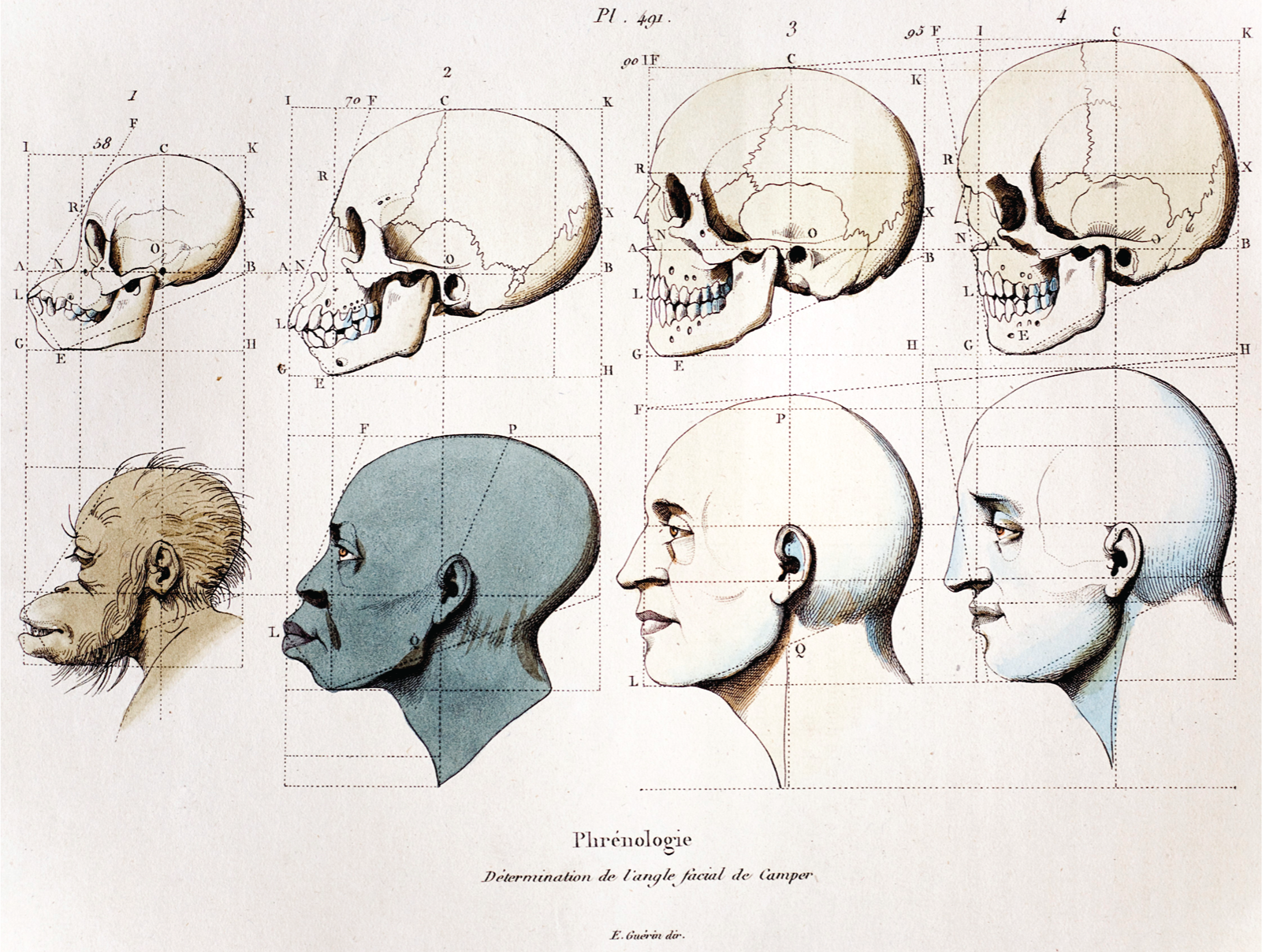
Copperplate engraving of Camper’s facial angle thesis with original hand colouring from Felix Edward Guerin-Meneville’s Picturesque Dictionary of Natural History circa 1830. Credit: Paul D. Stewart/Science Photo Library
Cuvier’s invocation of an apparently self-evident racial hierarchy thus provides the very basis upon which his comparative research could contend that certain (upright) anatomies are more intelligent than others. It follows that it is the very ‘knowledge’ embedded in colonial stereotypes of non-Europeans that comes to found the far-reaching modern contention that (a uniquely) human mentality is the product of (a uniquely) human anatomy.
As Cuvier’s English follower, William Lawrence, in his 1819 Lectures on Physiology, was to write: ‘In the external conformation of man we immediately remark his upright stature; his majestic attitude, which announces his superiority over all the other inhabitants of the globe. He is the only being adapted by his organization to go erect. Enslaved to their senses, and partaking merely of physical enjoyments, other animals have their heads directed towards the earth’. 54 Lawrence, too, drew on race in his own attempt to demonstrate that: ‘the moral and intellectual phenomena of man are the offspring not of some ‘immaterialist’ principle but of physical organization’. Again in his words: ‘The different progress of various nations in general civilisation and in the culture of the arts and sciences . . . convince us beyond the possibility of doubt, that the races of mankind are no less characterised by diversity of mental endowments, than by . . . differences of [physical] organisation’. 55 So, for both Lawrence and Cuvier – among others, such as the anatomist Thomas Soemmering in Germany – the exceptionality of the human was attributed not to some meta-physical idea of mind but to the distinctive, if variable, nature of the human body itself.
Arguably then with these developments the mind is no longer in its vat. Indeed if as Cuvier maintained ‘intelligence . . . is in constant proportion to the relative size of the brain’, 56 this was quite literally because ‘[t]he more elevated the nature of the animal, the more voluminous is the brain’. 57
‘Neuro-mania’: evolutionism and after
Cuvier’s interpretation of the facial angle was eventually refuted. Despite craniometry’s frantic search for some accurate correlation between physical features and some score of (usually racial) intelligence – an obsession evident in the sheer variety of measures, indices, ratios and instruments that craniometrists proposed as the century progressed – craniometry never managed to fix a concept of intelligence to the different skulls of the world’s people. Devices such as the facial goniometer, the cephalometer, the craniometer, the cranioscope, the craniophore, the craniostat, and so on all proved futile; as did other craniometric measures such as the cephalic index as the ratio of head length to head width. The practice of skull measuring thus fell into disrepute from around the end of the 19th century.
As a key but demonstrably unstable technology in the fragile assemblage of modern humanism, craniometry failed. Or at least it failed in a technical sense. For the identification of human distinction with an idea of intelligence – conceived as a physical attribute of the brain and often related to human bipedalism – informed many subsequent elaborations of human exception. Further consideration of these, and the precarious trajectory of the notion of ‘intelligence’ through the 19th century and beyond is, of course, much too much to consider here. Just briefly though, and without proposing any linear narrative, certain singular attempts to further develop a distinctively anatomical humanism are nevertheless empirically discernible.
Evolutionists themselves, despite their significant differences, did not in general relinquish the belief that mental and moral faculties were unique to human beings as a species. Evolutionary continuity with the apes notwithstanding, numerous arguments were proposed in the late 19th century in order to try and account for the intellectual ‘gap’ that many evolutionists perceived between humans and (other) animals. These arguments involved various configurations of those distinctly human attributes – uprightness and greater brain development but also two-handedness – upon which Cuvier’s own account of human distinction had focused. In this respect, the distinct path of human evolution regularly became characterized as a movement ‘up’ from the ape.
Co-discover of evolution, Alfred Russell Wallace, provided one of the most influential arguments for the human’s distinct evolutionary path. Like Cuvier, for whom human uprightness released the hands for the so-called ‘arts’, 58 Wallace too (but writing in the 1860s) considered that it was the human’s ‘erect posture, with the consequent freeing of the hands, that provided . . . the crucial difference between mankind and the apes’. 59 For Wallace, though, it was the development of the brain that was the most significant step in human evolution. Accepting the ‘striking resemblances’, as Wallace called them, between the bodily structures of humans and apes, he nonetheless argued that at a certain point in humanity’s evolution ‘the power [of natural selection] that had modified the human body would have transferred to the brain and skull – the organ of the mind’, bringing increases in size and complexity to the brain and changes in form to the cranium. So ‘man’s body will have remained . . . the same’, whilst ‘his [sic] brain . . . would have increased in size and complexity and his [sic] cranium will have undergone corresponding changes in form’. 60
It is an argument for a distinct form of human mental evolution which itself came to provide the basis for anthropological accounts of the relative autonomy of human culture from the late 1800s and into the 20th century. Take as examples the American anthropologist, W.J. McGee, who ‘saw advancements through culture gradients from savagery to civilization as indicative of a corresponding cranial development’; as well as his compatriot Louis Henry Morgan who maintained that with cultural development, ‘the human mind necessarily grew and expanded’, such that there was a ‘gradual enlargement of the brain itself, particularly of the cerebral portion’. 61 As Wallace had earlier claimed, this link between social and cultural development and the physical development of the brain thus offered ‘a new argument for placing man apart . . . as in some degree a new and distinct order of being’. 62
Perhaps unsurprisingly and shifting focus to the present day, it is not to meta-physical accounts, but to 19th century arguments about human distinctiveness, that today’s human exceptionalists have turned. For, in the formulation of one of them, Kenan Malik and author of the 2000 book Man, Beast and Zombie, it is now considered to be in our very nature as human to transcend nature. 63
Another is Raymond Tallis, a UK clinical neuroscientist who calls himself a humanist and an atheist. In his 2011 book Aping Mankind, he distinguishes his own argument for human exceptionalism from a ‘belief that we are immaterial ghosts in the material machine of the body’. His take on ‘how’, in his words, ‘we came to be fundamentally different from other creatures,’ is traced to the distinctiveness of human anatomy. He states: ‘Although other animals assume the upright position from time to time, only man is overwhelmingly bipedal’. He then goes on to emphasise his agreement with what he states as ‘the majority of today’s explanations’ that hinge more fundamentally on the brain. 64
Sandy Starr, based at the Progress Educational Trust in London, offers one of those accounts. In a 2004 article, Starr relates the assumption that ‘we have been successful in cultivating our faculties, shaping our development, and impacting upon the wider world in a deliberate fashion’ to the argument that ‘the size and complexity of the brain have evolved more rapidly in humans than . . . in any other species, including apes’. 65 Wesley J. Smith, bio-ethicist at the Human Exceptionalism Centre at the Discovery Institute in Seattle, similarly talks up (in prolific blogs) the material uniqueness of the human brain. This he traces not to ‘the mind of God, or some other mechanism’, but to ‘a rational examination of the difference of the only species that has transcended the tooth-and-claw world of naked natural selection’. 66
The case goes on quite extensively. For although brain science today is often associated with the claim that humans are purely material – or in the title of a 2003 paper by Nikolas Rose ‘neuro-chemical’ beings 67 – nevertheless, some notion of the specialness of the human brain and its evolution is regularly articulated by neuroscientists themselves. A final example is V.S. Ramachandran, a psychologist at the University of California’s Neurosciences Graduate Program who Richard Dawkins has called the Marco Polo of Neuroscience and who published The Tell-Tale Brain: A Neuroscientist’s Quest for What Makes Us Human (2010). In it Ramachandran states that: ‘Although [h]umans are apes, we are still . . . something unique . . . unprecedented . . . transcendent . . . Any ape can reach for a banana’, he tells us, ‘but only humans can reach for the stars’. 68 For Ramachandran, however, as for Tallis, the view that ‘the human . . . is indeed unique and distinct from that of the ape by a huge mental gap . . . is entirely compatible with [the] claim that we are biological’. 69 This is precisely the ‘gap’ that, as proposed in this article, now tends to be articulated with reference to the physical rather than the meta-physical distinctiveness of human beings.
Conclusion
In July of 2012, around 100 tonnes of iron sulphate was (illicitly) dumped into the Pacific Ocean off the west coast of Canada as part of an ambitious geo-engineering scheme. 70 It was dumped with the intention of spawning a 10,000 square kilometre artificial plankton bloom intended to absorb carbon dioxide. Like other such attempts to address ecological crisis via grand technological intervention, the verdict is still out on the efficacy of this particular investment in human ingenuity. Here, this instance of technology-fix, invites consideration of an emerging paradox: that if it is the threat of ecological catastrophe that is provoking a critique of the idea that humans exist apart from nature, this threat also appears to be prompting a renewed commitment to the idea that humans possess a unique capacity to control our environment. Again, though, what is the basis of the reinvigorated commitment to such an idea? Is it a mere legacy of some theological and Cartesian fantasy of human exception from nature?
Apparently not. For in projects such as geo-engineering just mentioned, human intelligence is invoked precisely in an acknowledgment of the materiality of human life; exactly in the recognition, then, that we don’t exist on some other or otherworldly plane somehow distinct from the rest of the world’s life-forms. At work here is a manifestly post-metaphysical idea of human exception, one that informs the still widely held view that what is essential or most valuable about human beings is an intelligence that sets us apart from all (other) living beings on earth.
Tracing the emergence of this idea of human exception to the early 19th century, the argument of this article has been that it was in the attempt to correlate supposed knowledge about the inferiority of certain peoples with their physical – and, above all, cranial – features, that an anatomical notion of intelligence came to displace an earlier, immaterialist, conception of mind. Centrally, then, it is the modern colonial assumption that certain modes of life are superior to others which remains embedded in, and continues to support, a quite specific, contingent, and thoroughly situated concept of intelligence – as that attribute considered to be qualitatively different in beings that walk upright and that have more developed brains.
From the perspective of this argument, Christian or Cartesian metaphysics appears as just one strand in the history of the idea of human distinctiveness. Just one argument for human exceptionalism. Furthermore, as the previous section of this article indicated, it is perhaps not now even the most influential argument. More than this, though, in attempting to treat the figure of the thinking human subject not as an otherworldly fantasy, but as a worldly always-fragile production, this article has tried to make a case for materialist geography’s engagement with, rather than disengagement from, humanism. For in bracketing the figure of the rational subject – and all that is associated with it – there is a risk of just disregarding humanism rather than actively dispelling it. There is the grave possibility, too, as stated earlier, of entrenching the abstract and ethereal bearing of precisely that cultural figure. A politically charged materialist re/turn must therefore tackle rather than sideline the multiple formulations of humanism in all their guises. As indicated above, today’s human exceptionalists, like Tallis, are happy to acknowledge that we are biological creatures and, in this sense, ‘simply objects in nature’. It is just that, for Kenan Malik, for example, but doubtlessly for many others as well, human culture is distinctive because ‘we also have self-consciousness, agency and the capacity for rationality, and as a result we alone in the natural world are able to transcend our evolutionary heritage and to transform ourselves and the world in which we live’. 71
One can, then, easily imagine today’s human exceptionalists remaining untroubled and uninterested by the analysis of our material encounters with other materialities, as merely an analysis of something other than what they would consider to be culture. A materialist engagement with those attributes and activities that have been conventionally seen as setting the human apart from the nonhuman is, therefore, vital if this sense of separation is to be overcome. Vital, too, to a more consistent post-humanist Geography. For only if human ideas and meanings are acknowledged in their materiality can they be effectively challenged, and so also exposed to the ideas and meanings of other human-cultures, 72 other ‘modes of existence’, 73 and other more-than-rational intelligences.
We have to admit, environmental feminist Val Plumwood wrote, of ‘other kinds of minds’. 74 Not simply in order to restore to nonhumans the dignity they lost when they were ‘expunged’, as she calls it, of mind and intelligence. But also because we urgently need to overcome the still lingering idea that human reason, meaning, knowledge-making and creativity – what humanists call culture – lies in rising above our worldly and indeed our animal existence. As Tim Flannery’s recent Here on Earth attests, the idea that human beings are ‘uniquely empowered to shape our ends’ – articulated in his hope that we will use our intelligence to avert catastrophe – remains a pervasive one. 75 It is arguably, however, the persistence of this exceptionalist conceit that keeps us searching in vain for what barricades us from, rather than bonds us to, our co-habitants on earth. And, as this article hopes to have demonstrated, what is at stake in attempts to decentre the human – and so to re-imagine this bond – extends not only to the non-humans and not-quite-human ‘things’ whose agencies have been richly recuperated in Cultural Geography’s material turn, but to all manner of others: human, as well as nonhuman.
Footnotes
Acknowledgements
This paper is a transcript of the cultural geographies Annual Lecture presented at the annual meeting of the Association of American Geographers in Los Angeles in 2013. The author thanks the editors of the journal, Tim Cresswell and Dydia DeLyser, for convening and extending a warm reception and to SAGE for sponsoring the event. I would also like to thank Dr Colin Perrin, Research Associate on the grant mentioned in the funding statement, for his always incisive intellectual input and assistance throughout. Finally, the valuable feedback from the audience at the cultural geographies lecture is gratefully acknowledged, as are the comments of anonymous referees.
Funding
Research for this presentation and article was undertaken with the support of the Australia Research Council Discovery Program, DP110104298 ‘Decolonising the Human: Towards a Postcolonial Ecology’ (2011–13).