



Abstract
This paper describes and contextualizes the Situationist concept of psychogeography as a radical political strategy that can transform our experience in public space and examines three psychogeography-inspired public art experiments in New York City. These projects are designed to invoke the Situationist goal of momentarily disrupting routine and expectations in public space using the psychogeographic tactics of play, chance, dérive and détournement, as well as the similar anarchist notion of temporary autonomous zones. The paper documents the goals and outcomes of these experiments to see how brief transformations in public space can become liberating political acts.
Keywords
OUR CENTRAL IDEA is the construction of situations, that is to say, the concrete construction of momentary ambiances of life and their transformation into a superior passional quality.
Introduction
This paper will describe three psychogeographic experiments I conducted around New York City to momentarily transform our experience in public space. Psychogeography was a strategy created by the Situationists Internationale (SI), a small but influential French avant-garde art collective from the 1950s and 60s that demanded a revolutionary change of everyday life. As one of their manifestos declared: ‘We want the most liberating change of the society and life in which we find ourselves confined.’ 2
But rather than merely demand revolution, the SI outlined specific strategies that helped to achieve their goal. Psychogeography was one of the SI’s main tactics employed to create these heightened, transformative moments, using play and chance. Guy Debord, SI’s founding member, defined psychogeography as ‘the study of the precise laws and specific effects of the geographical environment, consciously organized or not, on the emotions and behavior of the individuals’. 3 Psychogeography, he further explained, was an open-ended, deliberately vague phenomena designed to encourage people to explore their environment – usually the streets of a city – as a way to open themselves up to play and chance and ‘turn the whole of life into an exciting game’. 4
Two practices were crucial to psychogeography: the dérive and détournement. Dérive, or drift, is ‘a technique of rapid passage through varied ambiances [that] involve playful-constructive behavior and awareness of psychogeographical effects, and are thus quite different from the classic notions of journey or stroll’. 5 Détournement, or literally ‘turnabout’, is a deliberate reusing of different elements – like images or text – to form something new out of the existing parts. 6
Psychogeography, the dérive and détournement were all conceived of as practices best implemented in the city 7 – the center of commerce, culture and community – and, in particular, the SI’s main base in Paris. However, they recognized that these strategies were increasingly endangered by the rise of privatization, big business and shrinking pedestrian-friendly public space 8 – urban trends that continue today. The SI’s prescient critiques of these conditions, as well as the spectacle of modern culture, have continued to resonate in academic, urban planning and artistic circles even after the group effectively disbanded in 1972. 9
More specifically, psychogeography has gained popularity with artists looking to reclaim public space. Many groups inspired by the SI, including the internationally popular street party Reclaim the Streets, and the public art festivals Conflux, 10 in New York, and Provflux, 11 in Rhode Island, have conceptualized the city as a rich terrain to explore not only the SI’s tactics of chance and play, but also to blur the boundaries between public and private, and to create participatory and process-based art. 12
The projects I will describe below are psychogeographic experiments that, following the SI’s original agenda and these later interpretations, attempt to create disruptions that offer a momentary liberation from everyday life. These projects employ the SI’s practices of chance, play, dérive and détournement in public space, require the engagement and participation of the public and make use of signs, symbols and talismans to trigger the transformative moments I am hoping to create.
Cell-Phone-Free TAZ
…it merely rings, and we serve it bitterly together, they and I.
In 1985, the anarchist theorist Hakim Bey, based on his research of 18th-century pirate utopias, decided that the way to revolt against modern life was through the creation of temporary autonomous zones (TAZ). Like these documented pirate hideouts, TAZ are ‘socio-political tactics of creating temporary spaces that elude formal structures of control’. 14 Why only a temporary zone? As Bey puts it: ‘Like festivals, uprisings cannot happen every day – otherwise they would not be “nonordinary”. But such moments of intensity give shape and meaning to the entirety of a life.’ 15
Inspired by Bey’s theory, I conducted an experiment to create a temporary autonomous zone designed to liberate us from a demanding and often oppressive technology – cellular phones. While a convenient way to communicate, search for information or entertain ourselves, cell phones inherently demand our attention at all times. The cell phone is now the most ubiquitous personal mobile technology, which approximately 90 percent of Americans own today. 16 Yet we are expected to respond to it anywhere, at any time, because the technology allows us to do so.
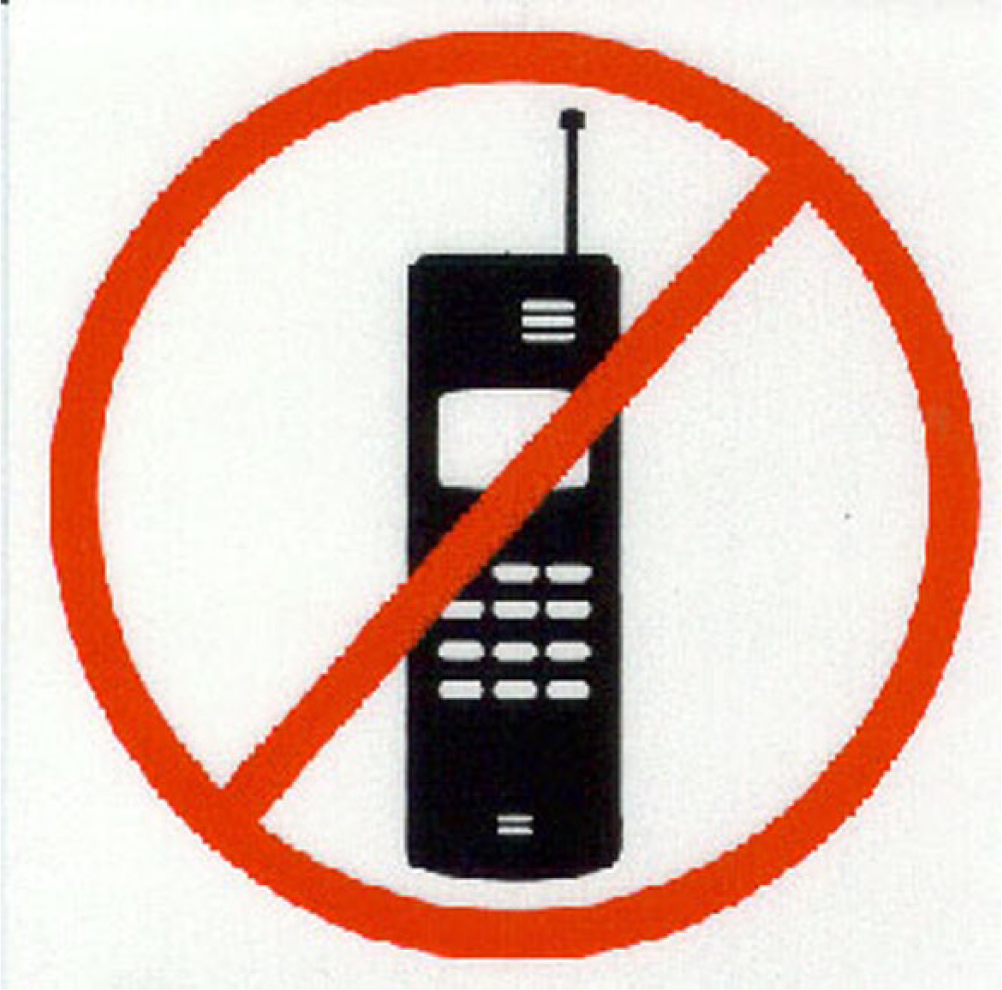
Cell-Phone-Free TAZ sticker.
Playing with this oppressive experience, I decided to create a temporary autonomous zone where cell phones would not be allowed. To delineate this, I designed a sticker to be worn on the body that would clearly state the nature of the zone, choosing the generic sign of a circle bearing a cell phone with a line through it, a near-universal signifier indicating that cell phones are banned in specific places.
I implemented the Cell-Phone-Free TAZ at an event at Hunter College in New York City and invited everyone attending to participate. If the people agreed, they were asked to not use their cell phone in any way. All participants were asked to display the sticker prominently to mark them as part of the zone. Whenever they decided to end their own TAZ, they could do so by simply removing the sticker.
Within a half hour of beginning the experiment, I had 30 participants eager to wear the stickers. The anti-cell-phone sticker also seemed to work very well as a way of delineating the TAZ. I speculate that this may be partly due to the fact that people are used to wearing political declarations on their body through T-shirt messages or buttons. In this way, the sticker served the same functions as traditional talismans worn for protection or good luck and seemed to manifest a psychological or spiritual change upon the person wearing it.
As one participant described: Personally, I was very surprised how I felt while wearing the sticker. I unconsciously disciplined myself with my use of the phone. I actually took [the sticker] off the two times I had to take two important phone calls from Italy. I also forgot to take it off later and somebody in the street asked me what it was. I explained and she really liked the idea … I think people are more sensitive to cell phone saturation than one thinks.
17
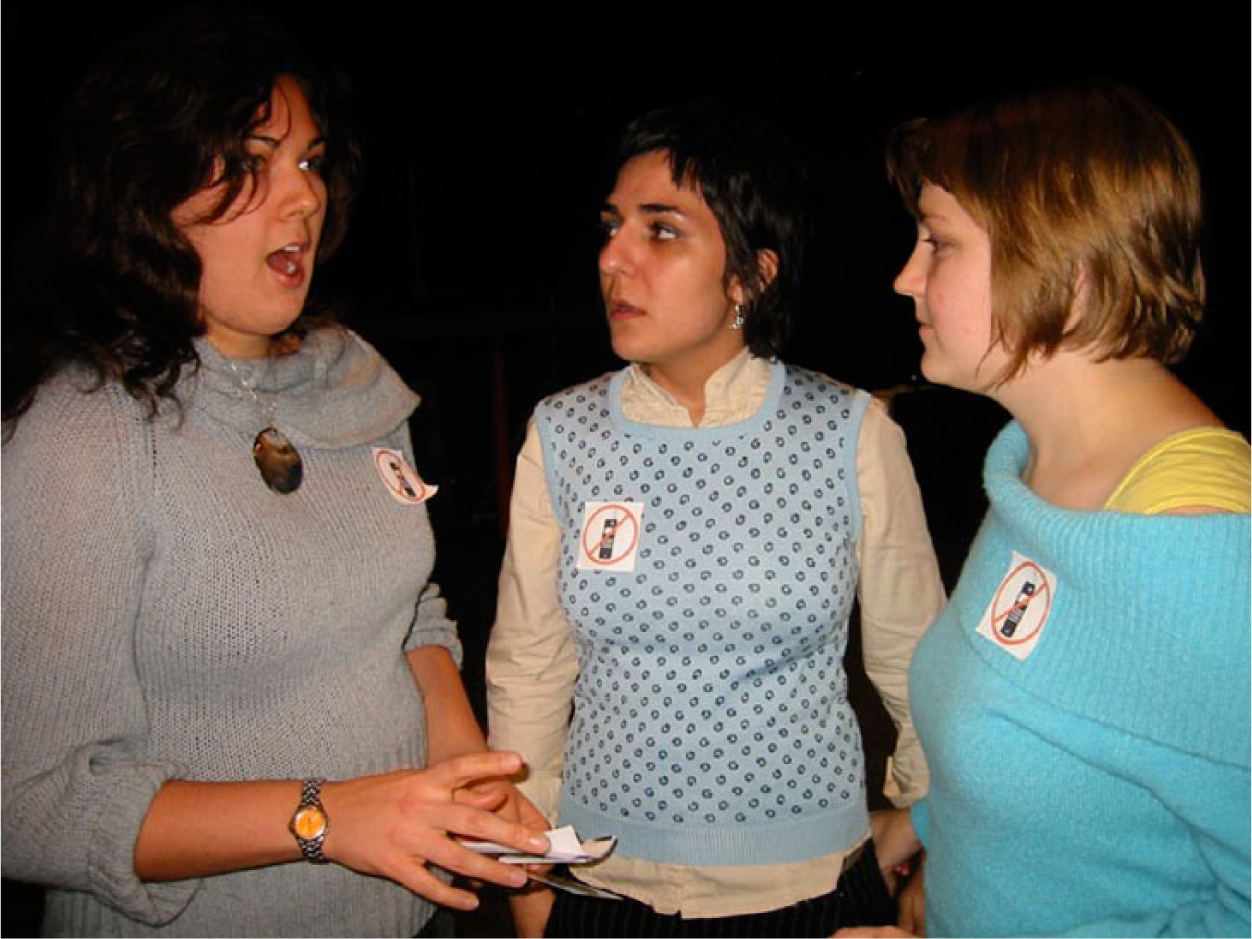
Cell-Phone-Free TAZ participants.
The sticker also successfully encouraged the TAZ because of its social control. Since the stickers were so visible, others would notice if someone broke the rules. In another instance, a participant used her cell phone only to be remonstrated by someone else. As the participant described afterwards, the dialogue spread the TAZ further: Unfortunately I had to find a friend, forgot about my zone, and texted someone. Just then another friend walked over and asked me why the heck I was doing that if I had a ‘no cell phone sticker’ on. So the discussion ensued, the phone was put away, the zone spread a little (sans stickers), and the people I spoke with about it loved the idea; about 2–3 turned their phones off voluntarily, even at the social event. It was as if no one had ever thought of putting their own social rules on the body so blatantly.
18
As these comments also reveal, the Cell-Phone-Free TAZ was enjoyable to the participants not only because of the sticker or dialogue, but because it was simply pleasurable to take a break from the heavy use of their cell phones. Finally, I should note that those people who use cell phones the most found the TAZ the most liberating. One participant who carried around two cell phones ended up placing a sticker permanently onto his work cell phone, perhaps to remind himself that there is an alternative.
As Bey remarked, temporary autonomous zones work because, by their very nature, they are temporary. We wouldn’t necessarily want to throw away our cell phones forever. But as this experience proves, the Cell-Phone-Free TAZ succeeded in Bey’s and the SI’s attempt to construct a moment or situation that liberates us, and that, even after it ends, continues to remind us that future liberation is also possible.
A Million Footprints
Take only photographs and leave only footprints.
Footprints document the ephemeral: our movement, up and down, telling one fundamental story: that humans had been there. The power of that symbol lies in this comfort (or danger), whether they were there a hundred years or just two minutes ago. Fascinated by this totem, I developed the project A Million Footprints, in which passers-by on the street trace and personalize the outline of their footprints, in order to document a collective mass of people in a public space through a physical representation of their presence.

Participant tracing his footprint for A Million Footprints prototype.
Given the ambitious nature of the project, which is to ultimately collect a million footprints on a large canvas for exhibition, I implemented a smaller-scale version one afternoon in the Park Slope neighborhood of Brooklyn, New York, soliciting participants randomly on the street. Using a length of brown paper rolled onto the sidewalk, and supplying markers, paints and colored pencils, I was able to obtain footprints from 12 passers-by. Based on their feedback and reactions, I observed that the project tapped into themes explored in Cell-Phone-Free TAZ: memorializing our bodies in public space, disrupting everyday life and encouraging collective participation.
First, the participants did seem to become more aware of their bodies as a result of the project. Decorating the outline of their foot immediately forced them to pay attention to their bodies in a way that they had not done so in years. Indeed, the ardor and time that several of the participants spent decorating their footprints spoke to both the excitement of expressing themselves creatively and honoring their mark on earth. This seemed evident when the participants used their cell phones to take pictures of their footprints and document the experience even further.
Second, the project inherently forced participants to disrupt the normal flow of everyday life and briefly disengage from the usual experience of walking in public space. Literally, they were asked to ‘step out’ of their own lives for a minute. This was evidenced by the fact that several participants spent 30 minutes or more decorating their footprints. Like the Cell-Phone-Free TAZ, they seemed to enjoy the literal break the practice offered them and the opportunity to do something different, much in the same way that we visit art in a gallery or museum to gain a new perspective.
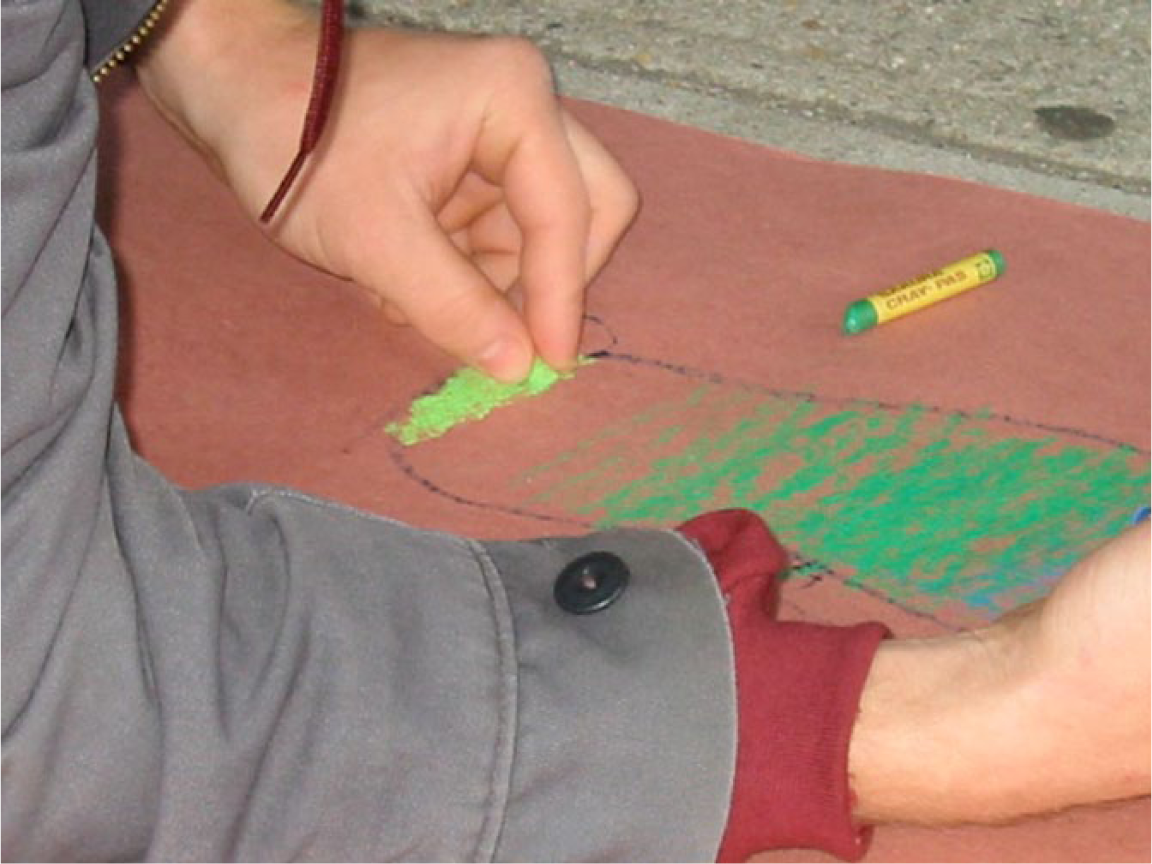
Participant in A Million Footprints prototype decorating his footprint outline.
Finally, the project encouraged community participation and a sense of collective creation. The participants, while at first focused on their own footprints, moved on to looking at the other ones on the canvas. They began talking to each other and in some cases, imitating or modifying other people’s decorative techniques. This change became apparent when the participants began to take pictures of the other footprints and the canvas as a whole.
In all of the ways I have described, the small-scale version of A Million Footprints generated the transformative experience I sought to create. Perhaps most importantly, this simple project created an experience that one participant described as ‘surprisingly fun’. 20 I look forward to implementing longer versions of this project, with the hope of building a larger canvas that memorializes both our individual and collective experience on the streets.
Hiking Trail
What are the dangers of the forest and prairie compared with the daily shocks and conflicts of civilizations?
For my third project Hiking Trail, I designed a series of hiking trail markers – similar to the spray-painted signs placed on trees in the forest to delineate a path – and posted them arbitrarily on lampposts around the Park Slope neighborhood of Brooklyn. These markers, colored in both red and blue, were set within visible distance of each other, forming two different trails that wound through the streets, ending at Prospect Park. At various points the trails intersected, which I indicated by using markers that featured both of the colored signs. Unlike Cell-Phone-Free TAZ or A Million Footprints, which engage our bodies directly with a symbol or sign to trigger a transformative moment, Hiking Trail used a familiar marker out of context to generate an altered walking experience. While I was unable to gain first-hand feedback in this first iteration, due to the intentionally anonymous nature of the project, I speculate that it works in several ways by triggering a sense of play, heightened awareness and cognitive dissonance.

Hiking Trail, Brooklyn. Posting red trail marker sticker on lamppost.
First, the project is designed as a game to pique people’s interests and entertain them. Following the trail of markers is exciting and puzzling, as people try to find the next one, wondering why they were put there and where they will lead to next. Generating this sense of discovery may help change our often banal, purpose-driven walks through the city into something far more playful.
Second, the design of Hiking Trail, following the SI’s derive, encourages people to pay more attention to their urban environment. As they walk, looking intently for the next marker, they are more likely to observe closely the landmarks, structures and other people on the streets, something that is usually ignored when rushing around the city.
Third, the project makes use of a détourned symbol – a nature trail sign placed out of context in the city – to trigger a cognitive dissonance that may lead us to question or contrast our experiences in these different places. Hiking trails are designed as a way to safely navigate through the dangers of the unknown woods. But in the city, a marker like this is logically meaningless since we know (usually) where we are going. This paradox will, I hope, jolt the participant into a greater awareness of the planned environment that we live in and take for granted. And, perhaps, help us briefly recapture the thrill of the unknown we feel when walking in the woods.
Ultimately, I hope that the experience of walking Hiking Trail will function similar to a labyrinth, where the act of following the twisty, coiled paths becomes more important than reaching the end of it. In this way, Hiking Trail incorporates the SI’s use of the détournement, derive and play to disrupt, question and effectively transform people’s experiences of walking in the city.
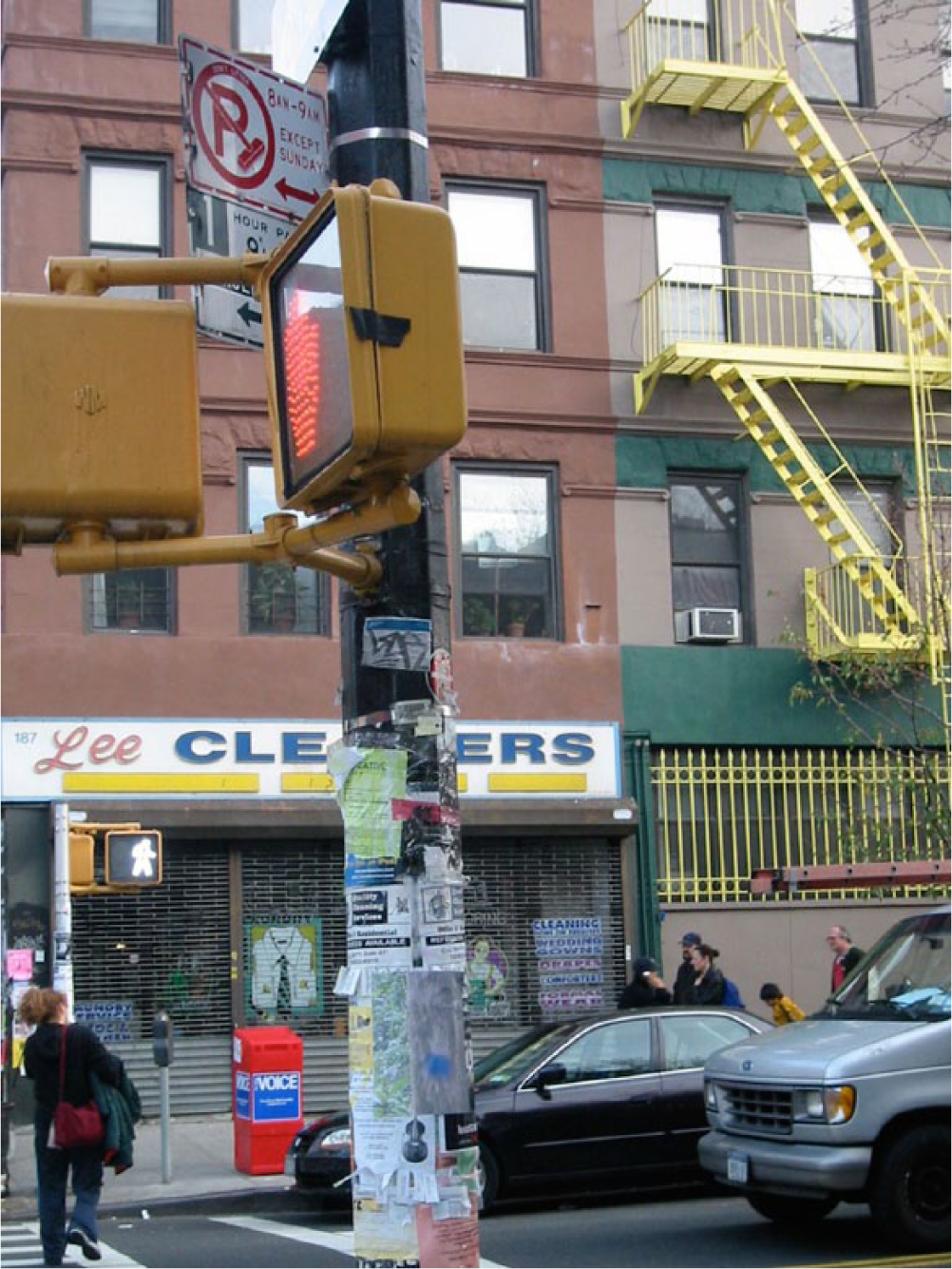
Blue trail marker sticker used in Hiking Trail.
Summary
In this paper, I describe the themes, goals and outcomes of three psychogeographic experiments that I created. Following the SI’s agenda to revolutionize everyday life, my experiments explored practices that might achieve momentary transformations. In addition to incorporating the SI’s strategies of dérive, détournement, chance and play, I also used signs, symbols and talismanic objects that physically and psychologically created an entryway into this transformative experience. In Cell-Phone-Free TAZ, a nod to Hakim Bey’s SI-inspired call for radical action, participants could freely choose to ban their own cell phone use temporarily by demarcating their bodies with an anti-cell-phone sticker. In A Million Footprints, the participants may created that symbol themselves by documenting their footprint to serve as a personal memorial and collective expression. Finally, Hiking Trailled people throughout the streets using a détourned sign – a hiking trail marker – to challenge the notion that walking needs to be goal-oriented, to encourage them to pay attention to their environment and to pose conceptual questions about walking practices in nature and the city.
These experiments are prototypes of larger public space projects I hope to develop in the future. In this initial survey I encourage any feedback, thoughts or suggestions that may aid in conceptually and logistically defining these projects further. The themes and goals I have set out here, as I have explained throughout, are firmly situated within a larger discourse of art, activism and the academy seeking to articulate and implement radical action on the streets of the world’s cities as well as our individual selves.
Footnotes
Funding
This research received no specific grant from any funding agency in the public, commercial, or not-for-profit sectors.