



Abstract
In a darkened room on Earth, an astronaut stands amongst a collection of moon rocks slowly and deliberately performing a maintenance task. With a grab stick in one hand and gas hose in another, he/she deploys the grab stick to pick up moon rocks spraying them, one by one, with the smell of the Moon. Titled Enter at Own Risk, this performance work is the creation of artist duo Hagen Betzwieser and Sue Corke who collaborate as WE COLONISED THE MOON. In this paper I consider the way in which the sense of smell has been deployed as an aesthetic object by this art duo and in so doing, unpack the qualities of smell that have traditionally made this a problematic sense with regards to its deployment within the space of the art gallery. These are spatial and temporal qualities that have been utilized by Betzwieser and Corke not only in the design of the installation space at Liverpool’s Foundation for Art and Creative Technology but also through the bringing together of maintenance practice and smell – the durational and the ephemeral – which has implications beyond the gallery space, imbuing the work with its critical edge.
Prelude
In a darkened room on Earth, an astronaut bedecked in a weathered Apollo suit sits on a stool nursing a grab stick in his/her lap. Positioned at the edge of a circle composed of fake moon rocks that adorn a darkened floor, the astronaut stands slowly and steps forward into the middle of the circle. Releasing one end of the grab stick from his/her left hand the astronaut moves to pick up a hose connected to a plastic container that rests in the middle of the stone circle. With grab stick in the right hand and spray hose in the left, the astronaut maneuvers the grab stick to slowly and deliberately pick up moon rocks spraying them, one by one, with the smell of the Moon 1 (see Figure 1).
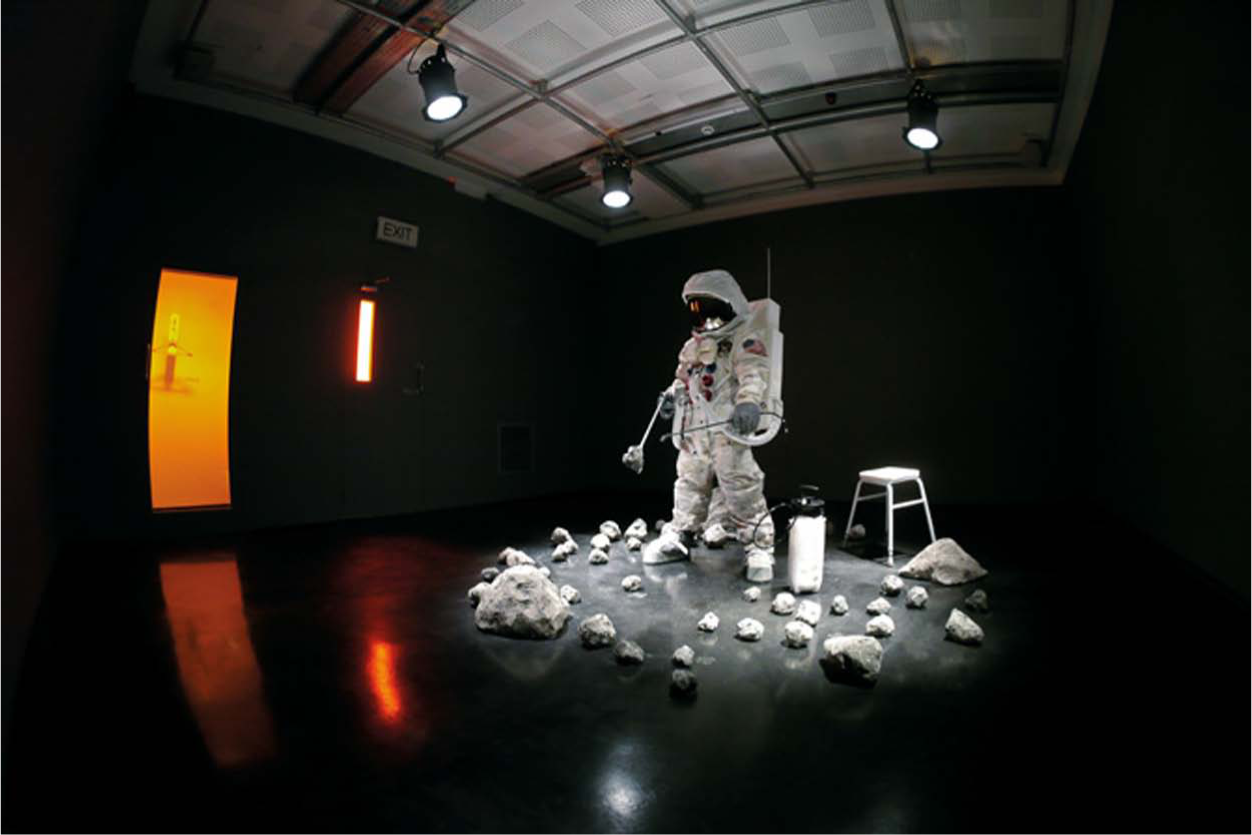
Enter at Own Risk, 2012, WE COLONISED THE MOON. Image taken at the Foundation for Art and Creative Technology (FACT), Liverpool.
Introduction
Enter at Own Risk is a performative installation, which brings Apollo Iconography together with anecdotal comments on the sensory experience of smell in the encounter with moon dust. The work of artist duo Sue Corke and Hagen Betzwieser, otherwise known as WE COLONISED THE MOON (hence forth WCTM), Enter at Own Risk situates the sense of smell as an aesthetic object positioned within the spatiality of an art gallery, namely Liverpool’s Foundation for Art and Creative Technology (hence forth FACT). As such Enter at Own Risk is one of a growing number of contemporary artworks that challenge the traditional demarcation of olfaction in aesthetic understanding.
Smell has usually been designated as a lower capacity in the sensory order, insufficiently analytic to provide for aesthetic enjoyment. In the 19th century, Hegel, for example, argued that ‘art is related only to the two theoretical senses of sight and hearing, while smell, taste and touch remain excluded from the enjoyment of art.
2
Promoting vision and hearing to the realm of cognition and reason whilst denigrating the other senses as those around which base desires hinged, aesthetics in the 18th and 19th century pivoted upon a sensory hierarchy. As Paterson
3
recognizes, however, Herder
4
argued for the inclusion of touch within this reductive aesthetic collective, denoting its import in relation to vision as ‘touch [is a] necessary [sense] in revealing the form of things rather than mere appearance’.
5
While the sense of touch has, then, received attention as a sense through which for example, painting and sculpture can be appropriated,
6
highlighting the aesthetic role this sense plays, the other two senses – smell and taste – have remained on the outskirts of aesthetic inquiry. Indeed for, Classen’s:
smell is usually associated with instincts and emotions rather than with reason or spirituality. With few exceptions, taste and smells have been discredited and removed from the arena of intellectual discourse, and, in many cases, from cultural life in general.
7
As Drobnick and Fisher highlight, however, the ‘visual arts have always been multi-sensory, both in production and reception’ 8 as artists are affected by the worlds they encounter through their bodies both within and without the art studio.
In recent years, however, a number of artists such as WCTM have sought to deploy smells and scents as part and parcel of an art works aesthetics. In this paper I aim to consider the sense of smell, as it has been deployed as an aesthetic object by this art duo and, in so doing, unpack the characteristics that make this a problematic sense with regards to the space of the art gallery. That is, as Brady 9 and others point out, this is a sense that on the one hand is not easily ‘bounded’, whilst on the other, unlike a painting, a moving image/film or a musical performance, the sense of smell is transitory and as such, it cannot be revisited. These are spatial and temporal qualities that have been utilized by artist duo WCTM to produce the immersive, performance installation Enter at Own Risk, one of an increasing number of contemporary art works that draw on olfaction, in this case, to play with and tie together maintenance practice and smell; the repetitive and the fleeting, the durational and the ephemeral. In so doing, these artists have worked to produce an olfactory geography that for Rodaway relates to the manner in which, this sense has the capacity to create ‘a kind of structuring of space and defining of space’. 10 While scholars have noted a recent rise in olfactory artworks, 11 little attention has been given to how such odorous works play with the space of the gallery; a point to which this paper attends.
Before moving on to consider the exhibition at FACT, I first consider the smell of the Moon itself, a phenomenon that emerges from an elemental convergence anecdotally recorded by Apollo astronauts. The paper then turns to consider the making of the scent used in Enter at Own Risk, which positions this as an art and science project where expert practice and knowledge is recognized. With the olfactory context laid bare, I then turn to think through Enter at Own Risk and the way in which it plays with the qualities of smell, qualities that give the work its critical edge. First, however, I consider the place of smell within and beyond geographic enquiry.
Olfactory art
Working in geography in 1985 with the aim of denoting smell as a non-visual aspect of embodied experience in environmental immersion, Porteous 12 sought to consider ‘landscapes of smell’ as an object of analysis, for which he deployed the term ‘smellscape’. Making a claim for this terminology he drew on the word ‘smell’ as he felt this was a term synonymous with both negative (e.g. stink), positive (e.g. fragrance) and neutral (e.g. odour) connotations. Rodaway, however, disagreed with this focus for he found term ‘smell’ was too often overloaded with negative connotations and so, instead, he chose to work with the word ‘olfactory’. This is, he explains, because olfaction is a precise and technical term that alludes to both the action of smelling as well as the object of a smell. Given this dual emphasis, Rodaway argued for what he described as an Olfactory Geography, which ‘would be interested in the role of smell in geographical experience, such as [in the] organization of space, spatial relationships, locatedness, orientation in space, and characterization or senses of place’. 13
As yet, however, Olfactory Geographies have received little attention within the discipline. Prior to Rodaway’s contribution only a handful of geographers have given time to this sense, such as, for example, Tuan, who considered smell from a humanist perspective. 14 Elsewhere, Bunge and Bordessa also briefly turned to smell in discussion of a Toronto Neighbourhood, 15 while Rapoport was interested in environmental smells and their import across cultures and age groups. 16 More recently, Law, for example, has considered the sense of smell in conjunction with the other external senses, as part of the creative act of cooking food as a means to emulate a sense of ‘home’ for Filipino migrants in Hong Kong, 17 while Brady has also turned to food to consider the everyday aesthetics of smell and taste together. 18 In recent years, geographers have also considered smell as media for a potential ‘scented cartography’, 19 and aligned its potential as a source of interest for geographers with affect, 20 whilst developments in new media have raised questions around the possibility for scents to emanate from the internet. 21 Smell has also formed an object of analysis in consideration of the spatialities and embodied politics of smoking in the city, 22 been used as a point of comparison between post and pre-socialist Poland, 23 and has been considered as the sense of interest in a historical project that examines the duality of the perfumed mountaineer, Walter Poucher. 24 Across these studies geographical investigations into the sense smell have, then, emerged in cultural, social and historical contexts but, to date, none have considered this sense in the space of the art gallery.
Outside of geography, however, olfactory art is a burgeoning area of practice. While Verbeek and van Campen 25 note that multi-sensory exhibitions have been around for a while, such as the 1938 International Surrealist Exhibition in Paris, there is an increasing focus upon olfaction in contemporary art practice. For example, Krischnaraj Chouat has deployed smell in concert with vision for the exhibition My Hands Smell of You, 26 while Robert Blackson curated an exhibition as well as a sniff and scratch book, 27 solely composed of ‘extinct and impossible’ scents. 28 Works like these, which take smell as artistic medium, are receiving growing attention from scholars reflecting this increase in art works foregrounding odours. For example, recognizing the denigration of this sense within aesthetic philosophy, Harris 29 has worked to position food and drink, sources of taste and smell as art, while Banes, 30 honing in on olfactory performance, contends that smell has, in the past, been a medium for theatrical representations and as such, she contends, it has the potential to be used in this context again. Also keen to dissolve the sensory hierarchy, Shinner and Kriskovets 31 note that while touch and gustory taste have been given aesthetic consideration, theoretical concerns with the sense of smell in art has largely been ignored. Working to fill this void, Shinner and Kriskovets 32 look first to multi-media, instillation and performance art where smell inter-mixes with other sensory mediums, before turning to consider perfume – a scent itself – as a work of art. While Shinner and Kriskovets highlight the potential of olfactory art they also note its challenges, which are recognized as practical concerns such as spatial design and documentation, as well as a need for artists to undertake chemical training to work with aromatic substances.
Within geography the aesthetics of art practice has been considered by Hawkins, whose interest in the ‘argument of the eye’ is one that aims to unpack the manner in which art ‘is both corporeal and conceptual, embodied, but also embedded in history and culture’. 33 Arguing that art is ‘not solely [an] intellectual act’, 34 Hawkins acknowledges that ‘[a]rt’s expanding field of practices has extended the long-standing role of art as a “lab” for sensory exploration, with the picture, the gallery and the installation all forming spaces in which the body and its senses have been made present for study’. 35 Building onto this work, Hawkins and Straughan 36 have sought to draw out the immersive, embodied qualities of art creations in relation to Midas, an art installation that highlighted the mechanisms of touch as it works with hearing at the level of the Nano; a project that draws out the way in which a body can become sensuously immersed in the space of the art gallery.
As Hawkins and Straughan explain, Midas was a fusion of art and science mirroring Enter at Own Risk in kind as one of a growing number of art works bridging the fields of art and science for creative affect and critical discussion. This is an area of work that has received attention by Dixon in consideration of bioart through the Tissue Culture and Art Project who use the semi-living as their medium of expression. Dixon argues that these works not only speak to the notion of the monstrous, producing a ‘political character of [the] biotechnological turn’, 37 they also provide a staging post to consider the politics of the aesthetic. 38 Elsewhere, Gabrys and Yusoff have also looked at art and science together, to consider their potential for re-thinking issues around climate change. 39 Looking to Enter at Own Risk, this paper considers the manner in which art and science have been brought together to produce an olfactory, performative installation, which demands sensitivity to spatiality and temporality. First, however, what lunar materials are reaching the olfactory nerve of astronauts, and what do they smell like?
Enter at Own Risk: the smell of the Moon
As outlined in the Prelude, during the performance of Enter at Own Risk an astronaut deposits the smell of moon dust on rocks arranged in a circular fashion, an act that resonates with Porteous’ recognition that, ‘smells are not randomly distributed, but are located with reference to source, air currents, and direction and distance form source’ 40 (see figures 2 and 3). This is an understanding echoed by Tuan as he tells us ‘compared with adults, children live in a more odoriferous environment, both because habit has not yet blunted their sense of smell and because children live closer to the earth – to the flowers and grass, the moist soil and the sun-baked pavement – from which most odours emanate’. 41 Tuan provides a number of smelly sources here that are reliant on the element of air for their dissipation from flower to nose, soil to cilia and pavement to olfactory nerve, for air ‘penetrates our bodies, ears, mouths, noses and throat and lungs, envelopes our skin: it is the medium for everything that reaches our senses’. 42
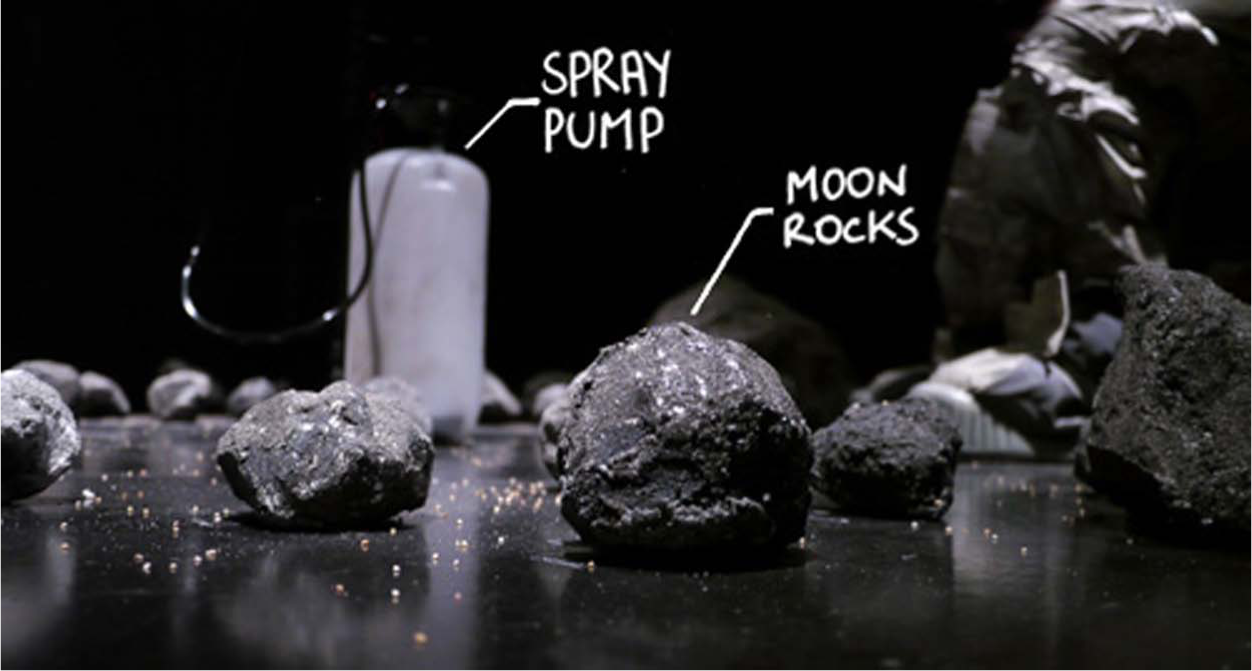
Enter at Own Risk, 2012, WE COLONISED THE MOON. Image taken at the Foundation for Art and Creative Technology (FACT), Liverpool.
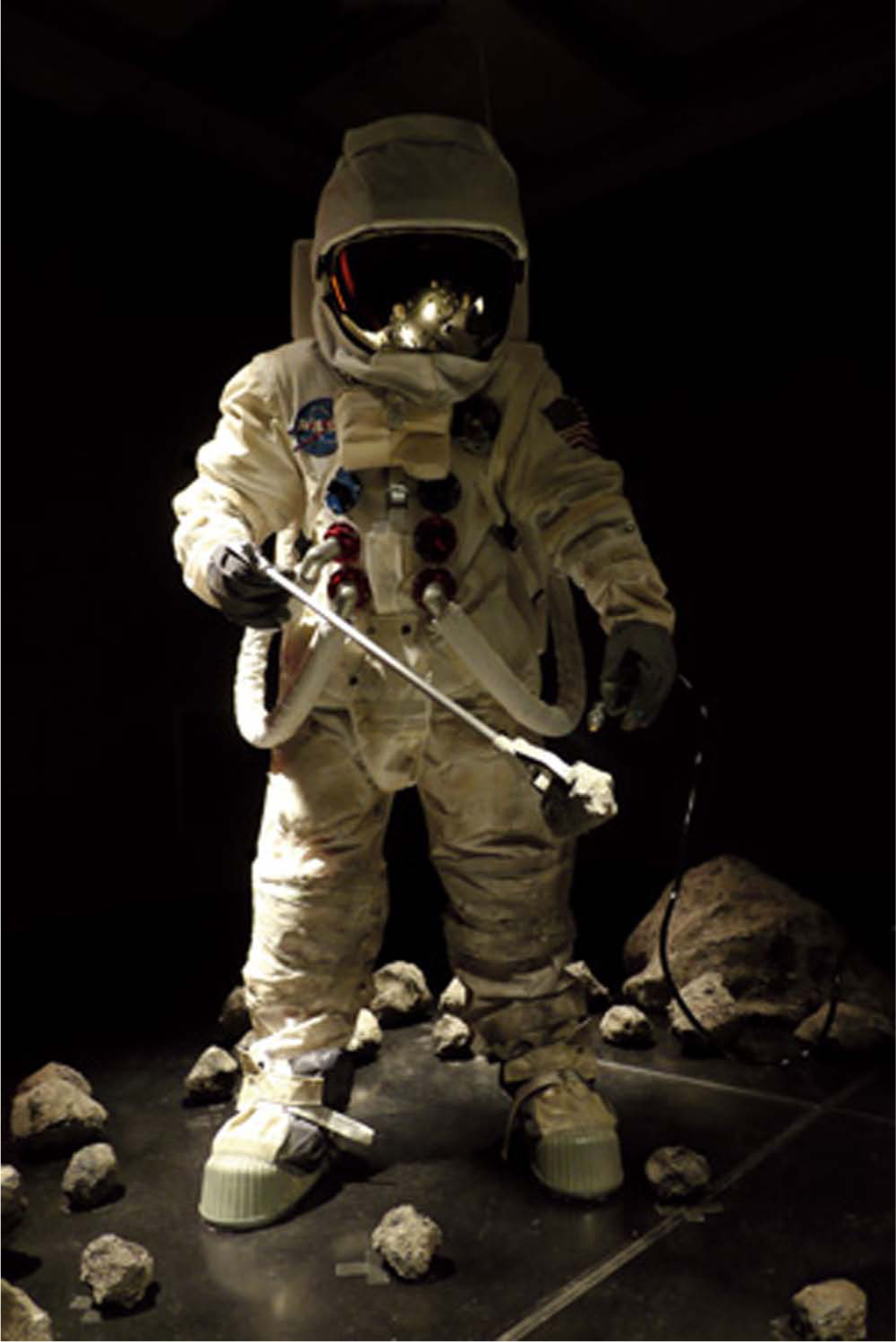
Enter at Own Risk, 2012, WE COLONISED THE MOON. Image taken at the Foundation for Art and Creative Technology (FACT), Liverpool.
On the Moon such enveloping is problematic due firstly to the suits astronauts wear, encasing them from the lunar environment, and second by the lack of atmosphere, creating a physical and chemical distance between the body and nose of the astronaut and the Moon dust from which a lunar odour is emitted. Drawing from her research into this phenomenon, artist Sue Corke gives the following explanation:
The moon itself is covered with this gritty tacky dust and this is the result of the moon not having an atmosphere like we do here on earth so it’s under constant bombardment from meteors. And there is a lot of dust, very gritty, very tacky, with lots of loose molecules, and these molecules that would on earth be responsible for transmitting smell, have never had the opportunity [pause] they have never been exposed to oxygen or moisture which is required for the molecules to travel through the air and into your nostrils . . . and into your brain to give you a very direct sensory experience. So what is happening when the astronauts get back into the landing module is this reaction happens for the very first time so it’s extremely short lived, extremely um I would consider the word loud but that’s not right. Volatile and excitable and over very quickly. (pers. comm. FACT interview)
As such, while the sense of smell may provide ‘a direct means to sample the environment by inhaling the chemical compositions of its objects’,
43
this is not possible on the surface of the Moon. As such, Corke comments that:
They [astronauts] only get the smell experience when they get back into the LEM [Lunar Exploration Module] and take off their suits and the clingy gritty dust starts to react with the oxygen and moisture in the atmosphere of the LEM and they smell this volatile rapid fire chemical reaction very briefly. (pers. comm. 08/11/2012)
NASA scientist Dr Tony Philips elaborates:
Every Apollo astronaut did it. They couldn’t touch their noses to the lunar surface. But, after every moonwalk (or ‘EVA’), they would tramp the stuff back inside the lander. Moon dust was incredibly clingy, sticking to boots, gloves and other exposed surfaces. No matter how hard they tried to brush their suits before re-entering the cabin, some dust (and sometimes a lot of dust) made its way inside.
44
These comments suggest that the smell of the Moon, as it has been experienced and is currently understood, has a very particular spatiality, confined to the liminal space of the LEM or lander. Furthermore, as Philips’ recourse to touch here suggests, the sense of smell is a proximate sense. 45 That is, olfaction is an intimate process, for as Porteous 46 informs us, smell is understood to be a chemical sense in that it relies on vaporized odour molecules carried in the air, to come into contact with and dissolve into the mucus on the roof of nostrils, before they are then detected by the olfactory receptor neurons that lie beneath. The smell of the Moon, then, emerges as an element convergence, a clashing and mingling of moon dust and water at the level of the molecular, creating a chemical reaction, which occurs in the atmosphere of the liminal space of the LEM.
The import of such a convergence in the instigation of a rock or dust scent is not tied to the Moon, for back on Earth it is understood that while ‘[m]ost rocks do not possess an odour’ 47 the sense of ‘[s]mell is used to detect certain chemical components in minerals and rocks’ 48 with the assistance of an event or catalyst. For example, Kiel comments that a carbonate under examination ‘exude[d] a strong petroliferous odour when struck with a hammer’ 49 while Genth, engaged in the process of identifying amorphous ores, repeatedly states that they have a ‘strong argillaceous odour when breathed upon’. 50 This was a process of smell detection echoed by De Vito, who comments that ‘most sedimentary rocks will give off an earthy odour when one blows one’s breath directly on the sedimentary rock and then immediately inhales’. 51 Meanwhile, Alden explains that ‘arsenic-containing minerals give off a garlicky odour when burned’, 52 adding another element to the process of olfaction in production of geological odours. These examples demonstrate that, within an atmosphere, an elemental convergence is required to induce the smell of rock, situating it as an ephemeral phenomenon.
What is described as the smell of the Moon by astronauts has been anecdotally linked to a few odour sources encountered on Earth. Within our interview, however, WCTM were not going to hand this fragrance to me on a plate, my nose had to be put to work:
. . . Its a really strong smell, I don’t know, did you smell it?
No I haven’t seen [pause] I’ve only seen your stuff online.
We have a small bottle in here [he gets up and walks to the corner of the room picks up a small jar and brings it back to me at the table]
. . . he had been, with NASA, he had been asked by NASA to work on a project to do with astronaut training . . . [Sue continues to talk about how she and Hagen first got in touch with Steve Pearce the perfumer/flavourist]
. . . [Meanwhile I have picked up the bottle and take the lid off to smell it with the others watching me]
[I have a sniff] Its fascinating [Hagen and Sue chuckle] I’m trying to figure out what it smells like. For some reason, I don’t know what to say.
Is it a familiar smell?
I almost feel there is a hint of bacon or something?
Yeah, yeah, a couple of astronauts have said BBQ, burnt steak.
Space is very connected to the smell of bacon and welding.
(Interview transcript 08/11/2012)
Here I engaged in a process of recollection, dredging through a series of known smells in order to ‘place’ the odour in the jar. My search for a description was not instantaneous; it took time to emerge, resonating with Press and Minta’s statement that ‘olfactory cognition can proceed without instantaneous linguistic representation’. 53 For Rodaway this process is hindered due to smell labels being ‘mixed [in] type (effect, character, specific) and arbitrary, leading to smell classifications that have weak typologies in comparison with those of light and sound’. 54 Classen et al., however, indicate that the elusiveness of smell is optimized in descriptive responses that commence with ‘it smells like . . .’, suggesting we are ‘groping to express our olfactory experiences by means of metaphors’. 55
My struggle to verbally ‘place’ the smell of moon dust was a process involving what has been termed ‘[s]emantic memory which attaches meaning and phenomena to objects’
56
and, as such, as Porteous suggests, [o]lfactory memory . . . is a very personal matter’
57
that depends upon a person’s experience base and frame of reference. Rather than consider the smell of bacon, Apollo astronauts noted the following with regards to the smell of moon dust:
Apollo 16 pilot: It is really a strong smell . . . It has that taste – to me, [of] gunpowder – and the smell of gunpowder, too. Apollo 17 astronaut: smells like someone just fired a carbine in here. It smells like spent gunpowder.
58
Such responses resonate with Classen et al.’s observation that ‘[t]he perception of smell . . . consists not only of the sensation of the odours themselves, but of the experiences and emotions associated with them’. 59 Indeed, as Philips comments, astronaut Jack Schmitt noted, ‘[a]ll of the Apollo astronauts were used to handling guns. So when they said, “moon dust smells like burnt gunpowder” they knew what they were talking about’, 60 demonstrating that ‘odours are essentially cues in social bonding’. 61 As Betzwieser comments, this meant that given the astronauts ‘were all military trained personnel . . . at that time, coming from jet fighting and military career’s . . . this would have been their frame of reference’ (pers. comm. 08/11/2012).
Furthermore, as Philips acknowledges, there is, to date, no means to verify this scent as:
Curiously, back on Earth, moon dust has no smell. There are hundreds of pounds of moon dust at the Lunar Sample Lab in Houston. There, Lofgren has held dusty moon rocks with his own hands. He’s sniffed the rocks, sniffed the air, sniffed his hands. ‘It does not smell like gunpowder’, he says.
Philip’s acknowledgment that there has been no verification of the moons smell outside of the LEM renders this a somewhat fantastical odour, which, for Betzwieser, meant ‘it lent itself beautifully to us as an artistic concept and project because there was this fairy tale narrative to it’ (pers. comm. 08/11/2012). Such a fairytale narrative, however, brought with it challenges tied to the production of a creative, sensory response to the moons smells, a challenge that required technical expertise.
Enter at Own Risk: fantasy smell
Enter at Own Risk was produced as a performative installation commissioned, in part, by the Arts Catalyst, for an exhibition titled Republic of the Moon, shown at Liverpool’s FACT in 2012. As a commissioning organization Arts Catalyst is ‘distinguished by ambitious art commissions and its unique take on Art-science practice’,
62
a take which director Nicola Triscott describes as one that:
. . . is not purely pedagogical or illustrative, [rather] its allegorical, its metaphorical, its philosophical, its critical and experimental, its collaborative, engaged, evocative and playful. (field recording 04/12/12)
Within this remit, art and science is observed by the Arts Catalyst to be a diverse field, which for Triscott signals an understanding of art ‘that is made in our age of advanced science and technology’ (pers. comm. 04/12/12). Meanwhile, for Rob Le Frenais, Curator of the Arts Catalyst since 1997 and the individual responsible for curating Republic of the Moon, an interest in art and science can also revolve around the ‘notion of the DIY sort of science’ (pers. comm. 19/11/12) in art practice, a curiosity that drew him to the work of WCTM. Here, artist Betzwieser’s strong interest in astronomy has, since childhood, seen him engage in DIY science, separate to, as well as part of his art practice.
As Triscott makes clear, however, it is important to acknowledge that art and science ‘have fundamentally different methodologies and modes of enquiry otherwise, what would be the point of bringing them together’ (pers. comm. 11/03/2013). Given this recognition, she argues ‘its really important to respect the different disciplines and the expertise and the professionalism and that cuts both ways’ (pers. comm. 11/03/2013). While WCTM deploy the use of DIY science within their art practice the duo also recognize such arguments, a recognition epitomized in their dealing with the smell of the Moon and its creation for Enter at Own Risk. That is, for this element of the work the duo recruited the skill set and knowledge base of Steve Pearce, Managing Director of Omega Ingredients Ltd, a company that ‘specialises in the innovative fusion of biochemistry with natural materials, to provide you with the very best quality flavours, fragrances and ingredients’. 63
A brief look at the history of perfumery suggests the development and production of flavours and fragrances has taken and still takes work. As Kauffman recognizes, ‘the use of fragranced materials for all kinds of purposes goes back thousands of years’,
64
such that methods and techniques for the synthesis of smells have developed slowly across time and in various places, from the perfumers of Egypt to the guild of glove and perfumery of 17th century France. It was not until the development of synthetic organic chemistry in the last century, however, that perfumes and scents became accessible as part of everyday products such as soaps and cleaning products as well as perfume. Methodologies and modes of enquiry involved in the process of synthetic organic chemistry challenge the traditional demarcation of smell as a lower sensory pleasure tied to the body sitting in opposition to the mind and intellect. Indeed, for Pearce, his work is an aesthetic practice:
For those of us who work in this end of the industry working with these aroma materials, we do talk about it being a creative art, we do talk about it as being something that, you know, takes many years of practice and experience to learn about how these materials work together, how they can be used in combination, so for us it is a unique combination of science and art to re-create these flavours and these aromas in this way. (pers. comm. 21/05/2013)
As Kauffman describes, ‘the components [of a fragrance or flavour] must work together to form a balanced overall composition’
65
requiring perfumers and/or flavourists to work as composers of smell, a mode of working to which Pearce eludes:
If we’re talking about fragrances particularly, we talk about building it in layers so you’ll talk about base notes, middle notes, top notes and then getting the whole thing to work together, that’s really the critical aspect. (pers. comm. 21/05/2013)
‘Accords’, with their ‘top’ ‘middle’ and ‘base’ notes and tones, form the terminology used to describe the character of an odour, words which nod towards the complexity of scents and perfumes composed by individuals that have undergone years of extensive training, experimentation and study. Shinner and Kriskovets
66
demonstrate that Pearce is not alone in his suggestion that the making of a scent is itself an art form. They note many perfumers argue the composition of a perfume or fragrance requires a combination of both imagination and intellect, placing this as ‘art proper’, while Thrift similarly suggests perfumers ‘are perhaps best described as artists of smell’.
67
These acknowledgments resonate with Pearce’s comments on working with fragrances as, he explains, they ‘tend to be much more creative and fantasy orientated than flavours’ (pers. comm. 21/05/2013) as, with fragrances, there is no frame of reference from which to draw. Describing the process of producing the smell of the Moon, Pearce eludes to this creative element inherent within his profession:
Unusually we managed to get it right first time, it doesn’t always work, there is often a lot of toing and froing but in this particular case I think that was pretty much it, was the first presentation to them their reaction was wow, that’s, that’s pretty much how we reckoned it would be so we were lucky with them if you like, that er we managed to get it right pretty quickly and straightforwardly. It’s not always like that. Often the customer will come back and ask for things to be tweaked, but I think there was an element in this that they maybe appreciated the artistic element of what we were doing and they basically took what I’d done gone wow, if your saying that’s what it’s like then we’ll take your word for it because we haven’t got any better ideas of telling you to go away and make it smell more like cucumbers or cheese or something. (pers. comm. 21/05/2013)
Here Pearce describes what he perceives to be sensitivity on the part of WCTM to his skill set and expertise in regard to creating a scent such as the smell of the Moon, a sensitivity they confirm:
[W]e had to trust him with the chemistry of course. We talked with him in detail about the experiences of the astronauts and we formed a final agreement when we all felt the smell was ‘right’. (email 03/09/2013)
While Shinner and Kriskovets 68 suggest that fragrances and perfumes might themselves be considered ‘art proper’, it is important to note the different expertise and creativity of perfumer and artists such as WCTM. For, the realization of the smell of the Moon’s presentation to gallery audiences at FACT required sensitivity to the spatiality and temporality of smell as well as a conceptual response to the same.
Enter at Own Risk: space maintenance
The smell of the Moon represents just one aspect of the installation Enter at Own Risk, for the use of scent also had an affect upon the art works spatiality. That is, WCTM worked with and utilized smells transitory and boundless qualities whilst simultaneously using the practice of maintenance to manipulate its ephemerality and give it duration. Before looking to the works temporality, however, I want to consider its spatiality, which was orchestrated to play with relations of scent exposure by mirroring the liminal space of the LEM.
As previously intimated, memory and association are central in attempting to verbally describe odours. This is because, Porteous tells us, ‘[f]ew smell preferences are innate; most are learned . . . stressing the importance of cultural adaptation and insideness’ 69 in the register of known smells. As a result, smells are often polarized between those that are familiar or unfamiliar, considered pleasant or unpleasant, placing the subject as either an insider or outsider. 70 The means by which the perceived intensity of smell declines as the result of prolonged exposure, therefore denoting registered smells as familiar, is psychologists explain, due to two processes. These are adaptation and habituation, both of which occur at the same time with similar same effect but for different reasons. That is, the former is caused by ‘fatigue receptors’ while that latter results from ‘an adjustment to an odour based on an unconscious judgement’. 71 This means that ‘[o]dorous descriptions are the work of outsiders’ 72 because they have as yet not adapted or been habituated to the smell of a particular place. The distinctiveness of the smell encountered by the Apollo astronauts in the LEM, then, is given its potency and power, making it worthy of sensuous registration through its status as ‘different’. It is a smell that simultaneously sits outside of the astronauts’ cultural registers, a smell ‘out of place’ in the bounded, functional space of the LEM. This and the transience of moon dust odour provide the scent with its potency, for its ephemerality disables both processes of adaptation and habituation.
Encountering the elemental convergence that instigates the smell of the Moon in the LEM, then, produces an odour that is the ‘exception rather than the rule’,
73
enabling the sensory register of this chemical reaction. This was an ‘exception’ reproduced by Corke and Betzwieser through the spatiality of Enter at Own Risk. Corke explains:
[Y]ou pass through an air lock and it’s easy to miss the door in the first instance because, it really forms part of the fabric of the building, it’s completely disguised, it’s like an anonymous door. You open the door and you are immediately told you are in an air lock, there is a rubber mat on the floor, so you feel you are in a different space, there is an orange light, fan grill from an air vent and you are warned . . . ‘you may enter at your own risk, there’s a strong smell its harmless but it may linger on your clothing’. If you accept, the challenge, then you can step beyond the second door into a dimly lit room in which there is an arrangement like a sort of Japanese garden of moon rocks. And if you walk around you’ll see, on the days where the performer is not being an astronaut, the storage cupboard where the Apollo suit is displayed. And the tools of the astronaut are left out because astronauts are working people. This is a routine maintenance task that they are involved in, they are merely on a break and er, you can look at the tools of the trade you can smell the moon rocks, you can see the genuine fake moon rocks that they have, and er, on the weekend when the astronaut is present then you will see space maintenance in action. (See figures 4 and 5.) (pers. comm., FACT interview)
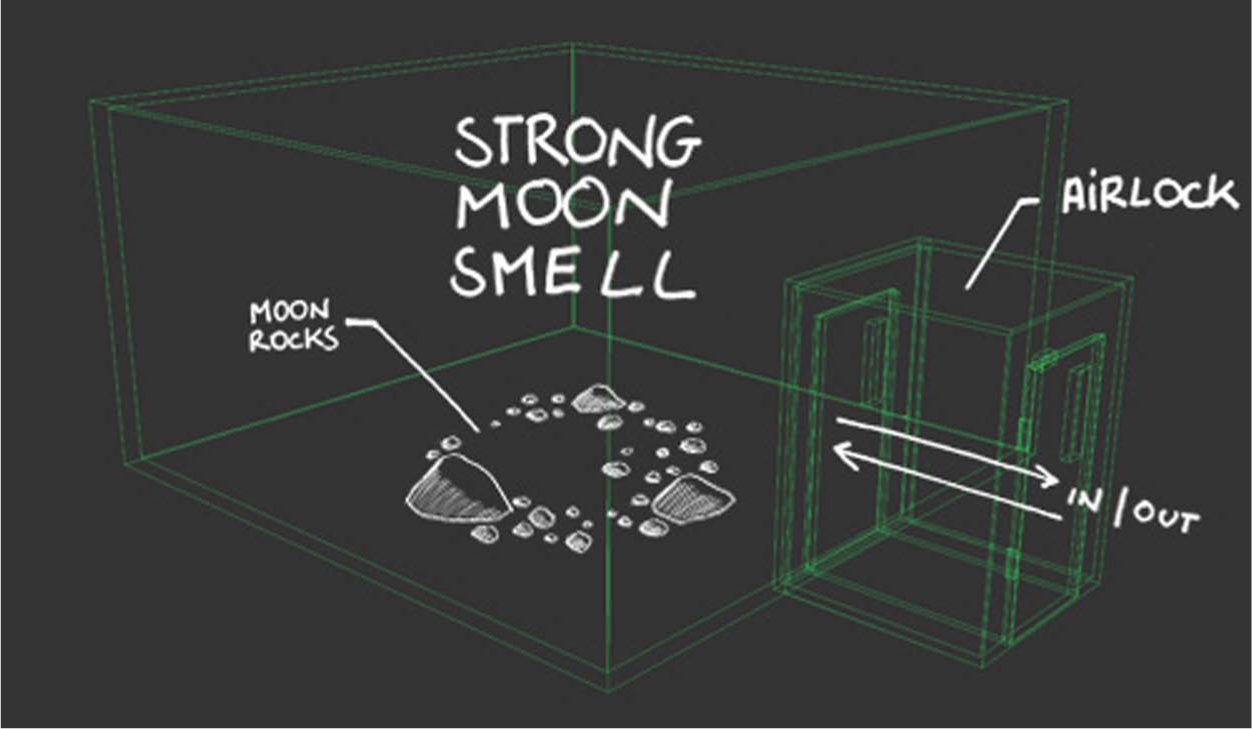
WE COLONISED THE MOON, Enter at Own Risk 2012. Diagram for Installation at Foundation for Art and Creative Technology (FACT), Liverpool
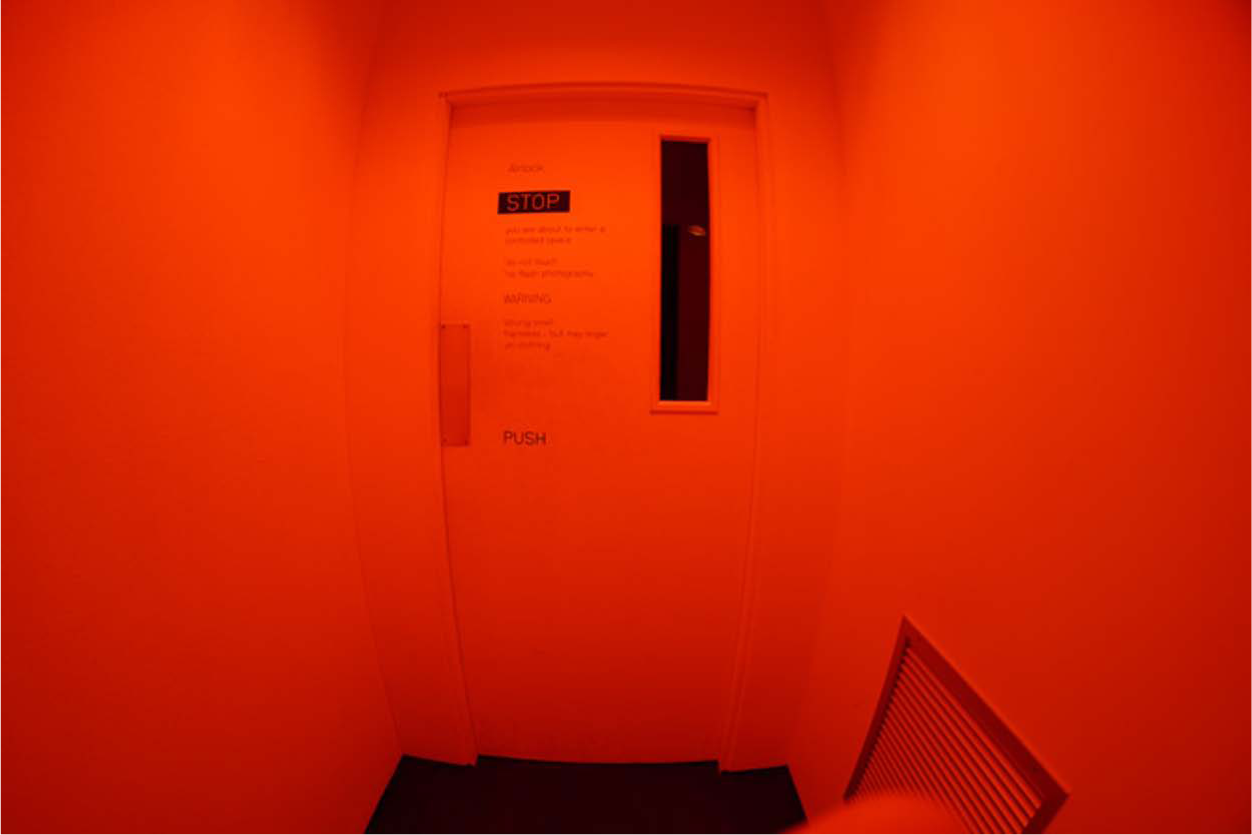
Enter at Own Risk, 2012, WE COLONISED THE MOON. Air Lock. Image taken at the Foundation for Art and Creative Technology (FACT), Liverpool.
Working with the spatiality of the gallery at Liverpool’s FACT, Enter at own Risk mimics and plays with the structure of a space craft, recreating an interior accessed only by a passage that forms another space on the margins. This liminal space leads visitors from exterior to interior and vice versa, emphasizing relations of insider and outsider, which are important in the registration of an odour. 74 As such, WCTM produces a spatiality, that acknowledges ‘smells . . . are not so easily “bounded”’ 75 as ‘odours cannot be readily contained, they escape and cross boundaries, blending different entities into olfactory wholes’, 76 positioning this as an unruly sense. 77 Indeed, the incorporation of a marginal space into the work not only stands as a reference to the space of the LEM, which separates interior space craft from lunar environment, it also sets a divide between the more everyday habituated smells encountered in the rest of the gallery space, preventing olfactory blending. As such, Enter at Own Risk resonates with Hawkins assertion that ‘to experience an installation involves installing one’s body and in particular being installed as a body’. 78 The crafting of space at Liverpool’s FACT produced an immersive, olfactory geography where an atmosphere emitting the smell of the Moon was re-produced.
This is a re-production that demonstrates there is more to this installation than just the experience of the Moon’s smell. WCTM have facilitated an intersection between the durational with the ephemeral, an intersection that pivots upon the practice of maintenance. That is, these artists have crafted a space, which is always and already saturated with the smell of the Moon, a saturation that requires ‘work’, or rather, maintenance. Enter at Own Risk is a work that draws inspiration from footage and documentation of early space age training programmes where astronauts would be required to carry out routine, maintenance tasks. The performance is, then, in Corke’s words:
. . . not just [about] the smell of the Moon[,] it’s this whole idea of creating a set which, is linked to the early space astronaut trainings where NASA created ‘stress events’ and invited the press to see astronauts perform picking up rocks, doing maintenance, explaining the tools and so on. So in the space we created here at FACT, is kind of this combination between an experience space and this awkward situation to be in a space with this iconic sculpture of an astronaut. (pers. comm., FACT interview)
There is a certain irony at work in Enter at Own Risk, for while a smell may only stand out as that which is unusual, given as Porteous states that the ‘insider: outsider antinomy is crucial’ 79 in the register of an odour, the installation enables the smell of the Moon to have a durational quality; it is maintained as ‘everyday’.
Enter at Own Risk echoes developments within the retail industry here, where consideration has been given to the sense of smell not only to create an environment that might instill ‘approach’ rather than ‘avoidance’ behaviors, 80 but also to ‘act as a place-marker’. 81 As such, smells have become a key sensory stimuli for consideration in the engineering of ‘atmospheres’ within the retail environment. In geography, Anderson has pondered the term atmosphere with regards to its use in everyday language and aesthetic discourse, from which he states, it ‘provides the best approximation of the concept of affect’. 82 While Thrift meanwhile, has considered smell itself as an ‘affective shape-shifter’. 83 However, Anderson finds atmospheres to be indeterminate, residing between the subjective and objective, the personal and the trans-personal. And so, he also notes, atmospheres are ‘the shared ground from which subjective states and their attendant feelings and emotions emerge’, 84 leading him to acknowledge that atmospheres do not fit neatly within analytic or pragmatic distinctions between affect and emotion.
In the retail industry, atmospheres have been engineered not only to ‘create a sense of place, but . . . [also] project an “image” that is bounded by the physicality of that space’. 85 For Davies, ‘[t]hese two elements may overlap, in that a scent used to create a sense of place may help create a particular atmosphere, and vice versa’. 86 The utilization of sensory stimuli to create an atmosphere in this context is a move that draws inspiration from psychological work on smell where its intimate connection, via the limbic system, to those receptors in the brain that deal with emotion as well as memory, is recognized. As such, the deployment of smell in the retail industry has been a move that not only seeks to create a pleasant, or to follow Porteous’ ‘insider’ relations, in the transfer of emotions and experiences from other contexts in life, ‘but rather develop a “unique” set of emotions triggered by a specific scent’. 87 In other words, smell has been deployed to construct an experience sensitive to the past as well as the present, one specific to the enclosed spatiality of a given retail outlet in an effort to instill particular emotional responses to that environment and in turn, to the products within.
In Enter at Own Risk the enclosed spatiality of the installation offers a similar opportunity in the deployment of smell as a ‘place-marker’. Indeed, WCTM aimed to instill a particular emotional response:
[W]e wanted to avoid creating a confrontational or aggressive situation in terms of transmitting the smell to the audience but at the same time we did want to create a certain tension, an awkwardness, a feeling of intrepidness perhaps. This heightened state makes the then sensory experience more impactful and more memorable . . . We hope people who experience the piece will retain a memory that feels special, privileged and strange, of a place that does not really exist. (email 03/09/2013)
This response by WCTM acknowledges the potential for creating a smell that might be perceived as ‘confrontational’ or ‘aggressive’, echoing Bone and Ellen’s recognition that utilizing odours for ‘specific effects (i.e., specific moods, thoughts, attitudes or behaviors) [is] a risky business’. 88 This is because, depending on a persons experience and personal history, ‘[a]romas can create an ambience of wellbeing, they can evoke [a] past situation, and they can [also] produce feelings of disgust and shame’. 89 Furthermore, there are health issues to consider with regards to smell. For example, Fletcher’s consideration of environmental sensitivities, which he terms a ‘quasi-legitimate medical condition’ that denotes a feeling of ‘being out of place in ways that most people aren’t’ is a sensitivity that might result in a negative experience for some audience members. 90 In addition, given the increasing number of synthetic scents produced for aesthetic effect within designed environments, a result of what Postrel 91 terms the ‘ratchet’ effect, Henshaw suggests that risk is posed to those with a respiratory illness and other health issues, 92 which, she notes, present challenges for those seeking to design spaces as smellscapes.
In the face of these sensibilities and sensitivities, the use of smell in Enter at Own Risk suggests an attempt at ‘place-marking’ where the ‘place’ constructed in the space at Liverpool’s FACT, is one of fantasy. Within the retail industry the mechanism of ‘place-marking’ via the sense of smell emerges when ‘an affective response may, in part, be generated as the result of an emotional memory that is transferred to the current, present context. This provides the retailer with a clear mechanism for the creation of an “emotional bond” between store and consumer: one that has the potential to endure over a long period of time’. 93 While the smell of the Moon is itself a fantasy smell given that it is known only through anecdotal information, these odorous descriptions are drawn from known smells such as BBQ, bacon, welding and for the astronauts, gun powder. As such, Enter at Own Risk offers the opportunity for the audience to not only draw on memories and emotions associated with such smells but also relate these to the contained context at FACT, to produce an uncanny sense of the familiar within the unfamiliar.
However, despite the confined spatiality of Enter at Own Risk, the smell of the Moon at FACT did escape its confinement, to become, once again, new. Corke explains in reference to the audience:
I think we would like them [the audience] to go out, back into Liverpool, pollinated by the smell of the moon and have some very interesting conversations with their friends and families [laughs] about their new perfume. (pers. comm. FACT interview)
Betzewieser continues:
This is my favourite idea . . . The idea to create something that is kind of like, invisible, but present or in the air, that can . . . go out of the gallery space, and communicate the piece of art which is in the gallery space into like, let’s call it the real world, in a wider context, this is something we are really interested in. (pers. comm. FACT interview)
In Enter at Own Risk the body of the audience member becomes implicated as an odour source demonstrating the power of olfactory artworks to ‘force their presence on visitors in a way that most visual works do not’ 94 as smells ‘penetrate so to speak, in a gaseous form, into our most sensory inner being’ 95 encroaching into the space of the body. This is because, along with taste, smell is a ‘contact sense whose receptors must be touched by molecules emitted by some object and for that reason are indeed physically intimate’. 96 In this way Enter at Own Risk can be seen as a ‘somatic work’ producing a ‘sensuous self’, which arises from and in the duality of ‘a feeling and sensing subject and the object of somatic experience’. 97 That is, the indirect exposure to the Moons smell carried by the air not only touches the body of the audience, the internal space of Enter at Own Risk also provides a period of absorption for the body and with it the clothes of the audience. What follows, then, is a phenomenon wherein each ‘person projects [the] odour into the area immediately around them [in as well as outside the gallery setting], and this odour is invasive’, 98 situating the audience themselves as an odorant: a smell source.
Conclusion
The performative installation Enter at Own Risk demanded spatial attentiveness for its realization as an olfactory work located within the gallery space of Liverpool’s FACT. Its spatiality, engineered by WCTM, was one that sought to subvert as well as utilize the characteristics of smell that have traditionally made it a problematic sense within the context of the art gallery. That is, WCTM created a space that enabled the smell of the Moon to be bound within the installation, a move that simultaneously divided the scent from the rest of the gallery’s smells, reducing olfactory blending, maintaining the smell as unfamiliar and therefore instilling the crafted smell of the Moon with its potency. And yet, this was simultaneously a work that celebrated the boundless qualities of smell, its capacity to be absorbed by materials and so become implicated in a spatiality within and beyond the built environment of FACT; the spatiality of the body.
As the work of Pearce attests, various industries have built up around and in response to smells associated with the space of the body. Soaps and deodorants for example, work to maintain everyday corporeal odours, and body sprays and scented cleansing products work to mask such odours, while perfumes become markers of identity as well as maskers of odour. Knowledge and experience of scented bodies and scented identities are tied to proximate encounters where olfactory blending has not yet taken place. Meanwhile, desires to undertake maintenance and masking of bodily odours signals a concern with social expectations and societal norms that are time and place specific, positioning some smells as acceptable and others unacceptable within different contexts.
Enter and Own Risk is, then, not just a work that asks the audience to consider the potential of an embodied experience of immersion in the lunar environment – to have a proximate, sensuous, relationship with moon dust – it also draws attention to the presence of smells in everyday as well as fantasy environments. This is a presence that can have both positive and negative effects and is one upon which various maintenance practices are predicated. As others have suggested, 99 then, smell is a sense worthy of geographic consideration, not only with regards to its spatiality and temporality, which Enter at Own Risk highlights, but also in terms of its import in the mobilization of emotion and affect in everyday life as well as the space of the art gallery.
Footnotes
Acknowledgements
I would like to thank Deborah Dixon, audience members at the 2013 RGS-IBG and two anonymous referees for their helpful comments and suggestions on an earlier version of this paper.
Funding
This paper and the research on which it draws was funded by the Arts and Humanities Research Council and the National Science Foundation as part of the project Art/Science: collaborations, bodies and environments.