



Abstract
This paper addresses the formation of subjectivity in the context of rock art, focusing on two prehistoric moments that exhibit the interrelation of nonhuman and inhuman forces in the art of becoming human. The first geologic subject of the prehistoric that is discussed is the ‘Birdman’ of Lascaux as an originary figure in human origins. The second subjects are the Gwion Gwion figures that were painted with the ‘living pigments’ of bacteria and fungi that continue to reproduce over geologic time to produce an image of human identity. This foray into the Palaeolithic imagination is done for two reasons: firstly, to examine the conceptual and corporeal genealogy of geologic subjectivity through an inquiry into originary and symbolic images; secondly, to examine geomorphic aesthetics as a space of inquiry within the apprehension of the Anthropocene. Methodologically, this paper moves beyond the boundary-work of hybridity to argue for the consideration of a queer ecology where subjects emerge as a constellation between inhuman time, nonhuman forces, and geologic materialities. In the opening of subject positions to nonhuman and inhuman forces, as both interior and prior to the emergence of identity, this paper argues that subjectivity always contains both an anterior and interior nonhuman excess; a surplus to identity that opens to non-normative arrangements that queries origins to suggest a queer genealogy, rather than an exceptional model of human subjectivity. In abandoning the assumption of discrete, identity-making autopoetic subjects, I explore the possibilities for apprehending a nonlocal, inhuman dimension of subjectivity that is difficult to accommodate in a relational ontology. Ecologies of subjectivities are discussed through the rock images to argue that the human is both constituted and riven by the torques of nonlocal forces in both identity and etiology, and this needs to constitute a new ontology of in/human sociality. I conclude that aesthetics possess an untimely quality that allows a passage into the radically incommensurate time of the geologic and therefore provide a possible site and mode of sensibility for engaging with the temporal and material contractions of the Anthropocene.
Perhaps we painted on our own skin, with ochre and charcoal, long before we painted on stone. In any case, forty thousand years later, we left painted handprints on the cave walls of Lascaux, Ardennes, Chauvet.
The black pigment used to paint the animals at Lascaux was made of manganese dioxide and ground quartz; and almost half the mixture was calcium phosphate. Calcium phosphate is produced by heating bone to four hundred degrees Celsius, then grinding it.
We made our paints from the bones of the animals we painted.
No image forgets its origin.
1
A rock is nothing else than a society of molecules, indulging in every species of activity open to molecules. I draw attention to this lowly form of society in order to dispel the notion that social life is a peculiarity of the higher organisms. The contrary is the case…
2
Inhuman origins
To begin again as a geologic subject. While science has provided the stratigraphic context of the Anthropocene – and with it a notion of geologic agency 3 – the humanities might take as its project the critical extension and speculative explication of this geology. What follows is an experiment in the geologic imagination and signification of originary conditions: an investigation into the sharing of geology across nonhuman and inhuman worlds through the reaches of geologic time. This paper is focused on two prehistoric moments in the formation of human subjectivity that exhibit distinct modalities of non/inhuman origination; the ‘Birdman’ of Lascaux, Southern France (Figure 1) and the ‘living pigments’ of the Gwion Gwion rock art in Kimberley, Western Australia (Figure 2). Both these aesthetic moments diagram distinctly mixed operations in the formation of human subjectivity through the incorporation of figurative and material non/inhuman elements. These early iterations of human identity raise questions about the production of subjectivity, the ‘nature’ of nonlocal elements, and the multiple genealogies that are inflected through the figure of the human. I want to argue that these prehistoric geomorphic aesthetics offer a passage into thinking a mixed inheritance that might help conceptualize a more ecologically excessive notion of subjectivity in the Anthropocene, which includes the geologic within its purview as constitutive of identity. If the ‘geologic turn’ 4 signals an engagement with the mineralogical dimensions of humanity, then there must be something buried in the origins of the human – as conceptual and corporeal body – that is already geological, such that the human can become a geomorphic agent in the Anthropocene. Yet the trace of this geology, in its undifferentiated temporal and material expanse – its nonlocal elements – is difficult to trace as a mode of subjectification. While the Anthropocene poses geologic time as an inhuman milieu that is both before and after ‘us’, it also needs to be articulated as compositional to this epoch. The aesthetic moments to be discussed here reassemble a radically different notion of what constitutes the social in prehistory (sociality as the event of non/inhuman kinship) to generate a set of questions about: the ideation of the human and the location of the nonhuman and inhuman in subjectivity; what it is to be a subject in the context of a broader field of ecological life; and the role of aesthetics as a site of ontological differentiation for subjectivity within this ecology. Aesthetics, I will argue, is a space of experience that hold relations of nonhuman force between phenomena to blur boundaries and cross inhuman timescales. This untimely quality of aesthetics gives the possibility of crossing incommensurable material and temporal bodies, and I will argue, is its politics. In the relation between the aesthetic, nonhuman and the earth, and in the context of human origins and subjectivity, geomorphic aesthetics offer passage into geologic subjectivity that bears on the conceptualization of the political geologies of the Anthropocene.
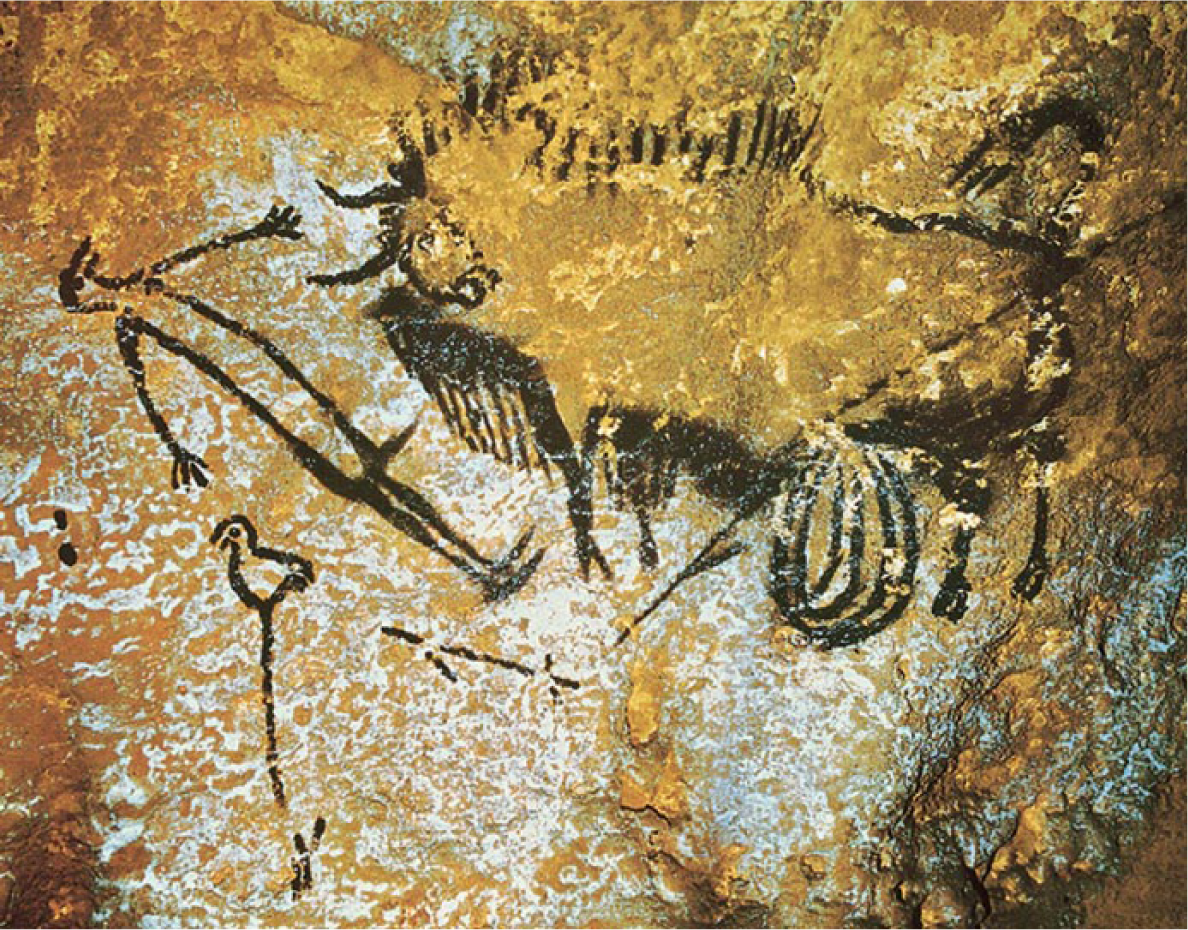
The ‘Birdman’ of Lascaux, Southern France.
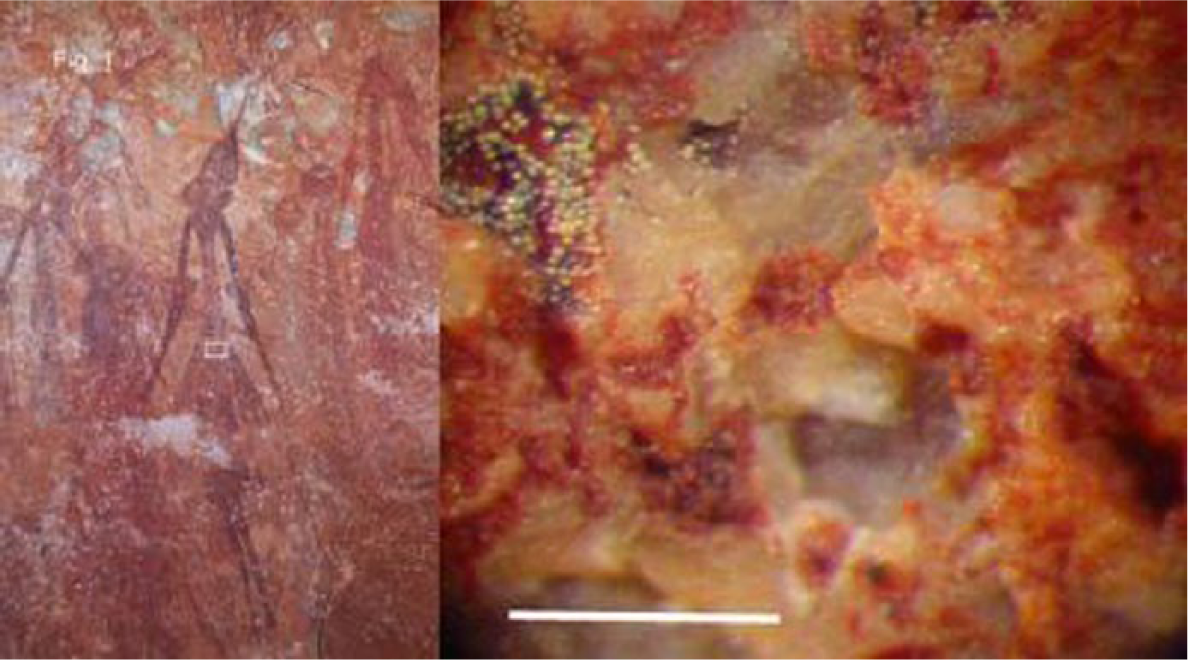
The ‘living pigments’ of the Gwion Gwion rock art in Kimberley, Western Australia.
The first geologic subject of the prehistoric, the ‘Birdman’ of Lascaux (dated ≈17–22,000 ya.), is an experimental actualization of how one form passes by way of another in triangulation of animal, bird, man, draw through line of flight, sex, cut. In this triangulation of forces a prehistoric iteration of identity is conceptualized. The ‘Birdman’ is one of only a few partial human figures – Anthropozoomorph (or therianthrope), composite creature with both human and animal characteristics – that adorn the cave amid several hundred animals. Despite the relative lack of human figures, the Lascaux paintings have become iconic in the articulation of the origins of subjectivity, receiving considerable attention from Continental philosophers, such as Jean-Luc Nancy, 5 Georges Bataille, 6 Maurice Blanchot, 7 Merleau-Ponty 8 and John Berger. 9 For all these writers Lascaux is examined as a point of origin in the expressions of ‘Man’, specifically within the context of Lascaux’s ‘birth’ in the midst of the murderous reason of fascism and the atomic era. In Human Origins Theory, Lascaux is consistently articulated as an originary moment of consciousness (or revolutionary cultural achievement) in the genealogy of European Homo sapiens, in which an evolutionary understanding of art is made evidential in a progressive narrative of human development ‘Out of Africa’. 10 Cave art is already then recognized as part of the symbolic order that operationalizes a particular genealogical account of life, so its aesthetics are not confined to forms of subjectification, but to the historicization of the genus of the human.
In a similar vein, evolutionary biologist Edward O. Wilson deploys Lascaux 11 to evidence an argument for group selection over kin selection as the driving force of human evolution. Contra to “Richard Dawkins selfish gene”, Wilson argues that the differential survival of whole groups of organisms is the basis of human (and insect) evolution, thus representing a social gene that ought to be considered in the context of extinction. For Wilson, art paints this tension between the individual and group, selfish and social forces, albeit within the socialization of discrete organisms. In agreement with Elizabeth Grosz’s assertions 12 in the context of her feminist reading of Darwin, Wilson argues that the creative arts are fundamentally biological in nature; an expression of biological forces rather than cultural accomplishment. In evolutionary discussions of cave art, this biological force has been understood primarily as being about ecological situatedness and proximity 13 or as a result of a shamanistic experience, 14 often explained as being about utilitarian hunting goals or hallucinogenic transcendence (i.e. something considered extraordinary within social life). But, there are other ways into the imperceptible forces of nonhuman and inhuman life that disrupt this proposed causality to suggest a more exuberant cosmic engagement with the forces of the universe. 15
The part-human, part-animal creatures of Lascaux are sullen, and exhibit a singular dimension that is in stark contrast to the animal vibrancy whose forms become more readily with the geomorphology of the cave. These caves were animal, rather than human spaces, inhabited by hibernating cave bears that disappeared towards the end of the last ice age. In Grotte of Peche Merle a cave bear has left scratch marks through one of the paintings marking another form of territorialization. The human in Lascaux cannot be human alone without the profusion and exuberance of nonhuman life and its community of being. Further to this animal exuberance, there is the rock itself and its inhuman qualities. Always there is the presumption that it is ‘Man’ who touches rock, but is it not the rock that touches Not-Man into being? Is it not the rock that lures the waiting imagination to find something that subtends it? If we remember that the commonest form of rock art is the open hand with ochre spat around it, then this is to remember the first act of touching rock, of opening hand, 16 spit, lip, and breath to the question of touching the earth and its geologic perspective. Jean-Luc Nancy suggests that such hands, ‘present nothing other than the presentation itself, its open gesture . . . ’. 17 In the context of subjectivity, it might be asked: What part does the earth of the cave, its geomorphology play in the bringing forth of these images? The image depends on geology, on how the mineral holds and paints the image, on how the shifts from glacial to interglacial seal the cave to guarantee its endurance beyond the present of its inscription. Geology gives the survival of these images, so that they can interrupt thinking and feeling about what it is to be human in the midst of the destruction of World War II; to offer another account of the subject amidst the extermination camps and the destruction of Europe. If the rock commands, authors, and provokes the contemplation of subjectivity as much as the animal or the human, what kind of fuller account of subjectivity could be realized through these geomorphic aesthetics to direct our understanding into the Anthropocene?
The second subjects are the Gwion Gwion paintings (17–40,000+ ya), a collection of unnumbered paintings in the rocky outcrops of Kimberley, Western Australia. There are two distinct ‘groups’ of image making in this area, the Wandjina face-like images and the Gwion Gwion, who are often referred to as the small and ancient figures. Unlike Lascaux, the heritage of these images is questioned: racially, archaeologically, historically and culturally. The Gwion Gwion have been at the center of Native Title claims, ‘interpretative’ and genealogical disputes, and racialized speculation in which art is mobilized to speak to contemporary questions of identity and belonging. For the Aboriginals of that land that claim them as their heritage, these images are part of the dreamtime, the origins of the earth and its retelling. 18 Archaeologists have referred to these images rather crudely as ‘mushroom head’ and ‘onion head’ depictions, which according to archaeologist Jack Pettigrew display the pervasive influence of trance visualizations and the hallucinogenic transformation of object boundaries. 19 There are also collections of micropsia (‘little people’) alongside macropsia (‘gigantic people’) that seem to suggest the polarity of perspectives; the contraction and enlargement of the cosmos. Whether we subscribe to these theories of the literal depiction of magic mushrooms as part of hallucinogenic states or not, is perhaps less interesting than the composition of these paintings themselves, and how they actualize the virtual and temporal crossings between human, fungal and microbial life that has an extraordinary symmetry with the ecologies of Aboriginal dreamtime.
The Gwion Gwion rock art was painted with the ‘living pigments’ of bacteria and fungi, which have continue to colonized the paint pigments and refresh themselves over millennia to generate a living artwork. 20 Successive generations of these fungi grow by cannibalizing their predecessors, who are direct descendants of the initial fungi that were contained in the original paint. Scientists speculate that the original paint had nutrients that kick started a mutual relationship between the black fungi and the red bacteria (thereby keeping the colours of the paintings differentiated), which generated the conditions of symbiosis where by the fungi provided water for the bacteria and the bacteria provide carbohydrates for the fungi. 21 Unusually the bacteria and fungi have ‘resisted’ one another and not formed lichen. Yet, who are the subjects and authors of this artwork? Who is making identity and carrying its formation into the future? What strange forms of kinship are at work? Considered as an event of subjectivity, what does this work of bacterial-fungi-human identity production open up in the conceptualization of a more distributed notion of bio-geologic subjectivity?
In the first instance, the bio-geo subjects of the Gwion Gwion have no originary condition, no telos, nor originary body or identity to deviate or adhere to. This is not to proffer that this is an ecological arrangement where there are not any determining limits to life, its forms of biological and mineralogical formation, but these living aesthetics do suggest a stranger collaboration. In thinking with these bio-geoaesthetics, I am not trying to move towards establishing some sort of continuity of being with non/inhuman entities, or to articulate an expanded general field of matter as such, but rather to investigate what constitutes the fractures in these forces across entities, and how to speak about these gaps or nonlocal elements in being that a subject traverses in becoming what it is. That is, not to begin with boundary work (as in concepts of hybridity), but to begin in the mix, to think about what is already constituting the possibilities of entities to be what they are, and the nature of the survival and resistance of non/inhuman elements within subjectivity. In investigating what is mixed between, I do not want to inadvertently render the between as a kind of ecological glue that sticks us to one another (rock to arm, platypus to nose, volcano to tree), rather to think the interjections and mixed operations that allow us to claim all this heritage as an ‘I’ that belongs to ‘us’, but has an excess of nonlocal origins that makes understanding the interstices of entities more complicated and untimely.
Examining inhuman and nonhuman excess in identity formation prompts a further question about the role of the nonlocal in subjectivities, its identifications, determinations, and qualities. But, how do we understand this nonlocality as a state of indeterminacy between entities if it exceeds normative understandings of identities and boundaries? How do we understand it as untimely and cosmic, as well as microbiological and originary? What is the nature and politics of this non/inhuman excess in subjectivity? How this excessive quality of identity is negotiated potentially has profound consequences for how human ‘life’ is understood in the context of a broader field of the Anthropocene. Considering the human within geologic time poses the problem of thinking an inhuman milieu, both before, after and internal to ‘us.’ Thinking with geologic subjects may be a way to generate new sensibilities around the recalcitrant nature of the geologic as a form of subjectivity, when what is at stake is not a nature that involves entities per se, but what passes between them; holding together or forcing apart. In the context of the Anthropocene, it might be a way to think about our geologic corporealities in a way that does not continue to place ‘our’ relations with matter outside the subject as something to be chosen, theorized or politicized (i.e. as a nonconstitutive element of survival).
While many discussions on nonhuman life and matter have been configured around ‘meetings’ that give rise to hybrid forms of identity, these often involve various forms of addition to human collectives. In this paper I want to think with geologic subjects that have queer genealogies and confounding origins. Claire Colebrook cites the queer nature of Deleuze’s vitalism, in which ‘every body in the world is possible as an individual because it gives some form and specificity in time and space to a potential that always threatens to destabilise or de-actualise its being’, in contrast to a univocity of being that stretches across life. This positive sense of queer being, is, according to Colebrook, ‘actualised not by the decisions that a body makes but by the encounters it undergoes.’
22
What this suggests is a form of nonlocality needs to be thought through geologic time in a way that does not resort to flattened ontologies (which erase important differences by setting up modes of equivalence or undifferentiation), but maintains the specificity of subject formation as a mode of differentiation established through its resistances and survival. When referring to ecological questions, Isabelle Stengers argues that this means: referring to a question of encounters and connections, the connection between what has come into existence and the many differences it can make to the many other existences with which it is connected. If productions of subjectivity cannot be disentangled from their milieu, ecology proposes that we do not think in terms of determination but in terms of entangling speculative questions.
23
Posing speculative ecological questions in the realm of aesthetics may have something to teach us about encountering non/inhuman forces, but those questions are posed in an ecological milieu where every decision made about what a subject is (and therefore, what it is not) in the context of these forces, countless ecologies fall asunder. 24 Such speculative questions operate in the ontology of potential rather than actuality. The point here is not to decide what this between is, but to begin to inhabit it, feel its affects, and learn what it might have to teach. That is, to discover how cave art may force speculative questions towards novel conceptualizations of ecological arrangements. This is also my approach to Aboriginal art, not to interpret, but to think with the opening of its affects (while not obscuring the importance of these paintings in contemporary Aboriginal identity politics).
The contraction of non/inhuman forces in rock art also suggests an ontological intimacy with other entities and the dismantling of the boundaries between life and environment (for want of a better word), and between biology and geology (or the significance of vitalism as the guarantor of engagement). And thus geologic subjectivity questions the very priority of boundary work that often frames the nature/culture, human/nonhuman, subject/object, life/nonlife bifurcations. So rather than see human exceptionalism in the ‘Birth of Humanity’, and the Lascaux paintings as a natal moment in European cultural ascendancy, we might follow Grosz and think about the inhumanities within the humanities,
25
and specifically how a focus on the inhuman might point towards ecological arrangements long neglected by a focus on an active vitalism.
26
For a number of feminist philosophers, particularly Grosz,
27
Kirby,
28
and Colebrook,
29
origins have been a key site of work in queering
30
the nonhuman and in the production of the inhuman as a constitutive part of opening up new and differentiated relations, while still retaining the subject as a constitutive part of the expression of that understanding. As Blanchot says of the origin, it is what ‘secures us against obscurity, but is itself obscure, either because it dissimulates itself or because, in doing so, it retains in itself the part of inhumanity that genealogies endeavour to make historical’.
31
In the opening of subject positions to non/inhuman forces and genealogies to multiple origins, as both interior and prior to the emergence of identity, subjectivity contains both an anterior and interior non/inhuman excess. That is, there is a surplus to identity that opens to non-normative arrangements and ways of being that do not add the nonhuman to the human, but query/queer origins to suggest a more temporally distributed and materially mixed model of subjectivity. As Colebrook comments, If we think of life beyond constituted bodies, as Elizabeth Grosz does in her re-reading of Darwin, Freud and Nietzsche,
32
or as Rosi Braidotti does in her notion of metamorphoses and transpositions that can be considered ecologically beyond the human,
33
then we have a new model of queer politics . . . To examine the potentialities from which subjects are composed.
34
Furthermore, if we push beyond the boundary of life itself, to consider the inhuman as not a step beyond, but within the very composition of the human, then ecologically there exists the possibility to think different relations with the earth that – materially and conceptually – do not begin and end with the subject. In the new era of geomorphic agency in the Anthropocene, such questions about the origins and potentialities of geologic corporeality are timely, lest the geologic, become once again, unthinkingly ascribed to the hand of ‘Man’ as a new form of Anthropogenesis 35 of the strata.
In ecological terms there is much to be gained in the recognition of a genealogy of geologic subjects that recognizes not distinct species and entities, but a mixing of material and immaterial forces, and non-normative arrangements in ecologies of the subject (that are not originary to the subject but to the potentials of the earth). There may be significant advantage in thinking the nonhuman and inhuman as part of the inside 36 and its incitements to become different from itself, and its affiliations towards that which might seem remote and decidedly unfamiliar. This is what Angela Last calls, ‘co-authoring with the alien’ in her discussion of Bakhtin’s playful engagements with the inhuman. 37 Co-authoring with the alien, however, may involve a far more intimate alienation that we have yet to reconcile ourselves with. In opening up the question of what it is exactly that passes between natures – human, nonhuman and inhuman – in the emergence of subjectivity, a form of posthumanism might be articulated that is not about articulating a convincing relational ontology with nonhumans, but one that acknowledges that the human is riven by the torques of non/inhuman forces in the establishment and maintenance of identity. In a time of extinction, such recognition might constitute an understanding of ecological survival as dependent on these inhuman forces.
What follows is an exploration of the geologic aesthetics of two subjects, leading into a broader discussion on geomorphic aesthetics and ecologies of subjectivity. My approach to cave art is based on an understanding that aesthetics hold the potential for untimely encounters, rather than attempting to establish the legitimacy of this work though a recourse to a historical account. I am not so much interested in what these images mean, but what they offer to thinking/feeling with modes of geologic subjectification for both the Palaeolithic imagination and the Anthropocene.
Geomorphic aesthetics and the ecologies of subjectivity
The work of art in the age of animality (Lascaux)
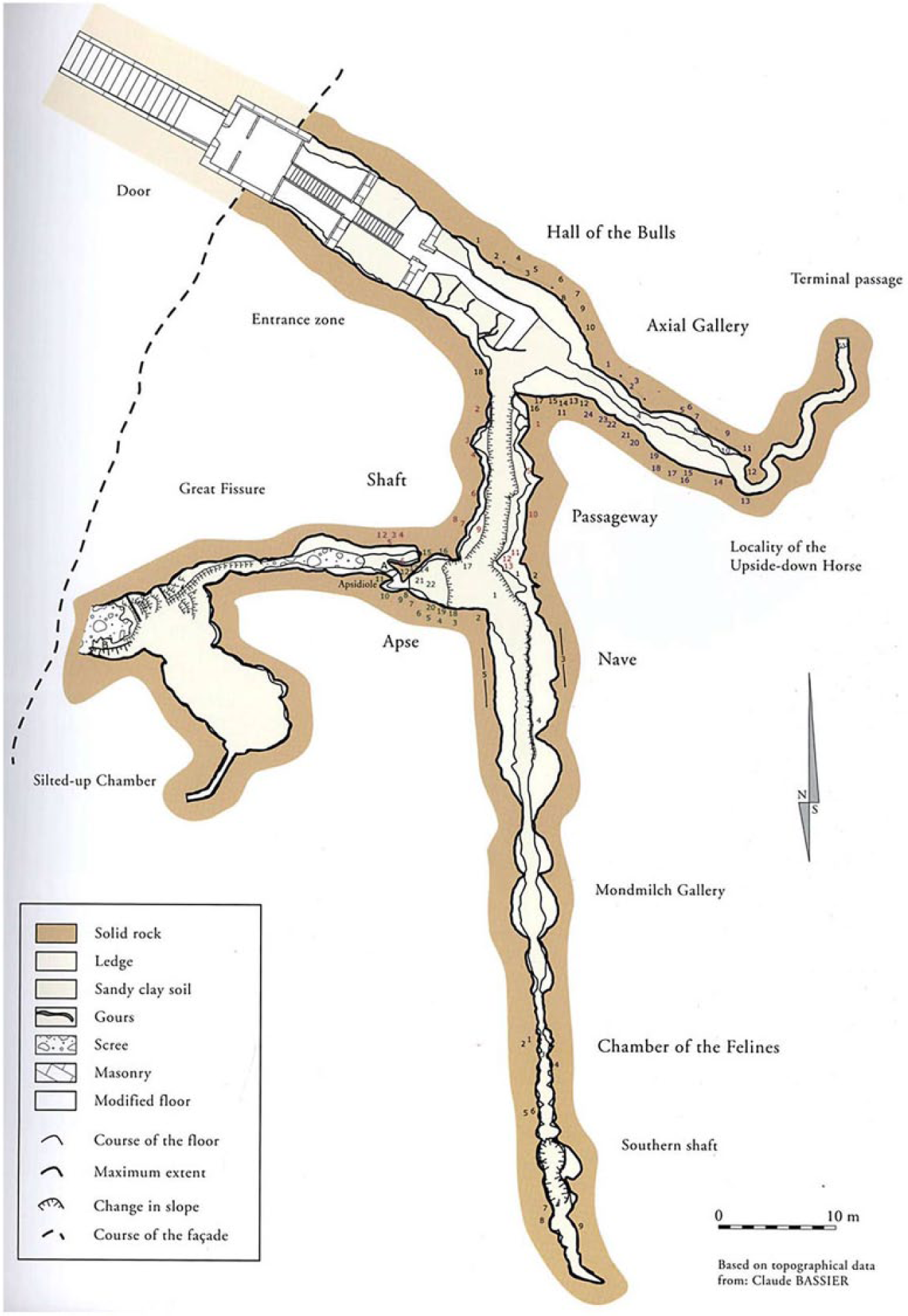
A line of time, drawn through geologic darkness, erupts into the present . . . 38
Lines were drawn by the light of a spluttering oil lamp, lines that reached through geologic time, from animal bone and mineral paint, to give an event of the Palaeolithic imagination. The torch light brushes the affective qualities of rock and like optical illusions they are there and then they are gone into the animal darkness as quickly as they have come. As Anne Michaels suggests in her epigraph, the cave paintings retained the origin of their signification, in the ground bones of animals and the tempered mineralization of their firing. Animals are painted in feldspar (aluminium silicates of potassium, sodium or calcium), Haematite (iron oxide – red), Limonite (iron oxide – yellow), charcoal (black) or manganese dioxide (blackish-brown). Flints working the edges of bodies, paint is made from mineral pigments and a binder of water, blood, urine or grease. The animal is already in the paint before it is painted. What was once animal is made so again. The animal fat traced the contours of its flank through the spluttering light. Light is the reader. Time, like light, is what is drawn through the geologic; a force is pulled through the darkness that presupposes a future. The work of art is that gesture of time given to the future. It is of the future. In aesthetics, versions of subjectivity are explored through the making, looking and seeing of new modes of expression. It is a space of the new, a space of speculative questioning. Time and light are that which are held as an intense presence in the images, flickering, pulsating against the chaos of prehistories’ night. For John Berger, ‘[e]ach line is as tense as a well-thrown rope, and the drawing has a double energy that is perfectly shared. The energy of the animal who has become present, and that of the man’s [sic] arm and eye drawing it by torch light. These rock paintings were made where they were so that they might exist in the dark. They were for the dark. They were hidden in the dark so that what they embodied would outlast everything visible, and promise, perhaps, survival’. 39 The secrets of these dark underground places became known just as everything visible on the surface was in darkness, illuminated only by the exploding field of destruction. In this ruptured landscape, a gift of such wealth arrives to suggest the potential of the universe to be otherwise.
On 12 September 1940, the landscape of France was reorganized with bombs and shovels, with occupational forces and traitorous compromises; men returned to mud holes in the ground to listen to the belly of the earth. Four adolescent boys went searching for treasure in underground passages. They saw an uprooted tree and a deep depression in the ground that their dog, Robot had identified (Robot comes from the Czech, used to denote a worker, meaning no longer human, mort). The depth of the hole is unknown, thrown rocks do not sound. They slid one by one through the hole, along a semi-vertical shaft embedded with stalagmites, down 15 metres to a dark chamber, into the underground. The boys followed the animal part of themselves down a hole to discover the hidden spaces of animality, and a line was drawn across time from the Pleistocene to war-torn France. It is a phenomena that blurs boundaries, crosses time, and holds relations of force to capitalize and concentrate them: spit, bone, fire, fat, minerals, patience, ice age, dog, sweat, curiosity and aesthetics in the body of the earth. With a flickering oil lantern, standing in the Hall of Bulls, they looked around, describing what they saw as a ‘cavalcade of animals larger than life painted on the walls and ceiling of the cave; each animal seemed to be moving’. As their light began to fade they swore an oath of secrecy. They kept their promise until the next day and returned to the cave with a rope to help them to the second level. After two days the secret is exposed. Their teacher, a member of the prehistoric society of Montignac, gave them two rules; to not let anyone touch the paintings and to guard the cave against vandals. Worried about the cave, Marshal and Ravidat pitched their tent at the entrance to the cave; they became life-long guardians of the secrets of Lascaux. 40 By 1948 daily tours brought as many as a thousand people a day through Lascaux. Lascaux began to have a carbon dioxide crisis of its own and in 1963 the cave was closed to the public due to microbial colonization.
There are lines made by spitting, sculpting, dabbing, rubbing, touching. Pigment of plant and animal origin is mixed and regurgitated, laid by tongue into the surfaces and folds of rock that give themselves to the right suggestion – rocks that suggest how to touch – shadows participating in the call to art, crevasses calling to the interior spaces of being to find their other. Rocks provide an altar on which to spit the self. A line is drawn Jean-Luc Nancy said and ‘everything is given in one blow.’ Everything between the subject and its relation to self and animality and to the presence of being present in the presence of itself: ‘Everything is given in this quick turn of the hand that traces the contours of a strange presence . . .’. 41 For Nancy, ‘Man began with the strangeness of his humanity. Or with the humanity of his own strangeness. Through this strangeness he presented himself: he presented it, or figured it to himself’. 42 In the recognition of strangeness, Nancy suggests that man did not penetrate a secret, ‘but was penetrated by it, and himself exposed as a secret. The schema of man is the monstration of this marvel: self outside of self, the outside standing for self, and he being surprised in the face of self. Painting paints this surprise. This surprise I am painting.’ 43 Surprised and humbled by this transposition of self outside of self, the painter hid his face in the face of a bird, and exposed himself in the vulnerable extension of his sex, and placed himself before the horns of the injured beast. This is what is called the ‘Birdman’ of Lascaux. I am your sacrifice, yet I am hidden, unsheathed, unable to fully see myself seeing. My eyes must become a mask; my face must be the face of another; my exposure must be trampled by the energy of animal presence. I am for you, I am because of you, and yet I am divided from you (my animal), and thus I am divided from myself, and so I must hide myself from that dark secret, and become with the face of another (my animal). This is the consequence of lines, a gesture of self, divided by and in the image, held apart from the secret that penetrates it; geology and animality open up the strangeness of being, aesthetics figures this stranger to itself.
After a fieldtrip to Lascaux in 1955, George Bataille lectures: It has become commonplace today to talk about eventual extinction of human life. The latest atomic experiments made tangible the notion of radiation invading the atmosphere and creating conditions in which life in general could no longer thrive. Even without war, the experiments alone, if pursued with a little persistence, might themselves begin to create these conditions.
44
Bataille states that he is not going to talk about extinction but will instead talk about beginnings. His reasoning is genealogical, connecting origins and endings: ‘I am simply struck by the fact that light is being shed on our birth at the very moment when the notion of our death appears to us.’
45
With the discovery of the Lascaux caves within the context of extermination camps and nuclear annihilation, Bataille’s interest was with a narrative arc that might verve sharply away from the proffered endings of modernity and its rationalized forms of death. Lascaux becomes a way to think the possibility of an otherwise. Stuart Kendall writes that prehistory for Bataille, ‘possesses, from the outset, a planetary sense, not a regional one, and, from the first determination, the entire future of man is at stake’.
46
Kendell notes this is a new notion of absolute death: ‘The image of death in the 1950s, at the height of the Cold War, is an image of death after Hiroshima and Auschwitz.’
47
Bataille’s contribution to the archaeology of the human is his ability to think with this planetary sensibility in sovereign terms. Kendall says: in Bataille’s revision of historical economy he slips from the history of Western civilization to a mode of universal history that embraces the histories of the entire globe and indeed the cosmos. Bataille is significant as a historical thinker because he attempts to change the register of our historical thought: he shatters Western paradigms and begins thinking the history of humanity on a scale vast enough to include geologic and even cosmic time.
48
Prehistoric art for Bataille is a way into geologic time and the question of origins and endings, questions that appear again in the Anthropocene.
In his lecture, Bataille says that the image of man is inseparable, henceforth from the gas chamber and that the image of man is inseparable, henceforth from Lascaux. These signs of man become for Bataille two possible outcomes of responding to excess, and in both these places this excess is characterized René by insensible silence. He says: In being a man, there is generally an oppressive, sickly element, which must be overcome. But this weight and this repugnance were never as heavy as they have been since Auschwitz. Like you and me, those responsible for Auschwitz had nostrils, a mouth, a voice, human reason, they could unite, have children. Like the Pyramids, the Acropolis. Auschwitz is the fact, the sign of man. The image of man is inseparable, henceforth, from a gas chamber . . .
49
The discovery of Lascaux in concert with Auschwitz provides a confirmation of Bataille’s central project of explicating economies of excess; to understand and reaffirm excess means not having to undergo the violence of that which is excluded from the ledger and returns as a destructive force because it has not been properly accounted for. In this double economy of excess there is a contrast between the banal excess of rationalized violence that Hannah Arendt speaks of in Auschwitz and the exuberant excess of art in Lascaux. The doubling of Auschwitz and Lascaux as sites that come into the world together means, for Bataille, that they are each other’s twin. These two signs of Man share a natal moment; respectively representing the annihilation of time and its possibility, of something exuberantly given to time and something exterminated from it. One is the beginning of language the other its death. Not so much origins and ends, as an ontology of possibilities and potentialities within the gesture of time. In the discovery of Lascaux we are given poetry, in Auschwitz we are given the struggle of language and the refusal of poetry (as Blanchot says language is not destroyed by Auschwitz, but we become aware of the unbearable weight its silences must carry). Both silences become a question of how absence speaks. As Blanchot comments on René Char’s poem about Lascaux: ‘What is striking, what appears “terrible” to him, in writing as in painting, is silence, a majestic silence, a mutism that is inhuman and introduces into art the shiver of sacred forces, those forces that, through horror and terror, open man to foreign regions.’ 50
This inhuman quality is pictured, right there in the cave, the human figure is shallow, stick-like, a man without dimensions (riven with lines of force), while the animals are complex, multi-dimensional, in perspective, rendered in the roundness of their flesh and its tense vitality. So rather than a Parthenon of hunting animal-trophies to be communed with, as Prehistorians tried to argue for many years despite evidence to the contrary, Lascaux offers the groupings of animal sociality; running, looking, jumping, licking, falling, floating, sniffing, breathing. The caves at Lascaux and Chauvet show animals intermingling, exchanging (sometimes with sexual fervour), but mostly just being together in all kinds of proximities (spatial proximities that belie the thousands of years that often separated their painting). In contrast the few depictions of Homo sapiens are solitary. Leroi-Gourhan calculates that, despite this being the Upper Palaeolithic, meaning ‘The Age of the Reindeer’, reindeer (the main food source) only make up 3.8 per cent of the figures in the Prehistoric caves of Europe.
51
Even then, reindeer are not figured as wounded or hunted animals but they are on the run or in a scene of tender intimacy as in the cave in Font-de-Gaume, where one reindeer is bending down to lick the head of another. In contrast, the human is drawn artlessly without conviction. The human is the shadow at the feast, the figure who witnesses alone the one injured animal in the whole cave complex. His shadow is there to see the death that he has inflicted, to bow before the horns of the bison, head covered, sex erect, vulnerable and yet inexplicably placed in the space of death that is opening up in the wound of the bison through the triangulation of lines. Blanchot says: It is striking that with the figuration of man, an enigmatic element enters this work . . . the mark left modestly in a corner, the furtive, fearful, indelible trace of man who is for the first time born of his work, but who also feels seriously threatened by this work and perhaps already struck with death.
52
The solitary figure is the shadow that accompanies death, and he is that witness. Death is interwoven with the sacrifice and birdman effaces himself before it. It is an image of the human that misses an image of self. It is an exteriority that cannot yet be fully drawn. It is hesitant, the markings of the line are necessarily incomplete, as if to draw the line in the round would be too resolute, too immutable. It would set up an impasse, a locked and lonely soul with no way to intensify herself. 53 The hesitation draws a desire that is unwilling yet to leave the nonhuman, yet it pictures this turning towards dying, its contemplation and inhuman relation, and its shiver.
These are not images that are about becoming-not-animal but about the thresholding of the subject as a body that is traversing non/inhuman states, given to being in time, not outside of it; it is about the labyrinths of the internal constellations of inhumanity and its potentialities of a cosmic perspective. It is no accident that these images are painted in the underground. The tie to these images is visceral because they offer an understanding of survival and about the inhuman spacing that subjectivity can bear. What could be a better testament to the subterranean stars – the inhumanity of the geologic expanse – than cave painting? If we understand relation not as a generative co-present between things but as ‘the narration of a genealogical narrative’, 54 then the possibility of such a relation is it’s summoning of a presence that is untimely (and thus it generates an inhuman supplement to the milieu through the introduction of geologic time). These geologic aesthetics are both the phenomenon of experience and a phantasm (more than experience), because they possess an untimely (or nonlocal) quality that delivers a relation between incommensurable moments, which according to historicism cannot be sensible to one another. 55 A line is drawn through geologic time. It is not a line of genealogical descent that is traceable through any localized account, and yet, repeatedly, it hits its mark with such precision that there is no doubt of the sincerity of its testimony.
The work of art in the age of bacterial reproduction (Gwion Gwion)
Cave art follows the geography of geomorphic events and the possibilities of inhabitation that they configured. In Europe it follows the snowline of the Last Glacial Maximum (LGM), from Southern France in the flanks of the Pyrenees to the northern Basque region of Spain. In Western Australia the Gwion Gwion follow a similar line of energy that is laid down in the rocky outcrops over more than 100,000 sites, spread over 50,000 km on the cusp the Northern-most part of Kimberley. Unlike Lascaux, which has been the subject of countless scientific and specialist consideration in the genealogical accounts of European settlement, the Gwion Gwion heritage is contested: the biological and cultural genealogy of their ancestry in relation in to contemporary Aboriginals; the location in understandings of the inhabitations of Australia; Native Title claims; the curatorship of scared sites (in response to growing tourism and the threat of Bauxite mining in the Mitchell Plateau). 56 Dating of the sites is also contested 57 because of the on-going retouching of the paintings and vital colouration of the ancient rock paintings through the colonization of bacteria and fungi. The pigments used in the painting may have initiated an on-going, symbiotic relationship between black fungus (Chaetothyriales) and red bacteria. One of the images was dated in 1996 by analysing an ancient wasp nest covering it (using thermoluminescene) and was found to be over 17,000 years old. It was concluded on this evidence that the paintings beneath the wasp nests are at least this old. However further interpretations suggest these artworks should be dated to ≈40–70,000 years, based on the extinct megafauna and -flora depicted.
There have been considerable attempts to argue that these paintings were made by another race not antecedent to contemporary Aboriginals. The amateur archaeologist and prolific recorder of these paintings, Grahame Walsh, proposed an ancient race theory to suggest a pre-Aboriginal civilization that had arrived by boat (evidenced, he argued by the paintings of figures in canoes), contending that the paintings were of ‘alien origin.’ 58 The cave art is seen as particularly important because of the proximity of Kimberley to the islands of Southeast Asia and the possibility of the short water crossing that may have been bridgeable during a period of lowered sea level at the LGM. It is argued that Kimberley was a likely shore for the initial peopling of Australia, yet paintings of Melanesian-style canoes in no way leads to the conclusion that the painters of the Gwion Gwion were therefore of ‘foreign’ ancestry. Walsh’s views were actively reported 59 and supported by many settler Australians who were trying to invalidate land rights claims. During the Native Title case, Walsh gave advice to the lawyers for the Pastoralists and Graziers Association (opposing the claim), to argue that Aboriginal people bore no resemblance genetically or culturally to those that painted the ‘Bradshaw art,’ 60 and so had no claim of the land through a recourse to cultural heritage. 61 But as Antony Redmond argues, the theory of a discontinuous heritage between the painters of the Gwion Gwion and contemporary Indigenous peoples of the Ngarinyin, Worrorra and Wunambal peoples would have been contested had scientists taken seriously the narratives of local inhabitants. He says: ‘those knowledgeable in local law can elaborate a body of belief linking their current cultural repertoire to these figures, which they call Gwion Gwion’. 62
The tension around these images as evidential artefacts in the mobilization of heritage, genealogy, and place rights remains in terms of access and appropriate practices (conservation or retouching). However, in 2003 the High Court of Australia recognized the Aboriginality of these artworks and the claim was secured through the paintings as the primary evidence of inhabitation and connection to the land. The case was in part supported by a number of academic articles that made the case for the Indigeneity of the artworks based on their strong linkages to other art styles across Australia, but as several commentators have argued,
63
nowhere was an aboriginal account of these works taken into account as a secure basis for interpretation.
64
That is, the account of the bird people who are believed to have created the paintings as a nonhuman passage to the origins of geologic being: ‘These theriomorphic bird-beings are known as the ‘inventors’ or the ‘messengers’ who introduced stone-age technology into the world.’
65
Hannah Rachel Bell critiques the inability of academic research in the context of the controversy over Gwion Gwion rock paintings to treat Aboriginal cosmologies with anything near due respect.
66
She says: From my Bush University teachers I have learned that Kimberley rock art does not exist as a discrete arcane phenomenon, unrelated to any living peoples. Rather, the images represent a coherent jurisprudence, an integral dynamic in the ontology and epistemology of a contemporary culture’s living people, in other words, a constituted Law.
67
What is evident in these claims and counter claims is the critical role that rock art plays in understandings of Human Origins, and how the trajectory of those genealogies make political (rather than just ontological) claims on the present and future. That is, ontological claims about cave art have territorial effects, and also reveal the privileging of certain ontological arrangements of temporality and territoriality in the designation of what constitutes admissible evidence. Yet, what is equally evident, is how those assertions about the first Australians continually fail to decolonize their notions of inheritance or inhabitation, treating art as artefactual rather than seeing aesthetics as an intervention in the politics of life, aesthetics that draw genealogical narratives and symbiotic relations into being. Bell recounts Bungal Mowaljarlai’s statement about rock art: Someone told me just recently that ‘rock art is dead’. If ‘Art’ was dead, that would not matter to we Aborigines. We have never thought of our rock paintings as ‘Art’. To us they are images. IMAGES with ENERGIES . . . We . . . dance those images back into the earth in corroborees. That makes us learn the story, to put new life into those IMAGES . . . Aborigines know that they stimulate the energies that bring increase and renewal by retouching sacred objects, painting or repainting, talking to the images, and dancing and singing at important sites. Instead of talking about ‘Rock Art’, we should be thinking about our responsibility to keep all things of Nature alive, to STIMULATE those places the way Aborigines have always done in the past . . . This is my statement about ‘Rock Art’.
68
Rather than artefactual entities that need to be historicized, for Mowaljarlai these images gather together and call into being the imperceptible forces of the cosmos. They are a realization of what Grosz calls, ‘cosmological imponderables’: ‘the forces of temporality, gravity, magnetism . . . [that] are among the invisible, unheard, imperceptible forces of the earth, forces beyond the control of life that animate and extend life beyond itself’. 69 It is a corporeal heritage that has incorporeal dimensions; forces and lines of energy that are designated as ‘heritage’ for want of a better word, but they are not the heritage of human culture so much as the site of an event of contemporary genealogical relations to the earth and its becoming, which moves away from claims of singularity of authorship and possession of identity. As Grosz suggests, ‘Artworks are not so much to be read, interpreted, deciphered as responded to, touched, engaged, intensified’. 70 The images are not past, belonging to some ‘alien’ civilization, but are a form of co-authoring the cosmos, a participation in its actualization. Retouching paintings is not some defilement of heritage, but a retouching as retelling; an event to reactivate the potential energy of the earth to bring traditional laws forth, rather than to make artefactual identity statements. Bell, says of Mowaljarlai that, ‘It baffled him that whitefellas developed their knowledge by “busting things up”, reducing things to little pieces separate from everything else that contributes to their nature’. 71 ‘Busting things up’ as Mowaljarlai says, is not a bad example of what human-other bifurcations do to the ecologies of subjectivity, and everything that contributes to what a subject can be. Acknowledging an ecological genealogy changes the question from what it is to be human, to what it is to acknowledge an ‘immanent geontological (being of geology) source of life and its possibilities’; 72 this shifts the understanding from an individuated to a cosmic perspective. It also shifts, as Elizabeth Povinelli argues, an ‘ontology of potentiality to a sociology of potentiality’, where ‘specific arrangements that extend far beyond simple human sociality . . . include humans and a host of other modes of existence being composed and decomposed.’ 73 As Redmond argues about the Wanjina images, they ‘present a dramatic vision of personages symbiotically bonded with the land and skyscape, part-human, part-lightning, part-rain, part-cloud . . . Nevertheless, any serious appreciation of these images and the peoples who make them proved, for a hundred years, to be too much of an imaginative leap for many observers’. 74 This imaginative leap also requires an ontological reconfiguration that can hold radically dissimilar and discontinuous originary states together. A multiple of forces and interactions between the bacteria and fungus provide a common mode of nutrition, this particular mode of nutrition provides the life for the vital colouration of a form of expression that is nonlocal to the bacteria (i.e. the image of the bird people). Similarly, the Gwion Gwion paintings do not represent ordinary individuals but primordial creative ‘bird-people’ whose movements emulate aerodynamic flight. For Mowaljarli, the paintings do not have a human origin, they come from ‘Koion, a small brown bird with a white beak, touches up these paintings with his beak. He hits and hits the rock wall with his beak. His beak bleeds while he does this and he uses the blood from his beak to touch up the painting.’ 75 These images are not a figuration of a hybrid entity, but something much more challenging to a notion of subjectivity that has no fixed beginning or end, and multiple points of origins. If bacteria and rock and Aboriginal painters are making the event of identity together then these images enact not just their own survival but also the survival of a sociality with the earth and all sorts of other forms of existence.
What the Gwion Gwion’s are is not necessarily for us to know, but it is clear that this ontology suggests a complicated genealogy where the images become present as rock art to give traditional law; a presenting that is inseparable from the nonhuman messengers, geology and its material, virtual and temporal qualities. As Paddy Neowarra, Chairman of the Ngarinyin Aboriginal Corporation, said in a testimony to UNESCO: ‘Everything comes from underground, the rain, the lightning, the people . . . In the Lalai, the Wanjina came out from underneath the ground to transform themselves into rock art’.
76
The Gwion Gwion’s are a dynamic ecology that is touched into being, constituting itself through these acts that cannot be divided between human-nonhuman, environment–organism, actual-virtual, material-immaterial, sensible-insensible, determinate-indeterminate and the boundaries that these framings institute. In Mowaljarlai’s words: See those trees . . . they dancing hip to hip. You can see they all the same . . . apart same space because they know how that energy works. That energy travel under the ground. They all connected in that energy grid, like electricity grid. ‘Energy come from lightning, that energy. Lightening Brothers. Bang! First ‘energy go up, then ‘energy come down . . . travel under the ground . . . fill up everything with power. That’s how power communicate. Trees know how to grow right place because of that energy. Same for us. We know right place too.
77
This energy field is the same for geomorphic aesthetics; aesthetics of imperceptible, yet actual forces of the earth that are realized through the painting, not in any abstract or figurative way, but as actual energy points in the land, where origins are made in the touching of rock. Touching holds together these mixed origins with radically dissimilar natal moments that cohere in the present, made present by the rock and the land, as rock images. Not abstract, an exiting from presence or distancing of presentation, but a presence-ing through geology into being. And, so the origin is installed through the geologic, as a configuration of place that is more like a poem than an artefact, and which begins anew through each telling. Its origins are born in presence with the earth through its geology.
The bacteria are given a prosthetic origin through the anthropogenic moment of their gathering into the pigment of the paintings to supplement the blind genealogy of their reproduction (origins are somewhat meaningless in a bacterial ontology). Yet, it is the bacteria that work towards, through every reproduction, the cohesion of the image, its definition and continuance into the future. Compared to the bacteria, every human is a newcomer in the Earth; their modes of signification are but a faint drawing of the forces of a more secret, incessant genesis of bacterial life. As Myra Hird’s work on bacteria 78 makes abundantly clear, bacteria make us who we are, and they are the ultimate inheritors and originators of the earth. 79 In this production identity is repetition without origin; a hundred tiny moments of bacterial finitude holding together the image of another nonlocal element (bird people) for 40,000 years. While much biological writing concentrates on change, on transformation and continuing mutation, where the ‘stuff’ of life is characterized as eventful, changeable and constantly bifurcating to create lively new formations, there is also ‘life’ that is constant in its adherence to a temporal pattern through geological time. While attention necessarily snags on change, there is also the fidelity of stasis, the life that continues to do what it does despite external conditions of geomorphic processes. What if bacteria continue to do what they do in the art of bacterial reproduction without change, refrain after refrain without becoming anything more or less? This is identity carried as nonincidence as much as incidence. Geology carries the formation of subjectivity too, not as base to the bacterial-fungal superstructure, but as participant in a mixed production that is not about addition of elements but about a configuration that is always in excess of all these elements because it is nonlocal in its material and temporal affiliations. The subject is the holding together of that gap that is stretched between the discontinuities of these ecologies; it is the gathering up of these communities into an entity that is discontinuous with itself because it contains nonlocal elements. The Gwion Gwion is a bodily working through of the inhuman subject stretched between the microorganism and the cosmos, which recognizes a different genealogy to that which is commonly articulated in the ‘Descent of Man.’
Deborah Bird Rose talks about aboriginal understanding of kinship across nonhuman worlds. 80 While she concentrates on dingo ancestors and the perverse coupling between dingo and aboriginal fates under colonialism, her stories elaborate on a cosmology where natality is a multispecies affair whose origins belong to the earth. To understand these paintings in this mode, as the aboriginal claims for the paintings do, is to understand that this multispeciality is not something that can be marginalized through the explanation of hallucinogens, but needs to be considered as vital to how human identity is. This is not to valourize Aboriginal ecological sensibility, but to suggest that these images externalize this question about the mixed attributes of bodies, and how the human is constituted through this on-going encounter in which humans are not entirely responsible for, or originators of, an image of identity.
Looking at the composition of bodies as itself an encounter in the on-going negotiation of what identity is, the most straightforward conclusion would be that both these art works are multispecies events. But, then they would also be encounters concerned with geologic-being, animal-being, energy-being, lightening-being, so already there is rock, animal, energy, lightening; bodies of flesh, bodies of energy and bodies of strata. There is no split between the geo and the bio, as earth origins couple with various life origins, and both propel the future into being. Then, there is a certain amount of confusion over what the body or subject of the art work actually is, is it bacterial body, an animal or a human body and who exactly is the author of the work, if it is bacteria that continue to paint its expression with their bodies? As Dorion Sagan reminds us, The human body, too, is an architectonic compilation of millions of agencies of chimerical cells. Each cell in the hand typing this sentence comes from two, maybe three, kinds of bacteria. These cells themselves appear to represent the latter-day result, the fearful symmetry, of microbial communities so consolidated, so tightly organized and historically orchestrated, that they have been selected together, one for all and all for one, as societies in the shape of organism.
81
In a bacterial version of Felix Guattari’s notion of ‘groupuscule,’ Sagan suggests that the ‘body is not one self but a fiction of a self built from a mass of interacting selves. A body’s capacities are literally the result of what it incorporates; the self is not only corporal but corporate.’ 82 A sociality of ecological activity produces subjectivity. However, incorporation, as complicated and surprising as it is, still retains its symbolic identity formation, it is not lines in the sand or dentric patternation, it is a historic form of identification that ‘lives’ its encounter (over and over again); ‘its reality of earth, its ‘matter-emotion’ 83 in which ‘the “I” is literally a figure of large numbers.’ 84 Its composition may even exceed the fertile imagination of its authors, who may have been using the living pigment for their timely iterations. Identity thus might be conceived as a spacing in the succession of origins in which a touching of rock is a moment of concrescence: a condensation of ecologies of presence that is the event of identity.
Geologic subjects and inhuman aesthetics
This paper has concentrated on two events in the genealogy of the human that queer origins and remind us that identity is always in excess of itself, and that this excess is not only social, but has origins that are non/inhuman; conceptually, biologically and geophysically. These geologic subjects locate subjectivity as a more distributed affair, which draws from a wider ecological and mineralogical field. If, subjectivity both incorporates and elaborates on non/inhuman elements, then it must also share a sociality with these animal and geologic forces, and in that sharing there are claims of responsibility that far exceed our current bifurcated models of ethical worlding (that inevitably seem to rely on a contagion of ethics). Considering a queer operation in the formation and continuance of subjectivity into the future opens thinking the human into non-normative arrangements and ways of being that do not have a model of accumulation at their heart (add-ing and and-ing). If subjectivity is stretched between the inhuman and nonhuman elements, determined by unfamiliar material and temporal orders, then this opportunes the possibility for an identification with the earth and other biological formations that does not start from a point of alienation or whole-ism (Gaia), but recognizes an entirely different mode of production. Claire Colebrook makes the distinction between an active and passive vitalism; an active vitalism ‘assumed that “life” refers to acting and well organized bodies’, a passive vitalism, in contrast is ‘where “life” is a pre-individual plane of forces that does not act by a process of decision and self-maintenance but through chance encounters.’ 85 Such a concept of passive vitalism is queer ‘in its difference and distance from already constituted images of life as necessarily fruitful, generative, organized and human. A passive vitalism is also queer in its transformation of how we understand the work of art.’ 86 Colebrook argues that all post-Kantian aesthetics refer us back to the subject and the constitution of a world of meaning for ‘us.’
There is much to gain in ecological terms by forming a passage into another aesthetic language removed from the ordinary forms of temporality that displace the persistent notion of the subject as the locus of self-presence. As Nancy suggested about the paintings at Lascaux, ‘It is all given in one blow’. What is given is the forces between entities, the energy and contagion of those forces that cement identities as entities in the on-going constellation of forces and relations. The slippage of subjectivity is an indeterminacy, a between,
87
that is not a pivot point on which terms turn to infect one another (as in hybridization) in a symmetrical arrangement, but it is a discontinuity, always missing itself, in radical asymmetry. As Colebrook comments: The key to Deleuze’s passive vitalism and the aesthetics it mobilizes lies in thinking difference beyond the kinds and generalizations of a politics of active vitalism. Whereas active vitalism would seek to return political processes to the will, intent and agency of individuals or subjects, passive vitalism is micropolitical: it attends to those differences that we neither intend, nor perceive, nor command.
88
In thinking with a passive vitalism, rather than one that always returns the subject to an image of itself as a discrete entity, there is a way to think a field of potentiality that is always nonlocal, yet socially specific.
Thinking with Palaeolithic images expands upon how aesthetics is a mode of experimentation in ecological arrangements 89 that suggests the ecologies of subjectivity might just recuperate a less exceptional, but more extraordinary human subject. Aesthetics can be understood as a space of communication with the interiority of non/inhuman forces that constitute what bodies are and can be. Aesthetics is a mode of experimentation with, and a concentrated sensation of, this other ‘life’ beyond life within a forgotten natality that is cosmological, microbiological and geomorphological. What these geomorphic aesthetics offer is a glimpse of that slippage between, that which is forgotten in our nature and what is immediate and remote, what belongs to us, but cannot be ours; the ambiguity of a discontinuous survival and the resistance of life to its inhuman self. Aesthetics might be considered as a transposition and transmutation of material and immaterial forces, which parallels life’s iterations across the ‘field’ without the prohibitions that govern the concerns of subject to be faithful to an image of itself. That is, aesthetics are not primarily about picturing or representing what life is, confirming its affiliations, and forms of self witnessing, it is about experimenting with what life can or might be – painting the exteriority of inhuman intimacy and imperceptible forces that draw entities into being. In this sense, aesthetics is a space of actualization in the formation of subjectivity, but also in the counter-actualizations of the new, 90 and beyond the temporal-spatial coordinates of the now. This power of the image to actualize the different temporalities of life, not just of the geologic past, but also of a moment that can be grasped in the present, is evident in the fact that this Pleistocene work is comprehendible at all (and that it was comprehendible to painters who painted 20,000 years apart). Aesthetics are now; like the retouching of the rock art, it renews a ‘now’ through the disruption of time and the promise of a future. The image holds the survival of its coming into being, and its survival through geologic time; it is also a survival in the sense that it fore-sees the future, in its creative power to survive as a possibility within meaning. Thus, rock art possesses the possibility of conversing with nonlocal, imperceptible and virtual qualities as sensation and aesthetic experience – ‘a stammering from the depths of ages’, 91 a geologic now.
Aesthetics are then connected to the virtual and its potentiality, in so much as it allows life to surpass itself, to pass the limit that is inevitably reached through the quiet confines of lives. It allows the passing of a limit that life itself cannot pass, this is why aesthetics has an untimely quality, because it draws into regions of temporality and experience that are beyond and yet also reverberate to actualize a hitherto unknown potential, which itself signals a field of experience that exceeds what is named human (or rather, it alerts us to the non/inhuman dimensions that the human carries and is carried by). For example, while rock art converses with geologic timescales, it also unearths rocks’ virtual qualities. An image of a winged micropsia figure transforms rock into the poise of flight, it brings out its immaterial qualities; the virtual qualities of movement that even a rock possesses as a material patience over epochs, while appearing immutable and inert. Aesthetics catches this quality and paints its withdrawal in matter; it shows this virtual quality while slipping away. 92 As Colebrook argues; ‘By understanding life as virtual we no longer begin with the image of a living body, and are therefore able to consider forces of composition that differ from those of man and the productive organism.’ 93 Considering these forces of composition and decomposition requires not just an enlargement of the collective but a reimagining of the virtual ecologies from which the potentialities of subjects are drawn.
Cave art has a symbolic quality because of its historical role in genealogical inquiries into human origins and anthropogenesis. Whether invoked as evidence of the ‘Birth of Humanity’ or as representative of the development of symbolic capacities in neurological studies of human development, cave art is not so much located in aesthetic history, as in the archaeology of originary occasions – ‘birth’, ‘cradle’ or ‘genesis’. These inquiries into origins are never disinterested, because they are inquires into life and its ordering, part of the scripting of thresholds, moments and limits in the genealogy of contemporary ‘Man.’ And, the heritage of ‘Man’ is of course expansive in its claims over life, in the sense that it priorities that life – human life – in relation to all other forms of life. One the one hand, this priority belongs to all beings in their attentiveness to their own existence. On the other hand, this priority is isomorphic and is not something that should be flattened out in relation to other life/minerals (as some argumentation in the posthumanities inadvertently does). It is a case of negotiating human exceptionalism rather than trying to do away with it all together, because that elision negates the power and responsibility that comes with what is inherited as a consequence of our humanism (the ontological debt). To be human is to be different to being mollusc or being rock – there are resistances on all sides to becoming equitable as life and nonlife forms. So I am not trying to say that in these two enunciations of subjectivity that the various arrangements of life and nonlife should be treated as equivalent or indistinguishable, but there are inheritances and actualizations of non/inhuman forces within life, the body and its affiliations. These affiliations speak to a broader, more complicated inheritance located in ‘other’ nonlocal histories and origins, and if corporeal generosity 94 demands that we examine what we have inherited, then these non/inhuman remains should not be located outside of the social sphere. To put it simply, the inhuman and nonhuman – biology and geology – are not on the outside of the experience and articulation of subjectivity, they might be considered as interior to the event of it. In the same way that an image of the body is not a body as such, it does have a communicative possibility with what a body does or becomes. Images are not representative, but give us the conversation between those bodies of sense without resolution or conclusion into stable forms (the temporal signature these images carry alone is enough to destabilize the whole process of incorporation into a stable lexicon of meaning). So, while these images are not conclusive in any sense, they are a conversation on what subjectivity is or could be within a cosmological perspective.
After a decade of relational ontology and the flowering of all sorts of engagements with nonhumans (and ‘things’ that are relationally constituted), there is a distinct value to ecological thought in supplementing this position and crafting a philosophy that can hold contradicting ontological states together to discover different kinds of relationality that are not so obviously proximate. Then there is not schema across relation as a flat ontology, but a depth relation that is something like a charge in its fathoming of deep, underground spaces. If subjectivity is considered as impersonal, nonlocal and variously constituted in ways that will continue to challenge our imagination of what a human is and can be, then the non/inhuman forces that constitute that composition must be accounted for. That is not to give up on the situated embodied site from which encounters may unfold, but to recognize that the event of subjectivity always draws from temporal and immaterial registers that exceed those localities. That is, not just to try to work against human exceptionalism, but to actively try to erode the exceptionalism (that always refers back to the human) that comes with the priority of location. Immediately, the question comes, in the attempt to consider the nonlocal, what happens to politics? This question is particularly sharp in the context of some feminist theory, because it is akin to an act of squandering. Yet, in squandering a certain type of political agency, how might another kind of politics be developed that recognizes the ecologies of subjectivity?
While the ‘hybrid’ troubles at the boundaries of identity, it can never dispense with these categorizations as its founding or originary structure, and is therefore wedded to the legacy of noticing the boundary work of those terms, the historicization, and mediation of those terms. What the caesura in hybridity 95 doesn’t get at is the forces between natures – that determine or act, but are not entities themselves. These indeterminate subjects are as much a determination of subjectivity as are the things-in-themselves, and yet the preference for object/subject-hood skews much of our theoretical analysis in the recognition of how and what comes together/falls apart. 96 Hybridity is always a local affair, because it involves the meeting of entities and concerns itself with that interaction in various ways. And so there is a neglect of the nonlocal elements that act through and within identity formation (and sometimes split it apart) that have nothing to do with that interaction as such. Not every interaction has the same force, or affect, not every meeting changes us. There is survival and resistance. This emphasis on the local is as much tied to a desire for a progressive political politics as it is to a material ontology, because the nonlocal is politically difficult to meet with and certainly not operative within what we can call politics. The nonlocal holds none of the political promise of relations and its generosity towards a progressive remaking of the world. In this sense the nonlocal is a difficult inheritance, it cannot necessarily be affirmed or resisted, it might just be something that has to be lived with, without the possibility of revision. This does not however mean that there is not a politics to living with that which cannot easily be changed, and that it is not necessary to examine that which is seemingly immutable or at least as transgressive so as not to actually readily ‘appear’ for analysis. If that which is not amenable to the social sphere is excluded, a whole lot of the world falls out. A material politics that does not prioritize human exceptionalism, or human politics as such, could possibly lead to a minoritarian politics of materiality and sociality; that which gets excluded because it isn’t seen as politics or available/operative in terms of political action, but might, nonetheless be essential to ecological survival.
While the majority of the philosophical narratives of the humanoid figures at Lascaux argue for the mobile border between human and animal in the articulation of humanity, it is as well to remember that such de-placings between human and animal require an a priori conception of a proper image of those two bodies (animal/man), rather than an unfolding event between the forces and actualization of bodies; an event that is given by the lines of flight that are already bisecting the organization of bodies into discrete entities, lines drawn in the rock from wound, to sex, to bird, to the encounter with death and its fierce assertion. This image of death’s passage that is located away from the main halls and at the terminus of the Lascaux cave substantiates an explicit configuration of the multiple sites of subjectification. Death belongs to both human and animal, it ties them together through its event. Bird occurs within the human as a point of perspective. The subjective event is always, already multiple; temporally, materially and in terms of the multiplicity of ‘organisms’ (for want of a better word). This suggests the field of the human as multiply authored, in biological and symbolic terms, where bacteria are equally involved in activating the event of the human. It is a microbial micropolitical event of subjectivity. There is already a multiple field of affections, desires, passages and deaths that compose this field of social relations. What death is, what sex is, what animal and what human is, emerge in the field of this image of cave cinema. The image is iterative. Aesthetics gives us this emergence of the territorialization of the human by the animal, of the animal by the human, of this passage between, out of the chaos of Prehistory’s night, as an event of subjectivity.
Recognizing how humanity is constituted through the negotiation of nonhuman and inhuman forces and entities, not through opposition or boundaries, 97 is the question that might open into a more generous ecological thought. If the exchange of forces that aesthetics gives us is brought to the fore, rather than the splitting of entities that hybridity ultimately still retains (and reinforces) despite the imagination of figuration that keeps that relation moving in Haraway’s account (through the dichotomies of human/animal, nature/culture, human/machine), then the geologic subject might release a consideration of inhuman time that is necessary for thinking with the Anthropocene and its extinction events. Rather than thinking non/inhuman in terms of ontological differentiation, queer genealogies offers a much less divisive ontology 98 that is able to ‘accommodate’ the unfathomable ‘depth’ of relations; relations that are discontinuous, fractured, voiding, radically asymmetrical, that bear little resemblance to that which is denoted or made available as relational. And, in acknowledging that which is discontinuous, there is also the capacity to notice that which ‘jumps’ between states in an untimely fashion without a causal logic, rather that just that which crosses between, that which is proximate or partial to relation. 99 Aesthetics shows up this leap. Geologic aesthetics possess an ability to be untimely, to jump between incommensurables, this is its politics: to suggest passages between politics and ontology.
Both these instances of geologic subjectivity in rock art mark human becoming with a distributed (and decidedly non/inhuman) form of subjectivity as an originary condition for the emergence (and maintenance) of some kind of human identity. Pleistocene cave art, while a seemingly esoteric subject, actually has a special place in the historicity of ‘the human’ for two reasons: firstly, cave art has a symbolic role in understandings of human genealogy and is therefore a site in the archaeology (and thus, historicity or prehistory) of the human; secondly, any understanding of what a properly post/protohuman approach might consist of requires a proper excavation of its buried origins. While these figures in Pleistocene art are often referred to as humanoid figures, their fabrication as distinctly mixed entities bifurcated by various nonhuman forces point to a more expansive mode of ecological subjectivity, unearthing the nonhuman and inhuman as a forgotten surplus in identity formation. So, rather than consecrate ‘Man’ (as prehistory is uniformly authored and gendered) as the origin of identity, these explorations into Palaeolithic art might offer a conceptualization of more distributed model of subjectivity that queries origins and composition to think beyond the image of man in the Anthropocene. If the Anthropocene requires as a critical extension to its scientific formulation, a reshaping of the conceptual apparatus that is used to think through geologic subjectivity, then the queer inhuman genealogies of human origins might be a place from which, to begin again as a geologic subject.
Footnotes
Acknowledgements
My sincere thanks to the anonymous referees who generously engaged with this paper on its own terms.
Funding
This research received no specific grant from any funding agency in the public, commercial, or not-for-profit sectors.